
InspectAPedia® FREE Encyclopedia of Building & Environmental Construction, Diagnosis, Maintenance & Repair |
Question? Just ask us! InspectAPedia
|
 Guide to Stains on Building Roof Surfaces, Cause, Cure, Prevention
Home page for diagnosing, removing, preventing stains on roofs
- POST a QUESTION or COMMENT about roof stains & tree trimming
Roof discoloration & stain diagnosis, cure, prevention & advice for trimming trees away from buildings.
Stains on roofs have a variety of causes, but noticing the stain color, its location, and the relation of he roof stain color and location to roof components such as chimneys, flashings, and the stain relation to roof conditions (pitch, shading, nearby trees, debris, roofing materials) will usually lead to a quick reliable diagnosis of the cause of the staining.
Knowing the cause guides us to knowing the cure for unsightly black, brown, green, red, rust, or other colored stains on building roofs. This document tells readers how to identify & explain the most-common causes of black, brown, red, gray, green, or white stains appearing on roof shingles and on other building surfaces.
This article gives a photo-catalog of types of stains that show up on roof surfaces and lists their common causes. For each stain color and type and cause we link to articles giving additional details about cause and remedy for that roof stain problem.
InspectAPedia tolerates no conflicts of interest. We have no relationship with advertisers, products, or services discussed at this website.
How to Distinguish Roof Stain by Type of Proximate Cause, Color, Source
 There are many sources of roof staining and they vary in significance, from cosmetic to harmful to the roof. Here we give an index of all sorts of roof stains and what causes them.
Dark black or brown roof shingle stains are often caused by black algae, bleed-through or extractive bleeding of asphalt, dirt, soot, or organic debris. But there are other roof stain colors and causes. The remedies for and means of preventing stains on roof shingles are discussed as well.
By proximate cause of a roof stain we mean that it's worth noticing the location of a stain on a building and the location and nature and condition of nearby building and site features that may be the cause of the stain.
For example, if you see stains around or below a chimney, take a closer look at the chimney as the stain source. It's pretty easy, right?
[Click to enlarge any image]
The red stains on the roof shown at left are almost certainly from rusting metal, perhaps rusty chimney flashing. These stains, cause ,and cure are discussed and diagnosed
In the photo shown at page top, the black stains on the lower roofs are bleed-through or extractive bleeding. The upper roof, shaded by the large tree in the page top photo, was also moss covered.
Notice the streak of "clean" roof shingles that lack the stains on the [page top photo] upper roof near its left edge? Those shingles were installed down-roof from an aluminum attic vent fan cover. The aluminum salts washing off of the fan cover prevented moss, lichens, and algae from growing on those shingles.
As stated in Best Practices Guide to Residential Construction (Steve Bliss, J Wiley & Sons) :
Black streaks on shingles caused by algae or fungal growth used to be limited to warm, humid climates, but now this can be seen on houses as far north as Canada. Some experts attribute the spread to the increased use of crushed limestone as a filler material in asphalt shingles.
Limestone is economical and makes a durable shingle, but the calcium carbonate in the limestone supports algae growth. In algae-resistant (AR) shingles, zinc or copper granules are mixed in with the colored stone topping. When the shingles get wet, the zinc or copper is released, inhibiting algae growth.
Warranties for algae resistance are usually for less than 10 years since the protection ends when the mineral washes away. Some shingles have longer lasting protection than others due to a higher percentage of AR granules.
For distinguishing between an algae growing on shingles and a fungus growing on roof shingles, building or environmentally-caused roof staining, or other causes, here are several approaches:
Proximate cause roof shingle stains: tree debris
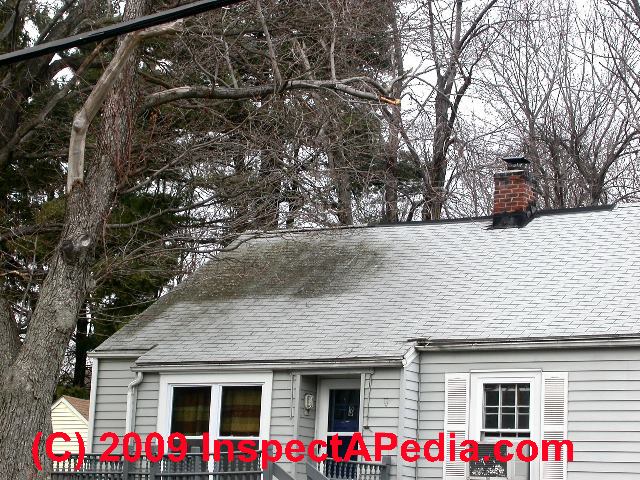
If you see a roof stain that develops only in limited areas of a single roof slope (photo above) look for a relation between the stained area and a proximate cause such as a sooty chimney top or a tree that shades that section of the roof or drops organic debris onto it.
These include tree shade caused moss, tree-shade caused lichens growth on a roof, or dark stains on roof coverings caused by organic debris such as leaves and sticks that fall onto and collect on the roof surface (photo at left).
See details at DEBRIS STAINING on ROOFS.
Our photo below shows brown stains below a metal roof chimney.
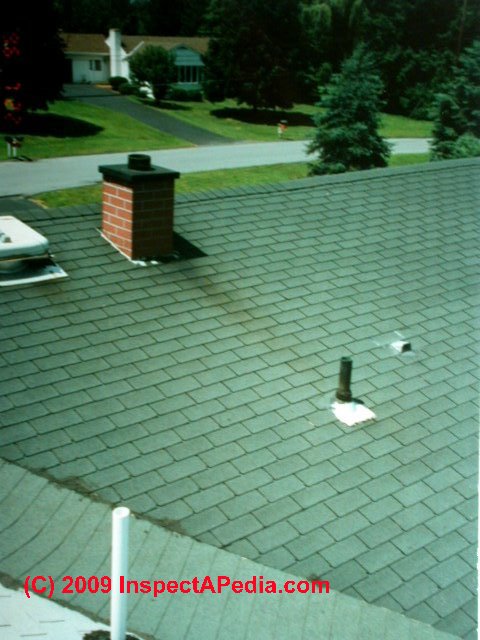
Probably more important than the stains is that this chimney has lost its cap, risking damage to the flue, possibly damage to heating equipment, risking heater malfunction that could be unsafe.
See details at SOOT STAINING (chimneys) and also see
Catalog of Types of Stains on Building Roofs, Surfaces, Walls
In the following guide we list types of stains by stain color & appearance, by building location or material, and by stain cause. We distinguish among the following stuff that may stain or be found growing building roofs, walls, or other surfaces, with extra focus on asphalt shingle roofs as well as other roofing materials such as wood shingles, wood shakes, roll roofing, and even slate or tile roofs.
Some of these types of roof stains or discoloration are only cosmetic in nature, while others may indicate growths that are likely to reduce the roof covering life. A more detailed, illustrated version of the list below is given
at STAIN DIAGNOSIS on BUILDING EXTERIORS.
- Algae-caused black or green stains on roof or other building surfaces - Some photos of black algae stains are
at BLACK ALGAE STAINS on Asphalt Shingles.
For details on roof algae
see ALGAE STAINS on ROOFS,
and ALGAE STAIN TEST METHODS.
Algae can produce black stains on asphalt roofing products.
Also see ALGAE, FUNGUS, LICHENS, MOSS COMPARED.
And see STAIN DIAGNOSIS on STONE for examples of algae staining on other building surfaces. - Black stains on asphalt roofing products such as asphalt shingles or roll roofing, caused by extractive bleeding (product defects) -
see EXTRACTIVE BLEEDING on SHINGLES and
see Roofing material defect / environmentally-caused roof shingle stains.
and see ASPHALT SHINGLE TARRY BLEED - Black, brown, or gray stains on roofing products due to debris left on the roof surface, such as piles of leaves and organic waste from nearby trees.
See DEBRIS STAINING (roof debris), and
see PROXIMATE CAUSE ROOF SHINGLE STAINS (types of roof stain by color, location, probable cause), and
see BLACK BLEED THROUGH SHINGLE STAINS (black bleeding stains from asphalt shingles - extractive bleeding). - Black or other colored chimney soot stains on roof surfaces may be caused by soot from chimneys, both wood-fired and oil-fired devices.
Black or other colored stains may also appear on roof surfaces from nearby industrial activities.
See SOOT STAINING. - Black stains on building interiors: such as on carpets, drywall, or trim:
see STAIN DIAGNOSIS on BUILDING INTERIORS and
then STAIN DIAGNOSIS on BUILDING INTERIORS
and also
see STAINS on INDOOR SURFACES, PHOTO GUIDE - Brown or red stains on roof surfaces are often caused by rust from wearing steel flashing or other on-roof metal products.
See TOBACCO JUICING SHINGLE STAINS - generally brown or reddish brown stains
See RUST STAINS ON SHINGLES generally red or reddish brown - CATALOG OF BIOLOGICAL SUBSTANCES THAT ALTER STONE OR OTHER INORGANIC MATERIALS lists the causes and types of damage that raise aesthetic and conservation issues on cultural artifacts, buildings, and art works.
- Chimney stains on roofs -
see SOOT STAINING - Black Soot Stains on Roof Shingles Around Chimneys
and see PROXIMATE CAUSE of ROOF SHINGLE STAINS - Debris stains on roof shingles -
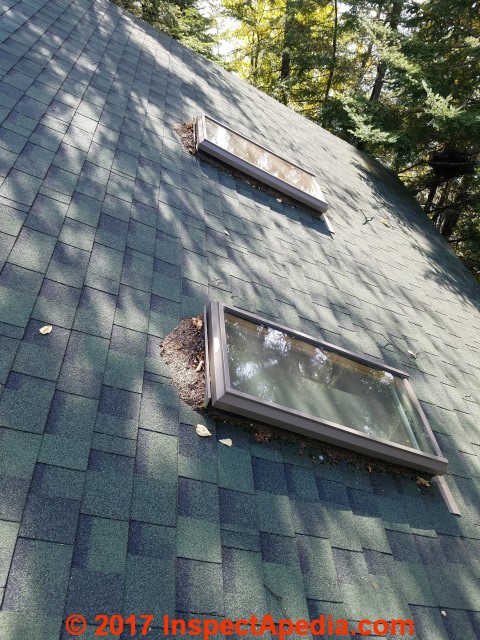
Below: the debris accumulated above the skylight on this Two Harbors MN roof should be removed.
At DEBRIS STAINS on ROOFS - Black Debris Stains on Asphalt Shingle Roofs we describe carefully sweeping off this trash to extend the roof life.
- Extractive bleeding stains on asphalt roofs -
see EXTRACTIVE BLEEDING on SHINGLES and
see ROOFING MATERIAL DEFECT , and
see Proximate cause roof shingle stains (types of roof stain by color, location, probable cause) - Green roof stains on roof shingles, clay tiles, cement tiles, and asbestos cement roof shingles or newer fiber cement roof shingles are often caused by algae. For details
see ALGAE STAINS ON ASPHALT ROOF SHINGLES.
Moss on roofs is also often green and should be unmistakable in appearance.
See ALGAE, FUNGUS, LICHENS, MOSS on ROOFS. - Lichens growing on building surfaces - Lichens are not the same growths as moss or algae, and are difficult to remove without damaging the roof surface.
See LICHENS on STONE SURFACES, and also
see LICHENS on ROOFS for details about how lichens can cause roof damage.
See METHODS FOR CLEANING STONE SURFACES
and ALGAE, FUNGUS, LICHENS, MOSS on ROOFS for a guide to preventing lichen growth and stains.
Also see ALGAE, FUNGUS, LICHENS, MOSS COMPARED for an explanation of the difference among these. - Mold or fungus growing on roof surfaces or on other building surfaces -
See ALGAE STAINS ON ASPHALT ROOF SHINGLES.
See MOLD in BUILDINGS for a guide to looking for mold contamination in or on buildings, and
see WHAT MOLD LOOKS LIKE for a guide to just what mold looks like on building surfaces.
Be sure also to see STUFF that is MISTAKEN for MOLD to avoid becoming excited about harmless substances that people think are toxic mold. If you know your building has a mold problem,
see ACTION GUIDE - WHAT TO DO ABOUT INDOOR MOLD. - Moss on roofs and other building surfaces:
see ALGAE, FUNGUS, LICHENS, MOSS on ROOFS,
and Green Stains on Stone. Green or other colored mosses are a bit easier to remove than lichens on roofing surfaces, but both can carry away mineral granules and damage the roof surface. Moss tends to hold more water and moisture on the roof surface. So in our opinion moss is more likely to damage a roof surface than lichens or algae.
Also see ALGAE, FUNGUS, LICHENS, MOSS COMPARED. - Red or Rust Stains on building chimneys, roofs, walls & swarf stains on metal roofs:
These red, brown or even black roof stains are often caused by corrosion of on-rooof or above roof metal components but may also be the result of improper combustion of wood, coal, or oil fired, possibly also gas fired heating appliances vented above the roof.
Rust stains on metal roofs, including particularly steel roofs, may be occur at nicks or gouges in the protective coating or they may be swarf stains caused by leaving the products of roof cutting (shards, shanks, nails, rivets, or any discarded steel object) on the roof surface.
Metal roof stains also may be caused by walking on roof surfaces with rough-soled shoes or walking on debris left on the roof surface during or after installation.
Because Swarf Staining is unfamiliar to many homeownes we include these excerpts from the New Zealand Steel Installers Guide:
Swarf is the term given to the steel debris arising from cutting or piercing operations when using friction saws, drills etc., on steel roofing and cladding products.
The use of abrasive discs is not recommended.
Whilst comprising mostly fine steel particles, in this context swarf may also be taken to include any other discarded steel objects such as rivet shanks, nails, screws and nuts, which may come into contact with coated products; ie: COLORSTEEL® prepainted steel, ZINCALUME® coated steel and galvanised steel.
Swarf particles, if left on the surface, will corrode and cause rust stains which will detract from the finished appearance of a project.
These stains are often mistaken for early deterioration of the roofing and cladding itself. Prevention of swarf staining is the responsibility of the installer and it is strongly suggested that the recommendations contained in this brochure be followed.
...
Fresh swarf stains are characterised by small red-brown coloured areas with a central dark spot (the remains of the steel particles). The surface will feel like sandpaper, and the particle may be lifted with a fingernail. An old swarf stain will appear as a localised red-brown stain, the steel particle having corroded away, and the surface will be smoother.
...
The effect of swarf staining itself on COLORSTEEL® prepainted steel products, is generally aesthetic and may not be detrimental to the performance of the product. The product life will, however, be severely affected where attached swarf particles have penetrated the prefinished film and are in contact with the protective metallic coating, although this only occurs in severe cases.
(New Zealand Steel Installers Guide, NZ Steel Co. 2005) - seeReferences or Citations to obtain a copy of this very helpful document.
See RUST STAINING - Red or Brown Rust Stains (on shingles) discussing rust stains on asphalt roof surfaces. - Soot or Creosote black or brown stains on roof surfaces near or below chimneys -
see SOOT STAINING - Black Soot Stains on Roof Shingles Around Chimneys and
see PROXIMATE CAUSE of ROOF SHINGLE STAINS - Stains on stone or masonry surfaces -
see STONE, STUCCO & BRICK CLEANING METHODS for cause, cure, and prevention - Swarf stains on metal roofs - see Red or Rust Stains discussed above in this article.
- Tree-caused stains on roofs -
see PROXIMATE CAUSE of ROOF SHINGLE STAINS - White stains on roof surfaces may be from wash-down of pigments in paint on surfaces above the roof such as a gable end or dormer wall; white or less-black roof surfaces may also be found below copper or aluminum flashing whose salts run down the roof surface in wet weather, preventing algae or moss growth and leaving a white area on an otherwise stained roof surface.
Details are at WHITE STAINS on ROOFS.
White stains on roofs may also be a calcium salt or similar mineral deposit left by roof-mounted evaporative coolers or swamp coolers that drain or leak onto the roof surface.
See EVAPORATIVE COOLING SYSTEMS.
Our article
at ALGAE, FUNGUS, LICHENS, MOSS on ROOFS includes a photograph of this condition on a wood shingle roof.
Roofing material defect / installation / structurally-caused roof shingle stains
If you see roof staining or defects that occur on all roof slopes regardless of slope orientation or presence/absence of proximate causes (chimneys, trees) then the condition may be due to roofing material, its installation, or the building itself (inadequate under roof venting).
Roofing material defect / environmentally-caused roof shingle stains
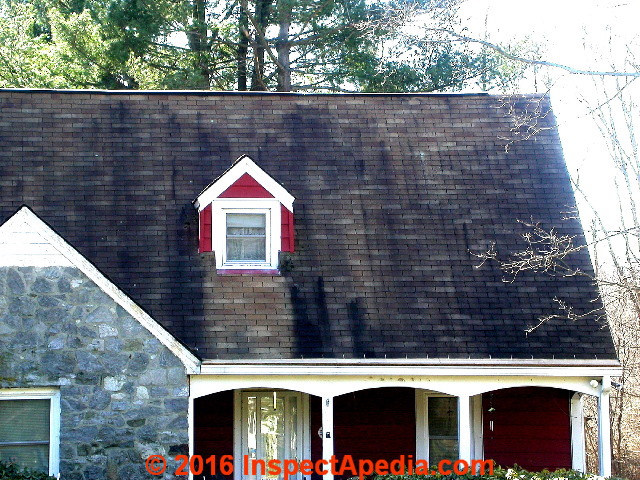
Our stained asphalt roof shingle photo above show what looks like (but is probably not) black extractive bleeding stains on roof shingles. Even on darker shingles these dark streaky stains that seem to emanate from a single point may occur.
Most black stains on roof shingles are due to algae or sooty molds, but a few black stain shingle problems are traced to defective product.
Really? Well extractive bleeding does occur - it's a shingle product defect, though not a common one, perhaps lack of adquate binder, but in the photo above notice that there is no staining below that dormer window?
I [DF] suspect that metal oxides washing down off of the dormer flashing explain the absence of the black staining below that area. In turn, that suggests that these stains could be organic in nature: a black or sooty fungus or mold.
See BLACK BLEED-THROUGH SHINGLE STAINS or Extractive Bleeding Black Stains on Asphalt Shingles for details of shingle product defects that show up as black streaky areas on shingles.
The roof below may also have another roof product defect - thermal splitting. We're not certain about the cause of the staining at above right. It is probably extractive bleeding but a second candidate might be roof algae. We need a closer look.
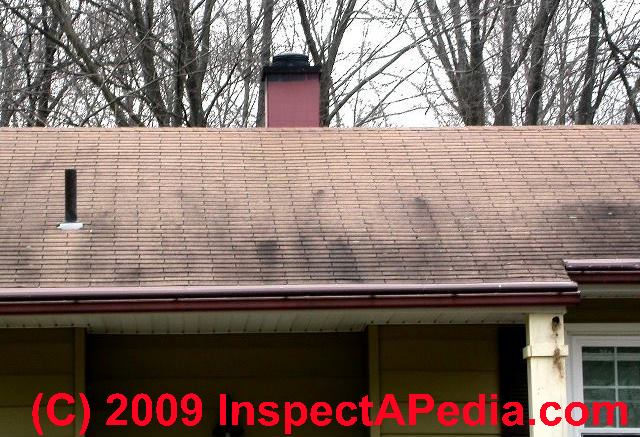
Click to enlarge our stained shingles photo at above left and you may also notice vertical cracks running up through shingles to the left of the dormer.z
See CRACKS & THERMAL SPLITTING in FIBERGLASS SHINGLES
If the stain pattern on a roof surface occurs across the entire field of the roof and independent of proximate causes like chimneys or trees, it is more likely due either to the roofing material itself (possibly extractive bleeding), the overall environment (downwind from a chemical plant or incinerator or factory), or due to the slope' orientation (North slope, cooler, East or West roof slope -more sunlight).
So Is the Black Staining a Sooty Mold?
While we have not confirmed its presence, some black stains on roofs and roof gutters might be due to black molds or sooty molds, for which the USDA has published
HOW TO RECOGNIZE & CONTROL SOOTY MOLDS.
Black mold growth on leaves, on roof debris that has fallen from a tree overhead, or on an aluminum roof gutter, is not a predictor that any of the species discussed in the USDA article will appear as black "sooty mold" growth on a roof shingle.
The chemistry of roof shingles, their granule coverings, and substrates is quite different from other organic substances that are home to many molds. Further, many newer shingle products include chemicals to retard black algae growth that may also retard mold growth.
Specific mold genera/species like to grow on particular surfaces - it's their food, and while some molds are more choosy than others (for example mildews grow only on living plants), you'll need to look carefully at a roof and the conditions around it (such as trees, and areas of sun or shade) and perhaps even sample the black debris to determine if it is mold and if so what is its species.
The roof cleaning methods to remove black algae will probably work well for black mold growth on a roof as well.
Forensic sampling of Roof Stain Material
A simple collection of the
stained roof surface material using clear adhesive tape followed by a laboratory analysis by an experienced microscopist is conclusive. We don't recommend lab sampling of shingle stains
in most cases but if you want to sample a stain material for analysis in our forensic laboratory, instructions are
at DUST / MOLD TEST KIT INSTRUCTIONS.
Don't bother worrying about mildew on your roof. Mildew is an obligate parasite which grows only on living plants. Unless your roof is covered with grapes it is not likely to have much mildew there.
Also see TEST LABS - ROOF SHINGLE for chemical and durability tests on roofing materials.
How to trim trees and shrubs away from a building roof or walls
 While most home inspectors will agree that we ought to keep shrubs at least 24" off of building walls, and that trees within five feet of a building wall risk damaging the structure by root pressure or impact, we don't think that there is an arbitrary correct distance for trimming trees back around a roof.
Our photo (left) shows the dramatic measures that a building owner followed to avoid removing a tree that was really too close to the building - in this case in Tupper Lake, NY.
For tree trimming advice, it is more useful to explain the objects of trimming trees away from a building so that the homeowner or maintenance worker can determine what is needed to meet those objectives at a particular site.
Here are some objectives to meet when trimming trees that may be close to a building:
- Remove or trim large or tall sick trees:
We don't want a big tree in poor health to fall or be blown onto the building, say in a storm, so it's important to cut off dead branches entirely and to have an tree expert assess the health of large trees near a building.
Watch out: some "tree experts" just love to cut everything down.
Consult experienced tree service companies, or an arborist - a real tree expert who knows not only trimming procedures but how to assess tree health. Also trees growing within five feet of a building are more likely to send out roots that can damage the structure - with the risk varying by tree species. - Remove dead branches:
We don't want tree branches falling onto a roof where they may cause damage and leaks - see (1) above. - Prevent on-roof debris accumulation:
We don't want tree leaves and debris accumulating on a roof because of both cosmetic staining and long term wear and leaks below the debris. - Reduce roof gutter clogging:
We sometimes also trim back branches whose pine needles or leaves are falling into and rapidly clogging gutters. So the amount of trimming and safe distance depend on the home, roof slope, roof drainage details, and the height and health and distance of trees near the building. - Reduce moss, algae,
and perhaps fungal growth on some roof surfaces by reducing shade on problem areas. - Remove vines from chimneys
and from building walls -
see VINES & SHRUBS on BUILDING WALLS, CHIMNEYS
Watch out: you should hesitate to remove beautiful, large, old trees at a property. Consult with a tree expert and think twice before drastic cutting or removal of trees.
Below I illustrate cutting away the branches of evergreen trees that were rubbing both the underside of the soffit and the roof surface of this home in Two Harbors Minnesota.
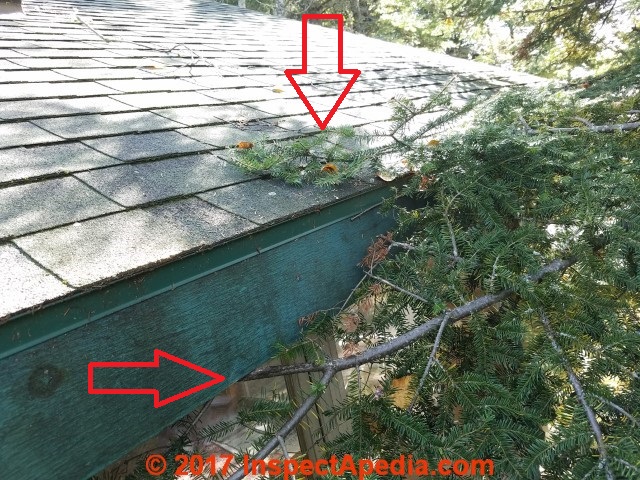
In my photo above you can see the branches in contact with the asphalt shingle surface. Even branches that are a foot or two above the roof, when weighted by snow, will rub on the roof surface.
Below: as well as rubbing on the underside of the soffit - an engraved invitation to squirrels or other animals to invade the roof cavity by providing them an easy highway into the building.

In my third tree trimming photo below you'll see that we cut away branches that were too close to the roof surface as well as too close to the soffit.
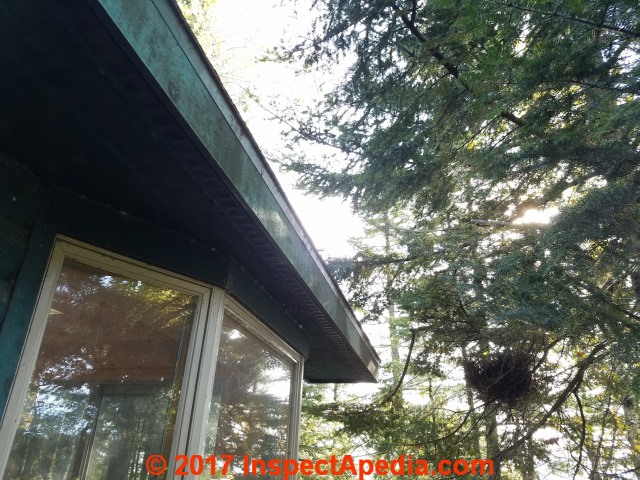
I cut surrounding tree limbs back far enough that when swaying in the wind the tree will still not reach nor rub against the building.
Notice that trimming away branches left a squirrel's nest: good evidence that branches were providing a welcome passage into the soffit of this home. (Not that northern Minnesota squirrels can't jump, but at least let's not leave the door open for them.)
Roof Stain Research
- Bretz, Sarah, Hashem Akbari, and Arthur Rosenfeld. "Practical issues for using solar-reflective materials to mitigate urban heat islands." Atmospheric environment 32, no. 1 (1998): 95-101.
Abstract:
Solar-reflective or high-albedo, alternatives to traditionally absorptive urban surfaces such as rooftops and roadways can reduce cooling energy use and improve urban air quality at almost no cost.
This paper presents information to support programs that mitigate urban heat islands with solar-reflective surfaces: estimates of the achievable increase in albedo for a variety of surfaces, issues related to the selection of materials and costs and benefits of using them.
As an example, we present data for Sacramento, California. In Sacramento, we estimate that 20% of the 96 square mile area is dark roofing and 10% is dark pavement. Based on the change in albedo that is achievable for these surfaces, the overall albedo of Sacramento could be increased by 18%, a change that would produce significant energy savings and increase comfort within the city.
Roofing market data indicate which roofing materials should be targeted for incentive programs. In 1995, asphalt shingle was used for over 65% of residential roofing area in the U.S. and 6% of commercial. Built-up roofing was used for about 5% of residential roofing and about 30% of commercial roofing. Single-ply membranes covered about 9% of the residential roofing area and over 30% of the commercial area.
White, solar-reflective alternatives are presently available for these roofing materials but a low-first-cost, solar-reflective alternative to asphalt shingles is needed to capture the sloped-roof market.
Since incoming solar radiation has a large non-visible component, solar-reflective materials can also be produced in a variety of colors. - Cheng, Meng-Dawn, William Miller, Joshua New, and Paul Berdahl. "Understanding the long-term effects of environmental exposure on roof reflectance in California." Construction and Building Materials 26, no. 1 (2012): 516-526.
Abstract:
Contaminants from cool-pigmented roof samples exposed at seven California sites were analyzed for elements and carbons to identify those that degrade or enhance solar reflectance.
The losses in solar reflectance varied by site and the color of the sample.
The least reflectance drop was observed in the alpine climate, while the largest drop occurred in sites near urban development.
The change of reflectance appears cyclical with the onset of seasons having more rainfall. A deposition model suggests that chromium ranks first, iron second, and elemental carbon third in importance to soil light absorption. - Also seeReferences or Citations
Reader Comments, Questions & Answers About The Article Above
Below you will find questions and answers previously posted on this page at its page bottom reader comment box.
Reader Q&A - also see RECOMMENDED ARTICLES & FAQs
Question: white stains on roof
(Aug 15, 2014) Deborah said:
I have a new roof with architectural shingles that has a white discoloration on it for the moment it was installed. The roofer said it was back surfacing mineral and would wash away. It has been months now. It has faded, but not completely.
It is most noticeable when the sun goes behind the house in the afternoon. In the morning, ( house faces east) it is barely noticeable. He said it will weather off. Is this true?
Reply:
I don't know, Deborah as I don't know what's on the shingles. Please take a look
Question: roof wear or stains above windows
9/1/14 Hodge said:
We have a 4 yr old roof in great shape except for sign of early wear above two windows. The areas of wear are the same width of the windows and extend up and gradually fade . Any ideas ?
Reply:
Hodge,
If the windows are a source of drafts, temperature variations in the roof above, or moisture sources, or if construction details obstructed roof venting over those areas those might explain variation in roof shingle wear. Use our CONTACT link email to send me some photos and I can comment more usefully.
...
Continue reading at ALGAE STAINS on ROOFS or select a topic from the closely-related articles below, or see the complete ARTICLE INDEX.
Or see these
Recommended Articles
- STAIN DIAGNOSIS on ROOFS - home
- ALGAE, FUNGUS, LICHENS, MOSS on ROOFS
- BLACK ROOF STAIN CAUSES
- BLACK or GREEN ALGAE STAINS on ROOFS
- BLACK or GREEN ALGAE STAIN REMOVE / PREVENT
- CHIMNEYS, STAINS on / near
- DEBRIS STAINS on ROOFS
- EXTRACTIVE BLEEDING on SHINGLES
- LICHENS on ROOFS
- MOSS on ROOFS
- POWER WASHING ROOFS
- RUST STAINS on ROOFS
- SOOT STAINS on ROOFS
- TARRY BLEED on ROOFS
- TOBACCO JUICING SHINGLE STAINS
- WHITE STAINS on ROOFS
- TEST LABS - ROOF SHINGLE
Suggested citation for this web page
STAIN DIAGNOSIS on ROOFS at InspectApedia.com - online encyclopedia of building & environmental inspection, testing, diagnosis, repair, & problem prevention advice.
Or see this
INDEX to RELATED ARTICLES: ARTICLE INDEX to BUILDING ROOFING
Or use the SEARCH BOX found below to Ask a Question or Search InspectApedia
Ask a Question or Search InspectApedia
Try the search box just below, or if you prefer, post a question or comment in the Comments box below and we will respond promptly.
Search the InspectApedia website
Note: appearance of your Comment below may be delayed: if your comment contains an image, photograph, web link, or text that looks to the software as if it might be a web link, your posting will appear after it has been approved by a moderator. Apologies for the delay.
Only one image can be added per comment but you can post as many comments, and therefore images, as you like.
You will not receive a notification when a response to your question has been posted.
Please bookmark this page to make it easy for you to check back for our response.
Our Comment Box is provided by Countable Web Productions countable.ca
Citations & References
In addition to any citations in the article above, a full list is available on request.
- "New Zealand Steel Installers Guide, COLORSTEEL®, ZINCALUME® steel and GALVSTEEL™ Installer's Guide", [PDF], New Zealand Steel Limited, Private Bag 92 121, Auckland, New Zealand. Tel: 0800 100 523, or 0-9-375 8999 Fax 0-9-375 8213, Website: http://www.nzsteel.co.nz/, Email: info@colorsteel.co.nz - retrieved 2015/12/07, original source: http://www.nzsteel.co.nz/content/media/ 77012/New%20Zealand%20Steel%20Installers%20Guide%20-%20November%202005.pdf - regarding Swarf Staining
- Roger Hankey is principal of Hankey and Brown home inspectors, Eden Prairie, MN. Mr. Hankey is a past chairman of the ASHI Technical Committee and the ASHI Standards Committee. Mr. Hankey serves as co-chairman of ASHI legislative committee, and has served in other ASHI professional and leadership roles. Contact: 952 829-0044 - hankeybrown@comcast.net
- NRCA - National Roofing Contractors Association - Website: www.nrca.net 10255 W. Higgins Road, Suite 600, Rosemont, IL 60018-5607, Tel: (847) 299-9070 Fax: (847) 299-1183
- Our recommended books about building & mechanical systems design, inspection, problem diagnosis, and repair, and about indoor environment and IAQ testing, diagnosis, and cleanup are at the InspectAPedia Bookstore. Also see our Book Reviews - InspectAPedia.
- Building Pathology, Deterioration, Diagnostics, and Intervention, Samuel Y. Harris, P.E., AIA, Esq., ISBN 0-471-33172-4, John Wiley & Sons, 2001 [General building science-DF] ISBN-10: 0471331724 ISBN-13: 978-0471331728
- Building Pathology: Principles and Practice, David Watt, Wiley-Blackwell; 2 edition (March 7, 2008) ISBN-10: 1405161035 ISBN-13: 978-1405161039
- Green Roof Plants: A Resource and Planting Guide, Edmund C. Snodgrass, Lucie L. Snodgrass, Timber Press, Incorporated, 2006, ISBN-10: 0881927872, ISBN-13: 978-0881927870. The text covers moisture needs, heat tolerance, hardiness, bloom color, foliage characteristics, and height of 350 species and cultivars.
- Green Roof Construction and Maintenance, Kelley Luckett, McGraw-Hill Professional, 2009, ISBN-10: 007160880X, ISBN-13: 978-0071608800, quoting: Key questions to ask at each stage of the green building process Tested tips and techniques for successful structural design Construction methods for new and existing buildings Information on insulation, drainage, detailing, irrigation, and plant selection Details on optimal soil formulation Illustrations featuring various stages of construction Best practices for green roof maintenance A survey of environmental benefits, including evapo-transpiration, storm-water management, habitat restoration, and improvement of air quality Tips on the LEED design and certification process Considerations for assessing return on investment Color photographs of successfully installed green roofs Useful checklists, tables, and charts
- Wood Shingle Roofs, Care and Maintenance of wood shingle and shake roofs, (EC), Stanley S. Niemiec (out of print)
- In addition to citations & references found in this article, see the research citations given at the end of the related articles found at our suggested
CONTINUE READING or RECOMMENDED ARTICLES.
- Carson, Dunlop & Associates Ltd., 120 Carlton Street Suite 407, Toronto ON M5A 4K2. Tel: (416) 964-9415 1-800-268-7070 Email: info@carsondunlop.com. Alan Carson is a past president of ASHI, the American Society of Home Inspectors.
Thanks to Alan Carson and Bob Dunlop, for permission for InspectAPedia to use text excerpts from The HOME REFERENCE BOOK - the Encyclopedia of Homes and to use illustrations from The ILLUSTRATED HOME .
Carson Dunlop Associates provides extensive home inspection education and report writing material. In gratitude we provide links to tsome Carson Dunlop Associates products and services.
 | HOME | ABOUT | ASK a QUESTION | CONTACT | CONTENT USE POLICY | DESCRIPTION | POLICIES | PRIVACY | |
| © 2024 - 1985 Publisher InspectApedia.com - Daniel Friedman | |||||||||