
InspectAPedia® FREE Encyclopedia of Building & Environmental Construction, Diagnosis, Maintenance & Repair |
Question? Just ask us! InspectAPedia
|
 Building Winterizing Guide
How to Freeze-Protect Building Drain Piping
- POST a QUESTION or COMMENT on Freezing Drain Lines: Cause, Prevention, Cure
How to protect building drains from freezing:
this article explains how to prevent frozen drain piping and freeze-damage or burst drain pipes in buildings and in the building connection to a septic system or to a municipal sewer line. You might think that because plumbing drains slope downwards (or should) that there is not freeze risk - that's not entirely true, as we explain here.
The articles at this website will answer most questions about freeze protection for piping and other building plumbing and heating system components: how to winterize a building to avoid frozen pipes, and how to thaw frozen water supply & drain piping, wells, & water tanks.
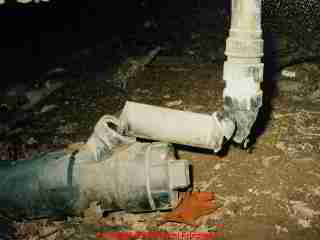
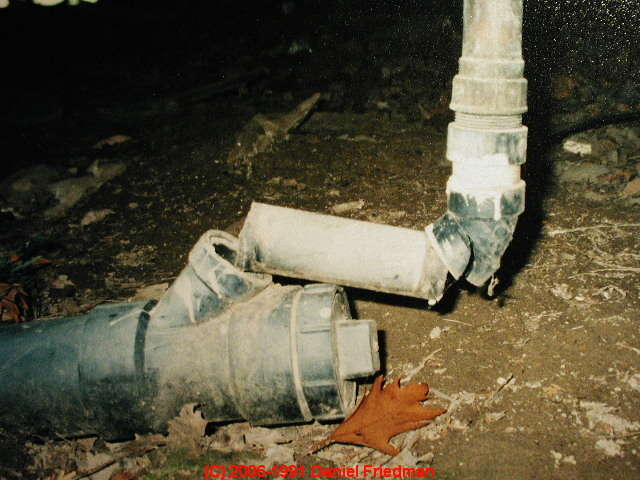
Our page top photo shows what might happen if a building drain is clogged, leading to standing wastewater in the pipes which then froze and burst.
InspectAPedia tolerates no conflicts of interest. We have no relationship with advertisers, products, or services discussed at this website.
- Daniel Friedman, Publisher/Editor/Author - See WHO ARE WE?
How to Avoid Freeze Damage to Building Drain Piping
Discussed here: How to avoid freezing drain piping, drains, traps, toilets, etc. How to winterize drain traps & drain pipes: frost protection for plumbing drainage systems.
Use of heat tapes, heat sources, pipe routing, to prevent freezing drain pipes. What is the proper depth to bury sewer and septic system piping? What is the proper slope for drain line pipes?
Is the building heat going to be left "on" or "off" - the answer determines the extent of freeze-proofing needed.
- If heat is to be left on in a partially winterized building see the procedure
at: WINTERIZE HEAT ON (continuing below) - If heat is to be turned off and the building completely winterized, see the procedure
at: WINTERIZE HEAT OFF
What? My Building Drains Can Freeze Too?
Freeze damage risk in buildings is not confined to water supply piping or hot water heating piping. Building drains can also freeze and break, including fixture traps and building drains.
Building drains can freeze inside the building and even outside a drain line that is not below the frost line can easily freeze in some conditions which we outline below.
Even if the building water supply piping has not frozen a drain line can freeze. You may first notice the problem when a toilet, sink, or tub simply stops draining.
In a building where water is left on at some plumbing fixtures, be sure that there are no leaky supply valves or running toilets.
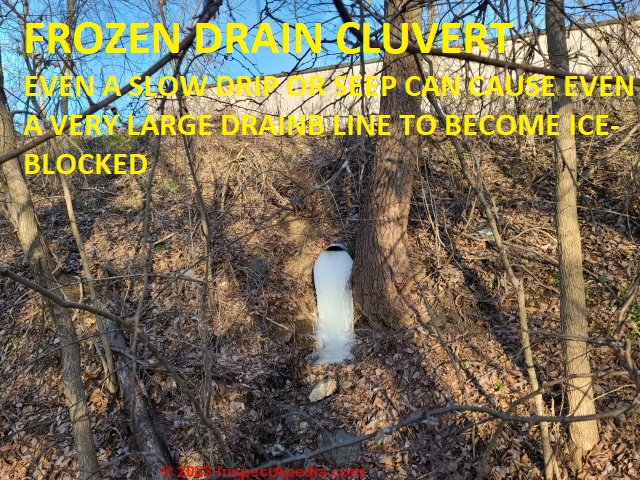
In freezing weather a slow drip or water running slowly into a drain pipe can lead to ice build-up, a frozen or even a frozen and burst drain pipe, or a water backup into the building.
Our photo above shows thick ice blocking and extending below a large drainage culvert along the Poughkeepsie Rail Trail in Dutchess County, New York, photographed during cold weather in December 2022.
Ice had accumulated nearly to the very top of this drain that is more than a foot in diameter.
What Causes Building Drain Pipes to Freeze?
- A building main drain or other building drain pipe is exposed to freezing temperatures outdoors
- A building drain is routed through an unheated crawl space or basement, or an attic or attic knee-wall that is unheated indoors
- A plumbing fixture drain trap extends down into an un-heated crawl space or basement or is in the path of a cold draft even if the crawl space or basement is heated.
- A toilet is running or a faucet dribbles continuously into the drain system
- A water softener or other water treatment equipment is left on and running improperly, perhaps sending a continuing stream of water into the drain system
- A roof gutter drains into the sewer piping (bad), perhaps through a drain line that enters the building (still worse) en route to the sewer connection; clogged gutters that dribble water slowly into the drain system increases the freeze risk.
Handling Roof Gutters that Drain into the Sewer Piping
Some older homes include roof drainage downspouts that are carried to drain pipes which connect to the building sewer drain piping. In some installations the gutter downspouts connect to a drain line inside the building, perhaps running out of the building under the basement floor onwards to a public sewer line.
Such drains can easily freeze in an un-heated home, leading to broken drain lines, frost-heaved basement floors, and severe basement flooding.
We recommend that drain connections between roof gutters and downspouts and the building sewer line be abandoned.
If necessary, install temporary above-ground downspout extensions to conduct roof runoff well away from the building rather than into the sewer line via the basement floor. Incidentally, because the volume of roof runoff sent into a sewer line can overwhelm municipal sewage treatment plants this connection is prohibited in some communities.
What Else to Do to Avoid Frozen Building Drains
- Make sure there are no "running" toilets or faucets or other equipment
- Make sure there are no blocked or clogged drains that will hold standing wastewater (that freezes and breaks the pipes)
- If heat is left off in a building, use a non-toxic antifreeze in plumbing traps
- Find & Fix PIPE FREEZE-UP POINTS, including adding insulation and heat in problem areas if necessary
Reader Question: What is the required or recommended depth for connecting house drain pipes(such as a bathroom waste pipe) to a septic tank to avoid freezing?
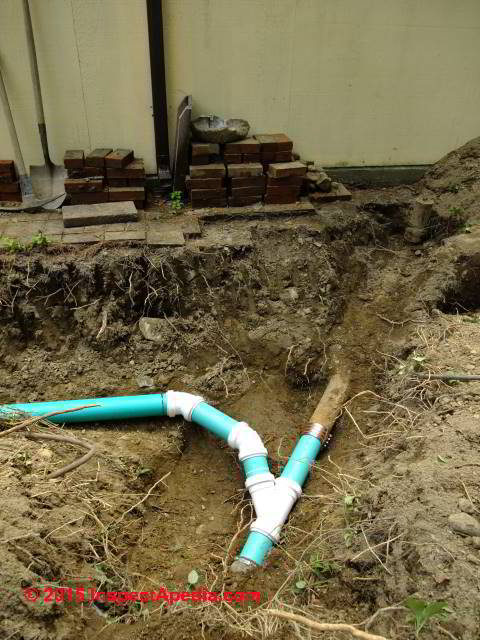 What is the required or recommended depth for connecting house drain pipes(such as a bathroom waste pipe) to a septic tank in New York State in order to avoid freezing?
If a house drain pipe is connected toward the top of a septic tank, is it vulnerable to freezing and, if so, how much soil should cover that pipe to protect it from freezing?
- Jane
Reply: House drains may be above the frost line and depend on proper slope and drainage to avoid freeze-damage.
Plastic drain pipes are usually buried at least 18" and bedded in sand to avoid mechanical damage to the pipe.
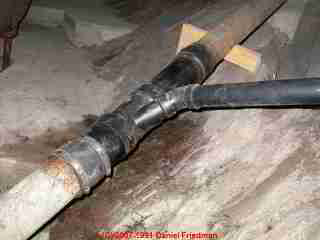
But building main drains (upper right circle in our photo at left) are often not below the frost line outdoors and in a freezing climate such as New York, the lines depend on proper slope to drain into a septic tank or into a municipal sewer main to avoid freezing.
So the waste piping depth is more determined by using the required pipe slope (1/8" to 1/4" per linear foot) and working backwards from the septic tank or municipal sewer line connection point and the property's own elevation and slope.
Our sewer piping photo (above left - click to enlarge) shows a new sewer line (at left and foreground) being connected to an existing house drain (circled areas) in a New York home.
You will notice that where the existing main sewer line exits the building the plumber included a cleanout (upper circle in photo) and that the depth of the waste piping is just about 12" below the ground surface.
At this particular installation the drain piping slope exceeds 1/4" per foot in the area of the new connection because the ground slope in this area falls rapidly away from the home.
From the point of entry into the septic tank or into a municipal sewer main, drain piping lines need to slope 1/8" to 1/4" per foot to drain properly. Some piping sections may slope more than this due to terrain properties (our photo above) but slope should not be less.
We don't find that in-use septic tanks freeze up - most likely due to the combination of the warmth generated bacterial action, the entry of warm water from the building, and the fact that a good portion of the tank will be below the frost line in most installations. Also
see SEPTIC TANK DEPTH.
Watch out: though: the whole theory behind allowing drain lines to be above the frost line in your state, to avoid a freeze-up of the drain line, depends on:
- Proper drain line slope
- Drain lines that are not clogged or blocked
- The absence of any ongoing plumbing supply leaks such as a running toilet
If the outside (or inside for that matter) building drain piping is not properly sloped it will clog.
If the drain line is blocked, the holding of wastewater in a drain line that is above the frost line means that in prolonged cold weather the line will freeze and often will burst
If there is a running toilet or other small plumbing supply leak, that rivulet of slow but continuous wastewater can freeze in the bottom of shallow outdoor drain lines in a freezing climate; over time and without sufficient wastewater passage to thaw out and flush out that freezing of water on the bottom surface of the drainline the whole line can slowly fill with ice, leading to a frozen waste line, blocked line, sewer backup in the building, or a burst sewer line.
Reader Question: how much does it cost to bury a pipe below the frost line
Wonderful information. I am currently in the process of buying a home in Virginia, and a portion of the drainage pipe is exposed.
Any idea how much (typically) it would cost to bury the pipe, or who I would contact to fix this? - Meaghan 5/31/12
Reply:
Meaghan,
if the drain pipe that is exposed is properly sloped and you don't have fixtures that run continuously into it (say a running toilet), the freeze risk is very low, especially in VA.
Speaking very generally, the 2013 cost to dig a 25-foot trench runs between $300. & $400. or about $13. to $16. per foot, with of course many variables such as depth, soil properties, and obstructions. There are online cost estimators that take your zip code and will give closer estimates, but even those can be way off as the cost estimator has no idea about local site conditions at your property. Simply hitting a big boulder, for example, can change the picture.
The cost to bury is something you'd best get from a local excavation contractor or landscaper who can see the actual site conditions, length of pipe to be covered, to what depth, thus estimating yards of soil, hours of machine and labor time, and finish landscaping requirements.
Without that data, an estimated cost to bury something arbitrary. Just be sure that your "burying" does not also bury building siding or you'll be asking for an insect problem.
Reader Question: what is the frost line depth in Nebraska's Platte Valley
Any idea what the specs might be in Nebraska's Platte River Valley? We are not far to ground water. - Gary 8/16/2012
Reply: easy to find frost line data for Colorado, but for Nebraska?
Gary, The spec is the frost line, right? Any local plumber will tell you. From a quick historical search about the frost line in Nebraska I learned from the Colorado Climate Center that for Colorado the frost line data is:
Typically the frost line in Nebraska in your area is around 10-14-inches from the ground surface
The deepest frost penetration in Nebraska in the last 20 years was at 20-inches. But watch out: more extreme variations are occurring in weather patterns everywhere so deeper frost penetrations may be in store.
In the 1930's in a cold winter with little snow cover the frost line extended down to 30"
So to be safe, and if you plan to move to Colorado, assume the frost level there is at least 20-inches and 30-inches would be safer.[8] OK, let's look for a better answer.
Take a look at the Air Freezing Index to Guess at Frost Line Depth for Your Area
Can we translate that data to Nebraska? Not directly. When you cannot find local frost line depth data, building codes adopted by your community still will have the answer. For example, the International Residential Code (IRC) for 2012 gives Air Freezing Index data for each U.S. state.
Figuring the Frost Line Depth for Nebraska
Most of Nebraska has an index of 1500 or less, except for Boyd, Burt, Cedar, Cuming, Dakota, Dixon, Dodge, Knox, Thurston counties where the air freezing index is 2500. Now we can do a little extrapolation and arm-waving:
The same IRC explains in Table R 403.3(1) that we can translate an air freezing index into a required footing depth. That data is in our table quotation just below. You can see that for an air freezing index of 1500 or less the minimum footing depth is 12-inches, and for an air freezing index of 2500 you'd have to make the footings at least 16-inches deep. Not very deep, right? Since the intent of footing depth is to protect a footing from frost heaves, I figure this is a good approximation of the frost line depth for your area: 12-16-inches.
MINIMUM FOOTING DEPTH AND INSULATION REQUIREMENTS FOR FROST-PROTECTED FOOTINGS IN HEATED BUILDINGS [Italics ours] [9] 2012 IRC, excerpt from TABLE R403.3(1) |
|
| AIR FREEZING INDEX (°F-days)b |
MINIMUM FOOTING DEPTH, D (inches) |
| 1,500 or less | 12 |
| 2,000 | 14 |
| 2,500 | 16 |
| 3,000 | 16 |
| 3,500 | 16 |
| 4,000 | 16 |
Watch out: local frost line data and local codes prevail; rules about minimum building footing depth, which you can use to guess at a safe frost line, may be different in your area from those assumed by and in the area addressed by the IRC. Best bet is to ask your local building department.
Use of Heating Tapes on Sewer Pipes & Building Drains
Reader Question: what about using heat tape on sewer pipes - our mobile home sewer line keeps freezing
You don't say anything regarding using heat tape on sewer pipes. We have an annual problem with a mobile home sewer line freezing. The line connects a toilet, shower and tub so when it freezes it is a mess. - Anon. 9/19/11
Reply:
Anon, you can add a heat tape on a sewer line provided the tape you choose is connected and secured to the sewer line the way the manufacturer instructs. Make sure that the bottom of the waste pipe is in contact with the heat tape, and provided the heat tape manufacturer permits, insulate the line as well.
The combination of a proper heat tape and sewer line insulation is usually enough to stop freeze-up but here are some additional tips for mobile home waste line freeze problems:
Watch out: some heating tapes cannot safely be used on drain pipes, possibly because of a concern for heat damage to the piping. Details are in the article above.
Because the waste line typically has a vertical segment between the floor of the mobile home and the ground and because that segment is exposed to cold air in the crawl space beneath the home you will want to insulate it. But in termite prone areas the risk is that your insulation provides an insect path from the soil up into the floor of the home.
Ask your local pest company for advice about protecting this area from insects or perhaps construct a surrounding (openable for inspection and repair) partition wall that uses termite shields.
Watch out: for dripping faucets and running toilets which can flood a septic soakaway bed or drainfield in any weather and can freeze, clog, and even burst drains in freezing weather.
A drain line does not normally contain standing water but when routed through freezing spaces and when there is a small rivulet of water in the drain due to a slow leak indoors such as a drip or running toilet, that water can freeze and accumulate until the line becomes blocked, frozen solid, and burst.
Reader Question: what kind of heating tapes can be used on PVC plumbing drains?
I have a PVC drain line for my water softener that goes outside. When it got very cold two winters ago, the drain line froze and it backed up into house. The drain line lays on the ground. I went to a local store to look for heat tape and they specifically stated not to use on drain lines. Is there some type of tape I could use that would be safe, and how should it be installed? - Don Corbett 9/30/11
Reply:
Don:
A concern with heat tapes on plastic piping is that it may damage the pipes. And if your water softener drain is simply draining onto the ground surface, that is an improper and illegal disposition of wastewater in just about every jurisdiction. Unfortunately the proper fix is costly: reroute drainage to a drywell or other approved drainage destination.
If you use drain piping of sufficient diameter and proper slope, even exposed to cold temperatures the drainage will generally not freeze up in normal use. More help on avoiding freezing piping is
Heating tapes and cables can be installed on PVC supply and drain piping provided you choose the right kind of heating tape or cable and that you follow the manufacturer's instructions. Details are in the article above.
Septic Drain Line Depth to Prevent Freezing
Reader Question: drain line depth for frost protection?
(June 4, 2014) Anonymous said:
how deep do the lines have to be
12/27/2014 Larry Slate said:
I want to extend the home sanitary line to the exterior of the house exposed under an exterior deck to a point where I would be able to dump the RV waste tanks via a macerator pump into the elevated pipe. The RV is parked approximately 10 ft below the interior home sanitary line. Normally the new exterior line would be empty.
Do I need to be concerned with freezing air entering the exterior part of the pipe and freezing the interior drain line. The 2 1/2 inch new drain line will connect 3ft inside the crawl space. If I need to be concerned, would a backflow preventer or even a valve prevent the cold air from possible freezing?
Reply:
I am not sure I have quite a full picture, but if you are describing a waste line properly sloped and with no traps in a freezing area, the line is normally dry and so should not be a freeze risk
Reader Question: drain line depth for protection against breakage when more backfill is added
(Sept 7, 2014) jackpicknell@gmail.com said:
I have been searching for basic info on how deep you can bury 4" concrete sewer pipe under "normal" soil. The question arose because of a broken pipe buried below 9 feet of soil. When originally installed it was about 3' below grade, but the homeowner added 6 feet of soil above the area later in order to level the lot. What kind of depths can these pipes withstand?
Reply:
Jack
Generally adding soil alone ought not to crush a pipe. Driving over it, or adding backfill that contains large stones or sharp objects can certainly result in broken pipe as can burying the pipe without proper bedding in sand or rock-free soil.
Improper trench grading, compaction or similar errors might also break a pipe as settling soils push down on the installation.
...
Reader Comments, Questions & Answers About The Article Above
Below you will find questions and answers previously posted on this page at its page bottom reader comment box.
Reader Q&A - also see RECOMMENDED ARTICLES & FAQs
On 2022-03-23 by InspectApedia Com Moderator (mod) - what to do with a drain at the base of a downward slanted driveway to a garage.
@Cynthia Chataway,
I would start by checking the drain for improper slope or for a blockage.
Then if necessary I'd add a heat tape run through the drain and to daylight.
On 2022-03-23 by Cynthia Chataway
Any ideas what to do with a drain at the base of a downward slanted driveway to a garage. The existing drain goes around the garage but freezes then when a thaw happens the water goes into the garage.
There is a drain that doesn't freeze 3/4 of the way into the garage. Would it be a good idea to bust into the garage and try to connect it to that drain?
On 2022-01-26 by InspectApedia Com Moderator (mod) - My tub trap keeps freezing.
@Debbie Signorelli,
You can use a heat tape - but be sure to follow the manufacturer's installation instructions since if you don't do so the tape could be unsafe.
Usually when a drain or trap is exposed in a crawl space, even a heated one as you cite, the key steps to avoid frozen drains are
- find and close off any cold air drafts
- insulate the crawl space by converting it from a vented space to a dry, conditioned space, and provide enough heat to keep it above freezing - usually I find that 40 deg F is enough.
- look for and fix any slow drips into the drain. If you added antifreeze to the trap of an unused plumbing fixture that should prevent freezing. If it doesn't then either your anti-freeze mix was the wrong concentration or someone ran a fixture that flushed the anti-freeze out of the trap.
On 2022-01-26 by Debbie Signorelli
My tub trap keeps freezing. It is in an I heated crawl space.
It has fiberglass insulation around it and I pour antifreeze down the drain but these don’t keep it from freezing. What else can I do? Can heat tape be applied to the trap?
On 2021-02-13by danjoefriedman (mod) - bob says run a garden hose outside to prevent sewer line freeze-up
Sorry Bob,
I'm unclear what problem we're actually fixing here.
Typically when people leave water dripping in the building or leave water running they're trying to prevent water supply pipes from freezing.
Watch out: In this article series I have warned that that can cause a freezing damaging the sewer line. Running a garden hose outside at speed is not going to prevent Frozen lines in the building in cold weather.
On 2021-02-13by Bob
At 28 degrees for 4 hrs in the early morning for two days. Run garden house outside instead of dripping the faucet inside to prevent the sewer line plugging under the house.
On 2020-07-31 by (mod) - clear definitions of frost depth, frost line, & footing depth
Thank you for that added observation and opinion, Ben. I'm a little confused by your comment and hope you'll find time to clarify your remarks.
If you're objecting to the "minimum footing depths given in a table above on this page, we didn't make those up, they are excerpted from the International Residential Building Code (IRC).
Footing depth is a fixed, given measure determined at the time that a building is constructed:
Definition of footing depth
the depth below the ground surface at which the under-side or bottom of a foundation support-footing is buried.
Definition of frost depth or frost line
the deepest-depth below the ground surface to which frozen soil extends - a figure that varies significantly by local climate conditions and soil properties.
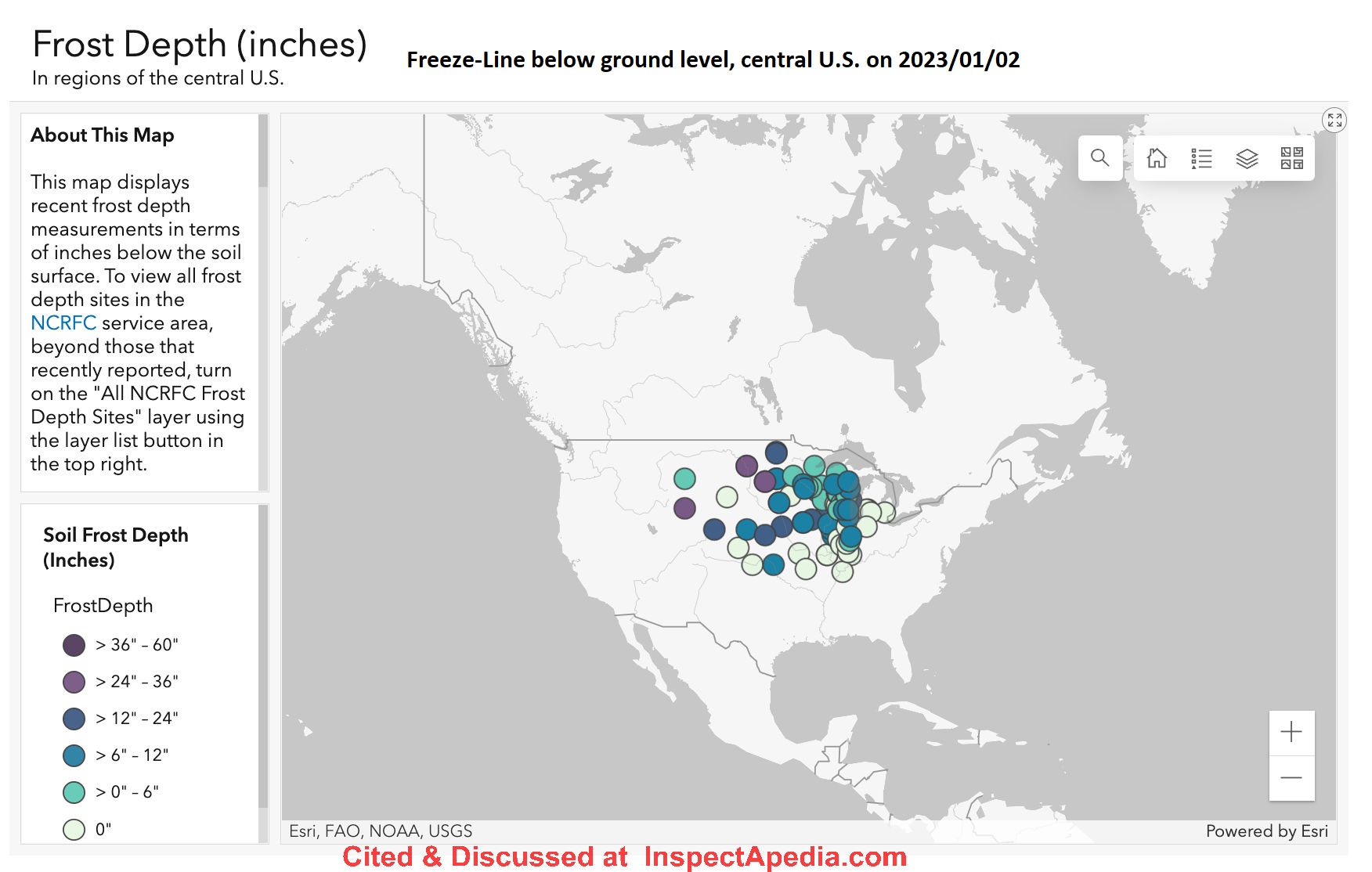
In the U.S. the U.S. National Weather Service, in the Department of National Oceanic and Atmospheric Administration (NOAA) gives recent frost depth measurement at various locations - from which we have excerpted the present frost depth (inches) map shown below
The data shown in the frost line map above are queried from the National Weather Service River Forecast Center (RFC) databases late morning each day. The values shown represent the latest measurement taken within the last seven days (up to 2023/01/02), so the observation times/dates vary.
- source: US NWS, NOAAS - https://www.weather.gov/ncrfc/LMI_FrostDepthMap (last updated 2023/01/02)
NOAA also gives these additional links to more about frost depth, AFI or Air Freezing Index, & soil temperatures:
- Link to ArcGIS Online app for Frost Depth - https://noaa.maps.arcgis.com/apps/dashboards/baff4b544783486abe9632334091e904
- NCDC Winter Severity and Frost Depth in a Warming Climate About AFI - Air Freezing Index - https://www.ncdc.noaa.gov/news/winter-severity-and-frost-depth-warming-climate
- Illinois State Water Survey - Water and Atmospheric Resources Monitoring Program (WARM) - IllinoisSoil Data - https://isws.illinois.edu/warm/soil/
- Iowa State Soil Moisture Network Iowa Average 4 inch Soil Temperature - Reports and Interpolated County Average - https://mesonet.agron.iastate.edu/agclimate/soilt.php
- North Dakota USGS Soil Moisture / Temperature Sites - https://maps.waterdata.usgs.gov/mapper/nwisquery.html?URL=https://waterdata.usgs.gov/nd/nwis/current?
type=soil&group_key=basin_cd&format=sitefile_output&sitefile_output_format=xml&column_name=agency_cd&column_ name=site_no&column_name=station_nm&column_name=site_tp_cd&column_name=dec_lat_va&column
_name=dec_long_va&column_name=agency_use_cd - North Dakota Agricultural Weather Network Soil Temperatures - https://ndawn.ndsu.nodak.edu/deep-soil-temperatures.html
On 2020-07-31 by ben
You have listed incorrect and potentially damaging information. That is not the frost depth, that is footing depth for a heated building, extremely different.
At air freeze index 2500 frost depth is in the 4-5 foot range, 16 inch is only acceptable if the building is heated, and with the use of foam heading down the outside perimeter of the building, with projecting wings where applicable.
On 2020-06-16 by Walden & (mod): "Septic" system design to dispose of graywater with protection from freezing in Maine
Walden: please find our discussion about a freeze-resistant graywater disposal field now posted
at GREYWATER FREEZE PROTECTION
On 2019-10-04 - by (mod) -
Linda
Generally if you convert a crawl area to a conditioned space, cutting off outside drafts, keeping the area dry, insulating it, and providing even the most modest heat source, that's good practice in avoiding water, moisture, mold, and freezing pipes. A heat tape might be sufficient.
A heat tape, properly selected and installed, ought not be a fire hazard. However the wrong type of tape or a heating tape or cable that was not installed as the manufacturer directed, could indeed be unsafe.
See HEAT TAPES to AVOID FROZEN PIPES
That article explains where, why, and how to add heat at cold problem spots to avoid freezing pipes - both supply pipes and drain pipes. We also point to information on using heating cables on heating oil piping and in in other locations. We discuss the safe use of heat tapes in buildings and warn about unsafe heating tapes and fire hazards.
On 2019-10-04 by Linda
Adding plumbing that is detached from home to a 4 season room. The crawl space will have approx 2-3’ of exposed water line. Our plumber did say he would add heat tape. But I would also like to surround this area with an enclosure of some type- whether that is 4 insulated walls with access for maintenance or...
I am picturing cutting a larger PVC pipe in half... place around pipe and latch back together. In my mind, it will create a smaller airspace and protect heat tape from wind and cold air etc. I am concerned this could be a fire hazard or anything else that I don’t know that I don’t know
On 2019-03-11 - by (mod) -
There are heating cables that can be used in a buried drain line including plastic pipe, but a better repair would be to use solid wall PVC that doesn't have Hills and Valleys so that you're not dependent on electrical current to avoid Frozen burst pipes or water backups around your house
On 2019-03-11 by michel leblanc
My problem is freezing of an exterior plastic extendable pipe from my roofing downspout. the pipe is approx. 7 metres long extending away from the house foundation. The water does not flow perfectly (gravity) within the pipe because the ground it lies on has some highs and lows.
Standing water within the pipe freezes and eventually becomes blocked with ice. Is there a cable that can be put in this plastic pipe to prevent freezing.
...
Continue reading at FREEZING FORCE of ICE or select a topic from the closely-related articles below, or see the complete ARTICLE INDEX.
Or see DRAIN FREEZE PROTECTION FAQs - questions & answers about freezing drain lines posted originally at the end of this page.
Or see these
Recommended Articles
- ANTIFREEZE for BOILERS
- DRAIN a WATER HEATER TANK
- FAUCETS, OUTDOOR HOSE BIBBS
- FREEZING FORCE of ICE
- FROZEN PIPE THAW-OUT
- GREYWATER FREEZE PROTECTION
- PIPE FREEZE PROTECTION - home
- DRAIN FREEZE PROTECTION
- HEAT SOURCES to AVOID FROZEN PIPES
- HEAT TAPES to AVOID FROZEN PIPES
- HEAT TAPES on OIL TANK PIPING
- HEAT TAPE HAZARD ON OIL TANK
- INSULATION to AVOID FROZEN PIPES
- PIPE FREEZE-BURST PATTERNS
- PIPE FREEZE-UP POINTS
- PIPE INSULATION CHOICES, MATERIALS, TYPES
- WELL SNIFTER & DRAIN BACK VALVES
- WINTERIZE A BUILDING - home
Suggested citation for this web page
DRAIN FREEZE PROTECTION at InspectApedia.com - online encyclopedia of building & environmental inspection, testing, diagnosis, repair, & problem prevention advice.
Or see this
INDEX to RELATED ARTICLES: ARTICLE INDEX to BUILDING FREEZE PROTECTION
Or use the SEARCH BOX found below to Ask a Question or Search InspectApedia
Ask a Question or Search InspectApedia
Try the search box just below, or if you prefer, post a question or comment in the Comments box below and we will respond promptly.
Search the InspectApedia website
Note: appearance of your Comment below may be delayed: if your comment contains an image, photograph, web link, or text that looks to the software as if it might be a web link, your posting will appear after it has been approved by a moderator. Apologies for the delay.
Only one image can be added per comment but you can post as many comments, and therefore images, as you like.
You will not receive a notification when a response to your question has been posted.
Please bookmark this page to make it easy for you to check back for our response.
IF above you see "Comment Form is loading comments..." then COMMENT BOX - countable.ca / bawkbox.com IS NOT WORKING.
In any case you are welcome to send an email directly to us at InspectApedia.com at editor@inspectApedia.com
We'll reply to you directly. Please help us help you by noting, in your email, the URL of the InspectApedia page where you wanted to comment.
Citations & References
In addition to any citations in the article above, a full list is available on request.
- [1] "New Electric Heat Tapes Help Prevent Fires," US Consumer Product Safety Commission (CPSC) #00936
- [7] "How to Winterize Your Pipes," Mike McClintock, Homeowners How-To Magazine, p. 59-62, Nov-Dec 1979.
- [8] Colorado Climate Center, "How deep is the frostline in the winter in various parts of Colorado?", website http://ccc.atmos.colostate.edu/questions.php, retrieved 3/1/13
- [9] Cyber Regs, " ICC Subscriptions International Residential Code for One- and Two-Family Dwellings". R403.3 Frost-protected shallow foundations, citing 2012 IRC, http://publicecodes.cyberregs.com/ icod/irc/2012/icod_irc_2012_4_par033.htm retrieved 3/1/2013
- Our recommended books about building & mechanical systems design, inspection, problem diagnosis, and repair, and about indoor environment and IAQ testing, diagnosis, and cleanup are at the InspectAPedia Bookstore. Also see our Book Reviews - InspectAPedia.
- In addition to citations & references found in this article, see the research citations given at the end of the related articles found at our suggested
CONTINUE READING or RECOMMENDED ARTICLES.
- Carson, Dunlop & Associates Ltd., 120 Carlton Street Suite 407, Toronto ON M5A 4K2. Tel: (416) 964-9415 1-800-268-7070 Email: info@carsondunlop.com. Alan Carson is a past president of ASHI, the American Society of Home Inspectors.
Thanks to Alan Carson and Bob Dunlop, for permission for InspectAPedia to use text excerpts from The HOME REFERENCE BOOK - the Encyclopedia of Homes and to use illustrations from The ILLUSTRATED HOME .
Carson Dunlop Associates provides extensive home inspection education and report writing material. In gratitude we provide links to tsome Carson Dunlop Associates products and services.
 | HOME | ABOUT | ASK a QUESTION | CONTACT | CONTENT USE POLICY | DESCRIPTION | POLICIES | PRIVACY | |
| © 2025 - 1985 Publisher InspectApedia.com - Daniel Friedman | |||||||||