
InspectAPedia® FREE Encyclopedia of Building & Environmental Construction, Diagnosis, Maintenance & Repair |
Question? Just ask us! InspectAPedia
|
 Copper Water Supply & Drain Piping
Install, inspect, test, troubleshoot, repair
- POST a QUESTION or COMMENT about copper plumbing: copper water pipes, copper drain pipes, installation, leak diagnosis, leak repair or replacement, causes of leaks in copper piping
Copper plumbing, copper supply & copper drain pipes:
This article lists our in-depth articles on inspecting, testing, and repairing problems with copper plumbing:
water supply and drain waste vent piping, plumbing traps, piping materials, clogged or noisy pipes, and types of pipe hazards or product defects.
The articles at this website will answer most questions about water supply & drain piping, wells, & water tanks as well as many other building plumbing system inspection or defect topics.
InspectAPedia tolerates no conflicts of interest. We have no relationship with advertisers, products, or services discussed at this website.
Copper Building Water Supply & Drain Piping
Article Contents
- COPPER PIPING in BUILDINGS
- K, L, and M COPPER DIFFERENCES and Other Types of Copper Pipes
- COPPER PIPE DIMENSIONS, Sizes, Thicknesses, Lengths of Copper Piping
- COPPER PIPE INSPECTION GUIDE - basic tips for inspecting the condition of plumbing supply & drains
- COPPER PIPE STANDARDS for Copper Piping Sizes & Thickness
- COMPRESSION FITTINGS for Copper Tubing
- FLARE FITTINGS for Flexible Copper Tubing
- SWAGE JOINTS in copper tubing
- SWEAT FITTINGS (soldered fittings) for Copper Pipes & Tubing
- BRASS PIPING Water Pipes vs Copper Piping
- COMPRESSION THREAD vs PIPE THREAD
- COPPER PIPE PINHOLE LEAKS: cause, cure, prevention
Types of Copper Piping used in buildings
Other types of copper building piping systems are discussed
at GAS PIPING, VALVES, CONTROLS and
at OIL TANK PIPING & PIPING DEFECTS.
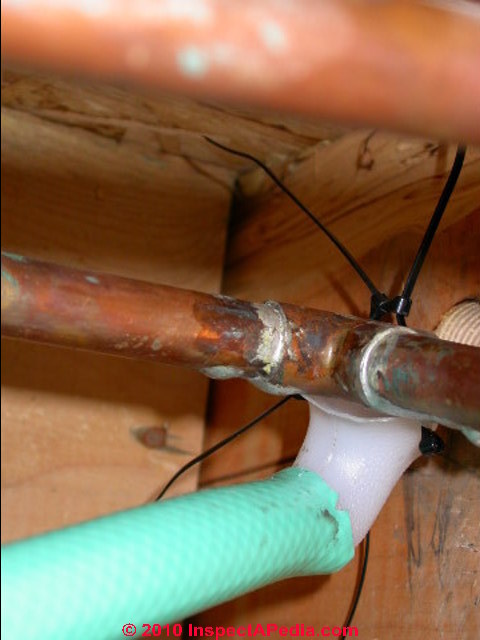
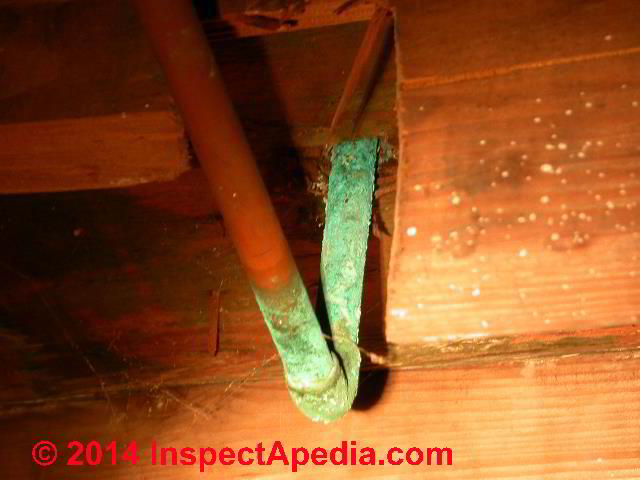
Our page top photograph shows a remarkable method used by a homeowner to handle leaks at a poor solder joint on copper water supply piping.
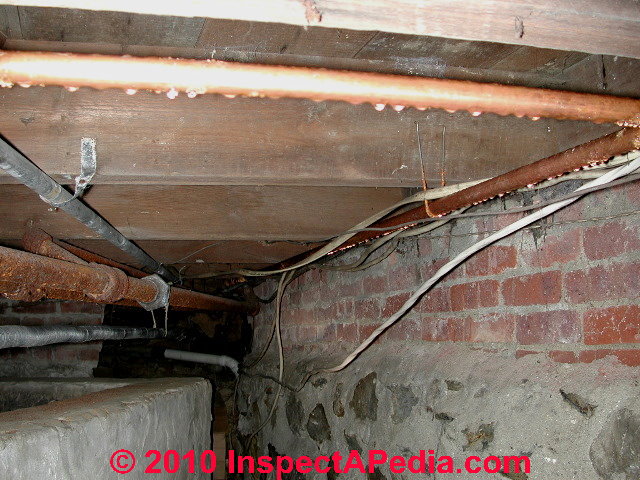
Our photograph of copper water supply piping (left) tells us that this is a cold water supply line located in a humid or wet crawl area - notice the condensation on the piping? More about "sweating" cold water pipes is
at CONDENSATION or SWEATING PIPES, TANKS.
The following summary notes about copper and other types of building piping are from Carson Dunlop Associates' Home Reference Book, used with permission:
Copper piping has been used extensively since the early 1950s for supply lines from the city main to the house as well as for in-building water supply and drain piping.
Copper water supply piping is typically 1/2 or 3/4 inch diameter. Copper piping is typically 1/2 or 3/4 inch diameter. Copper piping has soldered connections and the walls of the pipe are thinner than galvanized steel. Copper piping has soldered connections and the walls of the pipe are thinner than galvanized steel.
From 1950 to 1970, 1/2-inch diameter piping was used commonly for residential building water supply pipes. After 1970, 3/4-inch diameter copper service piping has been more common for building water supply piping.
Properties of Copper Pipe Types:
K, L, M, DWV, ACR, and Other Types of Copper Pipes used in Buildings: life expectancy, sizes, thickness, durability & uses
The life expectancy of copper piping is dependent on water conditions.
In many areas, its life expectancy is indefinite. In harsh corrosive water or corrosive soil conditions, it may fail within 20 years or even less.
Occasionally manufacturing defects also result in early failure of copper building piping.
We discuss water pH, acidity and corrosiveness
at CORROSIVITY or ACIDITY of WATER
and at LEAK INSPECTION of WATER SYSTEMS
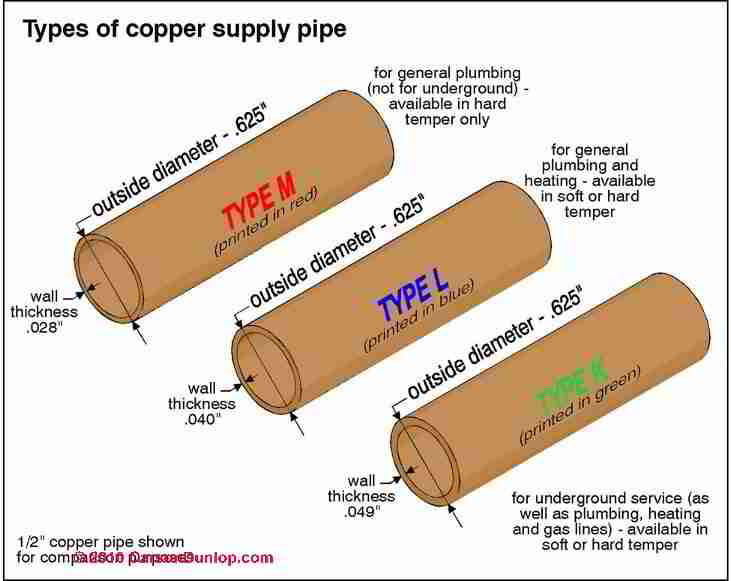
Carson Dunlop Associates' sketch (left) illustrates three types of copper piping used in buildings for water supply or drains. In order of thickness, from thinnest to thickest pipe walls, read Types M, L, or K copper.
- Type DWV, Drain-waste-vent copper pipe, color coded yellow is used for drain waste vent piping in buildings, also for HVAC condensate drains, and some solar heat or hot water systems.
Type DWV copper pipe conforms to ASTM B-306 - Standard Specification For Copper Drainage Tube (DWV)
- Type K copper piping - color code Green
K-copper is intended for use with domestic water supply piping, fire protection piping, solar applications, fuel or fuel oil piping, HVAC applications ,compressed gas distribution such as compressed air, snow-melting system, LP gas piping, natural gas piping, and underground
Type K copper piping is color coded with green markings.
Type K copper has a wall thickness of 0.049".
Type K copper piping conforms to ASTM B-88 [PDF] courtesy of Crane Copper Tube, or possibly other standards.
- Type L copper piping - color code Blue is also used for general plumbing as well as for heating system piping.
Type L copper piping is color coded with blue markings. Type L copper is intended for use in domestic water supply piping, fire protection systems, solar installations, fuel and fuel oil piping, HVAC systems, and snow melting systems. Unlike M-copper, Type L copper may be used for natural gas or LP gas piping in some jurisdictions and locations.
Type L copper piping is color coded with blue markings.
Type L copper tubing walls are thicker, at 0.040".
Type L copper conforms to ASTM B-88-16 Standard Specification for Seamless Copper Water Tube
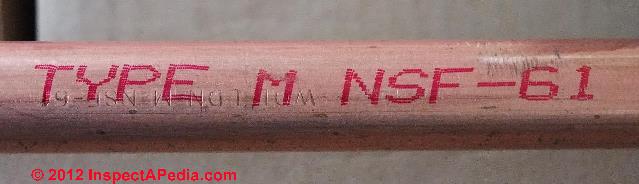
- Type M copper piping - color code Red is used for general plumbing, above ground.
Type M copper tubing walls are the thinnest used in construction, at 0.026" in wall thickness and thus more vulnerable to leaks if water being handled is aggressive or corrosive.. We illustrate both red and embossed-in-copper markings on copper piping in our photo shown here.
Type M copper is color coded with red markings
Type M copper conforms to ASTM B-88 - as above.
Below: flexible soft copper tubing such as typically rated type ACR used in air conditioning and refrigeration and some water piping systems. Below on this page we include size charts for flexible soft copper sold by OD or outer dimension size.
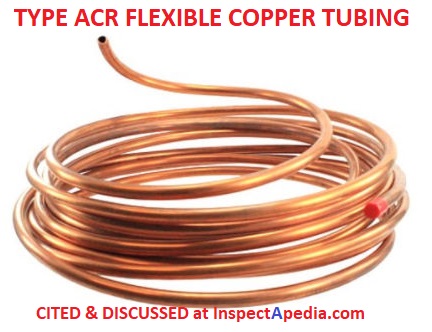
- Type ACR Copper Tubing: Refrigeration system - color code blue copper piping used for air conditioning and some gas piping applications
ACR copper conforms to ASTM B-280-18, Standard Specification for Seamless Copper Tube for Air Conditioning and Refrigeration Field Service - Type OXY, MED copper piping or tubing - Medical gas
or for compressed gases or for vacuum systems uses distribution copper piping (provided in copper types K - green color code, or L - blue color code) will be marked OXY/MED, OXY, MED, OXY/ACR or ACR/MED and is intended for medical gas use.
OXY/MED copper piping conforms to ASTM B-819-18, Standard Specification For Seamless Copper Tube For Medical Gas Systems - Flexible copper tubing used as water piping: Flexible copper tubing can be bent around corners using special tools. This is not common since it is more expensive and can be awkward to work with in close quarters.
Flexible copper tubing is also used for oil piping
See OIL TANK PIPING & PIPING DEFECTS
and natural gas piping
See GAS PIPING, VALVES, CONTROLS - Copper tubing used in heating baseboards varies in thickness and durability depending on the manufacturer and product line.[7]
Dimensions, Sizes, Thicknesses, Lengths of Copper Piping
How is Copper Piping Sold: lengths, diameters
Copper piping is sold in nominal or standard sizes in straight lengths of 12 ft. 18 ft. or 20 ft. from 1/4" diameter all the way up to 12-inches in diameter, depending on the copper type, thickness, grade, and intended application. Copper piping from 1/4" up to 2-inch in diameter is also sold in coils of 45' up to 100 ft. depending on the pipe diameter.
What is the Relationship Between Nominal Copper Pipe Size and its Actual Physical Size?
Plumbing Copper
Copper piping discussed here and used for plumbing is 1/8" larger in diameter than its nominal OD or outside diameter.
Example:
1/2" Copper pipe
- 1/2" copper pipe nominal size = 1/2"
- 1/2" copper pipe actual OD or Outer Diameter = 5/8" (that's 1/8" larger than nominal size)
- 1/2" copper pipe actual ID or Inside Diameter = 0.528" for Type K copper
Note that L and M copper pipes or tubing differ in ID and wall thickness:
1/2" Type L copper tubing will have an actual ID = 0.545"
1/2" Type M copper tubing will have an actual ID = 0.569"
So a 1/2" copper pipe will actually measure 5/8" in thickness. The actual internal diameter of a copper pipe will vary depending on the thickness of the pipe wall, even though these outside dimensions remain the same.
Copper Tubing Wall Thicknesses
Copper tubing wall thicknesses vary by tubing type.
Type K copper tubing: thickest wall section, used therefore in more-demanding applications such as high pressure, buried, harsh environments
Type L copper tubing: thinner walls than Type K, residential & commercial water supply piping
Type M copper tubing: thinnest wall section, used in low-pressure applications such as DWV (Drain Waste Vent) piping
Type K Copper Tubing SizesThick-walled underground, residential, commercial, industrial uses |
||||
| Nominal Tubing Size (Diameter) |
OD Type K |
ID Type K Interior Diameter |
||
| In | mm | In | mm | |
| 1/4" | 3⁄8 | 9.5 | 0.305 | 7.747 |
| 3/8" | 1/2 | 12.7 | 0.402 | 10.211 |
| 1/2" | 5/8 | 15.875 | 0.528 | 13.411 |
| 5/8" | 3/4 | 19.05 | 0.652 | 16.561 |
| 3/4" | 7/8 | 22.225 | 0.745 | 18.923 |
| 1" | 1 1/8 | 28.675 | 0.995 | 25.273 |
1. Wikipedia retrieved 2020/05/29
Type L copper tubing sizes (given below) will be a bit larger than the nominal K-copper sizes in the table above
Type L Copper Tubing SizesMedium-wall thickness, residential / commercial uses |
||||
| Nominal Tubing Size (Diameter) |
OD Type L |
ID Type L Interior Diameter 1 |
||
| In | mm | In | mm | |
| 1/4" | 3⁄8 | 0.315 | ||
| 3/8" | 1/2 | 0.430 | ||
| 1/2" | 5/8 | 0.545 | ||
| 5/8" | 3/4 | 0.666 | ||
| 3/4" | 7/8 | 0.785 | ||
| 1" | 1 1/8 | 1.025 | ||
1. Source: COPPER TUBING SIZES [PDF] Petersen Products Co.,421 Wheeler Ave Fredonia, WI 53021-0340 USA Tel: 1-800-926-1926 Website: https://www.petersenproducts.com retrieved 2020/05/29 original source: https://www.petersenproducts.com/Copper-Tubing-Sizes-s/1979.htm
Petersen's chart also gives DWV Drain/Waste/Vent copper piping in larger sizes, used for DWV or other non-pressurized applications.
Type M copper tubing sizes - given below, will be still a bit larger than K and L tubing sizes given in the table above
Type M Copper Tubing SizesThin-walled, residential, light commercial, above-ground use |
||||
| Nominal Tubing Size (Diameter) |
OD Type M |
ID Type M Interior Diameter 1 |
||
| In | mm | In | mm | |
| 3/8" | 1/2 | 0.450 | ||
| 1/2" | 5/8 | 0.569 | ||
| 5/8" | ||||
| 3/4" | 7/8 | 0.811 | ||
| 1" | 1 1/8 | 1.055 | ||
1. Source: Petersen Products Co.,421 Wheeler Ave Fredonia, WI 53021-0340 USA Tel: 1-800-926-1926 Website: https://www.petersenproducts.com retrieved 2020/05/29 original source: https://www.petersenproducts.com/Copper-Tubing-Sizes-s/1979.htm
Flexible Soft Copper Tubing Sizes
used with Flare Fittings or Compression Fittings
Flexible copper tubing is sold in sizes that correspond to the actual outside diameter of the tubing.
In North America the refrigeration industry as well as other users of flexible copper tubing size the tubing by its outer diameter or OD and add a letter indicating wall thickness.
Flexible Soft Copper Tubing SizesType ACR Used with Flare or Compression Fittings |
|||
| Nominal Tubing Size (Diameter) |
OD |
ID Interior Diameter |
Wall |
| In | In | ||
| 1/8" Type ACR | 1/8" | 0.065" | 0.030" |
| 1/4" Type ACR (Mueller) | 1/4" | 0.190" | 0.030" |
| 5/16" Type ACR | 5/16" | 0.249" | 0.032" |
| 3/8" Type ACR (Streamline) | 3/8" | 0.343" | 0.125" |
| 1/2" Type ACR | 1/2" | 0.375" | 0.032" |
| 1/2" Type ACR (Everbilt) | 1/2" | 0.430" | 0.125" |
| 5/8" Type ACR | 5/8" | 0.500" | 0.035" |
| 5/8" Type ACR (Everbilt) | 5/8" | 0.555" | 0.125" |
Notes:
Type ACR copper tubing is suitable for air conditioning and refrigeration piping systems meeting ASTM B280, ANSI B9.1
Unlike copper used for plumbing (above), copper tubing used for HVACR (heating, ventilating, air conditioning & refrigeration systems), is sold in sizes that correspond to the actual outside diameter of the tubing - see the dimensions given just above for common sizes and flexible soft copper ACR tubing dimensions.
What are the Standards for Copper Piping Sizes & Thickness
The copper content of copper piping meeting the ASTM standards below is virtually pure copper - or 99.9% Cu. The copper is shiny when purchased, typically having had any exterior or interior surface oxidants cleaned off using phosphorous. If you hear reference to DHP copper or C122 copper, this is the product being described.
The four most-relevant standards for copper pipe thickness and dimensions depend on the intended application and use and are listed as follows:
- ASTM Standard Classifications B-698 encompasses six plumbing pipe (or "tube") standards including ASTM-B88.
- Type K copper and Type L and M copper pipes are governed by Standard: ASTM B-88
- Type DWV copper piping is governed by Standard: ASTM B-306. This standard also applies to copper pipes used in solar energy and other HVAC applications.
- Type ACR copper piping intended for use in air conditioning and refrigeration systems and also for natural gas or LP gas (LPG gas) is governed by Standard: ASTM-B-280. [K, L, or M Copper tubing is not allowed for natural gas distribution.]
- Type OXY/MED copper piping intended for use in medical gas applications is governed by Standard: ASTM B-819
How to Inspect Copper Piping for Leaks or Damage
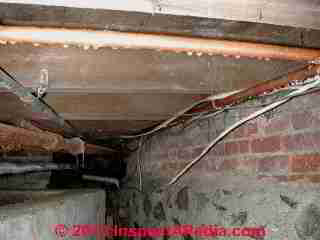 Question: how can I get a diagnostic inspection of the condition of house piping?
2020/01/29 Gilles said:
I just bought a house in Florida - and my neighbor warned me that I should be repiping because many house in the community had issues and leak -
how can i get a diagnostic on the house piping and if i should do anything to prevent leak or plan for repiping ($$$$)
Reply: How to look for plumbing leaks or pipe damage & defects
- Home inspection report, plumbing section.
As you just bought the house a good place to start would be with your home inspection report. What did your inspector say about the condition of the building plumbing system?
Home inspection standards require that the inspector identify the types of plumbing materials used in the building, identify leaks or necessary repairs, particularly costly ones that can be discovered by visual inspection such as corroded fittings or a piping material known for failures, and also that the inspector mention unsafe conditions such as the presence of lead water supply pipes - Functional clues of plumbing problems
Next let's look at functional clues such as poor flow or pressure at fixtures, or slow or noisy dreams. - Direct visual clues of condition of supply & drain piping
Start where water enters your building and follow all of the visible, physically accessible pipes that you can, in order to look for the materials that were used and the condition of the piping.
Look not only for leaks or corrosion at joints and connectors but also for signs of pitting, perforation, at runs of piping as well.
See LEAK INSPECTION of WATER SYSTEMS for details
At LEAK TYPES, WATER SUPPLY or DRAIN PIPES - we describe the types of leaks that occur in water supply and drain piping with an eye (or an ear) towards leak detection and towards hidden leaks in buildings
- Indirect clues of the condition of house piping
The other visual Clue set would be leak stains anywhere in the building or signs that ceilings or walls were recently repaired or replaced which in turn might, particularly if the area is below supply piping or drain piping, indicate a history of leaks. - When to cut holes to inspect piping:
I don't recommend invasive or destructive inspecting until the clues that we can find without doing that indicate that there's a problem worth digging further.
An example would be mold growth and leak stains in a ceiling; you'll need to open that ceiling to inspect for mold on the hidden side of the ceiling drywall or plaster, and to find the exact leak source.
Follow the water or leak path through a building to find what may be damaged, wet, or moldy in a building.
The ARTICLE INDEX found on this page gives a complete inventory of plumbing supply and drain piping defects, installation practices, inspection methods, and repair procedures.
There you'll see that we have article series on inspection, installation, and repair for each plumbing sub-topic, for example,
TOILETS, INSPECT, INSTALL, REPAIR
Compression Fittings for Copper Tubing Connections
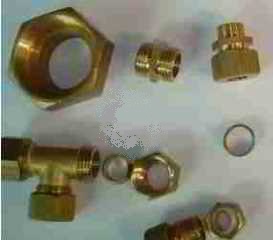
Flexible copper tubing is usually joined to additional tubing sections or to other plumbing fittings by either compression fittings or flare fittings, depending on the application.
For example, compression fittings (photo at left, from Wikipedia) are sometimes used on copper water piping where soldering is difficult or inconvenient, but these are not used on copper gas or oil lines where flare fittings may be applied instead.
Flare fittings and compression fittings are intended for use on soft-temper copper piping and tubing. In addition to flare and compression fittings there are also other mechanical connectors that now work with soft or hard copper that do not require soldering.
Watch out: compression fittings are very convenient and easy to install on copper pipes or copper tubing, but if you fail to de-burr a freshly-cut copper pipe or tube, properly ream out the interior opening, or if you over-tighten the coupling during installation you may crack the brass or copper ring, leading to leaks at the connector.
Compression fittings are used with K-copper. K copper pipes and tubing can also be joined or connected using flare fittings and sweat fittings discussed below.
Also see COMPRESSION THREAD vs PIPE THREAD
Flare Fittings Used for Flexible Copper Tubing Connections
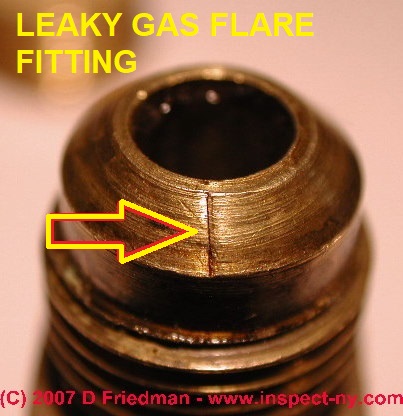
Flare fittings used on flexible copper piping and their leaks and defects are discussed
at GAS LEAK DETECTION, LP / NG
and GAS PIPING CLEARANCES, CODES & DEFECTS.
Using a special flaring tool the soft copper tubing or piping is actually spread open or flared at its end in order to mate with the female end of the flare fitting connector shown in our photograph.
Watch out: defects in flare fittings used on flexible copper tubing can result in gas leaks out of gas piping, and in the case of oil piping such as for oil-fired heaters, flare fitting defects result in both oil leaks out of the system and air leaks into the system.
Air leaks into oil piping in turn lead to improper oil burner operation and even potentially dangerous conditions. Flare fitting defects include:
- Improperly made tubing flares that are too small
- Improperly made copper tubing flares that are cracked
- Scratches or gouges on the copper tubing flare or on the brass flare fitting (shown in our photo, above left)
Seat and flare fittings are permitted on K and L copper. LP gas tubing. These fittings are not used on refrigeration equipment.
Swaged Copper Tubing Joints
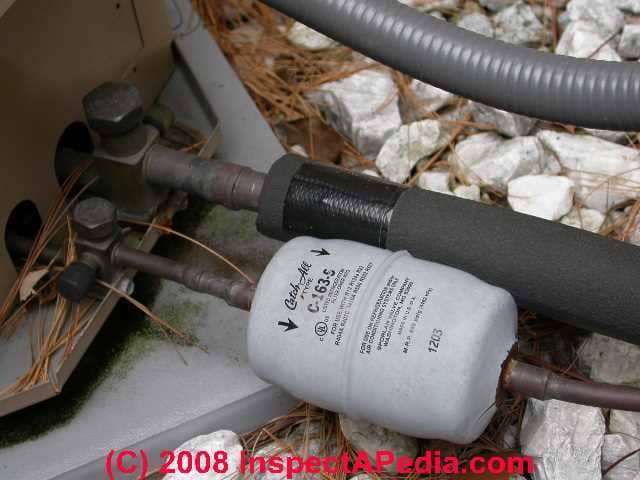
Soft copper tubing can also be joined by using a swaging tool that expands the open end of one of the tubes to be joined so that its mate can be inserted into the enlarged opening, and the result sealed by soldering or brazing.
This is a common procedure when using air conditioning refrigerant tubing because of the high pressures that may be involved and the need for extra strong resistance to leaks in piping that may be subject to wide temperature variations as well as mechanical vibration.
Our photo (red arrow in photo at left) illustrates swaged fittings on copper tubing - you can see the swaged tubing joints at the left and right ends of the gray filter-dryer on this air conditioning high pressure refrigeration line exiting at the bottom of a compressor-condenser unit.
A swaging tool is inserted into the end of the copper tube and hammered inwards.
As the properly-calibrated diameter of the swaging tool is forced into the copper tube, the copper expands to just the right size to accept the outer diameter of the mating section to be inserted.
For example, if we are swage fitting two sections a 3/8" nominal diameter copper tube together, the swaging tool will enlarge the receiving copper tube section so that its inside diameter will accept the 3/8" outer diameter of the un-treated tube to be joined.
Usually we work the swaging process on tubing at ambient temperatures but some procedures call for pre-heating the copper to make it easier to expand.
Watch out: Soft copper tubing is drawn copper while hard tubing is annealed. It's easy to swage fit soft copper, usually. But if copper tubing has been repeatedly bent, that process may have annealed the copper somewhat, making it difficult to form either a flare fitting or a swaged fitting without cracking the tubing.
Copper tubing may also become crack prone when exposed to mercaptan or other odorants in LP gas or natural gas. Moisture exposure and even some types of solder also can affect its susceptibility to cracking later. For these reasons copper tubing is not allowed for natural gas distribution.
Fittings Allowed for Types of Copper Pipes & Tubing
"Sweat" fittings or "soldered fittings" for copper piping refer to the traditional and perhaps most widely-used method for residential copper supply and drain pipe connections, bends, elbows, valves, and similar fittings in buildings.
Depending on the connection required, a coupling (straight connection), 90 degree ell, 45 degree ell, tee, and even fittings that marry copper pipes of different diameters are soldered to the copper tubing or pipe to make the connection.
Sweat fittings may themselves be made of copper tubing that has been formed by machine, or from cast or milled bronze.
Table of Types of Copper Pipe or Tubing Connections, Connectors, Fittings |
||||
| Sweat Fittings | Swage Fittings | Flare Fittings | Compression Fittings |
|
| K copper | ok | ok | ok | |
| L copper | ok | ok | ok | |
| M copper | ok if annealed ok if drawn-tempered |
ok | ok if annealed | |
| Flexible copper tubing - water | ok if annealed ok if drawn-tempered |
? | ok | ok if annealed |
| Flexible copper tubing - LPG | ? | ok | ||
| Flexible copper tubing - HVAC refrigerants | ok | ok | ||
Notes to the table above
Standard: Copper Tubes, ASTM B-88M
[this table is incomplete, other citations needed - ed.]
How to Tell Brass Water Pipes from Copper Piping
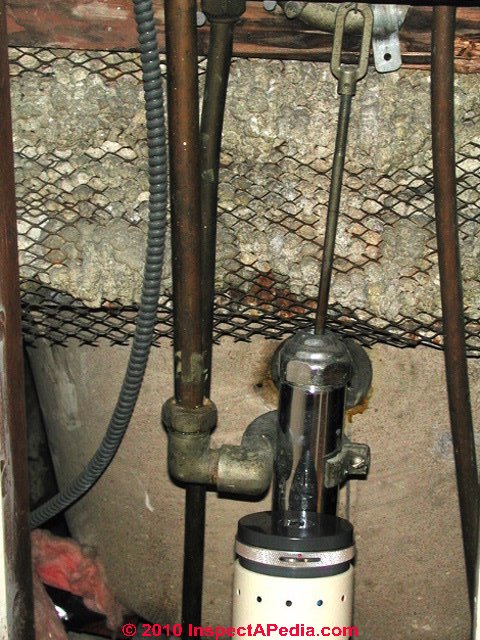 Watch out: on older buildings brass water supply piping may have been used, and may be at or near the end of its useful life
. It can be tricky to tell the difference between brass water supply piping and copper water supply piping if you are not experienced with these materials, as their colors are similar, especially when both types of piping have become an oxidized brownish color with age.
Both brass and copper are non-magnetic, so they won't respond to a "magnet" test to look for iron or steel.
Brass water supply piping, unlike copper, is a thicker material that is usually joined by threaded fittings of the same size and pipe thread specifications (NPT) as iron and galvanized iron piping.
Usually, brass piping is also so rigid that it is not bendable. Or not very bendable anyway.
So in our photograph (left) of water supply piping at a bath tub in an older home, the larger-diameter left-hand pipe is surely brass, connected to a galvanized iron fitting at its bottom end.
The right-hand vertical pipe may be copper tubing as is the darker copper pipe at left behind our brass one.
Don't worry about that odd little machine in bottom center of the photo - we were collecting an air sample in this wall cavity.
Copper Supply or Drain Pipe Pinhole Leaks: cause, cure, prevention
Water chemistry, Electrical Grounding, Neutral Wiring, & Copper Pipe Pinholing & Leaks
In a building where leaks are found recurrent in copper piping there are several possible explanations including these possible causes for the pinhole leak in copper water piping under a building concrete floor slab as well as at other locations:
- Defective copper piping: the pipe could have been defective from day one, e.g. with thin spots or damage that corrode through and leak
- Improper type of copper piping may have been installed - see the copper piping types and applications described in the article above.
- Damaged copper water piping: the pipe could have been damaged in transport or installation or even during the slab pour
- Improper electrical ground or neutral wiring: on occasion a bad or improperly-connected electrical ground or another electrical problem can contribute to plumbing or other pipe corrosion at a building.
In diagnosing recurrent failures in a ground water sourced air conditioning system that kept blowing out a very expensive cooling coil for we found that the problem was finally traced to unanticipated electrical currents in the ground system due to a neutral wiring error in the AC unit's controls.
Ask a licensed electrician check the home's grounding and neutral systems: that they are properly wired, that the grounding electrodes are properly sized and installed, and that there are no stray currents on the neutral system nor shorts or leaks in the wiring system (an AFCI or GFCI can help detect thee too). - Aggressive water: the water chemistry itself can be a source of metal water pipe (and even drain pipe) corrosion.
If the pH is low <6.0, the hardness low generally<50ppm, the alkalinity low generally <40ppm, the water could be considered
extremely “soft” and aggressive to the home’s metallic plumbing system. If the
chlorides are elevated >100ppm this would only compound the problem. The
water should be treated to make the water less aggressive by raising the pH, alkalinity or hardness. - CT DOH.[1]
See CORROSIVITY or ACIDITY of WATER for details about aggressive, acidic or corrosive water and its effect on building plumbing systems.
See GREEN STAINS from WATER SUPPLY for details about green stains on plumbing fixtures or on laundered fabrics or in the water itself: causes & cures.
Summary of the issue around grounding building water piping
Many sources, including the Connecticut DOH have pointed out a long-standing disagreement & confusion about the reasons for grounding building water supply piping. For example
AWWA opposes the grounding of electric systems to pipe systems conveying drinking water to a customer’s premises. ... AWWA asserts that a water utility has no direct or indirect responsibility in connection with the installation of water pipe grounding systems or for the maintenance of the integrity of any grounding attachment or connection made to a water pipe system. [AWWA 5/15/2003] [1]
This statement is a bit of a red herring.
Water and some plumbing associations are concerned about building owner complaints about metal water supply pipe corrosion and leakage that might be traced to or blamed on the electrical grounding of those systems.
Wishing to avoid those complaints the industry, under the aegis of warning that water suppliers can't be responsible for the failure of such an electrical ground [a valid caveat] a warning is issued that also gives relief for metal piping leaks caused by a variety of other problems such as
- water chemistry - see our notes just below
- defective piping
- improper installations
More to the point, metal water piping is grounded not to provide an electrical ground for the building (we agree completely that water piping as a ground is unreliable for many reasons, (such as inclusion of non-conductive plastic piping, diaelectric fittings, water meters, etc).
Metal water piping is bonded to a building ground system as an important safety precaution to protect building occupants from electrocution hazards should live electrical wires or components come in contact with building piping, faucets, fixtures, etc.
In a properly-wired building, the grounding conductor and bonding system do not normally carry current, and would not be blamed for copper pipe pinholing etc. The grounding system is intended to conduct electrical current only in the event of a fault or emergency [such as a lightning strike or a hair dryer dropped into the bath tub or sink].
Details about the code requirements and reasons for grounding metal water piping are
How to Check for Electrical System Problems that Corrode Copper Water Pipes
[For buildings served by private well water] Should the problem persist and the well water is still blue and it is discovered that the private well’s metal discharge line has an electrical “grounding” clamp, have them contact a licensed electrician to investigate the situation.
The electrician would check the main circuit panel for a faulty, missing or improperly secured “neutral” wire. He could also test the plumbing to see if there is any stray AC or DC current.
There should not be any current, even in milliamps! If there is current, the improperly functioning or shorted device/ appliance should be found and repaired. He should also check that the house plumbing has a greater resistance (>25 ohms) than the grounding rod(s).
The ground wire to the plumbing system should not be removed as it is mandated in the CT Building Code but it should not be the primary carrier of stray electrical current or voltage surges to “ground” - CT DOH.[1]
Common Causes of Leaks in Copper Water Piping
 Question: green stains, corrosion, gritty material around copper pipes & pipe fittings or connections
(Jan 14, 2015) JohnGotts said:
What is the green gritty mineral buildup around some sweat joints in my boiler installation?
Can it be removed or should it be left alone?
30 January 2015 Sal said:
If your house water main is green near the electric ground connection does that mean the ground wire is going bad or is bad
Reply: common causes of corrosion on or leaks in copper piping
See LEAK CAUSES in WATER PIPING for a catalog of the various causes of leaks in copper or other metal water piping.
John
Most likely it's an oxide of copper caused by corrosion. Look at it closely to be sure there are no leaks.
Watch out: never "pick" at or probe corrosion.The risk is that you convert a small leak into a big emergency leak that requires that you shut down the building water supply.
Sal:
Watch out: Green corrosion on a water pipe that is found only around the electrical ground is worth some further checking: stray electrical currents or improper grounding could be causing the corrosion that you see.
Some green corrosion on copper piping is common and may not necessarily mean a leak is present. For example we may see corrosion where solder flux ran out around a solder joint during pipe connections by sweating (copper soldering).
Question: Acidic water & copper pipe corrosion/leak risks
I get a lot of blue stains on bathtubs and sinks, which I assume is copper leached from the inside of the copper water-supply piping. I built the house about 16 years ago and replaced the water heater a few years ago.
Am I at risk of developing pin holes or other damage to the copper plumbing and other equipment, including an electric water heater, boiler, and baseboard radiation?
If that’s the case, what’s the preferred (and cheapest) solution: calcite neutralizer tank, soda ash feeder, or other?
FYI, copper level was last measured at 0.11 mg/L, well below the MCL of 1.3, so I don’t think there’s a health issue. But I figure if copper gets leached from the pipes for enough years, at some point there won’t be much pipe left.
Muchas gracias, Steven Bliss, 4 Burlington, VT
Reply:
This topic has been moved to its own article now found at CORROSIVITY or ACIDITY of WATER
Question: burned or charred-looking copper pipes
(Oct 16, 2012) Dan said:
What would make the cold copper pipes in the house appeared burned or charred. The hot is fine. Just the cold looks this way. Any ideas?
Reply:
Dan
What you describe is normal, provided there are not actual burn marks from overheating such as by a soldering torch, and in fact dark or even blackened copper piping often helps us identify cold vs hot water copper piping.
Cold water piping is seasonally wet by condensation that in turn boosts both soiling or dust collection and mild oxidation.
The result is that generally the cold water copper piping will be darker in color than the hot lines.
Copper Tubing & Piping Standards & Resources
- ASTM B-88 [PDF] courtesy of Crane Copper Tube, Website: http://cranecoppertube.com/, Address: 431, Cheonggyecheon-ro, Dongdaemun-gu, Seoul Tel: +82-2-3290-9084 Fax: +82-2-2231-9055 Email: sales@cranecoppertube.com
- COPPER TUBE HANDBOOK [PDF], Copper Development Association, Copper Alliance, 7918 Jones Branch Dr. Suite 300 McLean, VA 22102 USA, Website: www.copper.org retrieved 2019/07/15, original source: https://www.copper.org/publications/pub_list/pdf/copper_tube_handbook.pdf CDA Publication A4015-14/19: Copper Tube Handbook
- Also see additional research papers on copper piping, pitting, leaks, copper leaching into water supply, etc. atReferences or Citations below.
Reader Comments, Questions & Answers About The Article Above
Below you will find questions and answers previously posted on this page at its page bottom reader comment box.
Reader Q&A - also see RECOMMENDED ARTICLES & FAQs
On 2023-02-03 by Eli - when to replace the copper piping in a building & how to determine if replacement is needed
I have copper piping installed a drain lines in my home. I am trying to determine the health and if I need to replace all the piping. I have had issues with the drains from the toilets and have replaced the copper piping using flexable couplings
Do you have any experience with copper drain lines and what should be replaced or not. I am considering replacing as much as I can but that is a large task and due to the size difference of Copper vs ABS in some cases can be very difficult.
ANy way to tell what may be good or not or what should be replaced?
On 2023-02-03 by InspectApedia Publisher
@Eli,
Yes I have several decades of plumbing repair experience that includes inspection and replacement of leaky copper drain piping.
The most reliable reasons to replace the copper piping in your building more extensively would turn on a bit of closer inspection and diagnosis of the plumbing problems you've already had, the quality of installation, and the chemistry of your water supply.
If you're finding leaks in supply or drain piping traced to perforation / corrosion leaks of the copper piping for which there's no obvious external cause such as
- some external source of corrosion on the piping
- improper electrical grounding in the building
- poor original workmanship at solder joints
then you'll want to find some sections of piping that give the pipe brand and thickness schedule; you'll be alert for a brand reported to have a lot of defective product or for thin-walled copper
then you'll want your water chemistry checked: if the water has a high corrosivity index that could be the problem - and something you'll want to address by proper water treatment equipment.
In sum, let's get a handle on the cause of these leaks before we prescribe an expensive repair.
On 2023-02-03 by Eli
There is no obvious cause from what I could tell, overall joints appear to be good quality and no sign of leaks at the joints and no specific external corrosion issues.
The piping in question didn't have specific schedule markings but stated that it was branded with the name Anaconda, pipe size and Drain, Waste and Vent(DWV) made in USA. As a result I expect its standard schedule piping (40-80).
The main locations that I personally have dealt with was in the line horizontal line directly down stream from the toilets and there was a section that was thinned on the bottom where flow was obvious the fittings appeared to be sound.
The second location was odd. That horizontal line empties into a vertical that all the waste lines empty and this had a significant gap that had developed on one side. that would have been facing the drain line (if that makes sense) My initial assumption is that the water from the toilet had a more harsh chemistry than the lines from the sinks which from my inspection have not had this same issue.
I will test the water to see what the ph or corrosive chemicals look like to see it that is an issue that could affect the whole system and not just the toilet lines.
The house was built in 1966 so I have concerns that I could have a much larger issue and to ignore it would be a mistake and keep being a financial and time pit.
I appreciate the input if you have more input with this additional information I would love to hear it. Thanks
On 2023-02-04 by InspectApedia Publisher
@ Eli,
Let me know the water chemistry test result kind of a or maybe as a shortcut let's 1st find out this is your water from a private well or are you on a municipal system?
On 2023-02-04 by Eli
We are on city water. I plan on getting a test kit tomorrow and running a test.
On 2023-02-04 by InspectApedia Publisher - city water would be is unlikely to be highly corrosive
@Eli,
If you're in the US, it's useful to know that except for very small water systems with just a few people on them, the water chemistry is regulated by the federal clean drinking water act, and it's not likely that you're in this water would be highly corrosive.
On 2022-12-17 by ELKS - Do Flared Brass Fittings have to be used for copper piping?
I attempted to disconnect my old LP stove/oven range from the LP copper line running into it so I can hook up the line to a new range. BUT the line twisted as I turned the connected fitting.
There is enough line that I can cut the twisted kinked end off and still use this copper pipe to get Liquid Propane to my new stove.
BUT I do not know anything about Brass Fittings for Gas/LP so I do not know how to reattach the fitting to the copper pipe.
Do Flared Brass Fittings have to be used?
I would just replace everything from the tank to the inside but it’s -20 below zero here in Alaska and if I try to disconnect the regulator and switch over valve I know that something will snap from the cold.
I found the same size copper line at the hardware store that is specifically for LP use BUT I still need to put fittings on the ends to be able to attach it to the LP Regulator and new stove.
BUT I looked at 3 types of Brass Fittings at the hardware stores and they do not specify what application they should be used for…such as plumbing or gas connections.
And I thought the hardest part of this was going to be converting the new stove/oven range from Gas to Liquid Propane BUT I haven’t even got to that yet.
On 2022-12-18 by InspectApedia (Editor)
@ELKS,
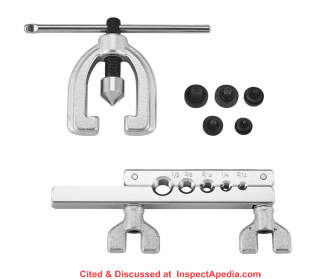
With a bit of care it's easy to make flare joints, following the instructions that come with even an inexpensive flaring tool like the one I'll show below (less than $30. U.S.)
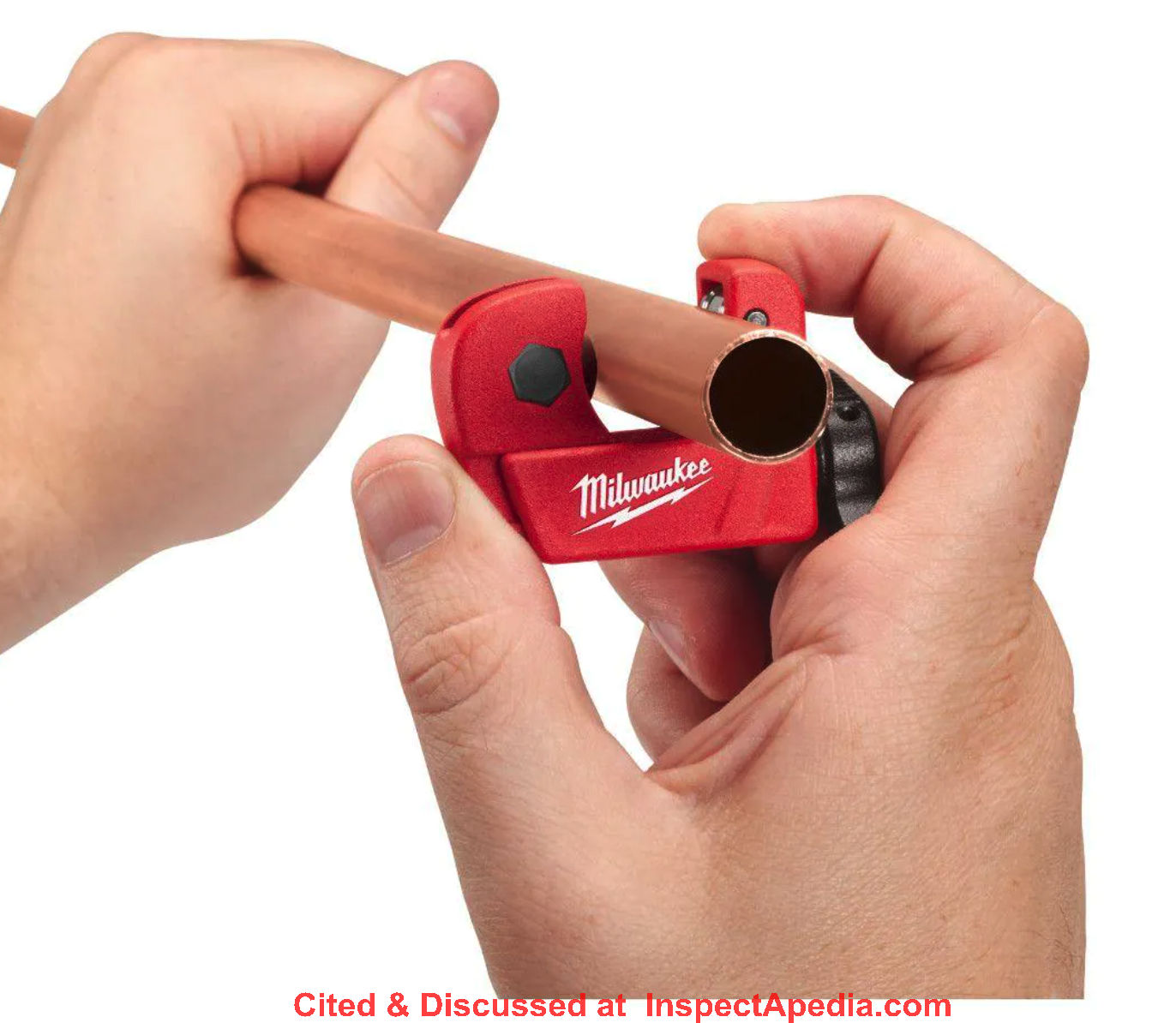
It's best to use a copper tubing cutter to make a clean cut to remove the damaged section of your LP line.
Most tubing cutters include a retractable triangular blade used to trim out / off the burr left inside of the tubing - be SURE to do this before making the flare joint else your joint is likely to be un-even and leaky, risking an LPG explosion or fire.
I'll show one of these cutters in a subsequent photo.
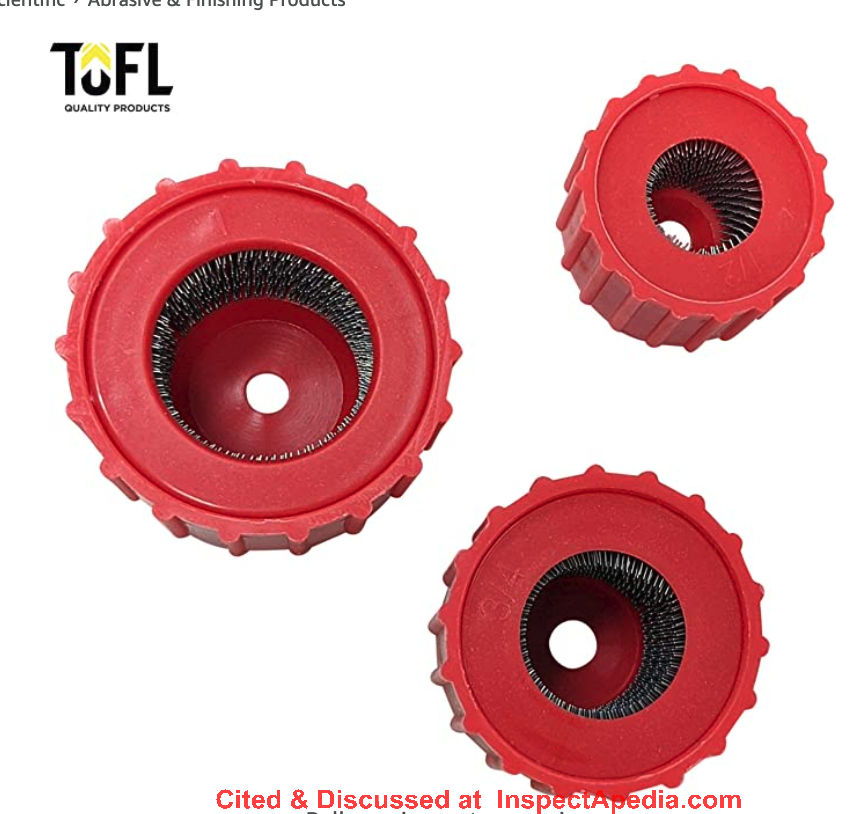
I then use very fine sandpaper or steel wool to remove any oxide from the tubing exterior before making the flare. Or you can buy the special tool sold to clean off the end of copper tubing - I'll show one of those in a subsequent photo.
Then slide the flare fitting over the tubing,
Then make the flare using the flaring tool. The tubing is pinched in the die and you screw down the flaring head to gradually flare out the tubing.
Inspect the result to be sure there are no nicks or cuts in the mating surface of the flare fittings.
Details on how to flare tubing - though lacking details of using modern tools - are at
COPPER FLARE CONNECTIONS
and this general guide
FLEXIBLE GAS PIPING DESIGN GUIDE and INSTALLATION INSTRUCTIONS [PDF] from OmegaFlex shows installation details for gas piping using some alternative materials.
And while using ordinary 220 grit emory paper to clean off your copper tubing before making the flare, for anyone doing a lot of copper tubing work, copper pipe cleaners like the ones I'll show below are appropriate for larger copper pipe sizes. This tool is made by Tofl.
Here's a tubing cutter - not showing the reamer blade that you need to use to clean the lip formed inside of the tubing after a cut. This one is a Milwaukee product.
On 2022-08-04 by Dean L. - low water pressure after bathroom remodel
So I recently changed my bath to just a stand-up shower is the only Plumbing I had to do was just in the shower so I turned the valves off downstairs I do my work I turn the valves back on now I have pressure issues with my double vanity sink one of them has low pressure as well as the shower has low pressure?
Any help on to why this maybe happening?
On 2022-08-04 by InspectApedia-911 (mod)
@Dean L.,
If you're sure the valves are fully open, check for debris clogging, starting at the faucet strainer st the sink.
On 2022-05-11 by Norm Payne - Is it safe to connect LP gas line to an exterior fire pit burner without using an adapter which introduces air?
Is it safe to connect LP gas line to an exterior fire pit burner without using an adapter which introduces air?
On 2022-05-12 by Inspectapedia Com Moderator
@Norm Payne,
Apologies for having to duck an answer to your question, but I'm not willing to bet your life and safety on a guess when I just have no information whatsoever about your installation.
Let's identify the brand and model of fire pit that you were trying to install and then get a hold of the installation manual to see what the manufacturer requires.
On 2020-01-29 by Gilles - basic tips for inspecting the condition of plumbing supply & drains
I just bought a house in Florida - and my neighbor warned me that I should be repiping because many house in the community had issues and leak - how can i get a diagnostic on the house piping and if i should do anything to prevent leak or plan for repiping ($$$$)
Thank you
On 2020-01-29 by danjoefriedman (mod)
Giles
Please see your question and my reply now at
COPPER PIPE INSPECTION GUIDE - basic tips for inspecting the condition of plumbing supply & drains
Thanks for asking a helpful question
Question: Water line insurance for leakage or failure - what is pipe life-span
(Jan 29, 2014) Curtis said:
My Clifton NJ house was built in 1952 and I recently received a Exterior Water Line insurance policy in the mail covering replacement of the water line should it fail. What is the lifespan for the water line? Is this something I should be worried about?
Reply:
I'm a little nervous about this one Curtis.
At PIPING in BUILDINGS, CLOGS, LEAKS, TYPES - we indeed give life expectancy of various building piping materials.
But for your question I'm in trouble:
We don't know the material of your water main, the soil corrosivity, nor how the line was installed, nor its length to the street water main, nor its depth: all of these are significant factors in water line replacement cost and life expectancy.
I'm also not sure who's selling you this sort of pig-in-a-poke insurance policy: that is, what sort of insurance are we buying when the insurer knows nothing about the property or item being insured?
If I were an underwriter (I'm not qualified to be one, this is just OPINION) I'd be nervous, especially knowing that a bevy of home warranty companies marketing to home buyers and home inspectors went belly-up due to the adverse selection problem.
And I'd want to know about the policy price and who's selling it. A quick web search turned up Excelsior Insurance as a company selling water damage coverage and possibly a part of Liberty Mutual group (reputable).
It also turned up something to look into: Insurance Firm On Thin Ice In Denying Claim, Judge Rules
January 09, 1988|By Robert Bruss. - admittedly an old snafu. But a quick search shows quite a few legal disputes over collecting on insurance policies issued by the Excelsior Insurance Co. for water damage. - Is this the company offering a policy?
Reader Follow-up:
- re-posting your comment without the link - our software prohibits links in comments in order to protect against malware.
Thanks for the response. I have not heard of anyone needing to replace a water main into the house but suspect it must need to be done at some point...The company is HomeServe.
Reply:
Certainly the lateral or in some parlance "water main" between house and street is ultimately replaced on buildings. But depending on variables I cited along with piping material and quality, wall thickness, care of installation, and soil conditions, these lines can last a long time.
20-40 years would not be unusual. In the Northeastern U.S. where lead entry mains went into homes around 1900 we saw replacements beginning to be more common 50-70 years later.
Question: leaks showing up in copper pipes, pipes feel soft
(Feb 13, 2014) Anonymous said:
I recently bought a duplex. All copper plumbing lines. Recently have had 2 leaks show up, and the pipe around leaks very soft feeling. Do I need to replace it all? slee5201@gmail.com
Reply:
Hi Anon;
The answer is ... it depends. On why the pipes are leaking; If the original installation used defective copper OR if the water supply is very corrosive then you could be facing an extensive repair.
I would want to know more about the leaks - where they occurred in the house, whether they were on hot or cold piping, and I'd like to see sharp photos of the leak; ideally you'd cut out four inches around the leak and have someone with experience examine the pipe itself -
or send me photos or a pipe fragment if you like and I can make a physical exam in our lab (while we have a forensic lab here I'm not a copper expert but I suspect we can figure out what's going on by microscopic examination)
Click on the CONTACT link at page bottom or top for mailing details if you want to pursue it.
On 2017-02-20 by Pete - do copper water pipes develop pin hole leaks over time?
do copper water pipes develop pin hole leaks over time?
On 2017-02-20 - by (mod)
Yes, pinhole leaks in copper pipes can occur for any of several reasons, Pete, discussed in detail at
COPPER WATER SUPPLY & DRAIN PIPING
and
...
Continue reading CORROSIVITY or ACIDITY of WATER or select a topic from the closely-related articles below, or see the complete ARTICLE INDEX.
Or see these
Recommended Articles
- BUILDINGS, CLOGS, LEAKS, TYPE
- COMPRESSION THREAD vs PIPE THREAD
- COPPER PIPE INSTALLATION
- COPPER PIPING in BUILDINGS
- CORROSIVITY or ACIDITY of WATER
- GAS LEAK DETECTION, LP / NG
- GAS PIPING, VALVES, CONTROLS - home
- LEAK CAUSES in WATER PIPING
- OIL TANK PIPING & PIPING DEFECTS.
- PLUMBING LEAK DETECTION METHODS
- PLUMBING LEAK DETECTION & SHUTOFF DEVICES
Suggested citation for this web page
COPPER PIPING in BUILDINGS at InspectApedia.com - online encyclopedia of building & environmental inspection, testing, diagnosis, repair, & problem prevention advice.
Or see this
INDEX to RELATED ARTICLES: ARTICLE INDEX to PLUMBING SYSTEMS
Or use the SEARCH BOX found below to Ask a Question or Search InspectApedia
Ask a Question or Search InspectApedia
Try the search box just below, or if you prefer, post a question or comment in the Comments box below and we will respond promptly.
Search the InspectApedia website
Note: appearance of your Comment below may be delayed: if your comment contains an image, photograph, web link, or text that looks to the software as if it might be a web link, your posting will appear after it has been approved by a moderator. Apologies for the delay.
Only one image can be added per comment but you can post as many comments, and therefore images, as you like.
You will not receive a notification when a response to your question has been posted.
Please bookmark this page to make it easy for you to check back for our response.
Our Comment Box is provided by Countable Web Productions countable.ca
Citations & References
In addition to any citations in the article above, a full list is available on request.
- Baylis, John R. "PREVENTION OF CORROSION AND" RED WATER"." Journal (American Water Works Association) 15, no. 6 (1926): 598-633.
- Beale, David J., Michael S. Dunn, Paul D. Morrison, Nichola A. Porter, and David R. Marlow. "Characterisation of bulk water samples from copper pipes undergoing microbially influenced corrosion by diagnostic metabolomic profiling." Corrosion Science 55 (2012): 272-279.
- Campbell, Hector S. "A natural inhibitor of pitting corrosion of copper in tap‐waters." Journal of Applied Chemistry 4, no. 12 (1954): 633-647.
- "Cause of Copper Corrosion in Plumbing Systems, A Review of Current Knowlege", Foundation for Water Research, Allen House, the Listons, Liston Road, Marlow, Bucks SL7 1FD U.K., TEL: +44 (0) 1628 891589, Website: www.fwr.org, retrieved 30 Jan 2015, original source: http://www.fwr.org/copper.pdf
- Boulay, Nicolle, and Marc Edwards. "Role of temperature, chlorine, and organic matter in copper corrosion by-product release in soft water." Water research 35, no. 3 (2001): 683-690.
- Campbell, H. S. "Pitting corrosion in copper water pipes caused by films of carbonaceous material", Journal of Applied Chemistry, Vol. 77 1950
- Edwards, Marc, and Abhijeet Dudi. "Role of chlorine and chloramine in corrosion of lead-bearing plumbing materials." Journal (American Water Works Association) (2004): 69-81.
- Dietrich, A. M., D. Glindemann, F. Pizarro, V. Gidi, M. Olivares, M. Araya, A. Camper et al. "Health and aesthetic impacts of copper corrosion on drinking water." Water Science & Technology 49, no. 2 (2004): 55-62.
- Edwards, M., Schock, M. R. and Meyer, T. E., "Alkalinity, pH and copper corrosion by-product releases", Journal of the American Water Works Association, March 1996
- Fuji T., Kodama T. and Haruo B. "The effect of water quality on pitting corrosion of copper tube in hot soft water", Corrosion Science, Vol 24, No. 10 pp 901-912. 1984
- Jacobs, S., and M. Edwards. "Sulfide scale catalysis of copper corrosion." Water Research 34, no. 10 (2000): 2798-2808.
- Karalekas Jr, Peter C., Christopher R. Ryan, and Floyd B. Taylor. "Control of lead, copper, and iron pipe corrosion in Boston." Journal (American Water Works Association) (1983): 92-95.
- LeChevallier, Mark W., Cheryl D. Lowry, Ramon G. Lee, and Donald L. Gibbon. "Examining the relationship between iron corrosion and the disinfection of biofilm bacteria." Journal (American Water Works Association) (1993): 111-123.
- Lytle, Darren A., and Mallikarjuna N. Nadagouda. "A comprehensive investigation of copper pitting corrosion in a drinking water distribution system." Corrosion Science 52, no. 6 (2010): 1927-1938.
- Mattsson, Einar. "Corrosion of copper and brass: practical experience in relation to basic data." British Corrosion Journal 15, no. 1 (1980): 6-13.
- MCNEIILL, LAURIE S., and Marc Edwards. "Iron pipe corrosion in distribution systems." Journal (American Water Works Association) (2001): 88-100.
- Oliphant, R. J. Causes of copper corrosion in plumbing systems. Foundation for Water Research, 2003.
- Oliphant, R. J., "Contamination of potable water by lead from leaded copper alloys", . 2nd International conference on Water Pipeline Systems 1994. BHR Group Conference Series Publication No. 10. Mechanical Engineering Publications Limited (MEP), London. ISBN 0 85298 921 0
- Reyes, A., M. V. Letelier, R. De la Iglesia, B. González, and G. Lagos. "Microbiologically induced corrosion of copper pipes in low-pH water." International Biodeterioration & Biodegradation 61, no. 2 (2008): 135-141.
- Rushing, Jason C., and Marc Edwards. "The role of temperature gradients in residential copper pipe corrosion." Corrosion science 46, no. 8 (2004): 1883-1894.
- Schock, Michael R. "Causes of temporal variability of lead in domestic plumbing systems." Environmental monitoring and assessment 15, no. 1 (1990): 59-82.
- Sosa, M., S. Patel, and M. Edwards. "Concentration cells and pitting corrosion of copper." Corrosion 55, no. 11 (1999): 1069-1076.
- Wagner, D., W. Fischer, and H. H. Paradies. "Copper deterioration in a water distribution system of a county hospital in Germany caused by microbially influenced corrosion–II. Simulation of the corrosion process in two test rigs installed in this hospital." Materials and Corrosion 43, no. 10 (1992): 496-502.
- [2] Clean Water Systems & Stores, Inc. 2806-A Soquel Ave, Santa Cruz, California 95062, Telephone: 1-888-600-5426 or international: 1-831-462-8500 . web search 4/23/12, original source: - cleanwaterstore.com/copper-pipe-corrosion.html
- [3] "pH in Drinking-water Background document for development of WHO Guidelines for Drinking-water Quality", in Guidelines for drinking-water quality, 2nd ed. Vol. 2. Health criteria and other supporting information, World Health Organization, Geneva, 1996. Web search 4/23/12, original source: http://www.who.int/water_sanitation_health/dwq/chemicals/en/ph.pdf
- [4] "Langelier Saturation Index (LSI), Wikipedia Web: https://www.wikipedia.org/ provided background information about some topics discussed at this website provided this citation is also found in the same article along with a " retrieved on" date. NOTE: because Wikipedia entries are fluid and can be amended in real time, we cite the retrieval date of Wikipedia citations and we do not assert that the information found there is necessarily authoritative.
- [6] "Basic Information about Copper in Drinking Water", U.S. EPA United States Environmental Protection Agency, web search 4/23/12, original source: http://water.epa.gov/drink/contaminants/basicinformation/copper.cfm
- [7] "Fin Tube / Bare Elements", Slant/Fin Boilers & Baseboards, Slant/Fin Corporation, 100 Forest Drive, Greenvale, NY 11548, Phone: (516) 484-2600, Fax: (516) 484-5921, E-mail: info@slantfin.com, web search 4/23/12, original source: http://www.slantfin.com/index.php/products/baseboard-residential/fin-tube--bare-elements
- [12] Compression fittings for plumbing connections, Wikipedia photograph, web search 08/09/2010, original source: http://en.wikipedia.org/wiki/File:Robinetterie-raccords.JPG
- [13] "Guidelines for drinking-water quality", 2nd ed. Vol. 2. Health criteria and other supporting information. World Health Organization, Geneva, 1996. WHO, op.cit.
- [14] "Pitting Corrosion in Copper Tubes – Cause of Corrosion and Counter-Measures", Mattsson, E.; Fredriksson, A.-M., British Corrosion Journal, Volume 3, Number 5, September 1968 , pp. 246-257(12), Maney Publishing, Quoting the article abstract:
An investigation of failures of hard-drawn copper water pipes (phosphorus-deoxidised copper) in service due to pitting corrosion was conducted from November, 1962 to February, 1965. Fifteen cases were reported. All those about which information could be obtained came from hot water installations and occurred in water with a low pH (?7) and a HCO3- content of, at the most, 100 mg/l but generally below 50 mg/1. Failures not due to pitting corrosion (i.e. caused by erosion and corrosion or corrosion fatigue) occurred in waters with a higher pH and higher HCO3- content.
A laboratory investigation into the ability of the corrosion products to counteract further corrosion in different types of water was also carried out, using an electrolytic cell which, in principle, was a model of an active pit in a copper tube. This led to the following conclusions, which are in good agreement with the results obtained from the examination of service failures:
If the pH value of the water is high enough, the copper dissolved by the corrosion can be precipitated as basic copper salt. At low pH values such precipitation does not take place.
If the [HCO3?]/[SO42?] ratio in the water is high, dissolved copper can be precipitated as basic copper carbonate in the neighbourhood of the corrosion site and counteract further corrosion.
At a low [HCO3?]/[SO42?] ratio, crusts of basic copper sulphate will be precipitated at some distance from the corrosion site and may lead to a high corrosion rate.
Pitting is not likely to occur in hot water tubes of hard copper if the pH is ? 7·4 and the [HCO3?]/[SO42?] ratio ?1 (the concentrations given in mg/1). The critical values mentioned are approximate and may be adjusted in the light of future experience. - [15] "Health and aesthetic impacts of copper corrosion on drinking water",
Dietrich AM, Glindemann D, Pizarro F, Gidi V, Olivares M, Araya M, Camper A, Duncan S, Dwyer S, Whelton AJ, Younos T, Subramanian S, Burlingame GA, Khiari D, Edwards M., Virginia Tech, Blacksburg, VA 24061-0246, USA. andread@vt.edu, Water Sci Technol. 2004;49(2):55-62.,
Abstract
Traditional research has focused on the visible effects of corrosion--failures, leaks, and financial debits--and often overlooked the more hidden health and aesthetic aspects. Clearly, corrosion of copper pipe can lead to levels of copper in the drinking water that exceed health guidelines and cause bitter or metallic tasting water.
Because water will continue to be conveyed to consumers worldwide through metal pipes, the water industry has to consider both the effects of water quality on corrosion and the effects of corrosion on water quality. Integrating four key factors--chemical/biological causes, economics, health and aesthetics--is critical for managing the distribution system to produce safe water that consumers will use with confidence.
As technological developments improve copper pipes to minimize scaling and corrosion, it is essential to consider the health and aesthetic effects on an equal plane with chemical/biological causes and economics to produce water that is acceptable for public consumption. - New mobile home and trailer units: 3/4" supply piping, min 6" off ground; shutoff valve required;
- In addition to citations & references found in this article, see the research citations given at the end of the related articles found at our suggested
CONTINUE READING or RECOMMENDED ARTICLES.
- Carson, Dunlop & Associates Ltd., 120 Carlton Street Suite 407, Toronto ON M5A 4K2. Tel: (416) 964-9415 1-800-268-7070 Email: info@carsondunlop.com. Alan Carson is a past president of ASHI, the American Society of Home Inspectors.
Thanks to Alan Carson and Bob Dunlop, for permission for InspectAPedia to use text excerpts from The HOME REFERENCE BOOK - the Encyclopedia of Homes and to use illustrations from The ILLUSTRATED HOME .
Carson Dunlop Associates provides extensive home inspection education and report writing material. In gratitude we provide links to tsome Carson Dunlop Associates products and services.
 | HOME | ABOUT | ASK a QUESTION | CONTACT | CONTENT USE POLICY | DESCRIPTION | POLICIES | PRIVACY | |
| © 2024 - 1985 Publisher InspectApedia.com - Daniel Friedman | |||||||||