
InspectAPedia® FREE Encyclopedia of Building & Environmental Construction, Diagnosis, Maintenance & Repair |
Question? Just ask us! InspectAPedia
|
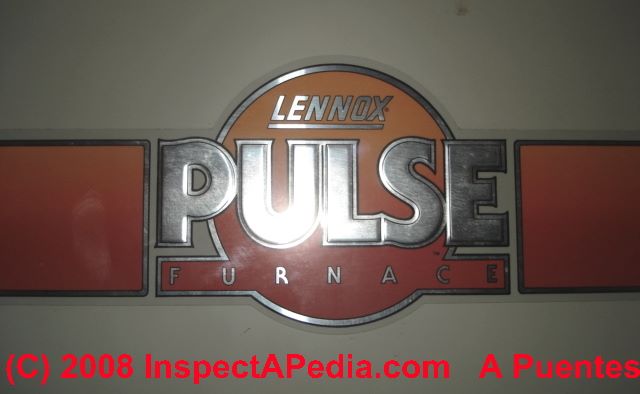 Lennox Pulse 21, Lennox 13GEP,
Lennox G14 Heating Furnace Safety Notices
Lennox Heat Exchanger Inspection & Warranty Program (discontinued)
- POST a QUESTION or COMMENT about the Lennox Pulse furnace warranty & inspection program.
Lennox pulse furnace safety notices:
This document describes carbon monoxide gas (CO) leak safety hazards on certain models of Lennox hot air heating furnaces and announces a Lennox pulse furnace safety inspection and recall/repair program for these systems.
Lennox Industries Inc., the maker of Lennox Pulse furnaces, announced it has set up a free program to inspect Lennox furnaces installed from 1982 to 1989 to check for carbon monoxide leaks or as the company stated: "because of "increased instances of corrosion in some Pulse furnace heat exchangers in units installed before 1990."
Page top photograph courtesy Arlene Puentes.
InspectAPedia tolerates no conflicts of interest. We have no relationship with advertisers, products, or services discussed at this website.
- Daniel Friedman, Publisher/Editor/Author - See WHO ARE WE?
Lennox Furnace Inspection Program and Heat Exchanger Warranty Program
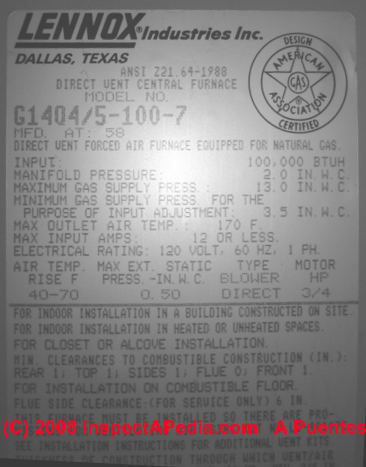 According to Bob Schjerven, president and chief operating officer for Lennox, dealers reported increased instances of corrosion in some Pulse furnace heat exchangers in units installed before 1990.
[Click to enlarge any image]
As part of the inspection program, Lennox will provide a free AIM Safety carbon monoxide detector.
The Lennox company urges owners of Lennox Pulse furnaces installed between 1982 and 1989 to schedule a furnace and safety check with an independent Lennox dealer.
We agree with other writers who've complimented Lennox for making an effort to honor the warranty on these items when other product manufacturers have disappeared or even been misleading about the hazards involved
For an example see Federal Pacific Electric FPE Panel Hazards
However the Lennox pulse combustion furnace safety inspection program does not appear to be in current operation (as of 2010-2012).
How To contact Lennox about a Pulse Furnace Warranty Question
We've seen a string of non-working contact numbers for Lennox, such as 800-537-4341 900-622-8000. Forget these numbers.
To find a Lennox Dealer near you go to http://www.lennox.com/residential/ and enter your zip code in the box at the web page upper right corner.
Contact information details for Lennox Corporation and links to some Lennox heating equipment manuals are provided at LENNOX MANUALS & GUIDES - HVAC.
The Lennox Pulse furnace safety inspection is (or was) free, but if the furnace has to be cleaned in order to be inspected, the customer could be charged for the cleaning.
How to Identify a Lennox Pulse Furnace that May Need a Safety Inspection
Pulse 21 Name on the Furnace Access Door:
To identify a Pulse furnace, look for its name on the door. If the unit is a Pulse 21 furnace, it was manufactured after 1990 and is not part of the inspection program.
For those with Lennox furnaces without the Pulse 21 name,
the next step is to remove the front door and look for the name tag. These tags are usually placed on the inside cabinet wall on the left side of the furnace.
Locate the model number
on the furnace data tag (either G14 or GSR14 followed by a series of numbers and letters) and the serial number on a tag below the name tag. The photo above [courtesy Arlene Puentes] shows a model number starting G14....
Homeowners who call the 800 number with the information will be told if their furnace is eligible for this inspection program.
The original Lennox furnace safety inspection program ran through July 1, 1999.
If the warranted heat exchanger needed replacing, Lennox indicated that the company would provide a new heat exchanger at no cost to the owner. Labor costs for replacement parts are not part of the Pulse furnace warranty.
Owners of Lennox furnaces in this series who discover this fact after July 1, 1999
should still have the furnace heat exchanger inspected for safety, regardless of whether a new heat exchanger will be provided under warranty. A "rusty" heat exchanger, or one which has a rust hole or crack may be unsafe and risks leaks of dangerous, even potentially fatal carbon monoxide (CO) flue gas.
See HEAT EXCHANGER LEAKS for more information about heat exchanger leaks and furnace safety and
see CARBON MONOXIDE GAS TOXICITY for information about carbon monoxide.
Reports of Lennox 13GEP Heat Exchanger Cracks & Failures
Reader Comments on Unsafe Lennox 13GEP furnaces:
We were very sick from it. Do you have a 13GEP model line? Lennox already sent a note on this in Feb 2015. Contact me for more information... newjava456@gmail.com. I am trying to document all this stuff. Basically, 100% of the homes we visited in our neighborhood with 13GEP model line had cracked heat exchangers.
The baffle/Nox unit/screen/turbulator warp and create a flame impingement. I am told Lennox stopped using these aluminum heat exchangers now. We found out from the technicians they had been repairing units without telling the homeowners. And much more. - (May 25, 2018) newjava456@gmail.com said:
Here's a website on the 13GEP's: ncidavid.blogspot.com/2014/10/nox-inserts-and-heat-exchanger-failure.html
And another: www.netsistant.com/mechanics/13GEPmodelline.html
For starters. Bad stuff. And not limited to 13GEP probably.
Reply:
We have read field reports of heat exchanger cracking and carbon monoxide hazards involving the Lennox 13GEPnnnnn series heating furnaces. I have not found details and am still researching the question.
Lennox 13GEP does not appear in Lennox's current product recalls list
I would be grateful to see what note you were sent. Use the page top or bottom CONTACT link to find our email, and perhaps then I can comment further.
The Lennox warranty for the 13GEP series furnaces was for a 5-year period.
I can provide that document if needed.
The links you provided suggest that the 13GEP model line suffers heat exchanger failures and thus would be unsafe.
Lennox 13GEP Heat Exchanger Warranty, Failure, & Inspection Information
- AHRI 2009 GUIDELINE FOR INDUCED DRAFT FURNACE HEAT EXCHANGER INSPECTION [PDF] (2009) Air-Conditioning, Heating, and Refrigeration Institute, Air-Conditioning, Heating, and Refrigeration Institute (AHRI)
2311 Wilson Blvd, Suite 400
Arlington, VA 22201
USA
Canadian office: 2800 Skymark Avenue, Building 1, Suite 201 Mississauga, Ontario L4W 5A6
Chinese office: 888 West Changjiang Road, Hefei, Anhui Province, China, 230031 Phone Number: +86 138 1043 2200 Website: http://www.ahrinet.org/ - retrieved 2018/08/21, - original source: https://mspplumbingheatingair.com/uploads/client/AHRI_Guideline_X_2009.pdf - Lennox Industries, LENNOX QUALITY CARE PROGRAM EQUIPMENT LIMITED WARRANTY [PDF] (2017) Lennox Industries, retrieved 2018/08/21, original source: https://www.lennoxpros.com/docs/Technical/W961L7.pdf
- Lennox Industries, LENNOX PACKAGED GAS/ELECTRIC ROOFTOP UNITS [PDF] (2012) Product Specifications, Lennox Industries, retrieved 2018/08/21, original source: https://surpluscityliquidators.com/images/file.php?file_id=39212
- First reported to Home Inspectors in print media by the ASHI Reporter, September 1997 p23, updated 12 February 2007, May 2008, with substantial edits and additions by D. Friedman, 1997 - present.
- [1] Heat Exchanger & Vent Pipe Test Kit [PDF] Lennox Industries, Dallas TX, retrieved 2/12/2012
- [2] Lennox Corporation, Gas & Oil Furnaces, Lennox Industries, Lennox International 2100 Lake Park Blvd. Richardson, TX 75080, Tel: 1-800-9-LENNOX, retrieved 12/2/2012, original source: lennox.com/products/furnaces/
Re inspect Lennox Pulse Furnaces Every Four Years
Some Lennox installers (and possibly the company too) recommend any Lennox Pulse furnace still in use be pressure tested every 4 years.
This almost never happens and in our opinion a visual inspection or other simpler tests of heat exchanger safety are much less reliable.
Therefore, unless you are provided with pressure test information at the time of a home inspection where a Lennox Pulse Furnace has been installed, you should ALWAYS recommend a pressure test by a Lennox trained technician, and a consultation with the Lennox dealer to determine the status of the warranty of the furnace. [Thanks to Roger Hankey for this tip.]
More details:
Lennox published this Service and Application Notes Feb. 1,2001, re-issued Nov. 3, 2003.
With the supply of replacement heat exchangers exhausted, a new G51MP furnace will be furnished to satisfy the remaining portion of the warranty. Just as the warranty does not cover labor and shipping of the G51MP is not covered.
If the homeowner wishes to upgrade to another Lennox furnace, the homeowner will be responsible for the cost difference between the two furnaces. The dealer is to order the upgrade furnace and will receive credit on the G51MP furnace only. In order to process a warranty claim of this type, the Lennox dealer must complete the attached form and have it signed by the homeowner.
According to Lennox procedure (#503594M, dated 11/97) a Lennox Pulse Furnace heat exchanger pressure test requires the heat exchanger assembly to be first plugged and then pressurized to determine if it can hold 4 psi pressure for 10 minutes. If not the heat exchanger is considered leaky and could be unsafe.
The Original Lennox Pulse Furnace Press Release is given Below
Original appearance at: Pulse Inspection Program Hotline 1-800-537-4341 [OBSOLETE NUMBER}
Lennox Heats Up Call For Consumers To Schedule Furnace Inspections - Sep 10, 1997
(DALLAS) -- Lennox Industries officials said that with cooler temperatures approaching, it is urgent that owners of Lennox Pulse furnaces installed before 1990 have those furnaces inspected.
Lennox, one of North America's leading residential and commercial heating and air conditioning equipment companies, will continue its Pulse furnace inspection program which began in April, 1997 and has already garnered over 25,000 consumer calls. The inspection program is a response to dealer reports of increased instances of corrosion in some Pulse furnace heat exchangers in units installed before 1990.
With all high-efficiency condensing furnaces, a combination of factors -- such as impurities in fuel or combustion air -- can cause corrosion of key components which could lead to potentially dangerous leaks. Furnaces which are inadequately inspected or improperly maintained can develop problems, including the possibility of carbon monoxide leaks that could be fatal.
According to Bob Schjerven, president and chief operating officer for Lennox Industries Inc., "Consumer response to the Pulse furnace inspection program has been terrific, but we need to reach everyone. We're urging all Pulse furnace owners, before they turn their thermostats from cool to heat, to call our 800 number and schedule a furnace inspection and a safety check with an independent Lennox dealer."
With each inspection, trained service technicians will perform the recommended 17-point Pulse furnace service check, conduct a visual inspection, and complete a pressure test of the unit's lifetime warranted heat exchanger. While Lennox is subsidizing participation in the inspection program, there may still be some cost to Pulse owners. Factors such as the location of the furnace, the condition of the furnace, and service unrelated to the inspection will determine the actual cost of the inspection.
If the warranted heat exchanger needs replacing, Lennox will provide a new heat exchanger at no cost to the owner. While labor costs for replacements are generally not part of the Pulse furnace warranty, Lennox will pay a reasonable allowance to the dealer for installation costs as part of this inspection program. There may be some costs to the owner, depending on the area of the country, type of installation, work required by local code requirements, and any other service required not related to the heat exchanger.
For those owners whose pre-1990 Pulse furnace has a heat exchanger which requires replacement, Lennox will provide, through the local independent Lennox dealer and at the owner's option, a $400 rebate on a new Lennox Pulse furnace. The Pulse furnace inspection program runs through July 1, 1999.
Lennox will also provide a free AIM Safety carbon monoxide detector, one of the highest quality detectors available, as part of the inspection program.
"Lennox has long been involved in a consumer carbon monoxide awareness program unrelated to this Pulse furnace inspection," explains Schjerven. "Since currently there is no device on the market that effectively shuts a furnace down if there is a carbon monoxide leak, it is important to install a carbon monoxide detector as a safeguard, in addition to annual maintenance and inspections."
Scheduling inspections: Homeowners can schedule a furnace inspection and safety check with an independent Lennox dealer by calling 1-800-537-4341. For convenience, the 800 number is staffed 24 hours a day, seven days a week. A Pulse furnace can be identified by its name on the door.
To determine whether your Pulse furnace should be inspected under this program:
1. Check for the Pulse name on the door. If the unit is a Pulse 21 furnace, it was manufactured after 1990 and is not part of this inspection program. However, as with all furnaces, annual inspections are still required.
2. Otherwise, remove the front door and look for the product identification stickers. These stickers are usually placed on the inside cabinet wall on the left side of the furnace.
3. Write down the model number that appears on the sticker (either G14 or GSR14, followed by a series of numbers and letters).
4. Write down the serial number on the product identification sticker (four numbers, followed by a letter, then five more numbers).
5. Call 1-800-537-4341 and have the model number and serial number ready.
All Furnaces Need Yearly Inspection
To maintain safety, efficiency, and reliability, Lennox recommends owners have their heating systems inspected at least once a year. The owner can extend the life of the furnace and help stop inefficient combustion and leaks, which could result in serious injuries, by:
1. Inspecting the filter monthly. Dirty filters can cause inefficient operation and could result in premature heat exchanger failure.
2. Watching for leaks and signs of deterioration. If found, call a certified service technician.
3. Insisting on a combustion efficiency test as part of the annual inspection.
Founded in 1895, Lennox Industries Inc. is an international manufacturer of air conditioning and heating equipment for residential and commercial applications. The company markets its products through a network of over 5,000 independent dealers.
Lennox Contact Information, Manuals, Safety Checklist
Contact Information for the Lennox Corporation is listed here
To assure that you have the latest and most accurate service manual or user's manual for your heating equipment we recommend checking with the manufacturer. Contact information for Lennox industries, in Dallas Texas:
Lennox Corporation
2100 Lake Park Blvd.
Richardson, TX 75080
P.O. Box 799900
Dallas, TX 75379-9900
1-800-9-LENNOX (1-800-953-6669)
To find a Lennox Dealer near you go to http://www.lennox.com/residential/ and enter your zip code in the box at the web page upper right corner, OR use the links to Lennox at the left side of this web page (supplied by Google).
To request Lennox product literature, you can also write to Lennox Consumer Affairs, P.O. Box 799900, Dallas, TX 75379 - but primarily the company sends product brochures, not technical manuals, from this contact point.
Free, downloadable Lennox Pulse Furnace User's Manuals and Service Manuals are listed
at MANUALS & PARTS GUIDES - HVAC
Lennox Pulse Furnace Inspection Checklist - 17 Furnace Inspection Safety Inspection Points
Here are seventeen inspection points suggested for Lennox Pulse Furnaces.
If a simple visual inspection of your Lennox pulse furnace (or any other heating appliance) shows evidence of leaks, corrosion, or if the system is making strange noises or odors, call your heating service technician promptly as the equipment could be unsafe.
Be sure that the building has working carbon monoxide detectors properly located and installed, especially where gas-fired heating equipment is in use.
1. Inspect the Lennox pulse furnace combustion air intake and exhaust PVC for condensate leaks and/or joint separations. Repair as necessary.
2. Inspect Lennox pulse furnace air diaphragm flapper material for dirt or deterioration and replace, if necessary. Air flapper material must be replaced every four years regardless of appearance.
3. Inspect Lennox pulse furnace purge blower for dirt build-up every year and clean, as necessary.
4. Inspect Lennox pulse furnace gas flapper material for dirt or deterioration. Replace entire assembly if flapper material is found to be worn.
5.Check the furnace combustion supply air blower wheel and clean, as necessary.
6. Inspect secondary heat exchanger for dirt build-up and clean, as necessary. Blower must be removed to do this check
7. Inspect Lennox pulse furnace heat exchanger assembly for any signs of corrosion or leakage. An air pressure test has been performed on the heat exchanger and exhaust venting system
8. Check all wiring for loose connections on the Lennox pulse furnace. Check for correct voltage.
9. Inspect stainless steel flexible gas connector for corrosion. Remember - Some soaps used for leak testing are corrosive to stainless steel. Failure to thoroughly rinse gas connector after leak check can lead to corrosion.
10. Inspect intake and exhaust pipe terminations to make sure they are free from obstruction.
11. Check the Lennox pulse furnace supply and manifold gas pressure. Adjust pressure, as necessary.
12. Check furnace firing rate by clocking gas meter.
13. Test oxygen/carbon dioxide level of flue gas to determine if proper combustion is taking place. For operating ranges, consult charts provided with testing instrument or unit information manual.
14. Test the Lennox pulse furnace exhaust carbon monoxide levels in flue gas. Level should never exceed 50PPM.
15. Check Lennox pulse furnace operating temperature rise and make sure proper speed is selected to match nameplate rating.
16. Check Lennox pulse furnace fan and limit controls for proper operation and setting.
(Refer to installation instructions)
17. Inspect Lennox pulse furnace condensate lines for free flow of condensate during operation.
...
Reader Comments, Questions & Answers About The Article Above
Below you will find questions and answers previously posted on this page at its page bottom reader comment box.
Reader Q&A - also see RECOMMENDED ARTICLES & FAQs
On 2021-10-04 by janet vandehaar - We have a 1991 Lennox Pulse G14. We have been told to replace it.
We have a pulse G14. We have been told to replace. We purchasd in 1991. We have all paper work. HELP! Janet Vandehaar 319-269-6570 We are the original owners.
On 2021-10-04 by inspectapedia.com.moderator (mod) - replace Lennox pulse G14
@janet vandehaar,
Please see our response below to the reader St. Cronan Church. Contacting Lennox directly for a direct answer is a good first step and we would appreciate hearing what you find out as it will help other readers as well.
Who is telling you to replace? A qualifed repairman or inspector or building authority?As noted, if your furnace dates from the 1990s they are now roughly 30 years old and may need repair or replacement regardless of their recall status. Not a welcome or inexpensive solution to be sure.
On 2021-10-01 by St. Cronan Church
We have a couple of Lennox Pulse model number Lenn-41W-00-1. Our HVAC company is telling us they were recalled back in the 90s and that we need to replace them. I can't find any info in any google searches to back this up. Do you have any info on this model number?
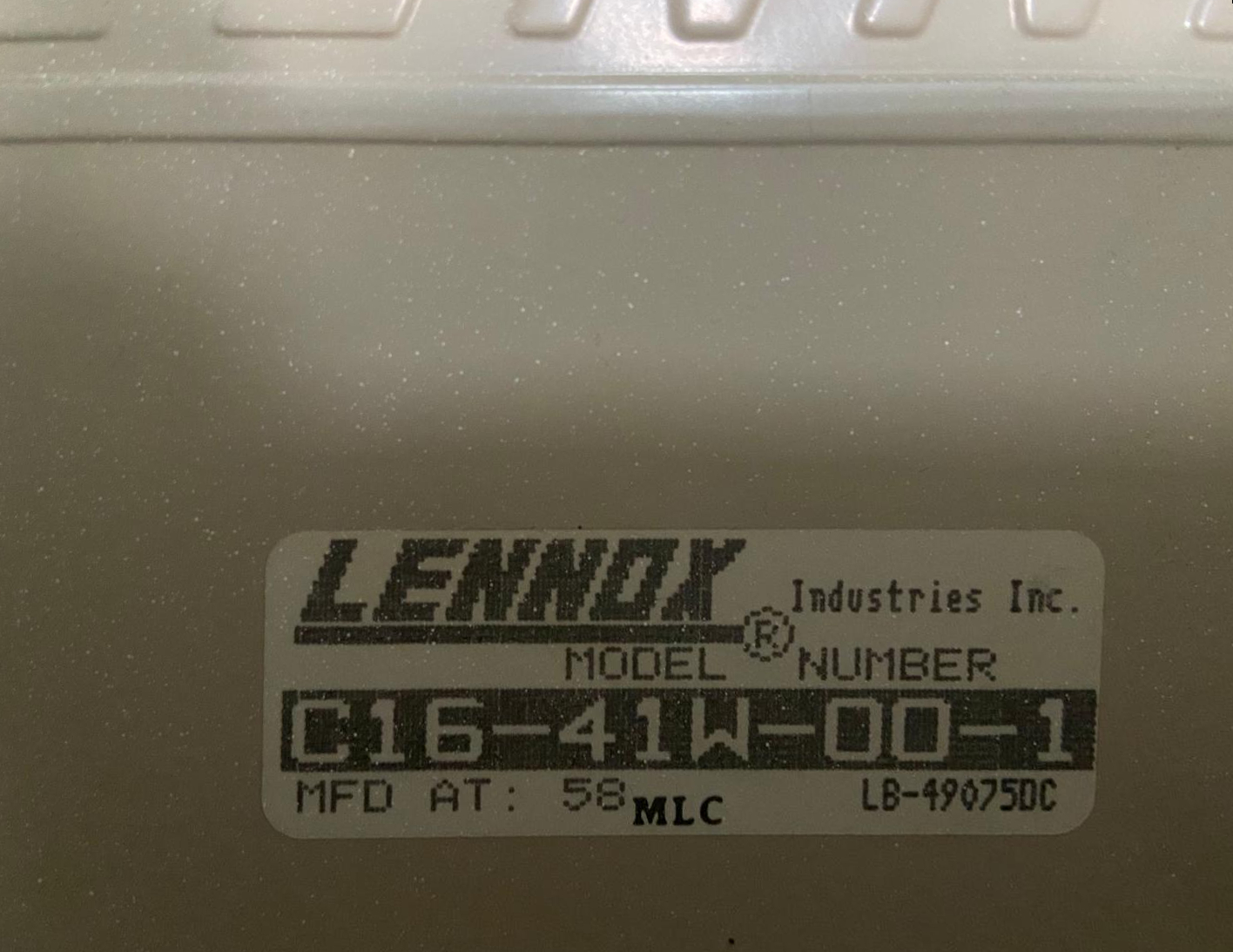
On 2021-10-01 by inspectapedia.com.moderator (mod) - Pulse model number Lenn-41W-00-1 Recall
@St. Cronan Church,
The known Lennox Pulse furnace recall, an important life-safety notice that we give here, pertained specifially to the 1982 and 1989 product line.
If your units were made in the 1990s they were manufactured after that recall.
Lennox provides a "product recall" web page that we found useless: https://www.lennox.com/about/safety
except that it leads to company contact information so that you can, for the most-authoritative answer, ask Lennox directly if there was a recall on your product. The company does not make it easy to find out if there have been Lennox recalls except by direct telephone:
1-800-953-6669 - Give Lennox a call and do let us know what you're told, as that will help other readers.
Following up: if your furnaces date from the 1990s they are now roughly 30 years old and may need repair or replacement regardless of their recall status. For safety it may make sense to at least have the units' heat exchanges inspected and tested for safety, leaks, proper adjustment, venting, and operation (by an expert who knows how to test reliably).
On 2021-06-24 by James Rosson - We think our Lennox Pulse isn't dependable
Whey have a lennox pulse that is broken, it's not a very dependable unit
On 2021-06-24 by inspectapedia.com.moderator (mod)
@James Rosson,
Thank you for the comment.
Watch out: be sure to read the article above: beyond reliability, there are life-safety concerns with this heater and an important consumer safety notice and inspection requirements to avoid a possible fatal carbon monoxide hazard.
On 2021-06-09 by Rod plemmons - How do I know if my Lennox 13 GDP furnace was recalled?
I had my 13 GDP unit installed about 8 years ago how do I know if it's been inspected for the recall or not?
On 2021-06-09 by inspectapedia.com.moderator (mod)
@Rod plemmons,
Thanks that's a good question;
I have not found any standard procedure for recording that a Lennox furnace has been inspected;
But you should
- look at the paper or cardboard service tags (or in some cases a sticker) put onto heating equipment manufacturers when it is inspected or serviced
- look for a note that may be written on or packaged with the service manual for the unit, especially if that documentation is stored nearby such as overhead in a ceiling or atop a foundation wall or in an envelope attached to the side of the furnace
- call your heating service company, if they have been constant over the period, to ask if they have such a record
Some Lennox installers (and possibly the company too) recommend any Lennox Pulse furnace still in use be pressure tested every 4 years. But as we note above, I doubt that this is being done at most buildings.
On 2021-04-22 6 by jh - Heat exchanger leaking on Lennox Pulse 21 furnace
I have a lennox pulse 21 and it has worked great until today.
They tested and said the heat exchange is leaking. And said I need a whole new system. johnh1551@yahoo.com
On 2021-04-23 by (mod)
@jh, well if we're confident that it really is leaking then you will probably find out the cost to replace the heat exchanger that's about the same as the cost to replace the whole unit. So generally for an older furnace he wouldn't do the repair and replace it. That's especially true for this particular model which is known to be on safe.
Watch out: for safety (risk of fatal carbon monoxide poisoning) You shouldn't use the unit in any event you should also have carbon monoxide detectors that are properly installed and tested.
On 2021-04-07 by Carl - My Lennox 1982 G14Q3-80 is still working
Still running a 1982 G14Q3-80. No parts have ever been replaced, except that I put in a new air flapper and gasket every four years. Service company that used to do my pressure test is now out of business. No Lennox dealer will work on it.
A Lennox pressure test kit is hundreds of dollars, so I made my own by looking at the diagrams in the Lennox pressure test instructions.
About $45 dollars for the test gauge setup and another $45 for the two plugs needed for the air intake and exhaust. Now I can pressure test myself every year. Clean the inner and outer exhaust drain plug, keep the dirt out of the purge blower area and the old girl just seems to keep going. I call the exhaust noise "The sound of savings" for nearly 40 years. Sure got my money out of it.
On 2021-04-07 by (mod) - Reader made his own pressure tester for Lennox Pulse Furnace
@Carl, admirable and creative, but remember to
Watch out: you are betting your life and the lives of other building occupants on your DIY procedure; the worry is that we don't know what we don't know about heating system safety and testing.On 2021-04-07 by Carl
Dear Mod,
Thanks for the anticipated warning. Not sure if you have ever worked on a pulse furnace.My "DIY" pressure test instrument is EXACTLY the same as the one in the kit Lennox sells.
The first thing is to pressure test the fittings on the tester to make sure there is no leak there, leading to a false reading.
The next thing is turn off the power and the gas to the furnace.
Remove air flapper and clean hole of any rust or debris.
Fit and tighten rubber plug.
Loosen collar on pvc exhaust and then fit and proper rubber plug in exhaust hole.
Remove gas pipe and gas flapper fitting.
Screw tester into gas fitting.
Pump up pressure to 4lbs and replace cap on air fitting. Monitor air gauge to see if pressure hold for 10 minutes.
If it does, test is passed and furnace good for another year. If it does not, check for air leaks at plugs and where tester screws into gas input.
If no leaks there, then the heat exchanger is leaking and MUST BE REPLACED!
If the heat exchanger holds 4lbs of air pressure for 10 minutes, it is NOT LEAKING and is good for another year.
There is no way for a bad heat exchanger to pass the test.
The worst that can happen is failing a furnace that is really perfectly good. All the pressure switch, electrical tests, etc.. that Lennox recommends are outside of the recall for bad welds on some heat exchangers that could leak carbon monoxide.
The real danger is not pressure testing as a DIY, but not pressure testing and continuing to use the furnace, relying on just CO detectors to protect the house.
Anyway, thanks for the reply and I hope you understand that my response is just a respectful disagreement with your warning and some detailed info that others might value.On 2021-04-10 by (mod) - DIY testing of heating system safety can be dangerous
@Carl,
Thank you for those added details.
Indeed back in the dark ages I installed and serviced heating equipment, along with a business partner, as American Home Service Co., but it was in fact before the Lennox Pulse furnace safety notification program.
I agree that a skilled and careful person might build and use a test device safely, but I also am obligated to warn other readers that for most homeowners, building inspectors, and many service people who lack the training and skills, such a step could be a dangerous plan that could end up killing someone.
It would be nice to see some photos of your equipment and its use (one photo per comment) and to include those here.Watch out: you give dangerous advice when you state "The worst that can happen is failing a furnace that is really perfectly good."
That's not so.
The worst thing that can happen is to give advice that kills people. That would include declaring a heating device as safe when in fact it is not. That's why it's best for most building owners to have their heating system checked by a qualified, experienced, trained heating service technician.
On 2021-02-19 by Linda Williams - My Lennox furnace is one that was recalled: it "died"
My Lenox is under the recall and it died.
On 2021-02-19 - by (mod) -
Linda
Thank you for the field report of the failure of a Lennox Pulse furnace.
On 2020-11-11 by Concerned - Is the Lennox Pulse 21 from 1988 still under warranty?
Have a Lennox Pulse 21 furnace from 1988. Is there still any warranty with this furnace ? Had a technician come look at it as is no longer heating was told nothing could be done to repair to get in in working order? Please advise.
On 2020-11-15 - by (mod) - NO
No, Concerned.
On 2020-11-02 by A Y - How many lennox pulses built after 1994 still exist
How many lennox pulses built after 1994 still exist
On 2020-11-02 - by (mod) -
A
Thanks, that's an interesting question; I have not been able to find the number of Lennox Pulse Furnaces still in use; I doubt that it has got to zero, however.
On 2020-10-31 by Cj - Is there still an active Lennox Pulse Furnace recall or warranty program?
Do the Lennox pulse warranties or recall still exist
On 2020-10-31 - by (mod) - NO
Not as a recall.
The Lennox company urges owners of Lennox Pulse furnaces installed between 1982 and 1989 to schedule a furnace and safety check with an independent Lennox dealer.
...
Continue reading at HEAT EXCHANGER LEAK TEST or select a topic from the closely-related articles below, or see the complete ARTICLE INDEX.
Or see Lennox PULSE FURNACE SAFETY FAQs - questions & answers posted originally at this page
Or see these
Recommended Articles
- CARBON MONOXIDE WARNINGS
- Goodman Furnace High Temperature Plastic Vent HTPV safety recall [PDF] US CPSC notice
- HEAT EXCHANGER LEAK TEST
- LENNOX HVAC MANUALS & PARTS GUIDES
- Lennox PULSE FURNACE SAFETY WARNING
- SAFETY, HEATING INSPECTION
- SAFETY RECALLS CHIMNEYS VENTS HEATERS
Suggested citation for this web page
Lennox PULSE FURNACE SAFETY WARNING at InspectApedia.com - online encyclopedia of building & environmental inspection, testing, diagnosis, repair, & problem prevention advice.
Or see this
INDEX to RELATED ARTICLES: ARTICLE INDEX to HEATING FURNACES
Or use the SEARCH BOX found below to Ask a Question or Search InspectApedia
Ask a Question or Search InspectApedia
Try the search box just below, or if you prefer, post a question or comment in the Comments box below and we will respond promptly.
Search the InspectApedia website
Note: appearance of your Comment below may be delayed: if your comment contains an image, photograph, web link, or text that looks to the software as if it might be a web link, your posting will appear after it has been approved by a moderator. Apologies for the delay.
Only one image can be added per comment but you can post as many comments, and therefore images, as you like.
You will not receive a notification when a response to your question has been posted.
Please bookmark this page to make it easy for you to check back for our response.
IF above you see "Comment Form is loading comments..." then COMMENT BOX - countable.ca / bawkbox.com IS NOT WORKING.
In any case you are welcome to send an email directly to us at InspectApedia.com at editor@inspectApedia.com
We'll reply to you directly. Please help us help you by noting, in your email, the URL of the InspectApedia page where you wanted to comment.
Citations & References
In addition to any citations in the article above, a full list is available on request.
- [10] Arlene Puentes is a licensed home inspector, past chapter president of the Hudson Valley chapter of the American Society of Home Inspectors, an educator, and building failures researcher in Kingston, NY who can be reached at ap@octoberhome.htm or at 845-339-7984.
- [11] Roger Hankey is principal of Hankey and Brown home inspectors, Eden Prairie, MN. Mr. Hankey is a past chairman of the ASHI Technical Committee and the ASHI Standards Committee. Mr. Hankey serves as co-chairman of ASHI legislative committee, and has served in other ASHI professional and leadership roles. Contact: 952 829-0044 - hankeybrown@comcast.net
- In addition to citations & references found in this article, see the research citations given at the end of the related articles found at our suggested
CONTINUE READING or RECOMMENDED ARTICLES.
- Carson, Dunlop & Associates Ltd., 120 Carlton Street Suite 407, Toronto ON M5A 4K2. Tel: (416) 964-9415 1-800-268-7070 Email: info@carsondunlop.com. Alan Carson is a past president of ASHI, the American Society of Home Inspectors.
Thanks to Alan Carson and Bob Dunlop, for permission for InspectAPedia to use text excerpts from The HOME REFERENCE BOOK - the Encyclopedia of Homes and to use illustrations from The ILLUSTRATED HOME .
Carson Dunlop Associates provides extensive home inspection education and report writing material. In gratitude we provide links to tsome Carson Dunlop Associates products and services.
 | HOME | ABOUT | ASK a QUESTION | CONTACT | CONTENT USE POLICY | DESCRIPTION | POLICIES | PRIVACY | |
| © 2025 - 1985 Publisher InspectApedia.com - Daniel Friedman | |||||||||