
InspectAPedia® FREE Encyclopedia of Building & Environmental Construction, Diagnosis, Maintenance & Repair |
Question? Just ask us! InspectAPedia
|
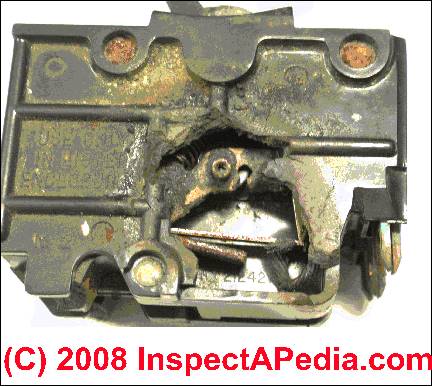 Federal Pacific Electric (FPE) Stab-Lok® Electrical Hazards Summary
- POST a QUESTION or COMMENT about the FPE Stab-Lok® hazard and what to do about a Federal Pacific Electric Stab Lok electrical panel or circuit breaker in your home, condominium, apartment, or business
This article summarizes the safety issues concerning Federal Pacific Electric FPE Stab-Lok® electrical panels and circuit breakers.
This website explains the fire and shock hazards associated with Federal Pacific Electric Stab-Lok® circuit breakers and service panels, provides a history of the issue, recounts research on FPE failures, and recommends replacement of the panels.
Replacement FPE Stab-Lok® circuit breakers are unlikely to reduce the failure risk of this equipment. We recommend that residential FPE Stab-Lok® electrical panels be replaced entirely or the entire panel bus assembly be replaced, regardless of FPE model number or FPE year of manufacture. We do not sell circuit breakers nor any other products.
InspectAPedia tolerates no conflicts of interest. We have no relationship with advertisers, products, or services discussed at this website.
- Daniel Friedman, Publisher/Editor/Author - See WHO ARE WE?
A Summary of the Problem: Federal Pacific Stab-Lok® ® Electric Panel and Circuit Breaker Hazards
Three thousand FPE type breakers tested to date (2018): the statistical certainty of conclusions drawn from the data is very high. These breakers have a significantly-high rate of failure to perform safely.
Details are at CIRCUIT BREAKER FAILURE RATES and also
Readers are welcome to make and distribute printed copies of our articles about FPE Stab-Lok® equipment provided the web page address is cited and provided that the content is not edited or changed. Electronic copies and reproduction of this information at other websites are prohibited.
- In 2002, in a class action lawsuit in New Jersey, the Court ruled that over many years FPE had violated the NY Consumer Fraud Act. Specifically, the court found that "... FPE knowingly and purposefully distributed circuit breakers which were not tested to meet UL standards as indicated on their label. This constitutes an unlawful practice proscribed by the Act."[1]
The court's decision, which was based on extensive evidence that included FPE's own documents, confirmed long-standing allegations of FPE's fraudulent testing practices. [2] - Due to FPE's fraudulent testing and falsified UL labeling, defective FPE Stab-Loc circuit breakers were installed in millions of residences throughout the United States. Recent tests on more than 500 Stab-Lok® breakers from homes across the country show defective performance for about 1/3 of the two-pole FPE Stab-Loc circuit breakers and about 1/5 of the single-pole FPE Stab-Loc circuit breakers. [3]
- Because of the proven high defect rate, the FPE Stab-Loc breakers that are presently installed in homes do not provide the circuit protection that is required by applicable codes and standards (NEC and UL). This constitutes an increased risk of fire and injury. [4]
- There is no practical way that a licensed electrician, inspector, or engineer can determine which breakers in a given electrical panel are seriously defective internally. The only way to do that is by means of functional and life test procedures that they are not trained to do nor equipped to perform.
- Given these facts, FPE Stab-Lok® electrical panels and circuit breakers should be considered an un-due fire and injury risk and we recommend that the equipment be replaced.
Details are summarized below, and are provided at length at the FPE Stab-Lok® HAZARDS & REPAIRS WEBSITE. Text above based on correspondence from J. Aronstein. [5]
FPE Stab-Lok® ® Circuit Breakers Fail to Trip
High failure rate:
The central safety defect in FPE Stab-Lok® (R) electrical equipment is that FPE Stab-Lok® (R) circuit breakers fail to trip under overload or short-circuit conditions, at a failure rate much higher than comparable equipment made by other producers.
This failure to trip occurs up to 80% of the time when the breakers are called-on to trip, depending on the individual breaker type and ampacity. We have found no data indicating that circuit breakers from other manufacturers fail at anywhere near this high rate.
Risk of fire or injury:
When an overload or short circuit occurs in an electrical device, say an electric clothes dryer, the circuit supplying electricity to the device is supposed to be interrupted, electrical power cut off, by either a fuse or a circuit breaker. This interruption of electrical power is intended to minimize the resulting fire hazard of electrical overloads or short circuits.
A circuit breaker that fails to trip is unsafe fails to protect the electrical circuit and the building and building occupants where that circuit breaker is installed. This can lead to fire, property loss, and injury or worse.
[PDF] Information for Homeowners, Inspectors, and Electricians (Updated November 10, 2017) describes independent research explaining the hazards involved with FPE Stab-Lok® electrical panels and includes a link to the most-current and easily-printable .pdf version of that document.
FPE Stab-Lok® ® Circuit Breakers Are a Latent Safety Hazard
A "latent safety hazard"
means that the product itself does not initiate the unsafe condition. Rather, when the unsafe condition occurs (as just described above), the product, in this case an FPE Stab-Lok® (R) circuit breaker, which is intended to interrupt electrical power, fails to do its job.
An impartial review of documentation regarding this issue, and discussions of the issue with forensic experts in the field, make clear that a latent hazard exists where FPE Stab-Lok® circuit breakers continue in use. The hazard is worst for double-pole breakers. Published reports of actual tests that were performed indicate that under certain conditions it is possible for one leg of these circuits to attempt to trip the breaker, resulting in a jammed breaker which will afterward not trip under any load condition.
An FPE Stab-Lok® Electrical Panel Should Be Replaced, not "Inspected by an Electrician" and not "Tested"
Having the FPE Stab-Lok® panel evaluated by an electrician
is unfortunately of absolutely no value. A visual inspection can not predict whether a circuit breaker is going to jam on the next occurrence of an overcurrent or short circuit. While a visual might pick up evidence of a previously burned circuit breaker or panel bus connection, the absence of such evidence is not any assurance whatsoever that the panel is safe.
There is no practical way that a licensed electrician, inspector, or engineer can determine which breakers in a given panel are seriously defective internally. The only way to do that is by means of functional and life test procedures that they are not trained to do nor equipped to perform. -- Aronstein
Having the FPE Stab-Lok® panel "tested" by an electrician is dangerous.
For example, placing an overcurrent on an electrical circuit in the building could cause a fire to occur.
Further, placing an overcurrent on a circuit "protected" by an FPE Stab-Lok® circuit breaker may actually increase the chances that the circuit breaker will fail to trip in the future, even if it appears to work when tested. Aronstein's research showed a dramatic increase in the jam-up and failure rate in these circuit breakers after they had been exposed to a first "event" such as an over-current.
But Up to Now the Electrical Panel has Never Shown a Problem!
A statement by a building owner or occupant that no problem has been observed
in a particular FPE Stab-Lok® panel is absolutely no assurance that the panel is safe. It may simply be the case that the building has not experienced an over-current or short circuit on an electrical circuit.
Or an overcurrent may have occurred, tripped a breaker, but in doing so, increased the chance that next time the same breaker will fail to trip.
It would be dangerous for a building seller, for example, to warrant the future safety of an electrical panel in the building s/he is selling.
It would be dangerous for a building buyer to rely on the claim by a seller, real estate agent, or electrician that an FPE Stab-Lok® electrical panel is "safe" since all independent research indicates that they are mistaken.
Bottom line on FPE: If it's an FPE Stab-Lok® electrical panel, it should be replaced, period.
Financial Assistance for Replacement of Electrical Panels
In general, financial aid is not available: Except for an almost-worthless class action settlement that affected some New Jersey homeowners, there is no financial relief offered by FPE nor by its successors to homeowners or home buyers for the replacement of these panels.
In some communities there may be generic financial aid for home repairs to elderly homeowners or to homeowners of limited financial means, such as the Christmas in April program or financial aid to seniors programs - check with your local city, town, county, or state financial aid offices.
Some electricians may offer discounted services to seniors or to others of modest means. Ask your electrician.
Panel replacement choices can save some money: FPE REPLACEMENT PANELS contains some panel-replacement suggestions that can in some cases save a portion of the replacement cost.
How Did These Unsafe FPE Stab-Lok® (R) Circuit Breakers Get Into Homes?
"In a class-action lawsuit against FPE/Reliance in New Jersey, the Court found that Federal Pacific Electric Co. (FPE) committed fraud by representing that their FPE Stab-Lok® (R) circuit breakers met the applicable (UL) standard test requirements when in fact they did not.
The Court's finding of fraud, published in 2005, indicates that FPE cheated on the tests that were required to obtain UL listings.
The company improperly applied UL labels to circuit breakers that could not and did not meet the UL requirements. FPE covered up the defective performance of the circuit breakers by a long-standing practice of fraudulent testing.
The Court's finding helps resolve the question as to how the defective breakers got into the marketplace and into homes." -- 2007 FPE Stab-Lok® TECHNICAL REPORT, p.1, Dr. Jess Aronstein [available at this website].
Why Do Some People Say There is no FPE Stab-Lok® (R) Hazard?
Most Circuit Breakers Are Never Called-on to Trip
In a home or on a circuit that has never been used, or has never experienced an overcurrent or short circuit, an unsafe breaker that would not trip when it should, will look just fine. That's because the circuit breaker has never been required to trip off.
As Aronstein points out, the performance of such an electrical circuit would look equally fine if there were no circuit breaker installed at all, since it has never needed to be interrupted. Does that mean such an electrical circuit is safe and that it is protected as intended? No.
Companies, Attorneys, Realtors, Home Sellers, Home Buyers with Conflicting Interests
A home owner who intends to continue living in a home, or someone buying a new home, has a great interest in assuring that the home's electrical system is properly protected and safe, as does their insurance company.
However in some circumstances such as wanting to push through the sale of a home without incident, or wishing to avoid admitting potential liability, or perhaps out of lack of accurate information, some people may still assert that this well-documented safety concern does not exist.
Some insurance companies now require that their policy holders replace FPE Stab-Lok® (R) equipment in the home before they will issue homeowners insurance for the property.
Has There Been a U.S. Government, CPSC, or Manufacture's Product Recall for FPE Stab-Lok® (R) Electrical Equipment?
No, not in the U.S. for FPE Stab-Lok® ® equipment. However some versions of the sister product sold Canada under the label Federal Pioneer, were recalled.
Did the CPSC Say There Was No Problem with FPE Stab-Lok® (R) Equipment?
No. A careful reading of the CPSC press release of March 3, 1984 suggests that the authors were careful NOT to conclude that there is no hazard, but simply that the information at hand did not prove the hazard [at that time], and that the Commission did not have funds to pursue testing.
In that 1983 document, the representation that no real hazard exists is made by the manufacturer of the device - not exactly a neutral party, and even that wording is cautious in tone: "FPE breakers will trip reliably at most overload levels." Readers should see the failure rates cited in Aronstein's updated 2007 Report and in the IAEI letter available at this website.
According to reports we've received from the field, a hasty reader or someone with conflicting interests, sometimes infers from the CPSC 1983 press release concerning FPE Stab-Lok® (R) equipment that the manufacturer and some Commission members were of the opinion that conditions producing FPE Stab-Lok® (R) incidents and failures would not occur in the field.
This is an erroneous conclusion. Some very common household appliances operate are powered by a two-pole 240V circuit (protected by the type of breaker under discussion) but use two or more independent 120V sub-circuits inside the appliance.
Two obvious cases are electric clothes dryers and ranges. If, for example, the low-heat (110V) heater in a dryer were to short to the dryer case, a serious overcurrent would occur on one "leg" of the circuit.
Another wiring practice, using a single two-pole breaker to power a split circuit which uses a shared neutral, such as may be installed in kitchens in some areas, is nearly certain to have each leg of the circuit loaded independently and thus subject to single-leg overloading and subsequent breaker jamming. A breaker which jams and then fails to trip under this condition is, in my opinion, a serious fire hazard.
So Is There an FPE Stab-Lok® (R) Safety Problem or Not?
Yes. Current research now confirms the safety hazards of FPE Stab-Lok® (R) equipment and documents its failure rates.
Using a larger pool of FPE Stab-Lok® circuit breakers than the older CPSC and Wright Malta tests found significantly higher failure rates of FPE Stab-Lok® circuit breakers, including a look at critical safety failures (breaker failed to trip at 200% of rated current or jammed) which found:
- 80% failure rate for FPE Stab-Lok® GFCI circuit breakers (n=4)
- 12% failure rate for double pole FPE Stab-Lok® circuit breakers (n=120)
- 1% failure rate for FPE Stab-Lok® single pole circuit breakers (n=345)
[The significance of these numbers can be understood more clearly if you consider that the typical failure-to-trip rate for circuit breakers in residential electrical panels is a small fraction of one percent.
For the latest update and reporting on a still larger number of FPE circuit breaker tests, see
2024 final report - HAZARDOUS FPE CIRCUIT BREAKERS AND PANELS - 2024 [PDF] independent research article by Jess Aronstein, supercedes older FPE / FP hazard reports by this author.
FPE Stab-Lok® ® Equipment Means Latent Fire Hazards
It's the exceptions that cause fires. An FPE circuit breaker will appear to "work just fine" in passing along current to the circuit it feeds, until there is an overcurrent, short circuit, or similar condition. When those exceptional conditions occur, this equipment fails to protect the circuit and the building from overheating and fires, in some cases at a failure rate around 60% of the time.
I estimate that the normal industry failure rate on circuit breakers is less than .01%.
Consumers should read and follow the Commission's advice regarding circuit breakers. But this advice is insufficient. The Commission's admonition to avoid overloading circuits and to turn off and have examined devices which seem to be creating a problem is a poor substitute for reliable, automatic, overcurrent protection.
It is precisely because dangerous conditions can and do occur without adequate recognition and action by a consumer that circuit breakers and fuses are installed to provide overcurrent protection in the first place.
Therefore it is hardly an adequate "fix" for FPE breakers to just tell consumers to handle these cases manually.
It is possible that some breakers may perform with adequate reliability, possibly those manufactured after the companies discovered safety defects and improper practices in listing the product, and possibly some of those manufactured in Canada (certainly not all Canadian Federal Pioneer breakers, since there was a Canadian recall).
In absence of an explicit statement from a manufacturer and/or the US CPSC indicating that newer stock equipment is defect free, and considering that defects occur in both breakers and the panels themselves, and finally, that testing showed failures in both in-use equipment and new off-the-shelf devices, my advice to consumers and electricians is that these panels be replaced with newer equipment, particularly those which use 240-volt double-pole breakers described in the literature.
A home inspector, electrical inspector, building inspector, electrician, or contractor who makes any warranty of safety, by virtue of his/her position close to the consumer, is certain bear this very liability.
...
Reader Comments, Questions & Answers About The Article Above
Below you will find questions and answers previously posted on this page at its page bottom reader comment box.
Reader Q&A - also see RECOMMENDED ARTICLES & FAQs
On 2019-06-24 by Jacob - Did FPE lose their UL listing or not? Just say yes or no!
Let me ask again a simple question. Did FPE lose their UL listing or not?
That is my question.
Don't need all the other info.
Just a simple yes or no.
On 2022-06-22 by InspectApedia-911 (mod) - Did FPE lose their UL listing or not? -- YES.
@Jacob,
Now that I answered your yes or no question with a yes, I implore you to take the trouble to read just a tiny bit more.
By a quick use of the InspectApedia.com online search box you on any of our pages, searching to find the phrase
FPE lost their listing
gives you, on this page:
FPE STAB-LOK HISTORY
This note
1982: 31 March 1982: Reliance Electric Financial Statements acknowledge that FPE previously obtained UL Listings by fraudulent means and that at "some point thereafter, lost their UL listing."
Easy wasn't it?
Watch out: insisting on an answer to what you might characterize as a "simple question" that you, inexpert, phrase, perhaps with an un-stated ulterior motive in mind, you could be putting someone at risk of fire or injury or death.
Focusing on whether or not FPE lost their listing is focusing on angels dancing on the head of a pin while homes burn or wires fry. It is a fundamental mistake to think that every unsafe product is recalled or that every fire hazard product gets recalled. That just doesn't happen, even when it should have, and for a myriad of reasons.It's as risky as insisting that because we have a police department in Poughkeepsie, there are never any robberies.
And that's before you even begin to understand the UL Listing requirements such as UL 486 that allow the manufacturer to conduct their own testing and report the results to UL or other listing agencies.
Had you read the history you'd also know that FPE obtained their listing by fraudulent means, incuding a fake test bed that included a hidden override button that allowed their demonstrator to "force" a breaker to trip at extreme overcurrent if, when a UL supervisor came to the site, the breaker didn't trip at the overcurrent at which it should have.
So while I understand that you might not want to read a whole encyclopedia to find out if a product is safe or not, let's be a little more careful about taking time to understand these electrical hazards.Also see FPE FRAUD - PRESS RELEASE
Also see FPE EXXON SCANDAL ARTICLE - public documents confirm that FPE lost their UL listing when deceptive testing and labeling of breakers was discovered
or go right to these document images
- Image126.gif - Reliance Electric (Federal Pacific Stab-Lok® ) Quarterly Report March 31, 1982, page 5 - Reports improper practices
- Image127.gif - Reliance Electric (Federal Pacific Stab-Lok® ) Quarterly Report March 31, 1982, page 6. - Reports improper practices
- Image128.gif - Reliance Electric (Federal Pacific Stab-Lok® ) Quarterly Report March 31, 1982, page 7. - Reports improper practices
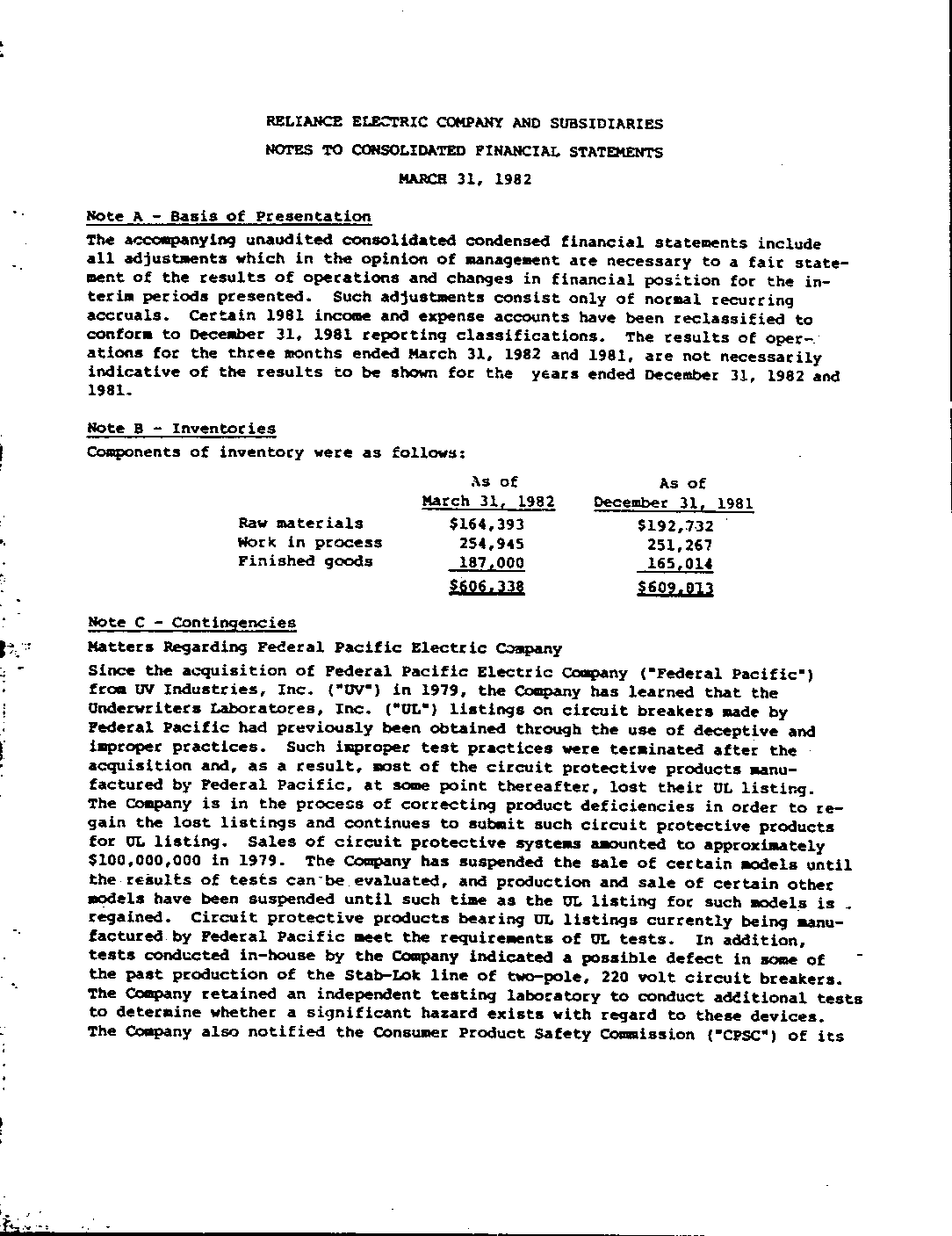
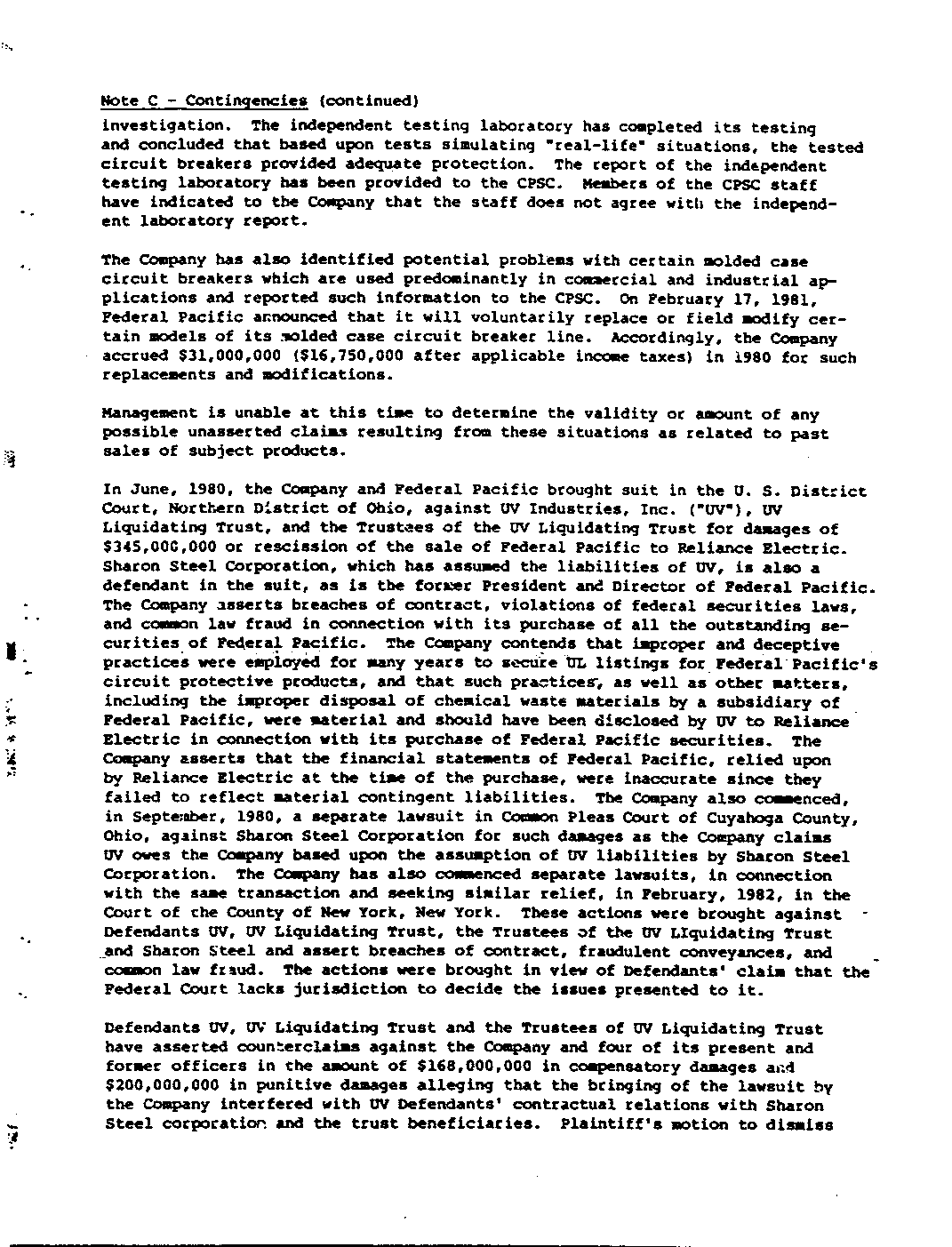
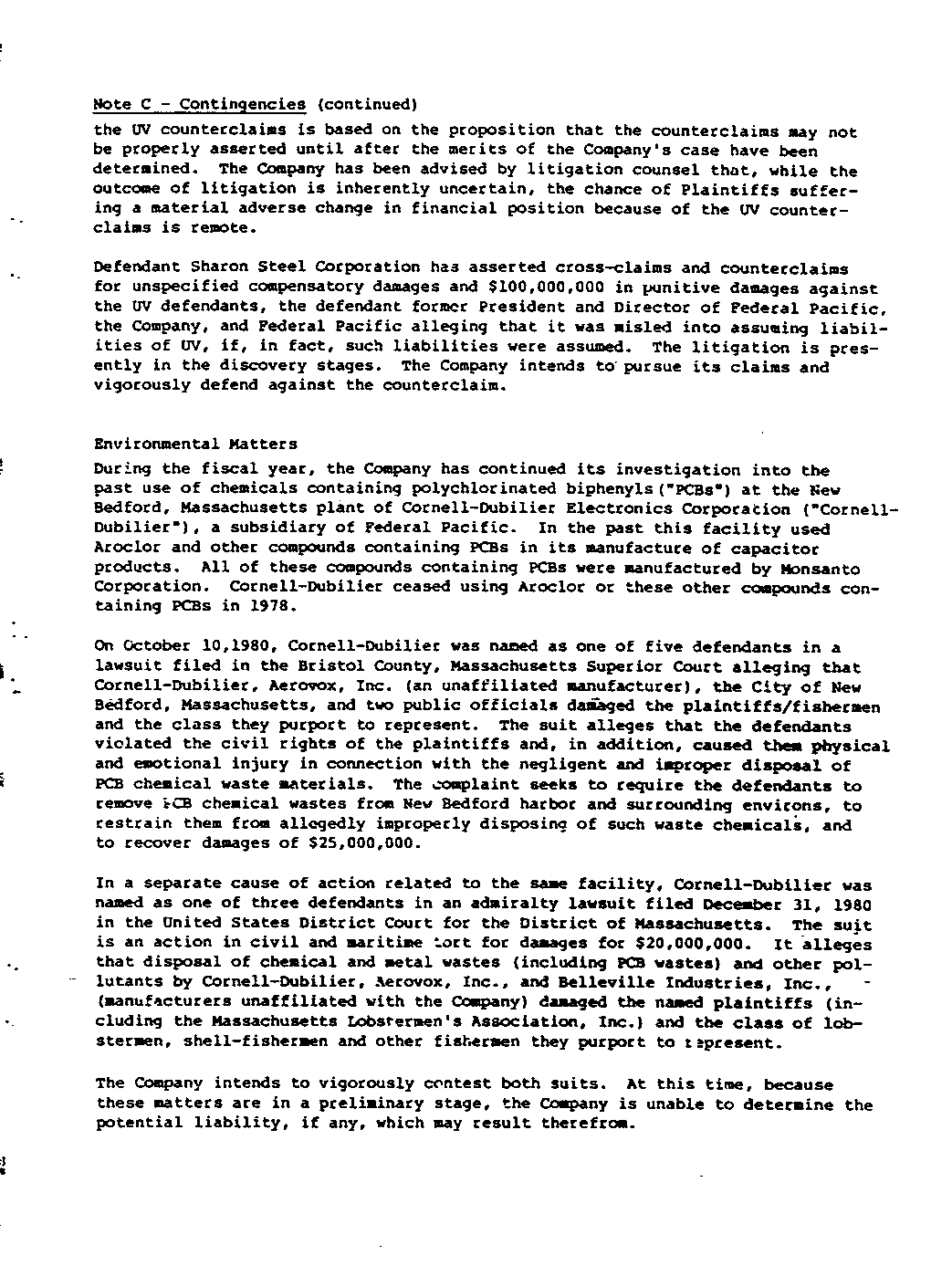
Thanks for the question.
On 2018-07-16 by Pete - any negative reports of the FPE 150 amp Main disconnect switch?
Are there any negative reports of the FPE 150 amp Main disconnect switch? The panel in my house has already been changed out, but I have yet to find any documentation about the Main switch outside.
On 2018-07-16 by (mod)
@Pete:
Unfortunately the failures found in FPE Stab-Lok breakers extend across the full range of breakers by amps and type, though the most-severe no-trip rates occur on the double pole breakers like your 150A FPE main breaker.
An electrician once opined to me that if there was ANY circuit breaker that he darn sure wanted to be able to count-on it was the main, because if there was that much overcurrent at the panel a building fire was unquestionably about to start.
(Oct 11, 2011) nancy said: sorry to find I have two Stab-lok breaker boxes in the basement
Thank you for this information. I was sorry to find that I have not one, but two Stab-Lok breaker boxes in the basement. I guess I'm going to have to get them replaced, and I will feel a lot safer when I do. I especially appreciate the amount of well-sourced factual info and the extensive links you provided.
(Nov 5, 2011) ray said:
I moved into this house in 1985, and had the power panel upgrade from the old fuse panel to circuit breakers, the electrician installed a federal pacific panel, fortunately we have never had a problem but I just wonder if the problem with these units was known back then? looks like I will be removing and replaceing this one soon.
(Jan 27, 2014) Anonymous said:
I am a Licensed and Insured Master electrician, in the trade for over 30 years and learned from other master electricians who all immediately won't even touch a job with that panel in the home, due to the inherent risk. Just explain to customer the facts and point them to unbiased research that helps explain it intelligently to them.
30 something years later and I am still explaining to customers that I don't work with Federal Pacific Panels.
The comment at the end of the ABC Video that attributes 2,000 house fires a year to Federal Pacific panels is scary when you combine the fact they have been used since the 1950's. Crazy.
Thanks again for the comprehensive research and now I have a place to send customers to get the facts for themselves. Thanks. Bill E.
Reply:
Anon,
Thank you for your comment. Naturally opinions from professionals working in the field are important and helpful for other readers.
I agree completely that one should offer a calm, informed explanation. Scaring people exposes them to folks who will take advantage of fear and who may not even perform proper work. (Those two seem to go together).
You are welcome to make printed copies of this page (or printed copies of any InspectAPedia pages) to give to consumers for their information.
And we would much welcome comments, questions, critique.
Daniel
Reader question/comment: Are all FPE panels considered Stab-Lok?
(Feb 12, 2014) Pat said:
Are all FPE panels considered Stab-Lok? I inspected a home with an FPE panel, but did not see the words Stab-Lok.
Reply: yes if they are circuit breakers; fuses OK.
hanks for the question, Pat. The simple answer is yes. The product line was made over many years and had a variety of labels.
You can see these in our article series
...
Continue reading at FPE HAZARD ARTICLES, STUDIES or select a topic from the closely-related articles below, or see the complete ARTICLE INDEX.
Or see these
Recommended Articles
- FPE EXXON SCANDAL ARTICLE - public documents confirm that FPE lost their UL listing when deceptive testing and labeling of breakers was discovered
- FEDERAL PACIFIC FPE HAZARDS - home
- FEDERAL PACIFIC ELECTRIC HAZARD SUMMARY - suitable for printing and available for copying at other websites
- HAZARDOUS FPE CIRCUIT BREAKERS AND PANELS - 2024 [PDF] Final Report - independent research article by Jess Aronstein, supercedes older FPE hazard reports by this author.
- FPE-INFO.ORG - a non-commercial site dedicated to electrical & fire safety, posted by Jess Aronstein
Suggested citation for this web page
FPE HAZARD SUMMARY at InspectApedia.com - online encyclopedia of building & environmental inspection, testing, diagnosis, repair, & problem prevention advice.
Or see this
INDEX to RELATED ARTICLES: ARTICLE INDEX to FPE STAB-LOK BREAKERS & PANELS
Or use the SEARCH BOX found below to Ask a Question or Search InspectApedia
Ask a Question or Search InspectApedia
Questions & answers or comments about the FPE Stab-Lok® hazard and what to do about a Federal Pacific Electric Stab Lok electrical panel or circuit breaker in your home, condominium, apartment, or business.
Try the search box just below, or if you prefer, post a question or comment in the Comments box below and we will respond promptly.
Search the InspectApedia website
Note: appearance of your Comment below may be delayed: if your comment contains an image, photograph, web link, or text that looks to the software as if it might be a web link, your posting will appear after it has been approved by a moderator. Apologies for the delay.
Only one image can be added per comment but you can post as many comments, and therefore images, as you like.
You will not receive a notification when a response to your question has been posted.
Please bookmark this page to make it easy for you to check back for our response.
IF above you see "Comment Form is loading comments..." then COMMENT BOX - countable.ca / bawkbox.com IS NOT WORKING.
In any case you are welcome to send an email directly to us at InspectApedia.com at editor@inspectApedia.com
We'll reply to you directly. Please help us help you by noting, in your email, the URL of the InspectApedia page where you wanted to comment.
Citations & References
In addition to any citations in the article above, a full list is available on request.
- Note: as we didn't add this reviewers list until 2007, this list of technical reviewers is incomplete; we have received comments and suggestions regarding this topic, edits and remarks included, from engineers and management from the US CPSC, electricians (many listed at our page on field reports of FPE failures), home inspectors, licensed electricians, and electrical engineers, and even a few attorneys and real estate agents, since 1986. Technical review, critique, content suggestions, questions, or clarifications are invited and where a contributor wishes, credit and links will be provided to that source. Contact us to provide feedback.
- Dr. Jess Aronstein, electrical engineer, Poughkeepsie, NY, forensic engineering services, independent laboratory testing for various agencies including the U.S. Consumer Product Safety Commission.
- Alan Carson, Carson Dunlop Associates, Toronto, Ontario. Mr. Carson is a home inspection professional, educator, researcher, writer, and a principal of Carson Dunlop Associates, a Toronto home inspection and education firm. Mr. Carson is a past president of ASHI, the American Society of Home Inspectors
- Mark Cramer Inspection Services Mark Cramer, Tampa Florida, Mr. Cramer is a past president of ASHI, the American Society of Home Inspectors and is a Florida home inspector and home inspection educator.
- Carl Grasso, Esq., Herzfeld & Rubin, New York, NY. Mr. Grasso is an attorney who managed a plaintiff's class action litigation against Federal Pacific Electric in New Jersey.
- William King, US CPSC Director of Electrical Engineering (Ret).
- Licensed Electricians: FPE FAILURE FIRE PHOTOS includes electricians who have provided cases and photographs of field failures of FPE equipment at this website.
- Homeowners, Home Inspectors, Electricians: FPE FAILURE FIELD REPORTS includes anecdotal field reports provided by a range of contributors including electricians (and some home owners or home inspectors) who have provided cases and photographs of field failures of FPE equipment at this website.
- [1] Partial Summary Judgment decision dated 8/15/2002 by Judge Bryan D. Garruto, J.S.C., Superior Court of New Jersey, Law Division: Middlesex County, Docket No L_2904-97.
- [2] FPE Exxon Scandal Article "Exxon Buys a scandal Along With a Company", Business week,July 21, 1980, p. 66.
- [3] 2008 - 2007 FPE Stab-Lok® TECHNICAL REPORT (revised) - an updated test report of independent testing (a large 1.2MB PDF file) using a larger pool of FPE Stab-Lok® circuit breakers than the older CPSC and Wright Malta tests found significantly higher failure rates of FPE Stab-Lok® circuit breakers, including a look at critical safety failures (breaker failed to trip at 200% of rated current or jammed) which found up to 80% failure rate for FPE Stab-Lok® GFCI circuit breakers (n=4), 12% failure rate for double pole FPE Stab-Lok® circuit breakers (n=120), and a 1% failure rate for FPE Stab-Lok® single pole circuit breakers (n=345).
- [4] Example: Dateline Journal (NJ), Feb 3, 1999, p. 1; and
Letter, J. Aronstein to Richard Stern, Office of Compliance, US CPSC, 7 March 2006, "FPE Circuit Breakers - Field Incidents of fire and personal injury" - [5] correspondence: "FPE Circuit Breakers and Panels, KBHI Advisory Bulletin No. 07-001, 12/3/0-7", J. Aronstein to Terry M. Slade, Director, Office of Housing, buildings, and COnstruction, Kentucky Board of Home Inspectors, 101 Sea Hero Road, Suite 100, Frankfort KY 40601, 19 February 2008. contact Dr. Aronstein at protune@aol.com
- In addition to citations & references found in this article, see the research citations given at the end of the related articles found at our suggested
CONTINUE READING or RECOMMENDED ARTICLES.
- Carson, Dunlop & Associates Ltd., 120 Carlton Street Suite 407, Toronto ON M5A 4K2. Tel: (416) 964-9415 1-800-268-7070 Email: info@carsondunlop.com. Alan Carson is a past president of ASHI, the American Society of Home Inspectors.
Thanks to Alan Carson and Bob Dunlop, for permission for InspectAPedia to use text excerpts from The HOME REFERENCE BOOK - the Encyclopedia of Homes and to use illustrations from The ILLUSTRATED HOME .
Carson Dunlop Associates provides extensive home inspection education and report writing material. In gratitude we provide links to tsome Carson Dunlop Associates products and services.
 | HOME | ABOUT | ASK a QUESTION | CONTACT | CONTENT USE POLICY | DESCRIPTION | POLICIES | PRIVACY | |
| © 2025 - 1985 Publisher InspectApedia.com - Daniel Friedman | |||||||||