
InspectAPedia® FREE Encyclopedia of Building & Environmental Construction, Diagnosis, Maintenance & Repair |
Question? Just ask us! InspectAPedia
|
 Air Conditioning & Heat Pump Refrigerant Leak Repair Procedures
- POST a QUESTION or COMMENT about how to find and fix leaks in air conditioner or heat pump refrigeration piping systems
Air conditioning, heat pump or refrigerator / freezer refrigerant gas or liquid leaks:
How do we repair refrigerant leaks in air conditioning, heat pump, or other refrigeration systems?
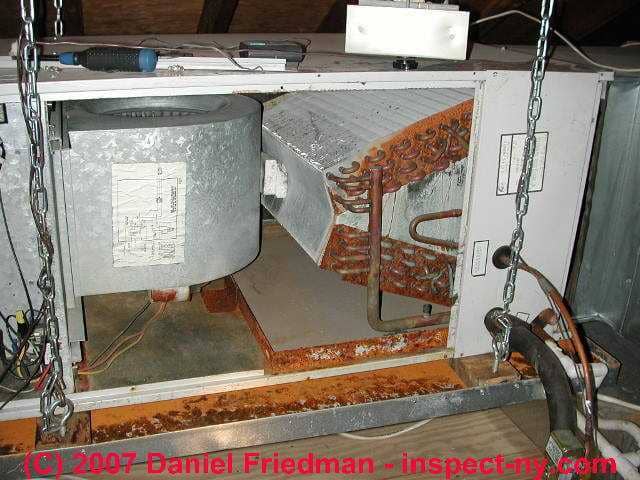
This article series discusses how to repair refrigerant leaks in air conditioning and cooling systems, using as an example, repairing a leaky or damaged air conditioning the cooling coil (evaporator coil) in the air conditioning air handler unit. Our photo at page top shows the cooling coil in the attic air handler component of a central air conditioning system.
Page top photo: accessing the refrigerant lines in the cooling coil in this horizontal air handler to test for refrigerant leaks is quite limited.
InspectAPedia tolerates no conflicts of interest. We have no relationship with advertisers, products, or services discussed at this website.
- Daniel Friedman, Publisher/Editor/Author - See WHO ARE WE?
How To Repair HVAC Air Conditioner Refrigerant Leaks
If your air conditioning or heat pump system has lost its cooling capacity or won't start see REPAIR GUIDE for AIR CONDITIONERS.
As we explain in our articles on lost cooling capacity or air conditioning systems or heat pumps that are not working, a refrigerant leak in your air conditioner or heat pump means that eventually it will just not produce cool air (during air conditioning) nor warm air (during heating if it's also a heat pump).
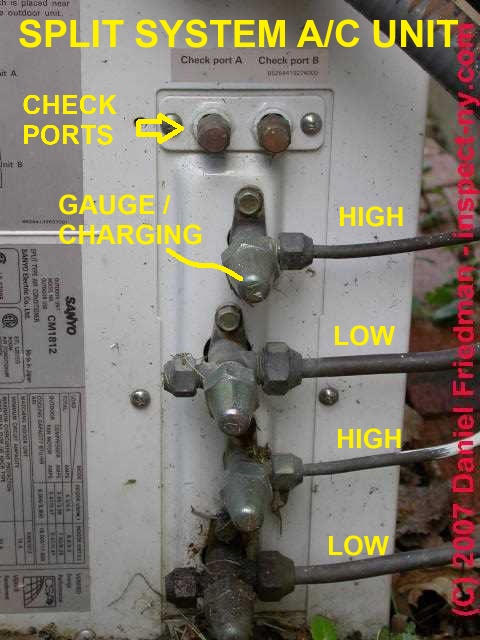
Photo: the two most-common refrigerant leak points we found at splilt system HVAC units like the outdoor compressor/condenser unit shown here are at the refrigerant line connector fittings themselves and at the refrigerant gauge set mounting ports.
Article Contents
- ACCURATE REFRIGERANT LEAK DIAGNOSIS
- ADD REFRIGERANT to "FIX" a LEAK?
- BUBBLES in the REFRIGERANT LINE SIGHT GLASS
- DIAGNOSE NEED to REPLACE COOLING COIL - separate page
- REFRIGERANT FILTER DRIER INSTALL AFTER REPAIR
- REFRIGERANT RE-CHARGE AFTER REPAIR
- REFRIGERANT LEAK / RELEASE LAWS & RESEARCH
- REFRIGERANT LEAK SEALANT USE - separate page
...
Accurate Diagnosis of a Refrigeration System Leak
First we need an accurate diagnosis of the air conditioning problem. If your air conditioning or heat pump system has lost cooling (or heating) capacity, there can be various causes besides loss of the refrigerant in the system.
- Confirm that the problem is a refrigerant leak:
First, see LOST COOLING CAPACITY to diagnose just why the system is not working. - Find the refrigerant leak:
If you know that the refrigerant level is low or zero, don't just re-charge the system. Find and fix the refrigerant leak.
See REFRIGERANT LEAK DETECTION.
While it's quick (and cheap) to just add refrigerant to a system, we were taught at HVAC school to scorn earning a living by developing a refrigerant gas delivery route. An air conditioning or heat pump system is normally completely sealed and should never "use" refrigerant. Refrigerant gases are not a substance which is "consumed" in an HVAC system.
In an emergency, such as at a commercial establishment needing time to move frozen food, one might just add refrigerant, but the proper repair or best repair is to find and fix the refrigerant leak. - If the refrigerant gas leak is in a valve or access port,
such as the service ports to which the HVAC technician connects her gauge set, the valves there may be able to be cleaned and salvaged, or the valves may need to be replaced.
Replacing a refrigerant gas service port valve is a soldering job similar to what we describe just below. In our AC repair career we never had to replace one of these valves but we did have to install them on some systems where they were not already in place.
Our photo at left shows refrigerant gauge access ports on a compressor/condenser unit. - If the refrigerant gas leak is in the air conditioning or heat pump copper tubing
a repair should be easy - the damaged line is re-soldered using high silver content solder and a high temperature torch. (We used MAPP gas for silver soldering of copper fittings, some technicians use Acetylene or other gases).
A damaged section of refrigerant line may need to be cut out and replaced. The repair is about the same regardless of whether the leak was in the larger diameter suction line or the smaller diameter high pressure line.
See REFRIGERANT PIPING DAMAGE & LEAKS for a list of common causes of damage and leaks in refrigerant piping.
Details about refrigerant piping installation or replacement are
at REFRIGERANT PIPING INSTALLATION. - If the refrigerant gas leak is in the condensing coil or in the evaporator coil,
repair might be possible, but we're less optimistic that repair is possible, but it might be, as we explain just below. - Use a halogen gas leak detector
to pinpoint refrigerant gas leaks and for thorough inspection & testing of the entire refrigerant piping system, including the condensing and evaporating coils.
Details are at USING the TIF 5000 GAS DETECTOR.
...
Bubbles seen or heard in the liquid refrigerant line?
 Clean Dust & Dirt Off of the Condensing Coil - Air conditioning and refrigeration performance &maintenance tip
As we also introduce
at CONDENSING COIL REPAIR REPLACE,
there is a big payoff in cleaning dust, debris, grass clippings off of a dirty refrigeration condensing coil (this includes outdoor condenser/compressor units for air conditioners and heat pumps and also the condensing coil on a home refrigerator or freezer).
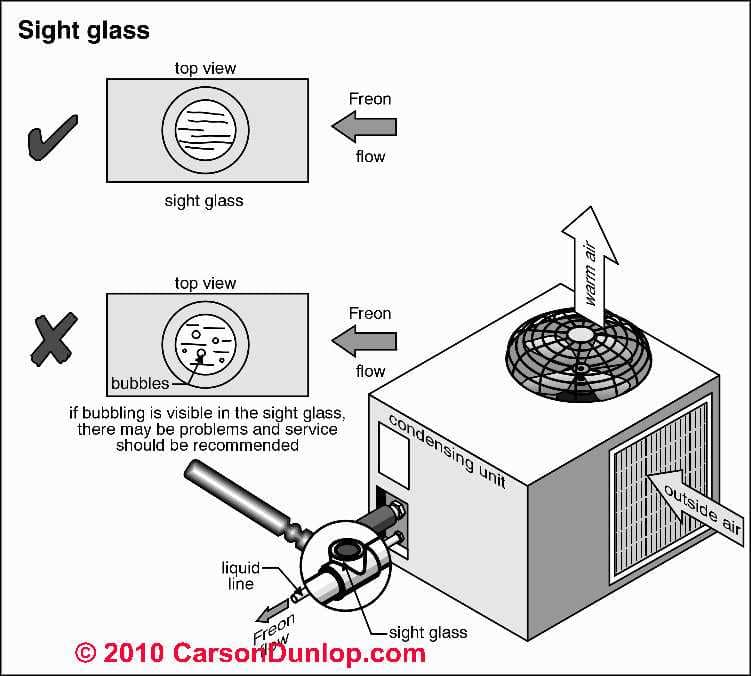
Sketch: showing the use of a sight glass on refrigrant piping is provided courtesy of Carson Dunlop Associates, a Toronto home inspection and education firm.
Because a refrigeration system works by transferring heat from hot refrigeration gas/liquid to ambient air around the condensing coil, if the condenser coil is blocked by dirt and debris, this can prevent complete cooling of the high temperature refrigerant gas back to a liquid state.
The result is you'll get refrigerant gas bubbles passing through the refrigerant metering valve. On refrigeration systems that include a sight glass you can actually see these gas bubbles passing through the system.
More details are
Gas bubbles in the liquid refrigerant line can result in complaints of running water, gurgling, burbling, or similar sounds coming from the refrigerant piping system.
See REFRIGERANT PIPING GURGLING.
Watch out: Incidentally a second source of bubbling sounds heard in the refrigerant piping suction line near the compressor could be refrigerant oil pooling in that location.
...
Should We Just Add Refrigerant Rather Than Finding and Fixing the Leak in our Air Conditioner or Heat Pump?
 At HVAC school we were taught that some HVAC technicians, in the opinion of the instructor (and our own as well), like the idea of a "delivery route" business, coming around periodically to replace lost refrigerant.
In our view in many circumstances this can be a questionable practice.
Air conditioners and heat pumps are designed as a closed, hermetically sealed system - they are not supposed to leak refrigerant, and refrigerant leaks are an abnormal condition.
While in the short run it may seem cheaper to just "add refrigerant" when the system refrigerant level is low, that ignores the fact that the system is illegally releasing refrigerant to the atmosphere, contaminating the environment. In fact, the refrigerant leak can be found and repaired.
If the technician was in a hurry, perhaps given many service call assignments, or if s/he didn't want to be hassled by a customer complaining over an "attempt convert a simple recharge to a costly service call", or if the company just likes to deliver refrigerant (lots of repeat business), or finally, if the system with the refrigerant leak is large, commercial, complex, and old - at end of life, s/he may not have mentioned that refrigerant leak repair is even possible.
If you are faced with a costly service call or repair on an old air conditioning system (such as the need to replace a corroded, leaky evaporator coil) on a system that is at or near end of life, it is understandable that you might just prefer to wait and replace the whole system.
But it is not air conditioner or heat pump system age that makes a refrigerant leak able to be found or not, it is system complexity. Sometimes, especially with large complex commercial systems, because tracing all of the piping and tubing and looking for leaks is time consuming, some people opt to just add refrigerant.
OPINION: Just adding refrigerant is not the best practice. And with old freon-based cooling or heat pump systems such leaks might be illegal as you are damaging the environment and making a prohibited release of Freon gases to the air.
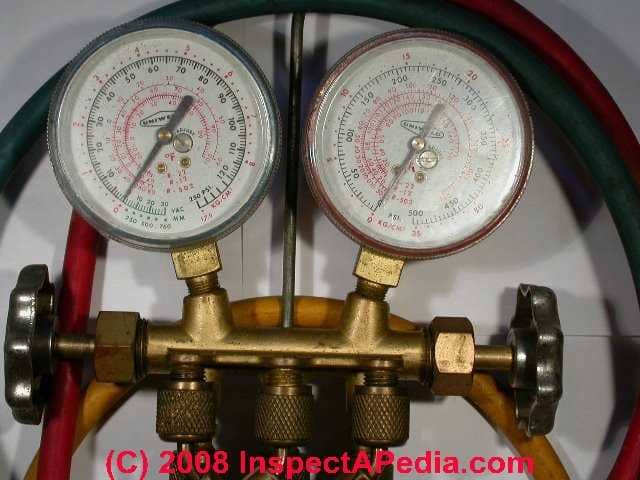
The refrigerant gauge set photo above is discussed in detail
at GAUGE, REFRIGERATION PRESSURE TEST.
A step by step example of adding refrigerant to an air conditioning system using a rather minimalist approach is illustrated
...
Recharging the HVAC System after Refrigerant Leak Repair
In case you didn't realize it, in order to solder a repair in an air conditioner or heat pump piping, tubing, evaporator coil/cooling coil, or condensing coil, it will first be necessary to remove all of the refrigerant from the system.
The HVAC technician will connect a pump to pull a vacuum
on the system to remove as much air, gas, debris, and moisture as possible.
An evacuator pump is needed for this step. [We made our own vacuum pump using a particularly good performing Frigidaire rotary compressor retrieved from an abandoned antique refrigerator.]
The HVAC technician will probably want to install a refrigerant filter/drier
to remove any moisture that leaked into the system while it was open to the atmosphere, and perhaps she will install other filtration equipment on the system at this time. It's a good idea.
See GAUGE, REFRIGERATION PRESSURE TEST for details about refrigerant that has been recovered and/or recycled can be returned to the same system or other systems owned by the same person without being reclaimed. But the refrigerant charging procedure using a gauge set and charging cylinder or scale.
Refrigerant Charging or "Topping Off Low Refrigerant" is Not a Homeowner Task
Watch out: Charging a home air conditioner is not a step I recommend to homeowners or a handyman; special equipment including refrigerant gauge set and possibly temperature measuring equipment, training, even knowing how to purge and then hook up the gauge and charging equipment, matching the right refrigerant, knowing the right charge amount are all stuff learned in HVAC school.
The risks are an over-charge, under-charge, or introducing air or dirt into the refrigeration system, leading to a still more-expensive repair than if you'd had a trained person do the job in the first place.
...
Laws Governing Refrigerant Release / Recapture / Re-Use
- US EPA STATIONARY REFRIGERATION REFRIGERANT RECLAMATION REQUIREMENTS [PDF]
Excerpt:
EPA regulations (40 CFR Part 82, Subpart FEXITEXIT EPA WEBSITE) under Section 608 of the Clean Air Act restrict the resale of used ozone-depleting and substitute (e.g., HFC) refrigerant to a new owner unless it has been reclaimed by an EPA-certified refrigerant reclaimer.
To be properly reclaimed, used refrigerant must be reprocessed to at least the purity level specified in Appendix A to 40 CFR Part 82, Subpart FEXITEXIT EPA WEBSITE [based on Air Conditioning, Heating, and Refrigeration Institute (AHRI) Standard 700-2016EXITEXIT EPA WEBSITE].
This purity level must be verified using the laboratory protocol set forth in this same standard. - RELEASE of REFRIGERANT to the ENVIRONMENT is PROHIBITED - 42 U.S. Code § 7671g - National recycling and emission reduction program [PDF]
Excerpt: Effective July 1, 1992, it shall be unlawful for any person, in the course of maintaining, servicing, repairing, or disposing of an appliance or industrial process refrigeration, to knowingly vent or otherwise knowingly release or dispose of any class I or class II substance used as a refrigerant in such appliance (or industrial process refrigeration) in a manner which permits such substance to enter the environment.
De minimis releases associated with good faith attempts to recapture and recycle or safely dispose of any such substance shall not be subject to the prohibition set forth in the preceding sentence.
Refrigerant Leak Research
- Brownell, K. A., Klein, S. A., & Reindl, D. T. (1999). REFRIGERATION SYSTEM MALFUNCTIONS [PDF] ASHRAE Journal, 41, 40-48. Retrieved 2019/02/03, original source: citeseerx.ist.psu.edu/viewdoc/download?doi=10.1.1.618.5464&rep=rep1&type=pdf
- Ishii, Noriaki, Kenichi Bird, Kiyoshi Sano, Mamoru Oono, Shinji Iwamura, and Takayuki Otokura. REFRIGERANT LEAKAGE FLOW EVALUATION FOR SCROLL COMPRESSORS [PDF] (1996).
Purdue University, International Compressor Engineering Conference, School of Mechanical Engineering. Retrieved 2019/01/03, original source: docs.lib.purdue.edu/cgi/viewcontent.cgi?article=2174&context=icec - Tang, Weier, Guogeng He, Dehua Cai, Yihao Zhu, Aoni Zhang, and Qiqi Tian. "The experimental investigation of refrigerant distribution and leaking characteristics of R290 in split type household air conditioner." Applied Thermal Engineering 115 (2017): 72-80.
- Taylor, Dan W., and David W. Corne. "Refrigerant leak prediction in supermarkets using evolved neural networks." In Recent Advances In Simulated Evolution And Learning, pp. 643-661. 2004.
- US DOE, COMMON AIR CONDITIONER PROBLEMS [PDF] retrieved 2019/02/03, original source: energy.gov/energysaver/common-air-conditioner-problems
Excerpt:
If your air conditioner is low on refrigerant, either it was undercharged at installation or it leaks. If it leaks, simply adding refrigerant is not a solution.
A trained technician should fix any leak, test the repair, and then charge the system with the correct amount of refrigerant.
Remember that the performance and efficiency of your air conditioner is greatest when the refrigerant charge exactly matches the manufacturer's specification, and is neither undercharged nor overcharged. Refrigerant leaks can also be harmful to the environment. - Maclaine-Cross, I. L., and E. Leonardi. PERFORMANCE AND SAFETY OF LPG REFRIGERANTS [PDF] In Proceedings of the Fuel for Change Conference—Australia, Surfers’ Paradise Queensland, Australian Liquefied Petroleum Gas Association Ltd, ISBN 0, vol. 646, no. 24884, p. 7. 1995.
...
Below are links to topics previously found on this page.
A/C or Refrigeration System Refrigerant Leak Sealer
 Sorry to ask readers to click again but for more space we have moved this topic
to REFRIGERANT LEAK SEALANT USE
"Stop leak" products have been in use for decades, particularly in the automotive industry where they were used to address leaks in automotive cooling systems.
Those products traditionally used a carrier and fibers (originally asbestos) - an approach not suitable for refrigeration systems whose refrigerant metering devices may not tolerate particulates, even small ones.
Since the 1980's several inventors (e.g. Packo & Bailey 1980, 1982, 1984) have patented other approaches (and chemistry) for sealing small leaks in refrigeration systems.
Some of these refrigerant leak sealant products use triethoxyl (vinyl) silane that forms a seal when exposed to air and can seal small openings in refrigeration systems without clogging up the capillary tube or thermostatic expansion valve.
Evaluate Evaporator Coil or Condensing Coil Refrigerant Leaks & Deciding to Repair vs Replace a Coil
This discussion has moved to
COOLING / EVAPORATOR COIL REPAIR
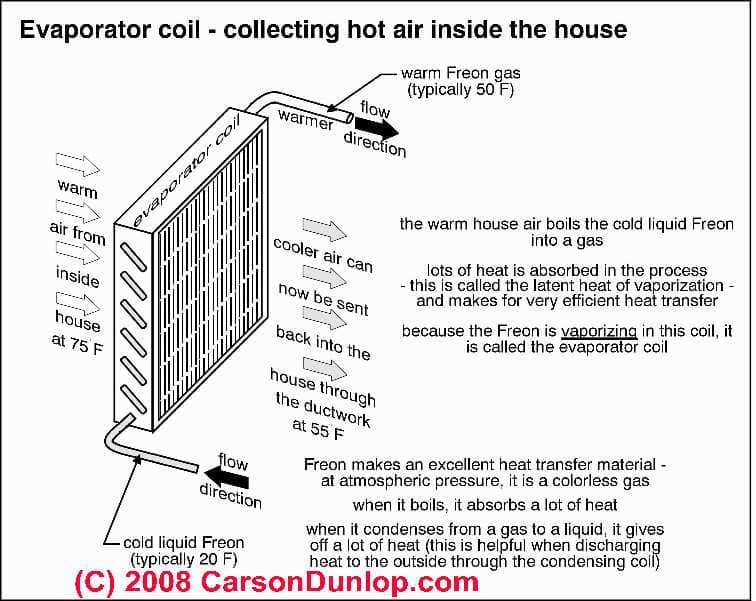
If an evaporator coil is leaking (or also if the condensing coil is leaking) you'll find out pretty quickly as refrigerant will be lost and the cooling system will stop providing cool air.
You'll need expert diagnosis by an HVAC service technician. Sketch above is provided courtesy of Carson Dunlop Associates, a Toronto home inspection, education & report writing tool company [ carsondunlop.com ].
Repair or Replace an Air Conditioning or Heat Pump Evaporator Coil or Condensing Coil
This discussion has moved to
COOLING / EVAPORATOR COIL REPAIR
For an example of coil replacement costs see our condensing coil replacement discussion
at CONDENSING COIL REPAIR REPLACE .
Install a Refrigerant Drier / Debris Filter after Piping Work or System Evacuation/Re-charge
Watch out: good practice following work on refrigerant piping systems or system evacuation and recharging within refrigerant includes the installation of a debris filter and refrigerant drier device.
Details are
at REFRIGERANT DRIERS & FILTERS
...
Reader Comments, Questions & Answers About The Article Above
Below you will find questions and answers previously posted on this page at its page bottom reader comment box.
Reader Q&A - also see RECOMMENDED ARTICLES & FAQs
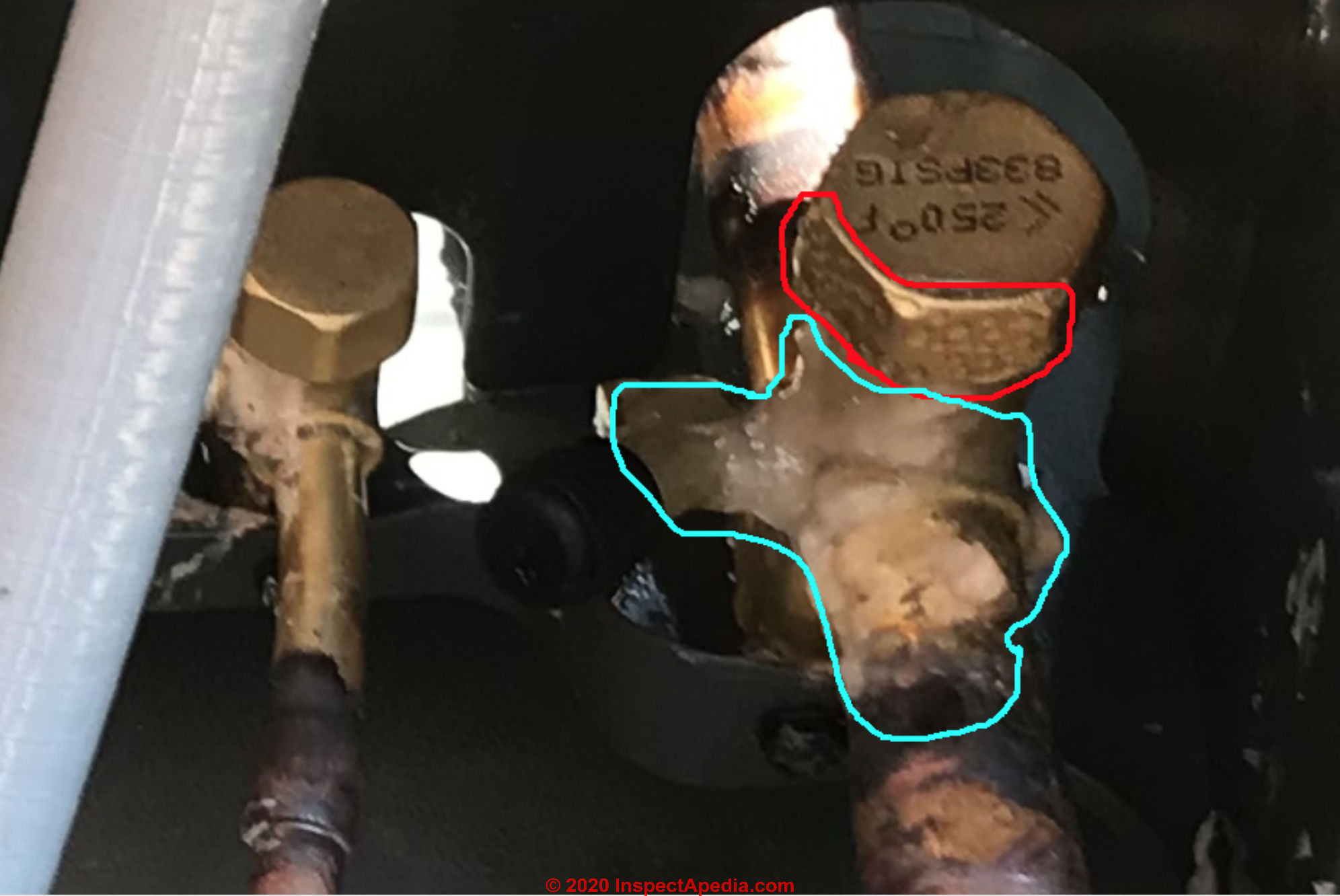
Question: are these refrigerant piping braze joints showing a leak ?
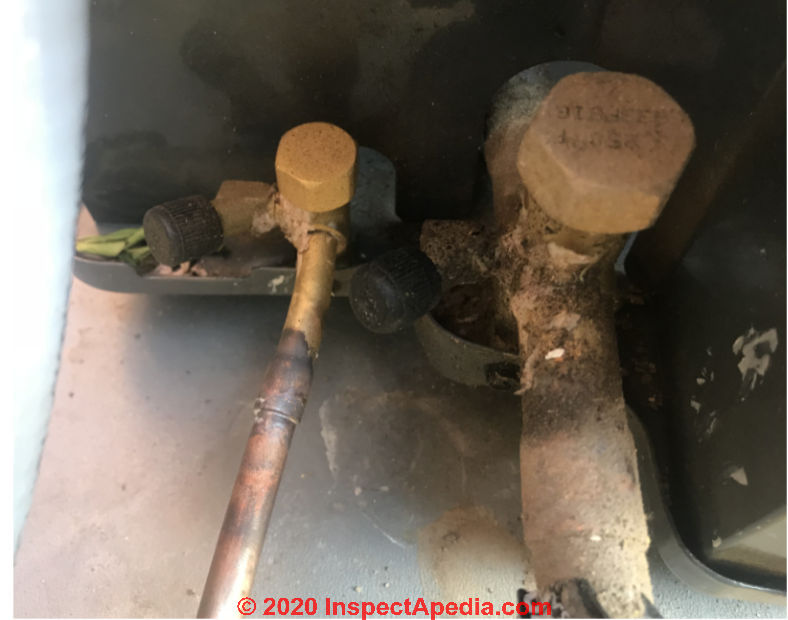
Above: refrigerant piping braze connections one day after installation.
Below: refrigerant piping connections one week after installation - note apparent ice formation on the suction line.
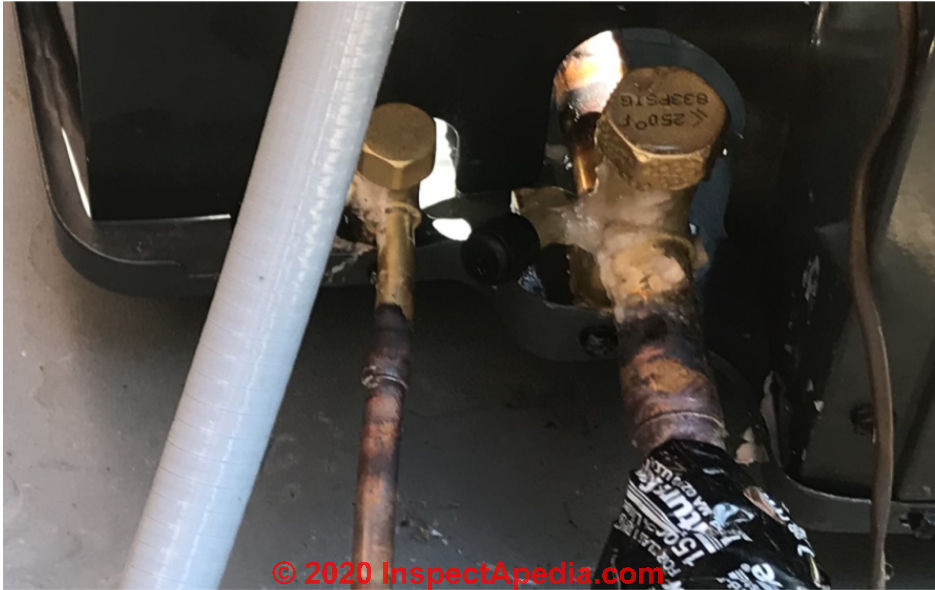
I just have a brand new central A/C installed 2 weeks ago. I wonder why the large refrigerant pipe near the service valve change surface color and texture dramatically as shown in the attached photo?
Is this a typical sign of leaking or else? - anonymous by private email 2020/05/12
Moderator reply: refrigerant leak detection
Sorry Anon, but I can't tell if there's a refrigerant leak just by looking; I see some normal discoloring of the copper tubing that occurs during brazing the connections.
And there does seem to be some icing on the suction line, and icing can be an indicator of loss of refrigerant.
Note that frost and possibly ice formation at the suction line occurs if there is missing insulation and might also be a sign of overcharged refrigerant. Frost can also form when refrigerant has been leaking and the charge is low.
Ultimately if there is a leak, the level of refrigerant drops so low that there is no longer icing, nor frost, nor will the system cool building air.
See details at REFRIGERANT LEAK REPAIR
Reader follow-up:
Attached please find two zoom-in photos of the service valves - one taken next day after the installation, the other one is two weeks after the installation. I wonder what are those wax-like material on the surface?
Moderator reply:
If its waxy it's not ice, and it could be an oil residue if there's a leak at that joint.
If the joint leaks you'll know it because first the piping will ice and eventually when enough refrigerant is lost it'll stop working entirely.
Did you touch it? It sure looks like ice to me.
Reader follow-up:
Which one looks like ice? - next day photo or 2 weeks after photo?
I didn't touch it though.
Reply:
The translucent material. If it's waxy there's a leak or contamination in the system. If it's cold and is ice or frost, then
See REFRIGERANT LINE FROST
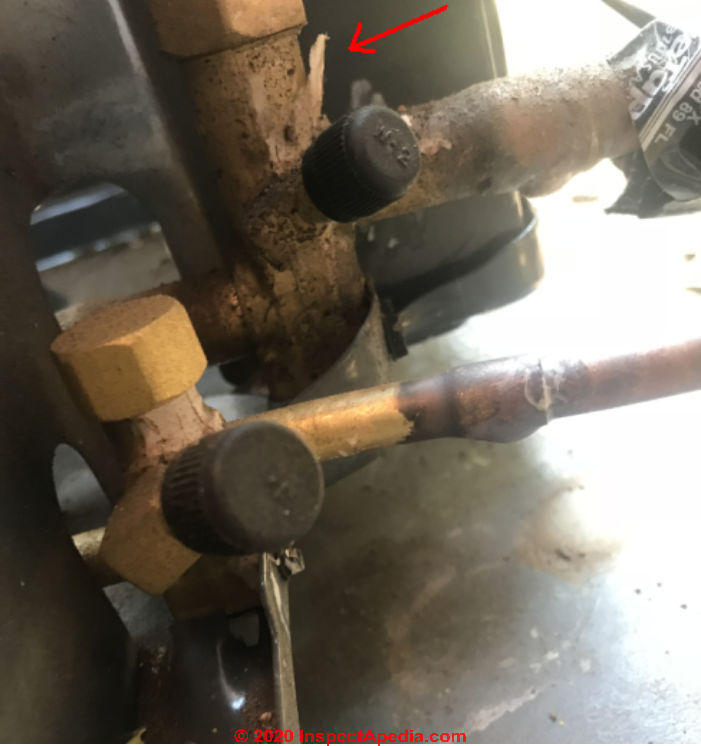
Causes of a refrigerant pipe leak due to cracking
What are the likely causes of a cracked pipe causing refrigerant leak in my air conditioner? - 2020-04-08 by Tony
Reply by (mod) -
Causes of a refrigerant pipe leak due to cracking might include
- vibration
- improper routing or support of the piping or
- stress caused by movement of the condenser/compressor unit or (less common) of the air handler due to inadequate support of those components
- omission of coiled slack to avoid tension or stress on the piping
- defective or mechanically-damaged copper tubing
- improper brazing or soldering
- corrosion
- something else I've forgotten but that a more-expert HVACR tech could add
...
Continue reading at REFRIGERANT LEAK SEALANT USE or select a topic from the closely-related articles below, or see the complete ARTICLE INDEX.
Or see REFRIGERANT LEAK REPAIR FAQs - questions & answers posted originally on this page
Or see these
Recommended Articles
- CORRECTING REFRIGERANT PRESSURE & LEAKS
- LOST COOLING CAPACITY
- REFRIGERANT GASES & PIPING - home
- REFRIGERANT CHARGING PROCEDURE
- REFRIGERANT DRIERS & FILTERS - add a filter/drier after repairing refrigerant line or coil leak
- REFRIGERANT LEAK DETECTION
- REFRIGERANT LEAK REPAIR
- REFRIGERANT LINE FROST
- REFRIGERANT PIPING GURGLING
- REFRIGERANT PRESSURE READINGS & CHARTS
- REPAIRS for FROST / ICE on COIL
Suggested citation for this web page
REFRIGERANT LEAK REPAIR at InspectApedia.com - online encyclopedia of building & environmental inspection, testing, diagnosis, repair, & problem prevention advice.
Or see this
INDEX to RELATED ARTICLES: ARTICLE INDEX to AIR CONDITIONING & HEAT PUMPS
Or use the SEARCH BOX found below to Ask a Question or Search InspectApedia
Ask a Question or Search InspectApedia
Try the search box just below, or if you prefer, post a question or comment in the Comments box below and we will respond promptly.
Search the InspectApedia website
Note: appearance of your Comment below may be delayed: if your comment contains an image, photograph, web link, or text that looks to the software as if it might be a web link, your posting will appear after it has been approved by a moderator. Apologies for the delay.
Only one image can be added per comment but you can post as many comments, and therefore images, as you like.
You will not receive a notification when a response to your question has been posted.
Please bookmark this page to make it easy for you to check back for our response.
IF above you see "Comment Form is loading comments..." then COMMENT BOX - countable.ca / bawkbox.com IS NOT WORKING.
In any case you are welcome to send an email directly to us at InspectApedia.com at editor@inspectApedia.com
We'll reply to you directly. Please help us help you by noting, in your email, the URL of the InspectApedia page where you wanted to comment.
Citations & References
In addition to any citations in the article above, a full list is available on request.
- Thanks to Ato Guy Benfante, Chesapeake, VA 8/26/07 for the photograph of an ice-blocked air conditioning system evaporator coil and for his suggestion that we provide an air conditioning system troubleshooting FAQ.
- Thanks to reader Don Jackson for HVAC refrigerant leak soldering repair tips (Aug-Sept 2008).
- [6] REFRIGERANT PIPING GUIDE [PDF] , Application Guide AG-31-011, McQuay Air Conditioning, Daikin McQuay International Equipment, 13600 Industrial Park Blvd., Minneapolis, Minnesota 55441 USA Tel: 800-432-1342 (Toll Free), Website: http://www.daikinmcquay.com/, [Copy on file as https://inspectapedia.com/aircond/AC_Guide_McQuay.pdf ]
- In addition to citations & references found in this article, see the research citations given at the end of the related articles found at our suggested
CONTINUE READING or RECOMMENDED ARTICLES.
- Carson, Dunlop & Associates Ltd., 120 Carlton Street Suite 407, Toronto ON M5A 4K2. Tel: (416) 964-9415 1-800-268-7070 Email: info@carsondunlop.com. Alan Carson is a past president of ASHI, the American Society of Home Inspectors.
Thanks to Alan Carson and Bob Dunlop, for permission for InspectAPedia to use text excerpts from The HOME REFERENCE BOOK - the Encyclopedia of Homes and to use illustrations from The ILLUSTRATED HOME .
Carson Dunlop Associates provides extensive home inspection education and report writing material. In gratitude we provide links to tsome Carson Dunlop Associates products and services.
 | HOME | ABOUT | ASK a QUESTION | CONTACT | CONTENT USE POLICY | DESCRIPTION | POLICIES | PRIVACY | |
| © 2025 - 1985 Publisher InspectApedia.com - Daniel Friedman | |||||||||