
InspectAPedia® FREE Encyclopedia of Building & Environmental Construction, Diagnosis, Maintenance & Repair |
Question? Just ask us! InspectAPedia
|
 Air Conditioning, Heat Pump & Refrigeration System Pressure Controls & Safety Switches
- POST a QUESTION or COMMENT about cooling system & heat pump system switches & controls
Air conditioning & heat pump pressure controls and switches:
This article explains where to find and how identify and adjust the refrigerant pressure operating and safety pressure controls for air conditioning and heat pump systems and similar equipment.
These same controls are used on other refrigeration systems such as commercial coolers and freezers.
InspectAPedia tolerates no conflicts of interest. We have no relationship with advertisers, products, or services discussed at this website.
Air Conditioner or Heat Pump Operating Pressure Control Switch & Electrical Sensor Safety Switches
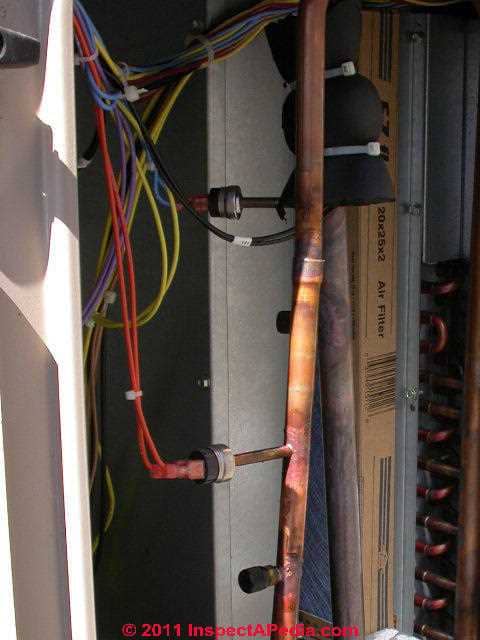
We distinguish between operating control pressure switches and safety switches that monitor against too-low or too-high refrigerant pressures in a refrigeration system. Both are described here.
[Click to enlarge any image]
If your air conditioning or heat pump system has lost its cooling capacity or won't start see REPAIR GUIDE for AIR CONDITIONERS.
See COOLING CAPACITY, RATED of air conditioning equipment if the system seems to be working but is inadequate to cool your building.
Operating Pressure Control Switches for Air Conditioners, Heat Pumps, Refrigeration Equipment
Operating pressure control switches set the normal compressor cut-in and cut out pressures in commercial refrigeration systems including air conditioners, coolers, refrigerators freezers.
Commercial refrigeration equipment such as refrigerators (coolers) and freezers use a pressure control switch to set the cut-in and cut out pressures at which the compressor shall operate.
The pressure control switch and the thermostatic expansion valve may both need to be inspected, tested, and set to cooperate with one another, as I describe in an old field service call report described at REFRIGERANT METERING DEVICES TEVs & EEVs
Also see WALK IN COOLER REPAIR
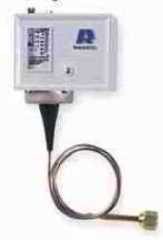
Shown at left is a Ranco™ single pressure control switch with an operating range of 12-50 psig and a differential range of 5-35 psig. Ranco produces a wide range of switches and controls including air conditioning controllers. This particular Ranco switch shown at left "opens" on low. Available from Grainger and other refrigeration equipment suppliers.
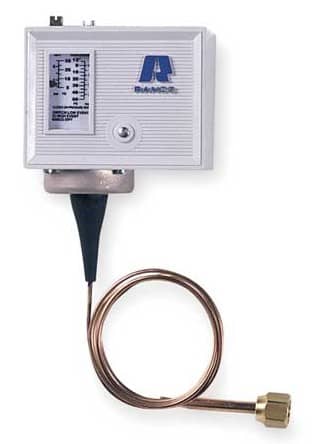 Among these refrigeration system pressure controllers, the Ranco Type "O" single function pressure controls are most common. These pressure control switches actually are designed to operate either as normal operating controls or as protection devices (see Safety Switches below). On these controls a "multi-capsule" pressure element operates a single or double pole electrical switch that typically will turn the compressor motor on or off.
Watch out: some pressure controls use a manual reset on their cut-out pressure feature. That means that your equipment may be shut down until you locate and press the reset bar on the equipment. Typically the reset bar is located on the top of the pressure control switch.
Pressure control switch sensor tubing warnings
Also for proper installation of one of these switches you should avoid sharp bends or kinks in the capillary tube sensor tubing, and don't let the tubing be exposed to vibration due to improper mounting or installation.
Tubing that is too loose and vibrates can rub and wear through; tubing that is too tight can vibrate in what Ranco calls "violin string" vibration that can cause the tubing to break. And of course all refrigerant lines in the system will need to be purged when installing a new control.
Adjusting the refrigerant pressure control switch
You should not mess with the switch adjustment unless you are a qualified HVAC service technician since doing so risks damaging the equipment or causing an unsafe condition.
But FYI, in general, turning the RANGE adjustment screw inwards or "clockwise" (the right hand screw on the control top) will decrease the control pressure setting, and turning the screw out or counterclockwise will increase the pressure setting.
The DIFFERENTIAL setting screw (the left hand screw of the pair as you face the front of the control) turns in or clockwise to increase the differential and out or counterclockwise to decrease the pressure differential.
Note: you won't normally see this type of refrigeration pressure control switch on residential air conditioners, heat pumps, nor residential appliances.
Similar pressure control switches are used in many mechanical system operations including steam heat -
see PRESSURE CONTROL, STEAM BOILERS and even on water pumps -
see WATER PUMP PRESSURE CONTROL
Refrigeration System Pressure Safety Switches: protect against over pressure or under pressure in air conditioning or heat pumps
Some HVAC systems (air conditioners, heat pumps, refrigeration equipment) include other sensor switches that may include an electrical pressure or temperature transducer/sensor (photo at left) or an air conditioning or heat pump pressure sensing switch that detects improper (too high) or [in some systems including automotive air conditioning] too-low refrigerant pressures in the system.
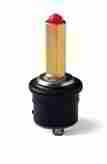
For safety the air conditioning or heat pump pressure switch can shut off the system. When pressures return to normal the pressure safety switch normally auto-resets and operation can continue.
Ranco also produces air conditioning safety controls: their G60 pressure controller (small photo at immediate left) is a cut-out switch that protects the refrigeration system compressor against abnormally low suction pressures that could otherwise cause liquid refrigerant to enter (and destroy) the compressor.
The Ranco G63 pressure controller is a high pressure cut-out switch that protects the refrigeration system against excessive compressor outlet or discharge pressure.
These air conditioner safety switches are offered in a range of models, depending on the cut-out and cut-in pressures desired. Cut out/in pressure ranges extend from 0.14 psi cut-out and 8 psi cut in up to 362 psi cut-out and <286 psi cut-in with variable differential settings.
Typically a low pressure safety switch to protect the compressor against liquid refrigerant will automatically reset when conditions return to normal. A high pressure safety switch may include an automatic reset and (for pressure decrease) a manual reset mode.
Watch out: As Ranco and others warn, both under pressure (that can damage the compressor) and overpressure (that can damage or eve blow something up) at an air conditioner or heat pump system - can be dangerous need to be guarded against.
Where to buy pressure control switches for refrigeration equipment
- Behr A/C pressure Switch (less than$30). and other automotive switches.
- Micro Pneumatic Logic [citation] pressure switches (wide range of applications).
- Ranco [citation] and Grainger [citation] - pressure control switches and pressure safety switches for air conditioning and refrigeration systems, protecting against overpressure and under pressure
- Sensata [citation] automotive air conditioning (A/C) pressure switches [dual function pressure switch provides high pressure cut-out (HPCO) with fan function or high side low pressure (HSLP) cutout functions
CONTACT us to add HVAC system switches or controls or diagnostic suggestions you do not find here.
Reader Comments, Questions & Answers About The Article Above
Below you will find questions and answers previously posted on this page at its page bottom reader comment box.
Reader Q&A - also see RECOMMENDED ARTICLES & FAQs
Question: refrigeration compressor won't start unless we manually press the contactor
(May 8, 2014) Anonymous said:
Compressor on refrigerated dryer can't start unless
you press the contact manually
Reply:
Anon, I don't know what's wrong but possibly you've got a bad contactor (relay) or less likely, a motor needs a start capacitor, or a compressor is failing. I would start by checking for voltage to see if the control board is trying to pull in the contractor.
Question: start up problems for AC at beginning of each cooling season unless I jam the start relay
May 12, 2014) Praveen said:
Every year, when I try to run my AC for the first time, the outside compressor does not start. I replaced the contactor switch but that did not help. I also replaced the time delay relay but even that did not help. I manually made the contactor complete the circuit (stuck a piece of cardboard) to start the compressor. I let it run for about an hour. After this, the compressor started working properly on its own. This has been happening for past 3 years. What am I missing? Which component could be it? It is a Rheem unit, about 15 years old. Thanks.
Reply:
Praveen,
Never, ever do that again. Jamming a relay to force it to run risks starting a fire or ruining a very expensive part - the compressor motor. It was creative, though. I understand the temptation.
IF we assume that the thermostat and control wiring are working and correct, then
Try replacing the relay switch. It may have corroded contacts or bad wiring; if that doesn't work I'd suspect a bad control board.
Question: turned on the AC but it didn't cool
(June 11, 2014) Paul S said:
I turned on my AC and it failed to cool.
It is a two unit system one for downstairs one for up.
I went to the isolator switch outside and removed the link before opening the downstairs unit.
As soon as the link was removed the upstairs unit started and started delivering cool air.
Putting the link back in place momentarily energized the downstairs unit contactor and stopped the operation of the previously running upstairs unit.
Any ideas. I have checked the dual capacitor and it is OK.
Reply:
See the diagnostics beginning at LOST COOLING CAPACITY
Question: AC has packed up, contactor not engaging - can this cause refrigerant loss?
(May 11, 2015) Jack Jones said:
My Mrs turned on the A/C in early spring this year. I hadn't got round to taking off the cover on the outside fan. Sure enough the A/C has packed up. I tried to diagnose the issue myself & realized the contractor wasn't engaging. After testing all components, it looks like it's the low pressure switch that's packed up.
I determined this by connecting a jumper for a short time between the two points it's wires terminate at. Sure enough it ran the fan but still blew out cold air. I did the same test with another temperature switch which read open circuit with my ohm meter. It looks like i need to replace both. My questions are, can I replace the low pressure switch myself?
Or is there a risk of losing gas in the pipeline? Also did I diagnose the fault correctly? Lastly, after running the unit for a while once parts are replaced, will it start blowing out cold air? Or could the suspected over heating caused by the cover left on while running the A/C have done more damage? Only the RED trip led is on solid, so I'm assuming it hasn't.
Sorry, edit on earlier post......when the fan ran after shorting out the low pressure switch terminals, the fan didn't blow out cold air. Sorry. Shorting out the other switch made no difference to the fan operation. Just wanted to be very clear on that.
Reply:
Jack
Forcing an AC system to run when it doesn't want to risks causing further damage to its controls and possibly burning something up. If by "packed up" you mean that the system was ice-blocked, I'd have wanted to turn power off for 24 hours to let all of the ice and frozen components melt, then I'd have tried turning it back on again.
(May 20, 2015) Jack Jones said:
All I want to know, before some guy comes & trys to rip me off like most do here in Toronto, is did running the relatively new unit with the cover on make the freon escape from the system? That's what it seems like by the tests I've done. The moderator needs to read my post clearly before making assumptions which are nothing to do with the issue.
Reply:
No, running an AC unit won't itself cause a loss of refrigerant.
...
Continue reading at REFRIGERANT METERING DEVICES TEVs & EEVs or select a topic from the closely-related articles below, or see the complete ARTICLE INDEX.
Or see these
Recommended Articles
- A/C - HEAT PUMP CONTROLS & SWITCHES for our complete list of HVAC controls and switches. We include photographs to assist readers in recognizing cooling system defects.
- GAUGE, REFRIGERATION PRESSURE TEST
- OPERATING CONTROLS, A/C & HEAT PUMP for a discussion of thermostats, zone dampers, and circuit breakers on air conditioners and heat pumps.
- PRESSURE CONTROLS & SAFETY SWITCHES
- REFRIGERANT GASES & PIPING - home
- CAR / TRUCK AC PRESSURE SWITCH
- FROST BUILD-UP on AIR CONDITIONER COILS
- GAS DETECTION INSTRUMENTS
- GAS EXPOSURE EFFECTS, TOXIC
- GAS LAWS & CONSTANTS
- GAUGE, REFRIGERATION PRESSURE TEST
- REFRIGERANT CHARGING PROCEDURE
- REFRIGERANT DRIERS & FILTERS
- REFRIGERANT FLOODBACK, LIQUID SLUGGING
- REFRIGERANT LEAK DETECTION
- REFRIGERANT LEAK REPAIR
- REFRIGERANT METERING DEVICES TEVs & EEVs
- REFRIGERANT METERING CAPILLARY TUBES
- REFRIGERANT PIPING INSTALLATION
- REFRIGERANT PRESSURE DIAGNOSTICS
- REFRIGERANT CHARGE QUANTITY
- REFRIGERANT QUANTITY on DATA TAG
- REFRIGERANT HIGH HEAD PRESSURE DIAGNOSIS
- REFRIGERANT LOW HEAD PRESSURE DIAGNOSIS
- REFRIGERANT PRESSURE READINGS & CHARTS
- REFRIGERANT PROBLEM TYPES
- REFRIGERANT UNDERCHARGE EFFECTS
- REFRIGERANT SIGHT GLASS
- AIR CONDITIONING & HEAT PUMP SYSTEMS - home
- SPLIT SYSTEM AC / HEAT PUMP REPAIRS
Suggested citation for this web page
PRESSURE CONTROLS & SAFETY SWITCHES at InspectApedia.com - online encyclopedia of building & environmental inspection, testing, diagnosis, repair, & problem prevention advice.
Or see this
INDEX to RELATED ARTICLES: ARTICLE INDEX to AIR CONDITIONING & HEAT PUMPS
Or use the SEARCH BOX found below to Ask a Question or Search InspectApedia
Ask a Question or Search InspectApedia
Try the search box just below, or if you prefer, post a question or comment in the Comments box below and we will respond promptly.
Search the InspectApedia website
Note: appearance of your Comment below may be delayed: if your comment contains an image, photograph, web link, or text that looks to the software as if it might be a web link, your posting will appear after it has been approved by a moderator. Apologies for the delay.
Only one image can be added per comment but you can post as many comments, and therefore images, as you like.
You will not receive a notification when a response to your question has been posted.
Please bookmark this page to make it easy for you to check back for our response.
Our Comment Box is provided by Countable Web Productions countable.ca
Citations & References
In addition to any citations in the article above, a full list is available on request.
- Thanks to AAlan Carson and Bob Dunlop, Carson Dunlop, Associates, Toronto, for permission to use illustrations from their publication, The Illustrated Home which illustrates construction details and building components. Carson Dunlop provides home inspection education, publications, report writing materials, and home inspection services. Alan Carson is a past president of ASHI, the American Society of Home Inspectors.
- Thanks to Lester Richer, a professional home inspector, for the reminder that a bad air conditioner condensate drip tray switch can shut the whole system down.
- Behr Hella Service A/C pressure switches,
- Grainger, http://www.grainger.com/
- Ranco Corporation, http://www.invensyscontrolseurope.com/ranco/ Tel (Europe) +44 (0)845 130 5522
- Sensata Technologies, 529 Pleasant Street, B41 Attleboro, MA 02703-2964 Phone: 1-248-692-5600 Fax: 1-248-692-5630 Email: auto-mktg@sensata.com Web: www.sensata.com, pressure switches for automotive air conditioning systems
- Micro Pneumatic Logic, Inc., Pompano Beach, Florida Tel. (954) 973-6166 - pressure switches
- Our recommended books about building & mechanical systems design, inspection, problem diagnosis, and repair, and about indoor environment and IAQ testing, diagnosis, and cleanup are at the InspectAPedia Bookstore. Also see our Book Reviews - InspectAPedia.
- Modern Refrigeration and Air Conditioning, A. D. Althouse, C.H. Turnquist, A. Bracciano, Goodheart-Willcox Co., 1982
- Principles of Refrigeration, R. Warren Marsh, C. Thomas Olivo, Delmar Publishers, 1979
- Refrigeration and Air Conditioning Technology, 5th Ed., William C. Whitman, William M. Johnson, John Tomczyk, Cengage Learning, 2005, ISBN 1401837654, 9781401837655 1324 pages
- In addition to citations & references found in this article, see the research citations given at the end of the related articles found at our suggested
CONTINUE READING or RECOMMENDED ARTICLES.
- Carson, Dunlop & Associates Ltd., 120 Carlton Street Suite 407, Toronto ON M5A 4K2. Tel: (416) 964-9415 1-800-268-7070 Email: info@carsondunlop.com. Alan Carson is a past president of ASHI, the American Society of Home Inspectors.
Thanks to Alan Carson and Bob Dunlop, for permission for InspectAPedia to use text excerpts from The HOME REFERENCE BOOK - the Encyclopedia of Homes and to use illustrations from The ILLUSTRATED HOME .
Carson Dunlop Associates provides extensive home inspection education and report writing material. In gratitude we provide links to tsome Carson Dunlop Associates products and services.
 | HOME | ABOUT | ASK a QUESTION | CONTACT | CONTENT USE POLICY | DESCRIPTION | POLICIES | PRIVACY | |
| © 2024 - 1985 Publisher InspectApedia.com - Daniel Friedman | |||||||||