
InspectAPedia® FREE Encyclopedia of Building & Environmental Construction, Diagnosis, Maintenance & Repair |
Question? Just ask us! InspectAPedia
|
 Peel & Stick Flashing Tapes & Membranes
Flashing Tape Product Choices &
Installation Details
- POST a QUESTION or COMMENT about how to buy & apply peel and stick flashing tape around window & doors or at housewrap joints or holes.
Peel and stick flashing tape or membranes are used around building openings and at other locations where there is extra risk of leakage.
This article describes the selection and installation of peel-and-stick flashing membranes used on building exteriors to seal housewrap joints and to seal against air or water leaks around windows, doors, or other openings.
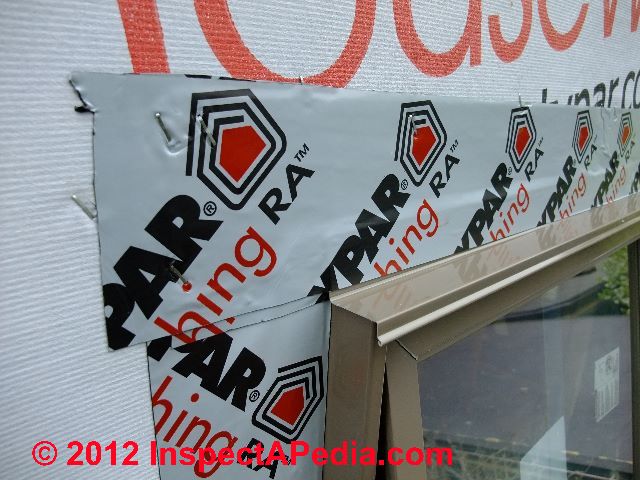
Our photo at page top shows Typar® flashing tape installed above a new window. A better practice laps the housewrap over rather than under the stick-on flashing tape, a detail omitted by many builders.
InspectAPedia tolerates no conflicts of interest. We have no relationship with advertisers, products, or services discussed at this website.
- Daniel Friedman, Publisher/Editor/Author - See WHO ARE WE?
Using Building Flashing Membranes - Peel & Stick Flashing Tape
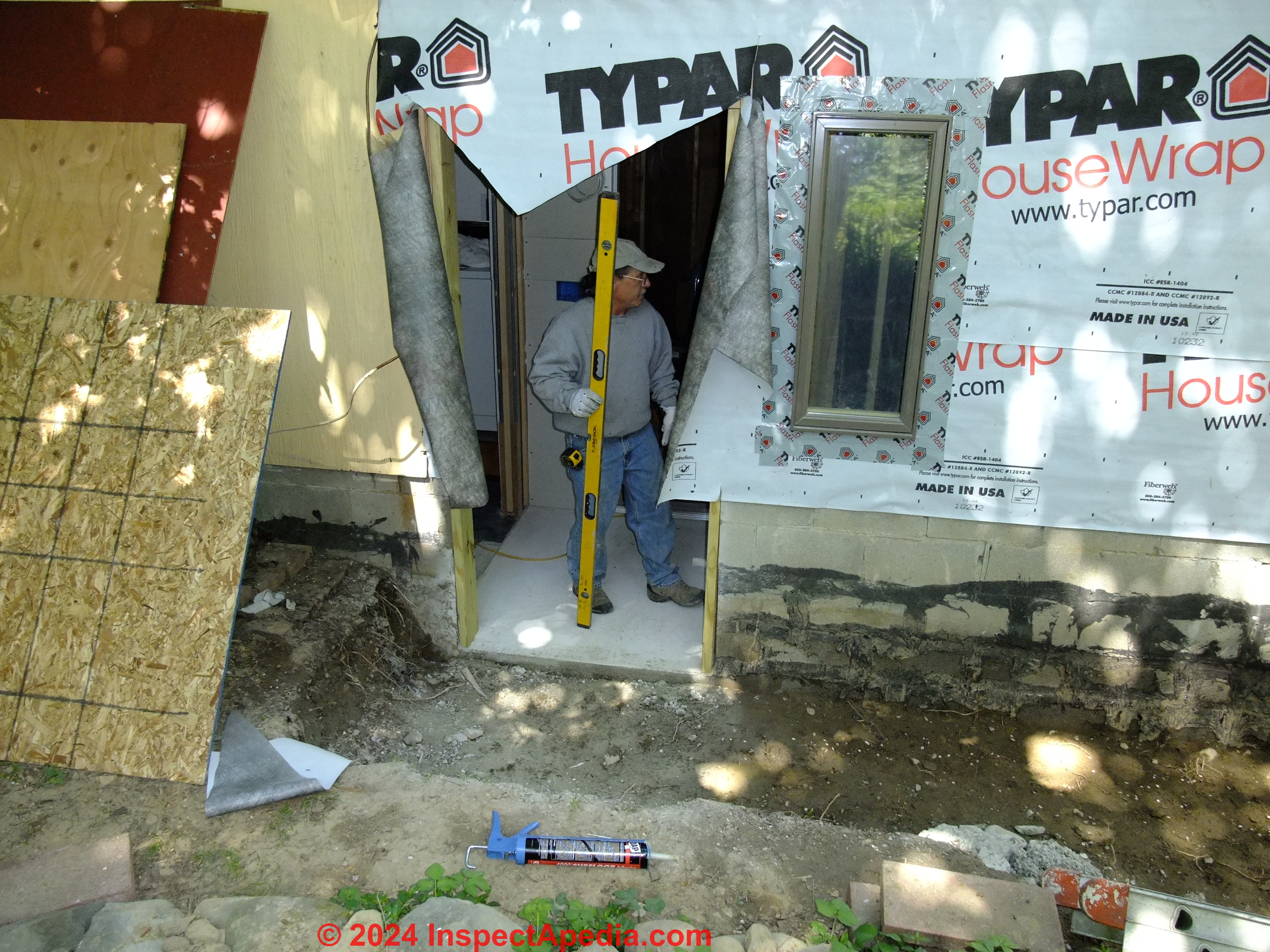
Use of flashing tape or peel and stick housewrap tape can prevent water leakage through building exteriors. What is the best way to flash around windows & doors and how should flashing tape be used at these openings?
This article shows best practices, common practices, and some not-so-good practices using peel-and stick flashing tape around windows, doors, and other building wall penetrations.
Photo above: working with builder Eric Galow (Galow Homes), the author and crew installed flashing tape membranes around every wall opening and penetration.
Article Contents
- FLASHING TAPE TYPES, USES
- FLASHING TAPE INSTALLATION TIPS
- WINDOW & DOOR SHIMS & SEALANTS - separate article
- FLASHING TAPE BRANDS, SOURCES, MANUALS
Portions of this article are adapted/paraphrased with permission from Best Practices Guide to Residential Construction (Steve Bliss, J Wiley & Sons) by Steven Bliss, courtesy of Wiley & Sons.
Peel-and-Stick Flashing Tapes, Types, Uses, Applications
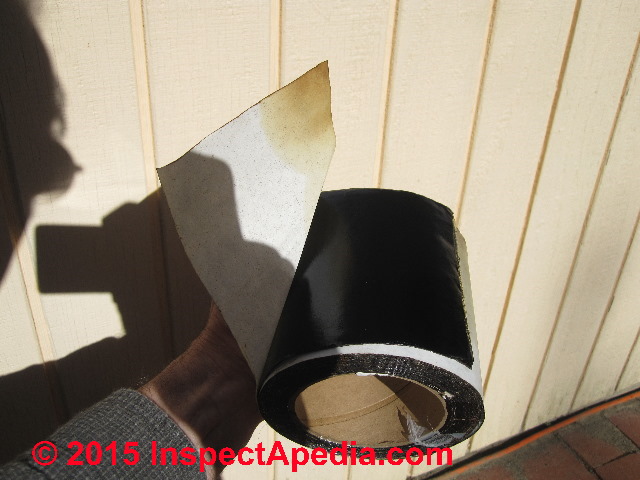 Typically ranging in width from 4 to 12 inches, these peel and-
stick membranes greatly simplify the task of creating
a continuous barrier to water entry around doors, windows,
decks, and other problem areas.
Typically ranging in width from 4 to 12 inches, these peel and-
stick membranes greatly simplify the task of creating
a continuous barrier to water entry around doors, windows,
decks, and other problem areas.
Flashing tapes are faced with reinforced polyethylene or foil on the outer surface and a peel-away paper on the adhesive surface.
The foil faced products may be left exposed to the weather permanently, whereas the plastic-faced tapes should not be exposed to sunlight and weather for more than 30 days (longer for some brands) since UV radiation will degrade the facing.
Comparing Modified Bitumen vs Butyl Peel and Stick Flashing Tapes
Most flashing membranes are made from modified bitumen, the same rubberized asphalt used in eaves flashing. Some use a more expensive butyl rubber core, which stays more flexible in cold weather and is more stable at high temperatures.
Butyl products also bond better to difficult substrates than modified bitumen and can be peeled off and adjusted during installation.
Moldable Flashing - Butyl-based
A unique butyl-based flashing tape from DuPont, called Tyvek FlexWrap®, has a wrinkled facing that allows it to be molded easily to irregular shapes such as the head flashing of round-top windows. It can also be bent to create a pan flashing at window sills without any cutting and folding at the corners. Despite the higher material costs, labor savings make this product appealing for tricky applications.

Applications for Flashing Tapes
These products offer several distinct advantages over metal flashings: They are easily bent or molded for an accurate fit, can accommodate settlement and shrinkage movement, are self-sealing around nail holes, and bond well to a variety of materials, including metal, wood, plywood, and vinyl window flanges.
Flashing tapes provide long-lasting waterproof protection if installed correctly. Oriented-strand board (OSB), concrete, and other masonry materials, however, can be problematic for some of the rubberized-asphalt flashings and may require priming for a good bond. Consult with the product’s specifications for compatible surfaces and priming requirements.
Guide to the Installation of Flashing Membranes
To obtain the best results with these products and be protected by the manufacturer’s warranty, it is advisable to follow the manufacturer’s recommendations.
These vary from product to product, but generally they address the same issues: application temperature, priming, installation techniques, and compatibility with surrounding materials.
Temperature Effects on Peel-and-Stick Flashing Membranes
In general, the rubberized asphalt (modified- bitumen) products start to lose stickiness at around 50°F and will not bond much below 40°F. Unless you are working with a rubberized-asphalt product specifically formulated for low-temperature applications, a butyl-based product is a better choice in cold weather.
Very high temperatures can also be problematic for rubberized-asphalt membranes. When subjected to high temperatures and pressure, for example, when squeezed under a dark-colored metal flashing exposed to direct sun, the material will soften and begin to flow.
Unless formulated for high temperatures and labeled “hi-temp,” most modified bitumen will begin to soften between 185°F and 210°F. High-temperature formulations can tolerate up to around 240°F, but are generally not as sticky.
Substrates: Bonding Flashing Membranes & Tapes to Solid Wood, Plywood, Vinyl, Metal, OSB
Each manufacturer specifies which products are safe to bond to and which require priming. Solid wood, plywood, vinyl window flanges, and metal are usually fine as long as they are free of oil and dust. Some manufacturers of rubberized-asphalt tapes recommend that all materials be primed for best performance, particularly in cold weather.
Most require that concrete and masonry be primed, and some require the priming of OSB and gypsum sheathing as well.
Many published details show asphalt-rubber flashing tapes bonded to asphalt felt and plastic housewraps. While these are rarely listed as suitable substrates in product literature, manufacturers of flashing tapes claim that their products will bond satisfactorily to both these materials as long as they are clean.
Do not expect a good bond to dirty housewrap that has been exposed to the weather for a month or to any dirty job-site material. For that reason, it is always best to detail flashings and to layer materials so that they shed water even if the adhesive bond fails.
Compatibility Flashing Membranes & Tapes With Vinyl
Rubberized-asphalt flashings should not be in direct contact with flexible vinyl flashings. The asphalt compound will draw the plasticizers out of the vinyl, causing the asphalt to soften and flow and the vinyl to become brittle.
The rigid polyvinyl chloride (PVC) used in window flanges, however, is generally not a problem. Rubberized-asphalt flashings should also not come into contact with any caulks or sealants unless specifically formulated for that use. Like soft vinyl, sealants may react with the asphalt, causing it to flow and stain the adjacent materials, such as window flanges.
Butyl-based flashings are compatible with most construction caulks and sealants, but they should never be installed in contact with any asphalt-based products such as roofing cement or bituminous flashing membranes.
These may degrade the butyl and undermine its ability to seal. In these applications, rubberized-asphalt is a much better choice.
Watch out: FortiFlash, for example, is not compatible with EPDM [rubber roofing] or flexible (plasticized) Polyvinyl Chloride (PVC) based products. FortiFlash and Moistop E#-Z Seal are not compatible with some sealants. Consult with sealant manufacturer for compatibility information.
Applying Pressure is Important in Stick-On Flashing Membranes
Flashing tapes must be pressed firmly into place to ensure full contact and a good bond. Some manufacturers recommend using a hard rubber roller for best results.
Splashback Protection and Other Uses for Peel-and-Stick Flashing Tapes & Membranes
While most flashing tapes are used around doors and windows, they can be put to good use wherever water penetration is an issue. Other applications include band joists, deck ledgers, inside and outside corners, and any areas subject to frequent wetting.
On wall areas adjacent to a deck or abutting a roof, for example, where splashback or snow buildup is likely to wet the siding, sections of membrane up to 36 inches wide can protect wall assemblies. Make sure to lap all layers of flashing, sheathing wrap, and adhesive membrane so that water is directed to the outside of the building, even if the adhesive bond fails.
Caution re Cold-Side Vapor Barrier: Don't Cover Entire Walls with Peel-and-Stick Flashing Membranes
Watch out: In cold climates, covering an entire wall section with waterproof membrane will create a cold-side vapor barrier, potentially leading to serious moisture problems and wood decay within the wall cavity. A section of membrane up to 3 feet wide, however, is unlikely to cause problems.
How to Installing Peel and Stick Flashing Tape Over & Under & Along the Sides of Windows & Doors
Which is the right way to install peel and stick flashing below a window
Reader question: Can someone please clarify this issue?
Most everywhere I've read about window flashing tape, it states to never apply it to the bottom of the window on the outside so water can exit to the house wrap instead of under the house wrap.
My siding crew taped the bottom of the window like shown in this article but I'm less worried about it because there's an open flap of house wrap below the window where water can eventually exit.
Also, I insisted on a rain screen and the house wrap should let water escape so it should get stuck inside. Either way, I don't think taping the bottom is hardly ever recommended. - 2016/09/13 Pat
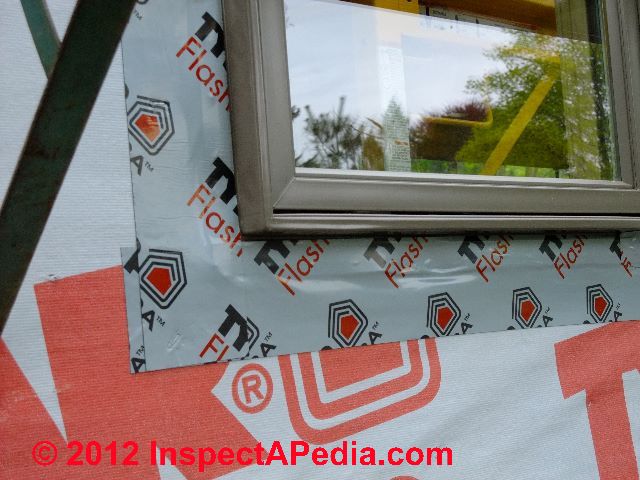
This photo of flashing tape installed below a window and over the window's bottom flange or fin does not show the very best installation practice. Photos by D Friedman & Eric Galow, Galow Homes.
Reply:
Pat:
You're quite correct. The photo showing peel and stick flashing tape applied over the window bottom flange and onto the building WRP or housewrap is not a recommended detail and might trap water in the window rough opening.
Please see complete details at WINDOW & DOOR FLASHING TAPE DETAILS - separate article
Sources & Installation Manuals for Flashing Tapes and Membranes - where to buy, how to install
- Avenco www.avenco.com Butyl flashing tape
- Bakor, Inc. www.bakor.com Blueskin self-adhesive, rubberized-asphalt flashing tape
- BERRY PLASTICS FLASHING TAPE MANUAL [PDF] Berry Plastics & Polyken Nashua Tape Products, distributed by various sources including Best Materials, retrieved 2016/09/13, original source:
www.bestmaterials.com/PDF_Files/flashing-tapes-manual.pdf - Blueskin SA, Henry Company, 999 North Sepulveda Blvd., Suite 800 El Segundo, CA 90245 310-955-9200. Contact the company at E-mail: productsupport@henry.com Phone: 800-486-1278
- Carlisle Coatings and Waterproofing www.carlisle-ccw.com Self-adhesive, rubberized-asphalt flashing tapes and membranes
- Dupont www.construction.tyvek.com StraightFlash and moldable FlexWrap Butyl flashing tapes
- DUPONT FLASHING SYSTEMS MANUAL - CURRENT, PDF] retrieved 2016/09/13
- FORTIFIBER FLASHING TAPE MANUAL, [PDF] retrieved 2016/09/13, original source: http://www.fortifiber.com/pdf/install_guides/IG_window_flashing_method_a1.pdf
FortiFlash® is a waterproof flashing membrane produced by Fortifiber Building Systems Group®, a Fernley NV USA company.
The product is a self-adhesive membrane reinforced by high-density polyethylene film that the manufacturer also refers to as “rubberized asphalt” and is described more technically as “a self-sealing SBS modified asphalt core laminated to a cross-laminated high-density polyethylene film reinforcement with a siliconized paper release sheet.
Contact the company directly for advice on the safest and most effective solvent to use. - Grace Construction Products www.graceconstruction.com Vycor self-adhesive, rubberized-asphalt flashing tapes and membranes
- Illbruck Sealant Systems www.willseal.com/usa Self-adhesive butyl and foil-faced butyl flashing tapes
- MFM Building Products Corp. www.mfmbp.com FlexWrap (foil-faced) and FutureFlash self-adhesive, rubberized-asphalt flashing tapes and membranes
- PELLA WINDOW FLASHING DETAILS, [PDF], retrieved 2016/09/13
- Polyguard Products www.polyguardproducts.com Windowseal self-adhesive, rubberized-asphalt flashing tapes and membranes
- Protecto Wrap Co. www.protectowrap.com Standard and moldable (Protecto Flex) self-adhesive, rubberized-asphalt flashing tapes
- Sandell Manufacturing Co. www.sandellmfg.com Rubberized-asphalt, PVC, and EPDM flashing tapes
- TYPAR FLASHING TAPE MANUAL, [PDF] retrieved 2016/09/13, original source: www.typar.com/assets/downloads/pdf/TYPAR_WPS_Install_Instructions_5-19-15.pdf
- ZIP WALL INSTALLATION MANUAL, [PDF] retrieved 2016/09/13, original source: sweets.construction.com/swts_content_files/102935/821515.pdf
Fortifiber Building Systems Group
Fernley, NV
1-800-773-4777 for sales and technical assistance.
Website: www.fortifiber.com
...
Reader Comments, Questions & Answers About The Article Above
Below you will find questions and answers previously posted on this page at its page bottom reader comment box.
Reader Q&A - also see RECOMMENDED ARTICLES & FAQs
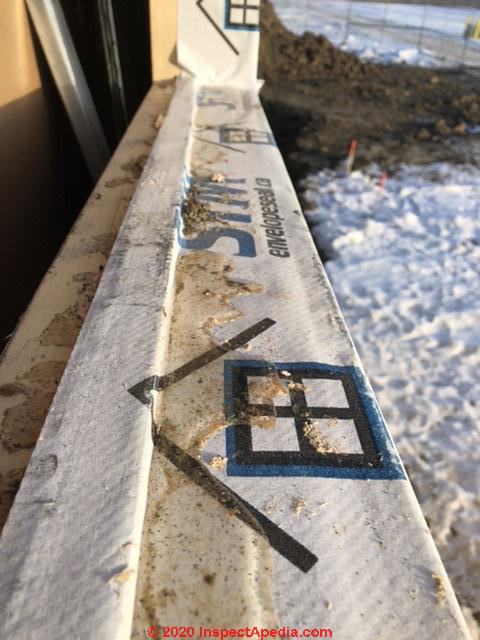 Most all peel and stick membranes are not designed nor warranties to hold standing water.
Interesting and educational piece.
Our efforts in this area have discoverer most all peal and stick membranes are not designed nor warranties to hold standing water.
Standing water such as a window will pan flashing. - On 2020-02-04 by Richard -
[Photo above of Envelopeseal peel-and-stick membrane used as a door pan]
Reply by (mod) - reliability & limitations of using peel-and-stick membranes as window & door pan flashing
Thanks for the photo and post, Richard;
I agree that durable pan flashing is a concern and that peel-and-stick membranes may not be up to the job; I prefer using a fabricated metal pan flashing and rely on the membranes only as an underlayment around the opening.
And in a freezing climate, even a modest amount of water under a window or door and atop the tape-fabricated pan flashing can cause heaving, door opening problems, or longer-term damage.
We can read what manufacturers like Pella have to say about using flashing tapes and membranes,at WINDOW & DOOR FLASHING TAPE DETAILS
where I include links to various installation manuals and guides
Typically you'll see that the instructions say "install a window pan" OR you can rely on flashing tapes but with some additional construction details such as exact placement of beads of sealant.
Watch out: the principal shortcoming of relying on peel-and-stick flashing tapes, speaking from personal experience, is that they don't always stick well to all surfaces. I've had problems with Typar and other tapes coming loose from
- OSB sheathing
- Plywood sheathing
- housewrap
- even framing lumber if it's not perfectly dry, free from contaminants, and not mill-glazed
- use in cold weather, applied to cold surface
My friend and sister site Steve Bliss - BuildingAdvisor.com makes a similar point at "Flashing Membranes" at buildingadvisor.com/materials/exteriors/flashing-membranes/
Let's see if we can find some research on the durability of window and door pan flashing that relies on tapes alone.Watch out: however it's also the case that window and door pans should be designed with slope and with an open exit along their outer face so that any water that enters the pan will drain out. I realize that "should be" is arm-waving; nobody frames a window or door rough opening with an outwards pitch on the bottom horizontal member.
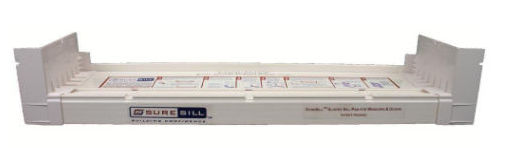
That's where using a pre-fab metal or PVC pan flashing can help us as those are often fabricated with the necessary slope.
Below: a PVC door pan flashing from SureSill, https://www.suresill.com/ as sold at Home Depot stores
Can you use flashing tape over top of step flashing?
can you use flashing tape over top of step flashing - On 2019-09-02 by Anonymous
Reply by (mod) - Nope
Not if left exposed to the weather
How do you remove flashing tape once it's been stuck onto a building?
How do you remove once applied - On 2017-10-12 by Anonymous
Reply by (mod) - flashing tape integration with housewrap - cut and repair housewrap as needed
Anon: removing self-adhesive flashing tape can give you a devil of a time if it's well-adhered to a surface.
if the flashing tape was applied to housewrap, we'd cut the housewrap above and alongside the flashing tape, then pull it away; we install new housewrap as needed up under the lower edge housewrap just above the cut-area
If the flashing tape was applied directly to wood or other hard surfaces you might find it slightly easier to remove by heating it a bit with a hair dryer.It's difficult to pull off and almost impossible to pull off without damaging the wood or other surface below - except when it wasn't pressed firmly in place onto a clean dry surface in the first place.
Can flashing tape be used to cover 'seam' between existing sheets of roof felt which have separated in parts?
Can this be used to cover 'seam' between existing sheets of roof felt which have separated in parts? - On 2017-03-14 by MFP
Reply by (mod) - Yes but ...
Yes, assuming you're going to cover that underlayment with new roofing material. But I'm unclear why you'd need an adhesive seam sealant on roofing felt underlayment since if the felt is in poor shape or damaged normally it would be removed and replaced, or a small damage area would simply have new felt overlaid in that spot.
Normal roofing felt under shingles is absolutely not a water barrier since it is punctured by the roofing nails.
If you need an underlayment that seals around roofing nails you'd be smarter to use an ice-and-water shield product that is wider and more economical in this application than flashing tape.Watch out: however in my experience peel and stick membranes do not bond well to roofing felt
Don't use flashing tapes in cold or snow climates?
Does this say to NOT use in climates that get cold, snow, or just to not APPLY during cold season? - On 2017-01-22 by 4000 elevation -
Reply by (mod) - OK in cold, wet climates, but don't apply flashing membranes in cold or wet weather
Do not Apply in cold / wet weather
Is it improper to ever put flashing membrane tape under a window?
Can someone please clarify this issue? Most everywhere I've read about window flashing tape, it states to never apply it to the bottom of the window on the outside so water can exit to the house wrap instead of under the house wrap. ...
My siding crew taped the bottom of the window like shown in this article but I'm less worried about it because there's an open flap of house wrap below the window where water can eventually exit.
Also, I insisted on a rain screen and the house wrap should let water escape so it should get stuck inside. Either way, I don't think taping the bottom is hardly ever recommended. - On 2016-09-13 by Pat -
Reply by (mod) - never apply it to the bottom of the window flashing on the outside - better for flashing to go OVER the flashing tape (if present)
Pat,
Thank you for asking: you're entirely correct that our photo of flashing tape set OVER the window flange of a new window installed into a R.O. is not the best practice.
To have space for illustrations and source citations I've included your question and a very detailed reply at WINDOW & DOOR FLASHING TAPE DETAILS
There you'll see that flashing tape IS used below windows but best practice installs it under not over the window flange. Best practice includes a window sill pan OR fabricates one from flashing tape.
Take a look, comment, and let me know what questions remain. Thanks. -Daniel
...
Continue reading at WINDOW & DOOR FLASHING TAPE DETAILS or select a topic from the closely-related articles below, or see the complete ARTICLE INDEX.
Or see FLASHING MEMBRANE FAQs - questions & answers posted originally at this page.
Or see these
Recommended Articles
- CAULKS & SEALANTS, EXTERIOR
- FLASHING on BUILDINGS - home
- FLASHING for METAL ROOFS
- FLASHING WALL to FOUNDATION or SLAB
- SHOWER PAN INSTALLATION & LINERS
- UNDERLAYMENT DOUBLE vs SINGLE - use of flashing membranes at roof eaves
- WINDOW & DOOR FLASHING TAPE DETAILS
- WINDOW FLASHING & SEALING Guide
- WINDOW TYPES - Photo Guide
Suggested citation for this web page
FLASHING MEMBRANES PEEL & STICK at InspectApedia.com - online encyclopedia of building & environmental inspection, testing, diagnosis, repair, & problem prevention advice.
Or see this
INDEX to RELATED ARTICLES: ARTICLE INDEX to BUILDING FLASHING
Or use the SEARCH BOX found below to Ask a Question or Search InspectApedia
Ask a Question or Search InspectApedia
Try the search box just below, or if you prefer, post a question or comment in the Comments box below and we will respond promptly.
Search the InspectApedia website
Note: appearance of your Comment below may be delayed: if your comment contains an image, photograph, web link, or text that looks to the software as if it might be a web link, your posting will appear after it has been approved by a moderator. Apologies for the delay.
Only one image can be added per comment but you can post as many comments, and therefore images, as you like.
You will not receive a notification when a response to your question has been posted.
Please bookmark this page to make it easy for you to check back for our response.
IF above you see "Comment Form is loading comments..." then COMMENT BOX - countable.ca / bawkbox.com IS NOT WORKING.
In any case you are welcome to send an email directly to us at InspectApedia.com at editor@inspectApedia.com
We'll reply to you directly. Please help us help you by noting, in your email, the URL of the InspectApedia page where you wanted to comment.
Citations & References
In addition to any citations in the article above, a full list is available on request.
- Best Practices Guide to Residential Construction, by Steven Bliss. John Wiley & Sons, 2006. ISBN-10: 0471648361, ISBN-13: 978-0471648369, Hardcover: 320 pages, available from Amazon.com and also Wiley.com. See our book review of this publication.
- John Rudy, Advantage Home Inspections, Flemington N.J. 08822 home inspector, 908-806- 6364, Home, Radon & Termite Inspections, Central & Parts of North New Jersey, email: jonadvantage1@yahoo.com
- In addition to citations & references found in this article, see the research citations given at the end of the related articles found at our suggested
CONTINUE READING or RECOMMENDED ARTICLES.
- Carson, Dunlop & Associates Ltd., 120 Carlton Street Suite 407, Toronto ON M5A 4K2. Tel: (416) 964-9415 1-800-268-7070 Email: info@carsondunlop.com. Alan Carson is a past president of ASHI, the American Society of Home Inspectors.
Thanks to Alan Carson and Bob Dunlop, for permission for InspectAPedia to use text excerpts from The HOME REFERENCE BOOK - the Encyclopedia of Homes and to use illustrations from The ILLUSTRATED HOME .
Carson Dunlop Associates provides extensive home inspection education and report writing material. In gratitude we provide links to tsome Carson Dunlop Associates products and services.
 | HOME | ABOUT | ASK a QUESTION | CONTACT | CONTENT USE POLICY | DESCRIPTION | POLICIES | PRIVACY | |
| © 2024 - 1985 Publisher InspectApedia.com - Daniel Friedman | |||||||||