 Return an Old Water Well To Service FAQs

- POST a QUESTION or COMMENT about how to return an old water well to service
How to return an old well to service:
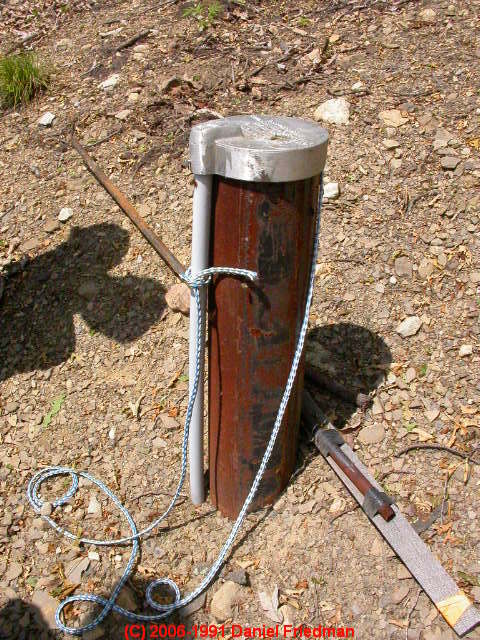
This article describes how to cure bad water test results or or non-potable water in an old, previously abandoned drilled steel casing water well.
Our page top photograph show an abandoned well casing at a property in Red Hook, New York. There was no well casing cap, the casing
InspectAPedia tolerates no conflicts of interest. We have no relationship with advertisers, products, or services discussed at this website.
- Daniel Friedman, Publisher/Editor/Author - See WHO ARE WE?
FAQs on Returning an Old Non-potable Drilled Well to Active Use
 These questions & answers about how to restore an old, abandoned well to use providing safe drinking water were posted originally at OLD WELL - RETURN TO SERVICE - please be sure to review the information found there.
Article Index
- DO I NEED A NEW WELL or IS THE OLD ONE USABLE? - before drilling a new well, read this Q&A
- HOW TO CLEAN OUT an OLD WELL - dirt, debris, chemicals, other contaminants
- HOW TO GET MORE WATER OUT OF AN OLD WELL?
- HOW TO RE-START AN OLD, LONG-ABANDONED WELL?
- WILL AN OLD ABANDONED WELL GIVE ENOUGH WATER?
...
Restarting an Old Water Well Q&A
I Need basic advice on starting up an old well that was abandoned for years
I'm looking to start up a well that's sat abandoned 2 years any advice will be greatly appreciated On 2016-09-24 by Anonymous On 2016-09-24 by Anonymous
Answer by (mod) - 9 basic steps to return an old well to service
I'd follow the advice in the article OLD WELL - RETURN TO SERVICE. Below I'll list some key steps for you:
- Review the equipment
to see what works and what needs repair/replacement: pump, pump control switches, pressure tank, piping, valves, well head - all of the above ground components you can access.
- Sanitize the well, piping, plumbing - WELL CHLORINATION SHOCKING PROCEDURE
- Check that there is a secure well cap or cover - WELL CAPS & COVERS
- Check flow rate - WELL FLOW TEST for WATER QUANTITY
- Check that the foot valve or any check valves are working - not leaking - WELL PIPING FOOT VALVES
- When there is a working pump you can further check for leaks in the well piping - WELL PIPING LEAK DIAGNOSIS
- Test the well water for potability (safe to drink) including testing for common contaminants that your water test lab says are often found on wells in your immediate area. - WATER QUALITY TESTS, CONTAMINANTS, TREATMENT
- If any of those steps raise question about the condition of the well bore or well casing, inspect the whole well bore using a well bore inspection camera. - WELL BORE CAMERA SYSTEM
- If you find that the well has debris or otherwise needs cleaning see WELL CLEANING PROCEDURES
Articles on each of those procedures at InspectApedia will give more detail if you need it.
...
How Can I get More Water out of My Old Well?
The water level dropped way down in my well, how do I fix it?
I have a well that was good for 100 gallons per minute. I watched as the drillers pump shot water 8 feet before it hit the ground with a 3 or 4 inch line. That was 11 years ago.
I put in a submersible 230V 25 gallon per minute pump running open discharge down 165 ft. Static water level WAS 6 ft. Now it cannot be seen. The pump runs dry after about 4 minutes. Sell is 200 ft deep as checked with a lead weight and fishing line. Whats the remedy? On 2018-06-29 by John G.
Reply by (mod) -
John
If you open WELL YIELD IMPROVEMENT you'll see techniques for increasing the water flow rate or yield that are worth considering.But it may be that the water level has changed (dropped) so much that you'll need to drill deeper or to drill a new well.
...
Cleaning Out a Well to Return it to Service
How can I decontaminate an old brick water well?
How do you decontaminate an old well made of brick ? On 2018-05-25 by Mary SQUIRE
Warnings by (mod) - it may not be possible to assure potable water without disinfection / treatment for that well
Mary
It sounds as if you are describing a brick-lined dug well. If so, I would not assume that the water is safe to drink.I think you are asking about well decontamination.
In that case
For a dug well, perhaps lined in brick, it makes no sense to try to shock or disinfect the well directly in my OPINION since it is impossible to keep such a well free from surface runoff and contaminants.
Instead I suggest that you have your well water tested for contaminants including
Test for bacteria
AND test for other contaminants that your local water testing company tells you are common in wells in your area
AND test for special contaminants likely to be at your property near the well such as pesticides, fertilizers, etc.
Those results will tell you what kind of water treatment equipment is needed to make the water safe to drink.
Watch out: testing for or treating just bacteria alone could leave your well water unsafe to drink.
See WATER QUALITY TEST CHOICES & WATER TEST FEES
At WELL CHLORINATION SHOCKING PROCEDURE we describe the disinfection of drilled wells - but that's a different situation from what I think is yours.
Watch out: practically no shallow dug well, brick lined or otherwise, can be guaranteed to remain free of contaminants because it's so easy for surface and subsurface runoff to leak into the well water. So use your water test results and advice from the testing lab to consider a water disinfection or other treatment system.
See DUG WELL CLEANING, DISINFECTION, SANITATION PROTECTION - Daniel
How do we recover an old well that was contaminated with kerosene?
Our water well was accidentally contaminated with kerosene 20 years ago. can it be safely recovered. On 2018-04-16 by Shirley
Suggestions by (mod) -
Shirley
I would start by collecting a water sample from near the top of the well and another from well bottom; have those tested by a water test lab who should screen for petroleum products.
The ability to recover the well depends on part on how much kerosene was poured into the well.IF the amount was large and the kerosene leached out of the well bottom into the aquifer during a period of low water table, recovery could be difficult.
If the kerosene remained only in the well bore it should be possible to pump out and flush the well, perhaps also sanitizing it.
Let me know your test results.
How do we get out dirt that has fallen into our water well?
 We have the same issue. Other then our well has dirt in it. Don't know how much or how far. Or how deep well is. What can we do to get dirt out of well? On 2018-03-25 by Ronda
Advice by (mod) - pumping systems specifically designed to remove dirt as well as smaller rocks or pebbles from water well bores
Ronda
There are pumping systems specifically designed to remove dirt as well as smaller rocks or pebbles from water well bores. Essentially the contractor pumps water down a supply line, through a suction venturi, then back up the return line - in essence a water-operated vacuum.
The set-up includes a foot valve, well piping, and a pump, any of several types: lever pump, inertial pumps, or other designs.The Waterra inertial pump we will illustrate below is one of the simplest methods to remove debris from a well and may be suitable depending on the diameter and depth of your well.
Contact Waterra (http://www.waterra.com/) produces inertial pumps used for this purpose.
Waterra Pumps Limited
5200 Dixie Road, Unit 17
Mississauga, Ontario
Canada L4W 1E4
tel: 905.238.5242
fax: 905.238.5704
email: sales@waterra.com
Waterra USA Inc.
5108 Mountain Home Ranch Road
Peshatin, Washington
USA 98847
tel: 360.738.3366
fax: 360.738.3399
email: waterra@openaccess.orgNote: be sure to have the well casing inspected for damage since a cracked or rust-holed casing will need repair before the well can be made usable.
...
Do I Need a New Well or is the Old One Usable?
Well driller said our well was dry; we drilled a new well then found the original problem was simply a bad wire to the well pump!
A small business well driller declared our well was dry and we needed a new well. He recommended another drilling company.
This company drilled 875 feet and then checked pump in the well that was previously used. The pump electrical wire was damaged - which he fixed, and now original well is being used.
We received bill for $9200 from this company which we feel should be partly paid by original well driller who said well was try without checking pump. Do we have any legal recourse? On 2016-04-30 by Expensive well owner
Reply by (mod) - DF - Watch out: warnings for homeowners: diagnose well problems carefully before deciding on expensive repairs or new well drilling
Expensive: I'm sure sorry about what's happened to you in this case.
I'm not an attorney, so I have to say that the "do we have legal recourse" question would best be answered by a local attorney who will doubtless review any contracts or documents that you received, reports on the well, etc.
My OPINION (not as an attorney but as a building and well inspection professional and as a prior AIA arbitrator) is that IF the person you hired in the first place - that "small business well driller" presented themselves as professional water well consultants or repair people, it would be reasonable to have expected a basic diagnostic inspection before declaring that you needed a new well.
For example, if no water is being delivered from a submersible pump down in a well bore one of the first things an installer would be expected to check was whether or not the pump was running.
There are some basic electrical tests that help answer that, and after that, if there were any remaining doubt the repair person would probably pull the well pipes and pump.
Pulling up the pump for further inspection and testing also allows inspection of the well pipe for disconnections, leaks, damage, and of course if there was water in the well, you'd see that because the piping and pump would have been wet when pulled.
Not all well companies have sophisticated well bore inspection equipment but WELL BORE CAMERA SYSTEMS permit inspection of the entire well bore and casing to determine if it is damaged, leaking, etc.
Normally it's a simple and basic procedure to measure the actual level of water in the well - the well static head, the well depth, and with a bit more effort to measure the well flow rate - the rate at which it delivers water - described at
- WELL DEPTH, HOW TO MEASURE
- WELL FLOW RATE
- WELL FLOW TEST for WATER QUANTITY
- WELL DYNAMIC HEAD & STATIC HEAD DEFINITION
Bottom line: read the articles I've suggested so that you will be familiar with basic water well components and inspection / testing procedures. That will show you what's reasonable to expect from a well and pump installation and repair professional.
Then collect all of your documentation and bills, photos, etc. and review them with a local attorney who is familiar with real estate, wells, and construction. - Daniel Friedman
Is it feasible to restore an old deep well or should I drill a new one?
I am exploring the possibility of reusing a well that has not been in use for 15 years. It has a pitless adapter and is 400 feet deep with the piping and submersible still in tact in the old well.
Is it feasible to try to restore to use or re drill a new well in a different part of the property? On 2015-07-14 by Rodger
Advice by (mod) -
Rodger
We need to know why the old well was abandoned, and it would make a lot of sense to have some actual objective facts: data on the well's ability to deliver water and the condition of the well bore.
I'd start by having the well casing and bore inspected by a well professional.If the casing is intact then I'd go to a flow test to see what water the well can deliver. That'll tell us if it's usable or not. Third is of course a water potability test plus checks for other contaminants that your local lab says are common in your area.
It is likely to be much less costly to return old well to service than to drill a new one.But also check with your local building department about well codes in your area. Basement wells may be prohibited - which could be a wrinkle at property re-sale time.
...
Can an Old Well Give Enough Water?
I want to know if this well can meet my needs for limited use. How do I begin?
I also bought property with an old well. I would like to see if the well can be used for limited number of farm animals (3) or keeping landscaping inventory watered before sale. Use as drinking water is not an issue.
The well is in a well house with an old pump that used belts still attached. When the pump quit working 30+ years ago the man moved his cattle to another location with a pond.
I do not want the huge expense of drilling a new well. I want to know if this well can meet my needs for limited use. How do I begin? When I contact someone to visit the well to assess its status, what should the steps be to determine the viability of using the water for farm and not drinking?
At some point I'd like to be able to determine if expense is justified by usage before I get too far into this. Thank You (June 11, 2011) M.R. F.
Reply by InspectApedia moderator: Checking out the flow rate of an unused water well:
M.R. F. you will want to hook up a pump and do a draw-down test or flow rate test on the well to see if the well is functional in water quantity to start. Then, even if only livestock are drinking the water you'll want the water tested to be sure it's not going to make them sick.
If the well is a shallow well you may be able to rent or borrow an aboveground pump to do the flow test.
If it's a deep well (more than 26 feet) you'll need either a submersible pump or a two-line jet pump and enough piping to get your pump or water pickup down to a few feet from the bottom of the well.
See details at WELL FLOW TEST for WATER QUANTITY
And be sure to read WATER USAGE REQUIREMENTS so that you have a realistic idea of your water needs.
...
Continue reading at OLD WELL - RETURN TO SERVICE or select a topic from the closely-related articles below, or see the complete ARTICLE INDEX.
Or see these
Recommended Articles
- DRIVEN POINT WELL RESTORATION
- DUG WELL POTABILITY TEST
- WATER TEST CHOICES & WATER TEST FEES
- WATER TESTING ADVICE for home buyers and building owners: water contaminants, water test procedures, well shock procedures, preventing drinking water contamination
- WELL FLOW RATE
- WELL LIFE EXPECTANCY
- WELL SAFETY WALL & COVER
Suggested citation for this web page
OLD WELL - RETURN TO SERVICE FAQs at InspectApedia.com - online encyclopedia of building & environmental inspection, testing, diagnosis, repair, & problem prevention advice.
Or see this
INDEX to RELATED ARTICLES: ARTICLE INDEX to WATER TESTING
Or use the SEARCH BOX found below to Ask a Question or Search InspectApedia
Ask a Question or Search InspectApedia
Share this article:Search the InspectApedia website
Need to make a private comment? Email editor@inspectApedia.com. We welcome email with your website content critique, corrections, suggestions or questions. Email is monitored daily but our workload may prevent an immediate reply. For immediate results, we hope you'll first try asking your question using the search box just above.
Citations & References
In addition to any citations in the article above, a full list is available on request.
- In addition to citations & references found in this article, see the research citations given at the end of the related articles found at our suggested
CONTINUE READING or RECOMMENDED ARTICLES.
- Carson, Dunlop & Associates Ltd., 120 Carlton Street Suite 407, Toronto ON M5A 4K2. Tel: (416) 964-9415 1-800-268-7070 Email: info@carsondunlop.com. Alan Carson is a past president of ASHI, the American Society of Home Inspectors.
Thanks to Alan Carson and Bob Dunlop, for permission for InspectAPedia to use text excerpts from The HOME REFERENCE BOOK - the Encyclopedia of Homes and to use illustrations from The ILLUSTRATED HOME .
Carson Dunlop Associates provides extensive home inspection education and report writing material. In gratitude we provide links to tsome Carson Dunlop Associates products and services.
 |
HOME | ABOUT | ASK a QUESTION | CONTACT | CONTENT USE POLICY | DESCRIPTION | POLICIES | PRIVACY | |
| © 2026 - 1985 Publisher InspectApedia.com - Daniel Friedman | |||||||||