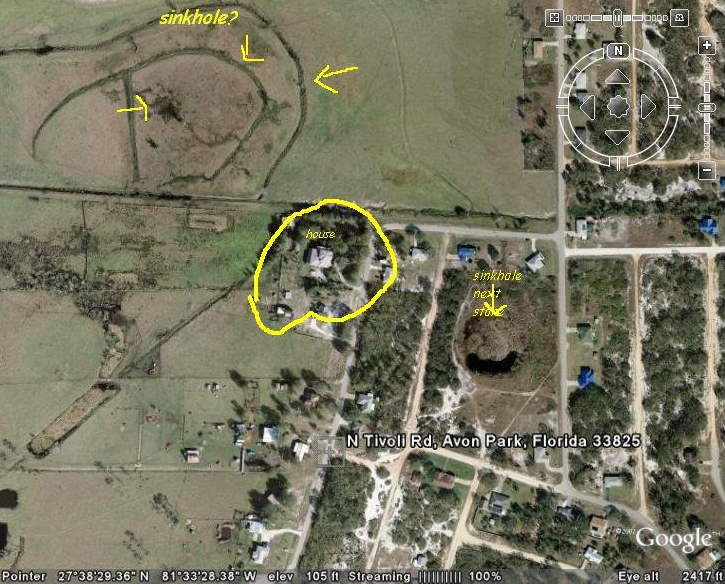
 Warning Signs of Imminent Sinkhole Collapse FAQs

- POST a QUESTION or COMMENT about sinkholes
Sinkhole & subsidence warning sign FAQs:
Questions & answers about detecting and taking action on suspected sinkholes developing at or near buildings.
This article series describes the visual signs that a sinkhole is likely or is already developing in an area: sinkhole warning signs.
InspectAPedia tolerates no conflicts of interest. We have no relationship with advertisers, products, or services discussed at this website.
- Daniel Friedman, Publisher/Editor/Author - See WHO ARE WE?
Sinkholes and Sudden Soil Subsidence or Yard Collapse Q&A
These questions & answers about detecting the presence of sinkholes and what to do about suspected sinkholes were first posted at SINKHOLE DETECTION, WARNING SIGNS.What can I do about a sinkhole risk for our northern Illinois village built over a marsh?
Hi, I live in a small village in Northern Illinois. When this area was settled in the 1800s it was a marshy area. From what I understand, the water was pumped out and the village was built. That being said, the ground on our one-acre property is very uneven.
The house is 118 years old and is built up on a mound. We have lots of low spots that collect rain water and then slowly is absorbed back into the ground. We also have two sump pumps in the basement that work non-stop. One spot that worries me is that on the parkway between street and sidewalk (village property) we have a very low spot that collects rain water.
What can I do about something like this? We want to place pavers there so we have a place to park out of the mud, but I'm concerned with the current condition of the area. It would have to be first leveled and then prepared for the pavers properly.\
This is not a DIY job. We bought the house two years ago. We have found that the storm drains for the village are in poor repair, broken and/or backed up with debris. We live on IL 173 and there is heavy truck traffic with lots of vibration. We don't know where to start to have this checked out. Thanks for any info. On 2017-03-27 by Vicki Kea
Suggestions by (mod) -
Vicki
I can't guess by e-text whether or not you are seeing a true sinkhole or more common settlement over fill and marsh.
But Illinois does have some Karst formations and sinkholes, as the Illinois State Geological Survey reportshttp://isgs.illinois.edu/outreach/geology-resources/karst-landscapes-illinois-dissolving-bedrock-and-collapsing-soil
You might want to start with your local building department to ask them to look at the site and give advice, and also to ask if there are known sinkholes or karst formations in your immediate area - else the hole is from something else.
I'm scared about a historic sinkhole in Winder, Georgia - what do I do?
Hi, I'm scared to death in Winder,GA. I live at the site of an inactive (at least at the moment & not since it's last week eruption in the 1800s which killed everyone in a 10 mile radius.) Mud volcano.
Our yard is pasture and woods except right up by the house from the foundation out 10 feet is peat moss and lately I've been feeling like the bottom is dropping out from my feet while I'm in the house. It's a three story governors mansion style brick home built in 1967.
Almost everything is just how it was back then except the wash down slope to the side that used to lead to a huge lake we had out back about two football fields behind our house and suddenly about a year and a half ago the damn broke and the water went somewhere but the lake is now gone not to mention there's black quicksand down around the area outside the crater a little ways which was already there.
The Indians called this place the gateway to hell and it used to be a burning swamp. Is this house on top of a sink hole cause I'm really certain that it's not safe but I can't convince anyone to listen inside our home. Help me please On 2016-05-30 by Sharon
Advice by (mod) - historic mud bog explosion in Winder Georgia
Sharon, I found a little history, not much, of the historic mud bog explosion in Winder Georgia, often referred to as a " mud volcano ", but not much scientific data; some texts posit that the Nodoroc mud explosion in Winder was due to decaying organic matter (leaves for example) in the bog.
If that was the case, it could certainly have been a methane explosion, though what ignited the methane gas is not stated. Certainly natural forces might ignite marsh gas as might a lightning strike.
Separately from the Nodoroc mud volcano, you describe a more recent bursting of a dam in about 2014. I haven't found references to that event. You might want to see the DeKalb County, Georgia Multi-Jurisdictional Hazard Mitigation Plan, February 2011, available from the DeKalb County government at http://dunwoodyga.gov/
If there was a sudden flooding of the site where your home is located there could have been damage to your home including its foundation.
It is, however, very unlikely that substantial foundation damage or movement could occur at your home, particularly as it is a brick structure, but with no visible evidence such as foundation cracks, building areas out of level, interior cracks, or other damage.Certainly enough house movement to make you feel "the bottom dropping out from under [your] feet" would be visually apparent on the home itself.
I can thus suggest these steps:
1. ask for a local inspection of the visual condition of your home and site for evidence of structural movement or damage
2. be sure that you have working CO detectors and smoke detectors, and ask your inspector to screen the site for presence of high levels of methane or other combustible gases
3. check with your doctor about any health conditions that might explain the conditions you describe
Insurance company won't cover sinkhole damage - what can I do?
What resources does a homeowner have when insurance company will not inspect the property and refused to cover any damages?
Reply:
Jackie, you may need to consult an independent insurance adjuster who will function as your advocate. S/he will in turn charge a fee, hire experts to evaluate the problem and basis for your claim, will negotiate with the insurance company in your behalf, and generally annoy them.(Aug 20, 2011) Jackie Venable
Is this a dangerous sinkhole below brick sidewalk?
A brick just fell though and there IS sand about six inches below. It ia a sidewalk. What do you think(Mar 13, 2013) Anonymous
Reply:
Anon,
Watch out: to be safe, I think you should rope off the area and ask the city to take a look - could be a water main or other thing undermining the walk - you haven't said where you area or if it's a sinkhole prone area.
My yard appears to be sinking, what do I do?
I am starting to see areas in my back yard that appear to be sinking. I have been watching them for a few months and they appear to be getting larger. What should I do?
There is a crack coming in the back yard seems to be getting wide quite quickly also around the foundation of house in same area the ground is sinking near the foundation leaving a wide gap all happening quickly we don't live in a common sink hole area(Mar 7, 2014) lee
Reply:
You don't say where you live - in some areas sink holes are a common and serious hazard
But just from your description it sounds as if you ought to
1. from a good distance away rope off or prevent access to the sinking area immediately
2. call your city building department and ask for an onsite inspection and advice
If you want to send us photos using the CONTACT link found at page bottom or top I may be able to comment further; do keep us posted.
Lee
There are lots of causes of sudden subsidence besides a geological formation associated with sinkholes; examples are underground water piping or sewer line leaks, buried stumps and trees, or collapse due to mining activity; for safety it would make sense to ask for help from your building department as a start, and to rope off or keep people out of the area.
Husband stepped into a hole yesterday that was approx. 1 ft. deep - Kentucky Sinkhole warnings
My husband stepped into a hole yesterday that was approx. 1 Ft. deep. We have had smaller ones outside under our large weeping Willow tree. Our neighbor has a underground well close to our home, which is close to our Weeping Willow tree. (75 ft.). The hole he stepped in was close to an entrance to his building outback.
He had to put something over it until he can fill it in. He has filled other holes up in the past. Our house has a door that won't close right, and a crack in our ceiling over the same door, (The crack has been there for years, but is getting worse, and in the garage ceiling.
Last year it was my sons bedroom door that was hard to shut, but it is okay now. Just was wondering what could be going on. Thank you. Sandy
I live in Eastern Daviess County Ky. Thanks (Mar 12, 2014) Anonymous
Reply:
Sandy, if it were just a small hole opening up in a yard I might suspect settlement around old buried debris.
But when you add that a door no longer closes and the ceiling is cracked, those suggest more serious foundation settlement - enough that it's worth having a more expert assessment. Foundation settlement can occur due to sinkholes but also due to soil compaction combined with water movement (roof spillage, surface drainage, underground water etc).
Certainly sinkholes do occur in Kentucky. Recently (3/5/2014) the Washington Post reported that a sinkhole opened beneath the Corvette Museum in Bowling Green south of Louisville.
And as has been studied by the University of Kentucky, there are karst formations in your state - a principal source of sinkhole formation.
I suggest contacting your building department to ask for some assistance. We can't say if the sinkhole risk to you is urgent or not based just on a text exchange.
I will add Kentucky karst references and information to the article above.
I add according to the U.K. experts at the Kentucky Geological Survey - U.K., www.uky.edu/KGS/gis/sinkpick.htm no sinkholes have been mapped in Daviess - your county in Kentucky.
So if investigation confirms that you and your neighbor are seeing actual sinkholes that could be important
Sinkhole risks to adjacent properties
If there is a repaired sinkhole in an adjacent property is my house at greater risk?(July 27, 2014) JoAnne Hahn
Reply:
Joanne
We can't assess that sinkhole risk by text. You need an onsite spent. On one hand we now know your house is in an immediate sinkhole area. On the other we can't guess how unspecified work at a neighbor might reduce or increase your risk.
The risk to your house depends on the type of sinkhole and the general sinkhole risk in your area too.
Pulling slate out of the ground exposed a tiny hole with running water - what do I do?
I pulled a few pieces of slate out of the ground in my driveway, I noticed a quarter sized hole. It was weird, so I took the hose to see if it would fill up, but it didn't.
Water just kept running into the hole, and then I touched the rocks around the edges of the hole and they were just falling away. So I stopped.
I don't know if this is serious, but it was definitely strange, The hole was only about 10to 12 inches around, but the hole wouldn't fill up after a few minutes. of putting water in it? What is that about?
The quarter sized hole was inside of the 10-12 inch hole where I pulled out the piece of slate. (Aug 22, 2014) kim
Kim
Reply:
Kim I can't know what you are seeing, but it MIGHT be an old cover over an old septic tank or drywall and so is indeed quite possibly very dangerous.
Or it might be a rodent hole - not dangerous unless you get bitten.
You want to rope off the area and keep people away until an excavator or other expert has figured out what's there. Nobody but a mouse is going to fall into a quarter-sized opening, but if there is a larger hidden problem you don't want someone falling into the opening.
...
Continue reading at SINKHOLE DETECTION, WARNING SIGNS or select a topic from the closely-related articles below, or see the complete ARTICLE INDEX.
Or see these SINKHOLE FAQs - questions & answers posted originally on this page.
Or see these
Recommended Articles
Suggested citation for this web page
SINKHOLE DETECTION FAQs at InspectApedia.com - online encyclopedia of building & environmental inspection, testing, diagnosis, repair, & problem prevention advice.
Or see this
INDEX to RELATED ARTICLES: ARTICLE INDEX to SINKHOLES
Or use the SEARCH BOX found below to Ask a Question or Search InspectApedia
Ask a Question or Search InspectApedia
Share this article:Search the InspectApedia website
Need to make a private comment? Email editor@inspectApedia.com. We welcome email with your website content critique, corrections, suggestions or questions. Email is monitored daily but our workload may prevent an immediate reply. For immediate results, we hope you'll first try asking your question using the search box just above.
Citations & References
In addition to any citations in the article above, a full list is available on request.
- In addition to citations & references found in this article, see the research citations given at the end of the related articles found at our suggested
CONTINUE READING or RECOMMENDED ARTICLES.
- Carson, Dunlop & Associates Ltd., 120 Carlton Street Suite 407, Toronto ON M5A 4K2. Tel: (416) 964-9415 1-800-268-7070 Email: info@carsondunlop.com. Alan Carson is a past president of ASHI, the American Society of Home Inspectors.
Thanks to Alan Carson and Bob Dunlop, for permission for InspectAPedia to use text excerpts from The HOME REFERENCE BOOK - the Encyclopedia of Homes and to use illustrations from The ILLUSTRATED HOME .
Carson Dunlop Associates provides extensive home inspection education and report writing material. In gratitude we provide links to tsome Carson Dunlop Associates products and services.
 |
HOME | ABOUT | ASK a QUESTION | CONTACT | CONTENT USE POLICY | DESCRIPTION | POLICIES | PRIVACY | |
| © 2026 - 1985 Publisher InspectApedia.com - Daniel Friedman | |||||||||