 Heating System Zone Valve Repair FAQs
- POST a QUESTION or COMMENT about how to repair or replace a zone valve on a heating system
Hot water heating system zone valve diagnosis & repair questions and answers set No. 2..
This article series helps diagnose and repair problems with zone valves on hot water (hydronic) heating systems.
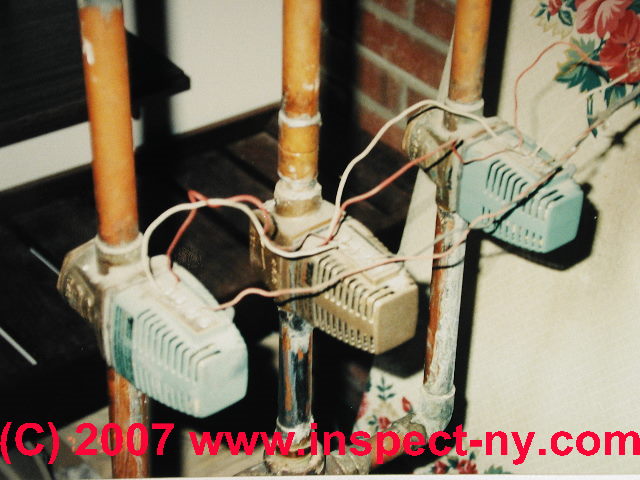
Page top photo: three older Taco zone valves, models 555-573.
InspectAPedia tolerates no conflicts of interest. We have no relationship with advertisers, products, or services discussed at this website.
- Daniel Friedman, Publisher/Editor/Author - See WHO ARE WE?
Recent Hot Water Heating System Zone Valve Diagnostic Q&A - Set #2
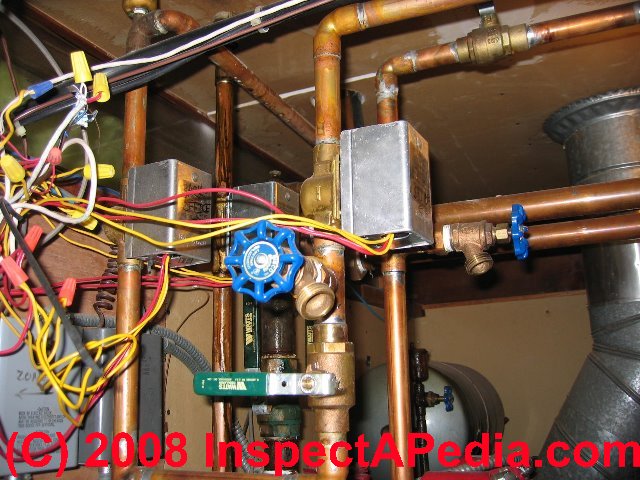
These hot water heating zone valve questions & answers were posted originally
at ZONE VALVES, HEATING - please be sure to check the advice found there.
Below is our index to questions and answers about zone valve installation, troubleshooting & repair.
Article Contents
- ADD SPLIT UP or ZONES
- BALANCE HEATING ZONES
- ZONE VALVE END SWITCH WIRING & OPERATING PROBLEMS
- ZONE VALVE HEAD MOUNT PROBLEMS - heads separate or fall apart or physically break
- ZONE VALVE HEAT is TOO SLOW - slow heating baseboards or radiators or radiant loop
- ZONE VALVE HEAT WON'T TURN OFF - also see Zone Valve Stuck FAQs & Zone Valve Too Much Heat
- ZONE VALVE HEAT WON'T TURN ON - no heat in some or all zones - also see Zone Valve Stuck
- ZONE VALVE LOCATION - where should we put zone valves and where might one be hiding?
- ZONE VALVE NOISES - bang clang tick click buzz hum noise cause & meaning & repair
- ZONE VALVE OVERRIDE - manually force the zone valve opened or closed
- ZONE VALVE PLUMBING, PIPING, LEAKS
- ZONE VALVE PRIORITY ZONE FEATURE
- ZONE VALVE INSTALL / REPAIR MISTAKES - after we installed or fixed a zone valve we had trouble
- ZONE VALVE STUCK OPEN or SHUT or ? - Also see Zone Valve Heat Won't Turn Off & Zone Valve No Heat
- ZONE VALVE TOO HOT - overheating zone valve controls
- ZONE VALVE TOO MUCH HEAT - temperatures too high, also see Zone Valve Stuck & Zone Valve Heat Won't Turn Off
- ZONE VALVE WIRING - connections to both low voltage & line voltage sources & relays or devices
- STRANGE ZONE VALVE Q&A
...
Zone Valve Won't Turn Off
Heat stays on when turned off if other zones call for heat
I have baseboard heating with 3 zones. 1 for the basement, 1 for the bedrooms and the last for the living areas. when we turn on the thermostat for the basement the baseboard heat turns on in the basement and in the bedroom zone.
I can turn the thermostat off in the bedroom area but the heat will still stay on if the basement is getting heat. last year all 3 zones worked correctly. Any ideas? 17 Jan 2015 Anonymous
Reply:
If you turn off heat at a thermostat and heat stays on in that zone when other heating zone thermostats are calling for heat I suspect a wiring error or shorted thermostat wires, or a zone valve that is mechaniacally stuck in the open position.
Fix unwanted heat at zones
We have a three-zone boiler system in our house. One zone controls the living room, dining room, and kitchen. One zone controls three bedrooms. And the last zone controls the family room, laundry room, garage, and two storage rooms.
When the zone for the 3 bedrooms calls for heat, the zone in the living room, dining room, and kitchen seems to also be receiving/circulating hot water and the registers get warm, but not hot enough to increase the temperature in that zone. Is this normal? We are new to this type of heat. Valerie said:
Reply:
Valerie
I was about to answer when I got confused by your word "registers get warm" - I think of registers as delivering warm air from a heating furnace.
If your heat is from a hot water boiler heating hot water baseboards or radiators,
AND
IFwe can assume that your thermostats are not calling for heat
and if we can assume that you're not just feeling left-over warm baseboards or radiators after the end of a heating cyle
that isIFyou mean that the zones not calling for heat continue to have baseboards or radiators well above room temperature for hours after there has been no call for heat
THEN
check for zone valves that are not closing fully, or check valves at the boiler that are not working.Let us know what your heating service tech says.
And see HEAT WON'T TURN OFF
Dunkirk HE boiler with indirect water heater: radiators get hot in summer
 I have a Dunkirk HE boiler that the hot water heater piggy backs off of, a total of 3 zones, two to radiators thru out the house one for the hot water tank.
I was wondering if i could shut off the radiator zones during the summer since the radiators become ambiently hot when boiler is called to fill hot water tank, thanks for your expertise (May 29, 2016) sue
Reply: zone valve should not open in summer
Sue
You could, but that doesn 't sound like the right fix.
In the summer when your thermostats never call for heat, your zone valve should never open and thus its end switch should never turn on a circulator pump and thus the boiler should not be turning on unless it it is asked to do so by your indirect water heater and its own zone controller.
So IF your boiler is running when your water heater's thermostatic control is NOT calling for heat, THEN there is probably a zone valve that sticks open or a check valve or flo-control valve that sticks open - that needs to be repaired or replaced.
First ask your heating tech to check to see that your heating system is using zone valves and if so to check to see if any of them is latched or stuck in the "open" position.
If there are no zone valves or if the zone valves don't seem to be sticking it's then worth looking for an open check valve in the system.
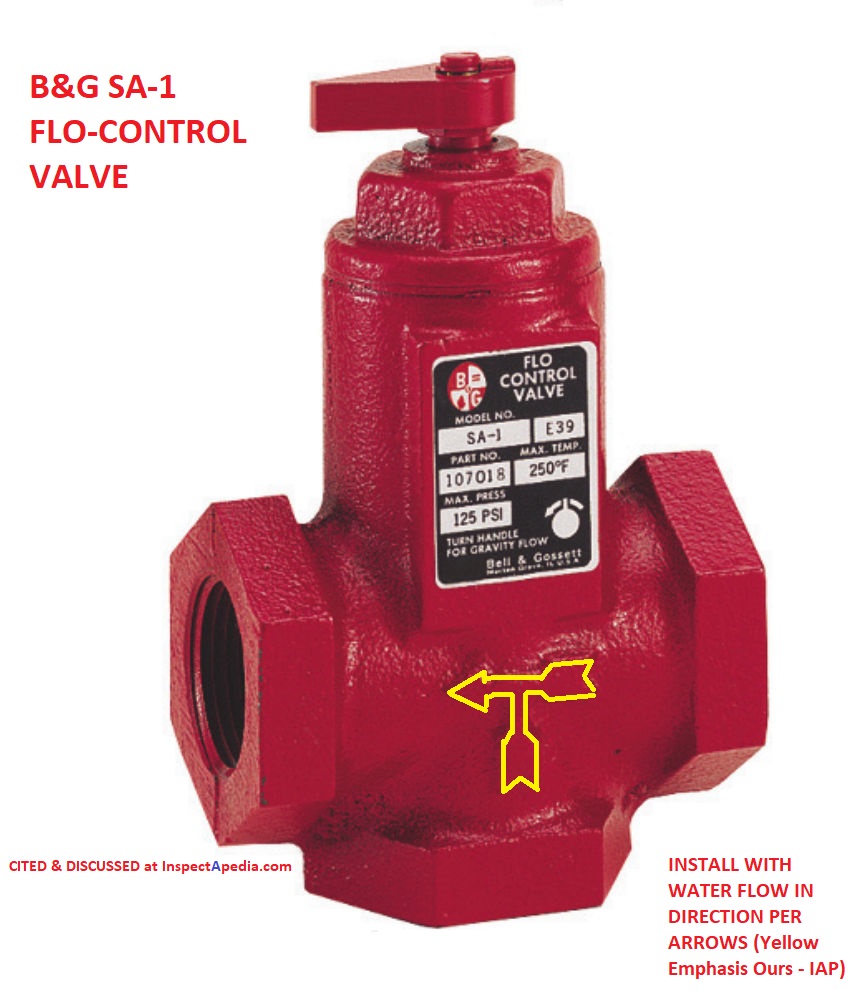
I've added a photo of a typical Flo Control Valve here in this discussion.
So I'd continue by looking at CHECK VALVES, HEATING SYSTEM
And then ask your heating service tech to check the flo-control valve or other check valves on your heating system.
My zone valve won't turn off: I can't turn off radiant heat in one room
If the zone valve is disconnected with it just run the hot water through the radiant heat? I ask this because our system won't turn off the radiant heat in our playroom. The valve was disconnected (flair valve) thanks! June 30, 2014) Katie
Reply:
Katie there are a couple of possibilities:
a zone valve may have been manually latched into the "OPEN" position
a zone valve may have failed and may be stuck in the open position
some zone valves may revert to "open" if their power source is interrupted.
Take a look at the valve to see if it includes a manual operating level;
Also be sure that the thermostat is not calling for heat - and that the thermostat wires are not shorted together (which would be the same as calling for heat).
See this diagnostic article
inspectapedia.com/heat/Heat_Stays_On.php
kate said:
Dan the zone valve was disconnect at the boiler - would that mean that the boiler just sends heat to that area now? or should I put the valve in the closed position?
thanks so much for your helpReply:
Kate if the zone wiring is disconnected you'll want to manually put it in the Closed position - else you'll keep getting heat
Tell me how to stop un-wanted heat in one zone - zone valve stuck open?
I had an electrician change the hard wired boiler service changed to a plug and outlet arrangement so I can direct connect to a generator during power outages.
Normally the boiler is plugged into an outlet fed by household current. During power outages I unplug the boiler from the house outlet and plug it into am electrical cord connected to an outdoor generator.
My question is in regard to the thermostats. Am I just heating the boiler water when connected to the generator or does the boiler wiring also control the thermostats?
In essence, does the electrical power for the thermostats/circulator come from the same boiler electrical source (if I supply power to the boiler am I also supplying power to the thermostats/circulators) or do they have a separate power source? (July 11, 2014) Anonymous said:
i have 3 zone s on gas boiler when zone 1 is on yhere is heat going zone 2 when it appears to be off (Sept 20, 2014) gordon
Reply:
Gordon if this is a new problem I suspect a zone valve stuck in the open position or manually latched open.
Stand by the zone valve while you have a helper turn the thermostat for that zone all the way down - you should hear the zone valve motor buzz or whir a bit as it closes the valve. And the pipe on the outlet side of the valve should cool down a few feet past the valve. If not the valve may not be closing.
...
Zone(s) too hot!
Why should my bathroom heating zone always be calling for heat?
I am not sure if bathroom zone should always call for heat when no other zones ever call for heat unless I turn them up - Steve 10/12/12
Reply:
Steve, Properly wired each zone normally calls for heat independently.
If your bathroom zone is always calling for heat, check for a short circuit in its thermostat wires, or for a defective thermostat, or a thermostat set higher than the room temperature.
If the termostat is set below room temperature it should not be calling for heat but it might if the thermostat wires are shorted together.
In our article on HEAT WON'T TURN OFF - topic home we include a step with details on checking for damaged or shorted thermostat wires that in essence has you disconnect the wires from the thermostat
and disconnect them at their other end at the control board
and then use a VOM or DMM in OHMS mode to check for a short between the wires
Our complete set of diagnostics for this problem are
Why are some zones too hot when the thermostats are not calling for heat
I have a 14zone HWBB system installed during home construction 8years ago.
Each room has its own loop and thermostat. I have zones that are hot 10-15 degrees above set points. All check valves were replaced 10/15/15.
System worked fine until spring 2015 when I first noticed the hot zones.
I guess my question from yesterday should have been, why are these zones so hot when the thermostats are not calling for heat?
Water is somehow bypassing the check valves, which is why I had them replaced. Any thoughts out there? 1 Nov 2015 Kerry
Reply:
Kerry:
I suspect that the flow-control check valve at the hot water lines exiting the boiler is either in manual "open" mode or is stuck open.
See
FLO CONTROL VALVE HANDLE POSITION - which way to turn the top lever, (Open, Winter, Closed on some valves)
and
ACCIDENTIAL HOT WATER FLOW by CONVECTION - or Gravity in hot water heating systems
If that's not the problem, check that the thermostat wires are not shorted together.
No heat: thermostat exposed to drafts? Overheating zone motor?
I moved it to manual but it didn't turn over in that zone. So I moved it back. As I raised the other zone upstairs the lower zone started to kick in. That's why I was wondering if it could be the motor of the zone valve. 2016-12-26 by Steve
Reply:
Perhaps there is a draft at or in the wall cooling the thermostat,or the temperature sensor could be dust blocked.
If with the motor-head removed from the zone valve you cannot easily open the zone valve then it needs replacement.
If you can open the valve but the line never gets hot, I suspect the line to that zone is air blocked. In that case,search InspectAPedia.com for AIR BOUND HEATING SYSTEM to read repair details.
Indirect fired water heater (zone) is making water too hot
We have an oil fired boiler situated on the ground floor which supplies heating to our radiators and also supplies hot water to our bathrooms and basins from a hot water tank situated in a cupboard on our landing.
Recently the actuator to the hot water system seemed to fail as the water was becoming very hot irrespective of whether the hot water was on or off at the control panel situated by the boiler as long as the central heating was set at "on".
I replaced the actuator to the hot water and it seemed to be ok for a while but then the problem recurred
Can you advise please?
The only thing I can think of is that recently our son in law opened all the valves to drain the hot water so that he could re-washer a hot tap. This may or not be relevant though. - Roger Cotton 10/28/2012
Reply: things to check to adjust indirect water heater temperature
Roger,
If the indirect fired water heater you describe is making water too hot,
- Check it's thermostat settings first, right at the thermostat or temperature sensor or limit switch that's probably mounted right on the hot water tank
- Then check for wrong replacement control thermostat or
- A sensor that is coated with mineral deposits and is not properly sensing temperature.
Boiler temperatures are too high and the circulator pump malfunctions
Our burner keeps getting hotter than 190 degrees and the circulator has been replaced six times in the last four months.
Our aquastat has also been replaced. We had a double then a triple installed. The aquastat currently in place is an electronic hydrostat.
The wiring to the burner has been replaced. What can be causing the Taco circulator to malfunction or the burner to get hotter than the settings on the aquastat? - Andrew D'Agostino 4/25/12
Reply:
Andrew, 6 circulators in 4 months sounds quite odd and as if no one found the real problem. I have seen repeat circulator failures when the tech replaced just the motor or pump but left a bent or worn support that torqued against the shaft bearing and ruined the replacement. If course, limited to no onsite assessment i am not sure what's going on.
If an aquastat us not shutting off the burner at the HI limit I suspect an improper installation, such as poor thermal contact in the sensor well or mis-wiring.
Perhaps you should ask the service manager for more expert help.
Heating boiler runs almost non-stop
After an annual maintenance visit I noted very hot water and the furnace running almost constantly.
They replaced zone valves and charged me. I recently evacuated my house to avoid hurricane sandy.
When I left I turned off oil burner and and turned off thermostat.
when I returned home -and turned oil burner switch back on i got hot water but no (baseboard) heat.
Technicians replaced zone valves AGAIN and said it was due to power failure. Does this make sense?
I would truly appreciate your opinion. - Zone Valve Issue 11/14/12
Reply:
Zone Valve Issue:
If your zone valves were flooded they'd likely be destroyed. It's also possible that other heating controls or electrical switches were water damaged. Any of those could cause the boiler to run continuously.
Since zone valves usually run off of a 24V transformer, if there were a power surge following a power failure, perhaps a transformer might be damaged, but I don't know how the zone valve itself would see the power surge nor power failure. But none of us knows it all.See if you can get your heating service people to be more explicit about exactly what component failed and how a power loss would cause that failure, and post the follow-up here for our research.
Also if you can let me know the brand and model of your zone valves we could check with the manufacturer too.
Don't assume malfeasance on the part of your heating people - often the service tech knows what s/he is doing but was not an English major in school.See the complete set of diagnostics for this problem
...
Zone Valve Won't Turn On / No Heat at Some Zones
How to diagnose zone valve that sometimes does not open - causing "no heat" on that zone
I have 3 separate zone valves in my home.
1 valve is for the basement apartment. At times it seems to be working normally; but at other times It will not call for heat until I turn the thermostat up for another zone valve. On 2021-05-13 by Anonymous
Reply by (mod) -
@Anonymous,
I would look first for a loose electrical connection and second I would consider replacing the zone valve actuator or motor that may be sticking or failing.
Upstairs heating zone won't turn on or doesn't receive heat
My upstairs heating zone is not turning on this year. I have checked the setting on the Electronic Aquastat L 7124/L7148 and can not find anything amiss. What might I be missing? - Lisa 12/30/11
Reply:
Lisa:
If your non-working heating zone has its own circulator pump, the service tech will check that the circulator responds to the thermostat on a call for heat. If not, check the thermostat, thermostat wiring, check for power at the circulator, check the separate circulator relay if your system uses one, then check the pump itself.
If the circulator is running, the boiler is hot, but heat is not delivered to one zone, your heating zone could be air-bound.See AIRBOUND HEAT SYSTEM REPAIR by WATER FEED VALVE
If the heating circulator pump runs but never causes the boiler itself to turn on and re-heat water, the primary control aquastat could have a burned-out primary or secondary circulator control circuit.
Keep us posted, what you find will help others.
Two zone boiler, single circulator pump replaced, now one zone doesn't heat
I have a two zone boiler with a single circulator pump that was recently replaced. I'm now having trouble with circulation for one of my zones. I think its the zone valve itself though when the thermostat calls for heat I see the valve adjust and I can also set the arm into manual.
My question is, is there a way test further if the valve is faulty. My instincts say if I can set the valve and it responds to the thermostat then its not faulty. Thanks - Chris 2/12/12
Reply:
Chris, as the circulator pump is running (else your working zone would also be cold) I suspect that either the zone valve is stuck shut or that zone is air bound.
You are right that setting the room thermostat up above room temperature should cause the valve to open, but if the zone valve itself is jammed or if the zone is air bound you won't get heat.
One problem zone valve opens when I adjust the thermostat but the hot water only flows to the valve not past it
I have a four zone one circulator pump hot water system. Three out of the four zones are working correctly.
The one problem zone valve opens when I adjust the thermostat but the hot water only flows to the valve and a little beyond then the line starts cooling down and I have no heat in that area.
Could my circulator pump be bad although the other three zones are working? On 2020-12-15 by GEORGE DRAIN
Reply by (mod) -
It's possible that the zone valve motor seems to run but it is not actually turning the mechanical valve in the pipe. This can happen if the valve itself becomes so stuck that gears are stripped in the zone control mechanism.
Try removing the zone head and see if you can manually open the valve.
Otherwise, if you're confident that the valve is opening then I suspect that zone is are bound. Use the on Page search box to look for our article series
on AIR-BOUND HEATING SYSTEMS to see how to diagnose and repair the problem.
100 Series gas boiler is not heating all parts of the house
Have a 100 series gas boiler. Part of the house gets heat but part of the house isn't getting heat. Worked for about a week and stop working and cant figure out the problem. - Brand 11/4/12
Reply:
Brand,
I would check for a thermostat not calling for heat, a zone valve not operating, a circulator not running, or an air bound system. Often it helps to feel the distribution piping to see where pipes are hot, and not.
Find out why a zone is not heating
A question, I have a zone that's not heating I hear no flow at all but the thermostat works, what I can't tell is I assume it would have a motorized valve but the motorized valves I see are for different areas how is it possible to pinpoint the area? (Nov 4, 2014) Mike
Reply:
Mike you'll need to follow the heating piping to locate a zone valve - it it's not in the usual spot close to the boiler itself. Open the valve manually.
If that works and if the thermostat wires are properly calling for the valve motor to open the valve and it does not, the motor head may need replacement.
If the valve can't be opened manually - that is if it's stuck - it needs replacement.
How do I fix a new zone that won't open
New powerhead on a zone valvce will not open when there is a call for heat.
All wiring is correct and have 26 volts when thermostat calls for heat.
I can manually turn open valve. (Oct 31, 2014) Anonymous
Reply:
Anon: sounds like mis-wiring or a bad motor in the zone valve head.
I have hot water but no heat. - 8 Diagnostic details
Oil boiler / baseboard heat. here's the situation:
1. Have hot water but no heat
2. Thermostat wires secured, batteries replaced, switched on forced air switch
3. Boiler turns on to replace lost hot water.
4. No breakers are tripped.
5. Bled the line, constant stream of clean fuel. Got fueled same day.
6. Emergency shut-off switch not engaged.
7. Emergency starter (we have a little red button) is not tripped.
8. Definitely sure nothing is coming from the baseboard heaters.
- (Nov 16, 2015) Dave
Reply:
Dave:
When the thermostat calls for heat, the circulator should turn on - which you can confirm by listening or feeling the exterior of the circulator pump;
and if the boiler is cold the burner will come on;
if the boiler is hot the burner may not come on until later
But in either case the pipes to and from the circulator pump should be hot.
If the circulator is running and the pipes are hot look for an air bound heating system or a zone valve that is not opening.
This sequence is where we start
Dave said:
-Circulator did turn on
-The upstairs heat works (confirmed)
-1 of 3 pipes coming from the circulator is hot
Found the problem, it was a zone valve not working and we flipped the switch. It needs to be replaced.
Thank you very much for the help, I really appreciate it!
Reply:
Good going, Dave.
With many zone valves you can hook the valve in the manual-OPEN position so you'll continue to have heat in that zone while waiting for repair.
If the failure is in the zone motor that may be replaceable without having to solder in a whole new zone valve assembly.
But if the problem is the valve itself jamming I'd go ahead and install a whole new unit.
Zone valve won't run - incompatible with circulator or thermostat type/brand/model?
I have a 3- zone hot water baseboard system. Oil fired boiler, separate electric hot water heater. The other day I had to rplace two old and leaking zone valves.
The Plumber and the electrician wired up the new zone valves and said they won't be able to turn on the furnace with the thermostat because the new zone valves don't work like the old valves.
The only way the furnace will heat the water is for the upstairs zone to be set on high. ? Please help me ! (Nov 29, 2014) Ken keller - kellerwelding@embarqmail.com
Reply: how a zone valve causes the boiler to run - indirectly - based on temperature
Ken
A separate electric hot water heater - providing domestic hot water for washing and bathing - has nothing to do with an oil fired heating boiler nor its controls. It is a completely separate appliance.
In typical heating boiler operation (for heating your hot water baseboards) when there are three zones, each thermostat is wired to a zone valve. When the thermostat calls for heat the zone valve opens.
When the zone valve is fully open, an end-switch in the valve closes a second switch that connects by wires to the boiler's primary control to turn on the boiler.
Traditionally in a 3 zone system there is a slight difference from what I just said: one zone, probably your upstairs zone, is wired directly to thermostat contacts on the boiler's primary control - that thermostat turns on a circulator and when needed, the boiler. The second two zones work as I described above.
So I suspect that the new zones installed are either improperly wired or were not properly chosen. It makes no sense to me that you'd have to call for heat where you may not want it (upstairs) just to get heat where you do want it in a separate zone (say downstairs).
Call the heating service manager at your service company and ask for help from an experienced heating service tech.
Keep us posted.
...
Zone Valve Wiring Problems
One of my heating zones won't run unless one of the other zones is "on"
the zone valve for my hot water heating system does not provide heat unless one of the other four valves are on. On 2019-09-12 1 by spencer
Reply by (mod) - wiring error or sub-zone hookup
Spencer
2 common causes for a zone valve refusing to open unless another zone is active are
1. Zone valve is not wired correctly
2. Zone valve is controlling a subordinate Zone that is actually fed off of one of the other zones' hot water line
It would be diagnostic to know if this problem has always existed or if it is new. If it's do then we need to ask what has changed or been modified in the system.
Where to find the wiring schematic for a Taco ZVC406 6 zone valve
Where can I find a schematic of the main board of a Taco ZVC406 6 zone valve control? - On 2022-03-10 by Anonymous
Reply by Inspectapedia Com Moderator - Taco wiring guide
@Anonymous,
Take a look at the wiring guides at
TACO ZONE CONTROLS WIRING GUIDE
Please let us know if you have additional questions.
Where to get a zone valve wiring installation diagram
I need diagram for install zone valve - Manuel 10/8/12
Reply:
Manuel, we don't know if you're asking about piping routing, zone valve location, or zone valve electrical hookup.
The wiring for zone valves varies slightly among brands and models - and will be shown in several options on the instructions that came with your zone valve. As you are installing a valve, look in the box.
I know, some fellows use the instructions to kneel on during work at the boiler, rather than reading materials. If you've lost the instructions, give us the zone valve brand and model and we (or you) can obtain the detailed instructions from the manufacturer.
Typically there are four wires at the zone valve.
Two wires connect from the room thermostat to tell the zone valve to open or close in response to room temperature.
They may be marked T1 and T2. Two other wires connect the zone valve end-switch (a switch that closes to make the circuit when the zone valve itself is fully open or shut) to the circulator relay. Those may be labeled C1 and C2.
See details at ZONE VALVE MANUALS & WIRING INDEX
Who should wire up our zone valves? Electrician or Plumber?
We're building a small house with 3 zone radiant heat. The plumber said it is all ready to go except for the wiring and to call the electrician.
The electrician says they don't do that wiring anymore...the plumber should do it. Who do I believe? On 2018-06-30 by Judy
Reply by (mod) -
Judy
I prefer to stay out of what my mother called "a lot of who-struck-john" arguments where people stand in a circle and point blame on the next person to their right.Watch out: never insist that a contractor do something that they might not, in fact, actually know how to do properly. That's asking for a bad job, possibly an unsafe one.
Usually the person who installs a zone valve also hooks up its wiring. I'd expect a zone valve installer to know enough about hot water heating systems that she or he knows how to wire a zone valve. But I realize that you might have at hand a plumber who only knows how to cut and connect pipes.
Watch out: in that case there is a 90% chance that after the plumber leaves your heating system won't work because it'll be airbound - since cutting pipes to install a zone valve probably will mean draining some of the heating system water and getting some unwanted air into the system.
If that happens, see AIR-BOUND HEATING SYSTEMS for details of how your heating service person will have to fix the trouble.
But in my OPINION, I would prefer to have a licensed electrician or a trained heating service tech who actually knows hwo to hook up a zone valve do electrical wiring and then if you want, your plumber can do the plumbing work.
Watch out: You need to find a different electrician, one who is familiar with wiring radiant heating systems, thermostats, zones, controllers, or who will at least read the instructions in the installation and operation manual for your heating system and each of its controls - be sure that your installer left those with you - and talk to the heating company directly if needed.
How do we figure out how our 5-zone baseboard heat controls are wired?
hi all, we just moved into a house and are trying to figure out the wiring for the 5-zone hot water baseboard heat.
The system uses 120V line level thermostats for each zone, and I'm trying to plan to replace with 24v and relays connecting the 24v to the 120v sections.
I see how this would work for single zone, but what's difficult to figure out is how each of the thermostats connects back the the boiler and valves for each zone. The wiring is spaghetti since it's using romex and mixed in with all of the normal 120v lines.
should I expect each thermostat to run back to the valve? do they all have to run to the boiler as well? Any links to wiring diagrams for these multi-zone setups with line level thermostats would be helpful- they seem really uncommon, On 2017-12-09 by carl
by (mod) -
Carl:
In a typical 24VAC system with just a few zones each thermostat talks to a zone valve (assuming you're using zone valves) or else to a circulator relay (if you have one circulator for each zone)
Where there are 5 zones you might look at a multiple-zone controller like the the controls we discuss
Why is there no voltage at my low voltage transformer for my zone valves?
I put on a new 24 volt transfomer and with test leads it shows 24 volts but then I connect leads on yellow and blue leads and it shows no current why ? On 2017-11-30 by Gene
Reply by (mod) -
Gene,
I don't know to what your yellow and blue leads are connected. But I'm guessing you refer to zone valve wires.The thermostat has to be calling for heat, the you should see voltage at the zone valve.
How many transformers do you need to power 4 zone valves?
How many VA transformer do you need to power 4 zone valves 1 Nov 2015 Dennis Santoro
Reply:
One should do it.
See LOW VOLTAGE TRANSFORMER TEST where you'll find articles about installing and wiring and repairing low voltage transformers.
More help is also at THERMOSTATS, HEATING / COOLING - home and the thermostat wiring articles.
How to Hook up a two wire thermostat vs White Rogers 1311-102 Zone-A-Flow valves
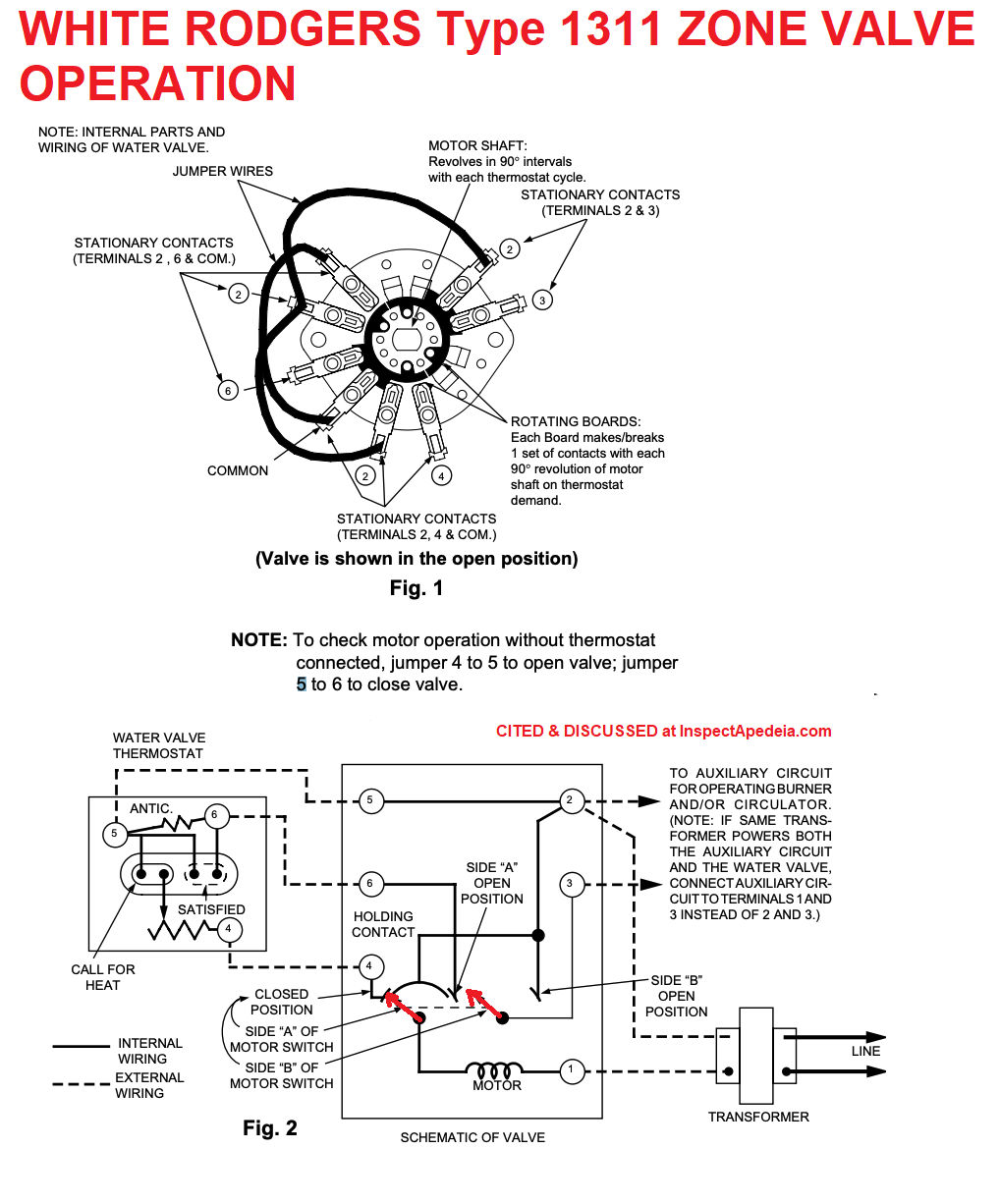
My boiler system has White Rogers 1311-102 Zone-A-Flow valves.
These valves require thermostats to send current to the valve to turn on, but then the valves also require current to the opposite wires to turn the valve to the off position.
Just stopping current to the "ON" position will do nothing as the valve stays open.
Therefore a simple 2 wire thermostat will not work without a relay to send current to the off wires when the thermostat turns off, or a special thermostat that sends current one way when heat is on, and current through another wire to turn the valve off.
Why would anyone want a valve like that, instead of a spring or mechanism that just turns the valve automatically to the off position when the thermostat turns off? - On 2021-05-18 by Jon Green -
Reply by (mod) - White Rodgers Type 1311 Zone Valve Operation & Wiring: normally-open vs normally-closed zone valves
@Jon Green, Thanks for pointing out the operation of the WR-1311 Zone Valve
About the "why" of requiring electrical energy to close the valve when the thermostat is satisfied, I'm embarrassed to pretend to second guess WR's engineers who certainly know more about it than you or I, but maybe the idea was to make an inexpensive zone valve that would close more-reliably than a spring-operated valve.
Among zone valves are models that are
NO - Normally-Open, and use a current to close the valveNC - Normally-closed, and use a signal to open the valve
and theWR-1311 type zone valve that uses current both to open and to close the valve.
This excerpt describes the operation of the White Rodgers 1311
As the thermostat calls for heat, the valve motor is energized and begins to open the valve. Soon thereafter side “A” of motor switch makes with the holding contacts.
This contact provides a holding circuit to prevent the valve from stopping part way through its cycle if the thermostat is changed to the satisfied position.
Just before the valve reaches the full-open position, side “B” of motor switch closes (providing a low voltage auxiliary circuit for starting burner and/or circulator).
The motor stops with the valve in the open position when side “A” of motor switch breaks the holding contact. (Completing a circuit through contact “6” and the thermostat anticipator.)
When thermostat is satisfied, the valve motor is again energized. Just after the valve starts to close, side “A” of motor switch makes with holding contact providing a holding circuit.
The side “B” of motor switch opens (breaking auxiliary circuit), and side “A” of motor switch makes with contact “4” then breaks the holding circuit stopping the valve in the closed position. (Fig. 2)The contact arrangement is constructed so that when the shaft of the motor revolves 90° a new set of stationary contacts makes while the old set breaks. (Fig. 1)
See more at NORMALLY-OPEN vs NORMALLY-CLOSED ZONE VALVES
For other readers, the installation instructions and wiring diagrams for this zone valve are at
WHITE RODGERS 1311 ZONE VALVE INSTRUCTIONS [PDF]
Trouble wiring up different zone valve controller brands together: Taco Zone controller + Honeywell Aquastat
Hi, I have a HE II Weil McClain nat gas boiler. A few years back I converted about 1/4-1/3 or my house into hydronic radiant floor heat running off same zone as the baseboard.
The guy who sweated the tubes and zoned it out has never come back to hook up the zone controller.
Someone else came out the other day to hook it up.
I have a TACO SR502 2-zone controller and this person purchased a Honeywell L6006C 1018 aquastat controller.
I am thinking he purchased the wrong aqua stat. He said the whole system will never allow for 2 zones.
I spoke w/techs @both TACO and WeilMcClain who, both said, I can have my floor heat operate separately from the BB units. (I do have 2 thermostats).
Can you shed a little light on this, please? Thanks, - T.B. 10/27/2013
Reply: known problem; check with the manufacturer, the wiring diagram, or send us more details
Absolutely, if properly wired, you can take a single loop of hot water baseboard heat and subdivide it, giving each sub-loop its own thermostat and zone control valve.
I have moved the details of this discussion to a new article ZONE VALVE MANUALS & WIRING INDEX where I give specific wiring examples for multiple zone valve installation and where I give more details about how we wire up "incompatible" brands of zone valves on the same heating system.
Too many thermostats & zone valves on one power transformer
I have a 7 zone heating system with thermostats. I was trying to replace honeywell thermostat with nest, when i un-installed the thermostat and installed nest, i noticed that i lost power and nest was not functioning.
my other two rooms also lost heat because they are wired to the same transformer(however, the other two rooms have power just no heat). Is this a bad transformer issue or something else? 2016-12-21 by Al
Reply: overloaded transformer
Al,
Perhaps 7 thermostats is 3 more than a single power transformer can support - or if the setup uses 2 transformers you may have blown one.
Make sure they have at least a 75VA transformer for the zone valves
Just curious about the query whose 7 zone valves keep failing once a year. I wonder what the rating on the transformer is? If it's a standard 40VA like you find on a lot of equipment from the factory, 7 of those valves will try to draw 60VA if they all open at once.
The voltage will sag, the current will go through the4 roof, and you'l burn the windings on those tiny synchronous motors. And this is not just an instantaneous short either - once those valves start going, they keep going as long as necessary.
Readers should make sure they have at least a 75VA transformer for the valves - 60VA for full load plus 20% headroom. 2016-10-20 by Andre
Reply: Voltage drops when 7 zone valves are on one transformer
Good question, Andre.
We often read about people hooking up too many zone valves to a single transformer, overloading it. When updating this article I'll be sure to include your helpful comment.
Readers should also see -LOW VOLTAGE TRANSFORMER TEST
and
also see ZONE VALVE MANUALS & WIRING INDEX
What's the allowed number of zone valves per thermostat?
How many zonal valves for floor heating can be connected to one room thermostat (Mar 5, 2014) tej
Reply: normally one thermostat runs one zone valve - for more, use switching relays
Tej
Interesting question. Normally one thermostat controls one heating zone and is connected to one zone valve.
But as the thermostat is basically an on-off switch, indeed we've discussed with readers the successful combining of more than one zone valve switched by the same thermostat.
Watch out: to avoid overloading the tt or its power or circuit, check the zone valve wiring instructions.
For switching multiple zone valves with one thermostat you may need to have the thermostat control a switching relay that in turn switches the gang of multiple zones.
A typical switching relay such as the Taco SR502 - 506 can switch 4 zone valves or more.
To find out more about the switching relay I cited contact
Taco Inc., 1160 Cranston Street, Cranston, RI 02920 Telephone: (401) 942-8000 FAX: (401) 942-2360 - USA
or if you are in Canada contact
TACO (Canada), Ltd., 8450 Lawson Road, Unit #3, Milton, Ontario L9T 0J8. Telephone: 905/564-9422. FAX: 905/564-9436.The company's website is at www.taco-hvac.com
How can I control two heating zones from one location?
I have hot water radiators in my house which is divided into two zones.
How can I have a control panel for both zones in one location that allows me to control both zones separately or together and just have two temp sensors, one in each zone?
I can't get a knowledgeable answer from any of the tech support people for the manufacturers, as they all seem to be off-shore contract customer service call centres and don't know much about heating system design.
Everyone tells me I need two thermostats. Tell me it ain't so. On 2019-10-02 by Daniel Dillon
Reply by (mod) -
Daniel,
There are several ways you could accomplish what you asked about.
Remember that a thermostat is essentially an on-off switch controlled by temperature.You could easily enough wire low voltage wires from each zone control to a central point where you provide your own on off switch.
The disadvantage of that approach is that you give up individual zone temperature control.
Instead, the most effective solution, one that would require the least special wiring and would continue to allow you to provide individual temperature control for each Zone, would be to install a smart thermostat that can talk to an app on your cell phone. If you search inspectapedia.com for NEST THERMOSTATS you'll see an example.
How do I wire one zone valve to cause another one to turn on?
How do you wire one zone valve to another. One controls the other? - Joe 11/22/2012
Reply:
Joe
I've never tried wiring zone valves in series,but in effect, if you want two zone valves to open at the same time in response to the same thermostat, you can wire them in parallel
- that is, the thermostat wires that talk to Zone Valve #1 are also carried to Zone Valve #2 and connected at the same point.
On Normally-open zone valves: power is required to keep valve open
What I understand is with the normally open valve power is required continuously keep the valve closed. I think that this could cause extra heat build up in the motor and cause premature failure along with more power usage.
The normally closed valve only uses power to open the valve when heat is called for.
The application that we have is residential, but was originally installed when the house was built 29 years ago.
It's a good system but we are trying to improve costs and new procedures develop with time. There are no special heating needs or requirements.
Thanks for all of the information it will help us in making a decision. Probably one thermostats at a time. (Feb 3, 2014) Dennis B. Hoff
Reply:
Dennis:
Dennis: thanks for the follow-up. keep us posted. As I noted, unless the valve mechanism itself is damaged, you can just change the power head - leaving the actual valve assembly in place. Quoting the product literature:
Easy servicing because the entire powerhead assembly can be replaced without removing valve body from line.
Optional accessory fittings can be provided to facilitate convenient removal of the entire zone valve unit. - op cit.
When changing the thermostat, there are some models that can be wired to operate either type of zone valve: normally closed or normally open.
An example we're looking at is the Honeywell FocusPro TH6110D programmable thermostat - it's quite versatile.
It's not clear to me that the added heat from the 40VA transformer wiring that powers this zone valve would normally be sufficient to contribute to the product's failure in the field. The temperatures of the circulating hot water are, in my OPINION more likely to be a factor in zone valve life.
Watch out: however, for wiring errors, short circuits, or a misbehaving low voltage transformer. Those defects could contribute to zone valve failure, as might corrosive or mineral-laden water in more rare cases.
How does the zone valve motor avoid burning out?
I just replaced the motor on my Honeywell V8043 zone valve and is working fine.
I was intrigued how this hearty little motor worked, so I removed the cover on the old motor.
The simplicity and durability amazes me not to mention the significant gear reduction.
Can anyone tell me if there is some sort of slip clutch or other means in the head unit that that allows this little motor to rotate without burning itself out while it continues to hold the valve closed and makes the endswitch until the thermostat opens? 12 Feb 2015 Chuck
Reply:
Chuck, (speaking beyond the edge of my expertise)
Typically the Honeywell V8043 series of zone valves are a "normally closed" valve that is opened by its motor that turns the valve against a spring. When the "open" signal stops the valve is closed by an internal spring.
Zone valves with a manual operating lever are intended to be able to be opened to allow heating water to circulate by "gravity" or convection during a power outage - of course since on most systems the burner will also be off during a power outage the duration of this benefit is limited.
But it seems to me that the manual design and the spring-closure design mean that the 24VAC motor simply is held in the open position without burn-up on a call for heat, without a slip clutch and often lasting for decades.
In actual operation the class F (temprature tolerance) synchronous motor of the zone valve is drawing at most about 7.7 VA
Zone valves don't work when on backup generator
Valves work fine--except when I switch the ac power to a generator--then they don't work at all. Power form generator is perfect sine wave and at 110 volts
Help! On 2018-11-03 by George
by (mod) - check which circuits are included in your backup generator transfer switch panel
George:
When you switch power from the main electrical panel to a backup generator it's likely that not ALL of your electrical circuits are receiving power.
So you may be powering the circuit that runs your heating boiler but the zone valves or circulator pump (s) may be on a different circuit.
...
Zone Valve End Switch Problems
What is a Heating Zone End Switch
A zone valve end switch turns the heating zone circulator pump on or off depending on whether the zone valve itself is open or closed.
Heating zone valves typically two pairs of wires: one pair, operated by the thermostat at 24VAC, actuate the zone valve motor to open or close the valve.
Zone valves also include a second pair of wires, operated an "end switch" that closes when the valve is fully open. The "end switch" is used to turn on the circulator pump (or pump relay control) once the zone valve has opened in response to a call for heat.
Diagnose a bad end switch on zone valve
I have a three zone residential system with a slant fin Galaxy boiler and three Honeywell v8043E1012 normally closed valves.
Had been having problems related to poor solder joints on controller relay but that seems behind me.
I think. Problem now is one control valve does not call for pump (single grundfoss ) to kick in. Works fine when either of the other two zones call. Zone valve motor works fine and zone is open.
Is there a bad end switch on this zone controller? (Nov 28, 2014) Bill c
Reply: test the zone valve end switch
Bill I suspect you've already guessed the most likely problem.
Try making the end switch wire connection manually, off of the zone valve.
If when you do that the circulator pump runs, then the problem is not the wiring or pump relay.
So in that case either the zone valve is not being called-on to open (a thermostat or thermostat-to-zone-valve wiring problem) or it is being asked to open but it is jammed and isn't working.
How do we know that a zone valve is working?
How do you check a zone valve to see if it is working? On 2020-11-04 by joseph simonelli
Reply by (mod) - turn up the thermostat and feel the pipes
Joseph
Thanks that's a very helpful question.
How do we know that a zone valve is working?
When the heat in the subject his own has been off for a while and the baseboards and radiators are cool turn the thermostat all the way up. Observe that the boiler runs and the circulator pump turns on.When the circulator pump is running you should be able to feel the heating pipe on the inlet and Outlet side of a zone valve go from being cool or cold to hot. If piping on the outlet side of the zone valve is hot then you can be pretty sure.
The heating boiler water is passing through the valve and the valve is open.
One zone is not working, doesn't turn on the circulator
My dual zone system is not working in 1 zone. Thermostat has been changed but still not turning on the circulator when calling for heat.
Upstairs is working correctly and turning on the circulator.
1 circulator runs both. Any ideas? 9 Feb 2015 Mike
Mark said: here's how I tested the zone valve end switch
To anyone having similar problem, where the thermostat calls, the zone valve opens but the boiler does not come on, it could be the motor.
The end switch is an actual switch. I removed the motor then the switch and pushed the button on the switch and the boiler came on.
I disconnected the zone valve motor and replaced with a new one, this is one screw and two wires; it was simple to replace. All is working now. 9 Feb 2015
Reply:
Good comment Mark; indeed we often refer to the "end switch" on the zone valve as one of the test points; if the end switch is not working the zone valve may open or close in response to the thermostat but it won't turn the circulator on or off.
Boiler never turns on to bring heat although the zone valve opens - Bad End Switch?
The zone valve for my main floor opens when the thermostat calls for heat, I can easily slide the lever from auto to manual with no resistance showing the valve is open, but the boiler never comes on to bring heat to the baseboard radiators.
It seems that the thermostat sends a signal (voltage) to the valve, the valve opens but no signal is sent to the boiler. Is this a problem with the valve? The other two zones respond the same way except that the heat does come on. 7 Feb 2015 Sharon
Reply:
Mark the zone valve has an "end switch" that should turn the boiler on when the zone valve is fully open.
Of course whether or not the boiler actually fires on a call for heat from that switch also depends on the boiler temperature and what the aquastat is telling the boiler to do.
You can test that the zone valve calls for the boiler to run at its end switch by jumping those two wires. The circulator should run at that point and if the boiler is not hot, the burner will also turn on.
Reader follow-up: (Feb 3, 2015) Mark
Thanks, DanJoeFriedman, I have a Honeywell V8043E1012 normally closed motorized valve, the wiring diagram inside the cover shoes the end switch to be two red wires.
Fortunately I have a fireplace insert on the main floor so I can wait until Friday when I am not working a full day to try jumping the wires together and have time to get a replacement if necessary.
When does the "end switch" close on a zone valve?
I have Watts brand zone valves that needs replacing.
On the side of the housing in a simple wiring diagram of the end switch and it states that "the end switch closes".
Does this mean it is a normally closed valve and can I replace it with say a Honeywell normally closed valve? On 2019-10-31 by Josh
Reply by (mod) -
Let's be sure we're talking about the same function.
When the valve instructions say that the end switch closes what they mean is that an electrical switch is closing or making contact in order to turn on the circulator pump.
So only when the zone valve has fully opened does it want to turn on the circulator pump. So the end switch "closes" to turn ON the circulator pump.
How can I fix a zone valve that's stuck? Can I override the end switch?
I have a bad zone valve that is stuck somewhere between open and closed.
I get warmth in the pipe on the upstream side of the valve, but when the thermostat calls for heat the circulator and boiler never kick on.
I get some heat in that zone when other zones are running.
Can I somehow override the end switch in the valve so I get heat in the zone? (Dec 20, 2014) Rick
Reply:
The end switch on a zone valve is basically connecting two wires that turn on the zone circulator relay or pump switch. The thermostat tells the zone valve to open.
Some zone valves such as some Honeywell models have a mechancial lever right on the zone valve that you can lock into the OPEN position.
But you should also take a look
...
Zone Valve Stuck
Stuck Honeywell Zone Valve V8043D1205/U
I have a normally open honeywell zone valve with 24VAC, 5W, 6RPM output motor actuator. The valve closes on when energized.
The model is V8043D1205/U. The thermostat is reverse acting. Now, if we turn down the thermostat, the thermostat will send 24VAC to the valve motor and the motor will operate to close the valve.
The valve will usually close in 10-15 sec, but it may take few minutes to reach the set temperature.
That means there will be a period when the valve is fully closed but there is still power to the motor from the thermostat - until the set temp is reached. So, once the valve closes fully, what happens next ?
Will the motor keep operating / turning trying to close the already closed valve and damage the gear assembly and also causing overheat in motor that will burn the motor ?
Is there any mechanism inside to stop motor turning the gears once the valve reaches full close position and there is still power to the motor ? Otherwise damage will result ? (July 20, 2015) Robert
Reply:
Yes, Robert.
You may need to replace the motor or possibly the whole valve;
I can't tell from your text whether the problem is a failing zone valve actuator motor (replace just the motor assembly while leaving the zone valve in place)
or if instead the zone valve sticks because of scale or wear in the actual mechanical parts of the valve itself (replace the whole zone valve assembly).
When thermostat kicks on, the manual switch on valve does not move
I have a Honeywell zone valve. I have 3 zones. 2 of the zones work fine.
Problem is, when thermostat kicks on, the manual switch on valve does not move. It does call for heat, however there is none.
I manually moved the lever on the valve and still no heat or water through the pipe. When the thermostat is on, the lever is loose and the actuator is depressed but the lever is still in auto position. when thermostat is off and not calling for heat, the lever has resistance when I move it to manual, but does not allow for water to enter pipe or heat.
I manually moved the lever and depressed the button in the valve to call for heat but still no flow. Help? Bad valve? Does whole thing need to get replaced. This sysptem was working fine for years. (Mar 7, 2014) Don
Reply: manual lever isn't the diagnostic for a stuck zone valve
Don I think when you are feeling the loose lever it's because the valve has opened on its own - normal operation;
But if the valve is broken internally indeed it could be in the "open" position (with respect to the zone motor and shaft) while the valve is remaining closed.
I am guessing that the tech will remove the valve head and inspect for stripping on the valve shaft, then try moving it manually in the course of deciding on the extent of replacement needed.
I have to bang on the zone valve body to get it to work
I have a gas fired hot water system with four zone valves, the one that is used for the main living area gets the most use. It is a one inch Honeywell zone valve.
When heat is called for the valve opens, the circulator goes on and the boiler fires as needed, when the zone thermostat reaches temperature the zone valve stays open and the circulator keeps running with the boiler continuing fire as needed.
If I bang on the zone valve body hard enough the zone valve will close and the system will shut down till the next time heat is called for. I have no problems with the other zones.
I'm thinking the valve and not the motor is bad, is there a rebuild kit or should a whole new valve be installed or could something else wrong? (Dec 3, 2014) Bill
Reply:
Bill
If the zone valve closes when whacked it's mechanical parts are probably sticking. Too bad. It's less work to just replace the motor but I suspect the whole valve is needed.
Zone valve motors are fine but the valve shaft keeps seizing up
I have a nine zone hot water baseboard system armed with Honeywell controllers( normally closed).
I have replaced faulty controllers over the years but that gets costly. The fault seems to always be sticky valves that stop closing.
The motors are fine but the shaft seizes up to the point that the return springs can't close the valve completely, causing constant hot water circulation.
Has anyone had any luck reconditioning the valve unit itself? 13 Feb 2015 Tim
Reply:
Tim
The newer Honeywell zone valves use a rotating rubber ball valve that presents a new surface to the closing orifice each time the valve rotates, expecting to offer longer service life.
I wonder if you've been replacing just the zone valve controller head but putting new heads on an older, sticky valve body. Have you tried installing the new valve body type?
How do I test for a zone control valve that may be stuck open?
I have a 5 zone system (3 of the zones work fine ) but the 2 lower zones are running continously. Could it be the control valves are stuck open - how would I test ? (Mar 21, 2014) Mark
Reply:
Mark, turn down the thermostat for the zone to be tested, to a setting below room temperature, or disconnect it entirely.
The zone valve should close.
With a zone valve shut the heating water piping in the outlet side of the valve will cool down - something one can check by thermal measurement or by careful (avoid a burn) touch.
On some but not all zone valves, if there is a manual slide switch, when the valve is closed you'll feel pressure against the sliding lever if you try to move it to the "open" position, while conversely, the lever may feel loose if the valve is already open.
My zone valve won't turn off
My zone valve will turn on but I have to over ride it to shut it off - (Nov 5, 2014) Anonymous
Reply:
Anon
sounds like a sticking zone motor or valve - one of those probably needs to be replaced - BUT first check the type and model of zone valve you have installed.
Some zone valves require voltage present on a "close" circuit to close the valve.
Intermittent zone valve cut-out problem
2 year old boiler -My installer can not figure this out - It was a 2 fold problem - Pump - which is fix now. 3 out of 4 zone /thermostat work fine - One, works for 4-5 hours and then cuts out - If temp is set at 65, it gets to 63- Radiators are hot - And then shuts it self down for 12 hours -
Then the next day it starts to work for 3-4 hour and shuts down again Never stays on to get to the set temp.
Zone valve has been replaced on all zones ,
Thermostats have been replaced. We can't seem to figure out why it works, good hot radiators and then shuts down, never getting to say 65.
Radiators all have bee bleed of air. Live in Wisconsin, soon going to get crazy cold- We've been working on this for weeks. So frustrated. (Nov 12, 2014) Anonymous
Reply:
check for an overheating zone motor that seizes when hot
White Rodgers 1311 Zone valves won't shut off when the call for heat ends
I have a WM boiler with 4 zone valves and W/R 1311 zone valves, they all open correctly when they call for heat but 2 do not shut off when they reach desired temperature and none of the units turn off the circulator pump.
I can manually close the valves and they remain so until the next call for heat, but the circulator still does not shut off. I think it is a wiring problem from the transformer into the valves but I am not sure. Any ideas ? On 2019-11-04 by Hank
Reply by (mod) - check that your zone valve is the right one and is properly installed, then check for corrosion or damage
Hank
If this problem has always been the case, since installation, then yeah I suspect the units are not wired properly; you can find some zone valve wiring examples in articles in this series and I'll give links to the instructions for your specific zone valve below.A second cause is corrosion or leaks that jam the actual valve, requiring more rotating force than the zone motor can exert. Disconnect the zone valve motor from the valve body and see if it rotates properly to the closed position.
Note that there are two types of zone valves - for purposes of this discussion:
1. Zone valve opens by the low voltage motor and closes by a spring
2. Zone valve is held closed by voltage and opens by a spring
So be sure to check the wiring and installation manuals for your White Rodgers zone valve model - see
- WHITE RODGERS 1311 ZONE VALVE INSTRUCTION MANUAL [PDF]
- WHITE RODGERS 1311 ZONE VALVE INSTALLATION & OPERATION MANUAL [PDF]
- WHITE RODGERS 1311 ZONE VALVE SCHEMATIC [Image file] White-Rodgers-1311-Schematic.png
You'll read that the WR 1311 zone valve motor actuates on a call for heat the side A of the motor switch "makes" with the holding contacts. Details of exactly how this valvce operates are on pages one and the top of page 2 in the IO manua.
When the call for heat is satisfied the valve motor is again energized.
OR
If the problem is new on a valve that was previously working properly then I suspect shorted thermostat wires or zone control wire or a failed zone relay.
Daniel Friedman

Boss Therm zone valve B3P28 does not open or close fully
I have an issue with my Boss Therm Motorised Valve, hopefully someone can help.. (Nov 26, 2014) Anonymous said:
It's a b3p28, mid-position 3-way valve, and for a while now it hasn't been fully selecting the central heating option.
The valve turns past the mid-position when the boiler is only calling for CH, but not far enough to engage, so the heating only comes on if both CH and water are selected at once. The water is working fine.
I've checked the motor, and it seems to be offering the correct resistance across its wires.
The manual lever also appears to work, however it also doesn't seem to push far enough when fully open. ie. when I look at the cog underneath, this doesn't appear to turn far enough, even using the lever.
I have taken the motor off, and moved the mechanism by hand, and in doing this it does turn further around (ie. the valve seems to be fully opening and closing). The springs are tight, but it can be worked by hand.
Does this sound like a sticky/ damaged valve, or is it likely that by changing the mechanical workings alone I'll be able to fix it? And if so, does anyone know if this is possible with a Boss Therm B3P28?!
Thanks in advance for your help - any suggestions gratefully received! - Kim
Reply:
Kim
I can only guess like you.
But it sounds as if the valve body - mechanical parts - may be obstructed or damaged.
Normally the manual open lever feels some resistance but will move smoothly and latch into place if the mechanical parts of the valve are working.
I'm not sure about the motor resistance test. A better test, but maybe not as easy to do, is to measure current draw when the motor is trying to run - to operate the valve. Higher than spec current (amps) draw would indicate that the motor is indicating mechanical binding and is under stress (or may even burn-up).
ELECTRIC MOTOR DIAGNOSTIC GUIDE was not aimed particularly at low voltage zone valve motors but still might be helpful.
Keep me posted and send along a sharp photo or two of the valve if you can - we may be able to comment further.
...
Overheating Zone Valve Controls
Cause & cure for an overheated Taco zone control valve
I have an overheated Taco zone control valve, that is always hot, even when the boiler is off and water temp in it is down to 100 degrees with cold pipes.
When boiler is on, and pipes hot, the zone valve is very hot, and much hotter than the other taco valve on the system. -On 2022-04-27 by Liz O'Connor
Reply by Inspectapedia Com Moderator - overheated Taco zone control valve that is always hot
@Liz O'Connor,
"Always hot" circulator suggests a failed or failing motor or control.
But first check for a bad check valve on that zone loop: hot water could be circulating even when the zone motor is off.
IF the motor is hot and nearby pipes are cool then the motor itself is seized and perhaps electrically unsafe.
The zone valve is too hot to touch
I just noticed that a zone valve located in the baseboard is always hot -almost too hot to touch. No matter if the heat is on or not, and there is a slight burning smell coming from the valve as well. Is this normal? (May 10, 2016) Jim
Reply:
If the heating pipes to and from the valve are cool and the valve body is hot, that Sounds like an overheating or burning-up or seized zone valve motor.
Try removing all wire connections from the valve.
Burning fume odors when Taco brand zone valve opens
I have a gas boiler with two zones. When the upstairs zone valve (TACO brand) opens I smell fumes as if from burning plastic.
I had it replaced a couple months ago and it stopped, but now the new one is doing the same thing.
The repair man who replaced it seemed to think I was imagining it, but replaced it anyway and the problem did resolve for a time.
Does anyone have any idea what could be causing this? - Thanks! 7 Feb 2015 Sharon
Reply:
Sharon since you're talking about hot water heat, I am guessing the smell you described is from an electrical or control component that is overheating or when the boiler is turnign on the burner is not operating properly or there is a vent or chimney or exhaust problem.
Watch out: for fire hazards and smoke or carbon monoxide poisoning hazards (fatal)
I don't assume the repair person is right that you're imagining odors - unless you suffer from some neurological illness - but people's sense of smell does vary widely.
See if you can get corroboration - does anyone else smell these fumes?
And see if you can sniff your way to pinpoint the odor source.
Watch out: be sure you have properly located, installed and tested smoke detectors and CO detectors.
Reader follow-up:
Thank you! I am sure the odor source is the zone valve.
I smell it immediately when the upstairs thermostat kicks in and the valve opens. It is not continuous, and as I said, it resolved for a time when the valve was replaced.
Does anyone have any input about this problem? Does a zone valve have any components that could present a fire hazard?
Moderator replied: odors traced to the zone valve?
Sharon
Zone valves themselves operate on a low voltage wiring system (24VAC) and draw low current - unlikely to be a fire hazard.
But the end-switch on the zone valve is switching a 120V circulator motor (typically) or another 120V component in which, if there were an electrical short, there could be a burn-up of electrical components if the appropriate circuit breaker or fuse were not doing its job.
Ask your trained heating service tech or electrician to:
Check wiring and nearby equipment to see if the zone valve is overheating.
Check for boiler fluid leaks - if there is antifreeze in the boiler that might also contribute to an odor.
...
...
Continue reading at ZONE VALVES, HEATING or select a topic from the closely-related articles below, or see the complete ARTICLE INDEX.
Or see ZONE VALVE REPAIR FAQs-3 - more-recent zone valve troubleshooting questions & answers
Or see these
Zone Control Articles
ELECTRIC MOTOR DIAGNOSTIC GUIDE to test zone valve motors themselves
Suggested citation for this web page
ZONE VALVE REPAIR FAQs-2 at InspectApedia.com - online encyclopedia of building & environmental inspection, testing, diagnosis, repair, & problem prevention advice.
Or see this
INDEX to RELATED ARTICLES: ARTICLE INDEX to HEATING BOILERS
Or use the SEARCH BOX found below to Ask a Question or Search InspectApedia
Ask a Question or Search InspectApedia
Share this article:Search the InspectApedia website
Need to make a private comment? Email editor@inspectApedia.com. We welcome email with your website content critique, corrections, suggestions or questions. Email is monitored daily but our workload may prevent an immediate reply. For immediate results, we hope you'll first try asking your question using the search box just above.
Citations & References
In addition to any citations in the article above, a full list is available on request.
- In addition to citations & references found in this article, see the research citations given at the end of the related articles found at our suggested
CONTINUE READING or RECOMMENDED ARTICLES.
- Carson, Dunlop & Associates Ltd., 120 Carlton Street Suite 407, Toronto ON M5A 4K2. Tel: (416) 964-9415 1-800-268-7070 Email: info@carsondunlop.com. Alan Carson is a past president of ASHI, the American Society of Home Inspectors.
Thanks to Alan Carson and Bob Dunlop, for permission for InspectAPedia to use text excerpts from The HOME REFERENCE BOOK - the Encyclopedia of Homes and to use illustrations from The ILLUSTRATED HOME .
Carson Dunlop Associates provides extensive home inspection education and report writing material. In gratitude we provide links to tsome Carson Dunlop Associates products and services.
 |
HOME | ABOUT | ASK a QUESTION | CONTACT | CONTENT USE POLICY | DESCRIPTION | POLICIES | PRIVACY | |
| © 2026 - 1985 Publisher InspectApedia.com - Daniel Friedman | |||||||||