 Zone Valve Control FAQs-3
- POST a QUESTION or COMMENT about zone valves on hot water heating systems: installation, diagnosis, repair advice
FAQs about fixing zone valves on hot water heating systems - set #3.
This article series explains what zone valves are, how they work, where they're installed, and how to troubleshoot and repair them.
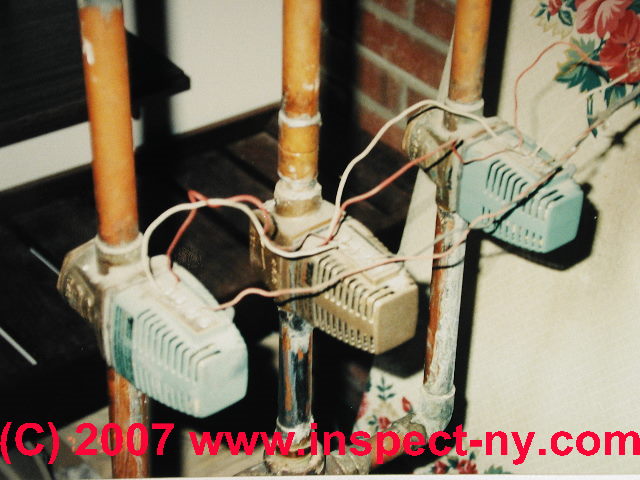
Page top photo: three older Taco zone valves, models 555-573.
InspectAPedia tolerates no conflicts of interest. We have no relationship with advertisers, products, or services discussed at this website.
- Daniel Friedman, Publisher/Editor/Author - See WHO ARE WE?
FAQs on Zone Valves Set 3
These hot water heating zone valve questions & answers were posted originally
at ZONE VALVES, HEATING - you will enjoy reviewing the advice given there.
Below is our index to questions and answers about zone valve installation, troubleshooting & repair.
Article Contents
- ADD SPLIT UP or ZONES
- BALANCE HEATING ZONES
- ZONE VALVE END SWITCH WIRING & OPERATING PROBLEMS
- ZONE VALVE HEAD MOUNT PROBLEMS - heads separate or fall apart or physically break
- ZONE VALVE HEAT is TOO SLOW - slow heating baseboards or radiators or radiant loop
- ZONE VALVE HEAT WON'T TURN OFF - also see Zone Valve Stuck FAQs & Zone Valve Too Much Heat
- ZONE VALVE HEAT WON'T TURN ON - no heat in some or all zones - also see Zone Valve Stuck
- ZONE VALVE LOCATION - where should we put zone valves and where might one be hiding?
- ZONE VALVE NOISES - bang clang tick click buzz hum noise cause & meaning & repair
- ZONE VALVE OVERRIDE - manually force the zone valve opened or closed
- ZONE VALVE PLUMBING, PIPING, LEAKS - zone valve size and piping sizing, leaks, repairs
- ZONE VALVE PRIORITY ZONE FEATURE
- ZONE VALVE INSTALL / REPAIR MISTAKES - after we installed or fixed a zone valve we had trouble
- ZONE VALVE STUCK OPEN or SHUT or ? - Also see Zone Valve Heat Won't Turn Off & Zone Valve No Heat
- ZONE VALVE TOO HOT - overheating zone valve controls
- ZONE VALVE TOO MUCH HEAT - temperatures too high, also see Zone Valve Stuck & Zone Valve Heat Won't Turn Off
- ZONE VALVE WIRING - connections to both low voltage & line voltage sources & relays or devices
- STRANGE ZONE VALVE Q&A
...
Zone Valve Location
I can't find the zone controlling some rooms in my house
My kitchen, bathroom and family room run off a different zone than the rest of the house and is not currently producing heat(gas) I replaced the thermostat with negative results.
Now I hear it might be the zone valve, where do I find the valve and how do I replace it On 2017-11-21 by Dave
by (mod) - zone valves can sometimes be hidden
Dave
Take a look at your boiler, follow the heat piping coming into it as well as following the hot water piping leaving it.
First: your heating system may not have any zone valves.
If each heating zone has its own circulator pump, then each thermostat controls one circulator, turning it on or off in response to a call for heat, and your system may have no zone valves so there won't be one to find.
In our photo taken near the heating boiler in the garage of this Two Harbors, Minnesota home, we see four zone circulators (different models and ages) and behind them four gray boxes each containing a zone circulator relay box. We don't expect to find any zone valves in this home.

The room thermostat is wired to a zone circulator relay that turns individual heating zone circulators on or off.
Now let's consider a heating system that is in fact using two or more zone valves.
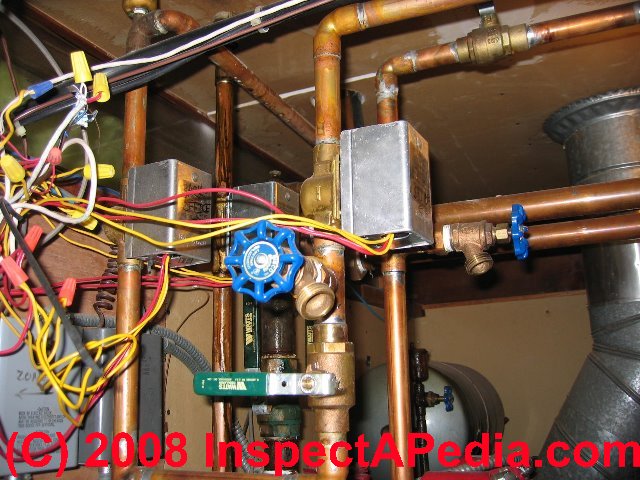
Photo above: locating the zone valves starts at the boiler, but you need to know what a zone valve looks like. A zone valve will be a small control located somewhere on the hot water heating piping, at or close to the boiler but maybe somewhere else in the building. Above we see two silver Honeywell zone valves.
At the top of this page are three older Taco brand zone valves.
If you need to identify other brands and models of zone valves see our complete zone valve guide and manual downloads
at ZONE VALVE MANUALS & WIRING INDEX
Where they are used, zone valves like those silver boxes shown above (Honeywell zone valves) are best placed at or close to the heating boiler on the return side of the zone heating loops.
Hydronic heating water that is returning to the boiler will be cooler than water leaving the boiler, so placing zone valves on the return side exposes them to less heat, possibly extending the zone valve's life.
If there are zone valves, annoyingly, they can sometimes be hidden enroute on the heat piping between boiler and a specific building area, but usually they are very close to the heating boiler itself, usually on the return side.
But I've found zone valves not only on the hot or output side of the boiler, but also hidden in remote locations such as corners of attics and crawl spaces, often because someone decided to split an existing zone into two sub-zones or because someone split off a new heating zone loop to warm a building addition.
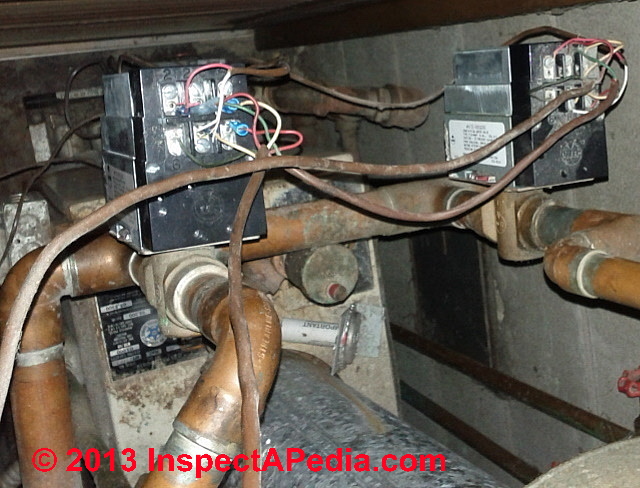
In the photo below I found these two zone valves hidden away in a tight crawlspace where their existence was a surprise to the new building owners.
Even more confusing, some heating systems may have a mix of multiple circulators but also one or more add-on zone valves. We find this on occasion when someone has added a room or added heat to a previously un-occupied space.
A new "sub zone" is connected off an existing hot water heating piping loop and is controlled by a zone valve.
Where are the zone valves located?
hi can any body hive zone valve installation working procedure, where the location in heating systems
thanks shibu. 2017-03-11 by shibu
Reply:
Shibu
Take a look at the photos at ZONE VALVES, HEATING - you can see the mostly silver-covered zone valves - usually located near the boiler and best, on the cooler return-side of the heat piping loop. But a zone valve can be located at more remote spots too if a heating zone loop splits into a sub-loop elsewhere in the building.
The thermostat controls the zone valve, telling it to open or close in response to a call for heat. The zone valve, when it is fully open, closes an "end switch" that turns on the circulator pump - in most designs, though in some countries installers keep the circulator on all the time - in that case the zone valve just opens or closes.
The temperature of the water turns the boiler on or off.
Search InspectApedia using the InspectApedia serarch at the top or bottom of any page, looking for ZONE VALVE WIRING to see typical wiring diagrams for all of the common zone valve brands and types.
...
Zone Valve Noises & Sounds
Do noisy heating pipes mean a bad zone valve?
When pipes make noise, does that mean Zone valve bad? - On 2022-01-09 by Mary
Reply by Inspectapedia Com Moderator - Probably not. Different pipe noises mean different things
@Mary,
If the noise is gurgling water sounds there may be air in your heating water piping;
If the noise is buzzing or clicking from the zone valve motor, then the zone valve itself may be failing.
Since we have no idea what type of noise you're hearing, please first look at this article
PLUMBING NOISE DIAGNOSIS & CURE
which may help with your question. Also see
PLUMBING NOISE TYPE CHECKLIST
If those still leave you with questions, please let us know.
Banging water hammer noise after zone valves changed
Replaced boiler and zone valves(3), then water hammer started.
The installer temporarily stopped it by adding a small expiation tank and increasing water pressure.
Hammering returned on one zone, but does not occur on every closing of zone valve.
I cannot totally prove this, but it seems if another zone is open at the time this one closes there is no hammer.
By the way the service company, with several techs, are stumped. Any clue? (Jan 1, 2015) Johnson
Reply:
Johnson
Water hammer occurs due to a sudden closing of an open water supply valve. It might also occur on a hot water heating system through a similar phenomenon.
See diagnosis and repair details at
How do I fix banging noise in one of my hot water heating zones?
I have been having problems with my firsy floor heating zone. I have a slant fin gas hot water baseboard system.
When the first floor called for heat the boiler would short cycle. I also would getting banging pipes. I have changed the thermostat the expansion tank and know the zone valve and bled the lines of air.
The boiler turn on and ran when the first floor zone called for heat and it seem that what i did solved the problem.
But 8 hours later I once again had banging pipes all the way up to the second floor zone. What esle could be wrong with this system On 2018-02-09 by James O'Grady
by (mod) -Two key diagnosis and repair articles about banging heating pipes & controls
James
I'd read the diagnostic article BANGING HEATING PIPES RADIATORSand also the article on WATER HAMMER NOISE DIAGNOSE & CURE - other banging pipe noise diagnosis help
Heating boiler water hammer noise tip for readers
Water hammer, can occur in both building potable water supply systems (sinks, tubs, showers) and also in hot water heating systems as well as at water heaters or calorifiers.
At water heating equipment water hammer risks an additional hazard besides noise: water hammer can cause leaks at the temperature/pressure relief valve. And over time a relief valve that leaks can also clog from mineral deposits and - to put it technically - crud on the valve seat.A clogged relief valve means that the heating equipment is unsafe to operate, risking a BLEVE (search InspectApedia.com for BLEVE Explosions for details)
If your heating system is giving a loud BANG when the zone valves open or close (and circulator starts or stops) take a look at the location of the zone valves.Good practice locates the zone controls and circulators on the return side of the hydronic heating loop. There's theory that the slightly lower temperatures give longer component life and that this location will reduce water hammer noise in the heating zones.
by locating the circulator downstream from the return-side zone valves - that is, between the zone controls and the boiler, the impact of the pump start-up on the zone valve is reduced.
If you continue to have annoying water hammer banging when the circulator pump starts (or stops) consider changing out your zone valves to a slow closing valve such as the Taco #570.
Too-fast closing zone valve can cause water hammer
Can a zone valve in a residential hot water system that closes too fast cause water hammer? 2020-05-11 by jack
Reply:
Jack
Thanks for asking a great question.Yes, we've had reports of water hammer from a too-fast closing zone valve, combined with high velocity circulation of water in the zone.
More details about controlling water hammer are
Honeywell v8043 zone valves stutters or gives off a "burping" sound when it closes
I have a 4 zone system. One of my Honeywell v8043 zone valves stutters or gives off a "burping" sound when it closes. Other than the noise the valve functions properly. Is it possible to stop this noise? On 2018-02-16 by Len F
Reply by (mod) -
I suspect you need to replace the zone valve - the valve is jamming. You are about to lose heat in that zone, or if the zone valve jams open, you won't be able to turn OFF heat in that zone.
But first check for air in that heating zone.
See AIR-BOUND HEATING SYSTEMS - home
Noisy buzzing zone valve won't open
Have a boiler with three zones, two for upstairs, one downstairs.
The zone valve (Honeywell) which feeds the upstairs kitchen/dining/living/bath (large area) is making noise, buzzing, overheating, and not opening when the thermostat calls for it to.
I have to sometimes push the lever to the right to lock it in the open position.
I don't like leaving it like that, so I put it there at night when the house gets cold, put it back to normal during the day.
I'm sure it needs to be replaced. Is this a pretty easy fix for the homeowner?
I have 30 years of maintenance experience changing pumps, motors, valves, piping systems, etc., though it is mostly heavy industrial.
I just look at this as a scaled down version of what I do for work.
Can't the module be changed out separately instead of changing the valve? Also, can the zones valves be installed on the return side of the boiler instead of the supply side?
They seem to always be very warm/hot. On 2020-09-29 by Steven
Reply by (mod) - "Sticking" "Buzzing" zone valve repair
Steven:
Thanks for a helpful "sticking" zone valve repair question.
There are two different situation:
If the zone valve failure is in the actuator motor,
that's a pretty easy repair as the cover can be removed, the motor removed, and a replacement installed without having to do any plumbing work.
The motor sits atop and operates a mechanical shaft that, by rotating, opens and closes the zone valve in response to a call for heat from the thermostat. Many homeowners can do such a repair.
But if the zone valve problem is not the motor but the actual valve in the valve body -
The parts that rotate to either allow or not allow hot heating water to flow through the piping, then what's needed is to cut-out or de-solder the old valve and put in a new one;that in turn also will require cooling down the heating system and draining the zone, the re-filling the zone after the repair, and then purging air from the system after that.
For that work, the job probably goes faster and easier when done by a trained heating service tech or plumber who is familiar with zone valve replacement.
When the zone valves open or close there is a loud noisy buzz
I've just had 2 zone valves (Sunvic) fitted to separately control under-floor hearing in one room and the central heating in the rest of the house.
When the valves open or close there is a loud noisy buzz for 45 seconds or so. Is there such a thing as a silent (or at least very quiet) actuator? The noise is driving myself and Mrs Dan mad... Thanks 2016-11-30 by Dan
Moderator reply:Dan take a look at the diagnostics and cures
at HEATING SYSTEM BUZZING NOISE
Buzzing zone control sounds unusual, perhaps a failing low voltage transformer or a valve that's jamming.
Follow up:
Thanks , my installer has just come back to me and has also said that it doesn't sound right. I'll see what I can do about a replacement. Thanks for your reply. Dan
Solve Zone Valve Clicking Noise
My zone valve clicks when call for heat motor moves and zone is open what can it be - (Dec 9, 2014) Anonymous
Reply:
Anon I'm not sure I understand the question correctly.
On a call for heat the zone valve motor should open the valve and when it's fully open an end-switch in the valve turns on the circulator.
If your valve makes noises and does not open I suspect the valve is jammed or the motor is shot.
Zone valve makes clicking noise when it is fully open and gear motor continues to run
Eric zone valve vt2343g13a02a works good but when in the open position it keeps clicking like the gear motor continues to run and the gear is clicking on the last tooth of the actuator or something???? - Ken 11/23/11
Reply:
Ken a zone valve that keeps clicking suggests to me that either
the zone valve motor gears have become stripped or
the valve assembly is jammed and is not opening fully - the motor is unable to turn the valve to the fully open position, it is not reaching its "end switch" position, so it keeps trying to open the valve. Most likely you need to replace the unit.
Humming noise at zone valve: is this trouble?
I live in a condo and the zone valve was hot to the touch and made a humming sound - is this a problem? -
I turned my thermostat right off and the valve cooled slightly to warm to touch but still makes humming sound -
thermostat is presently off and it is possible the building heat has just been turned on for fall -
I have no need for heat at the moment just possibly overnight - I am on the third floor -
should I consider replacing the valve or turning on the heat to clear the system and then turn it down? On 2020-09-15 by wendy
Reply by (mod) - signs of a failing zone valve motor
Wendy
It's common for the body of the zone valve to be hot as it's passing hot water for the heating system.But a humming sound may mean that the valve's motor is jamming (needs replacement) OR that a nearby low voltage transformer is humming and will need replacement soon. See if you can pin down the noise source precisely.
Followup by wendy
if I gently push on the valve the humming changes
Turned up thermostat - got heat and no more noise. so all good. thx
Reply by (mod) -
Good news about the heat, Wendy;
One of my zone valves makes a loud squealing noise
One of my zone valves makes a loud squeal noise when closing. It is just one of the 4 valves that makes this noise.
The rest close with no noise.
Could this be
a: a bad valve
b: pressure set to high in pro pain boiler
c: something to do with circulator being on pumping to other zones?
Any help would be appreciated. On 2019-12-02 by Jeff McNeil n
Reply by (mod) -
sounds like a failing zone valve mechanism or motor
since if it were the circulator pump you'd expect the noise when any heat zone was running
by Jeff
so you suggest replacing the whole valve and motor?
Reply by (mod) -
You can separate the motor from the valve and then see if it's the valve that's jamming - if so then the valve itself needs replacement; the motor might be ok - or vice versa.
Let's see which part is making the noise. (I suspect it's the valve but I don't know.)
Ticking zone valve noise when hot water is off
We have a two-port motorised valve that makes a ticking noise when the hot water is switched off.
Is there anything that can be done about this? 2017-05-18 by David
Reply:
David:
If the valve ticking stops after the system has cooled down I suspect it's thermal contraction; sometimes using plastic noise reducing pipe mounts can reduce or even eliminate that problem.
If the zone valve is ticking continuously and never stops that sounds like a failed or jammed zone motor and the valve head probably needs replacement.See details at THERMAL EXPANSION of MATERIALS
Follow up:
Thank you for the answer and reference research, as I am not familiar with these equipements, I tend to read all instructions carefully. And yes, I have an open loop system that feeds on my softened and filtered well water, but my heating system is well equiped with many automated gas purging devices.
I hope it will be enough to ensure good performance for a reasonable time. I guess that all other brands also do put this caution then.
Our upstairs zone makes noise as if it is opening, and the boiler turns on, but we don't get any heat
I have 2 zones to my furnace basement zone works , but the zone upstairs makes noises as if its working furnace kicks on (2 mins) but no hot water going thru pipes ... Help! - Terri 11/26/12
Reply:
Terri,
Take a look at the zone valve diagnostic steps listed at ZONE VALVES, HEATINGIf your zone valve is actually opening and the circulator is running but the zone doesn't receive heat, it may be air bound.
See AIRBOUND HEAT SYSTEM REPAIR by WATER FEED VALVE.
On the other hand, the zone valve motor may be making noises but the valve may be stuck and need replacement.
How do I remove or replace a zone valve?
If I tap the zone valve it clicks off
Tell me how to remove a zone valve
I sometimes have come home to find my house is really hot because the zone valve is stuck in the on position.
I tap it with a wrench and it then clicks off.
Lately this seems to be happening more often. Do you think I need to replace the whole valve or can I get away with just replacing the motor assy. -(Nov 23, 2015) Replace motor or whole valve? said:
Is there a core return on zone valves - (Nov 24, 2015) Garrett
Reply:
Replace:
Try removing the valve head to see if the valve assembly itself moves freely. If it does replace the control head. If not replace the whole assembly.
Garrett:
If you are asking if you are supposed to return the non-functioning zone valve core to your dealer, no.
If you are asking if the zone valve is self-closing, that feature is provided in some valves that are of the Normally-Closed variety; look for the controls and the normally-open vs. normally-closed specification on the zone valve model.
What's causing a grating noises in heating zone piping?
I have older Honeywell zone control valves on my Buderus home hot water heating system.
The opening and closing of the valves reverberates through the copper pipes and makes a surprising amount of loud grating types of noises throughout the house.
Is there a way of isolating the valve vibration from the pipes. (Nov 30, 2015) sam mcclenahan
Reply:
Sam:
I think that most-likely the problem is a form of water hammer (Search InspectAPedia.com for WATER HAMMER for details) that is due to rapid-closing zone valves and the velocity of water in the heating piping.
If your circulator is a variable speed unit (probably not) try a lower speed setting. Otherwise an option is to change out the zone valves for slow-closing models.
Before doing that however I'd ask your heating service tech if installing anti water hammer devices on the zone piping might work.
I don't think that vibration isolation pipe mounts will do the job.
A second possibililty is that the zone valve motor or valve itself on one or more zones is failing and making a grating or grinding noise. In that case you'll hear the noise loudest right at the zone valve in response to a call to turn heat ON or OFF.
Daniel Friedman
...
Zone Valve Piping / Plumbing Size, Types & Leaks
Will using a 1/2" diameter zone valve affect our heating system output?
We live in a condo, our zone valve was changed recently and reduced from 3/4 to 1/2, what effect will that have on heating in colder temperature like -35degrees Celcius - ac godbout to Mod 2021/11/14
Mod to ac godbout: heating zone pipe size matters more than the zone valve size itself
Thank you so much for a wonderfully helpful question. I have spent some time on making a detailed reply that you can now read at
Please take a look and don't hesitate to comment, criticize, or ask follow-up questions.
We had a "bad" plumber at a job in Poughkeepsie who, to increase is profit by maybe $50, used 1/2-inch rather than the standard 3/4" diameter piping throughout a hot water heating zone at a building addition.
The result was a lifetime of aggravation for the building owners who found heat slow to rise and a bit marginal. Ultimately, as most of the piping to the addition was not accessible without very costly demolition, the owners installed a higher BTU output baseboard and a faster-speed zone circulator that helped steal back some of the heat from their disappointing contractor.
Working together makes us smarter.
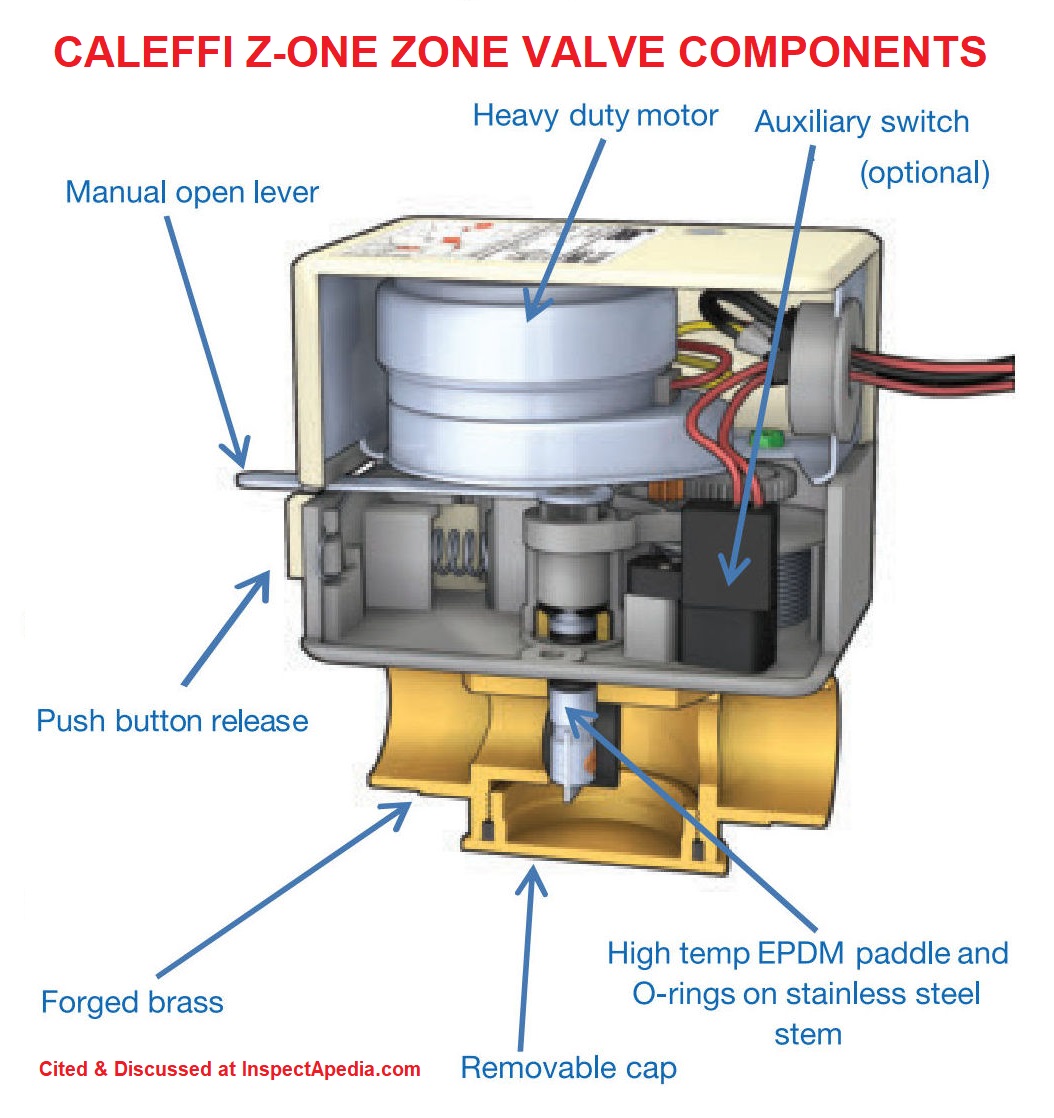
ac godbout to Mod - Caleffi 2 way on/off zone valve Z200043
 Thank you Daniel.
It seems from your article that the size3/4' to 1/2" cannot be causing, what I feel is, an unreasonable time to heat the room and fear that at -35C, the heating will be insufficient.
I've taken the cover off and see the valve. It does not seem to be a Honeywell valve but I imagine they must all work the same. There is a sliding lever on the side that is all to one side so maybe?
We were away winters so never noticed the heating time it took to heat our 1130sq. unit. The condo changed our valve late last winter from 3/4" to 1/2".
At our coldest this fall, -10C night temp, It take like 4-5 hours to raise the temp by 3 degrees celcius. We hoped the valve change was the problem. The reduction length is 7" but looks like it cannot be the problem. Thank you Al Godbout
It's a Caleffi 2 way on/off zone valve Z200043 not a Honeywell as we were told. Could that make any difference? Al
Mod to ac godbout - the diameter of the passage through the valve itself - 1/2" ir 3/4" isn't significant in impact of heat flow rate
The general concept is that while smaller pipe diameter can make a big difference in total flow through a piping system, the impact of that smaller diameter is very much dependent on the total length of small-diameter piping or tubing.
The zone valve people argue that the diameter of the passage through the valve itself - 1/2" ir 3/4" isn't significant.
IMO you should also be looking for a partially airbound system as an air bolus anywhere in the piping might be forming a partial blockage.
Usually an air bound zone won't heat at all past the air block but in some piping arrangements I've found a horizontal heating zone pipe that sits half full of air and slows delivery of hot water through the zone.
Go to AIR-BOUND HEATING SYSTEMS - home to see details of diagnosis and repair for air-bound heating systems.
Also be sure that your circulator is running - and that you're not getting hot water to the zone merely by convection.
For other readers here is the
CALEFFI ZONE VALVE INSTALLATION GUIDE [PDF] (2017) for Caleffi Z-One Zone Valves, Caleffi North America, Inc., Email: sales@caleffi.com Web: www.caleffi.com
Do the zone valves go on the supply side or the return side of the heating loop? Does it matter?
In a residential hot water (radiators) system are the zone valves installed on the supply or return side of the boiler. Does it make a difference? On 2018-04-12 by Ron
by (mod) - put zone valves on the cooler return side of the heating loop
Ron
Zone valves will work properly on either supply or return side of the system,but in my OPINION and that of many service techs, installing the zone valve on the return side is preferable since the valve then operates at a lower temperature and has a longer life.
You'll find that recommendation in typical instructions for zone valves as well.
Do I have to cut the heating pipe to install a zone valve?
Does the pipe need to be cut to install a zone valve. - On 2021-11-22 by Carole
Reply by Inspectapedia Com Moderator - Yes. how to install a zone valve
@Carole,
Somewhere, logically, yes.
Consider that the zone valve is nothing more than a mechanical water flow valve on a loop of hot water heating pipe that
1. responds to a thermostat's call for heat
2. opens to allow hot water to flow through the zone
3. turns on the circulator pump once the valve is open
So I can't imagine any way to install a zone valve without installing it somewhere on the hot water heat piping loop for the zone it's intended to control. That means "interrupting" or cutting the pipe to place the valve in the path of water flow.
"Cut" pipe, I interpret conceptually, since physical "cutting" or sawing isn't necessarily required if instead there are threaded fittings that can be unscrewed.
How to replace a heating system zone valve without using solder or sweat fittings
I was wondering If I could replace a 40004850-001 Honeywell end-zone valve with some other replacement Zone Valve. Preferably the NON SWEAT type .
I have a 3 Zone system and a brand new thermostat on this zone and the other two zones respond when I call for Heat but this one doesn't. It looks like water got into It from the top. All 3 were replace about 5 years ago. 2020-09-12 by Thomas
Reply:Thomas
How to replace a zone valve without having to sweat (solder) connections:
Zone valves are pretty generic and interchangeable, with the caveat that you have to look carefully at the wiring connections to get that right. Those details are in manuals found at ZONE VALVE MANUALS & WIRING INDEX
To connect a zone valve without soldering copper (sweat connections), you'd need to buy a valve that uses threaded pipe (in the U.S that's NPT threading) connections.Here's an example of a zone valve that connects by providing female NPT threaded connections
- this is a Belimo zone valve sold by https://bostonaircontrols.com/ and others.
I'm not touting this particular brand nor any other specific product.
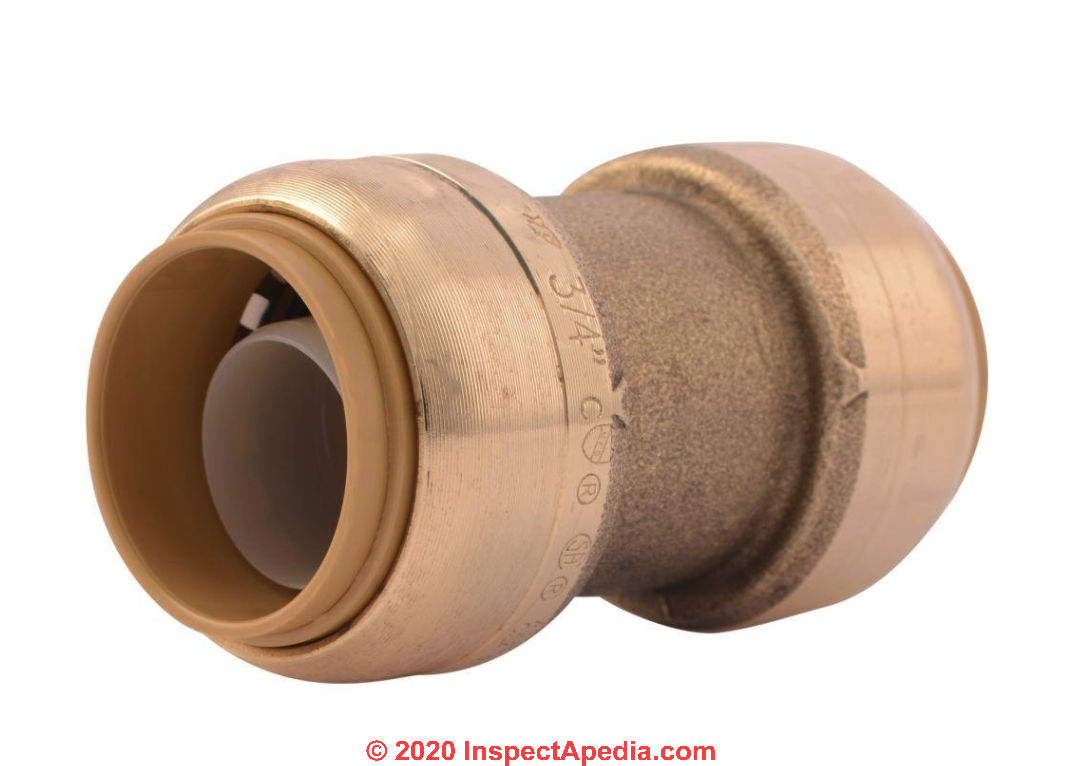
You could try SharkBIte non-sweat push-type connectors like a 3/4-inch SharkBite push-to-connect coupling.Do not try using PEX tubing as the heating system temperatures are likely to exceed the PEX maximum (typically 130F).
But SharkBite, used in an all-copper system can work.
"SharkBite Universal fittings have a maximum temperature of 200°F maximum pressure 200 psi when used on copper pipe."
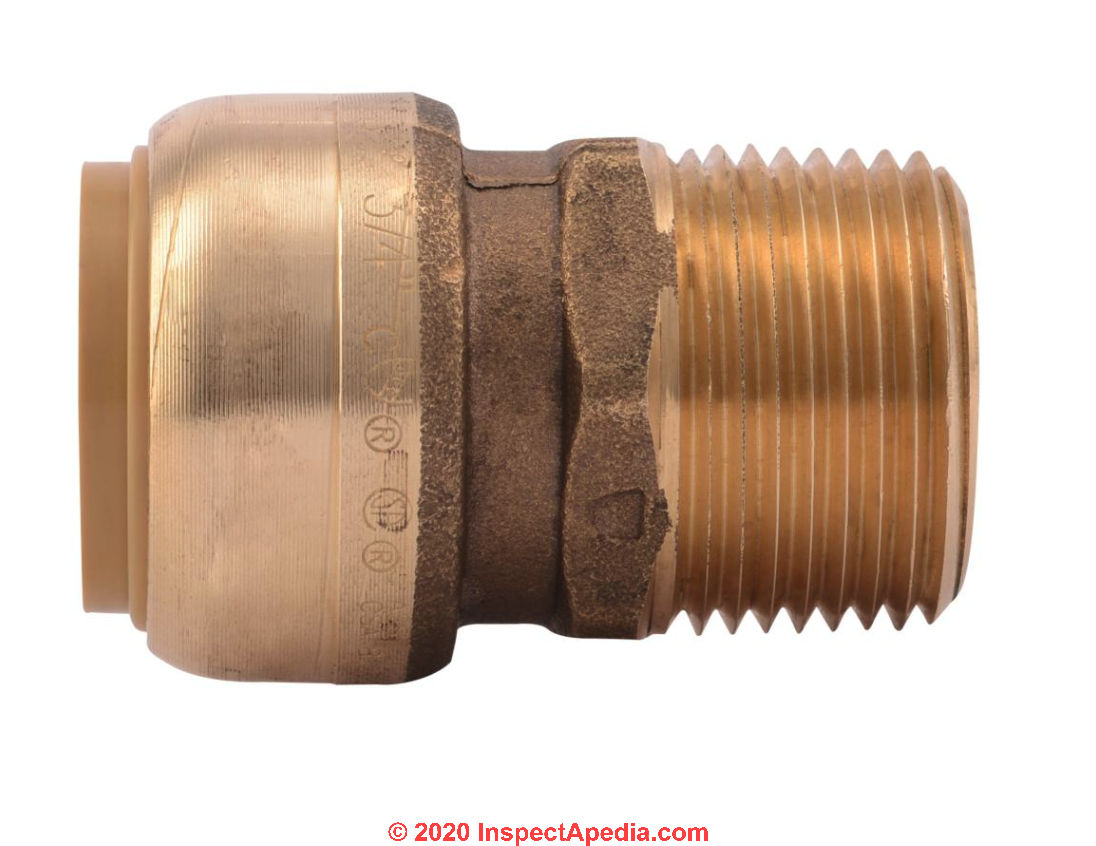
Here's a SharkBite 3/4" copper connector that sports male NPT on one end.
You'll need to use either a coupling (shown below) or a SharkBite connector that provided a male NPT fitting on one end- to connect to the new zone valve, and a push-to-connect to copper fitting for (probably 3/4") copper heating zone piping on its other end.
Below is a photo showing typical Sharkbite connectors, in this case where I was hooking up a Bosch tankless water heater to a control valve and a service drain.

I want to move a radiator - can I just lower the temperature & cut the pipes?
I want to move a radiator tied to one of my zones. Can I just lower the temperature on thermostat for that zone and then move the pipes to the new location.
By lowering the temperature, will that prevent the water from circulating. On 2018-12-05 by TOM
Reply by (mod) - NO, you will need to drain the system
Assuming that we are talking about a hot water and not a steam system, lowering the temperature or simply turning off off the boiler or allow your system to cool.
However you will discover if you open any pipe that you'll have a flood.
In other words you need to drain the water from the system in order to cut a pipe to move a radiator.Watch out: In restoring the system to service you need to bleed all of the air from that piping or the system will be air bound and you won't have heat.
See AIR-BOUND HEATING SYSTEMS for details of how to do that.
Do the primary (central heating) and secondary (hot water) circuits use the same water ?
Do the primary (central heating) and secondary (hot water) circuits use the same water ?
If so, can I use the electric immersion heater to heat the water within the calorifier / heating coil via the hot water in the tank and pump this around the radiators ?
I ask because we have a holiday home with a pressurised oil fired central heating which sometimes cuts out for no reason. If this were to happen when the house was unoccupied there would be a risk of freezing.
If I set the immersion to cut in when the water was cold would the heat transferred to the heating coil via the hot water in the tank get pumped around the radiators if the zone valves were open and the pump was on.
I know that this wouldn't be a very efficient propcess but may just prevent the pipes from freezing if the boiler had tripped out ? (Jan 27, 2014) richard lewis
thank you
Richard
Reply: No
No Richard.
The physical water inside a heating boiler is not the same water as used for domestic washing and bathing, withe the sole, unusual and not recommended occasional small heating load design in which someone tries to use a domestic water heater also for building heating.
If your heat is cutting out for "no reason" I am guessing more likely there is a reason, possibly one having to do with safety, but that has not yet been properly diagnosed.
No you do not want to cross connect your home heating system with your hot water system. I realize we could figure out a way to do it, but you are cross-contaminating both systems.
To change out a White Rogers Spin on or Twist On Zone Valve do you have to turn off the water
In order to change out a White Rogers Spin on or Twist On Zone Valve do you have to turn off the water or can you simply take off and twist on the new one? Thank you. On 2021-02-15 by John P
Reply by (mod) -
Typically the zone motor or actuator itself, (properly, the "zone motor assembly") including the White Rodgers models can be removed without interfering with piping
but if it's the valve itself I'd expect to turn off water and remove pressure from the zone.
Laars JVS boiler makes noise like an airplane
I have gas fired boiler laars mini therm jvs model and when one zone calls for heat boiler makes sound like plane passing by over the house but when two zones are calling for heat boiler runs fine and the noise goes away. Do i have flow issue. Any advise is appreciated On 2021-02-10 by Ali
Reply by (mod) -
Ali
It's possible that there is air in the noisy zone, or that the zone valve actuator motor is buzzing and failing, or that a relay is buzzing;
More diagnostic suggestions are at HEATING SYSTEM NOISE DIAGNOSIS https://inspectapedia.com/heat/Heating_Noise_Diagnosis.php
Small boiler leak: will stop-leak products clog the zone valve?
I have had a small boiler leak, I put a quart of Hercules Sealer in my boiler,It stopped the small leak, now it seams like my zone valves (automag) are not opening when the zone calls for heat, or maybe my automatic air valves on my baseboard heat trim may be plugged,
Should I now drain my system to clean out excess sealer, what do you suggest? (Feb 4, 2014) Ray
Reply:
Ray, I'm researching the Hercules Stop-Leak product - so far don't see a warning about clogs.
I would try two things just to start:
1. if your zone valves have a manual-open position and latch, use that to move the zone valve open - at least you'll have heat, and moving the valve (rarely) might free it up
2. try (with the heating system cooled down) opening and cleaning a manual air bleeder if that's what you've got; if you've got only the float type air bleeder devices, indeed the bottom opening or float could be stuck.
Those are inexpensive devices; I'd remove an old one, allow a small amount of boiler water (ounces) to blow out the mount opening, and install a new one.
3. depending on where the boiler leak was, is it possible your system is air bound? If so we can point you to diagnosing and fixing that problem.
I'm collecting this discussion along with added information at our article titled
Heating Boiler Chemicals, Treatments, Leak-Stop
(which you should be able to find by searching InspectApedia for that title.
Recurrent problem with leaking White Rogers 1411-102 aquastats
I have White Rogers 1311-102 style aquastat. Both are leaking and need replacing.
Every 2 to 3 years they need replacing because they start to leak. Both are on the return lines before entering the boiler.
Our water here is very hard with a high concentration of calcium/lime.
Can I use a different Aquastat that would not not require changing them so often? And can this be done without harming the boiler? (Dec 9, 2014) Don
Reply:
Don
Because the water in a hot water heating system is pretty much the same physical water all the time - it doesn't change unless the system is drained and re-filled or has a leak and keeps taking new water - I think the problem may be elsewhere.
You could however discuss with your heating service company or heating supplier the use of a chemical treatment or additive to put into your boiler water.
I would look more closely at exactly where the leaks are occurring.
For example if an aquastat probe sensing well was improperly installed or threads were cut or damaged the leaks could be recurring independently of the control itself.
Conversely, you should consider installing a water softener to protect the rest of the building water supply system.
Adding under-floor heating to a hot water heating system do I need zone valves?
For underfloor heating do I need to install 2 zone valves in my heating system ,
I am fitting a single room underfloor heating kit to my baxi combi boiler system
Reply:
Under
The requirement for additional zone valves hinges on whether or not there is a need to control heat to that area individually.
If the single-room to which you are adding heat would not be adequately heated by the settings of the room thermostat that is presumably located elsewhere, you may want to add a zone valve and thermostat for the single room.
Reader follow-up:
so the kit can be plumbed into the main flow and return and use the existing thermostat
Reply:
Under
You did not describe your heating system so I don't know that your assumptions are correct. For example, radiant under-floor heat systems typically operate at a different temperature range and flow rate than hydronic heating that uses radiators or baseboards.
So a hybrid system that uses a mix of heat types in different rooms may need separate controls of both flow and temperature.
The temperature control is typically achieved by a recirculating mixing valve that prevents the floor from becoming too hot.
See
inspectapedia.com/Energy/Radiant_Heat_Use.php
Reader follow-up
ok i understand i think lol can i fit a thermostat to the underfloor heating as well as the one on the main heating system the underfloor heating has its own pump thanks
Reply
Take a look at radiant floor heat designs - you'll probably see that a temperature control is also necessary for your system unless your heating boiler is one of special design and model with those controls built-into the base unit. .
You did not describe your heating system so I don't know that your assumptions are correct. For example, radiant under-floor heat systems typically operate at a different temperature range and flow rate than hydronic heating that uses radiators or baseboards. So a hybrid system that uses a mix of heat types in different rooms may need separate controls of both flow and temperature.
The temperature control is typically achieved by a recirculating mixing valve that prevents the floor from becoming too hot.
See
inspectapedia.com/Energy/Radiant_Heat_Use.php
Reply
ok i understand i think lol can i fit a thermostat to the underfloor heating as well as the one on the main heating system the underfloor heating has its own pump
thanks
...
Add or Split Up Heating Zones
How can make individual steam radiators into individual zones?
Is it possible to put two 3rd floor radiators on a separate zone with two pipe steam heating system in my old house? (Nov 1, 2014) Gary
Reply:
Gary the practical way to achieve what you ask - more fine zone control over steam heat - is to replace the steam radiator's manual valve (right at each radiator) with a thermostatically operated valve that allows room or zone occupants to choose their own heat level.
As long as the boiler is making steam that'll work.
Running separate steam pipes to a 3rd floor and adding a thermostat is technically possible but expensive and iMO not feasible.
You can even more easily install thermostatically installed steam vents.
See
or
The article ZONE VALVES, HEATING - where you first posted this question, pertains to hot water or hydronic heasting, not steam heat.
How do I add zones to an existing hot water heating system?
I want to divide my central heating system in two so that I can heat rooms used during the day without heating the whole house.
I propose to do this by installing a 2 port motorised valve to interrupt the flow but am not sure whether to use an NC or NO valve for this purpose.
It would be installed on the return pipe unfortunately not bear the boiler. Any advice would be appreciated. (Nov 17, 2014) Dave
Reply:
Dave,
You might find it easier to simply install a second zone valve on the second or divided heating zone loop.
...
...
Continue reading at ZONE VALVES, HEATING - topic home, or select a topic from the closely-related articles below, or see the complete ARTICLE INDEX.
Or see ZONE VALVE REPAIR FAQs-4 - more-recent diagnostic questions and answers about zone valve repairs.
Or see these
Recommended Articles
- ELECTRIC MOTOR DIAGNOSTIC GUIDE to test zone valve motors themselves
- ZONE VALVES, HEATING
- ZONE VALVE BANGING or BACKWARDS
- ZONE VALVE MANUALS & WIRING INDEX
- ZONE VALVE SIZE vs GPM
- ZONE VALVE MANUALS & WIRING INDEX
Suggested citation for this web page
ZONE VALVE REPAIR FAQs-3 at InspectApedia.com - online encyclopedia of building & environmental inspection, testing, diagnosis, repair, & problem prevention advice.
Or see this
INDEX to RELATED ARTICLES: ARTICLE INDEX to HEATING SYSTEMS
Or use the SEARCH BOX found below to Ask a Question or Search InspectApedia
Ask a Question or Search InspectApedia
Share this article:Search the InspectApedia website
Need to make a private comment? Email editor@inspectApedia.com. We welcome email with your website content critique, corrections, suggestions or questions. Email is monitored daily but our workload may prevent an immediate reply. For immediate results, we hope you'll first try asking your question using the search box just above.
Citations & References
In addition to any citations in the article above, a full list is available on request.
- In addition to citations & references found in this article, see the research citations given at the end of the related articles found at our suggested
CONTINUE READING or RECOMMENDED ARTICLES.
- Carson, Dunlop & Associates Ltd., 120 Carlton Street Suite 407, Toronto ON M5A 4K2. Tel: (416) 964-9415 1-800-268-7070 Email: info@carsondunlop.com. Alan Carson is a past president of ASHI, the American Society of Home Inspectors.
Thanks to Alan Carson and Bob Dunlop, for permission for InspectAPedia to use text excerpts from The HOME REFERENCE BOOK - the Encyclopedia of Homes and to use illustrations from The ILLUSTRATED HOME .
Carson Dunlop Associates provides extensive home inspection education and report writing material. In gratitude we provide links to tsome Carson Dunlop Associates products and services.
 |
HOME | ABOUT | ASK a QUESTION | CONTACT | CONTENT USE POLICY | DESCRIPTION | POLICIES | PRIVACY | |
| © 2026 - 1985 Publisher InspectApedia.com - Daniel Friedman | |||||||||