 FAQs: Find Hidden Leaks in Heating Boilers
- POST a QUESTION or COMMENT about leaks on hot water heating systems: how to find and fix leaks and hidden leaks in boilers, piping, tanks, condensate lines, controls, radiant tubing
Hidden leaks in hot water heating systems, FAQs.
These articles explain how to determine that a hot water heating system is in fact leaking, and second we describe how to find the location of hidden leaks in or on heating boilers, hot water heat piping, baseboards, radiators, convectors, or radiant heat floors or ceilings.
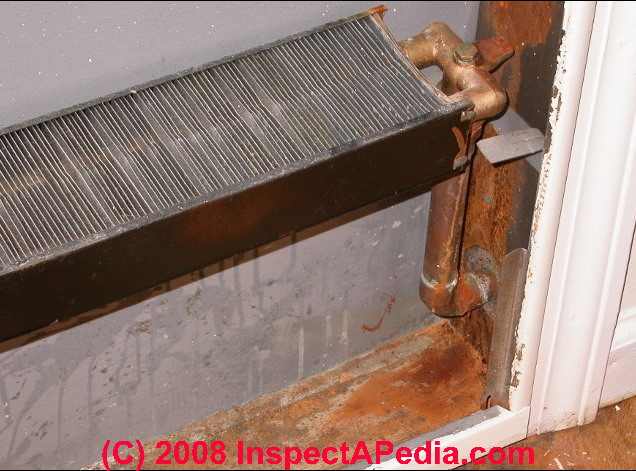
Page top photo: the extensivvfe rust on the sides and bottom of this hot water heating convector pont to leaks, probably at that top fitting.
InspectAPedia tolerates no conflicts of interest. We have no relationship with advertisers, products, or services discussed at this website.
- Daniel Friedman, Publisher/Editor/Author - See WHO ARE WE?
Tips for Finding Leaks on Hot Water Boilers or in Hot Water Heating Distribution Piping
 These questions and answers about tracking down the source of leaks at hydronic heating (hot water) boilers were postd originally
at BOILER LEAKS, HOW TO LOCATE - you should be sure to read the detailed advice given there.
Boiler Water feeder feeds water to the tank after every cycle
My water feeder feeds water to the tank after every cycle at more than 3/4 of tank and I get a lot of noise in some of the radiators ,Is there a problem with the feeder? (Jan 9, 2015) Joseph
Reply:
Provided we're talking about a hot water (hydronic) heating boiler, not a steam boiler, you'll want to check for a leak in the hot water heating piping or if you are discussing steam, check for steam vents that are not closing down even when the radiators are hot.
See
Frustrated by leak problem at old Utica boiler
I have had it up to my ears with this boiler system! I have a 20+ year old Utica Boiler on a two story house.
My pressure relief valve was leaking so i replaced it.....no improvement...I was instructed to look for moisture in the expansion tank.
I pushed the air valve open on the expansion tank and and light (droplets immediately came out) amount of water came out, so i replaced it....no improvement.
I moved on the the pressure reducing valve and replaced it and some of the surrounding piping (someone had used black pipe along with copper!!) all copper and brass now....no improvement.
The operating pressure is right around 30psi according the gauge. The temperature is around 180 degrees. The house is on a well and minerals in the water is common problem with everything else the water touches.
The next thing is the circulation pump right? It is the Taco 007-F5 and it appears to have been replaced at least once. However, I've not noticed the upper levels not heating correctly.
BTW this website is awesome your write ups are the best I've found thankyou! (Jan 11, 2015) Roger C.S. said:
Reply: here are key diagnostics for tracking down heating boiler leaks
Roger
I understand the frustration but it sounds to me as if you need a competent onsite heating repair technician - the repairs you tried are incorrect even though in the right direction. Therefore it's no surprise that they were not successful.
1. "moisture" in the expansion tank is misleading. A waterlogged expansion tank - full of water and not enough air, can cause TP valve leaks. The place to check that is not by pressing an air valve.
Watch out: See our diagnosis and repair advice as well as safety warnings
at RELIEF VALVE LEAKS2. Replacing the pressure reducer valve might work if the valve were defective and feeding high water pressure but replacing it without diagnosing that can be barking up the wrong tree.
Diagnostics for that part are
at PRESSURE REDUCER / WATER FEED VALVE, BOILER3. The operating pressure at 30 PSI is too high and would be expected to make the TP valve empty.
See PRESSURE & TEMPERATURE SETTINGSMoving on to the circulator pump is not a coherent step. You need to find why the pressure is too high.
For example if your boiler has a tankless coil it could be leaking water at house pressure into the boiler.Diagnostic suggestions for leaky TP valves are
at RELIEF VALVE LEAKSDiagnostic suggestions that include a tankless coil leaking into a boiler and how to detect that are
at TANKLESS COIL / HOT WATER COIL LEAKS how to recognize, evaluate, and repair boiler leaks on or around the tankless coil.4. "not heating correctly" at upper levels is a bit vague but if you mean radiators or baseboards are not getting hot the system may be air-bound, possibly a separate problem
5. Back to the circulator pump : it's a bit obscure but conditions that cause water hammer in any water system including a heating boiler, can cause TP valve occasional leaks.
That could be (but is uncommon) a sudden stop of water running anywhere including a circulator.
See WATER HAMMER NOISE DIAGNOSE & CURE - home
Let us know what you find as that will assist other readers.
I have to add water to my hot water boiler heating system every 2 weeks & pipes gurgle
Hoping I can call on you for some help, currently playing find the leak and have for several years.
I'm in a century home with a Weil McLain NG boiler (HEii), my system requires topping up every one to two weeks for optimal performance and to rid my self of the highest baseboards from gurgling when the heat cycles on.
I have checked every visible joint and repaired any that were suspect, replaced a run of pipe the previous owner had incased in concrete all to no avail.
I emptied the system and ran compressed air to see if it would whistle at the leak (system held to 20psi with no loss of pressure) and had no luck as I think its an expansion issue where a joint somewhere is opening when both heat and pressure are present.
I have no obvious stains anywhere in ceilings although some runs are under floors where I have no access to inspect.
Are there any other leak detection methods you can think of that might help me locate and fix the issue without ripping up floors walls and ceilings.
Any additional help would be most welcome. Thank you for your time. On 2018-12-01 by Jake
-
by (mod) - check if there's a tankless coil
Jake,
Air in the system can cause gurgling noises in heating pipes even if there are no actual boiler leaks.Are there automatic air bleeders installed at the boiler and are there other air bleeders at higher points in the system?
And a small leak on a hot surface such as on the boiler itself may never show up as water on the floor, and may not even be apparent during your air test when the system is cold.
Or is it connected to an indirect fired water heater?
And unusual cases in which house water pressure is low there could be reversed leakage out of the boiler into the water system.by Jake
Thanks or the prompt reply.
No tankless coil or indirect water heater just a basic stand alone boiler. I think im likely fighting something that is evaporating or dripping into a crawl space (century brick home with a dirt basement) likely a combination of the two.I would like to upgrade my boiler and go with a tankless water heater but not until I resolve the leak.
Thank you again for the response and if you have any other suggestions im all ears.Reply by (mod) -
Jake
More steps for finding hidden boiler leaks.
A basic procedure to isolate leaks is to shut off input to a boiler, leave boiler off, and watch for a drop in pressure.
As you've confirmed that I'd move on to isolating whatever piping leaks possible and then repeat that test.
You might also be able to use IR infrared scanning or thermography: with the system hot and circulator(s) running, IR scanning can sometimes spot added heat spreading under a floor or area where hot water is leaking.by Jake
Other than the IR method I have attempted to isolate where I could and have it in the zone that heats the rear of the house however its two floors and lots of inaccessible pipe runs.
I may be able to lay my hands on some infrared gear from work, hopefully it can put an end to my weekly gurgle gurgle top up routine so as not to shock the boiler.
Thanks again
How to find a hot water heating pipe leak under a slab
I have been told i have a leak in the pipes in the slab. How do i locate the leak. I see no obvious water inside or out On 2018-12-17 by John
Reply by (mod) -
John
I have off and had success in locating a hot water heating pipe leak under a slab by borrowing or even buying a low priced thermal scanning device that can measure temperature over in the area.What's the boiler up to operating temperature in the circulator running you will see a warmer area under the floor where water is leaking out of the pipe.
I see leaks at my circulator pump flanges - is it due to poor choice of metals?
2015 - Valerie asked: are leaks at my circulator pump flanges due to poor choice of metals by the manufacturer?
Reply:
Valerie,
We discuss leaks at circulator pumps and flanges in detail at
It would be most unusual for a plumbing valve failure to be Dir to the manufacturer's choice of metals. Typically a valve body is grass with stainless steel shaft. Dezincification can explain leaks at brass fittings on some systems, depending on water chemistry, but not at the flanges of a circulator.
Why is there no "cold water" pressure at my Slant-Fin Galaxy GG Boiler?
Hello! I have a 70's model Slant-Fin Galaxy GG Hot Water Boiler. It works pretty good and I just had a "professional" help me flush the system and refill it. He swore that the circulation pump needed to be switched around. Well... a few days after he left I decided to check pressures etc...
the pump wouldn't work. It was sucking air. So... I switched it back the way it was and topped everything off and
voila... the pump worked again. Here is my dilema... I don't show any cold water pressure at all. (I have a closed system...
I have to manually add water if needed) The hot pressure seems to be fine.
Should I worry that I don't have any cold pressure on a system like this? I wanted to just replace this thing (and I still might), but I was told that these cast iron heat exchanger boilers will almost last a lifetime and there's no sense in replacing it.
Would sure be happy to chat back and forth about this if someone would be willing to help. I can provide pictures etc. Thanks so much. What a great site with lots of great input. Regards. On 2018-09-21 by Robert
Reply by (mod) -
Robert
I may be missing something here but normally a residential hot water heating boiler system will show at least 12 psi when the boiler is cold.
Start by finding out if your pressure gauge is working - does it change (go up) when the boiler is hot? IF not, replace it.by Robert
Hi! Thanks for the reply. The gauge does go up when the boiler is hot. I have to manually fill the boiler with water so how would I get it to have cold pressure?
It's weird. Like I said, the boiler actually works pretty good. Especially now with the flush and refill. I am starting to think the "if it ain't broke" philosophy applies here. Hehe.
Another question if you might know.The lines that go to my baseboards have two parts at the origination point from the boiler. I have no idea what these are. I have sent pictures to boiler companies etc and no one has yet been able to identify them for me. If I attach a photo would you be willing to give it a shot?
Thanks again! :)Reply by (mod) - water feeder valve failure
Robert,
IF your boiler has an automatic water feeder/pressure reducer valve it is possible that it has failed internally - I have encountered that exact situation. IN that case the valve may simply refuse to feed water to the boiler.
Separately,
IF you are filling the boiler manually, when the boiler is off and cold you should see 12 psi pressure - more if the building is more than 2 or 3 floors in height.
Once adding water to a hydronic boiler (this is NOT true for steam boilers) you should not have to keep adding water. If you do there is a leak somewhere to be found and fixed - in the boiler or piping or radiators or baseboards.
Please review PRESSURE & TEMPERATURE SETTINGS, CONTROLSAt PRESSURE REDUCING VALVE DISASSEMBLY you can see examples of what clogs and prevents an automatic feed valve from working - which is why manufacturers don't claim it's an automatic water feeder.
I hear water running in heating pipes when the boielr kicks on - does that mean there's a leak?
I had new carpet installed in my baseboard boiler heat rental house last year. I suspect a small leak because when the boiler kicks on it sounds like water is running through the heating pipes until they are heated up. I don’t remember it doing that before.
Will I have to have the entire system replaced or can a small leak be repaired. The pipes are incased in these thin aluminum “slats” that I assume help radiate the heat. The slats are about every quarter inch or so On 2018-06-02 by Mary
by (mod) - not necessarily
You're right that are in the heating pipes could be a sign of a leak somewhere in the system. I could also be, however, that the air eliminators are not working.
You should ask your heating service person to inspect the system for leaks and also to make sure that all of your automatic air purging devices are working.
Detailed help is
at AIR-BOUND HEATING SYSTEMS - home
One of my commercial heating boiler lines has to be air-bled every week!
I have a commercial boiler with 14 heating lines going to and from it and connected to an indirect hot water tank.
The issue is that only one of the 14 heating lines needs to be bled every two weeks or so, specifically when warm days stop the circulation of heat thru any of the 14 heating lines, sometime thereafter I need to bleed that one line.
All the heating lines, including the problematic one, travel under a slab as they make their way to the apartment and on the return. I have not seen any puddles anywhere where the lines go or any ceiling or wall leaks (rust, etc. ).
I was thinking of closing the valves at both ends of the heating line and then putting a pressure gauge on the boiler drain valve of the return line.
If it dropped in 24-48 hours I would know there is a leak, but I may not know exactly where.
Should I pressurize the line to force the leak if the pressure drops? One other point is when the heat circulator is off a boiler pipe joint drips (1 1/2 inch pipe), not sure of this could be a factor or not, I'm thinking not for just one of 14 heating lines. Any advice on how to diagnose? On 2017-04-14 by CP
by (mod) - leaks under the slab
CP
Your question includes some good diagnostic clues. I suspect that there is a leak somewhere - as do you.Under a slab a small leak could let water out into the soil. You might spot this, depending on piping routing, by borrowing or hiring someone who has a good infra-red IR scanner or imager; often a leak in an under-slab hot water pipe will show up as a wide blossoming area in the IR image.
Your pressure gauge idea would work too but that'll mean of course taking the time to cut the lines, install the gauge, shutoff valves, then bleed all air, then restore the system to operating pressure. If you run the troublesome zone up to full heating temperature you'll probably have 30 psi in the line - that ought to be enough to find a leak.
Before going to that trouble I'd fix that circulator drip: air can enter the heating zone elsewhere, such as at a bad circulator pump gasket.
Usually those leak "out" but I've had some heating techs insist that the suction side of the circulator can sometimes also draw air in at the same point. Your drip is a good clue. And it's probably not a costly repair.
Any experience with using additives in hydronic heat to seal pinhole leaks in pipes
Has anyone used an additive in a closed hydronic system to seal a pinhole leak in copper pipe?
The boiler holds pressure but the return side before circulating pump loses pressure when zone valves close, it takes approximately 10 minutes. I cannot find any evidence of water leaking anywhere. On 2017-01-30 by Don B
by (mod) - chemical treatments can sometimes seal pinhole leaks in boiler piping
Don:
Please see CHEMICAL TREATMENTS, BOILER
Watch out: if corrosive boiler water has thinned the copper piping the pinhole leak you see and fix may be just the proverbial tip of the leaky iceberg. Expect more trouble until pipes are replaced and boiler water corrosivity corrected
Our heating pipes keep banging and we keep bleeding air out of the system
This year we keep having banging in the pipes and we are still bleeding air out of the system.
We have heat but also have noise. Our system is 27 years old. We are looking for things to look for? Nov 2, 2012) Anonymous
Reply:
Anonymous said:
You have a rupture diaphragm in your expansion tank so it is filled with water and no longer has an air cushion to dampen system. Be prepared to get wet- have everything ready when changing.Moderator said:
It sounds as if you have not found the cause of air leaks into the system or have not adequately bled air out of the system.
See AIR-BOUND HEATING SYSTEMS - home
Then
Steam boiler leaks & I can't find the crack.
My gas steam boiler is leaking lots of water and don't know how to locate probable crack in the boiler.
At first it was the piping, which I fixed. Please help (Jan 22, 2014) nathan
Reply:
Nathan, there are some additives that claim to stop boiler leaks but I'm doubtful.
Typically the tech will remove the boiler jackets or covers and inspect to see if it is a repairable leak or not.
We sometimes see boiler leaks showing up simply as mineral salts or effloresence or corrosion between boiler sections or at the underside of the boiler's water-containing sections when viewed through the combustion chamber.
So look for rust, corrosion, or mineral salts build up even if you never see water on the floor.
Then look for leaks elsewhere in the system at condensate return lines.
Is this a steel or a cast iron boiler? Leak damage risks are even greater.
Watch out, never pick at corrosion or you may turn a slow leak into an immediate catastrophe.
Water is coming out of the side of the boiler - can it be fixed?
I have a oil beckett oil heater Model S-165-AP it has water starting to come out the bottom on right side of heater. no water came out any values. Can it be fixed ? Mar 9, 2014) Anonymous
Reply:
Anon:
There are leak-stop products that can be added to some boilers that may stop a leak, though not without risk of clogging circulator pumps, zone valves, controls; IMO the success depends on the nature of the leak - a crack vs. a rust-perforation, as well as other factors. Though its costly, welding has been used on occasion too.
I would let the heating tech take a closer look at the boiler - removing jackets to determine the location and nature of the leak;
If the leak is not at a fitting or tapping but rather in the body of the boiler itself, especially from rust, it's probably time for a new boiler.
What might be causing leaks at a new boiler installation
I have a brand new hydronic air conditioning unit in my attic. I had the air on set at 76 for the past two weeks. Water started coming thru my ceiling from the unit leaking.
The air filter is new so I can't figure out why a new system would leak so much water. I can see it is coming from inside the unit. (Apr 22, 2014) Anonymous said:
I too have installed my hot water boiler from a Boiler in Brooklyn but after two three months its starts leaking. But when i called them they said just turn off and tighten it. - izza bella said:
Reply:
Anon, it sounds as if the AC condensate is leaking - your service tech needs to open the unit, check the condensate drain system, etc.
Izza
Tightening something may be all that's needed to stop a leak - or it may not.
All depends on the where and why of the leak.
It also depends on how long the leak has been going on: a longer leak risks corrosion of the surfaces over which water is passing or mineral deposits, either of which can make it tough to stop the leak without shutting down the system, disassembling parts, cleaning surfaces, installing new gaskets and where appropriate, using an appropriate gasket sealer.
Since some leaks could imply unsafe conditions (such as spilling from a temperature-pressure relief valve), you should have a trained HVAC technician inspect and repair the system.
...
...
Continue reading at BOILER LEAKS, HOW TO LOCATE - how to find where the boiler is leaking, or select a topic from the closely-related articles below, or see the complete ARTICLE INDEX.
Or see these
Recommended Articles
Suggested citation for this web page
BOILER LEAKS, HOW TO LOCATE, FAQs at InspectApedia.com - online encyclopedia of building & environmental inspection, testing, diagnosis, repair, & problem prevention advice.
Or see this
INDEX to RELATED ARTICLES: ARTICLE INDEX to HEATING BOILERS
Or use the SEARCH BOX found below to Ask a Question or Search InspectApedia
Ask a Question or Search InspectApedia
Share this article:Questions & answers or comments about leaks on hot water heating systems: how to find and fix leaks and hidden leaks in boilers, piping, tanks, condensate lines, controls, radiant tubing.
Search the InspectApedia website
Need to make a private comment? Email editor@inspectApedia.com. We welcome email with your website content critique, corrections, suggestions or questions. Email is monitored daily but our workload may prevent an immediate reply. For immediate results, we hope you'll first try asking your question using the search box just above.
Citations & References
In addition to any citations in the article above, a full list is available on request.
- In addition to citations & references found in this article, see the research citations given at the end of the related articles found at our suggested
CONTINUE READING or RECOMMENDED ARTICLES.
- Carson, Dunlop & Associates Ltd., 120 Carlton Street Suite 407, Toronto ON M5A 4K2. Tel: (416) 964-9415 1-800-268-7070 Email: info@carsondunlop.com. Alan Carson is a past president of ASHI, the American Society of Home Inspectors.
Thanks to Alan Carson and Bob Dunlop, for permission for InspectAPedia to use text excerpts from The HOME REFERENCE BOOK - the Encyclopedia of Homes and to use illustrations from The ILLUSTRATED HOME .
Carson Dunlop Associates provides extensive home inspection education and report writing material. In gratitude we provide links to tsome Carson Dunlop Associates products and services.
 |
HOME | ABOUT | ASK a QUESTION | CONTACT | CONTENT USE POLICY | DESCRIPTION | POLICIES | PRIVACY | |
| © 2026 - 1985 Publisher InspectApedia.com - Daniel Friedman | |||||||||