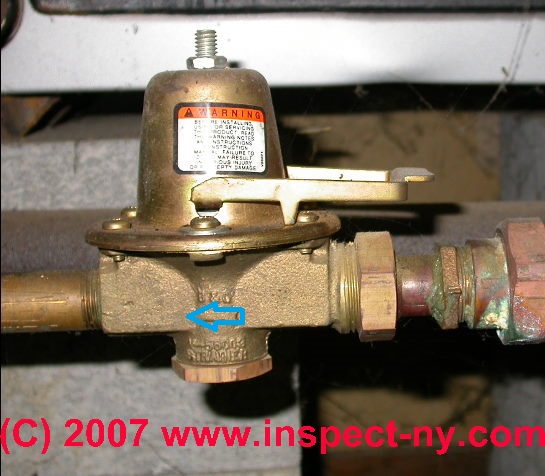
 Air-Bound Heating System Repair FAQs-2
- POST a QUESTION or COMMENT about fixing an air-bound hot water heating system
Air-bound heating baseboard or radiator repair FAQs:
Frequently-asked questions about how to remove un-wanted, air from noisy or air-bound hot water heating system pipes, radiators, convectors, and baseboards using the automatic water feed valveOn a heating boiler.
If necessary there are additional methods used to remove air from air-bound hot water heating systems using two different service procedures to force air out of airbound pipes in a hot water heating system.
InspectAPedia tolerates no conflicts of interest. We have no relationship with advertisers, products, or services discussed at this website.
- Daniel Friedman, Publisher/Editor/Author - See WHO ARE WE?
FAQs help Fix a Cold, Air-Bound Hot Water Heating Baseboard or Radiator
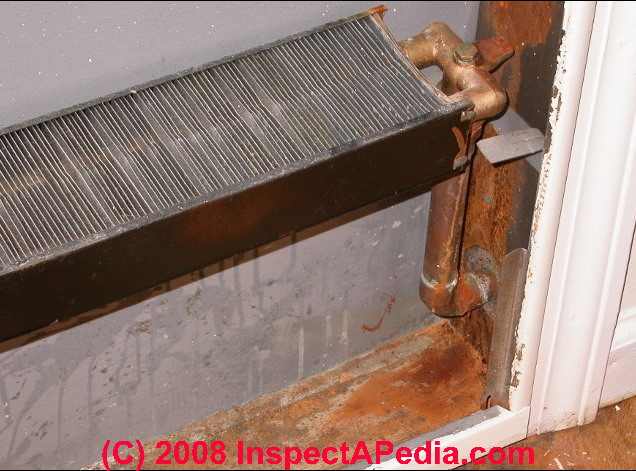 Discussed in this second set of FAQs: How to diagnose and fix cold heating baseboards or radiators, and how to diagnose and fix heating circulator pumps that won't stop running.
These questions and answers about air bleeders and air removal valves used on hot water (hydronic) heating systems were posted originally
at AIRBOUND HEAT SYSTEM REPAIR by WATER FEED VALVE - be sure to see the diagnosis and repair steps given in that article.
Also see this AIRBOUND HEAT REPAIR FAQs INDEX - to all questions & answers about fixing airbound hot water heating systems including air bleeder valves, air vents, and air removal methods.
Article Contents
- AIR REMOVAL by WATER FEED DID NOT WORK FAQs
- AIR BOUND BASEBOARD or RADIATOR REPAIR FAQs - fix individual cold radiators or baseboards
- BOILER PRESSURE & TEMPERATURE vs AIRBOUND SYSTEM FAQs
- CAUSES of AIRBOUND HEATING ZONES FAQs
- FIND THE LEAK in an AIRBOUND HEATING SYSTEM FAQs
- NOISY HEATING PIPES CAUSED by AIR ? FAQs - gurgling, burbling, knocking noises in heating pipes or radiators or baseboards
- SIGNS of an AIRBOUND HEATING SYSTEM FAQs
...
If Purging Air using the Water Feed Valve Doesn't Work
Tip: See details at
- AIR BLEEDERS NOT WORKING - NO WATER COMES OUT - we open the vent and nothing happens
- AIR BLEEDERS NOT WORKING - NO AIR COMES OUT, ONLY WATER - we open the vent and just get water, no air
My heating pipes are still cold even after I tried to get the air out
I found AIRBOUND HEAT SYSTEM REPAIR by WATER FEED VALVE a very intuitive article. But it didn't work for me.
Even after applying this technique, the pipes leading into/out one of my kick-space heaters are still cold despite the fact that the kick-space heater in the the other room as well as the rest of the loop that makes up the entire zone on the floor works fine.
Any suggestions? On 2017-11-18 by Dorky Daven
Reply by (mod) - Time to use a pony pump
Dave,
Indeed it can be difficult to force air out of all sections of an air-bound heating system.Sometimes I see a nearly horizontal pipe run that holds onto air; that's where the bleeder valves alone won't work.
Instead the technician forces water through the whole system with a more powerful pony pump to push air around and out even when it has to push the air "down".
So when AIRBOUND HEAT SYSTEM REPAIR by WATER FEED VALVE - doesn't work, we go on to a more forceful method I explainat AIR BOUND HEAT SYSTEM REPAIR by PUMP
Another method to remove air from a hot water heating system is to use
a PRESSURE-STEP DEAERATOR [PDF] remove entrained air in the hot water heating system.
And at AIR-BOUND HEATING SYSTEMS - home we provide a complete list of causes and cures for airbound heating systems.
by Dorky Dave - the circulator pump doesn't produce enough pressure to push air through the heating pipes
Thanks for responding MOD. The only ball valve with a tee off for a garden hose connection is on the return lines heading back down to the boiler and also at the bottom of the boiler. It may sound impractical, but can I do a 'reverse' power flush with my type of set up?
The only other possible conculsson I can come up with is that circulator pump for this zone is not producing enough pressure since the failing kick-space heater is last on the loop zone before heading back down to the return lines.
Have a great Thanksgiving.Reply by (mod) -
Dave,
It is certainly the case that a hot water heating zone circulator pump has very little lift or push pressure. The impeller assembly can move water through a heating zone loop but the "lift" to push that hot water up to higher floors above the boiler really comes from the starting cold boiler pressure (12 psi cold) and that pressure sometimes has to be set a bit higher for three or four story homes with a boiler in the basement.You'll probablty have to feed in at the boiler drain and take the loop back out at the higher valve that you described.
The problem was trying to force out air pumping backwards through the system is that you may run into check valves that will not let the water circulate.
And yes you could have a circulator pump with a bad impeller.
Hopefully you won't freeze everyone out during Thanksgiving
I Need a more powerful way to force air out of my hot water heating sysem
I have a 4 zone boiler radiator system. Each zone has it's own circulator pump, thermostat, and control unit. The boiler and three of the zones are heating and one zone is not. For that zone, the thermostat is calling for heat and the circulator pump is running.
I suspect the zone is air-bound.
I have no air-bleed valves on any of the zones (baseboard radiators) but the system does have a water spigot installed on the supply side of each zone after the flow control valve and another identical spigot on the return side of each zone just before the circulator pumps and common return manifold. Both spigots have garden hose connectors. I also have a conveniently located floor drain.
Can I bleed the zone by attaching a garden hose to the supply side and another garden hose to the return side, turn on the water and open the valves?
Do you see any problem with this or is it time to call a service rep? Thanks, Robert On 2016-02-16 by Robert Smith
Reply by (mod) -
Sure Robert. See details of how your heating service tech might use a pony pump to push water through the heating system with more force than can be provided simply by building water pressure at the water feed valve.
at AIR BOUND HEAT SYSTEM REPAIR by PUMPBut while you're at it, I'd suggest looking into some strategically located air bleeder valves at high points in the system piping and baseboards or radiators.
What's the problem if the radiator is cold but no air comes out of the vent?
In my dining room register has no heat if take off screw can feel warm water spray but still no heat what do I need to do to fix On 2019-02-01 by conniemorris168@gmail.com
by (mod) - If water comes out of the air bleeder
Connie
If water comes out of the air bleeder then there's no air to be removed at that location.See AIR BLEEDERS NOT WORKING - NO AIR COMES OUT, ONLY WATER - we open the vent and just get water, no air - now what?
Still there can be an air blockage ahead of that point, OR there an be other causes such as
- a circulator pump that is not running when it should
- a zone valve that's not opening when it should
No success removing an air blockage using upstairs air bleeder valve: now what?
My second floor is not working but the first floor is hot. One zone only. I opened the upstairs bleeder valve and water came out. any comments to help me? johnmmazzola@gmail.com On 2019-01-08 by john mazzola
by (mod) - remote air blockages in heating lines - use a pump
John
It's possible that piping elsewhere in the 2nd floor heating loop is air bound even though you just saw water at the bleeder valve.
First look for more bleeder valves on that floor's heating loop and check them all.
If that doesn't work,
see AIR BOUND HEAT SYSTEM REPAIR by PUMP
I have no heat and think my system is air-locked - nothing comes out of bleeders
I have no heat anywhere in the house, not downstairs nor upstairs. I tried to bleed the upper radiators first but did get any pressure to release. I tried downstairs with the same results.
I guess I have a bad air lock in the system. It's a very old system, probably 40 years old. One zone, each radiator has a manual check valve. How do I release the air from the system. On 2018-03-23 by Joe Jiuliani
by (mod) - if your heating system is not up to pressure air bleeding won't work
Joe
If the heating system is not hot and up to operating pressure you may find you cannot bleed air out of the air bleeders even though the system is air bound.
Have you checked that the boiler runs and the circulator pump seems to run ? If not see See NO HEAT - BOILER
In the Continue Reading suggestions at the end of this page you'll see articles on Fixing Air-Bound Heatiing Systems
I hear air noise in heating pipes but the service tech couldn't get it out.
Tired of trying!
I have audible air flowing through my hydronic system pipes. A service tech was not successful in purging through the return with a garden hose, though he did get some out.
He quit and said he’s not supposed to do it under contract and what he did do would’ve been $300. With his parting instructions I have shut the system down, let it cool for an hour and repeated the return pipe purge of water for 30-60 min each time.
When I turn it back on and crank the thermostat up to 80* I can still hear air in the pipes. When I manually purge from the valves on the 2nd floor (where I have no heat) I can get almost a cup of water with little air bubbles in it out of one of the two (convector?) valves
. It never becomes all water. Then it starts sucking air in while I rush to turn the key closed. That one section gets piping hot but doesn’t stay hot when I turn the heat back down to 65*.
The other, smaller one never gets hot and only spews about 1/8 cup of water before sucking air back in. This is not the first time I’ve purged air from these two 2nd floor covectors, but have never had this kind of problem.
What the service tech told me was that those two convectors are filled from venturi valves. I have them in the basement on two 4-5’ lengths of baseboards that are positioned overhead.
He also told me the pressure/temperature gauge on the boiler is not working so it can’t be trusted to safely add water manually to raise the pressure to force more pressure upstairs. The bladder is fine in the expansion tank.
The relief valve is not clogged. He forced steam out, though it hasn’t come out for me. I don’t know what else to do. If a service tech couldn’t do it in two hours, and I’ve spent 6 days trying to do it all I can do is continue sleeping on the couch til spring.
Can you give me any safe (for my system) direction? I’m about ready to pull my hair out! :( On 2018-02-17 by Cher
by (mod) - Service tech says they are not allowed to remove air? Are is he kidding?
It might be that the problem is not with the procedure but rather that there is an air leak into the system that has not been found.
But Baloney! a heating service company can certainly be expected to be capable of removing air from a system and also they can expect to be paid for doing so.
by Cher
Thanks for the help. I’m not sure how but I got some heat back in the larger one in the bedroom. I think maybe by giving it some days in between for the air to fully rise.
I don’t have flow/water in the smaller one but did get a bunch of air out without drawing it back in. I’ll just give it more time to again rise to the top and hopefully purge out enough air to get full flow in that convector also.
It’s almost spring so it can be further and more easily addressed when it’s not painfully cold to work on it.
...
What Causes Airbound Heating Zones?
Why is there air in my hot water heating system? Where did the water go?
What are the causes for an airbound zone? Where did the original water go ? On 2017-12-24 by Mij
by (mod) - Causes of airbound heat
Basic physics: Air that is entrained in the water is forced out of the water to form air as a gas when the water is heated.
Automatic air bleeder(s) not working:
air scoops and air bleeders are installed on hot water heating systems to permit that air to escape at those air vents. If the automatic air bleeder vent cap is closed tightly or if the air bleeder internal float has failed, the device won't remove air from the system and the heating pipes or zone may become air blocked.
See details at AIR BLEEDER VALVESand at AIR SCOOPS SEPARATORS PURGERS
Air let into the system during service or maintenance:
draining a boiler or even draining just part of a heating system during service or repair allows air into the system. It can be difficult to force that air out simply by running a heating zone circulator pump. Those pumps do not have much lift or force.
Leaks
in a system could also allow air into some heating systems. That may seem counter intuitive since a hot water heating boiler system is normally always under some pressure - at least 12 psi cold.
But we've seen air leaks into heating radiators and piping at defective air bleeders, at air scoops right at the boiler, or at other leak points. The air seemed to be drawn in as the heating system cooled down.
When a hot water system has a leak anywhere, as water leaks out, air may also leak into the system.
Automatic water feed valve not working: a properly-functioning hot water heating system does not use any water.
But if there is a leak, and despite the manufacturers warning that their "automatic pressure reducer water feeder valvefs" should not be considered an "automatic water feeder", we expect the water feed valve to add make-up water to the system. But the valve may not respond, particularly to a small leak.
At STEPS in TRACKING DOWN CAUSE of an AIRBOUND HEATING SYSTEM we include a description of an owner discovering that his water feeder was not feeding water to the boiler.
See our complete list of causes and cures for airbound heating systems
Part of a split heating zone won't get warm even though I bled out "all the air"
The other day my oil fired hot water system acted up. The furnace itself is operating fine the system is single zone and splits to go upstairs and downstairs and rejoins at the end of the system to go into the circulating pump.
The pump is fine and the upstairs feed gets very hot but the downstairs stays cold. I bled the system found no air.
I then drained the entire system and refilled it and bled all the air out but it's still cold. I bled the downstairs system at all 3 points. I get plenty of water out of the bleeders so i know there is no blockage. Any thoughts? On 2016-02-14 by JIM
by (mod) - remote air blockage may not be fixed at air bleeders;
Jim
As you have only one circulator and one piping that branches into two sub loops, it sounds as if the circulator works and thus your cold downstairs must be due to a blockage, usually air. Feel along the pipes following them until you feel where the temperature drops off.
My guess is that although you say you bled out all the air, you didn't get it all. If the air blockage is in a long pipe run that's distant from the air bleeder valves that you're opening, you can be fooled into thinking that there's no more air blockage in the piping.
You may need to use the procedure cited at AIRBOUND HEAT SYSTEM REPAIR by WATER FEED VALVE
Can the boiler feed cause air in system if not working properly
At a oil burner can the boiler feed cause air in system if not working properly ? (Feb 26, 2017) J Tuffarelli
Reply:
I'm not sure what you mean by "boiler feed" - if you refer to the water feed valve, I suppose that a leak in that valve might introduce air into the system but it seems unlikely as an air source.
See AIR-BOUND HEATING SYSTEMS - topic home
...
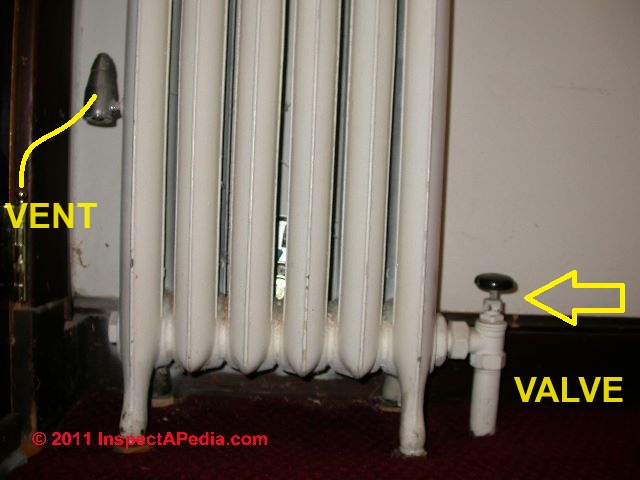
Fix Individual Cold Baseboards, Convectors, or Radiators
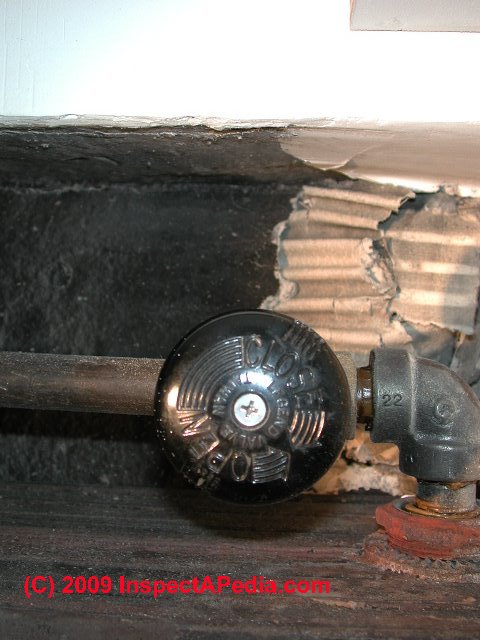 One Radiator on my Top Floor is Cold
I have one radiator on the top floor that is cold. I tried to bleed it but nothing comes out. On 2017-03-04 by Anthony
by (mod) -
Anthony
When you are bleeding a radiator on the top floor of a building it's particularly important that the heating system be up to full temperature and pressure - otherwise there may not be enough pressure in the system to force hot water up to that rad.
First be sure that the radiator valve is open (counter-clockwise) but if it's stuck don't force it as you could break it.
Then turn the thermostat up and watch your boiler to see that the boiler runs, the circulator(s) run, and let it run until the boiler turns itself off.
Then try bleeding the radiator again.
Finally, check the boiler pressure when the system is cold. If pressure is below 12 psi the system may not be properly adjusted.See details at COLD HEATING RADIATOR REPAIR (hot water / hydronic heat)
If you lack of heat in an individual radiator or convector what are 4 things to check?
If you lack of heat in an individual radiator or convector what are 4 things to check ? On 2017-12-07 by Tony
by (mod) - Good luck on your heating service school test
Tony,
The answers are at
- 5 APPROACHES to REMOVING AIR - from heating boilers & piping
And more detail is at
- AIR BLEED VALVE LEAK REPAIR - a faulty air bleeder may leak air into heat piping during hot water heating system cool-down
- RADIATOR STEAM VENTS - a steam vent at an individual radiator may not be working. Also see RADIATOR VALVE TYPES - hot water vs steam
- RADIATOR VALVES & HEAT CONTROL - a radiator valve may be closed or if it's a gate valve, may look open but be closed internally
- WHICH WAY DO I TURN THE RADIATOR VALVE HANDLE? - clockwise (right) = closed
- FIX A STUCK RADIATOR VALVE - can't turn the handle?
Good luck on your test.
One heating baseboard doesn't work
All my heating baseboards work except 1 and it's located on the corner of 2nd floor.
I open the air valve, the water is cold and I wait till the hot water come out before closing the air valve.
Did many times and I even closed all the working baseboards, and still not working On 2017-12-05 by 1 b
Reply by (mod) -
1 B
The right way to use an air bleeder valve is to bleed air out of the baseboard, not water.So if you're opening the valve and no air is coming out then the air blockage is at another location and that valve isn't quite helping you.
It may be that a more forceful method of getting air out of the system is necessary. That would require help from heating service tech.
But another thing I might check first is the system pressure.If you're in a three-story house for example it might be that the starting cold pressure isn't quite high enough.
You see the circulator pump doesn't really have lift capacity. Instead it depends on adequate system pressure to get the water up to the highest floor. So tell me how tall is your building and on what floor is the cold baseboard.
Detailed advice is
at AIR BLEEDERS NOT WORKING - NO AIR COMES OUT, ONLY WATER - we open the vent and just get water, no air
...
Signs of an Airbound Heating System
If the room thermostat is calling for heat, the boiler has run and is up to temperature, and the circulator pump(s) is (are) running and the zone valves (if present) are open to allow hot water to circulate through the hot water heating piping loop(s), and if the radiator valves (if present) are open, then we expect the heating devices (radiators, baseboars, convectors) to get warm or even hot.
If no radiators or baseboards are getting warm or hot we suspect that the system is airbound, though there could be other hidden causes such as a broken circulator pump impeller.
If heating pipes are hot into the circulator pump and hot for a short distance out of and past the circulator pump, the system may be airbound.
If on a call for heat some zones or radiators get hot and others don't then those zones or radiators could be airbound.
Start at
- AIR-BOUND HEATING SYSTEMS - home
Signs of air in electric boiler heating pipes or radiators
I have an Electric Hydronic heating system in a 2 story home, 2 zones on each level, (system is in the basement heating the other 2 levels)
2 questions I need help with:
1 - The first floor has no vents of any kind on the rads is this a concern ? My rads on this floor dont seem to get as hot as the 2nd floor witch has air vents that I can bleed on every 2nd rad.
2- When a zone calls for or shuts off heat you can hear a loud rush of waster type noise is that normal? (10 psi on system)
Thanks On 2019-03-09 by Gerald
Reply by (mod) -
Sounds like there may be air in your heating system piping. Solutions are given throughout this article series such as installing air bleeder valves where needed or your service tech may use a pump and may manually Force water through the piping to remove air.
...
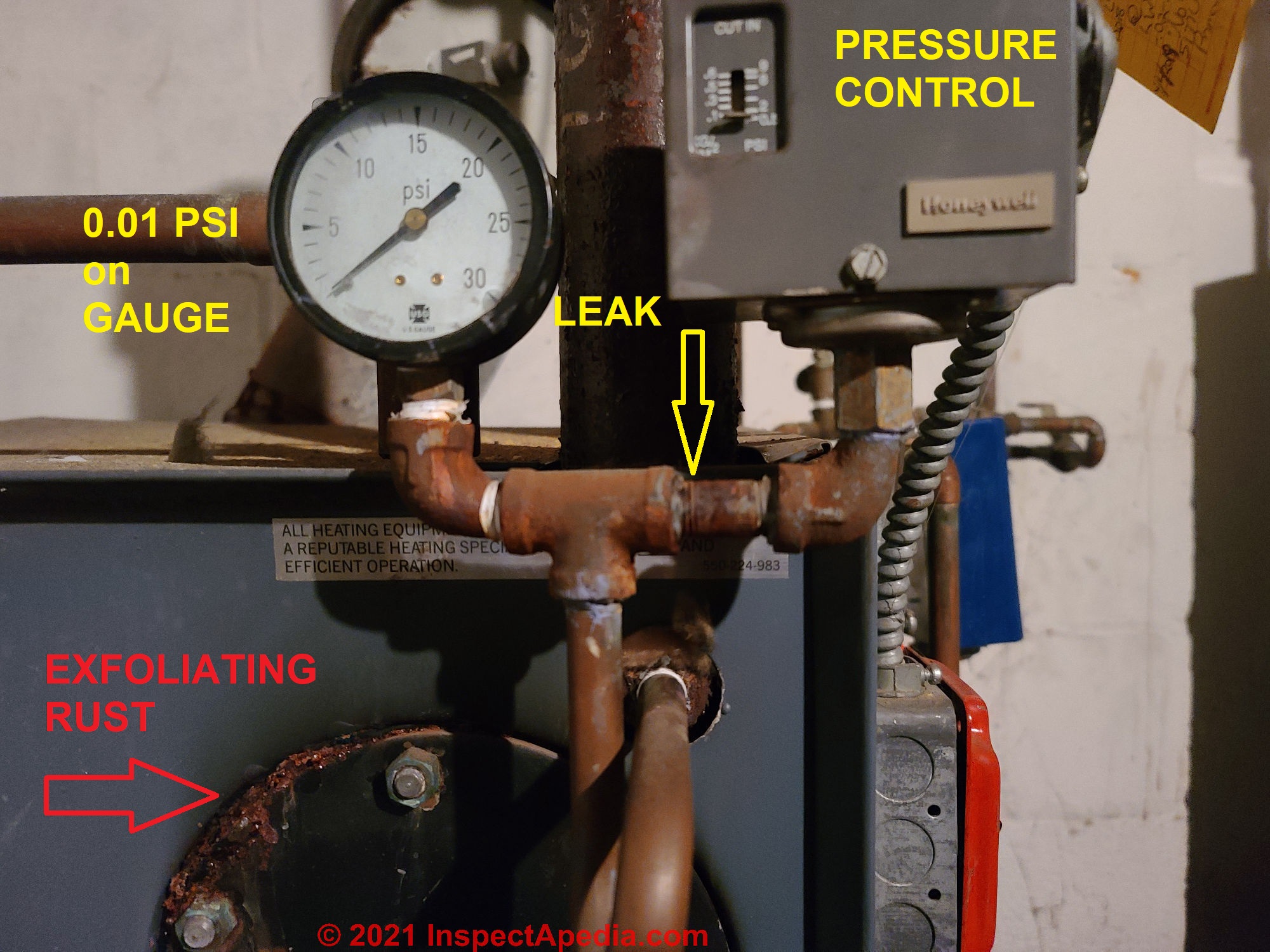
Steps in Tracking Down a Leak in an Airbound Heating System
Automatic water feeder was not keeping water in my boiler (small leak somewhere)
I've finally found a cure, albeit a band aid. I swapped the auto-fill pressure reducing Watts SB1156F for a new one and left it at the preset pressure, purged the air and it came back again within the same couple of days as before.
So, having given up hope of anything else working I decided that since the boiler gauge pressure was consistently going down before the air was audible there must be a water pressure issue of some kind.
That said, I increased the auto-fill water pressure on the Watts until I could hear water entering the system.
As soon as I heard the auto-fill topping up the system I stopped increasing the pressure.
That was a week ago and still no air. The operating pressure is constant at around 27psi. Not ideal.....but no air. On 2017-02-12 by Will -
Reply by (mod) - There is a leak somewhere in your system that you've not found or air purgers that are not purging air - hidden leak search tips
Will,
That's progress at keeping the system running, but if the water feeder keeps feeding water to a hyrdonic heat (forced hot water, not steam) boiler then something's wrong and there's a leak to be found and fixed.Ask: where is that leaking water going? Probably it's up to no good.
Watch for "hidden" boiler leaks and water that's evaporating
Watch out: a small boiler leak can be very hard to find.
For example, I've inspected cast iron hydronic boilers that were using water but no water appeared anywhere.
The leak was between cast iron boiler sections, leaking inside the boiler jacket, and ultimately showing up as mineral salt deposits that we might see first on the bottom of the boiler heat exchanger, viewed by looking up from inside the boiler combustion chamber (use an inspection mirror and a good flashlight).
Look for leaks at heating piping joints or around a tankless coil (photo above) . If the leak is slow, the water leaking out of the boiler may just be evaporating.Watch out: On some boilers that had hidden leaks inside the boiler jacket for a long time, the boiler ends up being beyond repair. For an example, although in this case it's a steam boiler not a hydronic heater,
by Will
Yeah, I can't figure that part out. There's no evidence of leaking water anywhere at all.
Reply by (mod) -
Aside from the possibility of a hidden leak, I'm stymied too. This is not a steam heating system, right?
Also: is there a large or are there multiple expansion tanks on the system? Could they have been increasingly waterlogged? Have you checked that
- there are no leaky relief valves
- there is no antique attic overflow that drains into a vent, drain, or outside the buildingby Will - I purged air from my system but it's back again
Well, my air is back again.
I've purged many times, replaced both the automatic vents, replaced the pressure relief valve, have no visible leaks anywhere and yet I still get air in my heating. The bucket under the relief valve is dry so it's not releasing water there.
I have a Watts SB1156F pressure reducing valve with the autofill bypass lever on top. I was told that I could remove the cap and push rod and screw clockwise to increase the output pressure from 15psi to something slightly higher.
So, thinking that I wasn't getting enough output from the Watts I tried that. I turned it a quarter turn and immediately water started coming up from the screw head and out through the top of the valve where the override lever screws on.
Assuming this is a bad thing I put it back to where it was and the water stopped.
My thought is that the Watts is faulty and not actually refilling correctly. However, when the system was empty for the pressure relief valve repair, when I went to refill the system I left the valve on automatic fill and I could hear the water filling the system until it reached operating pressure which the gauge on the boiler said was about 15psi.
So it works, I just don't know for certain how much pressure it's providing based just on a notoriously inaccurate gauge. This is infuriating.
One more thing, when I do get air in the system it seems like it's suddenly very noticeable.
Not a slow increase in air, just a lot of air suddenly. Not enough to become air-bound but I'm worried that if I leave it for a day or two that will happen and being in New England in January....it's a bit cold outside ;-)
Frozen pipes are all I need....
About two years ago a plumber replaced the expansion tank, is there a right way and wrong way to replace one ? I'm wondering if that's it since I feel like I've addressed everything else short of replacing the reducing valve (Watts).
The tank is warm at the top and cool at the bottom so I know it's not full of water, I just wonder if the pressure is wrong or some other issue that may be caused by a mistake during the installation.
I don't know, just trying to get to the bottom of this. If I test the pressure on the tank and the heating is hot what should it be ? Would it be higher/lower/equal to the normal pressure of (I think) 15psi when installed due to the heat in the water above ?
FWIW, I asked my plumber and his only suggestion was to install a scoop for about $800 but told me that that might not make any difference.
I trust his judgement but his last "repair" was to purge the air and it came back 2 days later. I have since replaced the parts I mentioned above to no avail.
by Will
No, oil fired hot water baseboards. The expansion tank is small, hot in the top and cool in the bottom and only two years old.
There are no attic tanks or additional expansion tanks that I know of. As far as I know all of the first floor pipes run above the basement ceiling (under the hardwood first floor) so any leaks would be visible in the basement ceiling tiles.
The second floor pipes presumably run in the first floor ceilings under the second floor hardwood floors.
There was some evidence of a small leak in the basement ceiling a few years ago but I'm not even sure that was a heating loop, I think it was domestic water.
Yeah....I'm confused. It has to be a hidden leak.Reply by (mod) -
You can often confirm that by watching the system pressure when the heating system is off and has cooled down.
Check in detail for other air bleeders that could be seeping
...
Noisy Heating Pipes Related to Airbound Heat?
Tip: See AIRBOUND HEAT SYSTEM REPAIR
for help with getting air out of the piping, baseboards, radiators.
Do pipe squeaks mean our hot water heat is airbound?
We have two zone gas fired hot water baseboard heat and I do not think there are automatic bleeders.
In the upstairs zone, the pipes are making some very loud squeaking noises (like a cracking sound almost sounding like wood squeaking when prying loose from a structure) when the heat comes on. There is also a gurgling sound as well as a sound like water trickling when the water is circulating.
Although the pipes do get warm, they don not get as hot as I've known them to get in the past. I am thinking that there is excess air. There is a bit of gurgling in the first floor pipes but not much and those baseboards do seem to get hot enough. Any suggestions on a cure?
The noise issue has been worsening over the past few years, actually waking us up at times. The circulator is new (<1year) but the noise preceded its replacement. On 2016-01-03 by Neil McKenna
Reply by (mod) - squeaking noises vs air gurgling noises
The squeaking creaking sounds you describe may be due to thermal expansion and movement of piping through tight openings or along tight wall mounts
I'd try to track that down with a mecanics' stethoscope so that you can see where to give space or better mount piping.
The gurgling is indeed typical of air in the heating system - eventually it can lead to loss of heat.AIR-BOUND HEATING SYSTEMS describes 1 of several approaches to removing air from the system.
All of the key links are given at the end of this page..
How can I cure bubbling gurgling noises at my heating system?
I have been eagerly reading your contents regarding noises in a heating system. If the answer is within, I have not found it yet. Hopefully you can help. We have a gas fired boiler with baseboard heaters.
Relatively small house, it's a 3 bedroom cape built around 1920-1940, and the boiler was replaced just before we moved in...2013.
It's a Burnham hydronics series 2, 80.1% efficiency, which is at the very low end of the spectrum. I started by having a plumber drain the system, there are three zones.
He flushed each one as I looked on trying to learn how to do it. When he was done, he said there wasn't much air in the pipes at all. And of course, it did not make a difference with the noises we experience.
The three zones appear to be
1. two bedrooms and bath upstairs;
2. front half of first floor, living room and dining room;
3. rear half of first floor, kitchen, bath and rear bedroom/den;
The noises range from loud gushing of water through the pipes! Not just trickling, gurgling or bubbling/burbling.
Almost sounds like someone is squeezing a large diaphragm/container of water though the pipes, then a little less noise while the diaphragm/container refills and gets squeezed again...over and over.
Another noise sounds like metal on metal clanking, and it seems to be coming from the boiler room itself...i.e. not in the baseboard radiators throughout the house. I've tried to run downstairs to see if I could see exactly where the noise is coming from, and I just can't seem to isolate it!
I've checked to make sure all the exposed copper pipes running horizontally in the basement are secured and not loosely hung.
Other times it’s a loud vibration noise that softly rumbles the house. If I can explain it better by sending or attaching pics, let me know. Thanks in advance.
PS my plumber said he would have to be here to hear the noises to offer any other real help…since we don’t know when the noises will happen, and they don’t happen all day long, it doesn’t make sense to pay him hourly to sit around and wait for the noise to happen…or does it? On 2017-12-14 by Arthur -
This Q&A were posted originally at ELECTRIC MOTOR NOISE DIAGNOSIS
Reply: Here is a summary of curing heating system air noises + other noise sources
Arthur,
1. Air noises, bubbling, burbling, gurgling, rushing water:
I infer from your question that there may be air trapped in the system. Such air, essentially a hydronic heating system that is not completely filled with water, can cause sounds like water gushing through pipes, also bubbling and gurgling.It's also possible that during boiler re-fill, instead of removing previous trapped air, we are left with new, worse air trapped in the system.
Just what sort of noise air makes in a hot water heating system will depend on the orifices through which it is being forced. I speculate that that can create a wide range of sounds, not all of which would be polite to describe.
There may be two other sounds from your system that bear thought
2. Vibration noises,
for example transmission of normal vibration from an oil burner motor through oil piping or other metal parts into the building structure or piping.3. Creaks and clanks
can occur where pipes move through walls and floors as they expand and contract during heating system operation.All of these sounds can be fixed.
I'm not sure why you drained the system in the first place. Saying "there's not much air in the pipes" is like saying "our cat is only a little-bit pregnant".
That's not the best analogy since even if there were only a little air that was observed, there could have been a greater amount of air that the plumber didn't find and thus didn't observe.
In any case, draining (and presumably re-filling) the boiler with water is not a repair for noises. And for hot water heat there are some small disadvantages in doing so (increasing the level of minerals in the system, for example).
That suggests that maybe your plumber was not an expert on hydronic heating and air purging.
She should have
- discussed the sounds and where they were heard
- inspected for the location and operating condition of air bleeders throughout the system, making sure they're properly located and working
- tried opening manually operated air bleeders
- if that didn't work, tried one of the methods we describe in our AIR-BOUND HEATING SYSTEMS article series to force air out of the system.
See OIL BURNER CLANKING RATTLING NOISE
See HEATING SYSTEM NOISE DIAGNOSIS for our full catalog of heating system noise & sound causes & cures.
See OIL BURNER RUMBLING NOISE for other sources of rumbling noises.
We hear gurgling sounds in hot water heating baseboards
I get gurgling in my water baseboard units, when i bleed and fill system the relief valve leaks water starting problem over again what is happening?- Roger
Reply: check for and purge air in the hot water heating boiler & piping system
Roger
Usually gurgling means there's air in the system that has not been purged.
See AIRBOUND HEAT SYSTEM REPAIR
for help with getting air out of the piping, baseboards, radiators.
The bleeding you've done may not have been effective.
If the relief valve is leaking the system may be operating at too high a temperature or pressure or might be (more rarely) suffering from a water hammer problem as a circulator pump starts and stops. Or of course the TP valve itself may need replacement.
Start by purging air, then
Continue by checking for a water-logged expansion tank on your boiler.
Loud knocking from radiators we returned to operation
 We have a one pipe steam heat system with an oil furnace.
Recently we just added 2 old heaters back onto the system ( these are original heaters back to there original locations) now we are getting a ton of really loud angry knocks all over the house.
Not just from the heaters that were reinstalled. Any ideas? On 2017-02-11 by MB
by (mod) - gurgling pipes in hot water heat are probably air
MB:
When a hydronic (hot water) heating system has excess air in the pipes, we may indeed hear gurgling sounds as water is circulating through pipes, baseboards, or even radiators or convectors.
But yours is a steam heating system.
Steam heat radiators won't be "air bound".
But your added-back radiators may not be draining steam condensate properly, perhaps because they're sloped the wrong way or because rust or crud is blocking condensate from draining back out of the system.We might hear gurgling in a steam heat condensate return pipes. But banging - less likely.
For causes of banging hissing or other noisy steam heating pipes.
See BANGING HEATING PIPES RADIATORSfor complete details of diagnosing and fixing that problem.
For causes & cures of gurgling or clicking, creaking hot water (hydronic) heating pipes,
see those details at BUBBLING GURGLING SOUNDS in HOT WATER HEATING PIPES
and at CREAKING CLANGING HOT WATER HEATING PIPES
and see the article AIRBOUND HEAT SYSTEM REPAIR by WATER FEED VALVE that discusses air removal from hot water / hydronic heating systems.
Now that I bled air out of baseboards I hear clicking noises
I have a boiler system and I am not getting heat to all my baseboards am I able just to bleed 1 baseboard and clear the air from the pipes.
Only 1 baseboard is cold and its been silent.
I bled the air from a different baseboard and now the baseboard that was cold is making clicking noises. On 2017-01-08 by Cheryl Martina
by (mod) - Normal thermal expansion noises may click or snap or tick
If you successfully bled air out of one of your heating zones and if the thermostat calls for heat and the circulator pump runs and the boiler is hot, it's normal to hear some ticking or clicking noises as the hot water entering the cold baseboards causes thermal expansion that in turn causes the baseboard itself or pipes feeding it to expand slightly, moving against tight surfaces such as flooring or metal parts.
See details at TEMPERATURE CHANGE RELATED NOISES
Whether or not you can bleed a single length of baseboard depends on where air bleeder valves are located.
For example if you check the ends of runs of baseboard in your home you may find that some but not all of them have air bleeders installed.
If the cold section of baseboard does not have an air bleeder installed it still may be possible to push the air out of that section of heat piping by opening the bleeder valve anywhere on the piping Loop that is higher than the cold section.
This article series includes two different approaches to correcting an Airbound heating system. One of them involves opening bleeders the other involves increasing the boiler operating pressure briefly and pushing water at higher pressure through the heating piping to force trapped air out. You can read both of those methods in this article series
I can't figure out how to drain system to stop the boiler air noise
I have an older system (Boiler gas fired 77) Can't figure out how to drain system to stop the noise.
I checked expansion tank and no water came out. The system seems backwards. Water from hot water heater to vertical piping and 3 zone valves off that each with a drain valve and then looks like into cirq pump than boiler.
This seems backwards to me. on the output side of boiler has 3 branches off and expansion tank with auto relief valve.
I can send photos if needed.
Any advice would be great!
I'm just trying to make it through the winter then I will replace the system, but I would like to get some sleep in the mean time. (Nov 19, 2012) Todd
Reply:
Todd,
I would like to see some photos of the system and piping arrangement.
But too, our article may have confused you. In general, we don't try to stop air bubbling noise in a hot water heating system by draining water out.
Quite the opposite. We want the system piping to have no air in it at all - filled with water.
Draining an expansion tank to get air into that component is correct for non- bladder type tanks, but is a separate topic.
Try the detailed aire removal steps we describe beginning
at AIR-BOUND HEATING SYSTEMS - home
Pipe noise reduced but is still there after bleeding air out of our heating system
Last week I had a leak through the light fixture on the first floor which turned out to be caused by a puncture on the heating line running to the second floor (right underneath the baseboard) that piece was replaced.
first we couldn't get heat on the second floor. After bleeding it for a long while, finally heat came out. Now I hear strong bangs on the pipe (there was always this noise but it was mild before). I was told that baseboard needs to be bled when that happens since that is caused by air.
However, the noise continues and I have bled it for quite sometime.
I went to the basement and have open and close the breathers as well but I didn't hear any air coming from there (although early today it did expel a lot of air)
I bled all baseboards and for a bit the noise diminished; however, the bangs increase from time to time. Can you please help how to fix this problem? (Jan 25, 2014) hearty
Reply:
The fact that when you opened some air bleedes the heating water pipe noise diminished suggests that you're on the right track.
But it is possible for individual radiators or baseboard sections to remain partially air-bound once air has leaked into the piping system.
If your air bleeders are located somewhere lower in the piping system it can be difficult to get that air out.
In a severe case no hot water circulates. But it's possible to get *reduced* but not totally-blocked hot water flow from air in the system too.
The options are to use a pony pump to force water around and try to force air out of such locations or to identify the problem sections and install additional air bleeders at high points that will solve the problem.
Air Bleeding Doesn't Work, Pipes Gurgle - Water feeding through the Amtrol tank fitting
I tried to follow your procedures listed at AIRBOUND HEAT SYSTEM REPAIR by WATER FEED VALVE but I am thrown off by the fact that even without a auto fill valve the cold water feed does not refill the system thru the fitting at the Amtrol tank?
I have a weil-mclain #68 boiler used for heat and hot water.
The gurgling noise in the baseboards has slowly gotten noisier until its now a bang/clang on cooling off. No vents on the baseboards and there is no auto fill valve.
Three drain valves on boiler 1 on the the ( 2 zone) return line above recirc pump, one at the base of the boiler & one off the cold water feed below the mixing valve. the amtrol tank is mounted high and the vent over it occasionally vents but the noises have not improved.
I shut the boiler down and after the temp dropped I ran a hose from the cold water fill below the mixing valve to the drain at the base of the boiler.
I had both zone valves open and cracked the valves while watching the gauge.
I then tried opening the valve on the return line but did not notice any air bleed.
The pressure stayed around 15+ psi. I am going to recheck for the noises and just want to make sure that the lines are properly filled ( I assume more efficient and minimal to no noise) and to find out why the gauge is usually on 0-5 inspite of being professionally installed (1993) and serviced continually by the same shop.
Please let me know if I should run more water out of the return line while feeding the boiler drain until I hear air coming out. Thanks John (Feb 19, 2012) John said:
All my radiators are cold just one gets hot in the bathroom i need help to fix it/ (Nov 4, 2012) sarah
Reply: Add water, turn up the thermostat, feel pipes to see where heat stops.
I'm not sure what fitting you're using to try to add water to your boiler, but I agree that if you drain water or open an air bleeder but don't get water going into the system your repair won't succeed.
If you can show me some photos of your system I may be able to point you to a suitable fitting - else you really need help from an onsite heating service tech.
Manual air bleeding at a radiator or other valve or vent only works if the bleed opening is at a high point in the system and is where or uphill and just past where the air blockage is locate
At AIRBOUND HEAT SYSTEM REPAIR by WATER FEED VALVE you'll see photos of the typical water feeder valve used to add water to your boiler and piping system.
Often it helps to locate the air blockage by turning up the thermostat, and when the boiler is hot, feel piping to see where heat stops.
That can tip us off about which section of heating pipe still is air-bound.
Detailed step by step help is
at COLD HEATING RADIATOR REPAIR (hot water / hydronic heat)
...
Abnormally High Boiler Pressure vs Air Bound Heat?
Boiler pressure doesn't drop when the circulator runs & boiler pressure is too high
My hot water boiler is not working correctly. High temp is set at 180, pressure is too high, 30 psi.
I put in a new expansion tank.
If temp in boiler is 175 then circulator comes on temp does not go down much but when boiler starts within 60 second a 30 degree drop in temp.
Do I have an air block or is circulator bad? - On 2015-12-29 by Neil
Reply by (mod) -
Your boiler pressure is abnormally high. Normally a residential boiler is at 12 psi cold and just under 30 psi when hot.
If the boiler pressure is over 30 psi it would be proper for the pressure/temperature relief valve to open.
If the underlying cause was your expansion tank then see
- RELIEF VALVE LEAK DUE TO ZILMET EXPANSION TANK for an example of detailed leak diagnosis traced to the boiler expansion tank.
See
to see the other causes.
The drop in temperature in the boiler at the start of a heating cycle is normal as cold water is returning to the heating unit from cool baseboards, radiators, or piping.
To understand boiler pressure and tempeature see
...
OTHER Air Removal Q&A
Why do bad smells come out of our baseboard radiator when heat turns on?
Why is there a fume coming from baseboard radiator when heat is coming in On 2017-01-04 by betty
Reply by (mod) -
Betty
Typically there has been spillage, debris, or even a dead animal on or behind the baseboard. or in the wall or under the floor. That is, the odor won't be from the heating water itself unless there is a leak.
I bled the heating pipes but there's a tank over my boiler - how do I drain that?
I have bled my hot water baseboard heaters successfully, but I have what appears to be a pressure tank on my oil fired furnace.
I think I recall that the tank should be empty.
By weight, it feels like there is water in it. How do I properly remove the water from the tank? Just open the hose bibb valve? On 2016-02-13 by Dennis
Answer by (mod) - how & when to drain the heating boiler expansion tank
Sure Dennis
You'll see that a boiler expansion tank will normally have some water in it; when the boiler is cold the tank might be as much as 1/4 to half full of water.
But if/when your expansion tank gets more full than that, and if yours is an older expansion tank that doesn't use an internal bladder, then it needs to be drained and re-charged with air.
Step by step details of how to do that are
at EXPANSION TANK DRAIN & AIR RE-CHARGE - Daniel Friedman
...
...
Continue reading at AIRBOUND HEAT SYSTEM REPAIR by WATER FEED VALVE or select a topic from the closely-related articles below, or see the complete ARTICLE INDEX.
Or see these
Articles on Fixing Air-Bound Heatiing Systems
Suggested citation for this web page
AIRBOUND HEAT SYSTEM REPAIR by WATER FEED VALVE FAQs-2 at InspectApedia.com - online encyclopedia of building & environmental inspection, testing, diagnosis, repair, & problem prevention advice.
Or see this
INDEX to RELATED ARTICLES: ARTICLE INDEX to HEATING RADIATORS
Or use the SEARCH BOX found below to Ask a Question or Search InspectApedia
Ask a Question or Search InspectApedia
Share this article:Questions & answers or comments about fixing an air-bound hot water heating system
Search the InspectApedia website
Need to make a private comment? Email editor@inspectApedia.com. We welcome email with your website content critique, corrections, suggestions or questions. Email is monitored daily but our workload may prevent an immediate reply. For immediate results, we hope you'll first try asking your question using the search box just above.
Citations & References
In addition to any citations in the article above, a full list is available on request.
- In addition to citations & references found in this article, see the research citations given at the end of the related articles found at our suggested
CONTINUE READING or RECOMMENDED ARTICLES.
- Carson, Dunlop & Associates Ltd., 120 Carlton Street Suite 407, Toronto ON M5A 4K2. Tel: (416) 964-9415 1-800-268-7070 Email: info@carsondunlop.com. Alan Carson is a past president of ASHI, the American Society of Home Inspectors.
Thanks to Alan Carson and Bob Dunlop, for permission for InspectAPedia to use text excerpts from The HOME REFERENCE BOOK - the Encyclopedia of Homes and to use illustrations from The ILLUSTRATED HOME .
Carson Dunlop Associates provides extensive home inspection education and report writing material. In gratitude we provide links to tsome Carson Dunlop Associates products and services.
 |
HOME | ABOUT | ASK a QUESTION | CONTACT | CONTENT USE POLICY | DESCRIPTION | POLICIES | PRIVACY | |
| © 2026 - 1985 Publisher InspectApedia.com - Daniel Friedman | |||||||||