
InspectAPedia® FREE Encyclopedia of Building & Environmental Construction, Diagnosis, Maintenance & Repair |
Question? Just ask us! InspectAPedia
|
 Prime a Well Pump
Through the Pump Body
at the Priming Opening
- POST a QUESTION or COMMENT about how to prime a well pump - priming through the pump body itself
How to prime the water pump:
This article describes how to prime a water pump to restore water pressure to a building by pouring water through a plugged opening in the well pump.
The procedure is pretty easy: here we'll will describe
How to find the well pump priming plug
How to remove the plug, and if the water pump priming plug is not easy to remove we suggest an alternative procedure that skips that step.
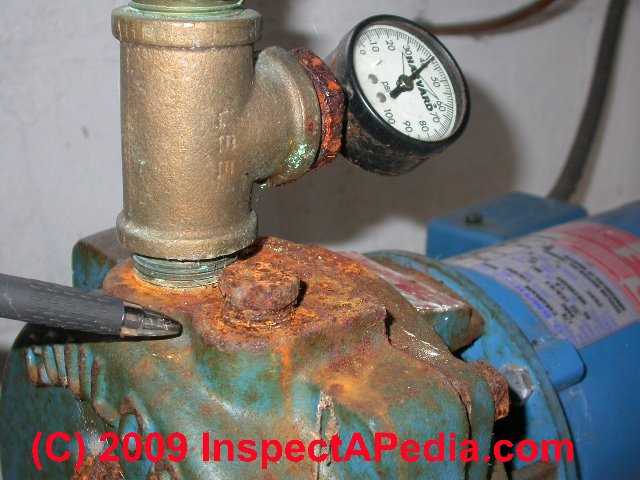
In the page top photo my pen points to the priming plug atop an older jet pump.
InspectAPedia tolerates no conflicts of interest. We have no relationship with advertisers, products, or services discussed at this website.
- Daniel Friedman, Publisher/Editor/Author - See WHO ARE WE?
Step by Step Procedure for Direct Priming a Well Water Pump
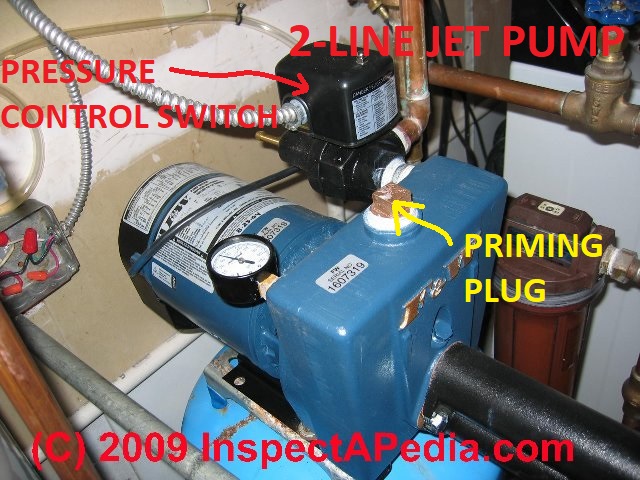 Our photo at page top shows the plug that would be removed to prime this Meyers pump by pouring water into the pump housing.
If your water pump is a two-line jet pump and if it's running but there is no water delivered to the building, the problem could be that the pump has lost its prime.
This pump needs to send water down into the well (and through a special valve at the end of the water pickup-pipe in the well) in order to bring water back to the building.
See WATER PRESSURE LOSS DIAGNOSIS & REPAIR for help in determining why you have no water or no water pressure in a building. If the diagnosis determines that you need to re-prime the water pump, the instructions are provided in this article.
Where a two line jet pump is installed, you may have lost prime at the pump. The pump motor will run but no water is delivered.
If this happens it is possible to re-prime the pump with water from another source.
Check valves installed at the proper location at the pump and perhaps elsewhere can help prevent loss of prime on this system.
(Other problems that can give the same symptom include internal damage to the water pump, a well that has run dry, or a piping leak between the well and the building it serves.)
Turn off the water pump if it is running "dry": If your jet pump (or other above-ground well water pump) loses prime and cannot draw water from the well, don't let it keep running as you may burn up the pump motor or damage the pump internal parts. The pump won't be damaged if it runs dry for a minute or a few minutes, but leaving it running for half an hour with no water could be another story.
Before following this procedure to directly prime a dry water pump that has lost its prime, you might want to try the alternative water pump prime method that avoids any disassembly or the need for tools
- described separately at PRIME the PUMP using a GARDEN HOSE.
Our photo (left) shows the two line F&W (Flint and Walling) two line jet pump in our lab. That big brass plug in the center of the top of the pump body (center of the photo) closes the opening that is used to prime the pump if it should be dry. Don't take out this plug before reading the instructions below.
- Find the water pump and water pump electrical switch
- Turn off electrical power to the pump
- Release any remaining water or air pressure
in the system by opening a nearby faucet or drain, then close it again. - Obtain a gallon or two of water to use for re-priming the water pump.
If you have a little water pressure remaining in the system just run the water into a couple of clean one-gallon milk cartons (or any clean container in an emergency).
If you don't have any water pressure you may be able to draw some water out of the bottom of the water pressure tank or the hot water heater using the drain valve at the bottom of each of those
- but be careful: sometimes old drain valves are stuck or will break and then leak. We keep a garden hose cap around to screw over a drain valve to handle the emergency case in which we could open the valve but it leaks when we try to close it.
- Find the water prime opening at the top of the mechanical pump body
(this is not the electric motor) where you can pour water into the pump assembly.
Our photo shows the priming plug on an F&W water pump, pointed to by my pen.
At the top of this page we show the priming plug on a Meyers water pump.
Often there is a pipe plug that can be removed from the top of the pump mechanism, or it may be necessary to remove a water pressure gauge that has been screwed into that opening.
Don't try to remove a water gauge by twisting the gauge body - you'll break it. Use a wrench on the brass gauge base where it screws into the pump. - Remove the water pump priming opening plug discussed just above.
If you do this before releasing air and water pressure from the system you'll get soaked. - Pour water into the pump prime opening
until the pump housing is filled. You might want a funnel to make it an easier job.
When the pump body has filled, you will need to screw the pump prime opening plug (or water pressure gauge) back in place.
If water seems to get lost without ever filling the pump housing,
water may be running past an internal check valve and down piping into the well.
In this case you need to be nimble: pour water into the housing to get it as full as possible, quickly screw in the prime opening plug by hand (it should be secure but it does not have to be tightened with a wrench) and quickly turn on the power to the water pump.
Using this procedure you may need to prime the pump a time or two before you tighten the plug. - Replace the pump prime opening plug
or pressure gauge that you removed to pour in water. You may need a little teflon tape or pipe dope to be sure the plug won't leak. - Turn the pump electrical power back on
- Listen to the pump and watch the water pressure gauge.
If the pump prime operation was successful you'll hear the pump start with a horrible noise, then get quieter as water begins to return to the pump body from the well, and you'll see the pump pressure gauge climb. If the pump keeps making a horrible noise for 45 seconds to a minute you should turn it back off and try priming again. - Check the pump, water tank, and piping around the pump for water leaks.
- Run some water to flush out the system
and reduce the chances that you've contaminated the pump or piping with bacteria from your own procedure. - Fill and keep a couple of pump priming water jugs handy for next time.
- If this procedure did not work,
see WATER PRESSURE LOSS DIAGNOSIS & REPAIR
If your water pump is a submersible unit,
the pump is located down in the well itself. In this case if you have not got water pressure, the problem may be with the pump or the well itself, but it's not a loss of prime - submersible water pumps are self-priming.
If your water pump is a one-line jet pump,
it is sucking water from a shallow well; you probably don't need to do so, but the instructions below show how to prime the well pump and they should work equally well for either a one-line jet pump or a two line jet pump.
If your water pump keeps losing prime,
a shallow well jet pump well line could have a bad foot valve (in the well) and so be losing prime.
A leak in the well line can also lead to loss of prime. If priming the well water pump using one of our methods shown below seems to fix the problem but soon the well pump loses prime again, your plumber will want to check for a bad foot valve in the well or a leak in the well piping between the well and the building.
Reader Question: can't get the new pump to deliver water - New Goulds JS 10 well pump on a shallow well
31 August 2015 Phil said:
I tried to install this pump on my shallow well. The motor works and the impeller spins but the pump does not provide any suction at all at the top of the well pipe. All connections are tight, the check valve works and when I put a pitcher pump on the well, I got water flowing after 4 strokes.
Can I just replace the impeller and attach it to the shaft on the motor? I even took the cover off the impeller housing and made sure the slots on the impeller wheel were open.
Thanks
Phil
Reply:
Phil:
The JS-10 to which you refer is probably a convertible Goulds shallow well pump model JS-10.
If the pump is running dry, without prime, I'd try priming the system first. In addition to our own text on that procedure using several methods, I include some advice from the pump manufacturer just below.
According to Goulds, this JS-10 well pump has this feature: "Diaphragm retains water in the casing to ensure the mechanical seal can never run dry."
Watch out: That does not mean that you can install this pump and run it without an initial priming operation. Most pumps will be damaged if run without water. Once the pump has been primed successfully and has pumped water, the company says the pump is indeed self-priming. But for an initial installation, surely you need to prime the pump.
The pump is delivered set-up for a shallow-well application. If you are running it on a deep well (more than 25 ft) you'll need a special conversion kit provided by the manufacturer. I'm guessing, since you said "shallow well" that you know that.
Quoting Goulds - Xylem:
Deep well jet pumps require a pressure control device on the discharge to provide back pressure to the jet assembly.
Failure to control the amount of discharge by adjusting the back pressure (pressure control valve setting) will cause the pump to lose prime.
On pumps with low control valve settings, up to 40 psi, a simple ball valve or AV15 will work.
On systems with control valve settings of 40 - 80 psi an AV22, AV22KIT or AV21 is required. They measure the pressure on the outbound side so that the high pressure does not open the 30-50 psi switch and turn the pump off.
Gould's general manual for pumps of this type warns about other snafus including these notes on priming the pump:
It is very important to eliminate high spots and dips in suction piping as they will trap air and make the system very hard to prime. Never route the piping up above and then down to the pump suction.
Suction piping should be either straight from the well to the pump or should slope upward to the pump. Pumps do not ?hold? prime, piping systems and check valves do.
On sand points or driven wells you can install an in-line check valve near the well head or at the pump and use the well casing as the suction pipe. The closer the check valve is to the well the easier the system will prime.
Priming a Shallow Well System
Priming means filling the pump and suction pipe with water. Most shallow well jet pumps handle air well and will evacuate air from the suction line but it may take several minutes to prime depending on depth to water, and pipe size and length.
VENT THE PUMP FOR EASIER PRIMING!
It is easier to prime a pump if you allow all the air to escape from the pump and the pipes, the water cannot go in unless the air can escape!
Remove the pipe plug or pressure gauge bushing in the discharge tee to fill the pump with water. On shallow well pumps you should remove the 1 ⁄8" pipe plug located between the suction and discharge ports to allow air to escape as you fill the casing with water.
The port will be located on either the top of the casing or the top of the shallow well adapter. Fill the pump and as much of the suction pipe as possible with water through the discharge port.
Replace the 1 ⁄8" pipe plug and discharge gauge/bushing. Open the faucet closest to the pump/tank a small amount to allow air to escape the system. Do not open it too much or the pump will expel too much water and you will have to reprime the pump casing.
On jobs with long suction pipes you may have to add water to the pump casing several times to complete the priming process. Go to Power Motor.
Priming a Deep Well System
Priming a deep well system means filling the pump and the suction/pressure pipes with water. Deep well single stage and multi-stage pumps require a complete prime before starting. Filling the pipes with water before installing the pump will make priming faster and easier.
VENT THE PUMP FOR EASIER PRIMING!
To insure a complete prime we recommend removing the angled 1 ⁄8" vent plug located just above the suction pipe on horizontal pumps.
This will allow the air to easily escape as water enters. Our horizontal convertible deep well jets should be primed through a tee or the AV22 at the pump discharge. The tee is not supplied by Goulds Water Technology.
Our vertical deep well jet pumps have built-in pressure control valves. Priming is done through the pressure gauge port on the pressure control valve. Most verticals have a vent plug located on the side of the motor adapter that vents the seal cavity which is the high point inside the pump. Removing this vent plug will make priming much easier.
If your pump is going to lift more than 25 ft it needs to be converted to a deep well set-up including installation of a conversion kit.
- Goulds Water Technology, "Jet Pumps, Installation, Operation, and Troubleshooting Manual", [PDF] Xylem Inc.
2881 East Bayard Street Ext., Suite A
Seneca Falls, NY 13148
Téléphone: (866) 325-4210
Télécopie: (888) 322-5877
www.gouldswatertechnology.com, retrieved 31 Aug 2015, original source: http://documentlibrary.xylemappliedwater.com/wp-content/blogs.dir/22/files/2012/08/IM102R07.pdf - in English, Spanish, French.
Bombas de Inyección MANUAL DE INSTALACIÓN, OPERACIÓN E IDENTIFICACIÓN Y RESOLUCIÓN DE PROBLEMAS
Pompes À Jet MANUEL D’INSTALLATION, D’UTILISATION ET DE DÉPANNAGE
...
Reader Comments, Questions & Answers About The Article Above
Below you will find questions and answers previously posted on this page at its page bottom reader comment box.
Reader Q&A - also see RECOMMENDED ARTICLES & FAQs
Can a well pump lose prime through a loose priming plug?
Would a leaking or non-tightened prime plug make a 2 line jet pump lose prime overnight? On 2022-10-25 by Joe -
Reply by InspectApedia (Editor) - yes, especially if there's a bad check valve too
@Joe,
That could happen particularly if there is also a leaky check valve or foot valve - the priming plug allows air into the system.
What steps to take when returning a well pump to service
I have a 2 line deep well with verticle pump at the top that feeds the bladder which appears to be in great shape however i known for sure the well has been idle 7 years (that is when I bought the house and have not used it) In order to save money
I have decided it's a good idea to fire up the well in order to water my lawn when needed because I ran my water bill up to $250 last month on the lawn. That's $200 higher than a normal bill so I'm sure you would understand my situation. However I am afraid to fire it since it has been idle for so long.
I will use air to blow the dust off and out of the motor to prevent any damage or over heating and I know priming is a must. That's a given on any surface pump but is there anything else that needs to be done? Any advice would be very much appreciated. Thanks - On 2022-09-09 by Sean Pruden -
Reply by InspectApedia-911 (mod) - use the well in order to water my lawn
@Sean Pruden,
If you are using the well only to water your lawn then you want to make sure that there is no connection between the water pressure tank Outlet line and the building Plumbing supply. Otherwise there's a risk that you cross contaminate your Municipal Water Supply with well water up unknown quality.
Once you've made sure that you're keeping Municipal Water and well water systems completely separate with no connection between them it's perfectly fine to try priming the pump and seeing if it will pump from your well successful.ly
Keep us posted.Followup by Sean Pruden
@InspectApedia-911, already done. I was wondering if I needed to do anything with the pump, well, motor, and or pipes feeding down into the well before priming and firing up?
Reply by InspectApedia-911 (mod) - for drinking water you'd shock or sterilize the well
@Sean Pruden,
For drinking water you'd shock or sterilize the well; for lawn watering I'd not bother.
All connections need to be tight and leak free.
I can't guess at nor warn off of every possible snafu, but if your wiring is correct including overcurrent protection, wire size, connections, waterproofing, etc. and the plumbing is connected properly, not leaking, etc. then it's time to try the pump.
On 2022-06-04 by David - How do I fish out the strip nut from my pump's chamber?
 My house pump has a strip nut where I prime it . How can I fish it . No tool I've tried will work . We have water now but I cant prime it at all .
On 2022-06-04 by InspectApedia-911 (mod) - Retrieving magnet works well retrieving small ferrous objects including from a well
@David,
I don't understand the question - what's a "strip nut"?
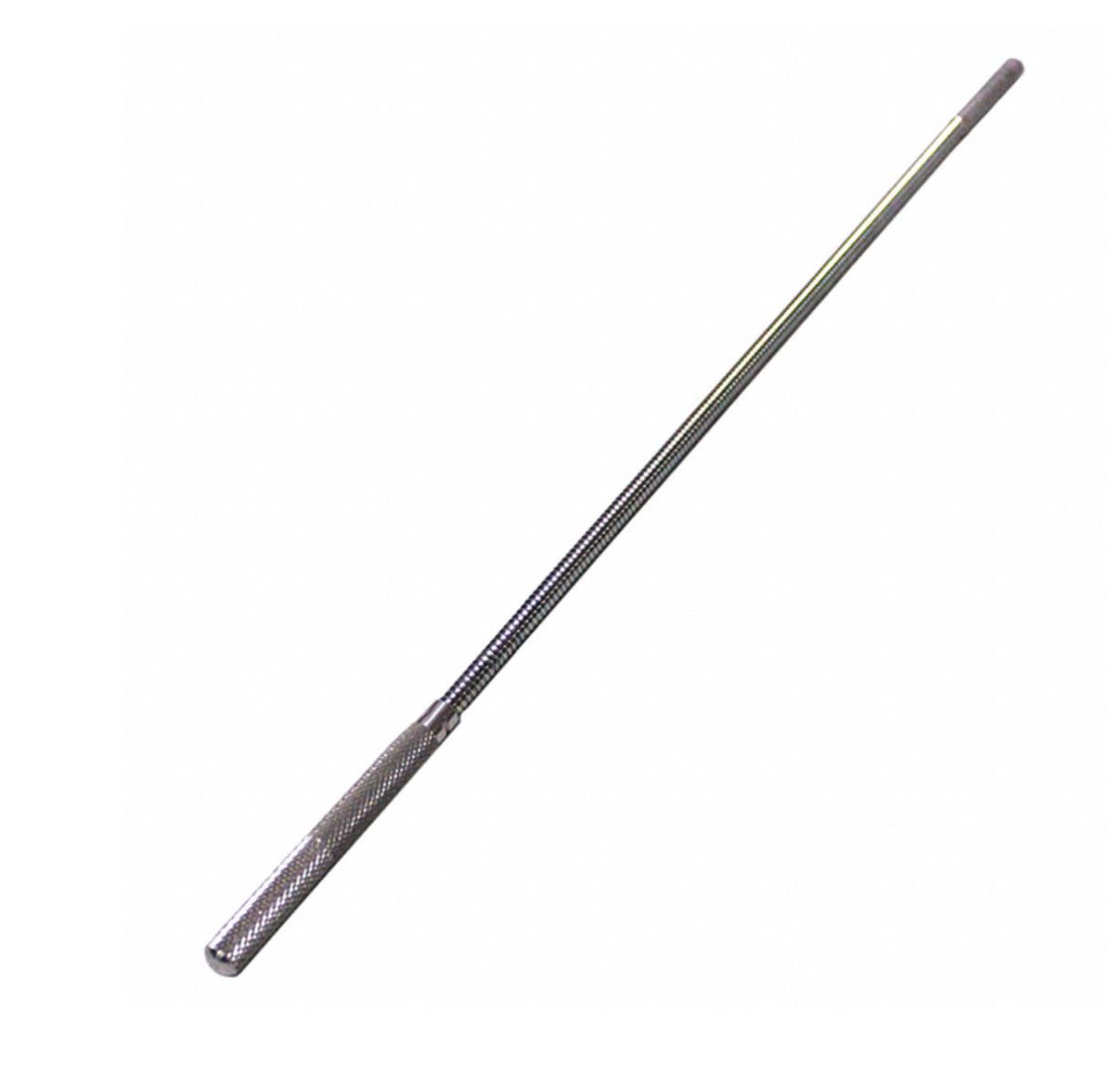
From where do you need to retrieve it? Have you tried a mechanic's retrieval magnet?
Shown here is a retrieving magnet I've used for over 50 years, the Storch Products magnet.
If what you meant is that the nut that needs to be removed in order to prime the pump has been rounded or stripped so that the wrench will not turn it,
that's pretty easy to remove.
Simply got a pair of vice grips and clamp them on to the nut. Then you'll be able to turn it.
If the priming nut is also rusted in place, then before trying to remove it try using a bit of Liquid Wrench or similar product on the threads and let it soak for 5 or 10 minutes before trying to turn it.
Take the removed nut to your hardware store where you can purchase a replacement that is in better condition.
On 2021-11-29 by Calvin - can't get my new 2-line jet pump to prime
I put a new 2line pump in an I can't get it to prime up
On 2021-11-29 by Inspectapedia Com Moderator - priming the pump advice
@Calvin,
The most-detailed advice on priming the pump is above on this page.
With no data about your installation we can but guess that there could be
- an air leak in your pump connections or well piping
- insufficient prime-water - you may need to fill the pump and piping many times or with a lot of water depending on the depth of your well piping
- no water in the well
On 2020-04-25 by Brenda - Small leak between well and pump - how do I test to see if it was fixed?
In a double line system, can you prime the pump if there is a small leak in the line between the well seal and the pump? We suspected a leak before a power outage, but still had decent water pressure. We have not had water since.
We did take the opportunity to replace the reservoir (that has a bladder) and added several ball valves to the system, since the original installation never accounted for future repair or maintenance, but we can't seem to get any psi.
The pump runs and runs, but no psi.
I'd like to be able to prime the pump to see if the suspected leak issue was resolved or if we still have an issue to address. If there is a leak, even a small one, will it be possible to prime the pump?
On 2020-04-26 by danjoefriedman (mod) - Here's an easy way to check for small leak in well piping
A Leak in the foot valve in your well could cause you to lose prime.
It's also possible that the pump ran dry and is internally damaged.
As to the question of whether a small leak can prevent you from priming the pump, I can't answer that since we don't really know what is small.
We also don't know the volume of water that's needed. In a deep well you may need considerable water to complete the priming operation.
Start by priming the pump, get it working,
pump the system up to full CUT OUT pressure.
Turn OFF water into the house.
Wait and watch the pump and water tank pressure gauge.
If the pressure drops then there is still a leak between pump and bottom of the water line in your well.
On 2019-03-27 by Ryan - When the pump stops it squirts water out of the well
We installed the waterpump from harbor freight. No problem, everything's working. However when the pump shuts off it spews out about a gallon of water or so at the well.
What's wrong and how can i fix it? Thanlk you in advance.
On 2019-03-28 - by (mod) - water hammer problem that is causing a relief valve to leak ?
Well as the Poughkeepsie police told Anna Bannana when she complained that the Metro North trains ought not be permitted to blow their horns at night because the noise bothered her the desk sergeant at the police building said:
"Well gee, that's one I've never heard before"
So thanks for an interesting problem.
Making a wild guess, I suspect there may be a water hammer problem that is causing a relief valve to leak, OR there is an artesian well whose well spool is leaky, causing water to spew out of a well casing vent.
We need first to be precise about exactly where the water is squirting from - what device or pipe.
Try posting a photo (one per comment) of the water squirting, using the Add Image button below our comments box.
On 2019-01-22 by Brian - In which direction to I turn the prime plug to loosen it
It should be righty tighty, lefty loosy
In which direction to I turn the prime plug to loosen it
Reply by (mod) - DF - turn the priming plug counter-clockwise to loosen it
Yes Brian, well pump prime plugs use conventional pipe threads - in the U.S. we call it "NPT" for National Pipe Thread.
Turn the priming plug counterclockwise (to the left) to loosen it.
On 2018-01-16 by Rory Hager - how do I prime the pump without a source of prime water?
It was shut down winterized but now need it back on
Prime a well pump without a doner water
On 2018-01-16 - by (mod) -
Rory
Bring on a bucket of water and a funnel.
On 2018-01-10 Michael Updegraff
Yeah, the AVC was a hopeful shot in the dark. I replaced it and eliminated the dripping problem, but we're (of course) still cycling (albeit less frequently, for some reason). I'd love to put the issue off until springtime when it isn't 0 degrees F outside, the thought of pulling well piping right now is not a pleasant one.
I've seen a fix with shallow-well setups that involves putting a check valve right next to the pump when the foot valve malfunctions, but I'm guessing there is no way to do such a thing with a 2-line deep well setup?
Maybe I could simply install a valve on each line just before the pump and shut the whole system down at night (including killing the pump at the breaker) so we don't have to listen to the regular cycling. Any ideas?
On 2018-01-10 - by (mod) - intermittent pump cycling is half an hour or an hour apart
Michael
If the intermittent cycling is half an hour or an hour apart you're not burning up the pump you're just wasting some electricity.
With a two line jet pump if you lose water out of the piping, as can happen if there is a combination of power outage (pump never comes on to keep pressure in the system) and a well piping leak, you will lose prime, lose water pressure, and will have to re-prime the pump.
You could install check valves (in the right direction) on both the up and down water lines, but if there is a leak below that point you may still lose prime.
So turning off the system at night risks loss of prime too.
At the very least I would visit and tighten every readily-accessible pipe connection to see if that helps. Sometimes on plastic piping I add a second stainless steel hose connector at each joint where I suspect one of them (don't know which) is leaking.
Question: Wayne CSW50 2-line jet pump, lost water pressure.
I'm absolutely confounded by my system. While we were away on vacation, the folks taking care of our animals called to tell us there was no water in the house. This is only to say I have no idea what's happened during the last 7 days to get to the point of having no water.
When I got to looking, the pressure switch did not appear to be working because the pump would run when I bypassed the switch applied current directly to the pump.
So I replaced the pressure switch, and the pump seemed to work fine. However, priming has been a problem. This pump is less than a year old, and I didn't have trouble priming it the first time (using the 2nd, or plug method) when I replaced the old one.
But this time - no dice. I do have a shutoff between the pump and pressure tank. When I close the valve, prime the pump, and run, enough pressure builds to trip the pressure switch and shut the pump off.
But as soon as I open the valve to fill the house (or if I prime with the valve to the house open), it won't prime. I also filled the pressure tank with some air and noticed a slow leak. This system predates me, and I don't think it's a bladder type.
My pump is a two line jet pump, Wayne CSW50. There are no markings on the pressure tank, so not much there.
One odd thing I did notice when I added air to the system was that I got air coming up from around the area where the lines go through the surface into the well. I didn't expect to see air escaping there.
I didn't think much of it since I could get the pump to pressure up when shut off from the house - but in the interest of full disclosure in case it sparks a thought.
I would appreciate ANY help, advice, suggestions on where to go next. I have no idea what's down the well. Predates me and the previous owner.
But I figure there are only 2 other parts to look at: either the pressure tank or the pipe down the hole. Just not sure which direction to head first and/or best practices for overcoming a pump that suddenly won't prime.
Thanks in advance,
Kevin - KMC Kurdy 6/27/11
Reply:
Mr. McCurdy: you might get somewhere in diagnosing this well water loss problem by starting with the diagnostics at the article WATER PRESSURE PROBLEM DIAGNOSIS TABLE - I'd start there rather than looking at pump priming (the article series here).
However, your clue that you got air coming up through the ground around the well piping near the pipe entry into the well suggests that there is one or there may be two issues:
1. a leak in well piping near the well - dig there and investigate the pipe condition, or look for a leak at the pitless adapter
2. an air leak into the well piping or low water in the well allowing air into the system
Question: Goulds 2-line deep well jet pump, worried about warm pump motor during priming
I just finished installing a Goulds 2 line deep well pump. I am currently priming the system, but I'm concerned about the electric motor housing getting warm. Is this a normal occurrence? I'm worried that the motor will burn out and my pump will be no more than a paperweight.
Also, after installing a new pump, how many times should the pump be manually filled with water? How will I know when full priming has been achieved? - Brian Scholtes 9/9/11
Reply:
Brian, it's normal for the pump motor to get warm but not red hot - usually you can find temperature numbers on the data tag. Don't run the pump dry however as you may damage the impeller. Usually I can get the pump working with just 1-3 fill-ups of prime, but it could be more depending on the depth of your well piping.
Provided the pump and piping are working properly and not damaged or leaking, you'll know when the pump is primed because it will begin delivering water into the home.
Question: leaky foot valve, pump and pressure tank are preventing loss of prime
I just used this method last night and we were lucky it worked. An electrician had installed a new circuit breaker panel and power was off for several hours. They tried to re-prime it but no luck. We thought we were looking at a $3K bill to open the well and finally make the switch to an in-well pump.
One thing I did not see (or missed) -- I closed the valve between the pump and the tank, so all the water I poured in went into the well line. I did have to be nimble -- fill it fast, quickly screw the gauge back, and flip the switch.
When the pump luckily started pumping, I opened the valve [to the tank] slowly. Our well guy suspects that we do have a leaky check valve, but as long as we don't lose power, we seem to be OK for a while. - Bob Stewart 8/25/2012
Reply: effects of slow well pipe or foot valve leaks on losing prime - relation to power outages
Thanks for the helpful field report, Bob.
Indeed a leaky check valve or foot valve means that whenever the pump stops water drains from the above-ground 2-line jet pump back into the well. The reason you don't lose prime immediately is that water stored in the pressure tank is feeding backwards into the well as pressure drops due to the leak. As pressure drops to the cut-in, the pump cycles on, repressurizing the water pressure tank and piping, and so prime is preserved for now.
This is the classic situation in which people observe
- First that the pump seems to run occasionally for no reason but otherwise water pressure is not being lost - see WATER PUMP INTERMITTENT CYCLING
- Second, the first time that electrical power is left off for some time the pump completely loses prime. Just how long the system can tolerate a power outage without losing prime depends on
- the size of the water pressure tank and how full it was when power was turned off or lost
- the size of the leak in the well piping or foot valve and how fast it is leaking back into the well (or into the ground depending on where the leak is found
Question: having trouble priming the pump
(July 22, 2014) Anonymous said:
having trouble priming pump
Reply:
Anon
If you are having trouble priming the pump through the primer plug opening described in the article above, be sure to check out an alternative method discussed in the article
PRIME the PUMP using a GARDEN HOSE
Question: suddenly lost all the air in tank bladder
12/1/2014 James aldrich said:
When I change the regulator and pull the pressure line off the regulator all the air in the bladder on the pressure tank was lost could you tell me if this is normal?
Reply:
James in a typical water pressure tank that uses an internal bladder, removing water from the tank or from the system won't lose air from the pressure tank - the air and the water are not living together in the tank, they've had a separation - the rubber tank bladder.
So if air is lost from such a tank the bladder is probably damaged.
Thank you to our readers for their generous comments
On 2020-02-05 by Don Ruhl - Thanks. I followed your instructions and it worked.
On 2020-02-05 - by (mod) - I followed your instructions and it worked
Thanks for the feed-back Don, that's great!
On 2021-08-29 by losswaterfrank - your pump priming instructions worked for my Goulds jet pump
thank you, primed thru gauge hole and it worked. family happy, wife gave me a kiss. Goulds 2-line deep well jet pump.
On 2021-08-29 by inspectapedia.com.moderator
@losswaterfrank,
Good going; glad this procedure worked for you.
Now watch out for loss of prime again; if it keeps happening you've got a leak somewhere or a bad check valve or footvalve.
On 2020-10-11 by Arman - Your info here probably saved me a thousand dollars
Your info here probably saved me a thousand dollars. One of my jet pump pipes broke (the small one) and of course lost prime. With your info, i was able to prime the pump after fixing the pipe. I couldn't find water at first, i only had 10 16oz bottles of Dasani.
They didn't fill it up so I went to the store and bought them out lol. I started filling the pump again and it only needed about 16oz to top it off! Oh well, plenty of water left over for next time. Thanks again for this very helpful information!
On 2020-10-11 by danjoefriedman (mod)
Arman
Thank you for the kind words and helpful feedback.
Perhaps other readers, not able to buy a dozen bottles of bottled water may instead find a generous neighbour who has a working water system and who can offer to fill clean containers with sufficient water to prime the pump.
Reader Comment:
(Aug 30, 2011) mike hanlon said: This pump priming procedure worked for me, thank you
...
Continue reading at PRIME the PUMP using a GARDEN HOSE or select a topic from the closely-related articles below, or see the complete ARTICLE INDEX.
Or see WATER PUMP PRIMING DIAGNOSTIC FAQs questions & answers posted originally on this page.
Or see these
Recommended Articles
- FOOT VALVES
- WATER PUMP PRIMING PROCEDURE
- WATER PRESSURE LOSS DIAGNOSIS & REPAIR if priming the pump is just not working for you
- WELL PIPING CHECK VALVES
- WELL PIPING LEAK DIAGNOSIS
Suggested citation for this web page
PRIME the PUMP, HOW TO at InspectApedia.com - online encyclopedia of building & environmental inspection, testing, diagnosis, repair, & problem prevention advice.
Or see this
INDEX to RELATED ARTICLES: ARTICLE INDEX to WATER SUPPLY, PUMPS TANKS WELLS
Or use the SEARCH BOX found below to Ask a Question or Search InspectApedia
Ask a Question or Search InspectApedia
Try the search box just below, or if you prefer, post a question or comment in the Comments box below and we will respond promptly.
Search the InspectApedia website
Note: appearance of your Comment below may be delayed: if your comment contains an image, photograph, web link, or text that looks to the software as if it might be a web link, your posting will appear after it has been approved by a moderator. Apologies for the delay.
Only one image can be added per comment but you can post as many comments, and therefore images, as you like.
You will not receive a notification when a response to your question has been posted.
Please bookmark this page to make it easy for you to check back for our response.
IF above you see "Comment Form is loading comments..." then COMMENT BOX - countable.ca / bawkbox.com IS NOT WORKING.
In any case you are welcome to send an email directly to us at InspectApedia.com at editor@inspectApedia.com
We'll reply to you directly. Please help us help you by noting, in your email, the URL of the InspectApedia page where you wanted to comment.
Citations & References
In addition to any citations in the article above, a full list is available on request.
- In addition to citations & references found in this article, see the research citations given at the end of the related articles found at our suggested
CONTINUE READING or RECOMMENDED ARTICLES.
- Carson, Dunlop & Associates Ltd., 120 Carlton Street Suite 407, Toronto ON M5A 4K2. Tel: (416) 964-9415 1-800-268-7070 Email: info@carsondunlop.com. Alan Carson is a past president of ASHI, the American Society of Home Inspectors.
Thanks to Alan Carson and Bob Dunlop, for permission for InspectAPedia to use text excerpts from The HOME REFERENCE BOOK - the Encyclopedia of Homes and to use illustrations from The ILLUSTRATED HOME .
Carson Dunlop Associates provides extensive home inspection education and report writing material. In gratitude we provide links to tsome Carson Dunlop Associates products and services.
 | HOME | ABOUT | ASK a QUESTION | CONTACT | CONTENT USE POLICY | DESCRIPTION | POLICIES | PRIVACY | |
| © 2025 - 1985 Publisher InspectApedia.com - Daniel Friedman | |||||||||