
InspectAPedia® FREE Encyclopedia of Building & Environmental Construction, Diagnosis, Maintenance & Repair |
Question? Just ask us! InspectAPedia
|
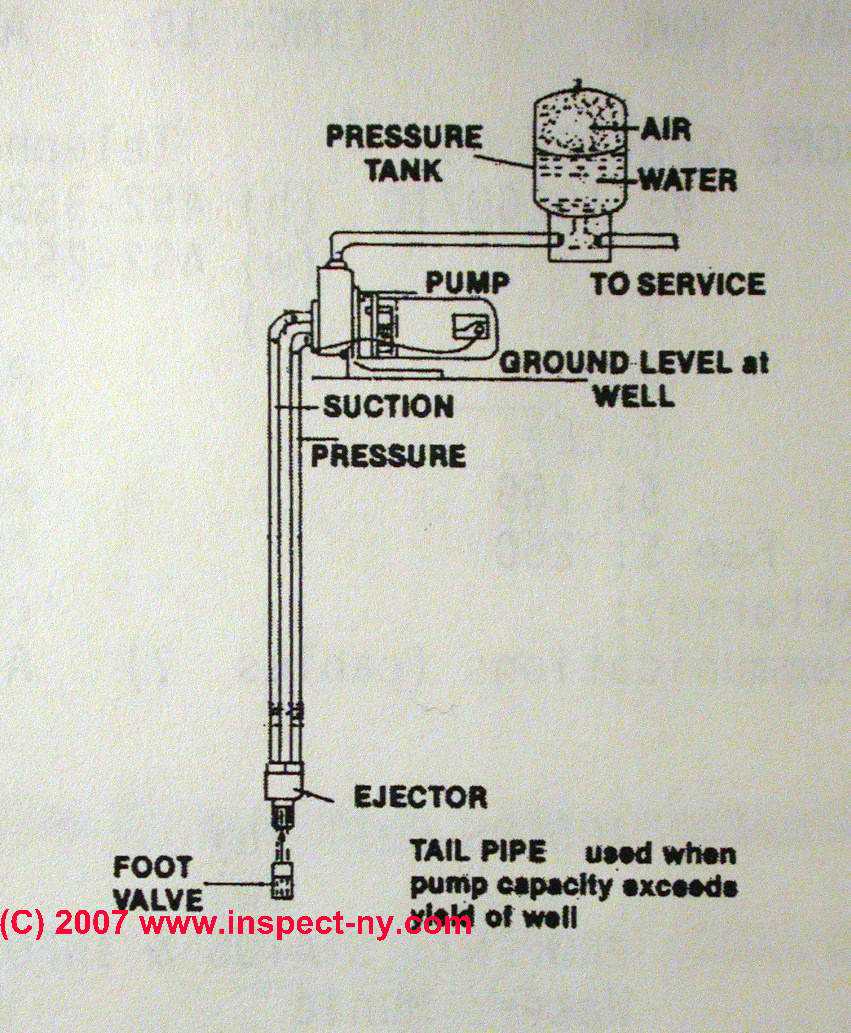 How to Prime a Well Pump
Two Line Jet Pumps & Drinking Water Wells
- POST a QUESTION or COMMENT about how to prime a water well pump
How to prime the water pump using a garden hose:
Fast and easy method to prime a well pump using a garden hose and a donor building. What types of water pumps are most likely to need to be primed?
This article describes how to prime a water pump to restore water pressure to a building by using a garden hose connected to another water supply source.
If you don't have a garden hose, a nearby working water supply, or don't like this idea, at the end of this article you'll find links to alternative approaches to restoring the water pump to operation.
InspectAPedia tolerates no conflicts of interest. We have no relationship with advertisers, products, or services discussed at this website.
- Daniel Friedman, Publisher/Editor/Author - See WHO ARE WE?
Simple & Fast Well Pump Priming Method Using a Garden Hose
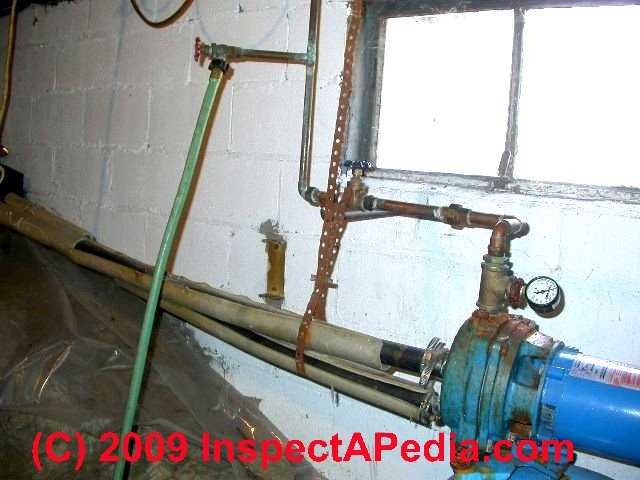 If your water pump is a two-line jet pump like the one in my photo, and if it's running but there is no water delivered to the building, the problem could be that the pump has lost its prime.
This pump needs to send water down into the well (and through a special valve at the end of the water pickup-pipe in the well) in order to bring water back to the building.
If your water pump is a submersible
unit the pump is located down in the well itself.
In this case if you have not got water pressure, the problem may be with the pump or the well itself, but it's not a loss of prime - submersible water pumps are self-priming.
If your water pump is a one-line jet pump,
it is sucking water from a shallow well;
you probably don't need to do so, but the instructions below show how to prime the well pump and they should work equally well for either a one-line jet pump or a two line jet pump.
If your water pump is a two line jet pump
(two pipes run to the well) it is drawing water from a deeper well and might need more than a small amount of water to prime the pump.
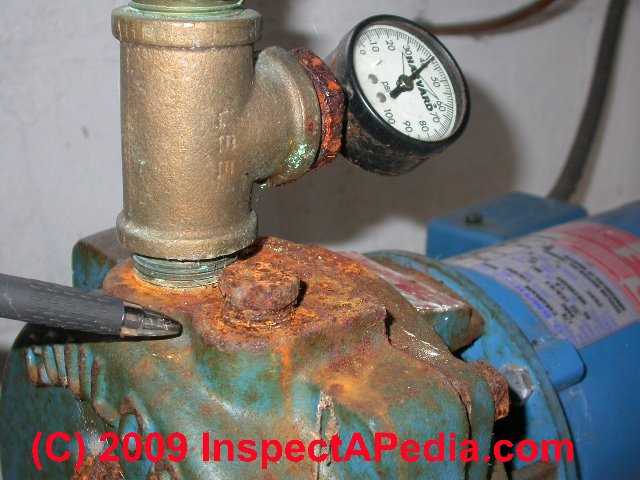
Our photo above shows my pen pointing to the rather rusty priming plug on a Goulds two-line jet pump.
Common causes of lost well pump prime
If your water pump keeps losing prime, a shallow well jet pump well line could have one of the problems we list below. Following this list we give step by step instructions to prime the pump using a garden hose.
- A bad foot valve in the well - water runs back out of the pump when the pump has turned off
see WELL PIPING FOOT VALVES - a bad check valve on well piping at or near the water tank or near the above-ground water pump - same effect as a bad foot valve
see CHECK VALVES, WATER SUPPLY, DRAINS, PUMPS
and so be losing prime. Or loss of prime may be because of: - A leak in the well line piping itself
can also lead to loss of prime. If priming the well water pump using one of our methods shown below seems to fix the problem but soon the well pump loses prime again, your plumber will want to check for a bad foot valve in the well or a leak in the well piping between the well and the building.
See WATER PRESSURE LOSS DIAGNOSIS & REPAIR for a complete diagnostic guide when you've lost water pressure and can't figure out what's wrong.
Where a jet pump is installed, you may have lost prime at the pump. The pump motor will run but no water is delivered.
If this happens it is possible to re-prime the pump with water from another source. Check valves installed at the proper location at the pump and perhaps elsewhere can help prevent loss of prime on this system.
Other problems that can give the same symptom include internal damage to the water pump, a well that has run dry, or a piping leak between the well and the building it serves.\)
Steps in Using a Garden Hose to Prime the Well Pump
Watch out: If your water pump cannot draw water from the well, don't let it keep running as you may burn up the pump motor or damage the pump internal parts.
Turn off the pump by turning off its electrical circuit.
Then take the pump priming steps given below.
The steps below describe how to use an ordinary garden hose connected to another water supply source to prime a well pump.
If you want to first try re-priming the pump by pouring water right into the pump body,
see PRIME the PUMP, HOW TO - prime using the priming plug on the pump assembly.
Priming using a garden hose is easy:
OK so you didn't click on the link just above - you're going to try my "hose priming "method: we give very detailed instructions, but actually the procedure is very simple and if it works, your pump will be primed and working in just a few minutes.
If your well pump has lost prime and you are about to try opening a plug on the water pump housing to add priming water you might see that the plug is badly rusted and corroded
- or there may be other reasons why you don't want to start taking apart plumbing fittings, such as - it's Sunday night and there is no chance of purchasing any replacement parts if you break something.
 If you click to enlarge the photo you'll see that we might have been able to remove and replace this plug but we decided to try the garden hose priming method first since we didn't want to disturb this rusty part.
- Find a water donor building:
If the water pump that needs to be primed is in a building close to a neighbor who has running water, this procedure will often get your well pump running again with the absolute least trouble and cost.
Make sure that the neighboring building is open and available and that its water system is working - that is, you have running water there.
- Find a garden hose hookup on the donor building:
Make sure that the neighboring building has a hose connection to which you can connect a garden hose.
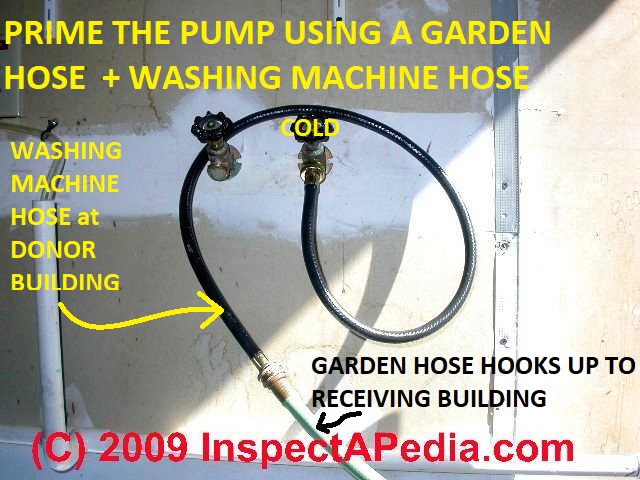
Our photo shows that we have now connected a black washing machine hose to the cold water faucet in our donor building, and we have connected a green garden hose to the other end of our washing machine hose.
We need the washing machine hose because its double-female ends permit making the connection between the supplying water spigot at the donor building and the male end of a garden hose that's going to take water to your building.
The hose connection at your donor building may be (most convenient) outside on a building wall closest to your own building, or it might be indoors (less convenient) at a clothes washing machine hook-up, a water tank drain valve, or similar fitting.
Make sure that valve is operable and that you can turn it on and off without problem. - Find a garden hose hookup on the recipient building whose pump needs to be primed:
Find a garden hose connection on the building whose pump needs to be primed.
Any fitting will do, but close to the water pump, such as a water tank drain valve, would be the very best place to connect.
- Get a garden hose:
Obtain sufficient length of common garden hose that you can reach from the water donor building to the pump prime building hose connections.
Watch out: don't assume that the interior of a garden hose is sanitary or that water run through an ordinary garden hose is safe to drink.
Also some garden hoses contain lead - do not drink water from a garden hose unless you know that yours is not a lead-containing hose. If you are purchasing a new garden hose, check the label.
- Get a clothes washing machine hose:
Obtain a short clothes washing machine hose - this is a garden hose that has a female connection (screw-on fitting) on both ends of the hose.
You can see a black washer hookup hose in our photo just above. You can borrow one of these right from a washing machine hookup if necessary. - Turn off electrical power to the water pump at the recipient building.
Drain water and water pressure from the system piping. - Open a plumbing fixture in the recipient building
nearest the water tank in the recipient building. This will let the incoming donor building water push air out of the recipient building's piping.
Some garden hose product labels indicate that the hose is safe for drinking. Others may indicate that the hose should not be used for drinking.
Unfortunately still other hoses are simply not labeled - we won't know about any chemical or lead hazards from drinking from such a hose without testing.
The lead hazard in a garden hose, as with possible lead hazards from lead plumbing or lead-solder-based copper pipe connections, depends on several variables including how long water has been resting inside the hose (longer absorbs more lead if lead is present), on the chemistry of your water supply (more aggressive may leach out more lead), and of course on the lead levels in the source: hose, pipe, or somewhere else.
If you are in any doubt about the cleanliness of a garden hose being used for well pump priming or for an emergency water supply connection between buildings, sanitizing the hose or the plumbing system after it has been used.
- Connect the two buildings:
Connect the clothes washing machine hose to the male end of the garden hose. Connect one end of the garden hose to the donor building water source.
First Flush out the garden hose for a few minutes by running water from the donor building. Then connect the other end of the garden hose to the recipient building. You now have a garden hose connecting faucets or spigots between the two buildings.
Our photo (left) shows our garden hose that was carried from the donor building (where it is already connected) and connected to a convenient faucet near our water pump and tank.
You can see the green hose hooked up in the left of the photo. Following the copper pipe down and to the right you'll see a house water shutoff valve (just to the right of the iron strapping supporting the plastic well pipes at the center of the photo). - This valve has to be opened
if we want water to run from the donor building into our water pump and water tank.
At the right side of our photo you can see our water pump that sits atop the water pressure tank in this installation. A peek at the gauge shows that after we opened all of the necessary water valves we were successful in pressurizing the water pump and tank to around 40 psi. - Turn on water at the donor building.
Shortly you should hear air coming out of the plumbing fixture in the recipient building. When you see water coming out of the recipient building faucet, close the faucet. - Listen for water entering the water tank
and pump at the recipient building. If the water tank was empty or low on water you'll hear water entering the tank. If there is a water pressure gauge (and it's working) you'll see water pressure rise at the receiving water tank.
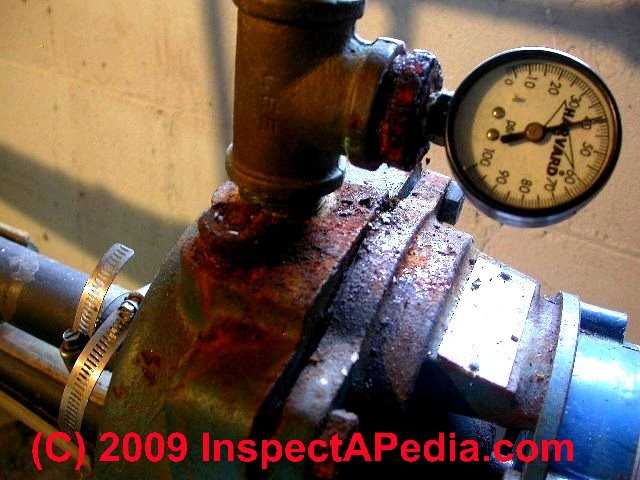
- When water stops flowing into the recipient building
you will have pressurized its water system (and water pump) to the shut-off water pressure that the donor building is able to provide.
Our photo shows that we've pressurized our recipient pump up to 40 psi using water from our donor building.
Turn off the spigot at the receiving building
so that you have in effect closed the connection between the two building. In fact you can turn off the faucet at the donor building as well, but don't disconnect the hose yet - we might need to repeat this process a bit more. - Turn on electrical power to the water pump at the recipient building.
The pump might not begin to run if the water tank pressure is at or above that pump's cut-out pressure. - Test the water pump operation by turning on water
in the recipient building at any plumbing fixture. If you have successfully primed the water pump, you'll hear the pump turn on. When you hear your water pump turn on, turn off the running water and listen to see if the pump reaches cut-out pressure and turns itself off. - If the water pump turns off at the end of a pumping cycle
you have finished priming the pump.
Run some water to flush out the system and reduce the chances that you've contaminated the pump or piping with bacteria from your own procedure. - If the water pump turns on but keeps running
for a minute or two, check the water pressure gauges at the pump and tank. If the gauges are not rising in pressure (or if the water tank is not filling with water - is not getting heavier) then the pump has not been successfully primed.
What now?- Try repeating the steps in this procedure,
making sure you're getting water into the receiving building's water piping system, pump, and water tank.
If your water tank is a steel bladderless type with a working drain, you might try opening the tank drain to see if water is in the tank.
If the water tank is dry
(empty) try leaving that drain open at the start of the procedure so that incoming water can enter the tank by pushing air out at the drain - but when you see water coming out at the drain, close it. - Try the detailed step by step
PRIME THE PUMP BY PRIMING PLUG OPENING procedure we describe separately - Diagnose other problems
with the well, piping, water pump, water tank: the problem might not be pump prime.
The problem could still be the pump if the pump impeller is damaged, or there might be a well piping leak or no water in the well.
See WATER PRESSURE LOSS DIAGNOSIS & REPAIR to sort out these other causes.
- Try repeating the steps in this procedure,
Prime the Pump Using a Garden Hose Without Access to the Water Pressure Tank or Well Pump
How to Troubleshoot loss of well pump prime after a storm
An InspectApedia reader asked :
After a power outage last night during our latest storm (which is continuing), my pump lost its prime.
I am attempting to use your garden hose method to restore the prime--am fairly desperate and have questions--I am on my third attempt but should probably count it as second since the first time I only let it run for maybe 10 minutes.
The water flowing from the donor house to my house was coming slowly--I am guessing that the small diameter of the washing machine hose accounts for that.
I do not know how to tell when the water stops flowing into my house and do not have any pressure gauge for the tank--am trying to avoid opening the pump housing because the concrete top of it is very heavy--last time I opened it I damaged my back--I weigh about 115# and am 65 years old.
The pump began running as soon as I restored power--I let it run two minutes and cut the power as you suggested--and am trying the procedure again.
Any suggestions would be appreciated
Reply:
We want to let the hose run until you think no more water is flowing into your pump and piping - with the pump turned off;
How about trying this - just inventing - connect the donor hose and turn it on at its source.
GO into the house; open a faucet closest to where water enters your house.
When you see water coming out of the faucet, then try shutting off the donor hose and turning on the pump.
Reader follow-up: power outage during cold weather froze the pipes, preventing priming and preventing pump operation
I appreciate your information--have resorted to plumber and problem resolved--apparently during the time of the power outage water froze in the pipe as it comes from the pump. I am reasoning that this prevented the water from entering the pump and well shaft.
I would appreciate your opinion as to whether the garden hose method would have worked (even with my lack of expertise), but for the frozen pipe from the pump.
Your directions are great-clear and easy to follow. I know that there will be more power outages and the resultant loss of prime and would like to be able to rectify the situation myself.
Reply: details of remote-priming of a water pump without access to the pump or pressure tank
Your email led me to think about using the garden hose pump priming method when there is not convenient access to the pump itself. In that case we're rather flying blind and with few instruments, but it may still be worth a try.
What I was thinking but didn't add ( I worry about giving so much information that I suffocate or in your case drown the reader) was that if we're talking about a well pit, for example, wherein are located the pump, tank, controls, and perhaps the well head,
and if we can't open the well pit to hook up a garden hose to a pressure tank drain or a drain near the pump itself, then hooking up a garden hose anywhere on the system might let us push water backwards into the pump to help prime it.
But if there were say a burst pipe anywhere between where we hook up the hose and the pump and tank themselves, we might just be pushing water into - well who knows where - and we might not know it.
For that reason I suggested hooking up the hose, turning it on, then opening a faucet in the home. IF we see water coming out of the faucet we've pressurized the system. If we don't then
- There are other frozen or burst pipes between the hose hookup point and the faucet we opened in the building
- There is no water coming from the hose
- There is a burst or frozen pipe between the hose hookup point and the well pump and tank equipment
Before assuming that a water problem is due to the well itself, remember that there could be other troubles, even simply a loss of power to the pump.
See WATER PUMP REPAIR GUIDE an specific case which offers an example of diagnosis of loss of water pressure, loss of water, and analyzes the actual repair cost.
...
Reader Comments, Questions & Answers About The Article Above
Below you will find questions and answers previously posted on this page at its page bottom reader comment box.
Reader Q&A - also see RECOMMENDED ARTICLES & FAQs
Well pump won't pump over 20 psi after losing prime
I have a two line jet pump that has lost its prime. I attempted to prime it only to get 20# pressure. I know the expansion tank is also bad. Is it still possible to prime the pump with a bad expansion tank? - On 2020-11-02 by Brent
Reply by (mod) -
Brent
I'm not sure what's wrong with your expansion tank so it's hard for me to answer.But usually the pressure tank on the water pump system actually helps with priming the pump. Perhaps you haven't used enough water or perhaps the pump impeller has been damaged.
On 2020-05-31 by Anonymous - How do I make the connect a hose from my well to a neighbor?
I need to know what is the name of the tool you can use to connect a hose from my well to a neighbor's well?
Our well got hit by lighting so until we can fix it our neighbor said to get this tool to connect a hose from well to well.
Replyu by (mod) - how to connect between two buildings using a "food grade" garden hose
Anon
Indeed to connect between two buildings using a garden hose you will probably want a simple washing machine hookup hose that has a female connector at both ends.That will allow you to connect the garden hose to two outdoor spigots, one at your building and one at your Neighbour's building.
Watch out: For drinking water be sure to use a food grade rated hose to avoid lead contamination found in many ordinary hoses.
On 2020-04-29 by Anonymous - Why won't my pump prime?
Do you know what the problem is
Drained water to do a repair.trying to prime pump.pump will not prime
Reply by (mod) -
Usually when a pump was working previously but we can't get water into the building when the pump is re-started after having been turned off (deliberately or by a power loss) the root cause is a leaky foot valve or check valve in the well piping, and occasionally a leak in the actual piping itself.
With enough water poured into the pump and through it into the well piping (including the 'down-pipe, the smaller of the two in a 2 line jet pump or in the single down pipe of a 1 line jet pump) then it's usually possible to get the pump working again.
But the underlying problem hasn't been fixed, the pump will either lose prime again or will continue to run intermittently for no apparent reason as water drains back into the well through the leak, dropping pressure until the pressure switch turns on the pump.
So you'll want your plumber to find and fix the leak or leaky foot valve or check valve.
There are other causes of difficulty in priming a pump such as leaks at the pump itself - those are reviewed in this article series.
...
Continue reading at PRIME the PUMP, HOW TO through the pump priming plug If you do not have such a source available, we provide alternative methods, or select a topic from the closely-related articles below, or see the complete ARTICLE INDEX.
Or see WATER PUMP PRIMING DIAGNOSTIC FAQs questions & answers on how to prime the pump, posted originally at this article.
Or see these
Recommended Articles
- PUMP PRIME, REPEATED LOSS of if you can't keep the pump primed
- WATER PRESSURE TABLE 1: PUMP WON'T RUN, WON'T STOP, or CYCLES
- WATER PRESSURE TABLE 2: PUMP RUNS, WEAK or NO WATER PRESSURE
- WATER PRESSURE TABLE 3: PUMP RUNS, NO WATER or INSUFFICIENT WATER
- WATER PUMP REPAIR GUIDE - home
Suggested citation for this web page
PRIME the PUMP using a GARDEN HOSE at InspectApedia.com - online encyclopedia of building & environmental inspection, testing, diagnosis, repair, & problem prevention advice.
Or see this
INDEX to RELATED ARTICLES: ARTICLE INDEX to WATER SUPPLY, PUMPS TANKS WELLS
Or use the SEARCH BOX found below to Ask a Question or Search InspectApedia
Ask a Question or Search InspectApedia
Try the search box just below, or if you prefer, post a question or comment in the Comments box below and we will respond promptly.
Search the InspectApedia website
Note: appearance of your Comment below may be delayed: if your comment contains an image, photograph, web link, or text that looks to the software as if it might be a web link, your posting will appear after it has been approved by a moderator. Apologies for the delay.
Only one image can be added per comment but you can post as many comments, and therefore images, as you like.
You will not receive a notification when a response to your question has been posted.
Please bookmark this page to make it easy for you to check back for our response.
IF above you see "Comment Form is loading comments..." then COMMENT BOX - countable.ca / bawkbox.com IS NOT WORKING.
In any case you are welcome to send an email directly to us at InspectApedia.com at editor@inspectApedia.com
We'll reply to you directly. Please help us help you by noting, in your email, the URL of the InspectApedia page where you wanted to comment.
Citations & References
In addition to any citations in the article above, a full list is available on request.
- Mark Cramer Inspection Services Mark Cramer, Tampa Florida, Mr. Cramer is a past president of ASHI, the American Society of Home Inspectors and is a Florida home inspector and home inspection educator. Mr. Cramer serves on the ASHI Home Inspection Standards. Contact Mark Cramer at: 727-595-4211 mark@BestTampaInspector.com
- John Cranor [Website: /www.house-whisperer.com ] is an ASHI member and a home inspector (The House Whisperer) is located in Glen Allen, VA 23060. He is also a contributor to InspectApedia.com in several technical areas such as plumbing and appliances (dryer vents). Contact Mr. Cranor at 804-873-8534 or by Email: johncranor@verizon.net
Water Supply & Drain Piping, Wells, Pumps, Water Supply Equipment
- Access Water Energy, PO Box 2061, Moorabbin, VIC 3189, Australia, Tel: 1300 797 758, email: sales@accesswater.com.au Website: http://www.accesswater.com.au/
Moorabbin Office: Kingston Trade Centre, 100 Cochranes Rd, Moorabbin, VIC 3189
Australian supplier of: Greywater systems, Solar power to grid packages, Edwards solar systems, Vulcan compact solar systems, water & solar system pumps & controls, and a wide rage of above ground & under ground water storage tanks: concrete, steel, plastic, modular, and bladder storage tanks. - Grove Electric, Typical Shallow Well One Line Jet Pump Installation [PDF], Grove Electric, G&G Electric & Plumbing, 1900 NE 78th St., Suite 101, Vancouver WA 98665 www.grovelectric.com - web search -7/15/2010 original source: http://www.groverelectric.com/howto/38_Typical%20Jet%20Pump%20Installation.pdf
- Grove Electric, Typical Deep Well Two Line Jet Pump Installation [PDF], Grove Electric, G&G Electric & Plumbing, 1900 NE 78th St., Suite 101, Vancouver WA 98665 www.grovelectric.com - web search -7/15/2010 original source: http://www.groverelectric.com/howto/38_Typical%20Jet%20Pump%20Installation.pdf
- Water pressure tanks - how to diagnose the need for air, how to add air, stop water pump short cycling to avoid damage - water storage water pressure tank safety.
- WATER PUMP REPAIR GUIDE an specific case offers an example of diagnosis of loss of water pressure, loss of water, and analyzes the actual repair cost
- Water pressure tank failures & water pump short cycling diagnosis and repair
- Crystal Clear Supply provides portable ceramic water filter purifiers and portable reverse osmosis water treatment equipment - see http://www.crystalclearsupply.com/category_s/7.htm
- Principles and Practice of Disinfection, Preservation and Sterilization (Hardcover)
by A. D. Russell (Editor), W. B. Hugo (Editor), G. A. J. Ayliffe (Editor), Blackwell Science, 2004. ISBN-10: 1405101997, ISBN-13: 978-1405101998.
"This superb book is the best of its kind available and one that will undoubtedly be useful, if not essential, to workers in a variety of industries. Thirty-one distinguished specialists deal comprehensively with the subject matter indicated by the title ... The book is produced with care, is very readable with useful selected references at the end of each chapter and an excellent index. It is an essential source book for everyone interested in this field. For pharmacy undergraduates, it will complement the excellent text on pharmaceutical microbiology by two of the present editors."
The Pharmaceutical Journal: "This is an excellent book. It deals comprehensively and authoritatively with its subject with contributions from 31 distinguished specialists. There is a great deal to interest all those involved in hospital infection ... This book is exceptionally well laid out. There are well chosen references for each chapter and an excellent index. It is highly recommended." The Journal of Hospital Infection.: "The editors and authors must be congratulated for this excellent treatise on nonantibiotic antimicrobial measures in hospitals and industry ... The publication is highly recommended to hospital and research personnel, especially to clinical microbiologists, infection-control and environmental-safety specialists, pharmacists, and dieticians."
New England Journal of Medicine: City Hospital, Birmingham, UK. Covers the many methods of the elimination or prevention of microbial growth. Provides an historical overview, descriptions of the types of antimicrobial agents, factors affecting efficacy, evaluation methods, and types of resistance. Features sterilization methods, and more. Previous edition: c1999. DNLM: Sterilization--methods. - U.S. Army Field Manual 21-10, Field Hygiene and Sanitation, 1988, web search 07/02/2010, original source: http://www.enlisted.info/field-manuals/fm-21-10-field-hygiene-and-sanitation.shtml
The purpose of this manual is to assist individual soldiers, unit commanders, leaders and field sanitation teams in preventing disease and environmental injuries. The manual provides information on preventive medicine measures (PMM) to the individual soldier as well as essential information for the unit commander, unit leaders, and the unit field sanitation team on applying unit level PMM. - When Technology Fails, Matthew Stein, Chelsea Green Publisher, 2008,493 pages. ISBN-10: 1933392452 ISBN-13: 978-1933392455, "... how to find and sterilize water in the face of utility failure, as well as practical information for dealing with water-quality issues even when the public tap water is still flowing". Mr. Stein's website is www.whentechfails.com/
- In addition to citations & references found in this article, see the research citations given at the end of the related articles found at our suggested
CONTINUE READING or RECOMMENDED ARTICLES.
- Carson, Dunlop & Associates Ltd., 120 Carlton Street Suite 407, Toronto ON M5A 4K2. Tel: (416) 964-9415 1-800-268-7070 Email: info@carsondunlop.com. Alan Carson is a past president of ASHI, the American Society of Home Inspectors.
Thanks to Alan Carson and Bob Dunlop, for permission for InspectAPedia to use text excerpts from The HOME REFERENCE BOOK - the Encyclopedia of Homes and to use illustrations from The ILLUSTRATED HOME .
Carson Dunlop Associates provides extensive home inspection education and report writing material. In gratitude we provide links to tsome Carson Dunlop Associates products and services.
 | HOME | ABOUT | ASK a QUESTION | CONTACT | CONTENT USE POLICY | DESCRIPTION | POLICIES | PRIVACY | |
| © 2025 - 1985 Publisher InspectApedia.com - Daniel Friedman | |||||||||