
InspectAPedia® FREE Encyclopedia of Building & Environmental Construction, Diagnosis, Maintenance & Repair |
Question? Just ask us! InspectAPedia
|
 Clean Mold off of Lumber or Plywood
Effective Cleaning of Mold-Contaminated Wood Building Materials
- POST a QUESTION or COMMENT about removing mold from wood surfaces in buildings
Best procedures for cleaning mold-contaminated wood:
This article offers advice on cleaning mold found on surfaces of un-finished wooden building materials such as framing lumber (rafters, floor joists, wall studs), and building roof, wall, and floor sheathing such as plywood, tongue-and groove pine boards, and other structural wood surfaces in buildings.
We discuss the pros and cons of using fungicidal sealants and bleach on wood surfaces and give sources and list types of those products. We also discuss common errors made when cleaning wood surfaces, such as relying on bleach or performing expensive and unnecessary cleaning on cosmetic black mold on wood surfaces.
We include photographs of surfaces which have been cleaned during a good mold remediation project, and we provide photos of the effects of use of fungicidal sealants as encapsulants, particle immobilizers, and clear (or pigmented) surface sealants.
InspectAPedia tolerates no conflicts of interest. We have no relationship with advertisers, products, or services discussed at this website.
- Daniel Friedman, Publisher/Editor/Author - See WHO ARE WE?
How to remove mold from wood framing, plywood sheathing, tongue and groove subfloor or roof decking
 The object in cleaning mold from a wood surface is to remove all fungal material from the surface of the
wood: fungal spores, hyphae, and conidiophores (the spore producing structures of mold). It is not necessary
to remove all stains from wood.
The object in cleaning mold from a wood surface is to remove all fungal material from the surface of the
wood: fungal spores, hyphae, and conidiophores (the spore producing structures of mold). It is not necessary
to remove all stains from wood.
Here we provide a guide to cleaning mold from smooth wood surfaces.
We describe how to remove mold from irregular or hard-to-reach wood surfaces - media blasting and how to clean mold from wood trusses and cross-bracing.
We discuss when to try sanding wood surfaces to clean or remove mold contamination.
And we answer these questions:
How clean do moldy surfaces need to be? How do I clean mold off of wood flooring, subflooring, joists, cross bracing, or trusses?
Article Contents
- CLEAN MOLD from SMOOTH WOOD SURFACES
- MEDIA BLASTING to REMOVE MOLD from IRREGULAR or HARD TO REACH SURFACES
- REMOVE MOLD from WOOD TRUSSES & CROSS BRACING
- WHEN to SAND WOOD SURFACES to REMOVE MOLD
- HOW CLEAN do MOLDY SURFACES NEED TO BE?
- HOW to CLEAN MOLD OFF OF WOOD FLOORING
 Once we have physically removed mold from a building surface by wiping or vacuuming, stains may remain. Don't panic about those marks.
Microscopic examination of stained wood fragments will generally show that what remains in these wood cells are sterile fungal hyphae.
If the wood surface is cleaned thoroughly and building leaks, high moisture, or other water sources are prevented, keeping the humidity at the proper level, growth of problem mold on the cleaned surfaces is quite unlikely.
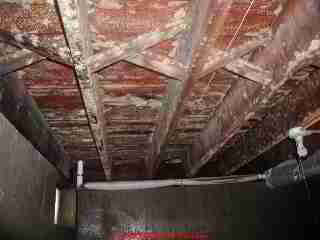
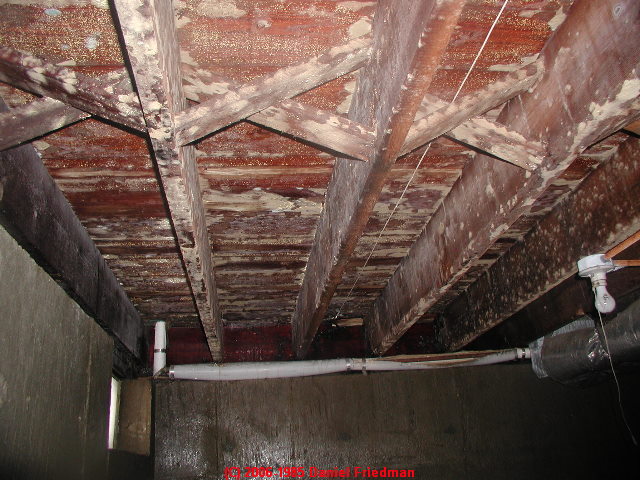
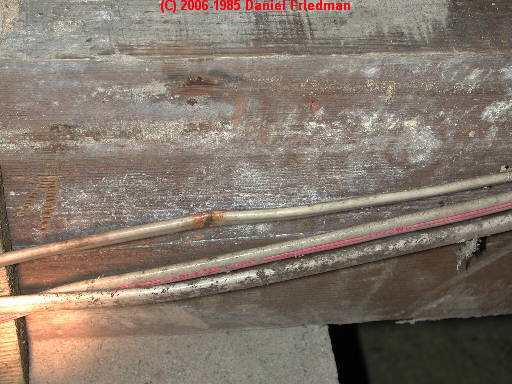
Our first photograph of mold on wood framing under a floor (above / left) as well as our page top photograph both show mold growing on wood framing lumber, subflooring, and even on electrical wiring insulating jackets in a wet basement before these surfaces had been cleaned by the mold remediation contractor.
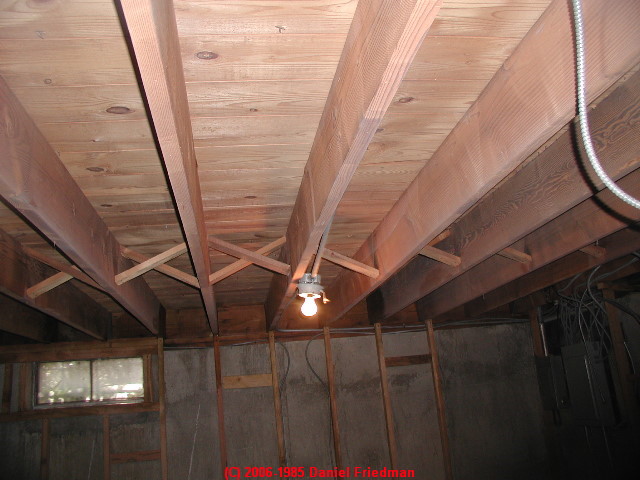
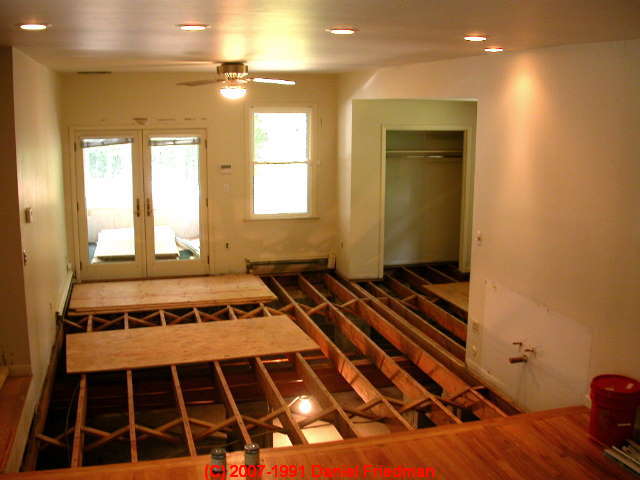
Our second photo (below) shows wood framing and subfloor that have been adequately cleaned, without any application of a fungicidal sealant.
At this inspection we found that although the mold cleanup looked complete to the naked eye, the remediation containment barriers had been removed before a successful mold remediation clearance inspection and test.
Testing in the crawlspace below the opened floor we found over 120,000 P/A spores/M3 - a rather high level of airborne mold that was identified as principally Penicillium or Aspergillus mold spores.
Technical note on Pen/Asp: When we have just the mold spores alone, as is common in a "mold air sample test", it can be difficult to determine which of these two mold genera is present so they're reported together as Pen/Asp or P/A.
The reasonableness of this reporting approach stems from the observation that both of these mold families produce many individual mold species that are particularly-harmful to humans (and other animals) because of their very small size - they're breathed deeply into the lungs and because the spores are often allergenic, pathogenic, toxic.
In the adjoining basement we found 7000/Pen/Asp spores per M3 of air. The rest of the house interior was low when tested immediately after containment removed. Our opinion was while cleaning had been well done, poor containment management meant that there was a high risk of recontamination.
Additional airing-out, air scrubbing, surface vacuuming, and re-testing in the adjoining basement were needed because of the mishandling of containment, despite good cleaning work.
Guide to Cleaning Mold from Smooth Wood Surfaces
 Perfectly adequate moldy-wood-surface cleaning may be accomplished by wiping or (where feasible) power-washing or media blasting.
Where wiping a moldy surface, take care not to spread moldy debris from a moldy surface onto a previously uncontaminated surface by making the mistake of re-using the same moldy rag over and over on all surfaces. Professionals use "steri-wiping" which takes care to avoid spreading moldy debris by always folding and using a clean side of the wipe when moving to a new spot.
Where the framing lumber is indoors or otherwise in a location where water spillage is a concern, wipe the areas of heaviest mold to remove any loose mold from the surface of the lumber.
Unless professional area-containment has been set up (barriers, negative air), do not use violent cleaning methods such as power-washing or sandblasting indoors, as you will spread moldy debris throughout the building and you'll increase the ultimate project cleanup cost.
Where the framing lumber is outdoors where water spillage and the creation of aerosolized mold spores is not an issue, pressure wash the infected lumber to remove surface mold.
"Cleaning" in this case can be simply wiping with a sponge wet with water or detergent.
The object of cleaning is to remove most of the loose moldy particles.
The object (except in medical facilities) is not to produce a particle-free sterile surface. However beware of cross-contamination. Wetting a rag and wiping a very moldy surface off is fine but if you then use the same dirty rag to wipe another fairly clean surface you may be in fact spreading moldy debris around.
A professional uses sterile wipes and folds to a clean side of the wipe for each wiping stroke. For a small homeowner non-critical project this may be overkill but think about and avoid spreading moldy debris by your cleaning procedure.
Watch out: An attempt to "kill mold" on moldy surfaces is not normally a proper nor sufficient approach to a moldy building. You need to remove the mold (cleaning) and correct the cause of its occurrence (fix leaks or moisture). Even if you could "kill" all of the mold organisms (which is doubtful) you may be leaving dead but still toxic or allergenic particles in the building.
See our detailed warnings about relying on bleach for "mold remediation"
Cleaning mold from irregular or hard-to-reach wood surfaces - media blasting
If mold needs to be removed from a roof deck through which roofing nails penetrate, hand wiping is not feasible. Power cleaning using spray equipment such as media blasting using baking soda or dry ice is very effective for these surfaces.
See our media blasting article at MOLD CLEANUP - MEDIA BLASTING - live link is given just below.
However spraying anything in an attic creates a secondary problem: contamination of building insulation. Our experience is that if attic conditions have been wet enough to produce problem mold justifying a professional cleaning of those surfaces, the insulation is probably contaminated and needs to be replaced.
Unless a building is being totally gutted to its framing, power-washing with water or any other liquid is problematic in a building attic where the procedure risks leaks into and wetting contents of the building below the work area. Dry-process spray cleaning works well in these areas. Typical high pressure sprays use baking soda or frozen C02, followed by HEPA vacuuming of the work area and probably of other building areas.
More Reading on methods for cleaning mold from difficult to access areas or removing mold from irregular building surfaces:
MOLD REMOVAL, MEDIA BLASTING (complete article, with illustrations) on the effectiveness of baking soda media blasting for cleaning fungal contamination in buildings, Daniel Friedman, Dennis Melandro, originally published in Indoor Environment Connections, Rockville MD, June 2003
Cleaning mold from wood trusses and cross-bracing
In an area of high levels of mold growth or moldy dust and debris, the irregular surfaces formed by wood trusses and also by older wood cross bracing between floor joists prevents thorough cleaning of surfaces and creates many dust collection points.
A similar construction detail where significant moldy dust reservoirs may be left in place is the upper surface of wood furring which has been nailed across the under-side of floor joists to support (now removed) ceiling tiles.
Because the surfaces formed by trusses and cross bracing can form a significant dust and debris reservoir, I always check these areas during a mold remediation clearance inspection. If work has been hasty or incomplete, these are among the first areas to be under-cleaned.
Spray process cleaning, media blasting (live link given above), and HEPA vacuuming are effective for these areas.
Sanding wood surfaces to "clean" mold
We often see remediators attempting to clean up mold by sanding surfaces, by hand or by power sander.
Sanding wood surfaces to remove mold is physically possible for smooth surfaces but in our opinion this is a slow, labor intensive procedure which is impractical for any large area cleanup. Spray processes are significantly faster and more thorough.
Sanding wood building surfaces by hand is
- probably completely unnecessary and
- may indicate inexperience or a response to an improperly informed and frightened building owner.
Clean the surface mold, dry the building, and if you like, use a sealant as discussed below.
The fungal material left inside of wood framing or sheathing and which forms visible stains is not going to affect building occupants provided the building is kept properly dry and free of leaks.
Even if you removed all of the stain by deep sanding, future building leaks will still \ produce new mold growth, so sanding is in most cases a wasted effort.
An exception we make to this general advice is where exposed beams are cleaned or sanded for cosmetic reasons. Still in that case media blasting cleans better and faster.
Just How Clean do Moldy Surfaces Need to Be?
Does the building need to be sterile? Is the object to reach a mold spore count level of zero?
No, the building does not need to be sterile, nor should you seek a "zero mold count".
We have worked on cases where sterility was a necessary cleanup goal: medical facilities such as in operating rooms and treatment rooms. But in a normal office or home there is always some airborne mold along with lots of other airborne particles in building dust.
No washing, sanding, scraping, or other surface cleaning will remove all mold spores from wood where mold was previously found. It is unlikely that most construction materials, even when new, are free of mold spores, nor is "zero mold" a reasonable nor possible objective.
Cleaning moldy framing lumber followed by application of a sealant may be the most cost effective alternative (where removal of the lumber is cost-prohibitive or otherwise not possible). While lumber replacement with apparently "clean" new lumber may sound appealing, it is likely to be cost prohibitive and in fact may include its own mold when it is unloaded at the work site.
How Much Mold Must Be Removed - How Clean Do Surfaces Need to Be?
Following a properly executed mold cleanup, if there is a future mold problem in a building it is unlikely to be due to having left behind an "inoculation" of problem mold, and more likely to be due to a new building leak that was left unattended.
Good practice for the extent of and means of physical removal of moldy debris varies by material.
For drywall we remove all visibly moldy material and continue removing drywall
to no less than the next adjacent stud, rafter, or joist.
For fiberglass or other porous building insulation which has been wet
we remove all suspect insulation and all insulation within 24" of the suspect material. However if moldy and wet conditions were long-standing in a building, removal of all of the insulation may be necessary.
For building insulation that has been exposed to dusty conditions
or high levels of airborne mold it is often more cost effective to simply remove the material, clean the surfaces, and re insulate than to spend that same money on testing the insulation for mold.
Generally it is less costly to remove and discard more material than to "finish" the job and then discover that it needs to be done over again because the initial work was insufficient.
Framing lumber, or roof or wall sheathing
that is not rotted does not need to be replaced. Unless framing lumber has been actually damaged, such as by rot, replacing it due to mold contamination is not justified and would be improper.
Physically clean moldy surfaces of the framing lumber and exposed roof or wall sheathing. No you do not normally need to demolish the roof or wall to treat the small remaining areas between the narrow edge of a rafter or wall stud and the roof or wall sheathing that is nailed against it.
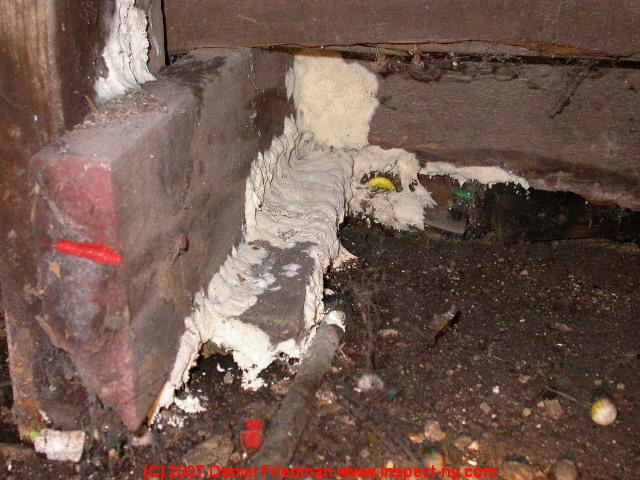
Our photo above shows wood supporting a basement stair that is surely rotted. We would remove and replace material like this rather than trying to clean it.
As with this stairway, there are other cases where it is less costly to replace a building material than to clean it.
Depending on the materials of which they were constructed, the cost to clean and re-seal the shelves in this moldy kitchen pantry may be greater than the cost of discarding and replacing the shelving.
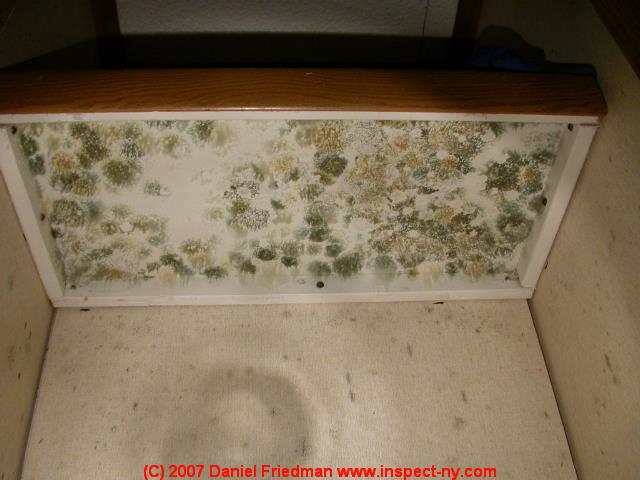
When we notice that the drywall on the pantry walls is also moldy we understand that the shelving has to be removed in order to remove the moldy drywall. We do not clean moldy drywall. It should be removed and the exposed framing surfaces cleaned.
Pantry gutting and reconstruction are a a more cost-effective approach to this particular mold cleanup project than any surface cleaning attempt.
Clean Mold off of Wood Flooring
Details about cleaning moldy wood flooring both when installed in buildings and when the flooring product has not yet been installed are discussed
at MOLD CLEANUP - WOOD FLOORING. Excerpts are just below.
Physically Clean Moldy Wood Surfaces, Dry The Wood Flooring Before Installation
Here we describe cleaning mold off of wood flooring products that have not yet been installed in a building.
Except where major costs are at issue that would be effected by a determination of the type of material or mold present, or where there are other reasons to test for mold, in our opinion testing is not necessary for small mold cleanup jobs (less than 30 sq. ft. of contiguous mold on a building surface).
In any case you can physically clean the surfaces to remove the mold.
Physically cleaning means wiping, scrubbing with a scrubby sponge and any household cleaner. Don't waste money or time with mold killing washes, it's not necessary, and using bleach or similar agents can create a cosmetic problem or a problem with future adhesion of finish coatings on the flooring upper surface after installation.
Watch out: be sure that your wood flooring has dried properly before it is installed or flooring shrinkage, gaps, or even more serious problems may occur.
The wood should be below 18% moisture before any coatings are applied, and it should be thoroughly acclimated to the building interior where it is to be installed before it is secured in place. This can mean storing the wood in the destination building for days or longer before it is installed.
If an exposed flooring surface remains stained even after surface mold has been removed, you will need to sand that surface - a step typically performed after the flooring has been installed.
Stains that might remain on the flooring underside will be of no cosmetic import and as long as the floor is installed indoors and not exposed to water or high moisture, mold growth should not be a problem.
If nonetheless you want to take steps for extra "mold proofing" you can, after cleaning and drying the wood, coat the underside with a fungicidal sealant, or even with simple quick dry shellac or a lacquer primer-sealer paint. The top flooring surface will be finished and sealed after installation unless you are dealing with a pre-finished flooring product.
If the exposed (upper) surface of the flooring material is moldy and if mold stains have penetrated the actual coating, for cosmetic reasons you'd need to sand through the coating and through the stain until the wood appearance is satisfactory.
Watch out: often mold-stains penetrate rather deeply into wood materials. While the stain does not itself signify an increased risk of future mold re-growth, its appearance may be unacceptable.
But deep stains can require removal of quite a bit of wood surface - something that can be a problem in wood flooring, and in particular if the flooring is a Vee-grooved pre-finished product.
See FUNGICIDAL SEALANT USE GUIDE
...
Reader Comments, Questions & Answers About The Article Above
Below you will find questions and answers previously posted on this page at its page bottom reader comment box.
Reader Q&A - also see RECOMMENDED ARTICLES & FAQs
On 2023-04-14 by InspectApedia Publisher - you can't clean between the two layers of plywood
@Craigmans ,
I agree that you can't clean between the two layers of plywood.
If it's possible to completely seal that area from the rest of the building and to keep it dry it may be possible to live with sealed dried moldy material without effect on the building occupants.
But no one with any experience should promise you that.
On 2023-04-14 by Craigmans
Thank you again for the reply. Let me see if I can clarify for you, answers below
(let's be sure that by "firring zone" you mean what we call "furring zone" or a dead air space formed by nailing furring strips to a roof surface atop which is applied another layer of plywood decking, then the rest of the roof system as described in the drawing.
Yes this is correct
If the structure has been completed as in your drawing, it isn't possible to clean the moldy surfaces without demolition of the whole roof - which leaves me unsure how or when your photos were taken.
The structure is complete to the timber batons to create the service zone (they haven't painted them black). The cladding has not been attached
You asked to clarify the current conditions:
1. what areas are or are not directly-accessible for cleaning?
The firring/furring zone (areas between the two layers of ply).
2. Has that plank ceiling been installed? And if so, where you live, do building code officials not require a fire barrier material such as gypsum board (drywall) across the ceiling joists before the wood ceiling is installed?
As it is a single story building this is not a requirement
3. Is that "service zone" "painted black" a fire barrier? If so, of what material? Was it ever wet? Moldy?
I don't know if it is a fire barrier, I will find out. I think they are just timber batons and did not get wet.
The image attached show some small inspection holes that have been made and I will attach another image that shows the state between the two layers of ply.

This photo shows in between the two ply layers, and I don't see how we can clean between these two layers

On 2023-04-13 by InspectApedia Editor
@ Craigmans,
If I understand the drawing
(let's be sure that by "firring zone" you mean what we call "furring zone" or a dead air space formed by nailing furring strips to a roof surface atop which is applied another layer of plywood decking, then the rest of the roof system as described in the drawing.
If the structure has been completed as in your drawing, it isn't possible to clean the moldy surfaces without demolition of the whole roof - which leaves me unsure how or when your photos were taken.
Clarify the current conditions:
1. what areas are or are not directly-accessible for cleaning?
2. Has that plank ceiling been installed? And if so, where you live, do building code officials not require a fire barrier material such as gypsum board (drywall) across the ceiling joists before the wood ceiling is installed?
3. Is that "service zone" "painted black" a fire barrier? If so, of what material? Was it ever wet? Moldy?
On 2023-04-13 by Craigmans
@InspectApedia Publisher, Thank you so much for having a look at this. Having read the various very informative pages on this site, I'm struggling to see how we effectively clean the top layer of ply, as there is no access to the surface. I've put arrows on this pic to show the sides we can't reach.

On 2023-04-12 by InspectApedia Publisher - what do we do about mold between the framing and the underside of the plywood
@Craigmans,
I'm about to take off on an air flight so a detailed answer will have to wait until late tonight. But we will answer you after studying your photos and reading your text.
Meanwhile I can say that although it's a legitimate question to ask about the mold between the framing and the underside of the plywood in my experience, after cleaning and sealing the exposed surfaces including at those plywood to framing lines, as long as there is no new water or moisture source we do not find mold release from those points. So usually demo and rebuild are not needed nor justified.
If insulation is already in place I'd remove that and replace it after inspecting and cleaning.
Replace any moldy or previously wet drywall.
On 2023-04-12 by Craigmans

We are currently building a flat roof timber frame extension. The build up of the roof is an single membrane, insulation, vcl, 18mm plywood, firring zone, 12mm plywood, joists, service zone, plaster finish.
Unfortunately during construction didn't protect the site during winter and the plywood and joists were exposed to heavy rain. They proceeded with applying the membrane, with some cursory drying.
Contractor has accepted he's made a mistake but is suggesting he will be able to dry out the roof void & then treat the mould that has now built up throughout. The timber & plywood are still getting very high moisture levels and the mould is on every ply board and it's not possible to easily access the top level of ply.
There is also some rigid insulation board that isn't possible to remove due to the positioning, which has some visible mould. We want the contractor to take the roof off and replace everything as even if he were able to bring the moisture levels down it will not be possible to treat the mould to ensure eradication.
Would you agree with this? This picture [above] shows the underside layer of ply.
This is a picture of the rigid insulation that we would struggle to replace if it were removed.

On 2023-03-14 by InspectApedia Editor - water infiltration from the ceiling/upper wall from an ice dam
@GN,
We appreciate the question and photos, but I'm reluctant to pretend that we can see and know as much as your onsite inspectors around this question.
It would be cost-reasonable to clean mold from exposed surfaces and to apply a fungicidal sealant as an added safety measure that both immobilizes a few remaining particles and seals wood against future moisture uptake - improving its mold resistance.
You might also seal any gaps that might leak air between the building interior and the cavities around this wood.
And critical is to be darn sure that any leaks that cause mold have been found and fixed.
After that, you'd probably want some objective data such as continued IAQ Complaints that point to this older mold source before justifying the cost of further demolition for what I think you're describing as a small suspect area - less than 30 sqft.
Watch out: about directing your worries to "black mold" - of the millions of mold genera/species there are plenty that are of almost every other color imaginable, and many of those are highly toxic, allergenic, and in some cases even pathogenic. For one, just consider the family of Aspergillus molds.
On 2023-03-12 by GN

Had water infiltration from the ceiling/upper wall from an ice dam. Caught the water within an hour or so and had the ice dam removed a few hours later. The water was coming through vapor barrier and tongue and groove pine paneling.
We removed the paneling and vapor barrier to ensure the dehumidifier could pull the moisture from behind the panels. However there is some mold growth. We had a remediation company come out who surface cleaned the back side of the pine panels and the front side of the framing and header above the window frame.
Should I be concerned about mold growing between the framing and the header? There is a very small gap big enough for water to have gotten into, and I don't know if there is mold growth between the frame and header or the backside of the header board, which is stapled to a piece of plywood and another board, creating a sandwich effect.
The remediation people didn't seem that concerned about it and was going to Killz it after surface cleaning. I said I would do it.
The remediation company said there is no moisture in the attic space or any evidence of mold growth there above this area in the picture. Should I try to remove the header board to see if there is more mold? What can I do to address potential mold between the frame and header or the backside? There is a gap above the window frame that I might be able to get some mold treatment products into if that seems reasonable.
A few years ago, I became very sick from black mold exposure in my old house that had 3 walls inside behind the drywall floor to ceiling with black mold. I don't want to take any chances with this and get sick again, as I have been recovering for 2 years now after moving. I have learned a great deal about the importance of dealing with mold and how much it can affect done people, like myself.
A view of the back of one of the pine panels after the ice dam issue. Closer up of the header and framing above the window that was surface cleaned by the remediation company. Should I be concerned about more growth between the wood where it joins and has small gaps? Thank you.
 ...
... 
On 2023-02-24 by InspectApedia Editor - owner does not want to pay for mold cleanup
@Bo,
It's no surprise that the owner doesn't want to pay for repairs - who would? But that doesn't mean it won't be their responsibility ultimately.
Would the HOA be open to a thorough inspection done by an independent professional home inspector? In my opinion, using an inspector that has any relationship, financial or otherwise, with the owner, realtor, or HOA, is not going to give an objective and complete inspection.
If so, we recommend that you use an inspector who has the necessary home inspection experience and education, has passed a national home inspector's certification exam with real test-content, and who subscribes to professional (and State) Standards of Practice and to a similar Code of Ethics.
That type of inspection, although an additional cost at the outset, may be able to give a more thorough answer on what the problem is, its source, and potential repair options. That would then give a better idea of financial responsibility.
See our directory list of licensed and certified home inspectors by state:
CERTIFIED, LICENSED BUILDING & HOME & BUILDING INSPECTORS
https://inspectapedia.com/home_inspection/Home_Inspectors_Directory.php
Adding, it may be helpful to point out to the people involved that when they allow a leak to continue in a building that's likely to cause increasingly expensive hidden damage such as mold contamination, rot or insect damage.
On 2023-02-24 by Bo
@InspectApedia Editor ,
the owner doesnt want to pay for anything - that is one of the issues. anyway, HOA doesnt work like that - they will not allow you do to work if it's not done by them - unless its' interrior. The inspector said it's an infiltration issues. Thanks anyway
On 2023-02-23 by InspectApedia Editor - a dispute over responsibility and HOA regulations is a question for a lawyer, not us
@Bo,
If there is a dispute over responsibility and HOA regulations, that is a question for a lawyer, not us.
Just saying rain and infiltration are the water sources doesn't mean that the homeowner maintained their property in an appropriate and responsible manner as to prevent water entry from an outside source.
So again, having absolutely no information about construction, maintenance, water entry points, etc., let alone the legalities of responsibility, we can't give you the answer you want.
Repeating, the priority is to repair and protect the home from further damage. If the owner pays for it and later determines that the HOA was responsible, then they can seek compensation. But the longer you wait, the greater the damage and if the owner has to pay for it ultimately, the greater the cost of repair.
On 2023-02-23 by Bo
@InspectApedia Editor , Water issues are caused by the rain outside due to infiltration issues, which according to owner, the HOA is responsible to fix. Rain from outside is the water source.
Without having responsibility, they cannot know who will pay, so that means priority to have $ , no? If you dont know who will fix it, then no one will fix it - know what I mean? Rain is the mold source also.
On 2023-02-22 by InspectApedia Editor - priority is to protect/repair the home before further damage/increased mold occurs and worry about who is responsible for the cost later
@Bo,
We know nothing about the town house, the water issues, the mold source, or the HOA regulations.
Typically, the homeowner is responsible for its upkeep and repair. If the "water issues" originated in some fashion from a water source that the HOA was responsible for, then maybe there would some shared responsibility. But of course, we don't know any of those details.
The priority is to protect/repair the home before further damage/increased mold occurs and worry about who is responsible for the cost later.
We have an extensive list of mold remediation articles and a good starting place would be our
MOLD ACTION GUIDE
On 2023-02-22 by Bo - Who is responsible to remediate and fix the mold issue and water issues?
Town house in Asbury Park - after inspection has water issues and some mold (possibly more building up).
Who is responsible to remediate and fix the mold issue and water issues?
The HOA or the current seller/owner?
On 2022-02-08 by Inspectapedia Com Moderator - black mold spots on the floor joists
@Harold,
Perhaps you could post a photo so that we have a better idea what mold stains we're discussing.
In general, painting over mold with a fungicidal sealant isn't effective nor useful.
Also be sure you read BLACK COSMETIC MOLD -
not all black mold is harmful
as it's actually pretty easy to figure out if that's what's present on your building framing.
On 2022-02-08 by Harold
i just bought a house that was built in 2019/2020 as i was walking through the unfinished part of the basement and i noticed what appears to be black mold spots on the floor joists. the previous owner had a personal Sauna down there so i believe that was the source of all the moisture.
when i moved in a ran a dehumidifier and had to empty it about 3 or 4 times. the black spots appear to be on most of the exposed joists, and some areas are worse than others.
I tried using concrombium on some spots, bleach water on some spots and antibacterial dish soap/water on other spots. none of these cleaning methods seem to be working. or maybe they are working and the joists are now stained. if they are stained would be able to just paint over them to hide the discoloration?
On 2021-11-14 by Inspectapedia Com Moderator - question the claim that mold on roof trusses "goes away" on its own
@lisa,
I don't agree with your builder; in over 50 years of work on this topic I have never seen, nor read an authoritative source that claimed that mold "goes away" on its own.
It might dry out, go dormant, but it remains in place and may be irritating or even unhealthy even in dry state depending on the mold genera/species and volume and occupant exposure.
Bleach will absolutely not rot trusses - frankly that's nonsense. But it's also not the best nor even necessarily an effective approach. See the live links to articles in the Recommended Articles list at the end of the article above.
And please read the advice given above on this page.
On 2021-11-14 by lisa
We just had trusses put up on our new home - unfortunately before placing them - they got heavily rained on. Now that they are up and roof plywood is on - I am seeing alot of pink powdery looking mold ? coming from the brackets and down the 2x4's
I am being told by the builder that it will go away - do not worry, once we enclose the attic - it will not live in that environment - but we are doing a spray foam on the top underside of the roof and I fear that the attic will not get hot enough to kill this - pink stuff ?
Any ideas - is it mold or fungus - should we be worried. I was told I could not spray with Bleach/Chlorine as it would rot the braces.
On 2021-07-02 by inspectapedia.com.moderator (mod) - how to remove mold from an outdoor storage shed
@Lynne,
Wearing eye and respirator protection & gloves to be safe - appropriate where there is a lot of mold - (more than 30 sq.ft. of contiguous mold or a lot of moldy materials stored in a small space)
You or your worker will want to
1. remove stored items from the shed
2. Sort through items to identify those whose value makes them worth cleaning;
Do not bring moldy items into other buildings before they are cleaned.
3. Hard-surfaced items that you want to keep can be wiped clean with steri-wipes, wipes using any spray household cleaner, or equivalent;
Some hard surfaced items such as hand tools, garden tools, metal equipment - would not usually be moldy but all can be spray-washed outdoors;
4. Soft goods like carpets, upholstered furniture, insulation, can not be cleaned and are either thrown away, or for a very-valuable upholstered chair or sofa you'd have it stripped, cleaned, re-upholstered.
Protect cleaned items from any wet weather until they can be returned to the shed.
5. Clean visible mold from shed interior surfaces: spray cleaners, spray wash, hand wipe - whatever is convenient and easy;
6. Fix the leaks
7. Return cleaned, DRY items to the shed.
On 2021-07-02 by Lynne
I have 2 outdoor shed that are used for storage of boxes and furniture. The older larger shed has a metal roof that has apparently been leaking for some time. Mold is evident on the things inside. Help!
On 2021-02-23 by (mod) - black mold worry during house construction
@Brad,
first let's not make the mistake of thinking that all that we care about is black mold. There are hundreds of mold species that may occur in buildings and that can be harmful and that are not black but instead can be any other color such as white, green, red, brown.
It would be prudent to clean off moldy lumber before and closing your wall studs such as that in your photo. That reduces the risk of a larger and more serious mold contamination problem later.
Please take a look at the article above where we discussed cleaning moldy lumber.
On 2021-02-23 by Brad
I have a large custom home that was exposed to the weather in summer and only recently dried in.
Some of the studs and plates were exposed for quite some time and showed black mold in the heat of the summer.
I recently visited the site to see the state of the studs and they were quite stained and had a moisture content of 10-12%.
The house is now dried in, but the HVAC is not running continuously and we're in a wet winter climate.
What would be the best next step to take? See attached picture. Thanks for the help!

On 2021-01-05 - by (mod) - surface clean and seal moldy wood trim.
 I would clean the surface, seal it, and look for a moisture source. Only if you find that water was leaking into building cavities would I urge more-destructive invasive inspection.
Really? Well there's more to say.
Often mold-stained wood or wood trim such as that shown in your photo can be easily surface-cleaned, but dark stains remain embedded in the wood itself. Those are not harmful provided you fix the conditions that caused mold growth in the first place.
But they're ugly.
If simple surface cleaning doesn't leave the wood looking nice and clean your options are
- paint the wood trim
- replace it
because in my opinion trying to sand out such deep stains rarely works.
Key question: are you sure that the building is dry?
Unless you're in a tropical climate, once you've cleaned mold from a wood surface if you see new mold growth then either there is a new or ongoing water leak or there is abnormally-high indoor moisture.
On 2021-01-05 by Jesse
Hi
We have recently been remodeling and tore out a drywall wall with fiberglass insulation..
we dont remember seeing any mold and there is no water source close to cause a leak but months later with the old studs still exposed we have what looks like mold growing...should we be worried about this
On 2018-11-30 - by (mod) - you need to remove the mold and fix the cause of its growth
Nevertheless you need to remove the mold and fix the cause of its growth. About doctor's you need to be guided by your primary care physician.
On 2018-11-30 by Susan E. White
If you have Penicillium/Aspergillus in your basement & Cladosporium upstairs, the penicillum/asp become a vapor.
It was blowing through the heater vents into son's room & gave bothh f us bhorrible migraines & sudden onset Diabetes, plus my brain carotid artery, despite statin use jumped from 50% in 2017 to 69% on my r. dominant side one year later. I have a child with autism I am still raising, I'm dissappearing & I cannot afford all of the super expensive mold removal doctors as I am now on Disability from work due to this problem.
IMAGE LOST by older version of Clark Van Oyen’s useful Comments code - now fixed. Please re-post the image if you can. Sorry. Mod
Reader Question: how should we clean moldy wood framing in our new home
We are building a new home, the wood framing has mold, the walls are still open. How should the builder clean or remove the mold? - Linda Lewis 4/7/2013
Reply:
Thanks for the question Linda.
If the mold is ONLY the cosmetic black mold that we describe
at BLACK COSMETIC MOLD then it really is only cosmetic and could be left in place.
There are two difficulties with this:
- First you may have trouble recognizing the cosmetic mold
I describe in that article, though sometimes the growth patterns make it clear. To address this you could spend roughly $50. to send a representative tape sample of the mold to a mold test lab for confirmation. - Second, while the black mold I describe (sapstain mold, bluestain mold, Ceratocystis or Ophistoma) is indeed harmless on framing lumber
and virtually always came in on the lumber from the lumber yard, also one wants to
Watch out: in some cases, particularly on lumber that has been wet, or on treated lumber, my own field and lab tests have found Aspergillus sp. and Penicillium sp. growing among the harmless black mold.
So we might want to clean the lumber.
- IF you are in time in the project -
say when just rough-in framing has been done, (this is the case you describe in your message) it's trivial to use a deck cleaner and power-wash the questionable framing lumber or sheathing.
Just be sure that you let everything dry completely before installing insulation, drywall, vapor barriers, etc. The contractor won't like the schedule delay - it'll take some negotiating and perhaps job planning. - If you are not in time,
that is, if the building has been enclosed, the problem is we don't want a lot of water inside creating secondary problems - like warping subflooring. In that case you might have to use dry media blasting.
See MOLD REMOVAL, MEDIA BLASTING - Also see MOLD CLEANUP - WOOD FLOORING where we describe removing mold from wood flooring surfaces.
I tend to stay away from labor intensive approaches (hand sanding) and from incomplete approaches (wiping off). Keep us posted and send along some photos if you can (by email to the page top or bottom CONTACT link) as what you learn may help others.
This article series includes advice on cleaning mold found on surfaces of un-finished wooden building materials such as framing lumber (rafters, floor joists, wall studs), and building roof, wall, and floor sheathing such as plywood, tongue-and groove pine boards, and other structural wood surfaces in buildings.
We discuss the pros and cons of using fungicidal sealants and bleach on wood surfaces and give sources and list types of those products. We also discuss common errors made when cleaning wood surfaces, such as relying on bleach or performing expensive and unnecessary cleaning on cosmetic black mold on wood surfaces.
...
Continue reading at MOLD CLEANUP - WOOD FLOORING or select a topic from the closely-related articles below, or see the complete ARTICLE INDEX.
Or see MOLD CLEANUP of WOOD, FAQs - questions about how to clean off moldy wood, posted originally at this article
Or see these
Recommended Articles
- BLACK COSMETIC MOLD - not all black mold is harmful
- FUNGICIDAL SEALANT USE GUIDE - sprays and sealants used after proper cleaning reduce further risks
- HIDDEN MOLD in CEILING / WALL CAVITY
- HIDDEN MOLD in FLOOR / SUB-FLOOR - mold trapped between layers of flooring?
- HIDDEN MOLD in FRAMING / SHEATHING - other places where you may find "trapped" mold contamination
- HIDDEN MOLD, HOW TO FIND - home
- MOLD CLEANUP, BLEACH - not an adequate mold remediation approach
- MOLD CLEANUP - WOOD FLOORING - how to remove mold from wood flooring surfaces
- MOLD CLEANUP - WOOD FRAMING & PLYWOOD
- MOLD / ENVIRONMENTAL EXPERT, HIRE ? - when do we need to hire an experty?
- MOLD REMOVAL, MEDIA BLASTING - good approach for irregular or hard-to-clean surfaces
- SIDING, WOOD CLEANERS, STAINS, PAINTS how to remove stains on siding & how to choose the proper paint or stain coating
- TEST CUTS for MOLD in BUILDING CAVITIES - look for mold in inaccessible areas
Suggested citation for this web page
MOLD CLEANUP - WOOD FRAMING & PLYWOOD at InspectApedia.com - online encyclopedia of building & environmental inspection, testing, diagnosis, repair, & problem prevention advice.
Or see this
INDEX to RELATED ARTICLES: ARTICLE INDEX to MOLD CONTAMINATION & REMEDIATION
Or use the SEARCH BOX found below to Ask a Question or Search InspectApedia
Ask a Question or Search InspectApedia
Try the search box just below, or if you prefer, post a question or comment in the Comments box below and we will respond promptly.
Search the InspectApedia website
Note: appearance of your Comment below may be delayed: if your comment contains an image, photograph, web link, or text that looks to the software as if it might be a web link, your posting will appear after it has been approved by a moderator. Apologies for the delay.
Only one image can be added per comment but you can post as many comments, and therefore images, as you like.
You will not receive a notification when a response to your question has been posted.
Please bookmark this page to make it easy for you to check back for our response.
IF above you see "Comment Form is loading comments..." then COMMENT BOX - countable.ca / bawkbox.com IS NOT WORKING.
In any case you are welcome to send an email directly to us at InspectApedia.com at editor@inspectApedia.com
We'll reply to you directly. Please help us help you by noting, in your email, the URL of the InspectApedia page where you wanted to comment.
Citations & References
In addition to any citations in the article above, a full list is available on request.
- Thanks to reader Jamie Longfellow, Tallahassee, FL for discussing how to clean moldy or mold-suspect wood flooring, August 2010
- Our recommended books about building & mechanical systems design, inspection, problem diagnosis, and repair, and about indoor environment and IAQ testing, diagnosis, and cleanup are at the InspectAPedia Bookstore. Also see our Book Reviews - InspectAPedia.
- Daniel Friedman, Dennis Melandro, originally published in Indoor Environment Connections, Rockville MD, June 2003
- Thanks to reader Jamie Longfellow, Tallahassee, FL for discussing how to clean moldy or mold-suspect wood flooring, August 2010
- Atlas of Clinical Fungi, 2nd Ed., GS deHoog, J Guarro, J Gene, & MJ Figueras, Centraalbureau voor Schimmelcultures, Universitat Rovira I Virgili, 2000, ISBN 90-70351-43-9
- A BRIEF GUIDE to MOLD, MOISTURE, and YOUR HOME, [PDF] U.S. Environmental Protection Agency US EPA - includes basic advice for building owners, occupants, and mold cleanup operations. See http://www.epa.gov/mold/moldguide.htm
- "Disease Prevention Program for Certain Vegetable Crops," David B. Langston, Jr., Extension Plant Pathologist - Vegetables, University of Georgia (PDF document) original source: www.reeis.usda.gov/web/crisprojectpages/209797.html
- Disease Prevention in Home Vegetable Gardens [PDF], Patricia Donald,Department of Plant Microbiology and Pathology,
Lewis Jett
Department of Horticulture, University of Missouri Extension - extension.missouri.edu/publications/DisplayPub.aspx?P=G6202 - "Management of Powdery Mildew, Leveillula taurica, in Greenhouse Peppers," Ministry of Agriculture and Lands, British Columbia - Original source: www.agf.gov.bc.ca/cropprot/peppermildew.htm
- Fifth Kingdom, Bryce Kendrick, ISBN13: 9781585100224, - we recommend the CD-ROM version of this book. This 3rd/edition is a compact but comprehensive encyclopedia of all things mycological. Every aspect of the fungi, from aflatoxin to zppspores, with an accessible blend of verve and wit. The 24 chapters are filled with up-to-date information of classification, yeast, lichens, spore dispersal, allergies, ecology, genetics, plant pathology, predatory fungi, biological control, mutualistic symbioses with animals and plants, fungi as food, food spoilage and mycotoxins.
- Fungi, Identifying Filamentous, A Clinical Laboratory Handbook, Guy St-Germain, Richard Summerbell, Star Publishing, 1996, ISBN 0-89863-177-7 (English)
- US EPA: Una Breva Guia a Moho - Hongo [on file as /sickhouse/EPA_Moho_Guia_sp.pdf - - en Espanol
- Our recommended books about building & mechanical systems design, inspection, problem diagnosis, and repair, and about indoor environment and IAQ testing, diagnosis, and cleanup are at the InspectAPedia Bookstore. Also see our Book Reviews - InspectAPedia.
- ENVIRONMENTAL HEALTH & INVESTIGATION BIBLIOGRAPHY - our technical library on indoor air quality inspection, testing, laboratory procedures, forensic microscopy, etc.
- Adkins and Adkins Dictionary of Roman Religion discusses Robigus, the Roman god of crop protection and the legendary progenitor of wheat rust fungus.
- Kansas State University, department of plant pathology, extension plant pathology web page on wheat rust fungus: see http://www.oznet.ksu.edu/path-ext/factSheets/Wheat/Wheat%20Leaf%20Rust.asp
- A BRIEF GUIDE to MOLD, MOISTURE, and YOUR HOME, [PDF] U.S. Environmental Protection Agency US EPA - includes basic advice for building owners, occupants, and mold cleanup operations. See http://www.epa.gov/mold/moldguide.htm
- US EPA - Mold Remediation in Schools and Commercial Building [ copy on file as /sickhouse/EPA_Mold_Remediation_in_Schools.pdf ] - US EPA
- US EPA - UNA BREVA GUIA a MOHO / HONGO - en Espanol
- In addition to citations & references found in this article, see the research citations given at the end of the related articles found at our suggested
CONTINUE READING or RECOMMENDED ARTICLES.
- Carson, Dunlop & Associates Ltd., 120 Carlton Street Suite 407, Toronto ON M5A 4K2. Tel: (416) 964-9415 1-800-268-7070 Email: info@carsondunlop.com. Alan Carson is a past president of ASHI, the American Society of Home Inspectors.
Thanks to Alan Carson and Bob Dunlop, for permission for InspectAPedia to use text excerpts from The HOME REFERENCE BOOK - the Encyclopedia of Homes and to use illustrations from The ILLUSTRATED HOME .
Carson Dunlop Associates provides extensive home inspection education and report writing material. In gratitude we provide links to tsome Carson Dunlop Associates products and services.
 | HOME | ABOUT | ASK a QUESTION | CONTACT | CONTENT USE POLICY | DESCRIPTION | POLICIES | PRIVACY | |
| © 2025 - 1985 Publisher InspectApedia.com - Daniel Friedman | |||||||||