
InspectAPedia® FREE Encyclopedia of Building & Environmental Construction, Diagnosis, Maintenance & Repair |
Question? Just ask us! InspectAPedia
|
 Cause, Cure, Prevention of Black or Green Algae Stains on Asphalt Shingles

- POST a QUESTION or COMMENT about the cause, cleaning, cure or prevention of algae staining on building roofs
Causes of roof stains by algae:
This article explains the causes of dark colored algae (sometimes mistaken for "black fungal growth") on roof shingles, the effects of these conditions, and how to cure or prevent them.
Algae growth is common on roof surfaces of several materials including asphalt shingles, concrete and clay roof tiles, and even slate. Often algae that is identified as green when studied microscopically, also looks "black" or quite dark on a roof surface. We provide a list of type of stains and colors that appear on roof shingles and on other roofing materials.
InspectAPedia tolerates no conflicts of interest. We have no relationship with advertisers, products, or services discussed at this website.
Black (or Brown or Green) Algae Stains on Asphalt Roof Shingles
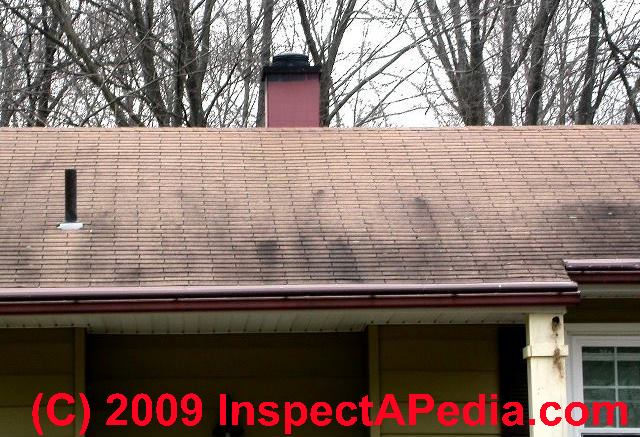 Misnamed as "mildew" or "fungus" by some writers, algae staining on asphalt shingles usually in
shaded areas or on the more-shaded roof slopes- characterized by black staining fairly uniform over shingles,
but appearing specifically in areas of the roof shaded by nearby trees.
Misnamed as "mildew" or "fungus" by some writers, algae staining on asphalt shingles usually in
shaded areas or on the more-shaded roof slopes- characterized by black staining fairly uniform over shingles,
but appearing specifically in areas of the roof shaded by nearby trees.
[Click to enlarge any image]
Black roof algae: Some black stains on asphalt roof shingles are caused by a black algae, typically Gloeocapsa magma. These black roof algal stains are sometimes misnamed or misidentified as a black fungus or even a "mildew") .
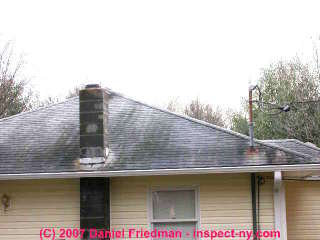
Algae is more likely to grow on shaded roof sections (probably the cause of black stains on the lower roof in the photo at above right), while asphalt shingle bleed-through stains more often appear to emanate from single points regardless of sun or shade exposure (probably the cause of stains in the photo at above left).
Article Series Contents
As NRCA's James R. Kirby [atReferences or Citations ] pointed out back in 1996, black or dark-green streaking on asphalt shingles is most likely caused by an airborne algae, Gloeocapsa that tends to grow in warm, humid environments, but can occur throughout most of the U.S. and Canada.
Kirby notes that algae on asphalt shingles is a cosmetic or aesthetic issue, not a roof performance (durability) problem, and it is generally not necessary to remove and replace asphalt shingles strictly because of algae growth and the associated discoloration.
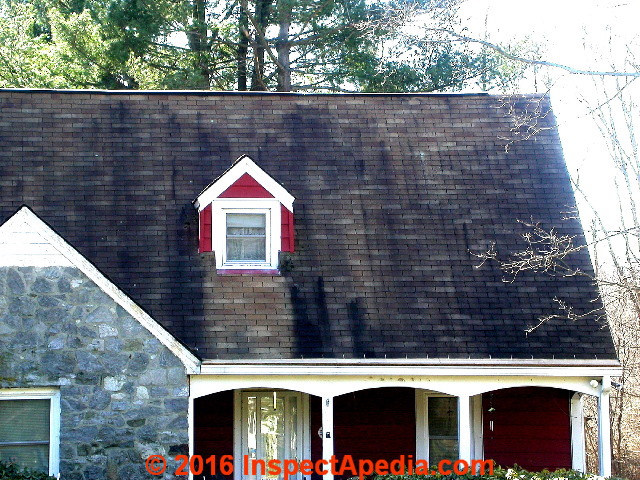
The more faint black stains on the roof in our photograph of roof stains at above are probably an algal growth.
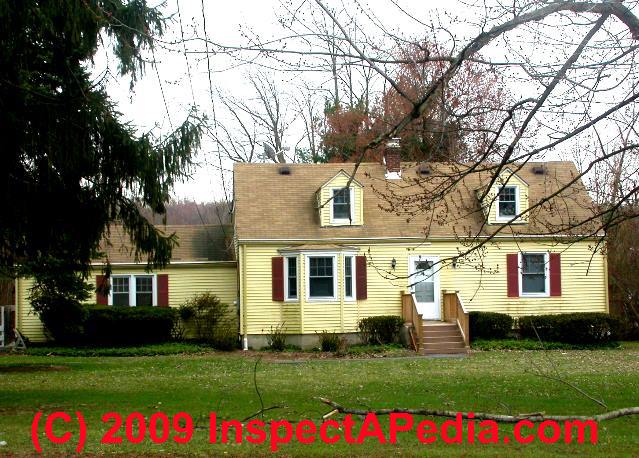
The black stains on the lower left roof in our photo immediately above are in an area that is shaded from sunlight and are almost certainly restated to that fact: algal growth. You may notice faint algae stains on the upper roof to the left side of each of the roof dormers.
Below we take an ever-closer look at algae growth on roof surfaces.
Closer Look at Dark Algae & Green Algae on Roofs & Under the Microscope
Algal growth on roofs also appears as green stains in many climates and locations. And keep in mind that some black roof stains, when studied in by an expert, may also be identified as actually green algae, even though it looks black on the roof surface.
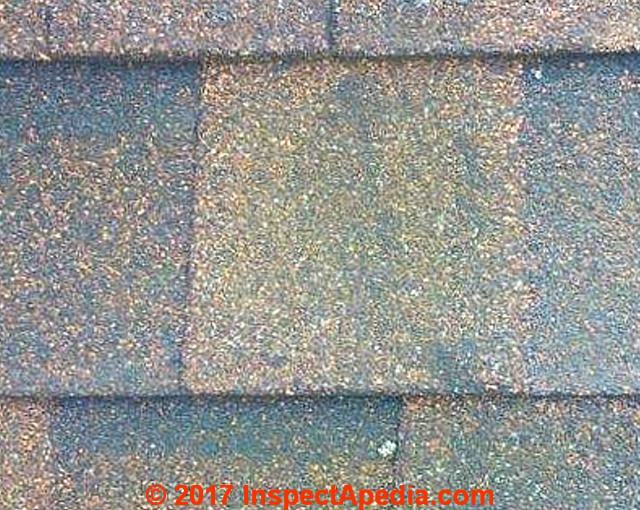
Above: green and black stains on this asphalt roof shingle [green and black arrows in the photo above] were examined under the microscope to confirm the presence of algae as shown in the photographs below.
Below: heavier green algae on a New Jersey roof, courtesy of home inspector Dovber Kahn, cited atReferences or Citations .
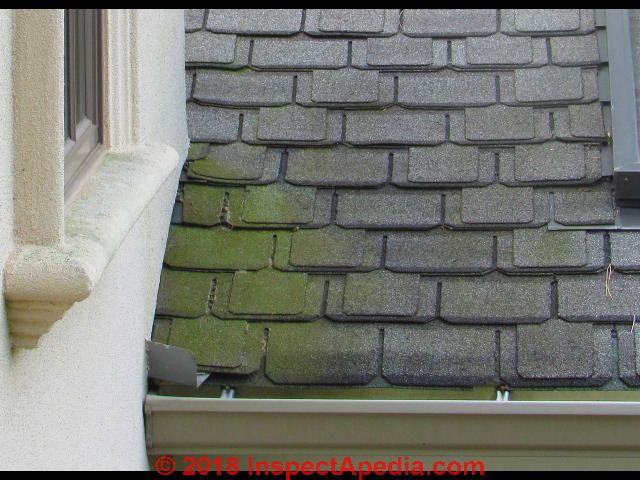
According to algae expert Michael Guiry, (Algae Base atReferences or Citations ) some of these “black algae” are (as identified in the lab), blue-green or even lichenized algae, while others are a diverse group of coccoid algae (like our microscope photo of more-green algae from a roof sample - below) that are turning out be be very diverse.

Green roof algae under the microscope
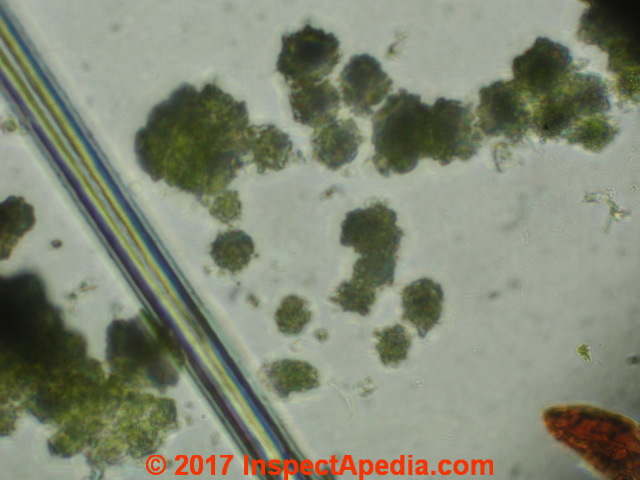
Our photo above shows green coccoid algae (tentative identification: Synechococcoideae) from an asphalt shingle roof, magnified 720x. (Coccoid algae are algae that appear as individual non-motile cells with a cell wall and lacking a flagella
Here is a similar sample [photo] from a different home.
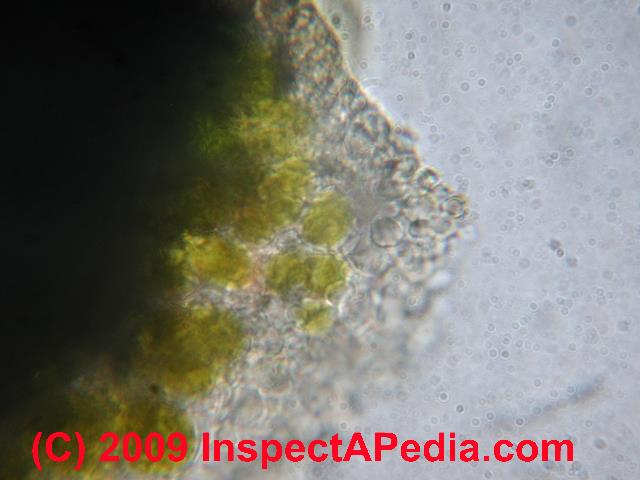
When black or green stains on a roof surface are more uniform and cover a wide area that does not originate at one or more single pinpoints in the shingles, this is likely to be a black algae growing on the shingle surface. Some writers refer to the black staining as a fungal growth - probably inaccurately in many cases.
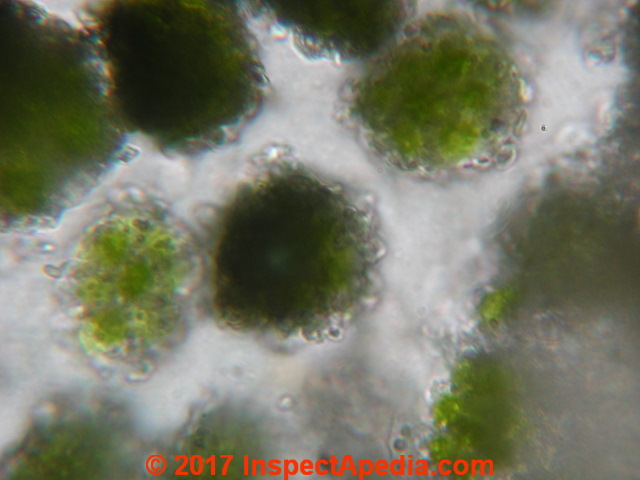

Above: two more examples of spherical clusters of green coccoidial roof algae from an asphalt shingle roof in a northern climate. Our first photo is of globules of conglomerates of coccoidial algae cells (720x) while the second photo of roof algae shows individual cells and cell chains (1200x).
On the roof surface and to the naked eye, these algae may appear as a dark brown or even black discoloration, showing up more abundantly on more damp, more shaded areas of a roof. Often, but not always, we will find moss as well as algae on the same roofs where algae growth is present.
The presence of moss, lichens, and algae together on a roof should come as no surprise since the conditions favorable to one are favorable to all three, and also because lichens itself is a symbiotic combination of an algae with a fungus. (Berdahl 2008).
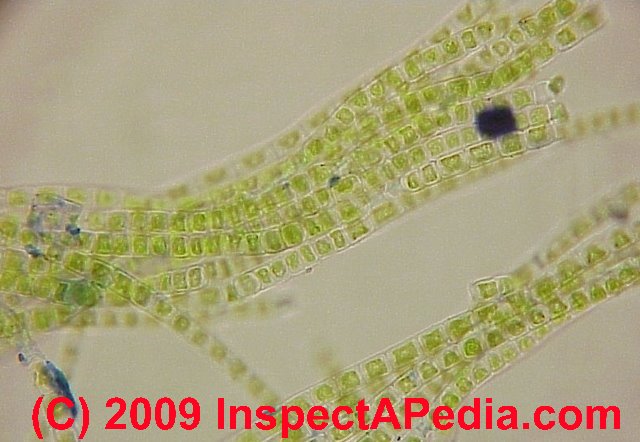
There are many genera/species of algae. AlgaeBase lists more than 125,000, and it is likely that quite a few different genera/species of algae appear on different types of building surfaces. Here is a photo of a different green algae [photo] identified in our lab from a tape sample collected from a concrete surface [photo] outdoors.
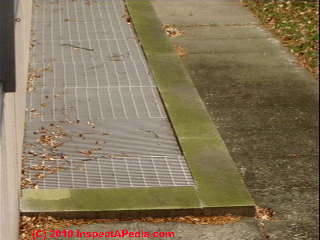
Watch out: don't waste much time arguing with your roofing manufacturer over cosmetic green or even most black algae stains on roofs: the warranty coverage for algae-resistant AR roofing shingles is limited, as we discuss
at ROOF SHINGLE ALGAE STAINS AND ROOF WARRANTIES
What Causes Black or Green Algae Stains and Algae Growth on Asphalt Shingles?
Why does algae grow on roofs? Algae is naturally in the air in most areas of the country except probably the very dry. It grows on building surfaces where it finds food (lime, paint, other) and moisture; it is retarded but perhaps not entirely retarded, by sunlight and heat.
The increase in occurrence of Gloeocapsa magma algae growth on asphalt shingle roofs in the last decade or so may be due to changes in the composition of asphalt shingles: limestone added to shingles to add weight also makes the surface attractive to Gloeocapsa magma.
Black algae stains may be mistaken for but are not "extractive bleeding" - a product cosmetic defect. We need a closer look.
Black algae stains on asphalt shingles tend to be fairly uniform over the stained area, appearing more on shaded and more damp roof slopes. When stains on the roof surface are more uniform in pattern and when they cover a wider area that does not originate at one or more single pinpoints in the shingles, this may be a black algae growing on the shingle surface.
At BLACK STAIN REMOVAL & PREVENTION we discuss getting rid of and preventing these stains.
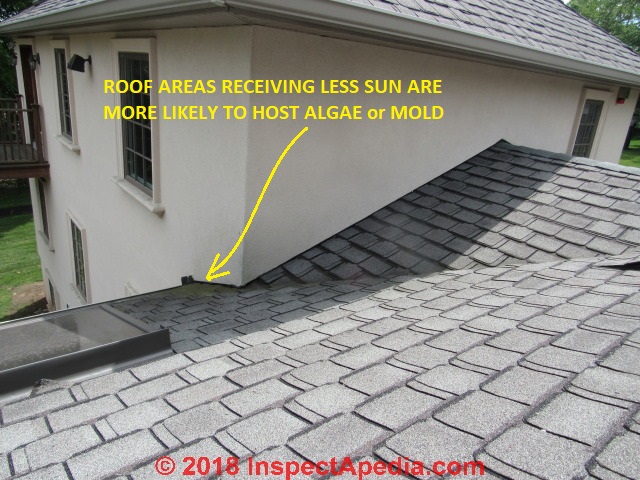
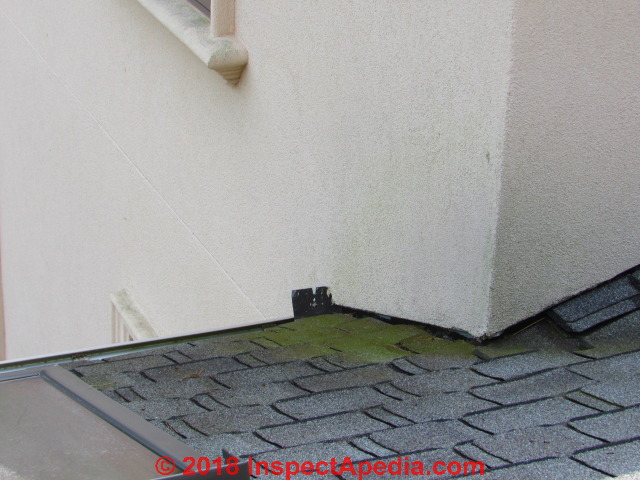
Green & black algae growth on shaded roof areas: why is the green "stain" - almost certainly an algae - found just in the area shown in photos earlier in this article as well as in the photo just below?
Mr.Kahn's green roof algae image, just below, gives a clue: the dominant shade pattern on the roof encourages algae growth in more-shaded areas that stay wet and cool more than other roof areas.
Tips for Distinguishing Algae on Roofs from Other Stains
 Since black or green roof algae is more likely to grow on a shaded, cooler, or more damp roof
surface, it is less likely that you'll find black algae stains uniformly on all roof slopes on a building. Black algae staining on an asphalt shingle roof is actually dead organic debris from
an algae.
Since black or green roof algae is more likely to grow on a shaded, cooler, or more damp roof
surface, it is less likely that you'll find black algae stains uniformly on all roof slopes on a building. Black algae staining on an asphalt shingle roof is actually dead organic debris from
an algae.
Photo: green algae on a New Jersey roof, courtesy of home inspector Dovber Kahn.
The algae most often found on black-stained roofs is Gloeocapsa magma (some writers refer to it as "GM" algae).
Roof consultant William Norman has pointed out that the absence of staining below the dormer in this photo is compelling evidence that the stains are due to algal growth, not extractive bleeding.
To remove and prevent black algae stains on roofs,
see BLACK STAIN REMOVAL & PREVENTION.
See EXTRACTIVE BLEEDING on SHINGLES for more on black stains that may be due to extractive bleeding on asphalt shingles. Some roofing consultants, including Mr. Norman (above) assert that many of the black stains on asphalt shingle roofs are due to algae growth and that extractive bleeding may not be a current roof problem.
Other dark roof stains from specific sources include soot from chimneys (brown/black, around a chimney and down-roof from the chimney), and debris staining on roof shingles or tiles where organic debris such as leaves has been left in place over time.
Free Testing Offered to Identify Roof Stain Material: see ALGAE STAIN TEST METHODS for a description of both free forensic microscopy lab tests and do-it-yourself roof stain tests that can help decide on the cause, clean-up, and prevention of algae stains on roofs.
Does Roof Algae Growth on Asphalt Shingles Affect Shingle Life?
Comments & Opinion on three claims of harm caused by roof algae:
1. Roof algae causes shingle granule loss? We have read in roof-cleaning-product sales literature that black algae reduces roof shingle life by "eating" at the shingles (loosening mineral granules and exposing the shingle substrate).
We agree that granule loss is associated with reduction in shingle life, but inspecting black algae-stained roofs in the U.S. we have not seen a difference in granule loss between the black algae-stained area and the non-stained areas. Contact us if you have different experience.
2. Roof algae causes shingle tab lifting? We have also read in roof cleaning product sales literature that black algae on roof shingles is a cause of shingle tab lifting. We have not observed this phenomenon nor have we found technical reports of this defect nor an explanation of its causal mechanism.
3. Roof algae releases harmful toxic spores on, around, and into homes? No. This is nonsense. Except when the ground is covered by snow, outdoor air has varying amounts, often very large amounts of all kinds of particles, including mold spores and rarely, algal spores.
Algae on the roof likes being there and hangs-on for dear life. It grew from random algae spores that landed on the roof and found a hospitable site.
Outdoor airborne particles indeed can enter a home through open windows and doors, and if building occupants are allergic to specific particles (typically certain pollen grains, some molds, other dust particles) they may suffer. Having inspected and tested airborne particles in and around nearly 3000 buildings we have never once found a significant level of algal particles in indoor air.
OPINION: As we said about green algae on roofs, the presence of these black "fungal" or algal stains on the roof is sometimes an indicator that this roof area is in a shaded spot (look for shade from trees or nearby buildings) where you may want to be alert for development of moss or other roof problems, but the level of damage from the black algae is probably low, even less than that caused by lichens and certainly less than that caused by moss.
To remove and prevent black algae stains on roofs,
see BLACK STAIN REMOVAL & PREVENTION.
Roof Shingle Algae Stains & and Roof Warranties
Watch out: Algae resistance provisions of asphalt roof shingle warranties are limited in coverage and scope.
Also see WARRANTIES for ROOF SHINGLES
Here are some major roofing manufacturer's warranty statements
- 2017 CertainTeed LIMITED WARRANTY, ASPHALT SHINGLE PRODUCTS [PDF] Corporation Saint-Gobain, CertainTeed Corporation,
20 Moores road Malvern, Pa 19355 USA, Tel: 800-782-8777, Tel-Professional: 800-233-8990, Website: www.certainteed.com
Excerpts:
p.3 This Limited Warranty does not provide protection against, and CertainTeed will have no liability for, any failure, defect or damage as a result of, including but not limited to: ...
p.4, Shading, stains or discoloration to the shingles arising from outside sources such as, but not limited to, algae (unless blue-green algae as described in the section titled “Limited Algae Warranty”), fungus, moss, lichens or other vegetation, mold or mildew growth, or paints, chemicals or other similar materials.
p.5 CertainTeed warrants that the Algae-Resistant (AR) versions of the products in Table 1 will remain free from blue-green algae growth (but not mold or mildew growth) which adversely affects the overall appearance of said shingles for a period of ten (10) or fifteen (15) years, as noted in Table 1.
If during the Algae-Resistant Warranty Period specified in Table 1, the overall appearance of the Algae-Resistant shingles is adversely affected by blue-green algae, CertainTeed will pay the reasonable cost to replace or clean at its option, any affected shingles. - 2016, GAF LIFETIME ROOFING SYSTEM LIMITED WARRANTY [PDF] The Legal Stuff (RESWT160), retrieved 2017/10/25, original source: http://www.gaf.com/Residential_Roofing/ Shingles/Royal_Sovereign/GAF_Shingle_Accessory_Warranty.pdf
Excerpt:
Algae Discoloration. All StainGuard®-labeled Shingles and Ridge Cap Shingles are warranted against algae discoloration for 10 years. There is no coverage for algae discoloration for any other GAF Accessory Products. - GAF Marquis WeatherMax® Shingles [product description], retrieved 2017/10/25, original source: http://www.gaf.com/Roofing/ Residential/Products/Shingles/3_Tab/Marquis_WeatherMax/Features
Excerpts:
StainGuard® Protection... Helps ensure the beauty of your roof against unsightly blue-green algae.
Details: StainGuard® protection applies only to shingles with StainGuard®-labeled packaging. See GAF Shingle & Accessory Ltd. Warranty for complete coverage and restrictions. - 2015 CERTAINTEED Saint-Gobain STATEMENT on ALGAE, MOSS and LICHENS [PDF] Technical Sheet #144, provided by anonymous reader who obtained this from the company 2017/09/13
- 2008 Owens Corning Roof Warranty (PDF), thanks to reader Carla Owens 4/30/2010, Kent State University
- 2001 Owens Corning International Shingle Warranty (PDF) 08/03/2010
Using OWENS CORNING ROOF SHINGLE WARRANTY [PDF] (4/30/10) as an example, note that [quoting]
Roof Shingle Warranty Exclusions [include the following]
Discoloration caused by algae, fungi, lichens or cyanobacteria (unless covered
under the section “What About Algae Resistance” that follows)
What About Algae Resistance
If the Shingles that you purchased were not specifically labeled as “Algae Resistant” (“AR”), then any discoloration caused by algae is not covered by this warranty as explained in the section above “What is Not Covered.” However, if you did purchase AR shingles, they are covered under this warranty for a period of five (5) years commencing on the date of installation (“AR Warranty Period”) against discoloration caused by algal, fungal, lichen, or cyanobacterial growth (“Algae Growth”).
If such discoloration occurs during the AR [Algae Resistant] Warranty Period, you will be entitled to the following remedy:
Remedy for Algae Growth – Should the AR Shingles exhibit discoloration due solely to algal, fungal, lichen, or cyanobacterial growth during the AR Warranty Period, your sole and exclusive remedy, and Owens Corning’s sole obligation, shall be for Owens Corning to pay you an amount equal to the reasonable cost of cleaning such growth off of the affected AR Shingles.
A later 2008 OWENS CORNING ROOF WARRANTY [PDF] provided to us by a client whose Owens Corning algae-resistant shingle roof was just two years old when an extensive green algae growth was observed, provides similar constraints as the 2001 warranty above, but extends the warranty period to ten (10) years.
An Owens Corning representative informed us (by telephone O.C. to DF, 04/2010) that the algae-resistant portion of a roof shingle warranty is also limited to one genera/species of roof algae, apparently excluding green algae staining.
Watch out: don't try cleaning asphalt shingle roofs without checking with the manufacturer about their recommended methods.
For example using power washers (not recommended), and some chemicals may damage the shingles and reduce the roof life.
Other chemicals such as bleach may also cause staining on other building areas and can be unsafe if not handled properly. To remove and prevent black algae stains on roofs, see BLACK STAIN REMOVAL & PREVENTION.
OPINION: algal growth on asphalt roof shingles, unlike moss and lichens growth, is a cosmetic concern and is not likely to affect roof shingle life.
See WARRANTIES for ROOF SHINGLES for more about roofing product warranties and for roofing product manufacturer claims & contact information.
Roof Staining Algae Types, Identification, Growth Research
Our photo shows green coccoid algae (tentative identification: Synechococcoideae) from an asphalt shingle roof, magnified 720x. (Coccoid algae are algae that appear as individual non-motile cells with a cell wall and lacking a flagella.
Common algae that form on roof surfaces, including asphalt shingles and roll roofing include the algae shown above and Gleocapsa magma, a species that generally appears black on the roof surface but under some lighting conditions even on the roof Gleocapsa magma can appear as a blue-green color as might other algae genera/species.
On a typical asphalt shingle or roof roofing surface, roof algae exude a chemical that dissolves carbohydrates that the alga then absorb as nutrients.
In my [DF] OPINION algae on roofs are a concern only as a cosmetic or staining issue. Unlike both moss and lichens that also grow on roofs, inspecting roofs in North America as well as in Europe since the 1970's I have not once found roof deterioration or damage that I could ascribe to the presence of algae.
Unlike algae, moss and lichens do damage roofs, both by holding water on the roof and by the mechanical damage to the roof's protective coating or mineral granules caused by both their roots and in freezing climates by the freezing action of water trapped within the roof coating by those invaders. See LICHENS on ROOFS - for an example.
Watch out: black and green algae genera/species may both appear as dark black or brown on roof surfaces, and the green color of the algae shown above as well as in other photos in this article series may be apparent only under the microscope.
You can see evidence of particles from the very same roof shingle algae stain samples appearing as black, brown, and green at ALGAE STAIN TEST METHODS.
The green algae clusters shown in my microscope-photo appeared as both green and black stains when examined in photos and by the naked eye set upon the Minnesota roof where the samples were collected by a professional roofer in 2017.
- ALGAE, FUNGUS, LICHENS, MOSS on ROOFS [web article] compares & illustrates algae, moss and lichens growth on roofs
- ARMA, ALGAE DISCOLORATION on ROOFS [PDF], (2014) Asphalt Roofing Manufacturers Association, National Press Building, 529 14thStreet,NW,Suite 750, Washington, DC 20045 USA,
Tel:(202) 591-2450 Website: www.asphaltroofing.org, retrieved 2017/10/25, original source: https://www.asphaltroofing.org/algae-discoloration-roofs
Excerpt:
... roof discoloration caused by algae has been observed throughout the United States and Canada.
The discoloration usually has a brown to black appearance, and may be mistaken for fungus growth, soot, dirt, moss, or tree droppings. Gloeocapsa magma is probably the most prevalent of several algae species that contribute to discoloration.
All species are transported through the air, and tend to collect and grow upon roofing structures.
Natural pigments produced by these algae may cause a white or light colored roof to gradually turn dark brown or black. Discoloration may appear as uniform discolorations or streaks. - Berdahl, Paul, Hashem Akbari, Ronnen Levinson, and William A. Miller. "Weathering of roofing materials–an overview." Construction and Building Materials 22, no. 4 (2008): 423-433.
Abstract:
An overview of several aspects of the weathering of roofing materials is presented. Degradation of materials initiated by ultraviolet radiation is discussed for plastics used in roofing, as well as wood and asphalt.
Elevated temperatures accelerate many deleterious chemical reactions and hasten diffusion of material components.
Effects of moisture include decay of wood, acceleration of corrosion of metals, staining of clay, and freeze–thaw damage. Soiling of roofing materials causes objectionable stains and reduces the solar reflectance of reflective materials. (Soiling of non-reflective materials can also increase solar reflectance.)
Soiling can be attributed to biological growth (e.g., cyanobacteria, fungi, algae), deposits of organic and mineral particles, and to the accumulation of fly ash, hydrocarbons and soot from combustion. - BLACK or GREEN ALGAE STAIN REMOVE / PREVENT - prevention of algae and other stain sources on roofs
- BLUE-GREEN ALGAE, [PDF] Aquatic Invasive Species, [PDF] Blue-Green algae, cyanophytes, cyanobacteria, including Cylindrospermopsis spp., Microcystis spp., Anabaena spp., Aphanizomenon spp., and Pseudoanabaena spp.(2007), Indiana State Government Division of Natural Resources, retrieved 2017/09/13 original source: http://www.in.gov/dnr/files/BLUEGREEN_ALGAE_Rev_Oct_2007.pdf
- Brook, Alan J. "The discoloration of roofs in the United States and Canada by algae." Journal of phycology 4, no. 3 (1968): 250-250.
Abstract:
Roof shingles are often colonized and discolored by blue-green and green algae. The former are mostly subaerial species and the latter are soil algae most frequently recovered from the atmosphere. - CASMA, ALGAE DISCOLORATION of ROOFS, [PDF] Technical
Bulletin No. 13, Canadian
Asphalt Shingle Manufacturers’ Association, Email: casma@casma.ca Website: www.casma.ca retrieved 2017/10/25, original source: http://www.casma.ca/algae-discoloration-on-roofs/#.WfDsxRNSwmq
Excerpt:
Occasionally light coloured asphalt shingle roofs may discolour with a brown to black stained appearance. Although this staining often is mistaken as dirt, moss, or even granule loss, it is caused by a type of common, air-borne algae known as Gloeocapsa. Natural pigments produced by the algae cells result in the dark discoloration. - Fabbro, L. and G. McGregor Blue-green algae General Information. Natural Resource Sciences. March 2003
- Forest, Herman S. "The soil algal community. II. Soviet soil studies." Journal of Phycology 1, no. 4 (1965): 164-171.
Abstract:
The enormous quantity of work done in the Soviet Union is inadequately known elsewhere. Soviet generalizations rest on extensive data published in the Russian and Ukranian languages. The primary criterion of community analysis is now the total algal flora, but it is foreseen that the ecology of individual species is a more desirable parameter.
Methods of sampling and culture in the Soviet Union are largely the same as those used elsewhere. The basic problems of sampling and quantification have not been solved yet.
It is felt that the prerequisite to understanding the Soviet experience is a commonly held taxonomy. Soviet taxonomists are judged as fully competent, but lack communications with outside taxonomists in respect to methodology and references. As a contribution to the common understanding, new identifications of Soviet species (mostly blue-greens) are included in this paper.
These were derived from: a study of moist soil dishes from collections made according to a horizontal distribution plan in a single field; collections from near Leningrad, Middle Asia (Alma-Ata, Tashkent, Samarkand, Buchara); liquid cultures of soil collected by a Soviet investigator in Kazakistan; and agar cultures of soil algae which are maintained in Soviet laboratories. Also included is a selected bibliography, in English translation, of 71 Soviet publications. - GAF, ALGAE STAINS on SHINGLED ROOF SURFACES [PDF], (2015), No: TAB-R 2011-102, 5 GAF Corporation, 1 Campus Drive Parsippany, NJ 07054 USA, Tel: 800-766-3411, Website: www.gaf.com retrieved 2017/10/25, original source: http://www.gaf.com/Warranties_Technical_Documents/ Steep_Slope_Technical_Advisory_Bulletins/English_Bulletins/ Algae_Staining_On_Shingled_Roof_Surfaces_Steep_Slope_Technical_Point_TAB_R_2011_102.pdf
- Gupta, S., and S. C. Agrawal. "Survival of blue-green and green algae under stress conditions." Folia microbiologica 51, no. 2 (2006): 121-128.
- Ihom, Aondona Paul, D. K. Uko, I. E. Markson, and O. C. Eleghasim. "Understanding the Nature and Characteristics of Dark-Black Stains on Rooftops in Uyo Metropolis-Nigeria." Mechanics, Materials Science & Engineering, July 2017, ISSN 2312-5954
Abstract:
Understanding the Nature and Characteristics of Dark-Black Stains on Roof-Tops in Uyo MetropolisNigeria; a study aimed at knowing the nature and characteristics of dark black stains on rooftops in Uyo metropolis has been undertaken.
The study which covered key areas of the town, involved taking samples from rooftops, these samples were sent out for tests using Energy Dispersive X-Ray Fluorescence (ED-XRF), Optical Emission Spectrometer (OES), X -Ray Diffractometer (XRD) and Scanning Electron Microscope (SEM).
The tests were carried out on the dark black stains which were scrapped from the rooftops. Tests were also carried out on the sheets, which were directly cut from the roofs.
The work was able to establish that the dark black stains on the roofs can be cleaned using soft brush and water. The results of the work equally provided the nature and characteristics of the dark black stains on the surface of roofs in Uyo metropolis. The major components of the dark black stains are alumina (16%), silica (43.80%), carbonaceous and volatile organic matter (16.59%), iron oxide (heamatite) (10.55%), potassium oxide (3.20%), titanium oxide (2.93%) and sulphite (SO3) (2.71%). Th
e SEM micrographs gave the structure of the dark black stains which were scrapped from the roofs, the structure revealed small shinny white particles, amorphous molecular structure similar to that of polymers and a crystal structure which resembles that formed by carbon and silica. The SEM micrographs also show how the stains are formed on aluminium and zinc substrate.
The nature and characteristics of the dark black stains have indicated that using water from these rooftops for direct consumption purpose may have some health implications, and relevant government agencies are requested to investigate the health implications. - Israel, Michael G. "Manufacture of composite roofing products with matrix formulated microbiocide." U.S. Patent 6,245,381, issued June 12, 2001.
Abstract:
This invention discloses improved residential roofing products with durable active protection against algae discoloration. Versatile organometallic salts and chelates for this purpose are incorporated in manufacture of composite concrete tile and asphalt shingle products via integrated process modifications.
These chemically stable non-volatile microbiocides, with exceptional effectiveness against both green and blue green algae, are tailored for specific matrix compatibility. By virtue of their composition and surface activity they serve a dual function in process improvement and product performance.
The control of microbiocide activity, long term, significantly advances the state-of-the-art protection against algae and the service life of these products. - Jones, William W., and Sarah Sauter. "Distribution and abundance of Cylindrospermopsis raciborskii in Indiana lakes and reservoirs." Prepared for Office of Water Quality. Indiana Depart. of Environ. Man. Indianapolis, IN (2005).
- Narayan, Sankar B., William T. Fay, Billy L. George, Christine A. Sobon, and Mark H. Kayser. "Method of inhibiting algae growth on asphalt shingles." U.S. Patent 5,356,664, issued October 18, 1994.
Abstract:
A method of inhibiting algae growth on an asphalt shingle surface exposed to varying humidity using a blend of copper-containing algae-resistant granules and non-algae-resistant granules.
The copper-containing algae-resistant granules comprise a substrate granule having at least one inner ceramic coating layer comprising cuprous oxide and a seal coating having a thickness covering the inner layer and which is at time to devoid of copper. - Roofer, “Tackling the Algae Problem,” Roofer Magazine, August 1994, p. 10.
- Schlichting Jr, Harold E. "Some subaerial algae from Ireland." British Phycological Journal 10, no. 3 (1975): 257-261.
- Tripathi, S. N. "Effect of temperature on chlorophyll stability of some subaerial blue‐green algae." Journal of Basic Microbiology 23, no. 7 (1983): 443-446.
- Also see additional citations atReferences or Citations
Reader Comment: negative effects of algae growth on light colored roofs
5/10/2014 Rebecca Vanderpool said:
In your articles concerning black algae you present that it is basically benign. You neglect to take into consideration that one of the basic tasks of a roof is to reflect the sun. In the south this has lead to significantly raising cooling costs in some cases with a fully involved roof the costs have doubled. I only suggest that all variables should be considered and all pertinent information included in your info.
Reply: research on the effects of algae on roof life, heat gain, and other effects
Rebecca, You raise an interesting point, arguing that on white and light colored roofs the effects of algae may include higher roof temperatures. My comments on algae address health effects or damage to roof - generally not measurable.
You might like to see these citations, particularly Levinson's work.
- Akbari, Hashem, Asmeret A. Berhe, Ronnen Levinson, Stanley Graveline, Kevin Foley, Ana H. Delgado, and Ralph M. Paroli. "Aging and weathering of cool roofing membranes." (2005).
- Berdahl, Paul, Hashem Akbari, Ronnen Levinson, and William A. Miller. "Weathering of roofing materials?an overview." Construction and Building Materials 22, no. 4 (2008): 423-433.
- discusses the effects on the roof life of stuff that grows thereon - Levinson, Ronnen, Paul Berdahl, Asmeret Asefaw Berhe, and Hashem Akbari. "Effects of soiling and cleaning on the reflectance and solar heat gain of a light-colored roofing membrane." Atmospheric Environment 39, no. 40 (2005): 7807-7824.
- Polkowska, Z. "Examining the Effect of the Type of Roofing on Pollutant Content in Roof Runoff Waters from Buildings in Selected Districts of the City of Gda?sk often,." Polish Journal of Environmental Studies 13, no. 2 (2004).
- Susca, T., S. R. Gaffin, and G. R. Dell?Osso. "Positive effects of vegetation: Urban heat island and green roofs." Environmental Pollution 159, no. 8 (2011): 2119-2126.
Question: algae may impact roof shingle life
(Oct 16, 2011) Anonymous said:
Sounds like the roofing industry has a big problem with black marks, algae, etc. Whatever they want to call it. I can go up and down street after street and see beautiful homes that roofs look terrible because of these marks. Use to be in the roofing industry 20 years ago, and i can honestly say i never remember seeing any of these black mark issues. So the question is, have they changed there roofing formula? Is it because fiberglass is being used more now than in the past? Something is going on!
(July 22, 2012) John B said:
Its my opinion that GM IS likely to affect shingle roof life, albeit indirectly and slowly. Follow my logic here...lichen, a known aggressor, is a symbiotic relationship between a fungus and a photosynthetic partner (ie GM). Without the presence of GM, you have no lichen. As an anecdote, I have never seen a roof (I'm in Iowa) with lichen or moss that did not already have extensive GM growth. I suspect the GM traps dirt and moisture, making fertile ground for further shingle aggressors, like lichen and moss. Clean the roof, and prevent all of the above.
Reply:
Thanks for the interesting comments, John. Your reasoning is that of intelligence but perhaps without field experience. I've seen lichens on roofs, lichens and moss on roofs, and lichens moss and algae on roofs together; but because we find plenty of roofs that have ONLY algal growth, it doesn't follow that algal growth is sufficient to cause lichens or moss growth. Instead the correlation is more likely to be that of roof chemistry, sun exposure, drainage, stuff like that.
Question: Roof stains caused by jet fuel ?
(Dec 8, 2012) Mike said:
Can these black stains be from JP8 (jet fuel) being dumped over residential homes by low flying planes? It seems to me that there should not be black stains that seem to run/bleed down sloped roofs. The staining is on the east, west, and sides but not south. I know the north side is shaded which is where algae growths, however, the sun would also burn off/break down jet fuel on the south face as well. To see black stains on a roof without a tree around seems weird. Lastly, I came across a journal that demonstrates a high incidence of cancer in roofers. which would lead me to think about the potential dangers of jp8 exposure to roof workers. Mold and algae exposure would more likely lead to autoimmune diseases such as rheumatoid arthritis.
Reply:
Loren said:
Mike, JP8 or any other jet fuel is not normally "dumped" on residential areas. There are specific dump zones that are coordinated with State and Federal Environmental and Aviation authorities. It is unlikely such a zone would be granted in an residential area. JP8 is kerosene and would evaporate on a hot roof. Its odor would be characteristic and would likely start dissolving asphalt shingles. JP8 is not classified as a human carcinogen by either ACGIH or IARC.
Thanks for your comment, Loren. We agree with you in all regards.
I add that in an emergency, such as a jet plane engine failure requiring an emergency landing (such as during or immediately after takeoff) a pilot might have to dump fuel to reduce weight to permit a safe landing. In that instance FAA regulations permit fuel dumping in the nearest unpopulated area.
Citation: Janega, James, & DeChant, Jim, "Jet's Emergency Landing requires fuel dump in lake", Chicago Tribune, 1 July 2008.
Excerpt: "A Japan-bound commercial airliner landed safely at O'Hare International Airport Monday afternoon after one of its engines malfunctioned over the northwest suburbs -- but not before it had to dump about 4 percent of its total fuel load over Lake Michigan in order to land."
The health effects of exposure to fuel oils (such as No. 2 home heating oil or kerosene or jet fuel) are discussed at
inspectapedia.com/oiltanks/ATSDR_tp75-c2.pdf
...
Continue reading at BLACK or GREEN ALGAE STAIN REMOVE / PREVENT To remove and prevent black algae stains on roofs, or select a topic from the closely-related articles below, or see the complete ARTICLE INDEX.
Or see these
Roof Algae Lichens Moss or Stain Articles
- ALGAE, FUNGUS, LICHENS, MOSS
- CHIMNEY STAINS
- EFFLORESCENCE SALTS & WHITE DEPOSITS
- SLIPPERY STAIRS, WALKS, ROOFS
- STAIN DIAGNOSIS on BUILDING EXTERIORS
- STAIN DIAGNOSIS on ROOFS
- STAIN DIAGNOSIS on ROOFS
- ALGAE, FUNGUS, LICHENS, MOSS on ROOFS
- ALGAE STAIN TEST METHODS
- BLACK ROOF STAIN CAUSES
- BLACK or GREEN ALGAE STAINS on ROOFS
- BLACK or GREEN ALGAE STAIN REMOVE / PREVENT
- STAINS on/near CHIMNEYS
- DEBRIS STAINS on ROOFS
- EXTRACTIVE BLEEDING on SHINGLES
- LICHENS on ROOFS
- MOSS on ROOFS
- POWER WASHING ROOFS
- RUST STAINS on ROOFS
- TREES & SHRUBS, TRIM OFF BUILDING
Suggested citation for this web page
BLACK or GREEN ALGAE STAINS on ROOFS at InspectApedia.com - online encyclopedia of building & environmental inspection, testing, diagnosis, repair, & problem prevention advice.
Or see this
INDEX to RELATED ARTICLES: ARTICLE INDEX to BUILDING ROOFING
Or use the SEARCH BOX found below to Ask a Question or Search InspectApedia
Ask a Question or Search InspectApedia
Try the search box just below, or if you prefer, post a question or comment in the Comments box below and we will respond promptly.
Search the InspectApedia website
Note: appearance of your Comment below may be delayed: if your comment contains an image, photograph, web link, or text that looks to the software as if it might be a web link, your posting will appear after it has been approved by a moderator. Apologies for the delay.
Only one image can be added per comment but you can post as many comments, and therefore images, as you like.
You will not receive a notification when a response to your question has been posted.
Please bookmark this page to make it easy for you to check back for our response.
Our Comment Box is provided by Countable Web Productions countable.ca
Citations & References
In addition to any citations in the article above, a full list is available on request.
- Dov Ber Kahn, a home inspector in Rockland County, NY has contributed photographs of various building features. Mr. Kahn is a licensed home inspector in New York and New Jersey, and can be reached at Website: Kahnbhomeinspectors, Tel: 845-445-8234, Email: kdovber@googlemail.com
See BRICK VENEER WALL DAMAGE ASSESSMENT and LOG CONSTRUCTION and also VINYL SIDING BURIED at WALL BOTTOM and also CORROSION & MOISTURE SOURCES in PANELS and BLACK or GREEN ALGAE STAINS on ROOFS for some example photos. - Shingle Shield™ are zinc strips that are inserted under the shingle tabs of individual shingles to reduce moss, lichens, and algae growth on asphalt roofing - see shingleshield.com
- StainhandleR are zinc strips that are inserted under the shingle tabs of individual shingles to reduce moss, lichens, and algae growth on asphalt roofing- see stainhandler.com
- Zinc-Shield® - zincshield.com and Z-stop™ zinc roofing strips - z-stop.com, are roll-out zinc strips intended for installation near the ridge of a roof to reduce moss, lichens, and algae growth on roofs
- 04/09: thanks to William M. Norman, P.E., S.E., Keeler-Webb Associates, 486 Gradle Drive, Carmel, IN 46032 for opening discussion regarding the legitimacy of extractive bleeding as a term to apply to asphalt roofing material. Mr. Norman suggests that many (not all) black stains on asphalt roofing may be due to algal growth. We will report progress in this discussion as updates to this web article.
- NRCA - National Roofing Contractors Association - Website: www.nrca.net 10255 W. Higgins Road, Suite 600, Rosemont, IL 60018-5607, Tel: (847) 299-9070 Fax: (847) 299-1183
- Guiry, M.D. & Guiry, G.M. 2010. AlgaeBase. World-wide electronic publication, National University of Ireland, Galway. http://www.algaebase.org searched on 28 April 2010, http://www.algaebase.org/
AlgaeBase is a database of information on algae that includes terrestrial, marine and freshwater organisms. 125,262 species and infraspecific names are in this algae database (April 2010) that includes images of terrestrial algae and aquatic algae, in situ and by microscope. But because this data base is intended for algae taxonomists and nomenclaturists, it can be difficult for a non-expert to search by image type rather than genus/species name.-DF
Quoting:
AlgaeBase is a database of information on algae that includes terrestrial, marine and freshwater organisms. At present, the data for the marine algae, particularly seaweeds, are the most complete. For convenience, we have included the sea-grasses even though they are flowering plants.
Thanks to Michael Guiry for discussing roof algae taxonomy in brief email 4/28/2010. - Classification of Algae, Oilgae, (Oilgae is the global information support resource for the algae fuels industry.
http://www.oilgae.com/algae/cla/cla.html
Quoting:
The classification of algae into taxonomic groups is based upon the same rules that are used for the classification of land plants, but the organization of groups of algae above the order level has changed substantially since 1960. Research using electron microscopes has demonstrated differences in features, such as the flagellar apparatus, cell division process, and organelle structure and function, that are important in the classification of algae. Similarities and differences among algal, fungal, and protozoan groups have led scientists to propose major taxonomic changes, and these changes are continuing.
Taxonomic Groups of Algae- Bacillariophyta
- Chloro phycophyta (green algae)
- Chrysophycophyta (golden algae)
- Cyanobacteria (blue green algae)
- Phaeco phycophyta (brown algae)
- Dinophyta(dinpflagellates)
- Rhodo phycophyta (red algae )
- Algae, common freshwater types of algae, http://www.microscopy-uk.org.uk/index.html?http://www.microscopy-uk.org.uk/pond/algae.html includes flagellated forms of algae: [Note that although these references pertain primarily to water-borne algae, the growth structures and characteristics are also generally helpful for identification of forms of algae encountered throughout the environment; for example some water borne algae may become wind-borne under certain conditions-DF]
- Euglenoids, Dinoflagellates, and
- Green algae (chlorophyta) Volvox (ponds), colonial flagellates Gonium, Eudorina, Pandorina, Sorastrum algae, Synura, & Uroglena algae. The site notes that not all "green algae" are green - some are red in appearance (Haemotoccus),
Also brown algae
and non-flagellated forms of algae - Blue-green algae (cyanobacteria), Diatoms, Desmids (green, no flagella, solitary, some colonial, two mirror image semi-cells),
- Green algae: no flagella, don't move, not attached to a surface
- Cyanobacterial Image Gallery, http://www-cyanosite.bio.purdue.edu/images/images.html provides a photo library of reference images for identification of cyanobacteria
- Freshwater Algae, George Booth, http://www.aquaticscape.com/articles/algae.htm includes low-magnification images of algae focused on aquatic algae, describes the differences among algae types:
- Blue-green, slime or smear algae
- Brown algae
- Green water
- Spot algae
- Fuzz algae, Beard algae, Fuzz algae
- Staghorn algae, and Brush algae
- 2001 Owens Corning International Shingle Warranty (PDF) 08/03/2010
- 2008 Owens Corning Roof Warranty (PDF), thanks to reader Carla Owens 4/30/2010, Kent State University
- The Ecology of Algae, F.E. Round, Cambridge University Press, 1984 ISBN-10: 0521269067 ISBN-13: 978-0521269063
After an introduction outlining the chemical and physical characteristics of the environment, the book goes on to look at the actual habitats in which algae occur. The communities of the individual habitats such as open water, sediments, rocky shores, coral reefs, hot springs, sea ice, soil, etc., are then discussed with special phenomena highlighted, for example rhythmic activity, nitrogen fixation and buoyancy. There are also chapters on seasonal cycles of algal growth, energy flow, geographical dispersion, palaeo-ecology and contribution to sediments. The importance of algae in symbiotic relationships and their considerable significance to animal grazers in aquatic food chains are also discussed. The final chapter deals with the relationships of algae to eutrophication and pollution of water. This is an important aspect, which can only be understood through an appreciation of algal ecology. - Lichens of North America, Irwin M. Brodo, Yale University Press, 2001, ISBN-10: 0300082495, # ISBN-13: 978-0300082494
Quoting from Library Journal:
Lichens are a combination of a fungus and an alga but have a unique structure and appearance quite different from either. Existing worldwide and growing on a variety of surfaces, including rocks, soil, and trees, they may appear leafy, shrubby, mossy, crusty, or jellylike and are seen in a wide range of colors, from brilliant oranges, yellows, and reds to dull grays and browns. This huge new book, written by a world authority on lichens and emeritus research scientist at the Canadian Museum of Nature, Ottawa, provides information on about 1500 of the roughly 3600 recognized North American lichens. Part 1 introduces lichens in 14 clearly written chapters that discuss their biology, ecology, geography, environmental roles, and collection. Part 2, the heart of the book, is a guide that offers identification keys to groups, genera, and species and their descriptions, with accompanying photographs and North American distribution maps. The more than 900 truly beautiful, full-color photos were taken by the Sharnoffs, nature photographers whose work has been widely published in National Geographic, Smithsonian, and elsewhere. Of value to professionals and amateurs alike, this book is certain to be a classic reference for decades to come. Highly recommended for academic and research libraries and for public libraries where interest warrants; libraries needing only a brief yet informative introduction to lichens should consider William Purvis's inexpensive Lichens (Smithsonian Institution, 2000). William H. Wiese, Iowa State Univ. Lib., Ames - Our recommended books about building & mechanical systems design, inspection, problem diagnosis, and repair, and about indoor environment and IAQ testing, diagnosis, and cleanup are at the InspectAPedia Bookstore. Also see our Book Reviews - InspectAPedia.
- Green Roof Plants: A Resource and Planting Guide, Edmund C. Snodgrass, Lucie L. Snodgrass, Timber Press, Incorporated, 2006, ISBN-10: 0881927872, ISBN-13: 978-0881927870. The text covers moisture needs, heat tolerance, hardiness, bloom color, foliage characteristics, and height of 350 species and cultivars.
- Green Roof Construction and Maintenance, Kelley Luckett, McGraw-Hill Professional, 2009, ISBN-10: 007160880X, ISBN-13: 978-0071608800, quoting: Key questions to ask at each stage of the green building process Tested tips and techniques for successful structural design Construction methods for new and existing buildings Information on insulation, drainage, detailing, irrigation, and plant selection Details on optimal soil formulation Illustrations featuring various stages of construction Best practices for green roof maintenance A survey of environmental benefits, including evapo-transpiration, storm-water management, habitat restoration, and improvement of air quality Tips on the LEED design and certification process Considerations for assessing return on investment Color photographs of successfully installed green roofs Useful checklists, tables, and charts
- In addition to citations & references found in this article, see the research citations given at the end of the related articles found at our suggested
CONTINUE READING or RECOMMENDED ARTICLES.
- Carson, Dunlop & Associates Ltd., 120 Carlton Street Suite 407, Toronto ON M5A 4K2. Tel: (416) 964-9415 1-800-268-7070 Email: info@carsondunlop.com. Alan Carson is a past president of ASHI, the American Society of Home Inspectors.
Thanks to Alan Carson and Bob Dunlop, for permission for InspectAPedia to use text excerpts from The HOME REFERENCE BOOK - the Encyclopedia of Homes and to use illustrations from The ILLUSTRATED HOME .
Carson Dunlop Associates provides extensive home inspection education and report writing material. In gratitude we provide links to tsome Carson Dunlop Associates products and services.
 | HOME | ABOUT | ASK a QUESTION | CONTACT | CONTENT USE POLICY | DESCRIPTION | POLICIES | PRIVACY | |
| © 2024 - 1985 Publisher InspectApedia.com - Daniel Friedman | |||||||||