
InspectAPedia® FREE Encyclopedia of Building & Environmental Construction, Diagnosis, Maintenance & Repair |
Question? Just ask us! InspectAPedia
|
 Sewer Line Leaks & Odors
Diagnose and Cure Sewer Gas Smells Due to Sewer Line Leaks or Septic Tank Problems
- POST a QUESTION or COMMENT about this article topic.
Drain & sewer line leak & odor diagnosis & repair:
How to prevent or cure sewer gas odors from septic systems, building plumbing, & other causes. Sewer gas smell diagnosis - plumbing checklist. Septic gas smell diagnosis - septic system checklist
This article describes how to diagnose, find, and cure odors in buildings including septic or sewage or sewer gas smells or "gas odors" in buildings.
InspectAPedia tolerates no conflicts of interest. We have no relationship with advertisers, products, or services discussed at this website.
- Daniel Friedman, Publisher/Editor/Author - See WHO ARE WE?
Septic System or Sewer Piping Blockage or Failure Can Produce Sewer or Septic Gases Outdoors OR Indoors
Our sewer gas odor diagnosis discussed here focuses on homes with a private onsite septic tank but including tips for owners whose home is connected to a sewer system as well. What makes the smell in sewer gas? Sewer gases are more than an obnoxious odor.
Readers should be sure to also
see SEWER GAS ODORS.
Watch Out: Because sewer gas contains methane gas (CH4) there is a risk of an explosion hazard or even fatal asphyxiation.
Sewer gases also probably contain hydrogen sulfide gas (H2S) In addition some writers opine that there are possible health hazards from sewer gas exposure, such as a bacterial infection of the sinuses (which can occur due to any sinus irritation).
Depending on the sewer gas source and other factors such as humidity and building and weather conditions, mold spores may also be present in sewer gases.
Sewer gas odors that can occur when a drain or septic system are partly blocked or sluggish.
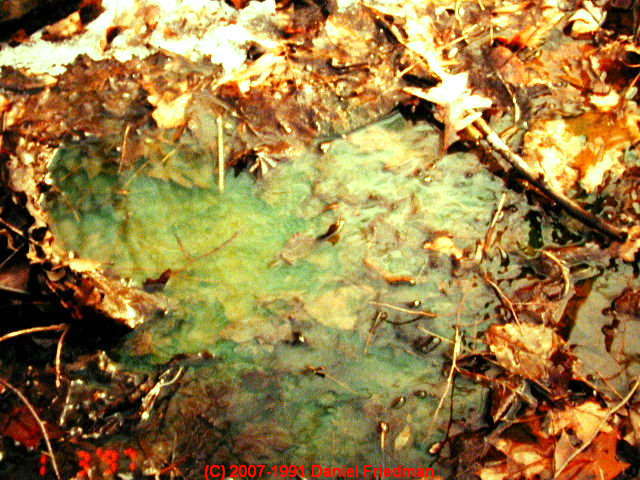
Inspect the septic system for evidence of failure: our photo shows green septic dye in the yard during a septic loading and dye test.
If the sewer or gas odor or smell is strongest outside, and if you rule out an unusual site shape or wind blowing odors down from your plumbing vent system,
your septic system may be failing.
Sewage odors may be noticed from a failing drainfield even if at the moment you don't see a wet or soggy area which shows actual sewage effluent on the yard surface.
If this is the case you may want to request a septic system inspection as well as a tank pumpout and inspection afterwards.
Also see SEWER GAS ODORS in COLD / WET WEATHER for additional odor tracing and cure advice for odors occurring during wet or cold weather.
- Check for a sewer line vent through the building foundation wall:
I often find that a vent has been placed at a house foundation wall just above where the sewer line leaves the building. I suspect the plumber thought that this would aid drainage into the septic tank.
Millions of homes have been built without this vent so I doubt it's needed. See if that's an odor source, and review the installation with your plumber. - Install a gas diverter in the septic tank:
the sludge in the bottom of a septic tank is being digested by anaerobic bacteria and perhaps also other microbes which form methane gas as a product of the decomposition of sewage.
In some septic tanks the sludge layer may produce an occasional "burp" of gas that forms a large methane/hydrogen sulfide bubble. In a single compartment septic tank such bubbles can force unwanted solids up the tank outlet tee and into the absorption system.
If this is suspected, special gas deflection devices (much like an upside down chimney cap) can be installed on the tank outlet tee. - Sudden and unusually large septic system system usage
that causes a large volume of water to enter the system, such as many loads of laundry or many visitors to a property which served by a small septic system might temporarily dilute the bacteria in the septic tank.
It would be odd for this problem to persist. Normally bacteria would recover, probably in a day or so. If a septic system drain, tank, or drainfield are partly blocked, usage surges can produce this condition more often and at an increasing rate as the system deteriorates. - Prolonged cessation of usage of the septic system,
such as a home being left vacant for years. It would be odd to have to do anything special about this condition as when the system is returned to use it should recover quickly.
However if the home has been vacant for a long time and/or if you simply don't know the condition of the septic system, it would be smart to have a septic contractor locate the tank, open it, pump it, and report on its condition both for operating confidence and more, for safety.
Watch out: Is the septic tank cover safe?
See SEPTIC & CESSPOOL SAFETY - Acidic septic tanks:
An Australian website suggested that (for the Australian climate) the septic tank contents may become too acidic. They recommend the following remedy, which I do not recommend in other areas without first consulting with local septic experts.
And certainly do not attempt this process nor any process using any other septic additive or product before you know in fact where the odor is coming from. If, for example the odor is from improper plumbing vent installation, flushing lime down a toilet is not a fix it's simply silly.- Reduce the septic tank acidity by preparing a mix 0.5kg of lime with 10 liters of water.
- Flush the lime mixture down the toilet 2 or 3 times a day for 3 to 4 days, until a total of about 5kg is used.
- Alternatively the 5kg of lime to 10 liters of water can be inserted into the septic tank in one dose, however this can be more difficult to flush through the system, especially with new dual flush cisterns.
- If the odours persist, repeat this process after 7 days.
This Australian septic system advice was paraphrased/near-quoted from advice given by Adelaide Hills Council, Australia.
In some areas such as South Australia, aerobic wastewater treatment is used to treat effluent to a sufficient level of sanitation that it can be used for irrigation within the property - in other words it is dispersed on the soil for the purpose of both disposal and for irrigation.
...
Continue reading at SEWAGE BACKUP, WHAT TO DO or select a topic from the closely-related articles below, or see the complete ARTICLE INDEX.
Or see SEWER LINE LEAKS & ODORS FAQs - questions & answers posted originally at the end of this page.
Or see these
Recommended Articles
- CONCRETE CORROSION DUE TO HYDROGEN SULFIDE
- DRAIN PIPE LEAK TYPES
- DRAIN & SEWER PIPING - home
- ODORS GASES SMELLS, DIAGNOSIS & CURE - home
- ODORS, SEPTIC or SEWER
- ODOR SOURCE TRACK-DOWN
- PLUMBING LEAK DETECTION METHODS
- SEWAGE BACKUP TEST & CLEANUP
- SEWAGE BACKUP, WHAT TO DO
- SEWER BACKUP PREVENTION
- SEWER GAS ODORS - home
- SEWER GAS TESTS & DETECTION
- SEWER LINE CLOGS & DAMAGE
- SEWER LINE REPLACEMENT
- SEWER / SEPTIC PIPE CAMERAS
Suggested citation for this web page
SEWER LINE LEAKS & ODORS at InspectApedia.com - online encyclopedia of building & environmental inspection, testing, diagnosis, repair, & problem prevention advice.
Or see this
INDEX to RELATED ARTICLES: ARTICLE I NDEX to PLUMBING SYSTEMS
Or use the SEARCH BOX found below to Ask a Question or Search InspectApedia
Ask a Question or Search InspectApedia
Try the search box just below, or if you prefer, post a question or comment in the Comments box below and we will respond promptly.
Search the InspectApedia website
Note: appearance of your Comment below may be delayed: if your comment contains an image, photograph, web link, or text that looks to the software as if it might be a web link, your posting will appear after it has been approved by a moderator. Apologies for the delay.
Only one image can be added per comment but you can post as many comments, and therefore images, as you like.
You will not receive a notification when a response to your question has been posted.
Please bookmark this page to make it easy for you to check back for our response.
IF above you see "Comment Form is loading comments..." then COMMENT BOX - countable.ca / bawkbox.com IS NOT WORKING.
In any case you are welcome to send an email directly to us at InspectApedia.com at editor@inspectApedia.com
We'll reply to you directly. Please help us help you by noting, in your email, the URL of the InspectApedia page where you wanted to comment.
Citations & References
In addition to any citations in the article above, a full list is available on request.
- Thanks to Slade Franklin for the reminder that a leaky wax ring at a toilet can lead to septic odors in bathrooms. 11/2007
- Thanks to J.V. (privacy protected) for the reminder to make a detailed inspection of the plumbing vent system when sewer gas odors are present. 07/2008
- In addition to citations & references found in this article, see the research citations given at the end of the related articles found at our suggested
CONTINUE READING or RECOMMENDED ARTICLES.
- Carson, Dunlop & Associates Ltd., 120 Carlton Street Suite 407, Toronto ON M5A 4K2. Tel: (416) 964-9415 1-800-268-7070 Email: info@carsondunlop.com. Alan Carson is a past president of ASHI, the American Society of Home Inspectors.
Thanks to Alan Carson and Bob Dunlop, for permission for InspectAPedia to use text excerpts from The HOME REFERENCE BOOK - the Encyclopedia of Homes and to use illustrations from The ILLUSTRATED HOME .
Carson Dunlop Associates provides extensive home inspection education and report writing material. In gratitude we provide links to tsome Carson Dunlop Associates products and services.
 | HOME | ABOUT | ASK a QUESTION | CONTACT | CONTENT USE POLICY | DESCRIPTION | POLICIES | PRIVACY | |
| © 2025 - 1985 Publisher InspectApedia.com - Daniel Friedman | |||||||||