
InspectAPedia® FREE Encyclopedia of Building & Environmental Construction, Diagnosis, Maintenance & Repair |
Question? Just ask us! InspectAPedia
|
 Cast Iron Drain Piping
Identification, Diagnosis, Repair
Cast Iron Drain Piping
Identification, Diagnosis, Repair
- POST a QUESTION or COMMENT about cast iron drain pipes in buildings
Cast iron plumbing drain piping:
This article lists our in-depth articles on inspecting, testing, and repairing problems with cast iron building plumbing drain waste vent piping, piping materials, clogged or noisy pipes, and types of pipe hazards or product defects. The articles at this website will answer most questions about water supply & drain piping of all materials and types.
InspectAPedia tolerates no conflicts of interest. We have no relationship with advertisers, products, or services discussed at this website.
- Daniel Friedman, Publisher/Editor/Author - See WHO ARE WE?
Cast Iron Building Drain Piping: Identification, Diagnosis, Repair
Cast iron drain piping has been used in buildings for more than 100 years and can last for 50 years or longer. T
his heavy material is available in diameters from 2" and up, with typical main building drains of 4" to 6" in diameter in residential buildings.
A hub system connects pipe sections, originally using melted lead to seal the joint against wastewater leaks or sewer gas odor leaks.
The cast iron pipe hub and stub were wiped with oil to remove water, avoiding a dangerous steam flash when lead was poured into the fitting.
Most modern cast iron connections are made using rubber or plastic fittings that no longer require heating and melting lead.
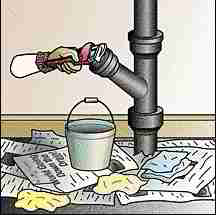
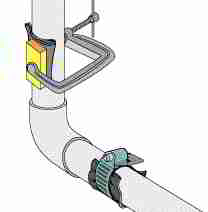
The illustrations (left) show accessing a cast iron drain cleanout and two methods of emergency, temporary repair of leaks in drain piping.
Making New Drain Connections to Old Cast Iron Drain Piping
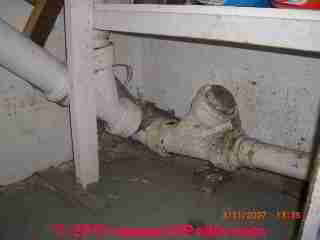
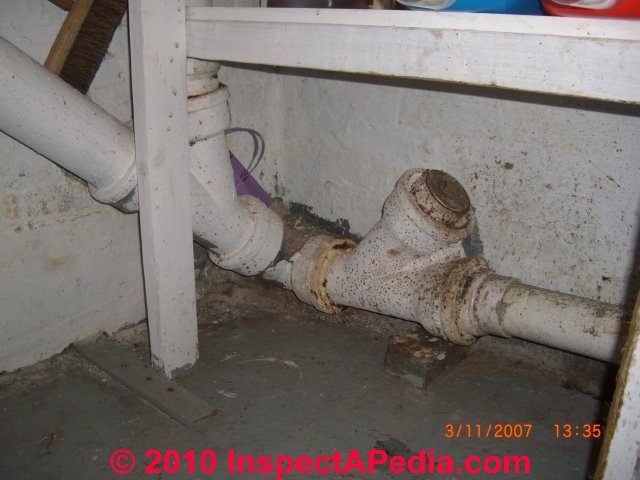
Our photograph of cast iron drain piping (below left) demonstrates two methods by which connections have been made to newer copper drain lines. At upper left a black plastic hub fitting has been used to connect the 4" copper drain to the cast iron drain line.
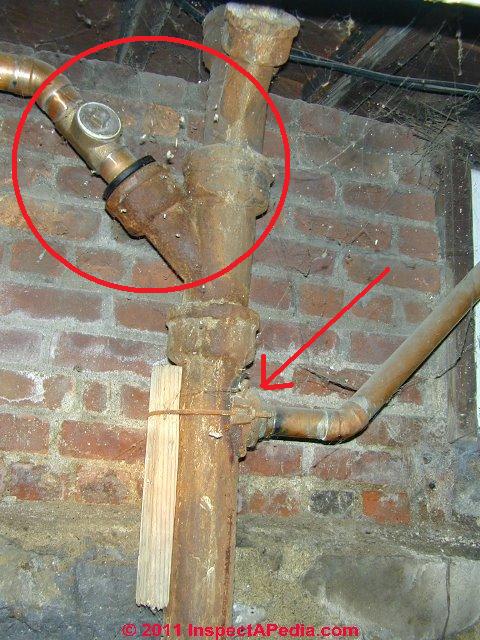
At center-right in the above left photo a questionable clamp-on type fitting has been used for the same purpose, including a makeshift clamp using a block of wood to accommodate use of the wrong-sized clamp around the cast iron drain. Stains on the upper section of piping indicate that this drain system has been leaking.
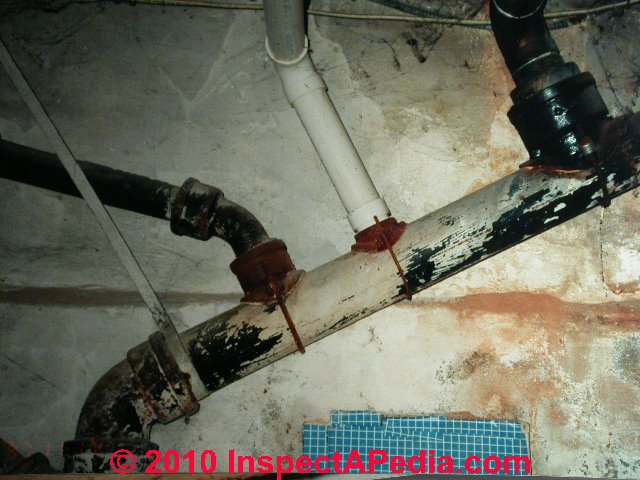
Our photograph above shows three clamp-on connectors joining cast iron and plastic drains to the cast iron sewer line.
Cast Iron Drain Piping Leak & Odor Locations, Causes, Diagnosis
Our photograph shows an odd double-hub connection on a vertical section of cast iron drain piping in a 1935-built home in poughkeepsie, NY.
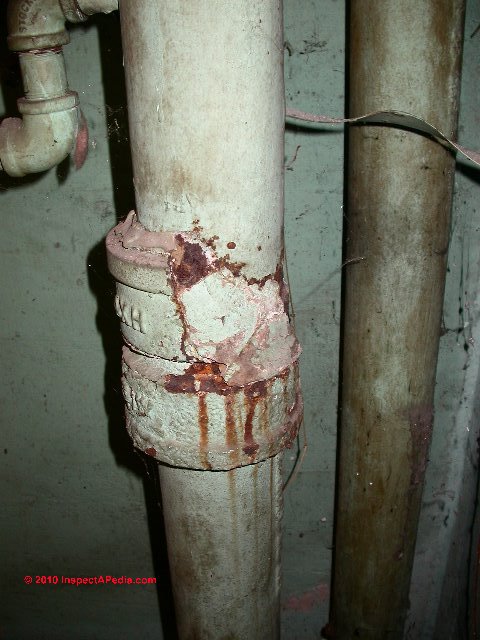
You can see by the rust stains that this cast iron pipe joint has been leaking for some time, that the concrete "repair" action was not fully effective, and that the basement is exposed to unsanitary conditions due to sewage leakage.
Our second cast iron drain leak photograph (below) shows a different type of drain pipe leak: sewer gases. This fitting and collection of galvanized iron elbows and nipples should be removed and the opening in the vertical cast iron drain plugged to stop potentially dangerous sewer gases from entering the building.
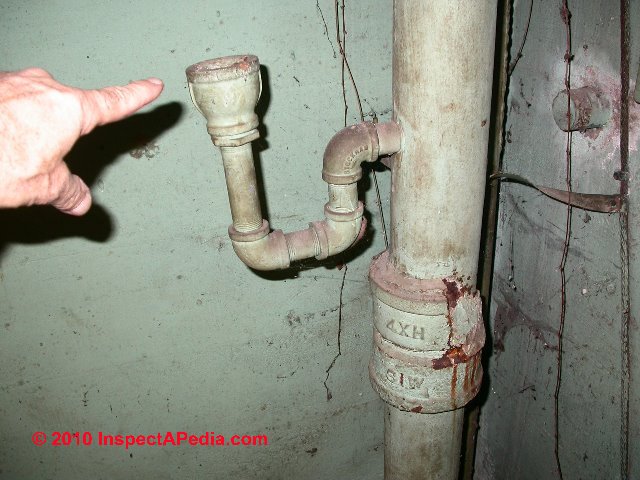
We suspect that this drain was once used to receive water from a basement dehumidifier or water softener, but it is no longer in use. The dry "trap" formed at the bottom of the piping "U" no longer serves to keep sewer gases out of the building.
Watch out: sewer gases may be both unsanitary and also risk of a very serious methane gas explosion.
See SEWER GAS ODORS.
Types of leaks occur in Cast Iron Piping

- Improper cast iron pipe connections or retrofit connections (see our photo just below), including poorly-prepared lead hub joints as well as use of improper clamp on or hubless connectors
- Perforations from defective cast iron material or corrosive conditions
- Splits in cast iron drains due to freezing - occurring when the drain line is blocked or improperly pitched, left full of wastewater, and exposed to freezing conditions
- Improper support leading to movement and separation of pipe joints.
- Breaks at cast iron pipes or pipe joints due to mechanical impact, movement due to poor support of the cast iron piping, or similar causes.
Our photograph above shows that the rope trying to secure the galvanized drain line to the cast iron sewer piping confirm a history of leak troubles and improper plumbing connections.
Cast Iron Drain Pipe Leak & Repair Case - Odors Lead to Discovery of Under-Floor Drain Leaks
Cast Iron Drains Receiving Roof Gutter Drainage May Burst Basement Floor Slabs
Often on city lots that are flat and poorly drained, builders or building owners were pressed to decide how to get rid of rainwater spilling off of building roofs and through the gutter and downspout system.
The best approach is to route these drains to a nearby city storm drain, pumping if necessary but best by gravity. This avoids overloading the city sewer system during periods of heavy rainfall.
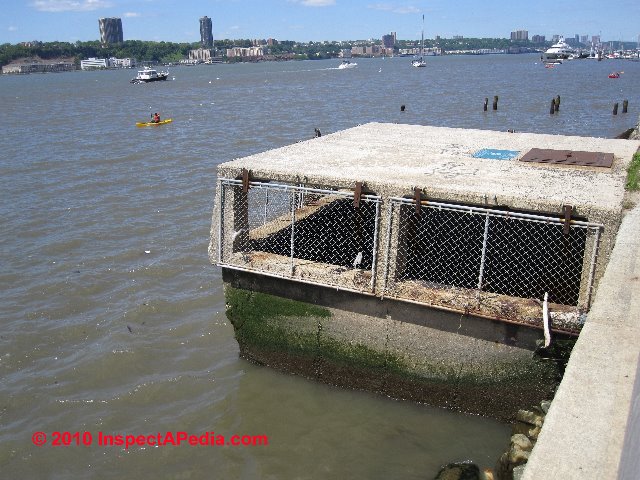
Our photograph above shows a New York City storm drain overflow station (officially, a: New York State Wet Weather Discharge Point) where excess drainage is dumped into the Hudson River when more water or wastewater enters the city sewer system than can be handled. The green sign atop this drain warns
If you see a discharge during dry weather, please call 311 - DEP (Department of Environmental Protection).
Overloading a city's sewer often means that raw sewage is simply overflowed or dumped into local rivers or streams.
But It was common in previous generations for builders to rout (usually cast iron) drain pipes from ground-level outside of a building into the building, under the basement floor slab, and out to the municipal sewer system. These drains were used to receive roof gutter drainage and dispose of it into the city sewers.
Our photo above shows an in-basement cast iron drain line that originally received outside gutter/downspout drain water. At the time of our inspection that system had been changed and downspouts were routed to above-ground drains (unfortunately still too close to the building to assure a dry basement).
A problem with the in-building, under-floor piping disposal of roof runoff, besides overloading the city sewers in wet weather, is that eventually the under-floor drain may become clogged, perhaps with leaves washing into the drain from the building's gutters. The best result of that problem is that the drain stops draining and gutters spill outdoors along the foundation, perhaps leading to basement water entry, rot, mold, and insect damage.
Still more troubling, a blocked under-floor drain in a building left with no heat sometimes led to frozen drain pipes and burst, heaved piping and floor damage in the building, followed by an in-building flood when freezing weather changed to a thaw.
If you have roof gutters connected to drains that enter the building and are routed to the sewers, (a step still permitted and even required in a few communities), reconnecting the drains from outside ground-level to a nearby storm drain may be a better approach.
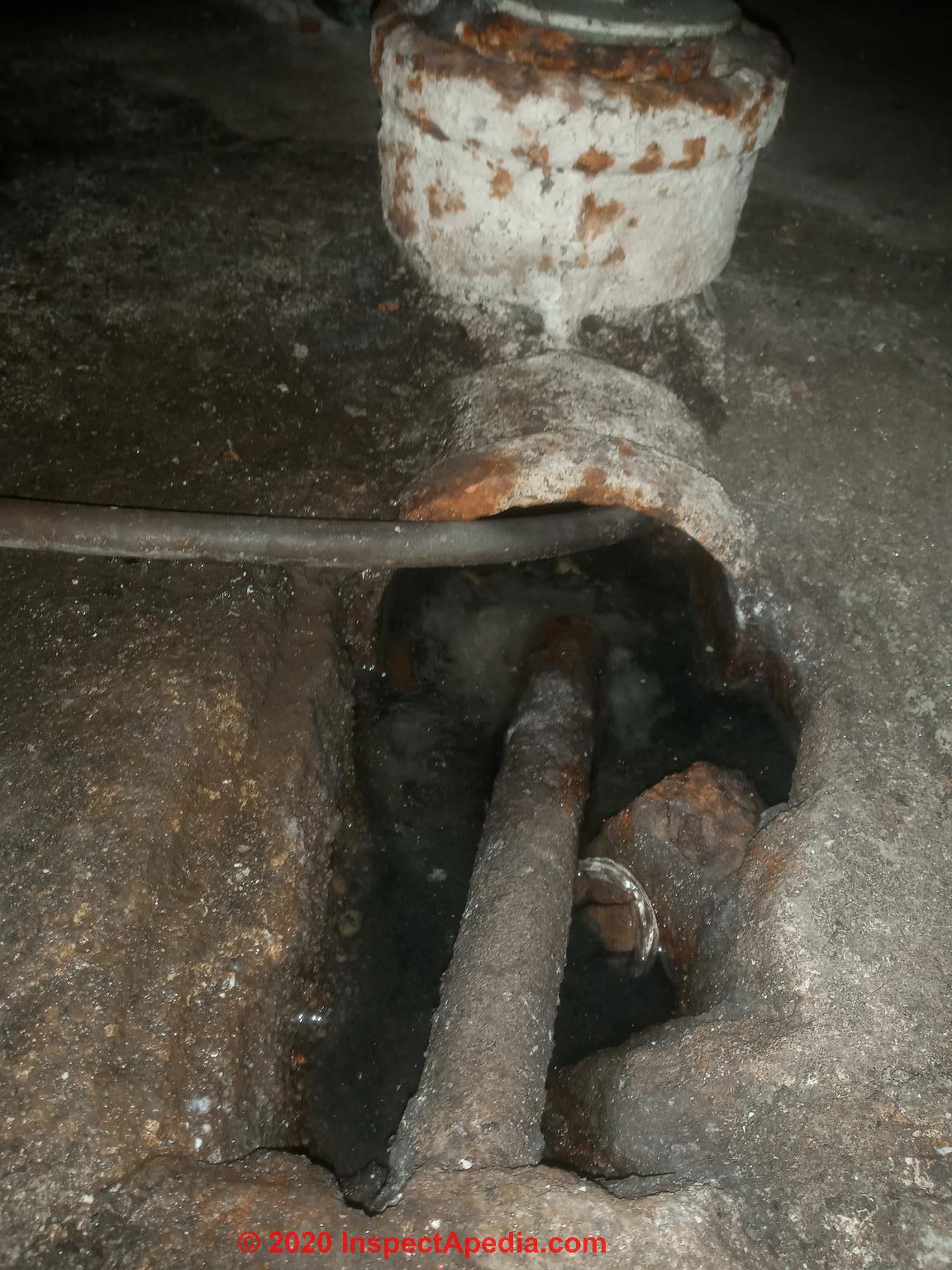
Above: an unsanitary and unsafe open sewer line cleanout, courtesy of an InspectApedia.com reader.
Tracking Down Leaky Cast Iron Drain Pipes Under a Floor Slab that Sent Sewer Gases into Transite (Asbestos Cement) HVAC Ducts
Details of this sewer gas odor case, cast iron drain leak, and repair are
at CAST IRON DRAIN LEAK, ODOR, REPAIR. Excerpts are below.
A reader (Conrad) provided us with the photographs and case history of the successful track-down of sewer gas odors in a building
SEWER GAS ODORS. The case began with a complaint of sewer gas odors in the building's heating duct work system.
Details about the case illustrated just below, including more pictures and notes on how the building owner tracked the sewer smell to the basement floor slab (and transite heating ducts in the slab) can be read
at CAST IRON DRAIN LEAK, ODOR, REPAIR.
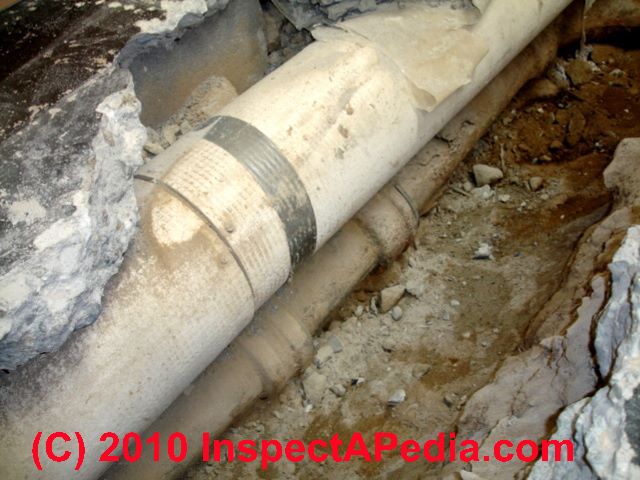
SLAB DUCTWORK - catalogs the functional and environmental problems found when HVAC air ducts are routed in or below floor slabs.
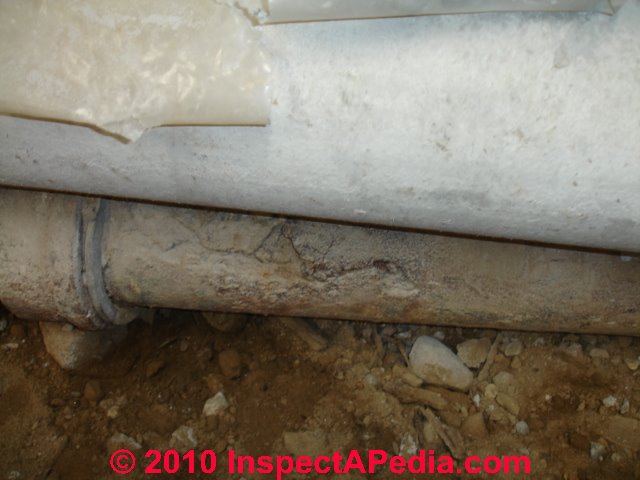
Cast Iron Pipe Research, Standards, Installation Guides
- ASTM a74-21, Standard Specification for Cast Iron Soil Pipe and Fittings, ASTM International, website: https://www.astm.org/a0074-21.html
Abstract: This specification covers cast gray iron soil pipe and fittings for use in gravity flow plumbing, drain, waste and vent sanitary, and storm water applications. These pipe and fittings are not intended for pressure applications.
The cast iron shall be produced by an established commercial method that provides control over chemical and physical properties. Castings shall be sound, true to pattern, and of compact close grain that permits drilling and cutting by ordinary methods and its interior surface shall be reasonably smooth and free from defects.
Ferrous scrap, pig iron, and any recycled ferrous material to be used in the melting operation shall be screened for radioactivity.
Tension test shall include breaking load, machined diameter, and tensile strength.
Chemical test shall conform to the chemical composition requirements prescribed for phosphorous, sulfur, chromium, titanium, aluminum, lead, and carbon equivalent. Dimension requirements for hub, spigot, barrel, grooves, water seal and trap, and threads of the pipe and fittings are detailed.
The pipe and fittings shall be uniformly coated with a material suitable for the purpose. - ASTM A888-21a Standard Specification for Hubless Cast Iron Soil Pipe and Fittings for Sanitary and Storm Drain, Waste, and Vent Piping Applications
- ASTM C564-20a Standard Specification for Rubber Gaskets for Cast Iron Soil Pipe and Fittings
- ASTM C1277-20 Standard Specification for Shielded Couplings Joining Hubless Cast Iron Soil Pipe and Fittings
- Cast Iron Soil Pipe Institute, Web: https://www.cispi.org/contact-us/ (good luck finding an address)
- Charlotte Pipe, CAST IRON SOIL PIPE AND FITTINGS HANDBOOK [PDF] Charlotte Pipe & Foundry Co., Charlotte, North Carolina, USA, Web: https://www.charlottepipe.com/ retrieved 2022/07/30, original source: https://www.charlottepipe.com/Documents/CISPI_Tech_Man/CISPI_Tech_Man.pdf revised IAW CAST IRON SOIL PIPE INSTITUTE 5959 Shallowford Road, Suite 419 Chattanooga, Tennessee 37421 (423) 892-0137 www.cispi.org
- Charlotte Pipe, CAST IRON FITTING PRODUCTS for MULTI-STORY APPLICATIONS [PDF] (2021) Charlotte Pipe & Foundry Co., Op.Cit., etrieved 2022/07/30, original source: https://www.charlottepipe.com/Documents/DimensionalCatalogs/BR-CI-MS.pdf
...
Reader Comments, Questions & Answers About The Article Above
Below you will find questions and answers previously posted on this page at its page bottom reader comment box.
Reader Q&A - also see RECOMMENDED ARTICLES & FAQs
On 2021-08-30 by inspectapedia.com.moderator (mod)
 @Old Home,
Sure, could have been a loop vent, though I haven't found that design common in homes from the 1950s or older.
For Other Readers:
OldHome posted other photos of what looks like an abandoned drywell at
https://inspectapedia.com/septic/Drywell_Design.php
DRYWELL DESIGN & USES
On 2021-08-30 by Old Home
@inspectapedia.com.moderator, Agree with all. I have found many surprises working in old buildings.
But they do make me curious why it was done that way and some you just shake your head. A thought came to mind.
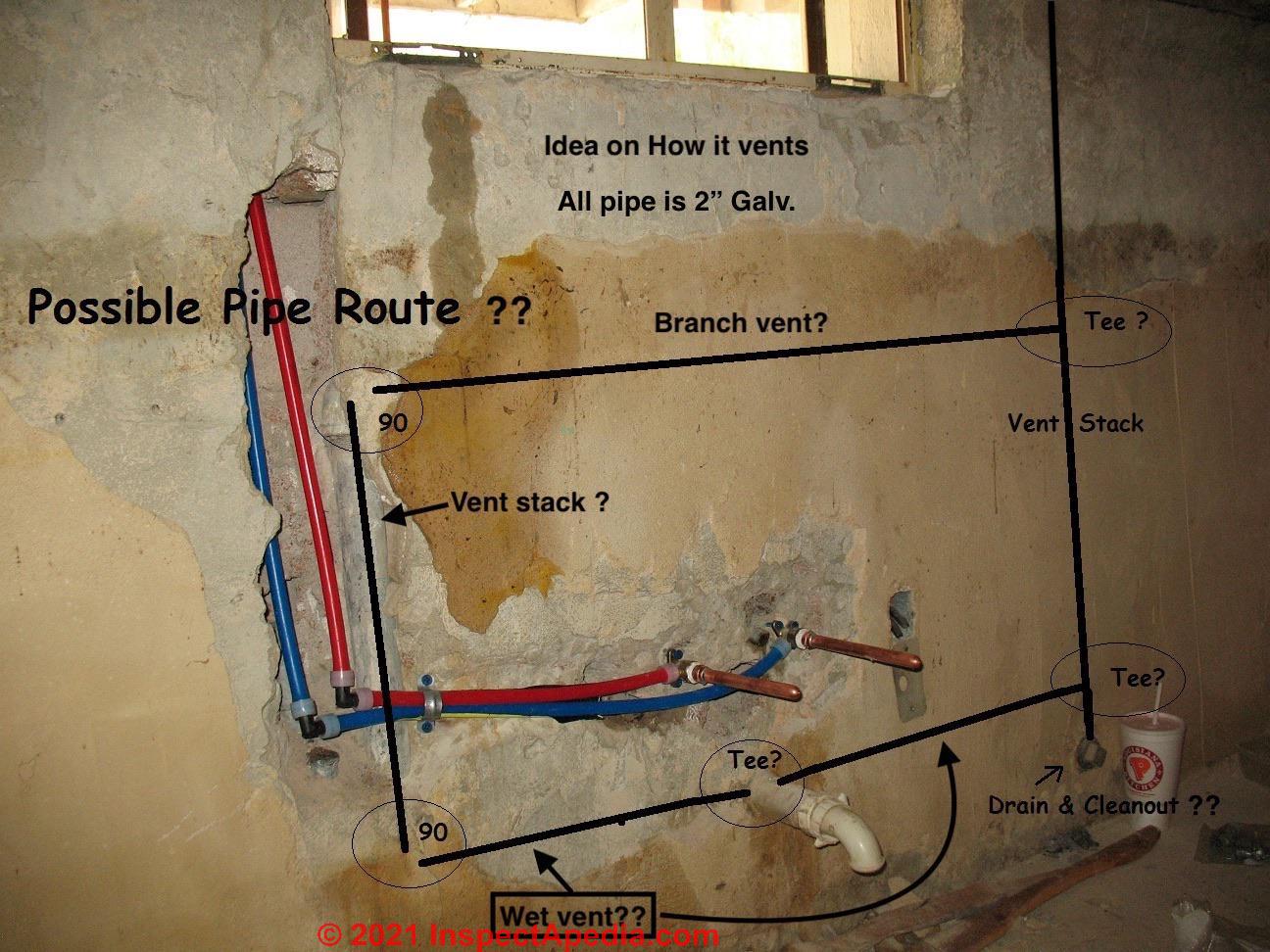
Could that mystery pipe be the downstream part of a 50s version of a loop vent?
Both have some water in them right now because of a downstream blockage but once I cut them to replace with PVC I can investigate further.
I'll send my "guess" pic of the loop vent [ shown above ] Let me know if I'm way off base or it could be right. Both pics are in the same area, less than 6 feet apart
On 2021-08-30 by inspectapedia.com.moderator (mod)
@Old Home,
Not really; having worked on many old houses I can testify that it's no surprise to find abandoned plumbing, wiring, and structural components as a building's features, occupants, uses, needs change over many decades. I've found garden hose used as piping in walls, septic tanks in basements, gutters used in a kitchen to catch roof leaks, dead raccoons in a shower converted to a closet.
As long as the building isn't being made unsafe or damaged by these left over pipes we cut them off and remove them if possible, else leave them alone during renovations.
But beware; a plumber at a home in San Miguel de Allende was making new building main drain connections to the street and didn't see any reason why a second drain, a "mystery pipe" needed to be included, so he just cut it off and buried it.
Ultimately the occupants found that while almost all of the building's fixtures drained to the building's main drain, now connected to the sewer, a kitchen drain had been routed separately - out through the wall, under the sidewalk, and down to join the main drain outside. When the kitchen drainage started bubbling up through the sidewalk the owners knew something was missing.
On 2021-08-30 by Old Home
@inspectapedia.com.moderator, Sorry I didn't proof read that last post before hitting send. It was a little jumbled. This is in south Texas. The soil here is very sandy for the first foot of so then more like a clay.
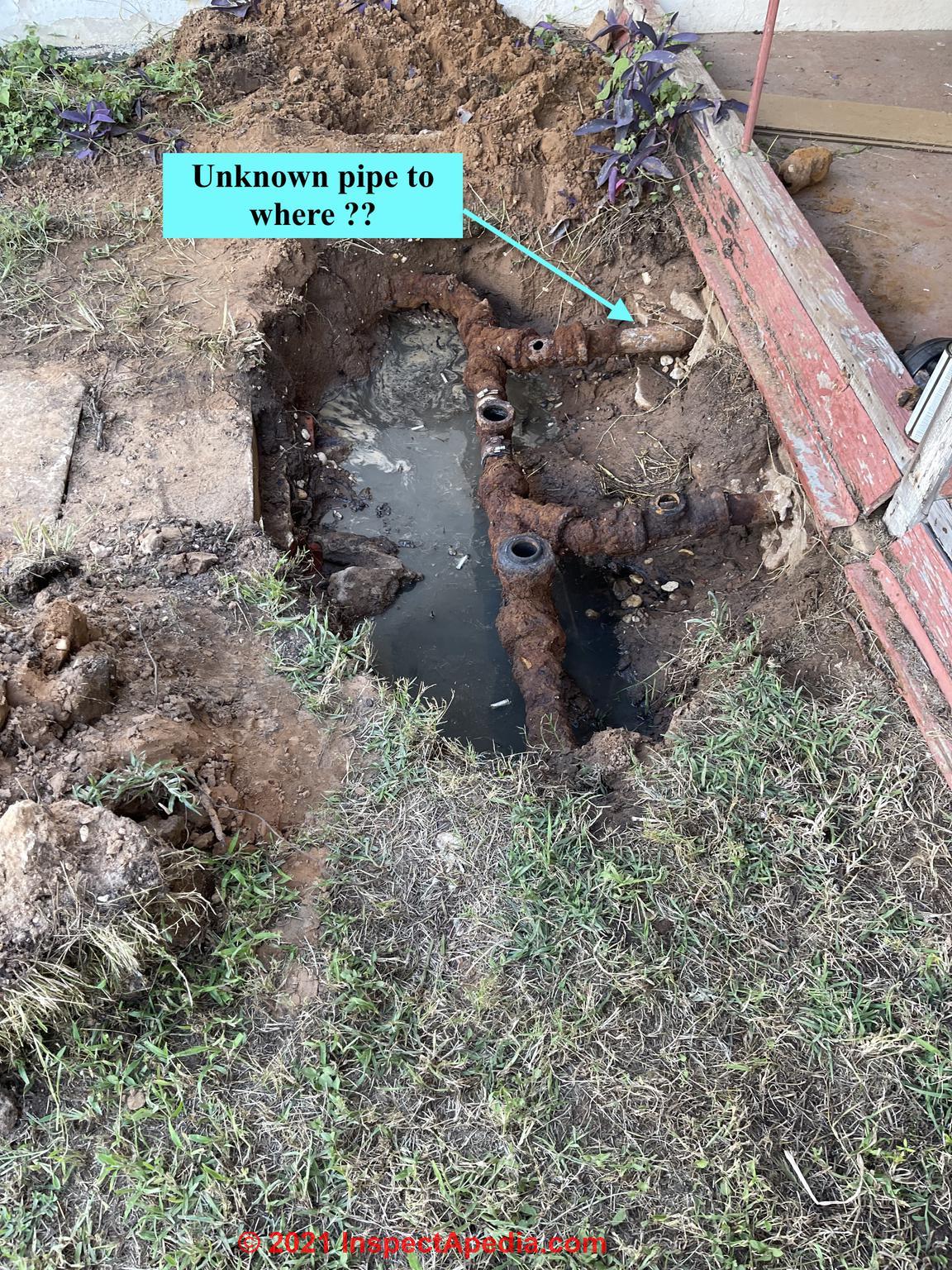
It is normally very dry but this spot was probably always wet due to all the rusted thru holes in the bottom of most of the tee's. As for soil corrosivity, No idea. The water is pretty hard. I added a water softener a few years back and because that pipe carries away the weekly softener regeneration pretty sure that didn't do it any favors. Any ideas on what that 2nd mystery drain in the pic might be?
On 2021-08-30 by inspectapedia.com.moderator (mod)
@Old Home,
Looks like all of that needs to be replaced. Where is this home located ?
and do you know anything about the corrosivity index of your soil?
On 2021-08-29 by Old Home
@inspectapedia.com.moderator, Thanks!
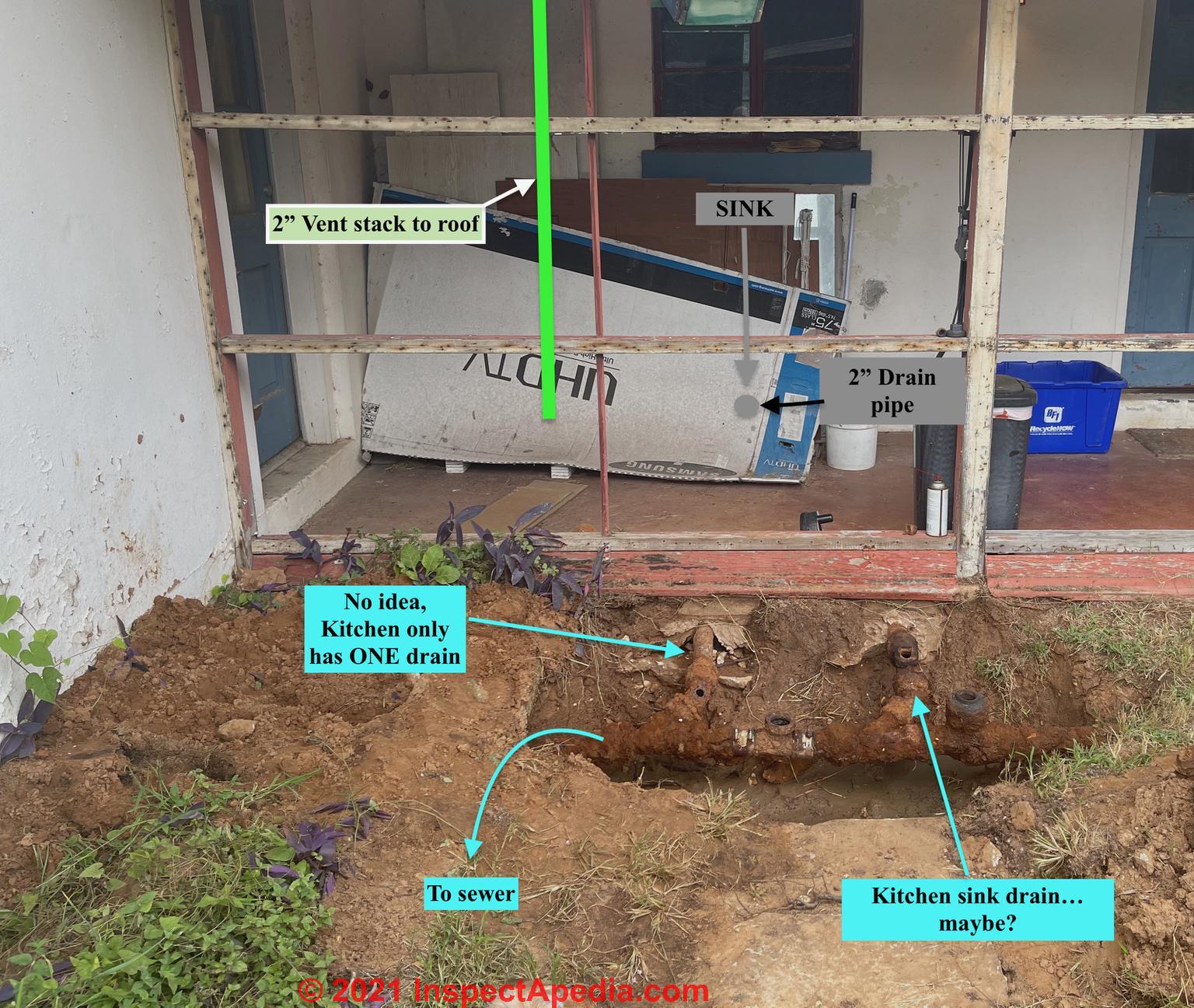
I am familiar with "cheater vent" It be to a option but sure if local code allows them here. No Gurgles so probably ok there. I did try to have my plumber scope the drain when I remodeled the kitchen but he couldn't get far. Now I know why looking at the rats nest of piping (posted below).
I wanted under the slab wall checked and He tried from the cap that popped off (bottom one ). Want I can't figure out is what is that second pipe (upper) going under the slab towards the kitchen? I had the room stripped to bare walls and there is only ONE drain in the kitchen. Nothing else is that requires plumbing is in the area.
On 2021-08-29 by inspectapedia.com.moderator (mod)
@Old Home,
If venting were the issue you'd probably hear gurgling drains; in any event you could try a "cheater vent" like those described at
AIR ADMITTANCE VALVES AAVs https://inspectapedia.com/plumbing/Air_Admittance_Studor_Vents.php
You could also have the drains scoped with a sewer line camera to be sure you understand the condition of the piping and the problem.
I've wasted money before paying plumbers to "snake" old cast iron and galvanized iron drains to no avail when what was really needed was drain replacment because the pipes were badly clogged with scale and worse, thick rust build-up.
SEWER / SEPTIC PIPE CAMERAS https://inspectapedia.com/plumbing/Sewer-Pipe-Inspection-Cameras.php
may be of help
On 2021-08-29 by Old Home
I originally posted some questions in the drywell section thinking it may of been my issue. It wasn't. After advice and my inspection I found cast steel pipes Passing close to (but not attached) to an abandoned drywell.
Background: this is an late 40s-early 50s house, on a slab, ciderblock walls with stucco inside and out. Home used to be on a septic system but changed to city service sometime prior to 1999. I have found both terracotta clay pipes 4" and cast iron/steel pipes 2" on the waste drains outside.
Bathrooms drain to the 4" at the one end of the house (closest to city connection) and the kitchen and washer at the other end have a Cast 2" drain. Haven't found where the two connect yet.
My problem is the kitchen/washer room 2" cast pipes are very slow draining, very rusty and some of the tee and wye joints have rusted thru. I found the problem when a cleanout plug rusted thru and soapy water from the washer bubbled up.
I have dug up the problem area and plan to replace as much cast pipe with PVC as possible (about 60 feet). Hopefully none of the pipe under the slab or in the wall is bad. Major problems if they do! Any additional suggestions would be helpful.
When I had the kitchen and laundry updated I had some questions of proper venting in the kitchen (the laundry had None! Laundry was replumbed with proper traps and a roof vent. The kitchen sink is on an exterior wall under a window so the roof stack is maybe 3' off to the side of the sink.
When they chipped away the wall to replace the Galv. water pipes with PEX I saw what appeared to be a loop vent system using 2" Galv pipe but that's just a guess. Also the sink drain pipe is very low, maybe 12" above the slab. As a result my sink trap lis ike 2" above the cabinet floor. Not ideal. Any idea's and suggestions would be appreciated.
I have some pics but have had trouble posting them on the site.
On 2021-05-24 by (mod) - Damage Cast iron pipes in basement
@Gladys,
To protect reader trust in this website we don't sell any product nor any service. You will want to call some local plumbers. If a question arises about the cause or perfect cure for the damage that your building will be glad to do what we can to help you answer that.
I can tell hyou that while plumbing costs vary widely by country and city within country, in the U.S. you can figure a ballpark cost to replace
basement cast iron drain piping of about $175./ft.
On 2021-05-20by Gladys
Damage Cast iron pipes in basement Leaking near damage water heater .How much estimated to replace?
On 2020-11-18 - by (mod) -
I would have to see the line both outside and inside to be confident that I know what it is, however it was a time when people would connect downspout lines to a cast-iron line that went into the building and out through a sewer line.
On 2020-11-18 by Debra Taylor
I had a down spout removed from the side of my house and it exposed a large cast iron pipe that's open just sticking out of the side of my house. What the heck is it and should it be covered so rodents don't get in.
No clue
On 2020-11-17 - by (mod) -
Re-posting from private email:
RK asked
I am searching for standard weight chart of cast iron spun soul waste pipes. I am requesting you for providing the same.
Moderator reply:
Steeltubesindia.net says
Size: diameter (inch) length (feet) weight (pounds)
2 x 5 5 25.0
3 x 5 5 44.4
4 x 5 5 59.6
On 2020-10-04 - by (mod) -
 That looks as if we're joining lead to cast iron and perhaps there was a cleanout - I can't see enough to be sure.
From the gray piping above the cast iron hub, probably lead, perhaps this is a cleanout below a toilet bend.
Watch out: an open sewer line in a building risks both escape of pathogens ( a health hazard) and methane gas (an explosion hazard).
On 2020-10-04 by Steve
What was this fitting for?it has 2” pipe that goes up thru roof all by itself and a 3/4 leg on the bottom? It can’t be a drain? I don’t know what the broken part was? It is in kitchen wall of an old apartment bldg.2 story bldg
On 2019-05-19 - by (mod) -
Chris I'm sorry but I don't have a clear picture of your situation.
I can say in general that a main building drain on a residential property is very likely to be larger than 2 ID and that it's normal for smaller drain lines such as from sinks, showers, tubs, (often 1 1/2" to 2" in diameter) to join a 4" ID or larger sewer line.
On 2019-05-18 by Chris
I have 2" cast iron pipe that splits off , one to my kitchen, and one to my bathroom, laundry. I've tour up the concrete floor to where the Y connection is.
Can you tell me the pipe from there that leaves the house, is it 3" , I need to replace the whole kitchen 2" pipe to the Y connection so I thought I would also replace the Y connector with PVC also. Does 3" pipe come into my house and will I find a 3" connector that splits off into 2" pipes? Any help would be appreciated, thanks. Chris
On 2019-01-15 by Steve
We have a one story commercial building that is 20 years old. We operate as a restaurant. Recently we realized that we had a sewer gas problem and a plumber came in and replaced 3 areas of vent pipe that had either cracked or rotted. We are still chasing at least one if not more leaks, and also wonder if we find them whether new ones will show up.
Replacing the entire vent system would be devastating to the building interior walls (10+ water closets, 12 sinks, dishwasher station all connected). Is there a reliable way to reline the vent pipes or other suggestions that you may have? Thank you.
On 2018-09-20 - by (mod) -
Nate
If you need to get Beyond careful visual inspection I think you would want to contact a company that provides equipment for electronic survey of existing Pipelines. For a small-scale project that's not going to be cost effective but perhaps in your situation it would be appropriate.
On 2018-09-19 by Nate
What is a quick method of determining if the cast iron waste pipe delivered to a job has been damaged in transit
On 2016-06-22 by Karl Burggraf / karlburggraf@yahoo.com
Yes plumber coming over to morrow. We have a cast iron and copper connection leaking. The copper pipe may actually have warn out or the alleged lead seal.
Had to get some one certified to work with this "hazardous material", and from this article the sewer gases sound like a problem. There is that rust and rot of the metal, the brownish color might actually be a reaction that produces hydrogen, I would guess, because the smell was indeed pretty nasty. I guess it is simple enough to fix, now after watching these repairs or others. Yes, a little nasty work though for sure and would not want to breath any of that.
It seems like the copper pipe could be cut and a replacement put in place with gaskets on both sides accordingly. There is a galvanized nipple, coming off a copper and brass supply line for the toilet, it is too close to the junction of the copper and cast that is leaking, matter of fact they do touch and this will need to be dealt with as well, that is a bummer.
It will need to be bent over, well cut and sauder to only move it over a slight amount half inch or so, will have to replace the old nipple and toilet supply connection. So that is another bummer for sure.
On 2015-12-26 - by (mod) -
Anon:
So clearly there is a drain line leak that needs repair; A drain blockage can also make leaks show up where they were not previously noticed. So I think you want help from a plumber; Depending on the cause of the leak, its location, and the condition of the piping, temporary repair or emergency repair might be possible with a clamp-around drain line leak fitting. Keep me posted.
On 2015-12-26 by Anonymous
Every time I use the shower, The cast iron pipe in the basement leaks severely
Question:
(Feb 27, 2012) Anonymous said:
which pipe is best between galvanized and pvc pipe for cool water supply
Reply:
Anon, if you are connecting a plastic pipe to any metal, you don't need an intermediate diaelectric fitting. The plastic is basically non-conductive.
You only need to install special diaelectric fittings (or brass, for example) between dissimilar metals - so you wouldn't go directly from iron pipe to copper without using an intermediate fitting, either a special diaelectric fitting (those have built-in plastic insulation components) or a brass fitting.
Question:
(Nov 26, 2012) Richard Young said:
I have moisture on my slab floor around the sewer pipe where it comes out of the slab. The pipe is completely dry and shows no sign of water leaking down to the floor. anyone out there have an idea?
Reply:
Richard,
If the drain itself is dry then perhaps
- there is water under the slab that is leaking up around the drain insertion point
- you had a water leak that ran across the floor, collected around the drain, but the run-path had dried
Reader follow-up:
No, the moisture definitely moves away from the pipe and the floor isn't wet, just slightly damp. Had the line tested and the water didn't back up in the pipe. But as soon as I started the shower again the dampness started to show up. Roto Rooter thought that the elbow under the concrete was probably corroded.
Does this sound right and should I get a second opinion?
Reply:
Richard,
Connecting the water appearance with the shower operation was a key diagnostic step.
Water may be entering the floor around the shower drain, or from a bad trap, or even from another shower leak point, following the drain to the point of exit at the floor drain.
Inspect the shower drain carefully, removing it's grate if you can, so as to check too for leaks around the drain flange.
Reader follow-up:
(Nov 28, 2012) Richard Young said:
It doesn't matter whether it's the shower on the first floor or the second floor. The drain pipe is dry on the outside all the way down into the basement as far as the concrete slab. The last part of the sewer pipe that shows above the slab is a flange and that is dry on the outside also. No water shows except as moisture on the surface of the slab.
Can green pvc be used for sewer replacement INSIDE a residence in Nassau County NY that is under the slab? And does it require a permit/inspection? Thanks
Reply:
For Nassau County code questions, as the local code inspector has final authority, I'd give them a call and ask that directly.
Question:
(Dec 29, 2012) John Juniet said:
Are second floor cast iron drain pipes general secured to the building on their run up the inside wall, or are they supported by themselves and the metal ties/supports in the basement floor joists? I have a leak somewhere along the main cast iron drain pipe from my second floor and am considering replacing all with pvc, but am anxious about the prospect of ripping open all my walls if there are support clips down the length.
Jan 30, 2013) Pumpkin said:
Hum & vibration in house. Wondering if it could be from saddle that connects our old cast iron pipe to new plastic system that the City installed? Anyone know about this problem.
Reply:
Such connectors can conduct building sounds or vibrations from one area to another unless sound-isolating fittings were used.
Question: gas pipe running across the concrete floor of the garage has rusted - British Gas says I can cover it with concrete.
8/8/14 John said:
I have a gas pipe running across the concrete floor of the garage that has gone rusty where the concrete has broken up (small area approx 6").
British Gas have inspected the pipe & told me there is no leak & I could cover it with concrete. My question is could I use PVA & Mortar mix or would this combination react with the rusty pipe?
Reply:
For a detailed reply to John's question please see GAS PIPING CLEARANCES, CODES & DEFECTS
Question:
(Aug 8, 2014) John said:
I have a gas pipe running across the concrete floor of the garage that has gone rusty where the concrete has broken up (small area approx 6").
British Gas have inspected the pipe & told me there is no leak & I could cover it with concrete. My question is could I use PVA & Mortar mix or would this combination react with the rusty pipe?
Reply:
John, I'm not a corrosion expert, but I think the safest bet would be to
1. gently clean off surface rust from the gas pipe
2. spray the exposed metal surfaces with an expoxy paint
3. follow British Gas' advice permitting covering the pipe with concrete
Unprotected-steel in concrete is exposed to corrosive effects that can damage the steel or in turn the concrete.
A more detailed reply to your question has been moved to
inspectapedia.com/plumbing/Gas_Piping_Defects.htm
Question: Why would contractor place black glue (abs?) down cast iron shower drain?
(Sept 3, 2014) Lilia said:
Why would contractor place black glue (abs?) down cast iron shower drain? New bathroom and plumbing for new building - horrible smell emanating from shower. Contractor added new vent after tearing into newly painted drywall - to no avail.
Then coated glue down the shower drain - still bad smell slightly reduced. Then added 2nd application of the glue - smell seems to be gone but I am worried that this is just covering a bigger problem.
Even though this is a new installation the shower drain is badly rusted and the screws on the shower drain cover rusted through.
This bathroom is only about 3 months old. Would a qualified plumber with a camera be able to diagnose this problem?
Reply:
Sounds odd to me too, perhaps thinking s/he is sealing a leak or deodorizing the drain but really risking a costly clog problem.
(Sept 7, 2014) Lilia said:
Dan thanks for your feedback. Would like to add that since the last comment I did have a plumber inspect. He pulled out an ABS sleeve out of the line for shower before the trap above and before the drain. He could see a 2" hole in side of the 2" ABS between trap and drain (possible incorrect vent).
Wasn't sure it the sleeve was covering up a hole and there was too much glue to see the problem. In order to see the problem the brand new marble tiles on shower floor need to be pulled out and beneath excavated just to inspect further.
Reply:
Nice going Lilia. So apparently someone tried to patch a significant hole in the cast iron drain line by inserting a plastic sleeve.
Sometimes such damage is better repaired through the ceiling from below
Question: assessing a clogged "4 cast iron drain which comes from a bathroom
(May 14, 2015) Mando said:
I am assessing a clogged "4 cast iron drain which comes from a bathroom. It supplied drainage from one side of the house to tee up with another one to lead out from the middle of the house's crawl space and out to the streets sewer.
Drilled a hole atop the cast iron about 30 feet before connecting to another cast iron and out the street. Inside the was about an inch deep of sludge. I continued the process about 25 feet and 3 holes down the sludge was deeper than the last one. 5 feet away from a Y connection to the street(by the way the opposite side of the home is a cast iron which works fine.)
Whats next? Details; cast iron comes down below the ground about "6 and is leaking and oxidizing. I have experience in new and repair plumbing. I plan to take this project on by the horns myself. So, "lay it on me,"
Reply:
Mando,
I"m not famliar with the approach of drilling holes into an existing cast iron drain - interesting. How will you seal them later?
About the sludge, if the sludge is actually sewage deposits (and not corrosion for example) it sounds to me as if the main drain was blocked, partly blocked, or lacked adequate slope.
...
Continue reading at CAST IRON DRAIN LEAK, ODOR, REPAIR or select a topic from the closely-related articles below, or see the complete ARTICLE INDEX.
Or see these
Recommended Articles
- BACKUP PREVENTION, SEWER LINE
- BLOCKED DRAIN REPAIR
- CLEANOUTS, PLUMBING DRAIN
- CLOGGED DRAIN DIAGNOSIS & REPAIR
- DRAIN LINE SEWER ODORS
- DRAIN PIPING & SEWER ODORS
- DRAIN & SEWER PIPING - home
- FIXTURE vs SYSTEM DRAIN BLOCKAGE
- LEAD PIPES in BUILDINGS
- PLASTIC PIPING ABS CPVC PB PEX PPR PVC
- PLUMBING FIXTURE TRAPS
- TRAP SIPHONAGE & SEWER GAS
Suggested citation for this web page
CAST IRON DRAIN PIPING at InspectApedia.com - online encyclopedia of building & environmental inspection, testing, diagnosis, repair, & problem prevention advice.
Or see this
INDEX to RELATED ARTICLES: ARTICLE INDEX to PLUMBING SYSTEMS
Or use the SEARCH BOX found below to Ask a Question or Search InspectApedia
Ask a Question or Search InspectApedia
Try the search box just below, or if you prefer, post a question or comment in the Comments box below and we will respond promptly.
Search the InspectApedia website
Note: appearance of your Comment below may be delayed: if your comment contains an image, photograph, web link, or text that looks to the software as if it might be a web link, your posting will appear after it has been approved by a moderator. Apologies for the delay.
Only one image can be added per comment but you can post as many comments, and therefore images, as you like.
You will not receive a notification when a response to your question has been posted.
Please bookmark this page to make it easy for you to check back for our response.
Our Comment Box is provided by Countable Web Productions countable.ca
Citations & References
In addition to any citations in the article above, a full list is available on request.
- Mark Cramer Inspection Services Mark Cramer, Tampa Florida, Mr. Cramer is a past president of ASHI, the American Society of Home Inspectors and is a Florida home inspector and home inspection educator. Mr. Cramer serves on the ASHI Home Inspection Standards. Contact Mark Cramer at: 727-595-4211 mark@BestTampaInspector.com
- John Cranor [Website: /www.house-whisperer.com ] is an ASHI member and a home inspector (The House Whisperer) is located in Glen Allen, VA 23060. He is also a contributor to InspectApedia.com in several technical areas such as plumbing and appliances (dryer vents). Contact Mr. Cranor at 804-873-8534 or by Email: johncranor@verizon.net
- Thanks to reader Conrad for discussing an under-slab sewer gas odor source traced to a combination of transite heating ducts in the floor slab and leaky cast iron drain piping - January 2010
- In addition to citations & references found in this article, see the research citations given at the end of the related articles found at our suggested
CONTINUE READING or RECOMMENDED ARTICLES.
- Carson, Dunlop & Associates Ltd., 120 Carlton Street Suite 407, Toronto ON M5A 4K2. Tel: (416) 964-9415 1-800-268-7070 Email: info@carsondunlop.com. Alan Carson is a past president of ASHI, the American Society of Home Inspectors.
Thanks to Alan Carson and Bob Dunlop, for permission for InspectAPedia to use text excerpts from The HOME REFERENCE BOOK - the Encyclopedia of Homes and to use illustrations from The ILLUSTRATED HOME .
Carson Dunlop Associates provides extensive home inspection education and report writing material. In gratitude we provide links to tsome Carson Dunlop Associates products and services.
 | HOME | ABOUT | ASK a QUESTION | CONTACT | CONTENT USE POLICY | DESCRIPTION | POLICIES | PRIVACY | |
| © 2024 - 1985 Publisher InspectApedia.com - Daniel Friedman | |||||||||