
InspectAPedia® FREE Encyclopedia of Building & Environmental Construction, Diagnosis, Maintenance & Repair |
Question? Just ask us! InspectAPedia
|
 Heating Oil Usage Rate
How Long Will a Tank of Oil Last?

- POST a QUESTION or COMMENT about how to determine the rate at which home heating oil will be consumed
Heating oil usage rate calculations: how to determine the rate of home heating oil consumption:
This article describes how long you can heat your building with a known amount of heating oil in the tank, or how to determine how fast your heating oil consumption is likely to empty the heating oil tank.
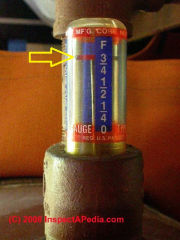
If your oil fired heating boiler, warm air furnace, or water heater has stopped working, one of the first things to check is whether or not you've run out of fuel. If your oil tank is above ground indoors or outside it should have a fuel level gauge installed similar to the one shown in our photo.
InspectAPedia tolerates no conflicts of interest. We have no relationship with advertisers, products, or services discussed at this website.
How Quickly Is My Heating System Using Up Oil in the Oil Storage Tank?
How long will a quarter of a tank of heating oil last?
The thermostat and the temperature in my house is always kept at 68 degF.
If my oil tank gauge reading is 1/4 of a tank, how long will that last???
We have no other heating source, ( I'm comfortable).
Betty
Reply: It Depends ..
We cannot answer accurately how long your quarter of a tank of heating oil will keep your home heated from just the information you provided, but we can list the facts you'd need to know and how you could estimate or find out the answer:
What Determines How Long a Tank of Oil Will Last?
How long a tank or part of a tank of heating oil will last at a building depends on the following variables:
- The size of the oil tank
and how much oil it contains at the time that you ask this question. You said that your oil tank gauge was at 1/4 full. If the oil tank were a perfect rectangle, that would mean that if your tank was a 500 gallon tank, you have 1/4 x 500 or 125 gallons of oil remaining.
But since oil tanks are often oval in cross section or round, the oil tank gauge is not precise, and it is giving the accurate reading of how much oil is in the tank only at 3 points: when the oil tank is full, half full, and empty. Details are
at OIL TANK GAUGES. - The setting of the room thermostat -
setting to a higher temperature makes a big increase in the rate at which heating oil will be consumed.
See THERMOSTATS. - The outdoor temperature -
colder outside temperatures increase the rate of heating oil consumption if other factors listed here remain unchanged. Because outdoor temperature varies widely during the day and season, oil companies use a better measurement, heating degree days (HDD), that describes the heating load that your heating system will have to meet.
Heating degree days or HDD are defined
using a base temperature at which it is assumed that no heat would be required, typically 65 degF. or 60 degF. For an accurate HDD measurement, the observer records the outdoor temperature minute by minute, or every half hour; but some computations simply use the average temperature for a given period.
The average outdoor temperature for a given period (one degree day) is subtracted from the base temperature (say 65 degF). If (65-Avg.Temp) = 0) then that was a "zero" degree day and no heat was required. If (65-Avg.Temp) is greater than zero, that number represents the number of heating degree days for that period. - Outdoor wind conditions -
wind significantly increases the rate of heat loss from a building, depending on building insulation and draftiness. Omitting wind consideration is a shortcoming of simplistic use of HDD or heating degree days to figure heating load. - Building insulation level - how well the building is insulated is a major factor in determining its rate of heat loss and thus its rate of heating fuel consumption.
See INSULATION INSPECTION & IMPROVEMENT. - Building air tightness -
a drafty building loses heat significantly faster than a tight building, even if the drafty building is "insulated".
See AIR LEAK DETECTION TOOLS
and AIR LEAK SEALING PROCEDURE. - Oil burner nozzle size
in GPH (gallons per hour) of oil delivery - oil burner nozzles deliver oil into the oil burner combustion chamber in a very fine spray to aid in combustion. Every oil fired heating appliance includes a data plate that includes the range of oil burner nozzle sizes or flow rates that will work properly for that appliance.
Typically residential heating oil burner nozzles deliver oil at rates from .65 gph for a small or highly efficient system to 2 gph for an older or larger capacity (in BTUs) heating appliance.
See OIL BURNER ELECTRODES.
More Details about selecting the proper oil burner nozzle are
at A TOTAL LOOK at OIL BURNER NOZZLES [PDF] provided courtesy of Delavan.
Oil fired heater BTU output estimating tip:
If there is no data tag on the furnace or you can't find the oil burner output BTUH you can guesstimate it as follows: Multiply the oil burner nozzle size (firing rate in gallons per hour) x 138,200 (Btus per gallon of No. 2 heating oil) x an efficiency estimate (use .75 for older furnaces and .80 for newer furnaces if you don't have a recent efficiency measurement). - Oil burner fuel unit pumping pressure:
oil burner nozzle sizes assume that oil is being delivered to the nozzle at a particular pressure, say 100 psi or 125 psi. If your heating oil technician has changed the oil delivery pressure then the oil delivery rate of the nozzle will also be changed accordingly.
Oil burner nozzle companies such as Delavan and others provide charts of oil burner nozzle patterns and size recommendations for different oil burner models and pressure rates.
For example, according to Delavan's "Fuel Nozzles for Oil Burners", the following simple equation and example relates oil flow rate and oil burner fuel unit pumping pressure when a 1.00 GPH oil burner nozzle calibrated for 100 psi is used at 125 psi of oil delivery:
F125 = 100 * (125/100).5 = 1.12 GPH - Oil burner efficiency and state of tune -
the efficiency of your heating equipment can vary widely by design, from say 65% efficient for an old antiquated out of tune oil burner, to better than 95 % efficient for a high efficiency heating system that is properly tuned. Just cleaning and tuning the heating system alone makes a huge difference.
When we were in that business we found that we could improve an old oil burner's efficiency rating from a start of 68% up to 78% or better by cleaning and careful tuning and oil nozzle selection. That's 10 absolute percentage points, or a 14.7% improvement in heating efficiency.
See OIL BURNER INSPECTION & REPAIR.
Heating system efficiency numbers
can be defined as the portion of each dollar that you spend on heat actually delivers heat into the building as opposed to sending it up the chimney or flue.
A heating system that is 85% efficient means that for every dollar that you spend on heating fuel, 85 cents of that dollar sends heat into the building and 15 cents of that dollar goes up the chimney as waste. - Oil burner cycling rate -
it's a bit more subtle, but most heating systems take a few minutes after start-up to reach peak operating efficiency.
So if your heating oil burner is turning on and off rapidly (short cycling) you are wasting energy and the controls may not be set properly. - Other building heating energy efficiency factors -
see ENERGY SAVINGS in BUILDINGS
How to Make a Rough Guess at How Long the Oil Tank Will Last
You can make a very rough guess by noting how many minutes per hour or day your oil burner is running. Oil burners use a spray nozzle that delivers oil at some flow rate in gallons per hour, typically on a home, around .8 to 1.7 gallons per hour.
On your boiler or furnace will be a data tag that gives the maximum recommended flow rate in gallons per hour. With the gallons per hour (GPH) and minutes of run time you are observing you can multiply GPH x (minutes of on time per day / 60 minutes per hour) = number of gallons of oil being consumed a day.
Of course this varies widely as weather and temperatures and house leaks vary, as we outlined just above.
So if you know your oil tank size (say 500 gallons) you can make a very rough guess at how much oil is in the oil tank - say 125 gallons. I'd round down to 100 to be on the safe side since the tank is probably round or oval.
See OIL TANK SIZES & VOLUMES for help determining the capacity, size or volume of an oil tank in gallons or liters.
Example of Calculation of Days Supply of Heating Oil Remaining in an Oil Storage Tank
G = Gallons of oil remaining the tank
GPH = oil consumption rate when the oil burner is running, in gallons per hour - the largest number on your oil heater's data plate, or the actual GPH number for the oil burner nozzle actually installed on your oil burner (usually this is smaller than the data tag maximum)
MPH = minutes per hour that your oil burner is running, averaged over 24 hours per day, from observation
GPD = (GPH x MPH / 60) = gallons of heating oil used per day
Here is an example using some sample numbers: 100 gallons of oil in the oil tank and a 1 GPM oil burner nozzle.
G=100 gallons of heating oil in the tank
GPH = oil burner nozzle deliver rate in gallons per hour (from data tag on oil heater or number stamped on oil burner nozzle)
MPH = 15 minutes per hour that the oil burner is actually firing (from observation)
15 (minutes of "burner on time" per hour) x 24 (hours in a day) = 360 minutes of burner on time per day
GPD = 1 (GPH) x (360 (burner on time per day) / 60 (minutes per hour)) = 6 gallons of oil used per day.
100 G (gallons of oil in the tank) / 6 (gallons of oil used per day) = 16.6 days of heating oil supply remaining
Thanks to reader Cass for careful technical editing 3/23/2014 - Ed.
Watch out: calculating the number of days of heat that oil in your tank can provide is very rough, since outdoor temperatures, wind, and other conditions keep changing. Your oil company knows this and uses a more sophisticated approach using degree days - a factor that considers not only your oil burner's usage rate but how that rate will vary as a function of changes in outdoor temperature.
Bottom line: if your oil tank shows 1/4 full or less and it's during the heating season, you ought to call your oil company and ask for a delivery soon.
In an emergency
if you are out or almost out of heating oil and your oil company can't make a delivery soon enough, the oil company can send a technician who can bring a 5-gallon container of oil to pour into your heating oil tank, or you can yourself purchase diesel fuel (in an emergency only) at a gas station and use that.
If you run out of heating oil,
re-starting the oil burner may require a service call from your heating company as it may be necessary to bleed air out of the oil piping in order to properly re-start the oil burner.
Watch Out: if you are purchasing fuel to use in your heating oil tank, be sure it's heating oil or in an emergency, diesel fuel or kerosene. If you put other flammables into your heating oil tank you are likely to blow up the building and kill everyone.
Your Oil Company Knows How Long Your Oil Tank Will Last
If you are on automatic oil delivery the question of how long the oil tank will last is easier to answer - your oil company will have computerized data showing your home's oil consumption rate as a function of "degree days" - a rough measure of how many hours at what outdoor temperature your home is being exposed to winter weather.
They can tell you your home's energy consumption rate more accurately.
How Much Oil is in the Oil Tank (if no gauge is installed)?
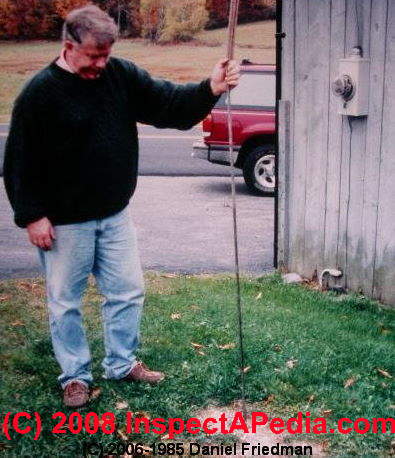 Your oil company can provide a stick, a folding rule, or even a string and weight that can be placed into an oil tank to locate the bottom of the tank and to determine the level of oil in the tank.
The depth of the oil in the tank is measured by marking the top of the tank on the stick or oil tank gauge, then placing the stick into the oil tank and withdrawing it. The oil level seen on the stick is compared with the distance from bottom of the stick (bottom of the oil tank) to top of the oil tank (which we marked on the stick).
In the old days people kept an oil tank stick that was already marked and calibrated to tell them how much oil was in their tank.
Today if we use a folding measuring rule or a generic "stick" to "stick the oil tank" to check oil level, we need to know the volume and shape of the tank as well as the depth of oil on the stick in order to calculate the number of gallons in the oil tank accurately.
In the photo our client is discovering a surprise buried oil tank at a farm we were inspecting.
See OIL TANK SIZES & VOLUMES for help figuring out the size of your oil tank.
Vapourising oil heating equipment
Wyn Parkin said:
I note that there is no mention on the site about vapourising oil boilers such as the Harmony range from Efel or Nestor Martin
Reply: free-standing space heaters that use a vapourising oil burner
Thanks Wyk, I'm working on that interesting addition.
It's worth noting that the heaters you cite are typically free-standing auxiliary heating sources. They are not central heating boilers nor central heating furnaces. They're more like an alternative to a wood or coal stove. However there are indeed (by other brands and applications) vaporizing oil burners and boilers used including in some commercial applications. Here we will address the type of heaters you cited:
Euroheat (a UK energy company) provides information about the Harmony Range and Efel, describing them as wood-burning / multi fuel stoves.
Eireheat [dot] com provides a nice description of vaporizing heaters from Nestor Martin (Belgium) heaters. We excerpt:
Nestor Martin stoves are equipped with a high-effi ciency stainless steel vaporizing burner to ensure clean, thorough combustion. The burner is fed a monitored fl ow of oil into the bottom of its cylindrical body, where the oil is heated and becomes vaporized.
As the vapor rises, it draws into the burner the air necessary for combustion through critically positioned and sized inlets.
The flame is stabilized and the combustion process maintained at the correct temperature by the catalyser.
The heat output of the burner is controlled by a carburetor which is manually controlled, giving you total command of the flame height at all times.
- Thermic Distribution Europe 5 Voie Axiale 5660 Couvin Belgium www.nestormartin.com
If you have other citations I'd appreciate receiving them (you can use our email found at our CONTACT link)
and we'll be glad to expand on the topic.
(Oct 17, 2014) Wyn Parkin said: Harmony range & Efel (Nestor Martin) heaters
Thanks for your answers, however, a few of the harmony range are fitted with 2-part boilers that form an L shape inside the unit. One supplies the domestic hot water and the other goes to the home heating.
I note that some of the oil fired boilers mentioned, eat up the fuel in Gallons Per Hour, whereas the Harmony 2 with its 10 inch burner (also supplied in 8 inch size)(and 6 inch for other models) on its lowest setting uses approximately 5 cc of fuel per minute (300cc per hour) of kerosene fuel.
The boiler is virtually silent in operation as it has no moving parts, and we have found that it is more than adequate for our 3 bedroom detached house, used mainly on setting no 2 out of 6.
Unfortunately, I have recently found (while searching for a spare part) that Efel (Nestor Martin) have gone into liquidation following a massive fire at their foundry in one of the Scandinavian countries.
Most parts are still available but the part I needed was a new coals bed (artificial coals that glow) was not available for my model, but I succeeded in replacing it with a coals bed from a Harworth Heating, Bubble 2 boiler. Looks almost the same!
...
Continue reading at HEATING COST SAVINGS METHODS or select a topic from the closely-related articles below, or see the complete ARTICLE INDEX.
Or see HEATING OIL USAGE RATE FAQs - questions & answers about how long an oil tank will last, posted originally at this page
Or see these
Recommended Articles
Suggested citation for this web page
HEATING OIL USAGE RATE at InspectApedia.com - online encyclopedia of building & environmental inspection, testing, diagnosis, repair, & problem prevention advice.
Or see this
INDEX to RELATED ARTICLES: ARTICLE INDEX to HEATING OIL, OIL BURNERS, OIL FIRED HEATERS, OIL TANKS
Or use the SEARCH BOX found below to Ask a Question or Search InspectApedia
Ask a Question or Search InspectApedia
Try the search box just below, or if you prefer, post a question or comment in the Comments box below and we will respond promptly.
Search the InspectApedia website
Note: appearance of your Comment below may be delayed: if your comment contains an image, photograph, web link, or text that looks to the software as if it might be a web link, your posting will appear after it has been approved by a moderator. Apologies for the delay.
Only one image can be added per comment but you can post as many comments, and therefore images, as you like.
You will not receive a notification when a response to your question has been posted.
Please bookmark this page to make it easy for you to check back for our response.
Our Comment Box is provided by Countable Web Productions countable.ca
Citations & References
In addition to any citations in the article above, a full list is available on request.
- Scully Signal Company, 70 Industrial Way, Wilmington MA 01887-0588 USA, Tel: 617-729-7510 / 800-272-8559, Email: sales@scully.com Web: scully.com
- A Total Look at Oil Burner Nozzles, available from Delavan Fuel Metering Products, a reference guide for oil burner service technicians, Delavan Spray Technologies, Fuel Metering Products Division, PO Box 969, Bamberg SC 29003, Tel: 800-982-6943 or 803-245-4347, ( Delavan is a division of BF Goodrich); web search 12/30/2010, original source: http://www.delavaninc.com/pdf/total_look.pdf
Note & disclosure: when we (DF) were servicing oil burner equipment, Delavan nozzles gave us such excellent results, especially using hollow cone spray patterns in solving combustion problems, that this brand was our standard stock-item on our truck. Other brands of oil burner nozzles are of course also of excellent quality. It is the proper matching of nozzle size and type and spray pattern to the equipment that is critical. - Fuel Nozzles for Oil Burners, Technical Aspects of Applications, E. O. Olson, Chief Engineer (deceased)
Delavan Fuel Metering Products Operation, Bamberg, South Carolina, Delavan Fuel Metering Products, a reference guide for oil burner service technicians, Delavan Spray Technologies, Fuel Metering Products Division, PO Box 969, Bamberg SC 29003, Tel: 800-982-6943 or 803-245-4347, ( Delavan is a division of BF Goodrich); web search 12/30/2010, original source: http://www.delavaninc.com/pdf/Fuel_Nozzles_for_Burners.PDF - Our recommended books about building & mechanical systems design, inspection, problem diagnosis, and repair, and about indoor environment and IAQ testing, diagnosis, and cleanup are at the InspectAPedia Bookstore. Also see our Book Reviews - InspectAPedia.
- In addition to citations & references found in this article, see the research citations given at the end of the related articles found at our suggested
CONTINUE READING or RECOMMENDED ARTICLES.
- Carson, Dunlop & Associates Ltd., 120 Carlton Street Suite 407, Toronto ON M5A 4K2. Tel: (416) 964-9415 1-800-268-7070 Email: info@carsondunlop.com. Alan Carson is a past president of ASHI, the American Society of Home Inspectors.
Thanks to Alan Carson and Bob Dunlop, for permission for InspectAPedia to use text excerpts from The HOME REFERENCE BOOK - the Encyclopedia of Homes and to use illustrations from The ILLUSTRATED HOME .
Carson Dunlop Associates provides extensive home inspection education and report writing material. In gratitude we provide links to tsome Carson Dunlop Associates products and services.
 | HOME | ABOUT | ASK a QUESTION | CONTACT | CONTENT USE POLICY | DESCRIPTION | POLICIES | PRIVACY | |
| © 2024 - 1985 Publisher InspectApedia.com - Daniel Friedman | |||||||||