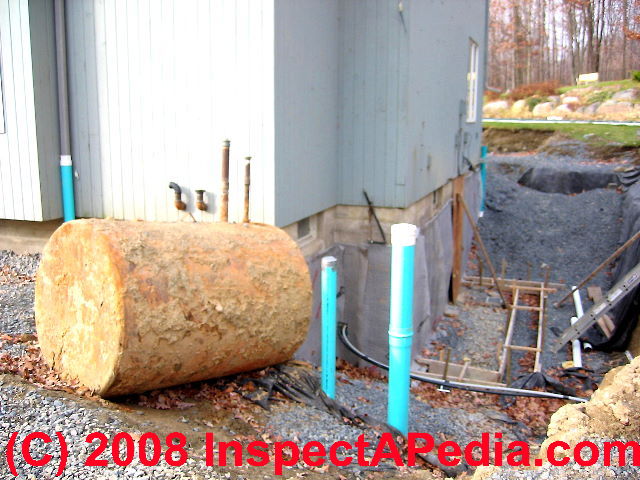
 Tips for Handling Old Residential Heating Oil
- POST a QUESTION or COMMENT about handling, using, or disposing of old heating oil or fuel oil
Shelf life of home heating oil:
No. 2 Home Heating Oil Shelf Life. This document explains the shelf life or storage life of home heating oil (No. 2 home heating oil) and discusses what can and should be done with old heating oil found in unused or abandoned oil storage tanks.
InspectAPedia tolerates no conflicts of interest. We have no relationship with advertisers, products, or services discussed at this website.
- Daniel Friedman, Publisher/Editor/Author - See WHO ARE WE?
What is the Shelf Life or Storage Life of Home Heating Oil?
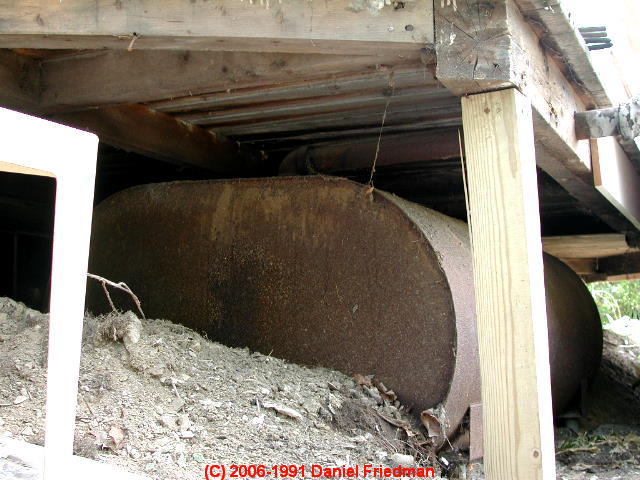 Proper oil storage tank abandonment requires the use of good
engineering practices, including consideration of the future condition of the tank.
Proper oil storage tank abandonment requires the use of good
engineering practices, including consideration of the future condition of the tank.
While the original of this article focused on commercial oil storage tanks, the concerns and steps should be examined by those abandoning residential oil tanks as well.
Diesel fuel, which is basically the same as No. 2 heating oil, is said by sources we've read to have a shelf life of 18-24 months without any fuel additives having been put into the tank. (Diesel fuel is basically No. 2 heating oil PLUS some fuel additives for winter use in vehicle engines).
Additives to diesel fuel are intended to be added when the fuel is put into the tank, not years later, and they claim to preserve the fuel's octane and combustion characteristics.
How can we extend the storage life of heating oil in a tank?
IF someone had put the proper additives into the tank of home heating oil when the fuel was delivered, it could have been reliably stored and then used up to two years later. Contact your heating oil delivery company to ask their recommended products for adding to and protecting the life of heating oil.
Can a heating oil additive "restore" old heating oil and make it good to burn in our oil burner?
Can an oil additive rejuvenate old stored heating oil? It's unlikely but we'd need to ask the chemical engineers who make those products. We speculate that products intended to be added to Diesel or perhaps to heating oil are intended to be added as preservatives at the time of delivery of the oil and that they are not designed to restore or rejuvenate old heating oil.
We have found no indication that adding a diesel fuel additive, or a heating fuel additive such as 4-in-one hot™ (sludge breakup and water remover) to heating oil will "restore" the original properties of oil that has been stored for a decade.
Remember that what was in the ground for a million years was not No 2 heating oil, it was a gooey ugly sludge crud that was then refined or cooked and purified at the oil refinery.
Why does heating oil deteriorate while in storage?
What might contribute to heating oil breakdown in an oil tank?
- bacterial action that is natural and happens in all heating oil tanks
- contamination by water, acids that form in the tank
- contamination by sludge, rust, crud that form in the tank
- contamination by someone dumping unwanted chemicals of any sort into an old heating oil tank that they knew was unused - old dirty motor oil, paint, thinner, or just about anything. We have had occasional surprising reports of weird stuff people dump down wells and into tanks because they didn't know what to do with it and were afraid to call their local DEP or the EPA (as they should).
What Can we Do with Old Unused Heating Oil
Used oils (not recovered "virgin oil") can be re-refined and used for various purposes according to the US EPA but we are doubtful that the volume of old virgin oil in a typical residential heating tank is enough to interest most large recyclers. Your heating oil company can remove and dispose of your unused heating oil, as we recommend just below.
Concluding Advice for People who Find Unused Oil in an Old Oil Storage Tank
Oil burners are tolerant of a range of oil quality, and it's possible that old heating oil would "work" in such a unit, but given the uncertainties and information we listed above, we would not risk a heat outage or an extra no-heat service call to make use of a couple of hundred gallons of heating oil. You are getting $600. or so of "free" home heating oil but you are risking $250. to $400. for a no-heat call, or a still greater expense if loss of heat leads to frozen, burst pipes in a building.
The owner of the old heating oil should call local heating oil companies to ask if they'll pump out the oil - be honest with them that it's old (give the date of last oil delivery if it is known) - lest the oil be distributed it to someone and cause a heating problem.
Removing the heating old oil avoids a future oil leak or environmental issue at the property - a potentially costly problem. It is improper to leave an abandoned oil storage tank with oil inside - the oil should have been removed and still should be removed now at this later point
Be SURE that the tank filler and vent are totally removed lest you get an unwanted oil delivery. Don't laugh, it happens.
...
Reader Comments, Questions & Answers About The Article Above
Below you will find questions and answers previously posted on this page at its page bottom reader comment box.
Reader Q&A - also see RECOMMENDED ARTICLES & FAQs
Is old fuel causing our soot problem?
We just purchased a house that had a full fuel tank and no idea on the age of fuel oil. After running old furnace for short time, it developed a soot problem. and repair man recommended we install new furnace which we did. Surprise after a couple of weeks the soot came back the repair man ran out of ideas. Our question is could the oil be bad. Thank you. 2026-01-10 by Larry
Mod reply:
@Larry,
Above in this article we quote from authorities who say "Diesel fuel, which is basically the same as No. 2 heating oil, is said by sources we've read to have a shelf life of 18-24 months without any fuel additives having been put into the tank. "
But certainly I've seen older fuel used successfully.
Based on my experience with oil heat system troubleshooting, the more likely problem is that there are contaminants that have accumulated in the (your) "old" oil storage tank.
When I serviced a system with this problem, even before working on cleaning and tuning the oil burner (and changing the filter screen and nozzle on the burner and its fuel unit), I'd open the oil filter canister that is just ahead of the oil burner and inspect both the filter cartridge (which I'd replace) and also the interior of the filter canister body.
If in the oil filter you see rust or water, there's a water problem in the oil tank (remove the water from the tank and use a suitable oil tank additive).
If there is no water but lots of sludge and crud, I'll bet a six-pack of Castle Danger zero beer that there is sludge accumulated in the oil tank and quite possibly the oil line(s) feeding your oil burner are coming off of the bottom of the tank.
Sometimes an oil delivery can stir up the crud (or water) in an old oil tank so much that those contaminants are sucked into the oil line (clogging it?) or into the filter (clogging it?) or into the fuel unit clogging its screen and fouling the nozzle. Fouling the oil burner nozzle is most likely how the soot problem you describe shows up.
So if changing the nozzle (and oil filter and fuel unit screen) get the burner going again, the problem is going to recur.
Where I've faced this problem we changed a 1-line oil feed line between tank and burner, moving it from the tank bottom to the tank top (a drop tube has to be included to draw oil out of the tank and the bottom of that tube has to stop above the bottom 1/4 of the tank to avoid sludge). In that configuration you usually have to change from a 1 line to a 2-line oil piping system - not a big deal if your oil heat service tech is actually trained. It requires closing an internal bypass plug in the fuel unit and adding the return line to the oil tank. (We have to go to a 2-line system because oil burner fuel units don't have much "lift" capacity and so can't as easily draw oil from the top of an oil tank as from its bottom.
The more costly "fix" is to have the old oil tank removed and replaced with a new clean one. IF inspection suggests that your oil tank has inches or more of sludge in the tank bottom, this is the best and most effective, reliable, and long-lasting fix. Where we've done this, accompanied by normal annual oil burner service (cleaning and adjusting, etc) the soot and oil burner problems were permanently solved.
SO:
- is your oil burner set up a 1-line piping system between tank and burner?
- has your tech inspected the items I mention?
- have you tried using an oil tank additive that can both disperse water and soften sludge?
Recommended reading:
EMERGENCY MEASURES for OIL TANK SLUDGE
OIL TANK SLUDGE
OIL TANK TREATMENTS, ADDITIVES
OIL TANK REPLACE due to SLUDGE?
Keep me posted
Daniel Friedman
Can fuel oil get too old to burn?
Can fuel oil get too old to burn? 2021-07-01 by Rob
Reply by Anonymous:
@Rob,
I'm no expert but I can tell you I have about 200 gallons of 9 year old #2 heating oil I have been using to run my diesel generator with no problems. It smells fine and there is no smoke in the exhaust.Moderator reply: Yes, fuel oil CAN get too old to burn
@Anonymous,
Fuel oil CAN get too old to burn if it has become thickened, or sludge or water contaminated. That old heating oil (No. 2 heating oil fuel) can still be burned in some types of equipment designed to handle waste oil or dirty oil, but it should no be used at a typical residential heating oil burner where there is a risk of clogged oil burner nozzle or oil filter, leading in turn to loss of heat that in turn risks frozen or burst water or drain pipe damage.
Details are in the article above.
Properly stored fuel is still OK to use
I have some diesel that has been in 2 five gallon containers since March of this year, it has been outside but in a sealed proper diesel gas can, is it still ok to use? From what I am reading here it should be! 2020-10-05 by Selena
Reply:
@Selena,
Yes as long as it was not contaminated by water or debris
Can I resell the oil in the tank that was used?
I half filled my oil tank just before Christmas last year and two weeks later the boiler packed up.
I intend changing to a gas boiler. Can I resell the oil in the tank that was used? 2020-09-09 by Jackie
Mod reply: Maybe but maybe not
Jackie
Depending on where you live, SOME oil companies or oil tank removal companies will give you an allowance (against the cost of tank removal) for the oil, or you might find someone who will come to pump out the oil to transfer it to a usable tank elsewhere.
But nobody is going to remove all of the sludge and crud in your oil tank as part of the re-sale of oil. Rather, that tank cleanout will be part of the process (and cost) of removing the old oil tank.
See details at OIL TANK REPLACEMENT PROCEDURE
How can I get rid of old clean heating oil?
how can I get rid of old clean heating oil no one will take it. 2020-06-08 by bruce
Reply:
Bruce
If no local oil company or environmental company is willing to remove your old oil, contact your state or provincial DEP or DEC - department of environmental protection - for advice.
Question: How can I get rid of fuel oil that is still able to be used?
(Feb 12, 2013) Joe Kilian said:
I purchased an old abandoned homestead that had a galvanized 1000 gal. storage tank inside a small shed. The tank was filled 9 years ago and was still usable. I needed the tank emptied and removed so i used it in my diesel GMC truck and my home heater Toyo 30 and filled many of my friends truck as well! All worked fine except a little less performance in the trucks.
(Mar 1, 2015) Kristen F said:
I Just bought a home that has a newer above ground Oil System and is full, what can I do with it? donate? sell? Its new oil and should not just be discarded when there are people who cant afford replacing the tank let alone 1000.00 worth of oil. Need help!
Reply:
Kristen
Give your heating oil delivery company a call to ask about pumping out the oil tank and donating the oil to a worthy cause.
Question: What is the life of fuel oil?
(Apr 29, 2015) Dave Lsahti said:
What is the life of fuel oil?
I have some approx. 20 years old , can it be used in a diesel
Reply:
Dave
Was the article on heating oil shelf life found just above unclear? If so let me know where it was confusing and we'll be glad to clarify.
...
Continue reading at HEATING OIL - OLD, usable? where we discuss how to move or make use of old heating oil. or select a topic from the closely-related articles below, or see the complete ARTICLE INDEX.
Or see these
Recommended Articles
- HEATING OIL SLUDGE
- MANAGING USED OIL [PDF] uses for and handling of used lubricating oils (not heating oil) is discussed in US EPA publication
Suggested citation for this web page
HEATING OIL SHELF LIFE at InspectApedia.com - online encyclopedia of building & environmental inspection, testing, diagnosis, repair, & problem prevention advice.
Or see this
INDEX to RELATED ARTICLES: ARTICLE INDEX to HEATING OIL, OIL BURNERS, OIL FIRED HEATERS, OIL TANKS
Or use the SEARCH BOX found below to Ask a Question or Search InspectApedia
Ask a Question or Search InspectApedia
Share this article:Try the search box just below, or if you prefer, post a question or comment in the Comments box below and we will respond promptly.
Search the InspectApedia website
Note: appearance of your Comment below may be delayed: if your comment contains an image, photograph, web link, or text that looks to the software as if it might be a web link, your posting will appear after it has been approved by a moderator. Apologies for the delay.
Only one image can be added per comment but you can post as many comments, and therefore images, as you like.
You will not receive a notification when a response to your question has been posted.
Please bookmark this page to make it easy for you to check back for our response.
IF above you see "Comment Form is loading comments..." then COMMENT BOX - countable.ca / bawkbox.com IS NOT WORKING.
In any case you are welcome to send an email directly to us at InspectApedia.com at editor@inspectApedia.com
We'll reply to you directly. Please help us help you by noting, in your email, the URL of the InspectApedia page where you wanted to comment.
Citations & References
In addition to any citations in the article above, a full list is available on request.
- "How do you choose the right tank testing method?", Cynthia Johnson, Fuel Oil & Oil Heat Magazine, November 1995
- National Association of Oil Heat Service Managers, PO Box 380, Elmwood Park, NJ 07407
- "Homeowners Guide to Fuel Storage," Agway Energy Products, Verbank, NY, November 1990
- In addition to citations & references found in this article, see the research citations given at the end of the related articles found at our suggested
CONTINUE READING or RECOMMENDED ARTICLES.
- Carson, Dunlop & Associates Ltd., 120 Carlton Street Suite 407, Toronto ON M5A 4K2. Tel: (416) 964-9415 1-800-268-7070 Email: info@carsondunlop.com. Alan Carson is a past president of ASHI, the American Society of Home Inspectors.
Thanks to Alan Carson and Bob Dunlop, for permission for InspectAPedia to use text excerpts from The HOME REFERENCE BOOK - the Encyclopedia of Homes and to use illustrations from The ILLUSTRATED HOME .
Carson Dunlop Associates provides extensive home inspection education and report writing material. In gratitude we provide links to tsome Carson Dunlop Associates products and services.
 |
HOME | ABOUT | ASK a QUESTION | CONTACT | CONTENT USE POLICY | DESCRIPTION | POLICIES | PRIVACY | |
| © 2026 - 1985 Publisher InspectApedia.com - Daniel Friedman | |||||||||