
InspectAPedia® FREE Encyclopedia of Building & Environmental Construction, Diagnosis, Maintenance & Repair |
Question? Just ask us! InspectAPedia
|
 Building & Home Safety Hazards & Accident Prevention for Elderly or Disabled People
- POST a QUESTION or COMMENT about home safety hazards of particular concern to senior citizens, the elderly, and people with disabilities
Home safety & security checklist & tips including advice for elderly or disabled occupants:
This article explains safety & security checklist items for everyone and includes special home safety concerns for the elderly and for disabled people, offering suggestions for safety inspections and for obtaining financial aid to perform necessary home safety or home accessibility improvements.
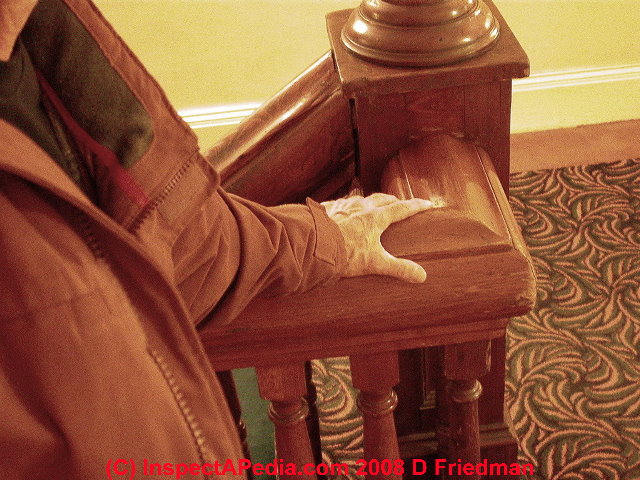
Our page top photo shows a too-fat hand railing that cannot be safely grasped.
InspectAPedia tolerates no conflicts of interest. We have no relationship with advertisers, products, or services discussed at this website.
- Daniel Friedman, Editor/Publisher - See WHO ARE WE?
Home Safety Checklist & Financial Aid for the Elderly and for Disabled Veterans
 Article Contents
The author's mother, at age 91, fell down carpeted stairs in her home in Boca Raton, Florida. Injuries from falls can be very serious, even fatal to more fragile elderly people.
At 2AM mom decided to carry an armload of clothes downstairs to her washing machine. Wearing open-heeled slippers with smooth soles, carrying an armload of laundry with both arms full, and stepping down stairs that were poorly designed with narrow treads and thick soft nosed carpeting, she lost a slipper and fell.
Mom's injuries included three broken ribs, an elbow so severely broken that an elbow replacement was required, and multiple lacerations to her head. After lying unconscious for some undetermined time Mom crawled to a telephone and asked a neighbor for help.
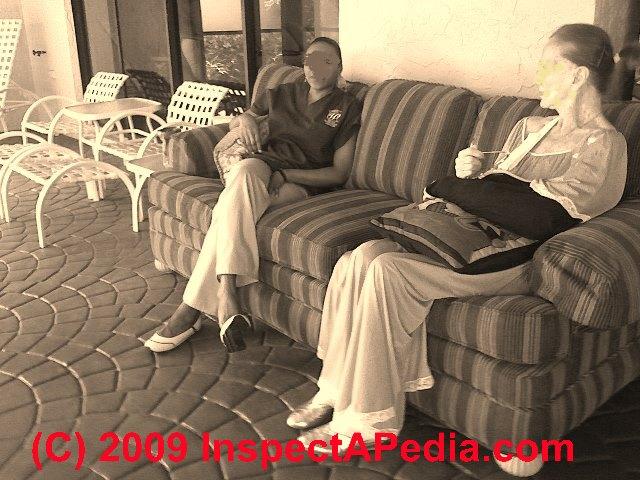
Major surgery, rehabilitation, round-the-clock nursing care, and a long, slow recovery were in store. (Photo above-left, modified for privacy, shows an elderly homeowner with her home health care aide after a stair fall injury).
The stairs and our long standing debate of their dangerous nature had been a recurrent debate between an independent-minded mother and son, to no avail. Obviously, being aware of their dangerous nature was not enough.
The author's neighbor, at age 85, made a wrong turn in an upstairs hallway after using the bathroom late at night. Dr. S. fell down stairs to a landing, narrowly-missing a fatal fall through a window located at the landing, and while he recovered, his injuries were so severe, both mental and physical, that he had difficulty walking and rarely left his home again until his death years later.
Falls like these are so severe that they can materially affect the length and quality of life for the elderly. Yet the hazards involved could be easily spotted by an experienced home inspector or home safety inspector.
Priority of Safety Concerns in Homes for the Elderly
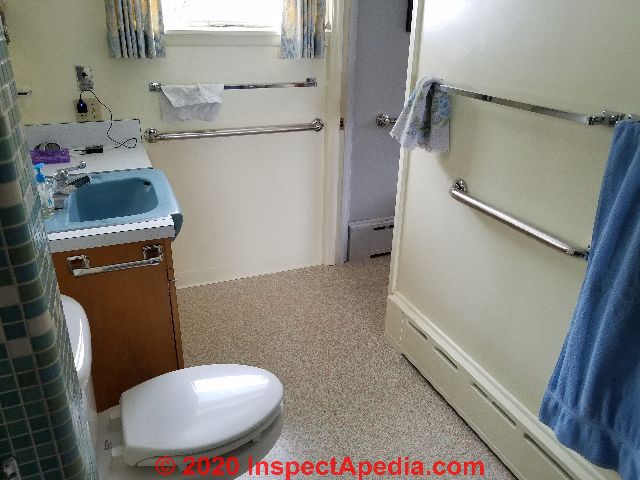 While every unsafe condition at a building should be corrected as soon as possible after it is discovered (see Safety Inspections below), below we list some of the highest priority safety concerns that should be checked.
This list is an OPINION based on field experience and literature review. CONTACT us to suggest changes or additions.
- Safe steps, stairs, handrailings, guardrailings & walkways.
Falls are perhaps the most common source of injury in the home, especially among the elderly. Missing, loose, or hard-to-grasp handrails, thick carpet on steps (use non-skid surfaces), uneven step riser heights, too-small stair tread depth or width, damaged stair tread nose, are examples of common problems.- GRABRAIL GRAB BAR SPECIFICATIONS - install ADA-compliant grab bars in appropriate locations to help occupants keep balance or arrest a fall.
- STAIR DESIGN for SENIORS - Stair design & safety recommendations for older adults or for people who have limited stair climbing ability.
- SLIP TRIP & FALL HAZARD LIST, STAIRS, FLOORS, WALKS - Photographs of all kinds of stair and step & walk defects illustrate a wide range of causes of falling down the stairs - stair trip and fall hazards and injury sources.
- SLIPS, TRIPS & FALLS, EXTERIOR STAIRS - Exterior Stair trip & fall hazard photographs & descriptions - a photo catalog of slip trip and fall hazards at outdoor steps and stairs. Dilapidated Stair Structures: rot, loose connections, pitched, wobbly, missing parts, collapse risk.
- See STAIRS, RAILINGS, LANDINGS, RAMPS for complete stair design information
- See TILED WALKING SURFACE SLIP HAZARDS
- Lighting, provided over stairs,
including properly located control switches at both stair top and stair bottom - Smoke detectors,
installed at proper locations, tested, working - CO - carbon monoxide detectors,
installed at proper locations, tested, working, especially where gas-fired appliances are installed - Safe means of egress in emergency
such as fire, including readily accessible exit stairs, doors, and exit doorway platform, stairs, railings.
For elderly or disabled people who are themselves mobile, safe egress must include doors that have handles that allow easy operation and that can actually be opened by the individual. - Scalding hazards:
set hot water temperatures to 120 DegF or lower.
See ANTI SCALD VALVE PROTECTION, Best Practices - Trip/fall hazards:
others, such as loose carpets, loose furniture that an individual may use for support, throw rugs, torn carpets, even small uneven surfaces or door thresholds, slippery surfaces, exposed extension cords. - Emergency contact numbers, posted in a visible location by telephones
Also see
- Home Safety Check-List, Harford County Government, Harford County Maryland, http://www.harfordcountymd.gov/services/aging/HomeSafety.html
- Housing Safety Checklist for Older People, Sara D. Kirby, Extension Housing Specialist, North Carolina Cooperative Extension Service, North Carolina A&T State University Cooperative Extension
Special Home Safety Inspections for the Elderly or Disabled
In a home safety article "Making Home a Safer Place, Affordably" by Lesley Alderman and appearing in the New York Times (July 2009), Alderman provided some excellent home safety inspection and home safety improvement financing suggestions that we summarize here:
- Occupational therapist:
hire an occupational therapist (an O.T.) to inspect and suggest modifications to the home to meet the specific needs of its elderly or disabled occupants. O.T.'s will consider safety and ease of movement concerns that are not addressed by a home inspector, such as height of chairs and sinks, and grasp-ability of handles. - AARP, the American Association of Retired People, assisted by the NAHB (National Association of Home Builders) provides a home safety checklist
- Building & Building System Inspecting, Testing, & Consultant Referral Directories:
- DIRECTORY OF ATTORNEYS & expert witnesses
- DIRECTORY OF ELECTRICIANS - Aluminum Wiring and DIRECTORY OF ELECTRICIANS - FPE Zinsco
- HOME INSPECTOR DIRECTORY
- MOLD & ENVIRONMENTAL INSPECTORS and MOLD CLEANUP COMPANIES
- DIRECTORY of OIL TANK TESTING COs and DIRECTORY of OIL TANK REMOVAL COs
- ROOFING MATERIALS TEST LABS
- SEPTIC CONSULTANTS, DESIGNERS, ENGINEERS and ALTERNATIVE DESIGN SEPTIC SYSTEM SUPPLIERS
- OTHER CONSULTANTS, PRODUCTS, SERVICES
- Building noise and sound complaints discusses the impact on the health and well being of the elderly and others who suffer from noise complaints.
See details
at HEALTH RELATED NOISE EFFECTS. - DIRECTORY of PROFESSIONALS to Inspect or Test a Building
- DISABLED or ELDERLY-USE TOILETS discusses
using chemical or composting toilets for elderly or disabled people for convenience (close access) or to avoid the effects of medication on septic tank bacteria.
Waterless toilets, low-water toilets, and other alternative toilet designs may solve practical problems in providing convenient, sanitary facilities for temporary or even longer term care of elderly, disabled, sick, or injured people. Special care needs to be taken to provide proper toilet height, grab rails, and maintenance. - The Home Safety Council (MySafeHome.net) provides a home safety checklist via visual tour
- Housing Safety Checklist for Older People, [PDF] Sara D. Kirby, Extension Housing Specialist, North Carolina Cooperative Extension Service, North Carolina A&T State University Cooperative Extension, 04/04 [Distributed in furtherance of the acts of Congress of May 8 and June 30, 1914.] Web Search 02/27/2011, original source: http://www.ces.ncsu.edu/depts/fcs/pdfs/FCS-461.pdf. This home safety checklist contains a longer list of items that should be examined and corrected as needed; it does not set priorites of attention. - Ed.
- Professional home inspectors [Directory] can provide an economical survey that addresses home safety and more broadly, a home inspector can identify and help prioritize repairs necessary to preserve the building as well as to keep it functioning safely.
These building professionals will consider indirect safety hazards and latent safety hazards affecting all building occupants and that are usually unfamiliar to other safety consultants who may not be building experts.
Examples include safe venting of heating appliances (carbon monoxide hazards),
unsafe electrical wiring (aluminum wiring, FPE and some other electrical panel brands such
as Zinsco, improper electrical wiring and shock hazards), unsanitary
or unsafe septic systems,
unsanitary drinking water, as well as
improperly designed steps, stairs, and rails (stair safety checklist).
Special Safety Improvement Financial Aid & Insurance Protection for the Elderly or Disabled
- Long-term care insurance:
the author's mom paid premiums for years for long term care insurance to help assure that she would be able to remain in her home should she become disabled.
But guarding her privacy and independence with fierce determination, Mom had made it extremely difficult for her children, coming to her aid after her fall and injury, to determine if she had kept such a policy in force much less what kinds of care it covered. - Durable power of attorney (DPOA): sometimes the elderly, particularly those living distant from close family, are victimized by local contractors who combine providing over-priced services (a Boca Raton electrician charged our Mom thousands of dollars for changing a few light bulbs).
Be sure that your elderly parent or disabled family member has designated a responsible family member or a reliable local attorney, one who has the client's best interest at heart, and one who will, if it is not a family member, will readily communicate with family members when their parent or other person requires assistance.
Our mom's attorney in Boca Raton, Florida, (Paul Roman, Esq.) to protect what amounted to a sinecure, kept his role as holder of her DPOA a secret from family members, making care arrangements for our mother particularly difficult when she was injured. - Guardianship services
may be needed to protect elderly or other individuals.
Consult your state health or elder care services departments for advice as guardianship laws and requirements vary by state or province. In some states trained, certified professional guardians may also be available.- California Guardianship Laws and Information - see
http://sandiegoestatecenter.com/california-probate
/what-is-a-guardianship-california-guardianships-in-san-diego-probate-court/ - Florida Guardianship Law and Information, 2007 - see http://www.flcourts18.org/PDF/gurardianship_rev1-07.pdf
- New York Guardianship Laws - see http://www.courts.state.ny.us/courthelp/forms.html
- National Guardianship Association, Inc., 174 Crestview Drive, Bellefonte, PA 16823, Tel: 877-326-5992, Fax: 814-355-2452 Email: info@guardianship.org - see http://www.guardianship.org/
- California Guardianship Laws and Information - see
- Sources of money: financial aid for home safety improvements:
- Department of the aging:
most communities have a local department of aging or elderly who can offer advice and possibly financial assistance for the elderly who need home safety improvements.
The department may function at a city, county, or state level. Check with your local building department or health department if you are having trouble finding an agency in your area, or try the federal government's elder care locator at www.eldercare.gov or call 1-800-677-1116. - Home equity loans, or a reverse mortgage
may be suitable for some elderly homeowners who need funds to make their home more safe or accessible. Check with the bank holding the present home mortgage as well as with other local banks. - Home repair charitable associations such as Christmas in April USA (community specific, for example
this Maryland association)
or Rebuilding Together (also sponsors a Christmas in April program) offer home repair services, sometimes at no cost to the homeowner. - Veterans Administration Benefits: financial aid for disabled veterans, can provide special equipment needed in the home for vets who qualify (1-877-222-8387). The VA also has
a home loans program as well as grants for home improvements and structural alterations needed by veterans.
- Department of the aging:
Safety & Emergency Monitoring Systems for the Elderly or Disabled - Aging in Place
BeClose Systems provides a definition of "Aging in Place" as follows: [Quoting]
What is Aging in place?
Aging in place is the ability to live in one's own home for as long as confidently and comfortably possible, without having to uproot oneself or move into some form of an assisted living facility. For many aging seniors, this can mean the difference between enjoying their lives in dignity on their own terms, and feeling forced to a lifestyle change that can be upsetting and disorienting.
Aging in place has grown in popularity in recent years and is celebrated by the National Aging in Place Week and the National Aging in Place Council, which promote the positive outcomes of seniors having a choice in their care and living arrangements.
Aging in place often requires that families of aging seniors install design adjustments that can ease movement throughout the home, or provide assistance to aging seniors living alone.
BeClose is one such technological innovation. Its unique system of discreet, easy-to-install, wireless sensors are placed throughout the home and communicate with a base station unit which, in turn, transmits the information from those sensors to a secure online center at BeClose.com.
Their caregivers can log on to monitor the activity and daily routines of their loved ones or choose to receive alerts to their email or mobile devices if irregular behavior patterns are detected.
This simple solution offers independence for seniors who are eager to remain in their homes, and peace of mind for caregivers who want to know about changes in the patterns of their loved ones, but are not living with them day in and out.
Monitoring Systems Support Aging-in-Place Programs for the Elderly
A wide variety of monitoring and safety notification systems for the elderly and disabled are offered to the public. And in August 2010 the New York Times reported on developing sensor and monitoring technologies that help children (or others) monitor aging parents (or others).
The Times article raised the important issue of privacy, quoting experts and suggesting that the decision for telemonitoring of anyone should be decided by the person being monitored, and should be negotiated as between co-equals. "If it’s not an agreement with the parent, it can be a very destructive thing."
For people who are comfortable being closely watched in their home, a family of sensors and telemonitoring devices, systems, and services can provide continuous and very detailed information such as indicators that the monitored person has:
- Arisen from bed
- Taken blood pressure, pulse, or other basic medical status indicators
- Opened and shut a medicine cabinet - presumably to take medications?
- Opened and shut a refrigerator - presumably to have eaten
- Opened or shut windows and doors
Examples of elder-monitoring services listed by the Times article (and others we have found) include the following:
Watch Out: we have not evaluated these services for cost, effectiveness, courtesy, privacy issues, nor other features.
- AARP American Association of Retired People, has advice about using elder monitoring systems and also provides a reprint of the NY Times article discussed here.
- Aware Home, research initiative, Georgia Tech University, experimental house instrumented with monitors. Web search 08/03/2010 original source: http://awarehome.imtc.gatech.edu/about-us
The Aware Home Research Initiative at Georgia Institute of Technology is devoted to the multidisciplinary exploration of emerging technologies and services based in the home.
Starting in 1998, our collection of faculty and students has created a unique research facility that allows us to simulate and evaluate user experiences with off-the-shelf and state-of-the-art technologies. With specific expertise in health, education, entertainment and usable security, we are able to apply our research to problems of significant social and economic impact. - BeClose all-wireless monitoring system, BeClose, 8150 Leesburg Pike, Suite 1401, Vienna, VA 22182,
Phone: 866-574-1784, Fax: 703-651-3090, Email: info@BeClose.com, Website: http://beclose.com/ . "All-wireless" means that the BeClose monitoring system can be installed without running wires through the home.
BeClose uses wireless sensors to gather information about what's going on in the home. Our sensors give you much more information than a video camera can - they tell you exactly when Mom got out of bed or Dad went out for his walk, and you can see the information in real time on a website wherever you are.
Then you can set up alerts to call or text you if something is out of the ordinary, so you can customize it exactly to fit your needs. - General Electric Co. - range of monitoring systems, sensors, General Electric Company, 3135 Easton Turnpike Fairfield CT 06828,Phone: +1 (203) 373-2211, Fax: +1 (203) 373-3131
GE website: http://www.ge.com/index.html
Quiet Care: Home Health Monitoring Fact Sheet from GE - Document (PDF), web-search 08/03/2010 original source:
http://www.genewscenter.com/Resource-Library/Home-Health-Monitoring-Fact-Sheet-7c0.aspx
Home health monitoring holds the potential to help seniors live independently longer and in better health, and to reduce the long-term costs of care.
Activity and behavioral monitoring, also known as telecare, uses wireless sensor-based systems and software to passively track the daily activity patterns of seniors, alerting care givers to potential problems, while at the same time maintaining privacy and enabling as great a degree of independence as possible. - GrandCare, GrandCare Systems LLC - 2412 West Washington - West Bend, WI 53095 (262)-338-6147. The GrandCare system allows families to place movement sensors throughout a house.
Example monitoring system installation and monitoring costs: $8,000. installation + $75./month.
Website: http://www.grandcare.com/ Quoting:
GrandCare Systems ... combine aspects of smart home technology, internet communications, and telewellness in one flexible, user friendly, and affordable package. The system consists of a central unit, which is very similar to a TiVo box, connected to a TV or monitor, and a source of internet, either wired or wireless. The system will then provide a continuous display of news, weather, pictures, email, reminders etc. to the loved one's TV.
At the same time, the unit listens to a wide range of wireless sensors, which monitor activities of daily living and wellness. The system can then be accessed via the internet by remote family or professional caregivers to assess the wellness and safety of the loved one.
The system can be instructed to send an email, text message, or phone call to the caregivers if something is amiss, say the temperature in the house falls below a certain level. The caregivers can also use the web interface to send pictures, email, reminders to the loved one's TV. - iReminder provides healthcare messaging and medication reminder support. iReminder.com, Westfield, N.J. 1-877-326-3293
Privacy note: iReminder’s Technology is HIPAA compliant. Quoting:
iReminder is a healthcare technology focused on improving medication adherence and persistence. Its products are: Compliance for Life™ for appointment and dosing reminders, Persistent RefillsSM for refill reminders, Global e-TrialsSM for patient recruitment and retention in clinical trials, and MedTriggerSM for virtual coaching.
All are patient-centric, personalized and flexible.
Reminders and messages are delivered by phone, email and/or SMS text, according to the patient's preferences, in the U.S. and internationally in any language and alphabet. Messages are recorded by native speakers and all written communications (email and SMS text) display in the patient’s preferred language. Patients do not need any special equipment to receive messages. - MedMinder medication management system, MedMinder, 716 Beacon St, Suite 590218, Newton, MA 02459,
Phone: 1-888-MED-MIND (1-888-633-6463), Fax: 1-888-647-8595, Email: info@medminder.com, Website: https://www.medminder.com
MedMinder provides patient reminders to take medication, remote monitoring, and medication refill support. Quoting:
Maya is equipped with wireless technology that updates MedMinder's central computer about the patient's dosage activity. This information is available, over the web, for caregivers who can also receive immediate email or text messages notifications and weekly reports.
You or your caregiver can easily program Maya and customize preferences remotely via the Internet. You can also call MedMinder and we will do this for you. At the patient's home, there is no need for a computer, phone line, wireless router or any other form of Internet access. - QuietCare sensor monitoring systems track ADL (activities of daily living, such as getting out of bed, safe navigation of the bathroom, eating, taking medications, overall activity, sleep quality. Also see General Electric. Tel: 866-216-4600, email: contact@quietcaresystems.com. Website: https://www.quietcaresystems.com or Website for the UK: http://www.quietcaresystems.co.uk/index_alt.htm
Quoting:
QuietCare functions as a 24 hour-a-day, seven-day-a-week early detection and early warning system that lets caregivers and family members know that a loved one is safe. It recognizes emerging problems before they become emergencies.
The system utilizes small, unobtrusive, strategically-placed wireless sensors to monitor the senior in their own home. It is virtually invisible. No video camera or audio intrudes on the seniors' lives.
Small, wireless motion sensors are strategically placed in key areas, including the senior's bedroom, kitchen, bathroom, and meal prep and/or medication areas. Each sensor transmits information 24 hours a day, 7 days a week about the senior's daily living activities to a book-sized base station.
The base station gathers this information and regularly transmits it to QuietCare's computers, using existing telephone lines. Changes in the senior's activities are analyzed so caregivers can be alerted to problems by call center professionals, or via e-mail, cell phone, text message or pager, or by checking a password-protected web site - Selfhelp Selfhelp Community Services, Inc., 520 Eighth Avenue, New York, NY 10018, 866.735.1234, Website: http://www.selfhelp.net/
SelfHelp is a social services company helps seniors use technology to live independently. Selfhelp provides on-site social services (New York) and senior centers. Quoting:
Our progressive social services, innovative aging-in-place solutions and cutting edge client centered technologies ensure that you will be independent, safe and secure. Senior Source, our comprehensive and personal private care management program, gives you access to the full range of Selfhelp’s services. Senior Source can enable you to manage your immediate senior care needs and plan for your future today.
Thanks to Senior Source, you’ll have a Care Concierge offering you access to outstanding services and affordable solutions for your later years. Selfhelp’s commitment to secure independent living for seniors is evident in our six, award-winning housing complexes serving more than 1,000 low and moderate-income seniors.
Our six senior centers provide programs that enrich the lives of over 6,000 older New Yorkers and our four Naturally Occurring Retirement Communities (NORCs) offer residents extensive on-site care services.
Costs:
Some of our services are free, some are covered by insurance, Medicaid or Medicare, some require for a small contribution and some are paid privately by the client. In all cases, our professional and caring staff members work with you to navigate the complex and often daunting maze of governmental, legal and financial regulations surrounding benefits and entitlements.
Our goal is to ensure that you receive the services you need and the benefits to which you are entitled.
Watch out: the same Times article reports that even where intensive monitoring systems are installed, people rarely check in on the monitoring indicators' status more than once a day. OPINION-DF: systems that are able to detect that something is wrong and initiate an emergency notification to close-by responders may be valuable.
Security Checklist for Apartments & Homes
The following security checklist, adapted from information provided by Snyder & Wenner, P.C., a Phoenix medical malpractice & pesonal injury law firm cited below. This list can be used to improve apartment or home security.
Watch out: this security checklist is incomplete. Other hazards or security risks are occupant, building or site specific. We would appreciate hearing suggestions for corrections and additions to this data. CONTACT US
Apartment & Home Security Checklist |
|||
|
Security Item / Topic Area |
Yes | No | Comments |
Building Security |
|||
| Common Areas such as mailroom and laundry room are well-lighted and monitored with video surveillance |
|||
| Security cameras & monitoring system: there is a monitoring system for who enters and leaves the property. | |||
| Security camera displays are monitored live | |||
| Security monitoring system records for 24 hours or longer; recordings are archived; | |||
Keys: Landlord or building manager tightly controls all keys |
|||
| Security Patrol: 24-hour security patrolling the property | |||
| Security randomizes their patrol times | |||
| Tenants: The property has a written policy on evicting tenants who engage in criminal activity |
|||
| Walkways, parking areas, hallways, stairwells, and elevators are properly and sufficiently lighted, 24 hours a day |
LIGHTING OVER STAIRS & AT EXITS | ||
Building Doors & Windows: Security Measures |
|||
| Front door has at least two locks | |||
| Front door has deadbolt lock | |||
| Front door includes a wide-angle peephole that has clear visualization of outside |
|||
| Doors are solid hardwood or metal-clad | |||
| Door glass is reinforced to prevent shattering (safety glass) | |||
| Door alarms are properly connected and working for all exterior doors | |||
| Emergency personnel can enter all building areas if needed, have access to keys, codes &c. | |||
| Sliding glass door locks not easily forced by pulling on the door with force nor by lifting doors off tracks | |||
| Sliding glass door has a rod in the track or a dropping deadbolt so it cannot be opened, and has pins in the overhead frame so it cannot be lifted out |
|||
| Windows at ground level or easily accessible on any level include working lock mechanism | |||
| Window alarms are connected and working | |||
| Any windows near a door are far enough away to prevent an intruder from breaking the glass and reaching in to open door |
|||
Site Security (Outdoors) |
|||
| Security cameras are properly installed to maintain sufficient visualization of entire property at all times |
|||
| Bushes, shrubs, and trees are properly trimmed and maintained to prevent a criminal from hiding |
|||
| All outdoor areas are sufficiently lit with proper lighting equipment | |||
| Parking areas are close enough to residence to avoid long walks at night | |||
| Bright lights properly installed outside each apartment so visitors can be easily and clearly seen |
|||
| Emergency kiosks are in proper working order | |||
| Sheds, storage units, and garage doors are all locked with high security padlocks |
|||
Building Interior Safety |
|||
OPINION: Fundamental building safety for occupants should begin by being sure that the most common and most serious hazards have been addressed. For example slip and fall hazards, loose steps, improper railings or guardrails, or missing / non-functional smoke detectors, carbon monoxide detectors are first priority safety features that should be attended in any home or building. Addressing other serious hazards found at suburban and rural properties such as unsafe septic tank or cesspool covers are equally urgent. |
SAFETY HAZARDS GUIDE - home SAFETY: Elderly & Veterans Home Safety |
||
| Stair & Railing Safety inspections are completed regularly and reports retained | |||
| Electrical & Mechanical Systems safety inspections are completed regularly and reports retained | |||
Notes to the table above
Adapted and expanded from "Apartment Safety Checklist", Snyder & Wenner, P.C., Snyder & Wenner, P.C. 2200 East Camelback Road, Suite 213 Phoenix, AZ 85016 USA, Tel: 602224-0005, The company is a medical malpractice & personal injury law firm in Phoenix, AZ, USA, retrieved 2 April 2015, original source: http://www.snyderwenner.com/wp-content/uploads/2014/07/Safety-Checklist.pdf
...
Continue reading at BALANCING SAFETY vs DESIRES for the elderly or disabled, or select a topic from the closely-related articles below, or see the complete ARTICLE INDEX.
Or see these
Recommended Articles
- ACCESSIBLE DESIGN
- ANTI SCALD VALVE PROTECTION, Best Practices
- BALANCING SAFETY vs DESIRES
- BATHROOM DESIGN, ACCESSIBLE
- GRABRAIL GRAB BAR SPECIFICATIONS
- HOARDING HAZARDS
- KITCHEN DESIGN, ACCESSIBLE
- NEST CAM INSTALLATION & USE - respectful use of a Nest cam® or Dropcam® or similar home security system may be helpful in some senior residences.
- RAMPS, ACCESS - home
- STAIR DESIGN for SENIORS
- STAIR FALL & TRIP HAZARDS
- STAIRWAY CHAIR LIFTS
- TILED WALKING SURFACE SLIP HAZARDS
Suggested citation for this web page
ELDERLY & VETERANS HOME SAFETY at InspectApedia.com - online encyclopedia of building & environmental inspection, testing, diagnosis, repair, & problem prevention advice.
Or see this
INDEX to RELATED ARTICLES: ARTICLE INDEX to BUILDING SAFETY
Or use the SEARCH BOX found below to Ask a Question or Search InspectApedia
Ask a Question or Search InspectApedia
Questions & answers or comments about home safety hazards of particular concern to senior citizens, the elderly, and people with disabilities.
Try the search box just below, or if you prefer, post a question or comment in the Comments box below and we will respond promptly.
Search the InspectApedia website
Note: appearance of your Comment below may be delayed: if your comment contains an image, photograph, web link, or text that looks to the software as if it might be a web link, your posting will appear after it has been approved by a moderator. Apologies for the delay.
Only one image can be added per comment but you can post as many comments, and therefore images, as you like.
You will not receive a notification when a response to your question has been posted.
Please bookmark this page to make it easy for you to check back for our response.
Our Comment Box is provided by Countable Web Productions countable.ca
Citations & References
In addition to any citations in the article above, a full list is available on request.
- Dan Haydon, is a professional home inspector in Phoenix AZ. Mr. Haydon can be reached at nahidan@msn.com 9 July 2009
- "Making Home a Safer Place, Affordably," Lesley Alderman, New York Times, 18 July 2009 - B-1/B-6
- "Technologies Help Adult Children Monitor Aging Parents," Hilary Stout, Hilary Stout, New York Times, July 28, 2010, The New York Times, online edition web search: 1 August 2010 . This article is re-printed at the AARP website
- AARP American Association of Retired People, provides
reprint of the Times article above:
http://www.aarp.org/home-garden/home-improvement/news-07-2010/technologies_help_adult_children_monitor_aging_parents.html - Aware Home, research initiative, Georgia Tech University, experimental house instrumented with monitors. Web search 08/03/2010 original source: http://awarehome.imtc.gatech.edu/about-us
The Aware Home Research Initiative at Georgia Institute of Technology is devoted to the multidisciplinary exploration of emerging technologies and services based in the home. Starting in 1998, our collection of faculty and students has created a unique research facility that allows us to simulate and evaluate user experiences with off-the-shelf and state-of-the-art technologies. With specific expertise in health, education, entertainment and usable security, we are able to apply our research to problems of significant social and economic impact. - BeClose all-wireless monitoring system, BeClose, 8150 Leesburg Pike, Suite 1401, Vienna, VA 22182,
Phone: 866-574-1784, Fax: 703-651-3090, Email: info@BeClose.com, Website: http://beclose.com/ . "All-wireless" means that the BeClose monitoring system can be installed without running wires through the home.
BeClose uses wireless sensors to gather information about what's going on in the home. Our sensors give you much more information than a video camera can - they tell you exactly when Mom got out of bed or Dad went out for his walk, and you can see the information in real time on a website wherever you are. Then you can set up alerts to call or text you if something is out of the ordinary, so you can customize it exactly to fit your needs. - General Electric Co. - range of monitoring systems, sensors, General Electric Company, 3135 Easton Turnpike Fairfield CT 06828,Phone: +1 (203) 373-2211, Fax: +1 (203) 373-3131
GE website: http://www.ge.com/index.html
Quiet Care: Home Health Monitoring Fact Sheet from GE - Document (PDF), web-search 08/03/2010 original source:
http://www.genewscenter.com/Resource-Library/Home-Health-Monitoring-Fact-Sheet-7c0.aspx
Home health monitoring holds the potential to help seniors live independently longer and in better health, and to
reduce the long-term costs of care. Activity and behavioral monitoring, also known as telecare, uses wireless sensor-based systems and software to passively track the daily activity patterns of seniors, alerting care givers to potential problems, while at the same time maintaining privacy and enabling as great a degree of independence as possible. - GrandCare, GrandCare Systems LLC - 2412 West Washington - West Bend, WI 53095 (262)-338-6147. The GrandCare system allows families to place movement sensors throughout a house.
Example monitoring system installation and monitoring costs: $8,000. installation + $75./month.
Website: http://www.grandcare.com/ Quoting:
Using a combination of remote environmental sensing, passive physiological sensing, artificial intelligence, and networking technologies, Grandcare Systems allows the caregiver to remotely and passively monitor a loved-one without compromising dignity or privacy. This reduces caregiver stress by providing peace of mind all around.
GrandCare recognizes the importance of an active body, mind & soul by simultaneously addressing the loneliness and social isolation associated with aging. Family can easily stay connected by virtually sending communications to the loved one’s TV or TouchScreen. - Housing Safety Checklist for Older People, Sara D. Kirby, Extension Housing Specialist, North Carolina Cooperative Extension Service, North Carolina A&T State University Cooperative Extension, 04/04 [Distributed in furtherance of the acts of Congress of May 8 and June 30, 1914.] Web Search 02/27/2011, original source: http://www.ces.ncsu.edu/depts/fcs/pdfs/FCS-461.pdf
- iReminder provides healthcare messaging and medication reminder support. iReminder.com, Westfield, N.J. 1-877-326-3293
Privacy note: iReminder’s Technology is HIPAA compliant.
Quoting:
iReminder is a healthcare technology focused on improving medication adherence and persistence. Its products are: Compliance for Life™ for appointment and dosing reminders, Persistent RefillsSM for refill reminders, Global e-TrialsSM for patient recruitment and retention in clinical trials, and MedTriggerSM for virtual coaching.
All are patient-centric, personalized and flexible. Reminders and messages are delivered by phone, email and/or SMS text, according to the patient's preferences, in the U.S. and internationally in any language and alphabet. Messages are recorded by native speakers and all written communications (email and SMS text) display in the patient’s preferred language. Patients do not need any special equipment to receive messages. - MedMinder medication management system, MedMinder, 716 Beacon St, Suite 590218, Newton, MA 02459,
Phone: 1-888-MED-MIND (1-888-633-6463), Fax: 1-888-647-8595, Email: info@medminder.com, Website: https://www.medminder.com
MedMinder provides patient reminders to take medication, remote monitoring, and medication refill support. Quoting:
Maya is equipped with wireless technology that updates MedMinder's central computer about the patient's dosage activity. This information is available, over the web, for caregivers who can also receive immediate email or text messages notifications and weekly reports. You or your caregiver can easily program Maya and customize preferences remotely via the Internet. You can also call MedMinder and we will do this for you. At the patient's home, there is no need for a computer, phone line, wireless router or any other form of Internet access. - QuietCare sensor monitoring systems track ADL (activities of daily living, such as getting out of bed, safe navigation of the bathroom, eating, taking medications, overall activity, sleep quality. Also see General Electric. Tel: 866-216-4600, email: contact@quietcaresystems.com. Website: https://www.quietcaresystems.com or Website for the UK: http://www.quietcaresystems.co.uk/index_alt.htm
Quoting:
QuietCare functions as a 24 hour-a-day, seven-day-a-week early detection and early warning system that lets caregivers and family members know that a loved one is safe. It recognizes emerging problems before they become emergencies.
The system utilizes small, unobtrusive, strategically-placed wireless sensors to monitor the senior in their own home. It is virtually invisible. No video camera or audio intrudes on the seniors' lives. Small, wireless motion sensors are strategically placed in key areas, including the senior's bedroom, kitchen, bathroom, and meal prep and/or medication areas. Each sensor transmits information 24 hours a day, 7 days a week about the senior's daily living activities to a book-sized base station. The base station gathers this information and regularly transmits it to QuietCare's computers, using existing telephone lines. Changes in the senior's activities are analyzed so caregivers can be alerted to problems by call center professionals, or via e-mail, cell phone, text message or pager, or by checking a password-protected web site - Selfhelp Selfhelp Community Services, Inc., 520 Eighth Avenue, New York, NY 10018, 866.735.1234, Website: http://www.selfhelp.net/
SelfHelp is a social services company helps seniors use technology to live independently. Selfhelp provides on-site social services (New York) and senior centers. Quoting:
Our progressive social services, innovative aging-in-place solutions and cutting edge client centered technologies ensure that you will be independent, safe and secure. Senior Source, our comprehensive and personal private care management program, gives you access to the full range of Selfhelp’s services. Senior Source can enable you to manage your immediate senior care needs and plan for your future today. Thanks to Senior Source, you’ll have a Care Concierge offering you access to outstanding services and affordable solutions for your later years. Selfhelp’s commitment to secure independent living for seniors is evident in our six, award-winning housing complexes serving more than 1,000 low and moderate-income seniors. Our six senior centers provide programs that enrich the lives of over 6,000 older New Yorkers and our four Naturally Occurring Retirement Communities (NORCs) offer residents extensive on-site care services.
Costs:
Some of our services are free, some are covered by insurance, Medicaid or Medicare, some require for a small contribution and some are paid privately by the client. In all cases, our professional and caring staff members work with you to navigate the complex and often daunting maze of governmental, legal and financial regulations surrounding benefits and entitlements. Our goal is to ensure that you receive the services you need and the benefits to which you are entitled. - Our recommended books about building & mechanical systems design, inspection, problem diagnosis, and repair, and about indoor environment and IAQ testing, diagnosis, and cleanup are at the InspectAPedia Bookstore. Also see our Book Reviews - InspectAPedia.
- Stephenson, Elliott O., THE ELIMINATION OF UNSAFE GUARDRAILS, A PROGRESS REPORT [PDF] Building Standards, March-April 1993
- "Are Functional Handrails Within Our Grasp" Jake Pauls, Building Standards, January-February 1991
- Access Ramp building codes:
- UBC 1003.3.4.3
- BOCA 1016.3
- ADA 4.8.2
- IBC 1010.2
- Access Ramp Standards:
- ADA (Americans with Disabilities Act), Public Law 101-336. 7/26/90 is very often cited by other sources for good design of stairs and ramps etc. even where disabled individuals are not the design target.
- ANSI A117.4 Accessible and Usable buildings and Facilities (earlier version was incorporated into the ADA)
- ASTM F 1637, Standard Practice for Safe Walking Surfaces, (Similar to the above standards)
- America's Favorite Homes, mail-order catalogues as a guide to popular early 20th-century houses, Robert Schweitzer, Michael W.R. Davis, 1990, Wayne State University Press ISBN 0814320066 (may be available from Wayne State University Press)
- American Plywood Association, APA, "Portland Manufacturing Company, No. 1, a series of monographs on the history of plywood manufacturing",Plywood Pioneers Association, 31 March, 1967, www.apawood.org
- Animal Allergens: Dog, Cat, and Other Animal Dander - Cleanup & Prevention Information for Asthmatics and regarding Indoor Air Quality.
- The Circular Staircase, Mary Roberts Rinehart
- Falls and Related Injuries: Slips, Trips, Missteps, and Their Consequences, Lawyers & Judges Publishing, (June 2002), ISBN-10: 0913875430 ISBN-13: 978-0913875438
"Falls in the home and public places are the second leading cause of unintentional injury deaths in the United States, but are overlooked in most literature. This book is unique in that it is entirely devoted to falls. Of use to primary care physicians, nurses, insurance adjusters, architects, writers of building codes, attorneys, or anyone who cares for the elderly, this book will tell you how, why, and when people will likely fall, what most likely will be injured, and how such injuries come about. " - Slips, Trips, Missteps and Their Consequences, Second Edition, Gary M. Bakken, H. Harvey Cohen,A. S. Hyde, Jon R. Abele, ISBN-13: 978-1-933264-01-1 or ISBN 10: 1-933264-01-2, available from the publisher, Lawyers & Judges Publishing Company,Inc., www.lawyersandjudges.com sales@lawyersandjudges.com
- The Stairway Manufacturers' Association, (877) 500-5759, provides a pictorial guide to the stair and railing portion of the International Residential Code. [copy on file as http://www.stairways.org/pdf/2006%20Stair%20IRC%20SCREEN.pdf ] -
- Slips, Trips, Missteps and Their Consequences, Second Edition, Gary M. Bakken, H. Harvey Cohen,A. S. Hyde, Jon R. Abele, ISBN-13: 978-1-933264-01-1 or ISBN 10: 1-933264-01-2, available from the publisher, Lawyers & Judges Publishing Company,Inc., www.lawyersandjudges.com sales@lawyersandjudges.com
- Steps and Stairways, Cleo Baldon & Ib Melchior, Rizzoli, 1989.
- The Staircase, Ann Rinaldi
- Common Sense Stairbuilding and Handrailing, Fred T. Hodgson
- The Art of Staircases, Pilar Chueca
- Building Stairs, by pros for pros, Andy Engel
- A Simplified Guide to Custom Stairbuilding, George R. Christina
- Basic Stairbuilding, Scott Schuttner
- The Staircase (two volumes), John Templar, Cambridge: the MIT Press, 1992
- The Staircase: History and Theories, John Templar, MIT Press 1995
- Steps and Stairways, Cleo Baldon & Ib Melchior, Rizzoli, 1989.
- "The Dimensions of Stairs", J. M. Fitch et al., Scientific American, October 1974.
- Stephenson, Elliott O., THE ELIMINATION OF UNSAFE GUARDRAILS, A PROGRESS REPORT [PDF] Building Standards, March-April 1993
- "Are Functional Handrails Within Our Grasp" Jake Pauls, Building Standards, January-February 1991
- Odenheimer, Germaine L., Marie Beaudet, Alan M. Jette, Marilyn S. Albert, Laura Grande, and Kenneth L. Minaker. "Performance-based driving evaluation of the elderly driver: safety, reliability, and validity." Journal of Gerontology 49, no. 4 (1994): M153-M159.
- Runciman, Bill, Alan Merry, and Merrilyn Walton. Safety and ethics in healthcare: a guide to getting it right. Ashgate Publishing, 2007.
- Ståhl, Agneta, Gunilla Carlsson, Pia Hovbrandt, and Susanne Iwarsson. "“Let’s go for a walk!”: identification and prioritisation of accessibility and safety measures involving elderly people in a residential area." European Journal of Ageing 5, no. 3 (2008): 265-273.
- Zhang, Guicheng, Andy H. Lee, Hoe C. Lee, and Michael Clinton. "Fire safety among the elderly in Western Australia." Fire safety journal 41, no. 1 (2006): 57-61.
- Zwijsen, Sandra A., Alistair R. Niemeijer, and Cees MPM Hertogh. "Ethics of using assistive technology in the care for community-dwelling elderly people: An overview of the literature." Aging & Mental Health 15, no. 4 (2011): 419-427.
- In addition to citations & references found in this article, see the research citations given at the end of the related articles found at our suggested
CONTINUE READING or RECOMMENDED ARTICLES.
- Carson, Dunlop & Associates Ltd., 120 Carlton Street Suite 407, Toronto ON M5A 4K2. Tel: (416) 964-9415 1-800-268-7070 Email: info@carsondunlop.com. Alan Carson is a past president of ASHI, the American Society of Home Inspectors.
Thanks to Alan Carson and Bob Dunlop, for permission for InspectAPedia to use text excerpts from The HOME REFERENCE BOOK - the Encyclopedia of Homes and to use illustrations from The ILLUSTRATED HOME .
Carson Dunlop Associates provides extensive home inspection education and report writing material. In gratitude we provide links to tsome Carson Dunlop Associates products and services.
 | HOME | ABOUT | ASK a QUESTION | CONTACT | CONTENT USE POLICY | DESCRIPTION | POLICIES | PRIVACY | |
| © 2024 - 1985 Publisher InspectApedia.com - Daniel Friedman | |||||||||