
InspectAPedia® FREE Encyclopedia of Building & Environmental Construction, Diagnosis, Maintenance & Repair |
Question? Just ask us! InspectAPedia
|
 Guide to Installing & Inspecting Draft Inducing Fans on Oil Fired Heating Equipment
- POST a QUESTION or COMMENT about bad draft on heating equipment & the use of draft inducer fans
Draft inducer fans & blowers:
This article discusses the use of induced-draft equipment
We provide a draft inducer fan guide: Here we explain Draft Inducers or Draft Booster Fans installed on oil fired heating equipment.
We also describe why you might need a draft inducer, how they work, and how a draft inducer is installed. We provider questions & answers about troubleshooting heating equipment draft, chimneys & flues, & draft inducers.
InspectAPedia tolerates no conflicts of interest. We have no relationship with advertisers, products, or services discussed at this website.
- Daniel Friedman, Publisher/Editor/Author - See WHO ARE WE?
Draft Inducer Fans for Problem Chimneys & Vents
This article series answers most questions about central heating system troubleshooting, inspection, diagnosis, and repairs.
We describe how to inspect, troubleshoot and repair heating and air conditioning systems to inform home owners, buyers, and home inspectors of common heating system defects.
Details about draft control on oil fired heating systems, including furnaces or boilers, are discussed at DRAFT REGULATOR, DAMPER, BOOSTER barometric dampers on oil fired equipment.
Details about draft control for gas fired heating systems, including furnaces or boilers, are discussed at DRAFT REGULATORS / HOODS GAS HEATERS On gas fired equipment.
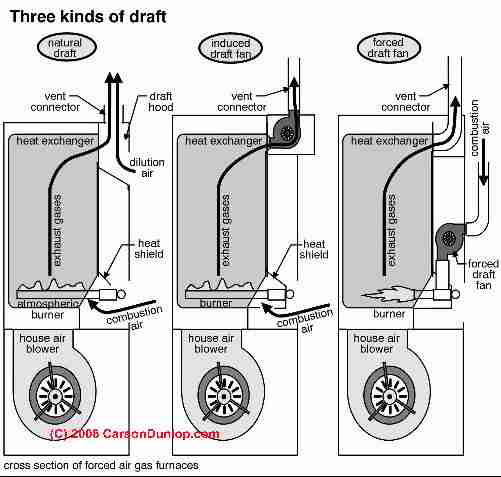
Our sketch at above left, courtesy of Carson Dunlop Associates, illustrates the three types of draft that may be found at chimneys and heating appliances: natural draft, induced draft by a fan blowing up a chimney, and forced draft by a fan blowing combustion air into a burner assembly.
[Click to enlarge any image]
This article discusses the use of induced-draft equipment.
The articles at this website describe the basic components of a home heating system, how to find the rated heating capacity of an heating system by examining various data tags and components, how to recognize common heating system operating or safety defects, and how to save money on home heating costs.
We include product safety recall and other heating system hazards.

Draft inducers are special fans that are installed in the flue vent connector (or sometimes in the chimney) used to vent a heating boiler or furnace. Most often we see these installed on oil-fired systems at which the technician was unable to obtain sufficient natural draft for proper oil burner operation.
If an oil burner lacks adequate draft it will not operate properly, leading to soot clogging, more costly heating bills, back pressure in the combustion chamber, and possibly unsafe heater operation.
The draft inducer fan shown in our photo was found in our garage of left-over stock from our heating service days. This model, the Tjernlund DJ-3 Draft Inducer Fan is sold by Tjernlund in St. Paul, MN, and the photo shows the essential parts of this draft inducer:
- An electric motor (this one made by Fasco)
- A blower assembly of fan blades driven by the motor and designed to project into a metal flue pipe or flue vent connector
- An electrical junction box to connect the motor to the oil burner controls to turn the fan on and off when needed
- A metal shroud around the fan assembly
The draft inducer fan motor and wiring need to be adequately protected from the heat of the oil burner combustion gases, that's why you wouldn't try to make one of these at home out of an old computer fan or stereo system fan.
When is it not appropriate to install a draft inducer fan?
Be careful; it would be a mistake and possibly dangerous to install a draft inducing fan to boost oil burner draft to solve a venting or backpressure problem before the cause of that problem is accurately diagnosed.
For example, if the oil fired appliance draft is poor because the chimney is blocked, or because the appliance itself is blocked with soot and debris, or because there is inadequate combustion air, the draft inducer fan might make the problem seem to go away, but at the risk of creating unsafe conditions in the heating system.
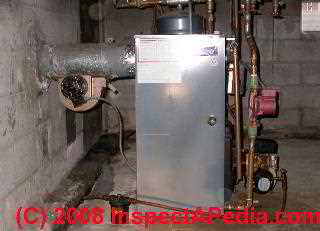
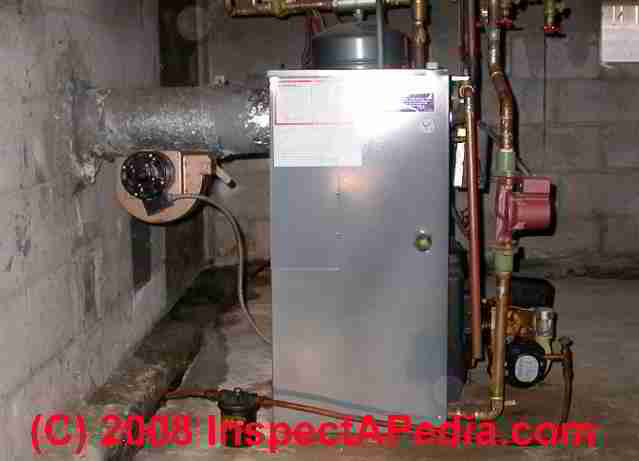
In our photo of an oil fired heating boiler has a draft inducer fan installed. The draft boosting fan is that mechanism you see on the under-side of the flue vent connector to the left of the boiler.
If this boiler is venting into a chimney that is really right at the wall where the flue vent connector enters the block wall, it's a very short flue run and we would not expect a draft problem.
Something must be seriously wrong with the boiler or with chimney itself to have induced the technician to install a draft inducer fan on this heating system.
When Might We Need to Install a Draft-boosting Draft Inducer Fan?
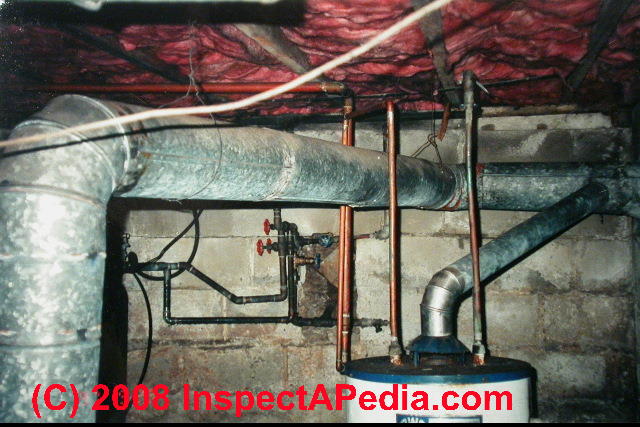
But where the flue vent connector run-length is abnormally long or tortuous it may be difficult to get good draft, or where the chimney size itself (to which the flue vent connector joins) is too big or too small, the use of a draft inducer might be permitted.
Watch out: the connection of smaller and larger diameter flue vent connectors together athead of the chimney such as shown in this photo is unsafe and improper.
See details at SHARED CHIMNEY & FLUE HAZARDS
Check with the fan manufacturer and a qualified HVAC service technician before asking that one of these fans be installed.
In the photo shown here we have a long metal flue run - we cannot see the end of it, and the flue is shared, and there is no barometric damper installed - we suspect there is poor draft at this installation.
We've installed draft inducer fans in a few cases where the building chimney design was just too difficult to get good venting by natural draft.
For example we encountered a 12' long horizontal chimney run through masonry placing the boiler too far from the vertical chimney flue for good draft.
But in general, before installing a draft inducer we should make sure that the chimney is safe, not blocked, and that the heating equipment has been properly serviced and adjusted first.
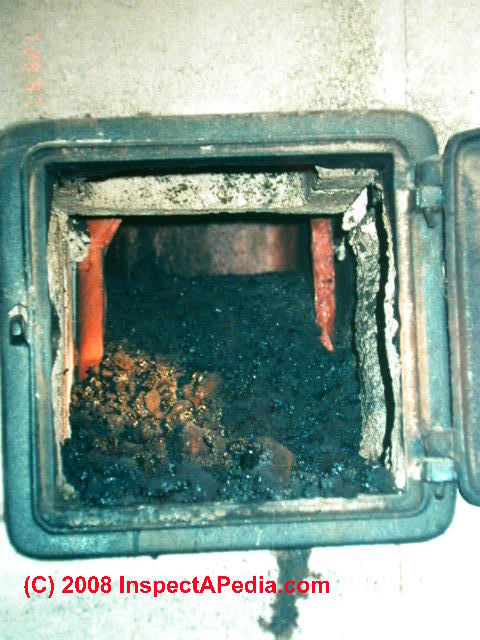
You might discover that someone simply left open the ash pit door on a heating system's chimney - all that may be needed to improve the draft could be closing that little door!
At the chimney cleanout shown here we see a bit of debris that has collected at the bottom - which could be normal depending on what flue is being served and how long since the chimney was cleaned.
But if leave this door open not only do you nearly eliminate the chimney draft needed by the heating equipment, you are also creating a fire hazard, a fire spread between floors hazard, and a possible point of release of combustion gases into the building.
Close the little door.
How is a draft inducer fan installed?
A rectangular opening is cut into the metal flue pipe at a suitable location - usually close to the heating equipment since that makes wiring easier. The draft inducing fan comes with a paper template showing the size of the opening to cut.
The fan is mounted to the opening on the metal chimney or flue pipe so that its blades project into the flue, and so that when the fan motor runs it's pushing exhaust air away from the heating equipment and towards the chimney.
We've seen people install these fans in fireplace chimney flues in an effort to improve a fireplace that has inadequate draft, but we can't say if the manufacturer would approve that installation. There may be hazards due to creosote and other deposits from a wood-burning fireplace when one of these fans is used.
A note from Tjernlund informs us that draft inducer fan model DJ-2 has been replaced by Model DJ-3 and that all references in instructions to DJ-2 fans apply to DJ-3 models too.
...
Reader Comments, Questions & Answers About The Article Above
Below you will find questions and answers previously posted on this page at its page bottom reader comment box.
Reader Q&A - also see RECOMMENDED ARTICLES & FAQs
Question: fixing a too-weak draft inducer
(Aug 22, 2011) Bill Williambarbjr@verizon.n said:
With only the draft inducer running get a draft of -.12, start the burner and the draft drops to -.01, furnace is soot free (unit is several years old), run is only a couple feet, oil fired fireing 1.35, 70B nozzle.
Reply:
Bill that's a pretty low draft - and the draft inducer suggests someone already knew there was a draft problem. But some interpretation depends on where you measured the draft, and also on the specific oil burner equipment installed.
Typically we want to see more draft at the breech (above the boiler or furnace) than over the fire (inside the boiler or furnace at the flame top or inspection port). I'm not sure which location you were measuring. For example if you had 0.01 at the fire and 0.04 at the breech, you'd be ok.
Also some oil burners and combustion chambers in newer boilers and furnaces are designed to tolerate or even run with backpressure in the combustion chamber, so low drafts might not be a sign of trouble with some models. If you let us know the boiler/furnace brand, model, age, and same for the burner, we might research the question further.
Question: Fasco Draft Inducor motor is getting very loud
[delete] (Jan 15, 2012) Draft Inducer Motor said:
Hi, Our Fasco Draft Inducor motor is getting very loud. Im not sure how old it is, as i bought this house a few years ago as a forclosure.
Its a system 2000, and it runs great. I recently changed the oil filter and that didn't seem to help the problem. The inducer fan kicks on and you can hear the motor throughout the house. I was wondering, can those motors be cleaned? I read that some can be oiled, but i dont see anywhere on this particular one to put the oil. Its a fasco, No. 70219770 Cust p/n 02-0302-1.
I've considered spending the money (which i dont have) for a new one and looked everywhere for an exact replacement, including Emailing Fasco themselves. Do you have any recommendations?
(Apr 15, 2012) Z29R said:
I have the same problem and have been looking for this part for months. Energy Kinetics won't sell it to me. Fasco won't sell it and te Oil Companies wont sell it without installing it. It seems all that is wrong with mine are the motor bearings which I am now going to investigate how to go about replacing them.
Reply:
Loud electric motors in draft inducers? I think the reason Energy Kinetics won't sell you a motor is not hard to understand. They are very worried that someone will take apart one of their units, make a mistake putting it back together, and burn down the house or poison its occupants with carbon monoxide.
For that reason, sorry to say, but where these critical safety devices are installed, I would not mess around with them unless you have the expertise and training.
Question: poor draft and carbon monoxide in oil fired heaters
(Aug 11, 2012) john said:
poor draft in 10 yr old oil furnace-doesnt meet requirements for
carbon monoxide
Reply:
John, I'd start by diagnosing why the draft is poor - so that we fix the right problem. Search InspectApedia for -
DRAFT MEASUREMENT, CHIMNEYS & FLUES
DRAFT REGULATORS / Barometric Dampers
Examples: dirty clogged boiler or furnace heat exchanger, chimney blocked, chimney cleanout door left open, misadjusted barometric damper/draft regulator, improper burner adjustments, even lack of combustion air, downdrafts at chimney, missing chimney cap, are some things to check.
Watch Out: in sum I don't like to add a "fix" like a draft inducer until I know that there is no other poor draft cause that can be corrected by cleaning, maintenance, repair. Else the system can be unsafe.
Question:
(Nov 24, 2012) John said:
I have a Burnham oil fired boiler and a bock oil fired hot water heater.
They each are vented thru there own thimble but share the same flue. When they both run the draft becomes very poor with both draft regulators closed.
The water heater loses efficiency fast and shuts off on flame failure. When each of the appliances runs seperatly they run fine. The efficency is not the best but I think they need to be down fired with smaller nozzels
. I installed a draft inducer in the water heater flue pipe but things still are not good when both run. Any thought's
I did clean the boiler and the water heater is 3 months old
Reply:
John
Have you had a chimney sweep check the flue for blockage or leaks ?
Watch out: This sounds dangerous.
Question: barometric damper on flue used by a power venter?
(Feb 5, 2014) Bill_in_Vermont said:
My Buderus was installed with a power venter. In this type of installation should a Calibrated Draft Control also be installed? Seems like it should not but I have one as well.
Reply:
Power venters do not generally use a barometric damper - it would be overhwelmed and the results unsafe.
Question: HVAC system blamed for illness in rental home
21 Jan 2015
Ana Keller said:
I have been dealing with major problems upon move-in at this rental community since May. I have noticed major dust problems in the hvac system, uncomfortable hvac conditions (too cold ac air and unbearably hot heat,) and I'm so broke that I'm unable to do anything but put up with it.
My leasing office manager purposely ignores or denies my claims and questions, even threatened to sue me.
I have lost all confidence in my own abilities and I'm just now beginning to come out of this personal funk and understand that there are a lot of things I do have reasons and rights to complain or ask about. My kids are 1 and 2, the other day we all got so sick that i had to call excel and barely made it to my car without passing out.
We are getting face ripping headaches, troublesome recurrent coughs, hoarse voices and total physical and mental fog.
My daughter is being questioned on sensory processing issues due to all of this. This apartment is ground level and sinking.
The level of moisture and constant wetness that occurs in this area is disgusting. I called to the manager 4 times over Summer due to my concerns with water waste and the moss growing on rocks and somehow, the manager was able to drain the ground ?? The concrete slabs are moving around my building all the time, depending on how cold it is, no plant growth is promoted due to the soil being like clay, and the visible signs indoor and outdoor of these movements are very noticeable.
I've recently discovered small yellowish egg looking things on the toilet bowl rim of my kids toilet, which was coincidentally just replaced due to the last toilet not flushing.. Now this toilet is grabbing water form another toilet and it's disgusting.
The carpet is HORRIBLE, the walls have splotches of color on them that happen daily and I am observing a lot of weird things. I think there is a total home ventilation problem and just want to get out. Have any suggestions of cheap ways of starting this process? I want these people to understand this isn't mine to fix, it's theirs.
Reply:
Ana
If you have good reason to believe that the HVAC system in your home is contributing to or even causes illnesses then that should be made clear in writing to your landlord. More help, though it focuses on mold, discusses dealing with property managers and owners beginning at
inspectapedia.com/sickhouse/Rental_Unit_Mold_Dispute.php
...
Continue reading at COMBUSTION AIR DEFECTS or select a topic from the closely-related articles below, or see the complete ARTICLE INDEX.
Or see these
Recommended Articles
- AUTOMATIC VENT DAMPERS
- CHIMNEY DRAFT & PERFORMANCE
- CHIMNEY CODES & STANDARDS
- COMBUSTION AIR REQUIREMENTS
- DRAFT REGULATOR, DAMPER, BOOSTER
- DAMPERS & DRAFT REGULATOR TYPES
- DRAFT REGULATORS / HOODS GAS HEATERS
- DRAFT INDUCER FANS
- DRAFT MEASUREMENT, CHIMNEYS & FLUES
- DRAFT REGULATOR SOOT INSPECTION
Suggested citation for this web page
DRAFT INDUCER FANS at InspectApedia.com - online encyclopedia of building & environmental inspection, testing, diagnosis, repair, & problem prevention advice.
Or see this
INDEX to RELATED ARTICLES: ARTICLE INDEX to HEATING SYSTEMS
Or use the SEARCH BOX found below to Ask a Question or Search InspectApedia
Ask a Question or Search InspectApedia
Try the search box just below, or if you prefer, post a question or comment in the Comments box below and we will respond promptly.
Search the InspectApedia website
Note: appearance of your Comment below may be delayed: if your comment contains an image, photograph, web link, or text that looks to the software as if it might be a web link, your posting will appear after it has been approved by a moderator. Apologies for the delay.
Only one image can be added per comment but you can post as many comments, and therefore images, as you like.
You will not receive a notification when a response to your question has been posted.
Please bookmark this page to make it easy for you to check back for our response.
IF above you see "Comment Form is loading comments..." then COMMENT BOX - countable.ca / bawkbox.com IS NOT WORKING.
In any case you are welcome to send an email directly to us at InspectApedia.com at editor@inspectApedia.com
We'll reply to you directly. Please help us help you by noting, in your email, the URL of the InspectApedia page where you wanted to comment.
Citations & References
In addition to any citations in the article above, a full list is available on request.
- [1] "Instructions for Installing FIELD Type AF Barometric Draft Controls," Form No. 31 DC 30666, Field Corporation, Mendota, IL 61342, web search 04/02/2011, original source: http://www.fieldcontrols.com/pdfs/04592700.pdf, Field Controls, Kingston, North Carolina 28501, Tel: 919-522-3031
- [2] Tjernlund Draft Controls, A Series (single action for oil, solid fuel, and fan-assisted gas burners) and B Series (double action for gas heating appliances), web search 04/02/1011, original source: http://www.tjernlund.com/Tjernlund_8500490.pdf , Tjernlund Products, Inc., 1601 Ninth Street, White Bear Lake MN 55110-6794, Tel: 651-426-2993 or 800-255-4208 website: www.tjernlund.com Email: fanmail@tjfans.com
- In addition to citations & references found in this article, see the research citations given at the end of the related articles found at our suggested
CONTINUE READING or RECOMMENDED ARTICLES.
- Carson, Dunlop & Associates Ltd., 120 Carlton Street Suite 407, Toronto ON M5A 4K2. Tel: (416) 964-9415 1-800-268-7070 Email: info@carsondunlop.com. Alan Carson is a past president of ASHI, the American Society of Home Inspectors.
Thanks to Alan Carson and Bob Dunlop, for permission for InspectAPedia to use text excerpts from The HOME REFERENCE BOOK - the Encyclopedia of Homes and to use illustrations from The ILLUSTRATED HOME .
Carson Dunlop Associates provides extensive home inspection education and report writing material. In gratitude we provide links to tsome Carson Dunlop Associates products and services.
 | HOME | ABOUT | ASK a QUESTION | CONTACT | CONTENT USE POLICY | DESCRIPTION | POLICIES | PRIVACY | |
| © 2024 - 1985 Publisher InspectApedia.com - Daniel Friedman | |||||||||