
InspectAPedia® FREE Encyclopedia of Building & Environmental Construction, Diagnosis, Maintenance & Repair |
Question? Just ask us! InspectAPedia
|
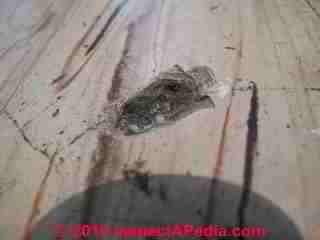 Asbestos Wetting & Cleanup Guidelines Reduce Hazard
Asbestos removal procedures
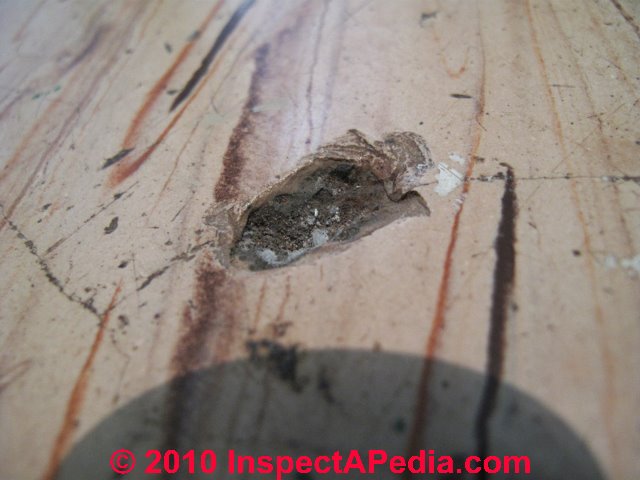
- POST a QUESTION or COMMENT about how to use wetting to reduce asbestos particle release hazards during demolition or removal.
How to Use Wetting to Reduce Asbestos Particle Release Hazards During Demolition or Removal:
This document series assists building buyers, owners or occupants in reducing the risk of asbestos exposure from flooring that contains or is suspected to contain asbestos. We provide photographs and descriptive text of asbestos insulation and other asbestos-containing products to permit identification of definite, probable, or possible asbestos materials in buildings.
This article describes how to use wetting procedures to reduce asbestos particle hazards during the demolition or cleanup of building products that may contain asbestos. We cite authoritative government and expert sources on safe handling of asbestos-containing waste materials, expanding and illustrating original sources.
InspectAPedia tolerates no conflicts of interest. We have no relationship with advertisers, products, or services discussed at this website.
- Daniel Friedman, Publisher/Editor/Author - See WHO ARE WE?
Building Owner Guidelines for Asbestos Cleanup
 Here we provide general guidelines for cleanup or removal of asbestos or asbestos-suspect materials in or around buildings. We include asbestos cleanup procedures for homeowners that can be helpful for various small or emergency asbestos problems.
Watch out: improper handling of asbestos or even asbestos-suspect materials can be dangerous, risking serious health effects and even increasing the cost of proper cleanup that may be required later. If you are faced with a possibly significant asbestos cleanup project start with a professional assessment and suitable tests of asbestos-suspect material.
Asbestos is safe and legal to remain in homes or public buildings as long as the asbestos materials are in good condition and the asbestos can not be released into the air. - U.S. EPA
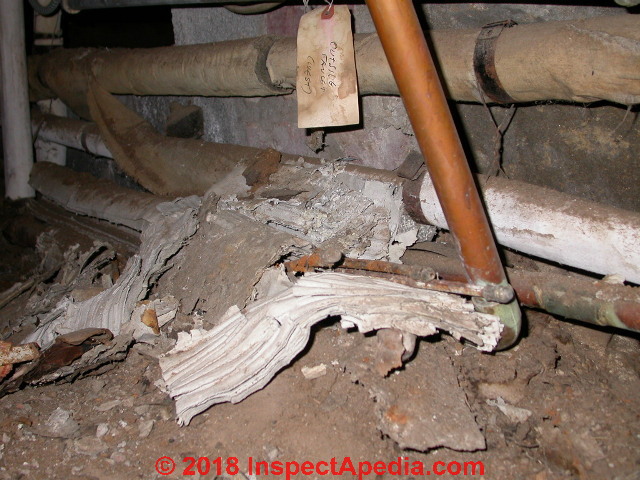
Photo: our photo of asbestos pipe insulation fallen to the ground in a building crawl space is an example of unsafe asbestos in a building. Simply crawling about atop the asbestos debris and soil in this space risks health problems for the worker and risks tracking harmful asbestos into other building areas. This situation deserves professional asbestos abatement.
[Click to enlarge any image]
Article Contents
- ASBESTOS CLEANUP BASICS for HOMEOWNERS
- ASBESTOS REMOVAL, WETTING GUIDELINES
- IMPORTANT TERMS IN ASBESTOS NESHAP ADEQUATELY WET GUIDANCE
- FRIABLE & NON-FRIABLE ASBESTOS-CONTAINING MATERIALS: DEFINITIONS
- REQUIREMENTS FOR ADEQUATELY WETTING ASBESTOS-CONTAINING MATERIALS
- EXCEPTIONS TO WETTING ASBESTOS CONTAINING MATERIALS
- TECHNIQUES USED FOR WETTING ASBESTOS-CONTAINING MATERIALS
- PROCEDURES FOR WETTING ASBESTOS CONTAINING MATERIALS
- PROCEDURES FOR WETTING ASBESTOS CONTAINING MATERIALS
- ASBESTOS CLEANUP & REMOVAL GUIDE DOCUMENTS - download these PDFs
Asbestos Cleanup Basics for Homeowners
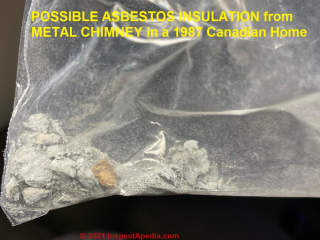 Question: Worried about possible Asbestos from Insulated Metal Chimney

My roof was recently replaced and I have a fireplace with a double-walled stainless steel metal chimney that I wanted to get rid of as I don't use the fireplace anymore.
The roofers were able to take off the chimney, but part of the flue was sticking out that they couldn't get off, so they decided to break it off. In between the walls of the metal flue was this light grey material that seems to crumble to dust if you touch it.
It seems to have small fiberglass strands but I'm worried it might be asbestos. My home was build in Canada in 1987. Thanks! - Matt Y 2021/04/05
On 2021-04-05 by (mod) - treat pre 1986 insulated chimney cementious material as "PACM" - Presumed Asbestos Containing Material - or test it
Watch out:
While no one can start with complete confidence that the material you describe as asbestos, I can tell you from the context and information in your note that it was common to use a cementious form of asbestos, perhaps mixed with other fibres, as the interior insulation in insulated metal chimneys up to about 1986 (in North America).
In sum,
Asbestos-Insulation was widely used in multi wall insulated metal chimney flue's.
So it'd be prudent to treat your material as asbestos-containing or have a sample tested.
The asbestos suspect material should be cleaned-up using damp wiping and HEPA-vacuuming. Wear PPE and take care not to spread asbestos dust and debris around the home. IF you find that there is more than a trivial amount of cleanup to be done, such as if the chimney insulation was spread through an attic, then professional cleanup services are probably needed. And depending on where you live, special rules and permits and licensing for cleanup and disposal of hazmat waste might apply.
Following is more general and CYA-and extra-cautious advice from NIH. Noting that your home is hardly a disaster area, still the advice below is generally reasonable to attend:
The following vague and general advice is from
HOMEOWNER’S AND RENTER’S GUIDE TO ASBESTOS CLEANUP AFTER DISASTERS - original source NIH at ww.niehs.nih.gov/health/assets/docs_f_o/homeowners_and_renters_guide_to_asbestos_cleanup_after_disasters_508.pdf
What You Can Do: Asbestos Handling Guidelines [for Homeowners]
Homeowners, renters, volunteers and contractors are encouraged to seek the assistance of a licensed/certified asbestos abatement contractor when cleaning up debris. At a minimum, use the following recommended procedures to handle any suspected asbestos-containing materials:
- Always wear personal protective equipment (PPE)
when handling asbestos. PPE includes gloves, goggles, Tyvek® or equivalent clothing and respiratory protection.
Asbestos fibers are impossible to see so a fitted rubber half-face respirator (mask) with cartridges rated for use with asbestos (HEPA, N100) is the minimum protection.
These masks are not effective in the presence of facial hair. - Wet down any suspected asbestos surface
and keep it wet at all times. However, even wet asbestos will release fibers if it is damaged or crushed during demolition.
Wetting broken or damaged asbestos insulation does not guarantee reduced exposure to airborne fibers. - Wash hands
after handling asbestos but before removing the mask.
Asbestos will cling to hair, clothing, car seats, pet hair, carpets and other textiles, and may become an ongoing source of exposure for family members. - Avoid activities
that will cause asbestos to generate dust such as vacuuming or sweeping.
Wet the area down completely and mop or wipe up the dust. If necessary, use a HEPA vacuum approved for use with asbestos fibers.
- Keep all family members out of the work area,
or seal the area. Do not carry contaminated clothing or other materials home to your family members.
Place the contaminated clothing with the asbestos waste into contractor grade plastic bags. Bag it again; seal and label the bag. - Avoid smoking,
eating, or drinking in asbestos-contaminated areas. - Post signs:
Danger: Asbestos Dust Hazard; Cancer and Lung Disease Hazard; Authorized Personnel Only. - Shower or hose off
to keep from bringing asbestos to your current living quarters.
This Q&A were posted originally at INSULATION IDENTIFICATION GUIDE FAQs
Also see
- ASBESTOS IDENTIFICATION IN BUILDINGS
- ASBESTOS DISPOSAL REGULATIONS
- ASBESTOS TESTING LAB LIST
- INSULATION IDENTIFICATION GUIDE - topic home
On 2021-04-23 by Matt Y - lab report confirms cementious gray-white insulation in a 1990s insulated chimney: not asbestos
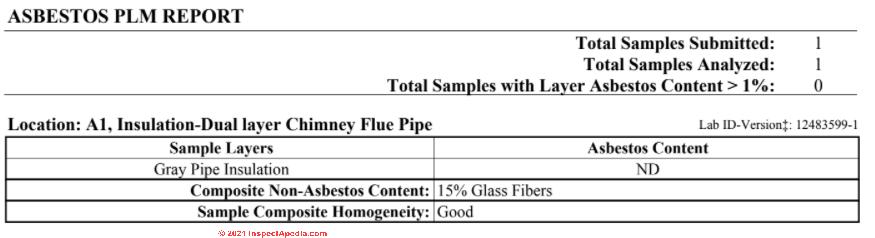
I'm happy to report that it is not asbestos - turns out it is 15% Glass Fibers, attached photo of the lab report.
Thanks again,
Matt
On 2021-04-24 by (mod) - white powdery insulating material - not asbestos!
@Matt Y,
Thanks for that follow-up - it will certainly be of interest to other readers.
Good news; reviewing the history of our conversation, looking at a 1990s insulated chimney insulation in North America, it'd likely be a product that that substituted fiberglass for asbestos long fibres and that must include some other paste or inorganic material to make up the bulk of the substance
Asbestos NESHAP Adequately Wet Guidance for Asbestos Flooring Removal
 This document quotes [with formatting & editing for read-ability] from Asbestos NESHAP Adequately Wet Guidance, EPA340/1-90-019 [Asbestos NESHAP Adequately Wet Guidance, EPA340/1-90-019, December 1990, U.S. ENVIRONMENTAL PROTECTION AGENCY, Office of Air Quality Planning and Standards, Stationary Source Compliance Division, Washington, DC 20460,original web source: http://www.epa.gov/region04/air/asbestos/awet.htm]
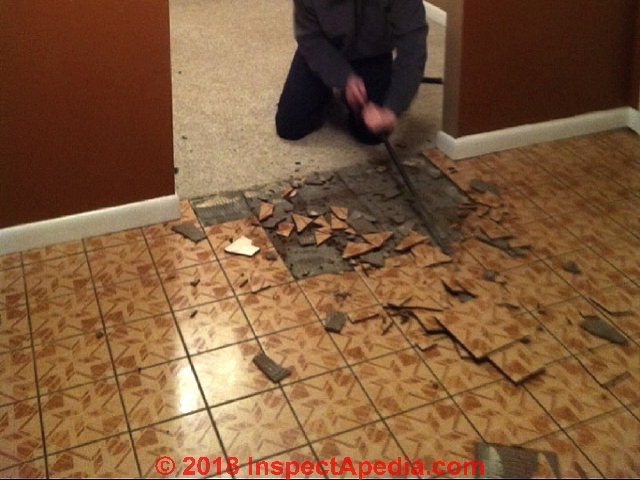
Photo: an amateur and improper removal of asbestos-suspect flooring is a dangerous mistake.
Also see DOES THIS FLOORING CONTAIN ASBESTOS?
1. Introduction to Asbestos NESHAP Adequately Wet Guidance
This document was written by Alliance Technologies, Inc., based on discussions with a work group from EPA. Additional citations and references or comments may be inserted by InspectApedia.com editors.
The original authoring group consisted of the Regional Asbestos NESHAP Coordinators, Ron Shafer, Scott Throwe, and Omayra Salgado of the Stationary Source Compliance Division, Charles Garlow and Elise Hoerath of the Air Enforcement Division and Sims Roy of the Standards Development Branch. We thank the individuals who reviewed an earlier draft and provided comments, many of which are incorporated in the final version. Their input is gratefully acknowledged.
The Clean Air Act (CAA) of 1970 requires the U.S. Environmental Protection Agency (EPA) to develop and enforce regulations to protect the general public from exposure to airborne contaminants that are known to be hazardous to human health. In accordance with Section 112 of the CAA, EPA established National Emissions Standards for Hazardous Air Pollutants (NESHAP) to protect the public.
Asbestos was one of the first hazardous air pollutants regulated under Section 112. The Asbestos NESHAP (40 CFR 61, Subpart M) addresses milling, manufacturing and fabricating operations, demolition and renovation activities, waste disposal issues, active and inactive waste disposal sites and asbestos conversion processes.
The Asbestos NESHAP requires facility owners and/or operators involved in demolition and renovation activities to control emissions of particulate asbestos to the outside air because no safe concentration of airborne asbestos has ever been established. The primary method used to control asbestos emissions is to adequately wet the Asbestos Containing Material (ACM) with a wetting agent prior to, during and after demolition/renovation activities.
The purpose of this document is to provide guidance to asbestos inspectors and the regulated community on how to determine if friable ACM is adequately wet as required by the Asbestos NESHAP.
The recommendations made in this guidance are solely recommendations. They are not the exclusive means of complying with the Asbestos NESHAP requirements. Following these recommendations is not a guarantee against findings of violation. Determinations of whether asbestos materials are adequately wetted are made by EPA inspectors on site.
2. Important Terms in Asbestos NESHAP Adequately Wet Guidance
Adequately Wet
EPA defines "adequately wet" to mean "sufficiently mix or penetrate with liquid to prevent the release of particulates. If visible emissions are observed coming from asbestos-containing material (ACM), then that material has not been adequately wetted.
However, the absence of visible emission is not sufficient evidence of being adequately wet (Section 61.141,Definitions). Amended water is often used to wet ACM during repair/removal operations.
Friable Asbestos Material
Friable asbestos material is any material containing more than 1 percent asbestos as determined using Polarized Light Microscopy (PLM), that, when dry, can be crumbled, pulverized, or reduced to powder by hand pressure.
Asbestos-Containing Waste Materials (ACWM)
EPA defines ACWM to mean mill tailings or any waste that contains commercial asbestos and is generated by a source subject to the provisions of this subpart. This term includes filters from control devices, friable asbestos waste material, and bags on other similar packaging contaminated with commercial asbestos.
As applied to demolition and renovation operations, this term also includes friable asbestos waste and Category II non-friable ACM waste that becomes crumbled, pulverized, or reduced to powder by forces that acted on the material during the course of demolition and renovation operations regulated by this subpart, and materials contaminated with asbestos including disposal equipment and clothing.
non-friable Asbestos-containing Materials
non-friable asbestos-containing material is any material containing more than 1 percent asbestos as determined using Polarized Light Microscopy (PLM) that, when dry, cannot be crumbled, pulverized, or reduced to powder by hand pressure.
Regulated Asbestos-Containing Material (RACM)
Is (a) friable asbestos material,
(b) Category I non-friable ACM that has become friable,
(c) Category I non-friable ACM that will be or has been subjected to sanding, grinding, cutting or abrading, or
(d) Category II non-friable ACM that has a high probability of becoming or has become crumbled, pulverized, or reduced to powder by the force expected to act on the material in the course of demolition or renovation operations.
3. Friable & Non-friable Asbestos-Containing Materials: Definitions
The Asbestos NESHAP defines two categories of non-friable ACM: Category I non-friable ACM (asbestos-containing packings, gaskets, resilient floor covering and asphalt roofing products) and Category II non-friable ACM (any non-friable material not designated as Category I).
The Agency requires that, where the Asbestos NESHAP is applicable, friable ACM and Category II and non-friable ACM that is likely to become disturbed or damaged so that the material could be crumbled, pulverized or reduced to powder during a demolition or renovation be removed, from a facility prior to its demolition/ renovation.
The fibrous or fluffy spray-applied asbestos materials found in many buildings for fireproofing, insulating, sound-proofing, or decorative purposes are generally considered friable.
Pipe and boiler wrap found in numerous buildings is also considered friable.
non-friable ACM, such as vinyl-asbestos floor tile, generally emits low levels of airborne fibers unless subjected to burning or to sanding, grinding, cutting or abrading operations.
Other materials, such as asbestos cement sheet and pipe, can emit asbestos fibers if the materials are crumbled, pulverized or reduced to powder during demolition/renovation activities. Whenever non-friable materials are going to be damaged to the extent that they are crumbled, pulverized or reduced to powder, they must be handled in accordance with the Asbestos NESHAP.
See ASBESTOS FLOORING HAZARD REDUCTION
4. Requirements for Adequately Wetting Asbestos-Containing Materials
The NESHAP regulation requires that RACM be adequately wetted during the following activities:
a. During cutting or disjoining operations when a facility component which is covered or coated with friable ACM is being removed from that facility as units or in sections (Section 61.145 (c)(2)(i)).
During demolitions or renovations a contractor may choose to remove an entire boiler, a section of pipe, or other facility components without first removing the asbestos insulation from these structures. Any ACM which will be disturbed during cutting or disjoining operations must be adequately wet.
b. During stripping operations when a facility component containing RACM remains in place in the facility. (Section 61.145 (c)(3)).
Stripping operations are the most common form of asbestos removal during renovation activities, since most items that are covered with asbestos are facility components or structural members which will not be removed. Stripping off all of the RACM can generate significant asbestos emissions if the ACM is not adequately wet during removal.
Friable spray-on ACM, which includes fire-proofing materials found on decking and support I-beams, is normally easy to wet throughout because of the absorbing property of the cellulose mixing/binding agent. The Asbestos NESHAP requires that these materials be fully penetrated with the wetting agent during demolition/renovation activities.
Other ACM, however, such as "thermal-block" insulation used on pipes and boilers, certain ceiling and floor tile applications, etc., which do not absorb water readily may be hard to penetrate by water or a wetting agent.
For such materials, adequate wetting consists of coating the surfaces of the materials with water or a wetting agent prior to, during, and, in most cases, after removal activities in order to prevent asbestos emissions. Whenever such materials are broken during the removal process, the exposed, dry surfaces must be wetted immediately to reduce emissions.
If pieces of dry ACM are accidentally disturbed, they should be immediately wetted and kept wet until collected for disposal. Removal personnel are commonly assigned to keep the fallen RACM wet prior to its being collected for disposal.
c. After the RACM has been stripped from a facility component, it must remain adequately wet until it has been collected and contained or treated in preparation for disposal. (Section 61.145 (c)(6)(i)).
After removal, adequately wetted ACWM must be sealed in leak-tight containers or wrapping which must be labeled as specified by the Occupational Health and Safety Administration (OSHA) under 29 CFR 1910.1001(j)(2) or 1926.58(k)(2)(iii). Such waste materials destined for off-site transport must additionally be labeled with the name of the generator and location of the waste generation site (Section 61.150 (a)(1)(iv and v)).
d. In demolitions where the RACM was not removed prior to demolition (Section 61.145 (c)(1)(i)(ii)(iii)(iv)).
- RACM on a facility component encased in concrete or other similarly hard material must be adequately wet whenever exposed during demolitions (Section 61.145 (c)(1)(ii));
- RACM which was not accessible for testing and, due to demolition, cannot be safely removed, must be kept adequately wet at all times until disposed of (Section 61.145 (c)(1)(iii)):
- The portion of a facility ordered demolished that contains RACM must be adequately wet during the wrecking operation (Section 61.145 (c)(9)).
5. Exceptions to Wetting Asbestos Containing Materials During Demolition or Renovation
The Asbestos NESHAP allows two exceptions to wetting RACM during a demolition or renovation project:
- When the temperature at the point of wetting is below 0C (32F) (Section 61.145 (c)(7)(i)). The owner/operator must remove facility components coated or covered with friable ACM as units or sections to the maximum extent possible and meet subsequent requirements of 61.145, including the wetting requirements.
During periods when wetting operations are suspended due to freezing temperatures, the owner/operator must record the temperature in the area containing the facility components at the beginning, middle, and end of each workday and keep daily temperature records available for inspection by the Administrator during normal business hours at the demolition or renovation site. The owner or operator shall retain the temperature records for at least 2 years.
- When the use of water would unavoidably damage equipment or present a safety hazard (Sec. 61.145 (c)(3)(i)(A)).
The owner/operator must first obtain written approval from the Administrator for an alternative work practice, prior to renovation activities and utilize a local exhaust ventilation and collection system designed to capture particulate asbestos released during removal operations. (Section 61.145 (c)(3)(i)(B)(1)); or a glove bag system or a leak-tight wrapping which can contain the particulate asbestos materials produced by stripping ACM. (Section 61.145 (c)(3)(i)(B)(2)and (3))
6. Techniques Used for Wetting Asbestos-Containing Materials
General Information
Adequate wetting of ACM is typically accomplished by repeatedly spraying it with a liquid or a wetting agent, usually amended water (water to which surfactant chemicals have been added), until it can absorb no more. However, this does not necessarily mean that the ACM will be soaked throughout.
Surfactant chemicals reduce the surface tension of the water, thereby increasing its ability to penetrate the ACM and surround the asbestos fibers.
Although amending agents are not required by the Asbestos NESHAP (the NESHAP only requires the use of a liquid), EPA, in its "Guidance for Controlling Asbestos-Containing Materials in buildings", EPA-560/5-85-024 (Purple Book), recommends the use of a 50:50 mixture of polyoxyethylene ester and polyoxyethylene ether, or the equivalent, in a 0.16 percent solution (1 ounce to 5 gallons) of water.
Wetting agents may be applied with garden sprayers or hoses. Garden sprayers are hand-held, portable, and have a one- to five-gallon capacity.
Water hoses are usually attached to a faucet tap, fire hydrant or water tank. Generally, the hose has a nozzle attached which spreads the water stream so that a fine mist is created.
An engineering control often used is a misting unit which can be used to create a high level of humidity within a removal area. It is believed that fibers emitted into a saturated environment will absorb the wetting agent and fall out of the air faster, thus reducing airborne fiber levels.
7. Procedures for Wetting Asbestos Containing Materials
The following procedures describe methods of adequately wetting various applications of ACM.
Thermal System Insulation
Molded Pipe Insulation containing asbestos
The recommended wetting procedure for this type of RACM is to saturate the outer surface with amended water, strip off the wet canvas coating and then re wet the surface in order to thoroughly saturate the ACM.
The metal bands supporting the RACM should be removed and the half-round sections carefully separated. While this occurs, the interior side and edges of the sections should be saturated with amended water.
If a section breaks during removal, the exposed surfaces should be wetted immediately. A misting sprayer may also be used to keep the air in the removal area or containment area saturated with amended water to attempt to reduce airborne asbestos fiber levels.
Corrugated Paper Pipe Insulation
The outer surface of the corrugated paper ("air-cell") pipe insulation, usually a canvas wrap, should be saturated with a wetting agent and then removed. Wetting should continue until all the insulation is permeated with amended water. Metal bands holding the insulation in place should be removed and the corrugated RACM insulation stripped.
Any unsaturated surfaces exposed during the stripping operation must be wetted immediately to reduce asbestos emissions. A misting sprayer may also be used to keep the air in the removal area saturated with amended water to attempt to reduce airborne asbestos fiber levels. Inadequately wetted and adequately wetted corrugated paper pipe insulation can be seen in Figures 1 and 2.
Figure 1. Inadequately wetted corrugated paper, pipe insulation. (Note the fibrous material adjacent to the lagging clamp.)
[FIGURE] - missing
Figure 2. Adequately wetted corrugated paper, pipe insulation. (Note the saturated material adjacent to the lagging clamp.)
[FIGURE] - missing
Boiler and Water Tank Thermal Block Insulation
Asbestos-containing preformed block insulation has been used as thermal insulation on boilers, hot water tanks and heat exchangers in industrial, commercial, institutional and residential applications. The blocks are commonly chalky in nature and may be held in place by chicken wire or expanded metal lath. A plaster-saturated canvas was often applied as a final covering or wrap.
Due to the number, thickness and varying absorbencies of these layers of materials, adequate wetting may be accomplished only by continually wetting the materials with amended water as the various layers are stripped.
One person may be assigned to spray the materials as they are stripped, and a misting sprayer may be used in an attempt to reduce airborne asbestos fiber levels.
Cementitious Fitting Insulation
Wetting of cementitious fitting insulation is similar to that used when removing asbestos-containing thermal block insulation. The outer surface is saturated with amended water and the outer covering (if applicable) is removed.
The fitting insulation is then re wetted and the insulation stripped. To ensure that the fitting remains adequately wet during the removal operation, a person is often assigned to spray the ACM as it is stripped. A misting sprayer may be used to reduce airborne asbestos fiber levels. Inadequately wetted cementitious fitting insulation can be seen in Figure 3.
Figure 3. Inadequately wetted cementitious fitting insulation. (Note that the part of the insulation which has been wetted is dark grey in color, whereas the dry section remains white.)
[FIGURE] -missing
Asbestos-Containing Surfacing Materials
"Surfacing Material" is a generic term designated by the Asbestos Hazard Emergency Response Act (AHERA; Asbestos Containing Materials in Schools, 40 CFR Part 763, Subpart E) to mean any wall or ceiling material that is sprayed-on or troweled-on, such as acoustical plaster or fireproofing.
The recommended wetting method for this type of RACM is to saturate the surfaces, begin the stripping operation and continue to wet the RACM as it is being removed.
A misting sprayer may also be used to keep the air saturated while the removal occurs. Since surfacing materials vary in their ability to absorb a wetting agent, inspectors must consider the type of surfacing material that is being removed in order to determine the required extent of penetration by the amended water.
Surfacing materials which easily absorb a wetting agent need to be fully penetrated or permeated to be considered adequately wet, whereas only the exposed surfaces of materials which do not absorb water readily need to be wetted.
The use of high pressure water to remove asbestos-containing surfacing materials, either through a steam-cleaning device or a diesel powered hydroblasting water applicator, should be avoided since such use may unduly disturb RACM and contribute to higher airborne asbestos fiber levels.
However, if this removal method is used, contractors must adequately wet the ACM prior to and during the removal.
Miscellaneous Asbestos-Containing Materials
Both friable and non-friable forms of other asbestos-containing building materials exist. Friable materials include asbestos-containing paper (commonly found beneath wooden floors), wallpaper, and joint compound. It has been estimated that 5 to 10 percent of the ceiling tiles currently installed in the U.S. contain asbestos.
Non-friable miscellaneous ACM includes floor tiles, asbestos cement sheet (transite board), siding shingles, asphalt roofing shingles, laboratory bench tops and even chalkboards. These materials may become friable with age, and under harsh conditions.
Category I non-friable ACM must be carefully examined to determine if the material is in poor condition, that is, if the binding material is losing its integrity, exhibited by peeling, cracking or crumbling; and is also friable. When Category I non-friable ACM has become friable it is subject to the NESHAP.
If Category I or II ACM is sanded, ground, cut or abraded it is also covered by the NESHAP. Category II non-friable ACM which is damaged to the extent that it has or will become crumbled, pulverized or reduced to powder due to demolition/ renovation activities, is subject to the Asbestos NESHAP.
Miscellaneous materials are wetted in manners similar to those used to wet other categories of RACM.
Coverings are saturated with a wetting agent before removal and the asbestos-containing portions fully penetrated with the agent prior to, during and after their removal, while stored in the removal area, and while being placed into disposal containers. Miscellaneous materials that don't absorb water readily (e.g., asbestos-concrete products, and floor tiles) are only required to have wetted surfaces.
A misting sprayer may be used to diminish airborne asbestos fiber levels.
8. Inspection Procedures re Asbestos NESHAP Adequately Wet Guidance
The intent of the following guidelines is to provide GUIDANCE ONLY, to the regulated community regarding the inspection procedures recommended to Asbestos NESHAP inspectors for determining compliance with the "Adequately Wet" requirements of the Asbestos NESHAP.
The purpose of the wetting provisions for asbestos containing materials is to require as much wetting as is necessary to prevent airborne emissions of asbestos fibers. In order to achieve this result, RACM and ACWM must be wetted and maintained wet until collected for disposal.
The determination of whether RACM or ACWM has been adequately wetted is generally based on observations made by the inspector at the time of inspection.
Observations probative of whether a material is adequately wet include but are not limited to, the following:
- Is there a water supply in place?
- Is water or a wetting agent observed being sprayed onto the RACM or ACWM both during stripping or removal and afterwards while the material awaits proper disposal? If yes, carefully note the method of application used (e.g., misting, fogging, spraying of surface area only or drenching to penetrate the ACM throughout).
- If water or a wetting agent is being used, what equipment is used to apply it (e.g., garden hose, plant mister)?
- If water or a wetting agent is not being used, determine why it is not and document the reason. Possible (although not necessarily valid) reasons include:
- prior permission obtained from the Administrator (safety hazard, potential equipment damage);
- no water source at the facility;
- temperature at the point of wetting below 32 degrees F;
- portable water supply ran out and contractor continued to work; or
- contractor prepared the area earlier, etc.
- Examine a stripped or removed piece of ACWM or RACM which wets readily. Does it appear to be wetted throughout? If it does not, adequately wet the sample. Describe and photograph how the physical characteristics of the material change upon wetting (e.g., color, weight, texture, etc.).
Take samples, as necessary, to document the presence of asbestos in the suspect material. - When examining materials that do not readily absorb water or a wetting agent (e.g., pre molded thermal system insulation, ceiling tiles, floor tiles) inspectors should note whether all exposed surfaces of these materials have been wetted as required.
- Is there visible dust (airborne or settled), or dry ACWM debris in the immediate vicinity of the operation? Inspectors should collect samples of such materials for analysis of their possible asbestos content.
- Examine ACWM in bags or other containers using the procedures that follow, to determine if the material has been adequately wetted?
Lift the bag or container and assess its overall weight. (A bag of dry ACWM can generally be lifted easily with one hand, whereas a bag filled with well-wetted material is substantially heavier.)
If the bag or other container is transparent:
- Visually inspect the contents of the unopened bag for evidence of moisture (e.g., water droplets, water in the bottom of the bag, a change in the color of the material due to water).]
- Without opening the bag, squeeze chunks of debris to ascertain whether moisture droplets are emitted.
- If the material appears dry or not penetrated with liquid or a wetting agent, open the bag using the additional steps described in step 9 below a collect a bulk sample of each type of material in the bag noting variations in size, patterns, color and textures.
If the waste material is contained in an opaque bag or other container, or if the material is in a transparent bag which appears to be inadequately wetted:
- Carefully open the bag (in the containment area, if possible). If there is no containment area at the site, a glove bag may be used to enclose the container prior to opening it to minimize the risk of any fiber release.
- Examine the contents of the bag for evidence of moisture as in 8 above, and if the material appears dry or it is not fully penetrated with water or a wetting agent, collect a bulk sample.
- Reseal the bag immediately after evaluating and sampling its contents.
Asbestos Cleanup / Removal Guides
- ASBESTOS IDENTIFICATION IN BUILDINGS - home
- ASBESTOS, YOUR QUICK GUIDE [PDF], UK HSE,
Retrieved 2018/04/05, original source: http://www.hse.gov.uk/asbestos/assets/docs/beware-asbestos-reference-cards.pdf
Excerpt: The simple steps outlined in these cards are not enough to protect against all risks from asbestos. For more information HSE 09/14 visit www.hse.gov.uk/asbestos - ASBESTOS, A GUIDE for MINOR RENOVATION, [PDF] Australia DEIR, includes common locations where asbestos is found in Queensland homes,
retrieved 2018/04/05, original source: http://www.deir.qld.gov.au/asbestos/resources/pdfs/asbestos-home-renovators-trades-guide.pdf
Excerpt:
This guide, produced by the Queensland Government, is based on an original guide entitled Asbestos: A home renovator’s and tradesperson’s guide for minor work in domestic buildings. - EPA Guidance for Controlling Asbestos-Containing Materials in buildings, NIAST, National Institute on Abatement Sciences & Technology, [republishing EPA public documents] 1985 ed., Exposure Evaluation Division, Office of Toxic Substances, Office of Pesticides and Toxic Substances, U.S. Environmental Protection Agency, Washington,D.C. 20460
ASBESTOS IN YOUR HOME - U.S. EPA, Exposure Evaluation Division, Office of Toxic Substances, Office of Pesticides and Toxic Substances, U.S. Environmental Protection Agency, Washington,D.C. 20460 - THE ABCs OF ASBESTOS IN SCHOOLS (August 2003), U.S. EPA, Web search 08/17/2010, original source: http://www.epa.gov/asbestos/pubs/abcsfinal.pdf - aqui se encuenta la misma documenta escrito en Espan~ol: El ABC del Asbestos en las Escuelas, fuente original: http://www.epa.gov/asbestos/pubs/spanishabcs.pdf
- HOW TO MANAGE ASBESTOS IN SCHOOL BUILDINGS, AHERA Designated Person Self Study Guide, U.S. EPA 910-B-96-001, January 1996, web search 08/17/2010, original source: http://www.epa.gov/region2/ahera/e23.pdf
- Asbestos NESHAP ADEQUATELY WET ASBESTOS GUIDANCE, EPA340/1-90-019, December 1990, U.S. ENVIRONMENTAL PROTECTION AGENCY, Office of Air Quality Planning and Standards, Stationary Source Compliance Division, Washington, DC 20460,original web source: http://www.epa.gov/region04/air/asbestos/awet.htm
- "Asbestos in your home or at work," Forsyth County Environmental Affairs Department, Winston-Salem NC 12/08
- "Asbestos Floor Tile Removal", the University of Minnesota's advice on removing VAT (vinyl asbestos or asphalt asbestos floor tile) can be read in detail at www.health.state.mn.us/divs/eh/asbestos/floortile/index.html
- EPA, ASBESTOS IN YOUR HOME [PDF] - U.S. EPA, Exposure Evaluation Division, Office of Toxic Substances, Office of Pesticides and Toxic Substances, U.S. Environmental Protection Agency, Washington,D.C. 20460
- Resilient Floor Covering Institute, 1030 15th St. NW, suite 350, Washington D.C.
- Asbestos regulations for schools (the Asbestos Hazard Emergency Response Act, "AHERA") (PDF) [on file as /sickhouse/EPA_Asebstos_Regulations.pdf ] - (96 pp, 589k), web search 08/17/2010, original source: http://www.epa.gov/asbestos/pubs/2003pt763.pdf,
- ASBESTOS REGULATIONS: STATE ASBESTOS REGULATORY AGENCIES (5 pp, 17k) (original source http://www.epa.gov/asbestos/pubs/statecontactsapril2009.pdf ) for information on how to find an accredited asbestos professional.
- EPA ASBESTOS MATERIALS BAN: CLARIFICATION 1999 [PDF]
- NIH, HOMEOWNER’S AND RENTER’S GUIDE TO ASBESTOS CLEANUP AFTER DISASTERS [PDF] (2015) U.S. NIH, Hurricane Sandy Rebuilding Task Force - Indoor Environmental Pollutants Work Group, - original source NIH at www.niehs.nih.gov/health/assets/docs_f_o/homeowners_and_renters_guide_to_asbestos_cleanup_after_disasters_508.pdf
Excerpt: WHAT YOU CAN DO: [Asbestos] HANDLING GUIDELINES- Homeowners, renters, volunteers and contractors are encouraged to seek the assistance of a licensed/certified asbestos abatement contractor when cleaning up debris. At a minimum, use the following recommended procedures to handle any suspected asbestos-containing materials:
- Always wear personal protective equipment (PPE) when handling asbestos. PPE includes gloves, goggles, Tyvek® or equivalent clothing and respiratory protection. Asbestos fibers are impossible to see so a fitted rubber half-face respirator (mask) with cartridges rated for use with asbestos (HEPA, N100) is the
minimum protection. These masks are not effective in the presence of facial hair. - Wet down any suspected asbestos surface and keep it wet at all times. However, even wet asbestos will release fibers if it is damaged or crushed during demolition. Wetting broken or damaged asbestos insulation does not guarantee reduced exposure to airborne fibers.
- Wash hands after handling asbestos but before removing the mask. Asbestos will cling to hair, clothing, car seats, pet hair, carpets and other textiles, and may become an ongoing source of exposure for family members.
- Avoid activities that will cause asbestos to generate dust such as vacuuming or sweeping. Wet the area down completely and mop or wipe up the dust. If necessary, use a HEPA vacuum approved for use with asbestos fibers.
- Keep all family members out of the work area, or seal the area. Do not carry contaminated clothing or other materials home to your family members. Place the
contaminated clothing with the asbestos waste into contractor grade plastic bags. Bag it again; seal and label the bag. - Avoid smoking, eating, or drinking in asbestos-contaminated areas.
- Post signs: Danger: Asbestos Dust Hazard; Cancer and Lung DiseaseHazard; Authorized Personnel Only.
- Shower or hose off to keep from bringing asbestos to your current living quarters.
- MANAGING ASBESTOS in PLACE: A Building Owner's Guide to Operations and Maintenance Programs for Asbestos-Containing Materials ("Green Book"), web search 08/11/2010, original source: http://www.epa.gov/asbestos/pubs/management_in_place.html
How to Develop and Maintain a Building Asbestos Operations and Maintenance (O&M) Program, This information is designed to assist building owners and managers in understanding how to develop and maintain an operations and maintenance program for asbestos-containing materials in their buildings.- Monitoring Asbestos-Containing Material (ACM), U.S. EPA, web search 08/11/2010, original source: http://www.epa.gov/asbestos/pubs/section6.html, quoting:
Periodic Visual Re inspections and Air Monitoring
A visual re inspection of all ACM should be conducted at regular intervals as part of the O&M program to help ensure that any ACM damage or deterioration will be detected and corrective action taken.
EPA's Asbestos regulations for schools (the Asbestos Hazard Emergency Response Act, "AHERA") (PDF) [on file as /sickhouse/EPA_Asebstos_Regulations.pdf ] - (96 pp, 589k), web search 08/17/2010, original source: http://www.epa.gov/asbestos/pubs/2003pt763.pdf, require that an accredited inspector re inspect school buildings at least once every three years to reassess the condition of ACM.
The AHERA regulations for schools also require a routine surveillance check of ACM every six months to monitor the ACM's condition. This surveillance can be conducted by a trained school custodian or maintenance worker.
While only school buildings are required to have surveillance checks every six months, it is a good practice for other buildings with ACM. The asbestos program manager (APM) should establish appropriate surveillance and re inspection intervals, based on consultation with the building owner and any other qualified professionals involved in the O&M program.
EPA recommends a visual and physical evaluation of ACM during the re inspections to note the ACM's current condition and physical characteristics. Through this reinspection, it is possible to determine both the relative degree of damage and assess the likelihood of future fiber release.
Maintenance of a set of visual records (photos or video) of the ACM over time can be of great value during re inspections
EPA recommends a visual and physical evaluation of ACM during the re inspections to note the ACM's current condition and physical characteristics.
Additional Prevention Measures
Supplemental Air Monitoring
As part of an O&M program, a carefully designed air monitoring program to detect airborne asbestos fibers in the building may provide useful supplemental information when conducted along with a comprehensive visual and physical ACM inspection and reinspection program.
For employees who are, or may reasonably be expected to be exposed to airborne concentrations of asbestos fibers above the permissible limits set by the Occupational Safety and Health Administration (OSHA), regulations require that the employer conduct both initial and periodic air sampling.
For more information about the OSHA exposure monitoring requirements, see the regulations at 29 CFR § 1910.1001(d). [EPA web page]If the ACM is currently in good condition, increases in airborne asbestos fiber levels at some later time may provide an early warning of deterioration or disturbance of the material. In that way, supplemental air monitoring can be a useful management tool. If an owner chooses to use air monitoring in an "early warning" context, a knowledgeable and experienced individual should be consulted to design a proper sampling strategy. (See Useful Links [EPA web page] for more information on air monitoring.)
This air monitoring should supplement, not replace, physical and visual inspection. Visual inspection can recognize situations and anticipate future exposure (e.g., worsening water damage), whereas air monitoring can only detect a problem after it has occurred, and fibers have been released.
Sampling Methods
Note that the collection of air samples for supplementary evaluation should not use aggressive air sampling methods. Aggressive sampling methods, in which air is deliberately disturbed or agitated by use of a leaf blower or fans, should only be used at the completion of an asbestos removal project inside the abatement containment area.
Methods of Air Sampling Analysis
The most accurate and preferred method of analysis of air samples collected under an O&M program requires the use of transmission electron microscopy (TEM). Phase contrast microscopy (PCM), which is commonly used for personal air sample analysis and as a screening tool for area air monitoring, cannot distinguish between asbestos fibers and other kinds of fibers which may be present in the air. PCM analysis also cannot detect thin asbestos fibers, and does not count short fibers. TEM analysis is more expensive than PCM analysis.
However, the more accurate information on actual levels of airborne asbestos fibers that can be derived from TEM should be more beneficial to the building owner who elects to use supplemental air monitoring in the asbestos management program
. TEM analysis is most reliably performed by laboratories accredited by the National Institute of Standards and Technology [NIST web page http://ts.nist.gov/Standards/scopes/temtm.htm ] and who follow EPA’s quality assurance guidelines. (See References, [EPA web page] U.S. EPA, Dec. 1989, Transmission Electron Microscopy Asbestos Laboratories: Quality Assurance Guidelines. Washington, DC: EPA 560/5-90-002).Selecting an Asbestos Test Lab
Selection of a reliable and experienced air monitoring firm and analytical laboratory is important, if the building owner elects to conduct supplemental air monitoring under the O&M program. A consultant knowledgeable in air sampling and analysis protocols can be contacted for recommendations if the building owner or APM has limited knowledge in this area. Contact your state asbestos regulatory agency for information on how to find an accredited asbestos professional.
In addition, the National Institute for Standards and Technology (NIST) maintains a listing of accredited asbestos laboratories under the National Voluntary Laboratory Accreditation Program (NVLAP). You may call NIST at (301) 975-4016.
See
- Monitoring Asbestos-Containing Material (ACM), U.S. EPA, web search 08/11/2010, original source: http://www.epa.gov/asbestos/pubs/section6.html, quoting:
...
Reader Comments, Questions & Answers About The Article Above
Below you will find questions and answers previously posted on this page at its page bottom reader comment box.
Reader Q&A - also see RECOMMENDED ARTICLES & FAQs
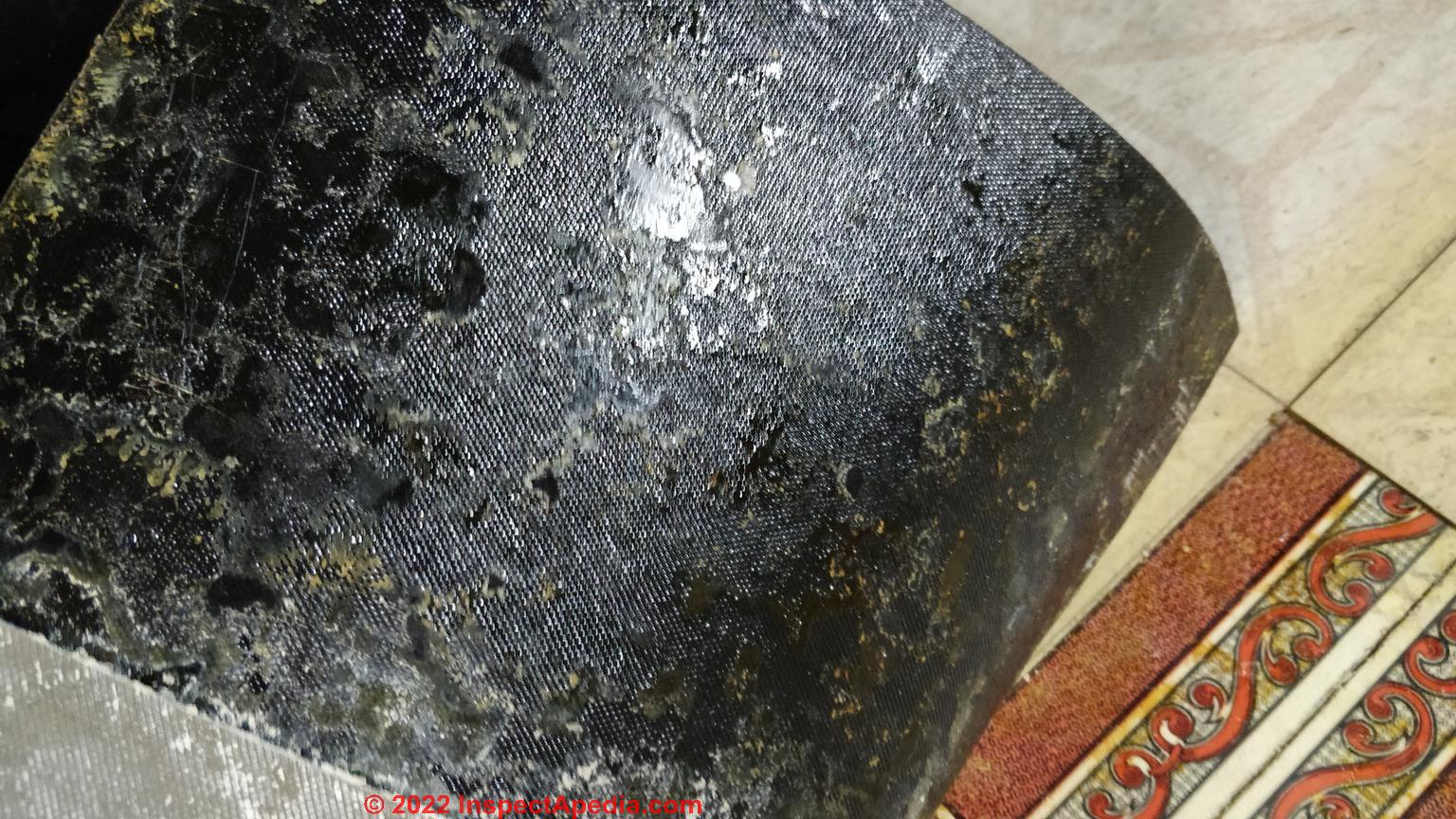
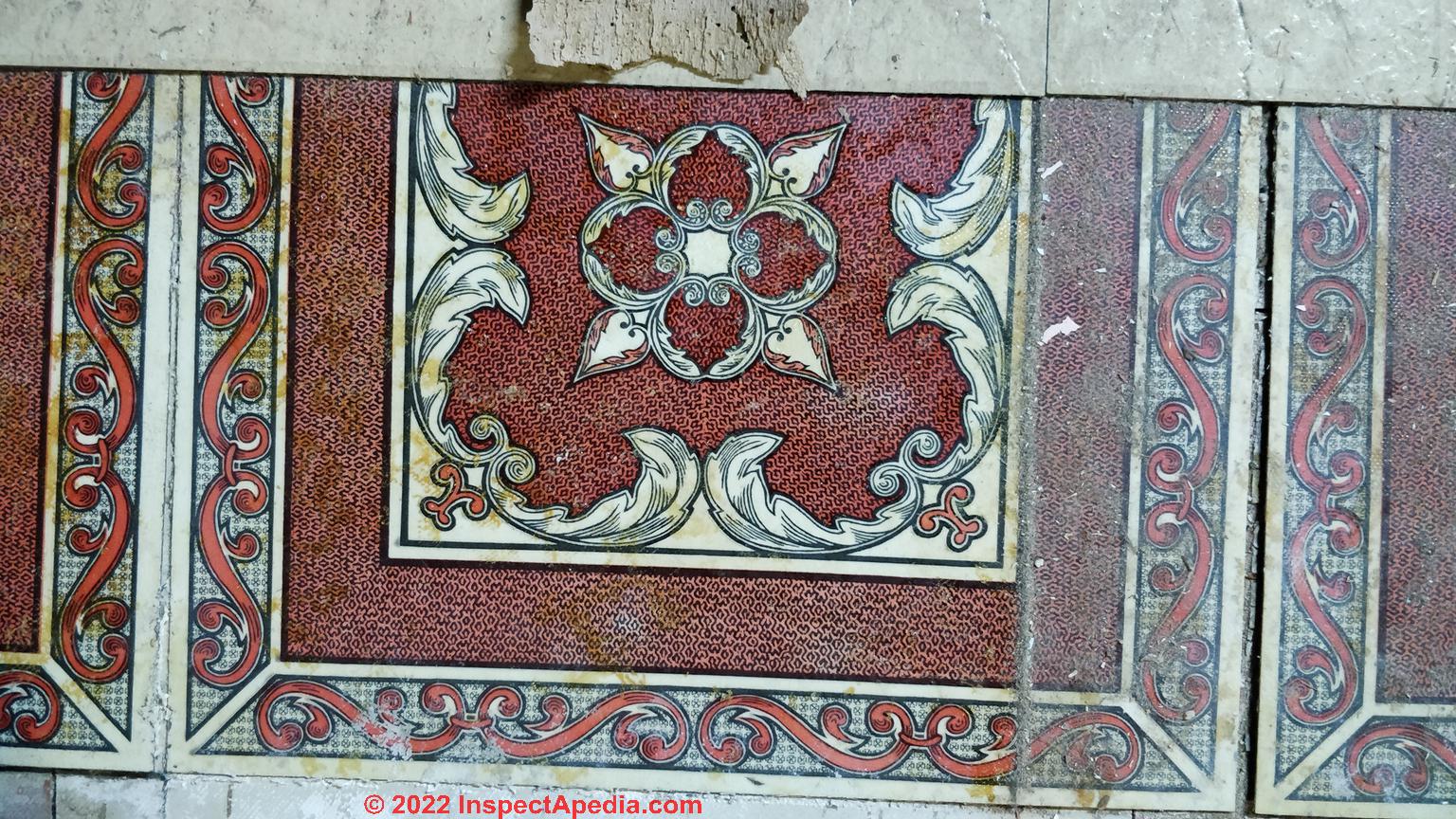
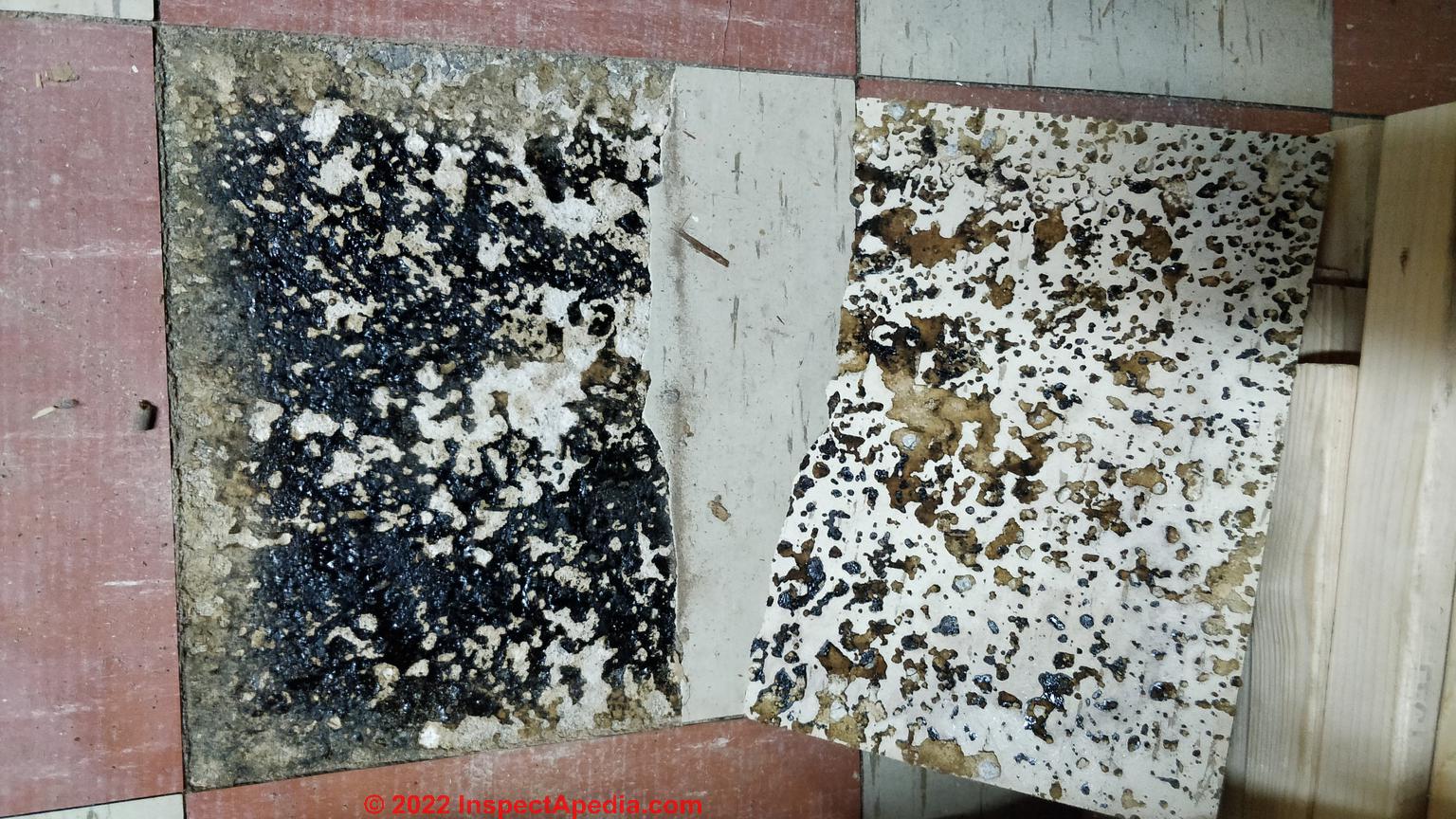
On 2022-03-24 by Andrew - Thanks for your work on this website. Does this black flooring mastic raise an asbstos concern?
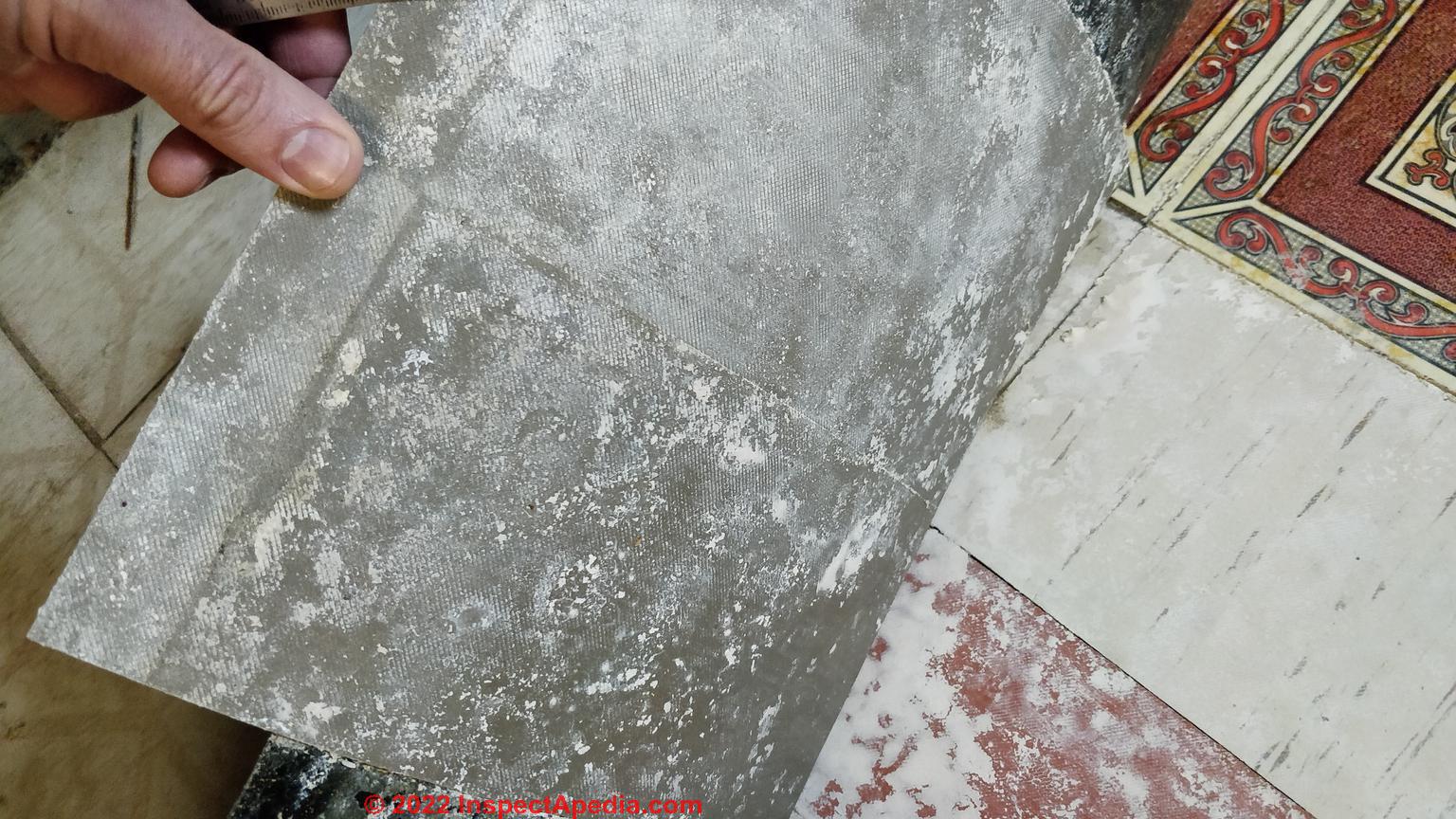
Hi there. Thanks for your work on this website. I'm doing a basement renovation and have 3 layers of vinyl tiles down there. Most are in good condition but stone are cracking and crumbling from moisture through the slab.
I would probably leave and floor over, but the contractor would prefer to lift them and seal the concrete. They are all 12" and probably 50's to 80's time frame. Some or all containing asbestos do you think?
Even if I lifted them, I'm wondering about the black glue on the slab that would remain and be walked over during construction. Do you think it would be black mastic? Thanks in advance
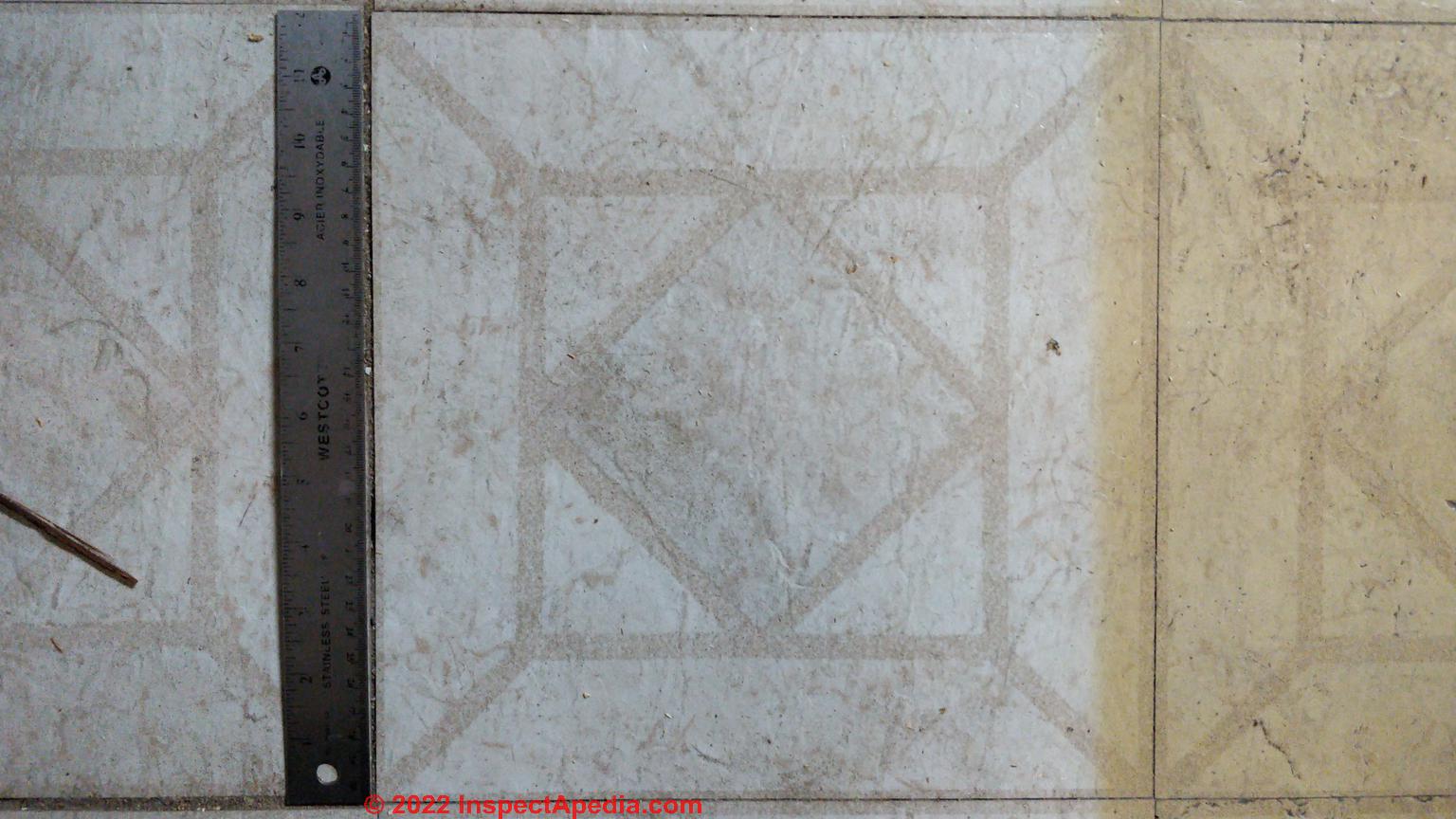 ...
... 
More pics.
 ...
... 
Last pics to show you
 ...
... 
On 2022-03-24 by Inspectapedia Com Moderator
@Andrew,
It's quite possible (common) for mastic adhesive below older floors to contain asbestos.
Where it's easy to lift old flooring to remove it, you can safely leave the mastic in place. Typically we seal the floor surface, then install a new floor over it.
Articles describing sealant coatings are in the article index.
Or go right to ASBESTOS ENCAPSULANTS & SEALERS
On 2022-03-24 by Andrew
@Inspectapedia Com Moderator, Thank you, that sounds like good advice.
I will remove the tiles that come off easily, then seal with epoxy. With the dimpled membrane and laminate vinyl flooring on top, it shouldn't even need levelling.
Thanks again.
On 2022-03-25 by Inspectapedia Com Moderator - asbestos sealant coatings will help with flooring project
@Andrew,
Reasonable, though epoxy is maybe more trouble than the asbestos sealant paints we mentioned as an alternative.
On 2020-10-30 by Nate - Your website is a godsend! Is this hard lagging asbestos material? Can I soak it to remove it?
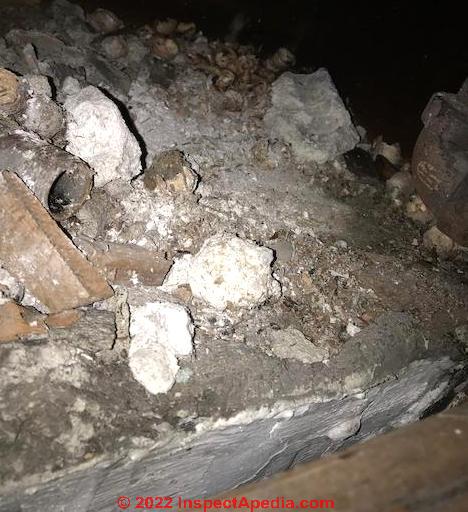 Your website is a godsend! Thank you for all the knowledge you share from your vast experience. I am in the process of isolating my rim joist, and as I was scooping out years of nut shells and chunks of wood, my hand fell upon a chunk of material I had not seen before.
I thankfully was gloved, but I had very limited visibility and accidentally grabbed it.
This photo shows a few pieces, with the upper right piece being the most helpful. This chunk is approx 3 inches long, 2 inches wide. The pipe on the side is an iron radiator return, and the mystery material seems to have once been applied to this pipe.
The chunk I picked up was very lightweight, fibrous, pure white, and (as I unfortunately caused) crumbled very easily, like chalk. My glove also looked like I had scooped dry plaster with it.
I sprayed the remaining pieces with water immediately, and under the stream of a garden sprayer, the material just melted into mush.
After studying your website, I believe this is "hard lagging", and this residue is all that I have encountered. I would like to soak it and remove it, ideally. It is only in this one bay, but in an awkward spot. May I spray it with soapy water and carefully remove the larger pieces intact, then perhaps redcoat the surface with Kilz or PVA glue, to cover any residue?
The house is 1922 farmhouse in upstate New York.
Thank you so much in advance for your help. I am eager to do a proper clean up of this. Best wishes, Nate
On 2020-10-30 by danjoefriedman (mod) - asbestos pipe lagging requires proper cleanup procedures
Nate
I agree that the white cementious material sure looks like asbestos pipe lagging;
It makes sense to remove loose asbestos-suspect debris, taking every precaution regarding air movement, dust control, wetting, personal protection gear, with the urgency being greater if for any reason one might expect this debris to move into or get tracked into the building.
OPINION: I can't see how much working space there is to deal with this (and I am not a certified asbestos remover) but if this were in my home I'd wet the area thoroughly, shovel the debris and top inch or so of soil into double bagged heavy contractor bags for disposal, then put down 6 mil poly over the cleaned, smooth crawl space surface.
Just spraying the dirt with an encapsulant won't address the problems down the road if/when someone has to enter the space to work on the building .
On 2020-10-30 by Nate - Thank you so much for the advice and for the wonderful website. It is an invaluable resource.
I am very grateful for your input. Thank you so much for the advice and for the wonderful website. It is an invaluable resource.
On 2020-10-30 by danjoefriedman (mod)
Thanks for the kind words, Nate; I've worked hard on this information for many years and am committed to making it accurate and unbiased, so I'm especially grateful when a reader finds it useful.
On 2019-05-29 by Mike K - Would it be safe (minimal asbestos particle released) to use water and a conventional wet vacuum to clean up as tile are placed into garbage bags?
Vast majority of floor tile (Presumed Asbestos Containing Material) installed in 1958 are loose due to repeated flooding in basement and must be removed.
Would it be safe (minimal asbestos particle released) to use water and a conventional wet vacuum to clean up as tile are placed into garbage bags?
If dry a HEPA vacuum is required. If a mister is used to keep entire area wet, is cleanup with a non HEPA vacuum acceptable?
On 2019-05-30 - by (mod) -
That's a great question Mike. I'd be concerned about causing both find water droplets containing asbestos dust as well as dust particles being made Airborne even using a conventional look back. I think a better approach would be to use wet cleaning methods to remove the majority of the debris and final dry vacuuming using a HEPA vac.
Question: possible asbestos cement board in 1950s house at air ducts
(Dec 30, 2011) Cathy T said:
We have a 1940's house and we removed the vent covers in order to put some filter fabric behind the vent covers.
We did notice that the actual vents where the ducts come up, were attached to the wall with a cement type board. Is there a chance that this could be asbestos related? Was asbestos used
in areas such as these?
Reply:
Yes that may be a fiber cement or asbestos cement millboard product. See ASBESTOS CEMENT PRODUCTS
Question: How do we contain any damage to asbestos flooring or remaining adhesive?
(Jan 23, 2012) Connie said:
We began removing flooring in our kitchen. The house was built in 1972 and had 2 layers of sheet vinyl on the floor. The first layer came up easily. The second layer looks similar to the 54282 random mosaic shown in your guide.
We had no idea it could contain asbestos until we went to Lowe's for supplies. At this point the flooring is gone and all that remains is the adhesive backing. Up to now we've done everything wrong. What should we do now? How do we know if it is indeed asbestos? How do we contain any damage at this point? Any help you can give us will be appreciated.
Reply:
You can assume the flooring contains asbestos based on age, or you can have a sample tested if the difference in handling cost will be significant.
also see ASBESTOS REMOVAL GUIDE, FLOORING
...
Continue reading at ASBESTOS IDENTIFICATION IN BUILDINGS or select a topic from the closely-related articles below, or see the complete ARTICLE INDEX.
Or see these
Recommended Articles
- ASBESTOS DISPOSAL REGULATIONS
- ASBESTOS FLOORING HAZARD LEVEL ASSESSMENT
- ASBESTOS FLOORING HAZARD REDUCTION
- ASBESTOS FLOORING REMOVAL GUIDE
- ASBESTOS IDENTIFICATION IN BUILDINGS
- ASBESTOS in GOOD CONDITION
- ASBESTOS PIPE INSULATION
- ASBESTOS TESTING LAB LIST
- ASBESTOS & FIBER CEMENT ROOFING
- ASBESTOS CEMENT SIDING
- CEILING PAINT TEXTURED / POPCORN ASBESTOS
- DOES THIS FLOORING CONTAIN ASBESTOS?
- DUST SAMPLING PROCEDURE - strategy for collecting building dust samples, when, where, how many samples to collect
- INSULATION IDENTIFICATION GUIDE - topic home
- OSHA REGULATIONS, ASBESTOS ROOFING, SIDING
Suggested citation for this web page
ASBESTOS REMOVAL, WETTING GUIDE at InspectApedia.com - online encyclopedia of building & environmental inspection, testing, diagnosis, repair, & problem prevention advice.
Or see this
INDEX to RELATED ARTICLES: ARTICLE INDEX to ASBESTOS HAZARDS
Or use the SEARCH BOX found below to Ask a Question or Search InspectApedia
Ask a Question or Search InspectApedia
Try the search box just below, or if you prefer, post a question or comment in the Comments box below and we will respond promptly.
Search the InspectApedia website
Note: appearance of your Comment below may be delayed: if your comment contains an image, photograph, web link, or text that looks to the software as if it might be a web link, your posting will appear after it has been approved by a moderator. Apologies for the delay.
Only one image can be added per comment but you can post as many comments, and therefore images, as you like.
You will not receive a notification when a response to your question has been posted.
Please bookmark this page to make it easy for you to check back for our response.
Our Comment Box is provided by Countable Web Productions countable.ca
Citations & References
In addition to any citations in the article above, a full list is available on request.
- Stanton, F., et al., National Bureau of Standards Special Publication 506: 143-151
- Pott, F., Staub-Reinhalf Luft 38, 486-490 (1978) cited by McCrone
- "Handling Asbestos-Containing roofing material - an update", Carl Good, NRCA Associate Executive Director, Professional Roofing, February 1992, p. 38-43
- In addition to citations & references found in this article, see the research citations given at the end of the related articles found at our suggested
CONTINUE READING or RECOMMENDED ARTICLES.
- Carson, Dunlop & Associates Ltd., 120 Carlton Street Suite 407, Toronto ON M5A 4K2. Tel: (416) 964-9415 1-800-268-7070 Email: info@carsondunlop.com. Alan Carson is a past president of ASHI, the American Society of Home Inspectors.
Thanks to Alan Carson and Bob Dunlop, for permission for InspectAPedia to use text excerpts from The HOME REFERENCE BOOK - the Encyclopedia of Homes and to use illustrations from The ILLUSTRATED HOME .
Carson Dunlop Associates provides extensive home inspection education and report writing material. In gratitude we provide links to tsome Carson Dunlop Associates products and services.
 | HOME | ABOUT | ASK a QUESTION | CONTACT | CONTENT USE POLICY | DESCRIPTION | POLICIES | PRIVACY | |
| © 2024 - 1985 Publisher InspectApedia.com - Daniel Friedman | |||||||||