
InspectAPedia® FREE Encyclopedia of Building & Environmental Construction, Diagnosis, Maintenance & Repair |
Question? Just ask us! InspectAPedia
|
 The Federal Pacific Electric FPE Stab-Lok® Electrical Hazards
Home Page & Index to Articles
- POST a QUESTION or COMMENT about FPE Federal Pacific Electric panels and circuit breakers, Federal Pioneer, and related brands
FPE Federal Pacific Electric Stab-Lok® Electrical Panel & Circuit Breaker Hazards Home Page: here we explain the fire and shock hazards associated with Federal Pacific Electric Stab-Lok® circuit breakers and service panels, provides a complete history of the FPE Hazard, and we provide and cite independent, unbiased research on FPE failures, and recommends replacement of the panels.
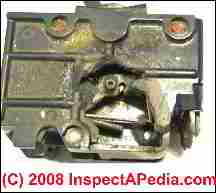
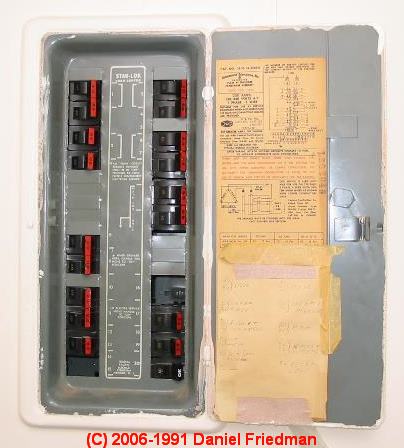
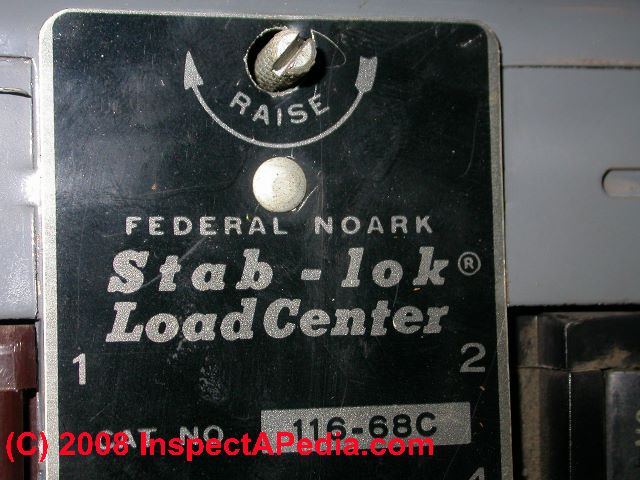
Photographs are provided to aid in identification of Federal Pacific FPE Stab-Lok® equipment. The current status of FPE Stab-Lok®equipment hazards, recalls, product safety research, and consumer warnings can be found here.
Replacement FPE Stab-Lok® circuit breakers are unlikely to reduce the failure risk of this equipment. We recommend that residential FPE Stab-Lok® electrical panels be replaced entirely or the entire panel bus assembly be replaced, regardless of FPE model number or FPE year of manufacture. We do not sell circuit breakers nor any other products.
InspectAPedia tolerates no conflicts of interest. We have no relationship with advertisers, products, or services discussed at this website.
- Daniel Friedman, Publisher/Editor/Author - See WHO ARE WE?
Federal Pacific Electric Stab-Lok® Circuit Breaker Hazard Current Status, Failures, Research, & History
 For information on FPE Stab-Lok® equipment that can be copied to any website,
see FPE Stab-Lok® Hazard Summary Page for Public Use
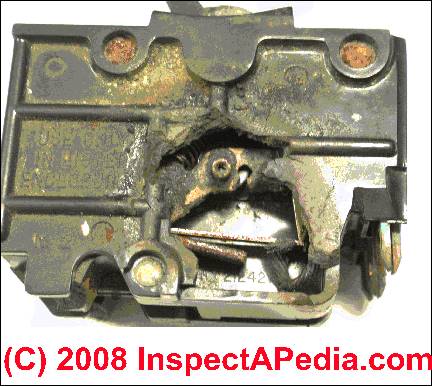
Federal Pacific Electric "Stab-Lok® " service panels and breakers are a latent hazard and FPE circuit breakers can fail to trip in response to overcurrent, leading to electrical fires. The breakers may also fail to shut off internally even if the toggle is switched to "off."
Some double-pole (240-Volt) FPE circuit breakers and single-pole FPE Stab-Lok® circuit breakers simply do not work safely.
There are other FPE panel-defects independent of the breaker problems, panel and panel-bus fires and arcing failures in some equipment. The failure rates for these circuit breakers were and still are significant.
In some cases failure to trip occurs 60% of the time - a serious fire and electrical shock hazard.
Failures are documented in the CPSC study and by independent research. Additional independent testing and research are on-going and are reported here.
FPE Stab-Lok® electrical panels should be replaced. Do not simply swap in some replacement breakers. (Details are
A Summary of the Problem: Federal Pacific Stab-Lok® ® Electric Panel and Circuit Breaker Hazards
 Please see FPE HAZARD SUMMARY for the full detail of this FPE topic.
Having reviewed documentation regarding this issue, and having discussed the issue with forensic experts in the field, we are convinced that a latent hazard exists where FPE Stab-Lok® circuit breakers continue in use. The hazard is worst for double-pole breakers.
Published reports of actual tests that were performed indicate that under certain conditions it is possible for one leg of these circuits to attempt to trip the breaker, resulting in a jammed breaker which will afterward not trip under any load condition.
A reader might infer from the CPSC 1983 press release that the manufacturer and some Commission members were of the opinion that these conditions would not occur in the field.
This was and remains an erroneous conclusion. Some very common household appliances operate are powered by a two-pole 240V circuit (protected by the type of breaker under discussion) but use two or more independent 120V sub-circuits inside the appliance.
Two obvious cases are electric clothes dryers and ranges. If, for example, the low-heat (110V) heater in a dryer were to short to the dryer case, a serious overcurrent would occur on one "leg" of the circuit.
Another wiring practice, using a single two-pole breaker to power a split circuit which uses a shared neutral, such as may be installed in kitchens in some areas, is nearly certain to have each leg of the circuit loaded independently and thus subject to single-leg overloading and subsequent breaker jamming. A breaker which jams and then fails to trip under this condition is, in our opinion, a serious fire hazard.
A more careful reading of the CPSC press release of March 3, 1984 suggests that the authors were careful NOT to conclude that there is no hazard, but simply that the information at hand did not prove the hazard, and that the Commission did not have funds to pursue testing.
In this document, the representation that no real hazard exists is made by the manufacturer of the device - not exactly a neutral party, and even that wording is cautious in tone: "FPE breakers will trip reliably at most overload levels." Readers should see the failure rates cited in the IAEI letter found
at FPE HAZARD IAEI LETTER INACCURATE
FPE Stab-Lok® Equipment Means Latent Fire Hazards
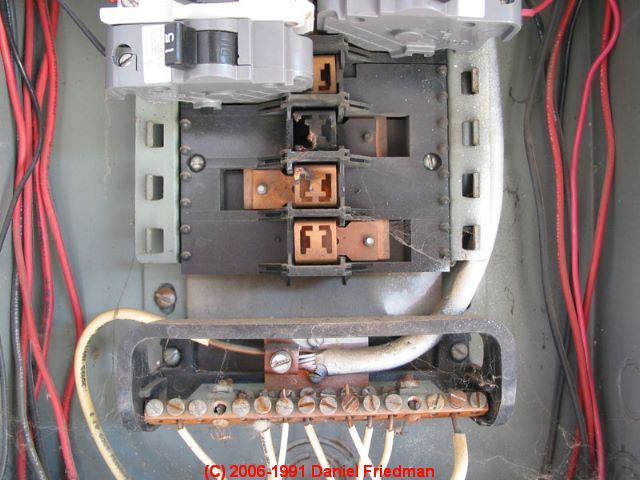 It's the exceptions that cause fires. An FPE circuit breaker will appear to "work just fine" in passing along current to
the circuit it feeds, until there is an overcurrent, short circuit, or similar condition.
It's the exceptions that cause fires. An FPE circuit breaker will appear to "work just fine" in passing along current to
the circuit it feeds, until there is an overcurrent, short circuit, or similar condition.
When those exceptional conditions occur, this equipment fails to protect the circuit and the building from overheating and fires, in some cases at a failure rate around 60% of the time.
We estimate that the normal industry failure rate on circuit breakers is less than .01%.
Consumers should read and follow the Commission's advice regarding circuit breakers. But this advice is insufficient. The Commission's admonition to avoid overloading circuits and to turn off and have examined devices which seem to be creating a problem is a poor substitute for reliable, automatic, overcurrent protection.
It is precisely because dangerous conditions can and do occur without adequate recognition and action by a consumer that circuit breakers and fuses are installed to provide overcurrent protection in the first place.
Therefore it is hardly an adequate "fix" for FPE breakers to just tell consumers to handle these cases manually.
It is possible that some individual FPE Stab-Lok® circuit breakers may perform with adequate reliability, possibly those manufactured after the companies discovered safety defects and improper practices in listing the product, and possibly those manufactured in Canada.
However, at least some "new" and "replacement" FPE breakers are actually new old stock that was never modified in design nor manufacture or appears as new stock made on the same production equipment, to the same specifications, and/or of the same design as old stock and failing breakers.
In absence of an explicit statement from the manufacturer and/or the US CPSC indicating that newer stock equipment is defect free, and considering that defects occur in both breakers and the panels themselves, and finally, that testing showed failures in both in-use equipment and new off-the-shelf devices, our advice to consumers and electricians is that these panels be replaced with newer equipment, particularly those which use 240-volt double-pole breakers described in the literature.
In our opinion, if a fire or other hazard occurs with this device, neither the manufacturer nor the Commission, who have suggested in the press release that data was inconclusive or inadequate to establish a hazard, will accept responsibility for losses that may ensue.
However a building inspector, home inspector, or contractor who makes any warranty of safety, by virtue of his/her position close to the consumer, is certain bear this very liability.
Canadian FPE Stab-Lok® panels and Federal Pacific or Federal Pioneer Circuit Breakers
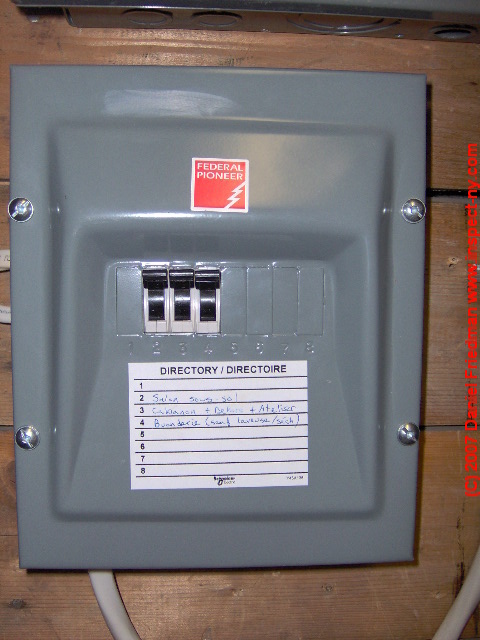 Please see FEDERAL PIONEER ELECTRIC PANELS for the full version of this article series on Canadian FP panels.
In May 1999 we learned from Schneider Canada that Federal pioneer circuit breakers sold by that company are re-named from Federal Pacific circuit breakers and that two 15-amp single-pole models NC015 and NC015CP made between August 1, 1996 and June 11, 1997 have been recalled.
The SCHNEIDER AND FEDERAL PIONEER AS WELL AS SOME SQUARE-D RECALL NOTICES are available.
We asked the company engineer with whom we spoke if he could determine if Federal Pioneer and Federal Pacific components sold in Canada were made in the U.S. or if tooling used to produce them was identical with that used in the U.S.
If this is the case (as one might expect based on economies of production) one should consider the possibility that other defects reported in the U.S. may also appear in Canadian installations.
As we report at FPE STAB-LOK HISTORY, quoting information from legal cases from 2005, all Stab-Lok® breakers are essentially identical.
The Federal Pioneer Warranty Alert was issued by the Ontario New Home Warranty program in October 1997 and provides for circuit breaker replacement. Schneider Canada is an electrical supplier whose product lines combine those previously marketed under the names Federal Pacific Electric, Federal Pioneer, Square-D, Tele Mechanique, Modicon, and Merlin Gerin.
Carl Grasso, an attorney who researched FPE failures for the New Jersey class action suit explains that since a portion of the safety defect with FPE breakers may be due to variations during manufacture, and since Canadian breakers may be manufactured in a different plant from those made in the U.S., it is possible that the field performance of Canadian breakers may be different than the U.S. design.
Schneider Canada, the Federal Pioneer parent company, has not provided information regarding design or manufacture changes over the U.S. design, nor provided test data regarding the product.
As of May 2008 we have had a few reports of failures in the Canadian Federal Pioneer (Stab-Lok® ) equipment and also reports of failures of "replacement" FPE circuit breakers installed in U.S. panels. Having inspected some Canadian FPE (Federal Pioneer-brand) electric panels, we observed two ongoing concerns:
1.) the same bus design was used as in the U.S. equipment. I've seen very poor retention of breakers in the bus - in one house the breaker was held in place by duct tape, as the spring design in the contact of the breaker where it plugs into the special opening in the bus appears not to have held the breaker in place.
We have also seen breakers modified with their inserting pins bent and modified to fit a breaker into a slot where it did not belong - a step that is impossible with other breaker designs.
2.) A similar or identical panel design may expose consumers to panel arcing and fires regardless of changes in the breakers themselves.
Also see FEDERAL PIONEER PANEL SAFETY
Back of the envelope cost-benefit analysis of replacing an FPE Stab-Lok® electrical panel
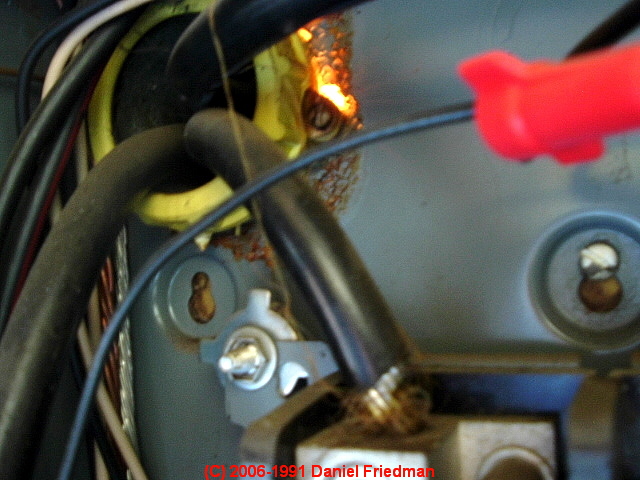 Aronstein/Lowry (2012), estimate that the potential savings from a ten-year replacement program for FPE Stab-Lok® electrical panels in the U.S. alone would result in
- Reduction of 5,212 building fires
- Reduction of 214 injuries
- Reduction of 25 deaths
- Reduction of $74.4 million in property losses [12]
[Incidentally, $74.4M / 5,212 fires = $14,275 average loss per event - a figure which may not include all losses such as cost of alternative lodging, time lost, etc. and it does not address the costs of injuries or deaths - Ed.]
These figures are difficult to translate into the cost/benefit of FPE Stab-Lok® electrical panel replacement for an individual building owner. Worse, some building owners, particularly home sellers, may figure that electrical panel replacement is an avoidable cost that is of more benefit to future owners than to themselves.
The cost to replace an electrical panel is basically the cost of materials and labor: the cost of the new panel and breakers and the labor to remove the old panel and connect existing electrical circuits into the new one.
The property owner or an electrician can buy a new electrical panel complete with circuit breakers for a cost ranging from under $100. U.S. to around $200. (depending on panel ampacity and number of circuit breakers) at most building supply stores. The cost of panel installation/replacement varies widely depending on where you live but typically ranges from $1000. to $2,500. .
Also there may be financial relief for seniors or people of limited means in some communities or according to some readers, even from some insurance companies. Check with your local senior citizens state, town, or county agencies and with your insurer.
A expert reviewer pointed out that:
- [we should] keep in mind that the 1/6000 per year is the added risk of an electrical fire due to FPE breaker defects [not the total risk]
- I think it is folly to propose a cost-benefit analysis on a safety item that people think "has been working fine all these years". The incentive to change an FPE panel is not based on saving money.
We agree that there is a lot of folly in how individuals approach safety and risk. Here we address viewers who may be open to a more accurate understanding of the risk of fire, shock, etc.
In my OPINION [DF], considering the significant contribution of FPE Stab-Lok® equipment to house fires, replacing the equipment is likely to be less costly than the cost of a fire.
If we wanted to make a completely emotionless assessment of the cost-benefit of replacing an unsafe electrical panel that is associated with about 2.5% of all of the annually reported electrical panels in the U.S. and is present in about 17 million homes in the U.S. as well as in many other buildings, or if we wanted to consider that there is about one fire per year for every 6000 FPE Stab-Lok® Panels in homes, let's say that your
- Annual risk of a house fire in a home with an FPE Stab-Lok® panel = 1/6000 or one chance in 6000, per year [12]
- Guess at a house fire cost in lost property, building repairs etc = $60,000
- Guess at number of years of a home having an FPE Stab-Lok® panel = 40 years
- Calculated guess at cost of not replacing an FPE Stab-Lok® panel = (1/6000) x ($60,000) x 40 = $400
- A serviceable replacement electrical pa nell cost at Home Depot for a 125A replacement electrical panel = $85.00 * To the panel cost we must add installation labor and licensing fees, making typical electrical panel replacement total cost about $1000 - $2500. or more.
(For details see FPE REPLACEMENT PANEL COSTS)
To the costs you are avoiding, add
- An assessment of how risk averse you are and what you will pay to reduce or eliminate a particular risk of fire, loss, and risk of injury or death.
- An assessment of the impact on home resale; few home buyers will accept a home with an FPE Stab-Lok panel without asking for an allowance of panel replacement cost - a stumbling block to negotiate if you are a home seller.
Why not replace the panel while you are living in the home, enjoying the reduced risk and addressing what you otherwise are likely to have to pay at time of home resale?
In my OPINION, one might infer that even if we were not willing to pay one cent to reduce the risk of the time, trouble, or even injury or death that might ensue from a house fire caused by an FPE Stab-Lok® electrical panel or breaker failure, that is, if we just consider the cost of a replacement electrical panel, replacing the panel is a good deal.
* GE PowerMark Gold 125 Amp 12-Space 24-Circuit Main Breaker Load Center Contractor Kit, Model # TM1212RCU1K, Internet # 100182490, Store SKU # 393844, retrieved 10/2/2012
For people who are unable to promptly replace an FPE Stab-Lok® electrical panel we recommend that you should be sure you have working smoke detectors properly installed and at least you will be able to sleep at night.
Also
see CAN'T AFFORD A NEW ELECTRIC PANEL?
Federal Pacific Electric FPE Stab-Lok® Panel Replacement Financial Aid?
There is no financial recourse, no product recall, no financial help, no warranty claim, no replacement fund currently available for FPE Stab-Lok® electrical panels except for a very limited class action result in the state of New Jersey.
New Jersey residents can see FPE CLASS ACTION SETTLEMENT for more information.
For more information about the cost of panel replacement, FPE replacement options, electricians, and an approach that can save part of replacement cost in some cases: see the articles listed just below
- FPE REPAIR ELECTRICIANS
- FPE REPLACEMENT PANELS
- FPE REPLACEMENT PANEL COSTS
- CAN'T AFFORD A NEW ELECTRIC PANEL?
How to report your FPE Stab-Lok® panel or circuit breaker Failure - Reporting Federal Pacific and Federal Pioneer Equipment Problems
Please see ELECTRICAL PANEL / BREAKER INCIDENTS, HOW TO REPORT for full details of reporting FPE Stab-Lok® ™ and other electrical product failures
We invite voluntary field failure reports from readers who are aware of or who experience failures of Federal Pacific and Federal Pioneer equipment order to add to the existing data base.
In addition to informing us of an FPE Stab-Lok® or Federal Pioneer electrical panel or breaker event so that we can add this incident report to the data base we maintain, we encourage readers to report such events also to the US Consumer Product Safety Commission - it's easy: you can use a simple form at the CPSC's website: https://www.cpsc.gov/incident.html or you can send the CPSC email on incidents to: info@cpsc.gov
There is no requirement that failures be reported to us for tabulation here. This website is not a government or other official document, nor does it receive nor request funding.
Printed copies of our website pages are permitted
(hard copies on paper) for free (not for sale) distribution provided that you do not edit the content, you include a citation of the source web page, and you do not imply that our website is endorsing any product or service for sale.
Federal Pacific Electric FPE Stab-Lok® Information for your website:
for information on FPE Stab-Lok® equipment that can be copied to your website,
see FPE Stab-Lok® Hazard Summary Page for Public Use
...
Reader Comments, Questions & Answers About The Article Above
Below you will find questions and answers previously posted on this page at its page bottom reader comment box.
Reader Q&A - also see RECOMMENDED ARTICLES & FAQs
On 2020-02-16 - by (mod) - comparative safety of fuse panels
Raymond
Indeed FPE **Fuse** type electrical panels did not have the breaker-no-trip hazard that we discuss in this article series.
Years ago another, older, electrician friend shared his opinion that he preferred fuses, particularly as the panel main overload protection, as the most-reliable device.
Thank you for the FPE field failure report involving a clothes dryer overcurrent and FPE no-trip event. This is EXACTLY the problem that we point out occurs when an FPE Stab-Lok breaker gets an overcurrent on just one side of a 2-pole circuit breaker.
The breaker jams internally and then will not trip at ANY overload level.
That's why your dryer overcurrent burned a hole in the steel plate as you describe.
Remarkably, this is the very defect that FPE's lawyers argued to the US CPSC was "unrealistic as it is a problem that never occurs in the field".
The error in that false claim is that many 240VAC appliances, including both electric stove tops and ranges and clothes dryers, though fed 240VAC through a double-pole breaker, will split off the 240V into separate 120VAC sub-circuits in the appliance.
For example an electric clothes dryer provides HI and LO heat ranges that work by switching on two or just one 120VAC electric coil type heaters.
On 2020-02-16 by Raymond M. Garafano
Frankly A HOME with proper service for its needs would be much safer with fuses than FPE.sta- block brkrs I did have an FPE fuse panel
with pull- outs for dryer and range and s mains brkr that worked very good.
All in all fuses have NO moving parts to jam up.
On 2020-02-16 by Raymond M. Garafano
Had 2 ecp. With fpe. 240 v dryer ckt.burnt a hole in steel plate behind dryer about an inch in dia. .if I was not home at that time I WOULD NOT have a home to come back to. short in space htr. Big white ball of power in cord exiting htr. Breaker hummed but did not trip.
On 2016-06-27 - by (mod) -
Kevin, is this a trick question? The high rate of no-trip failures cited ando documented by independent experts did not stop in 1981.
That fact suggests that it's not a good idea to wage the argument suggested by your question.
On 2016-06-27 by Kevin Adams
So, it is my understanding that the Stab-Loc breaker manufactured after 1981 do meet UL standards for that time period and are generally safe except for the ones recalled, of course. Is that correct?
Additionally, many of the problems with FPE of that era are the same or similar to other manufacturers of that era. I have seen both GE and Square D with the same problems ie failing after 1 over current, failing to trip, etc.
So would it be better to conclude old panels should be replaced to be more sake regardless of the manufacturer name?
I currently have Stab-Loc 1983, which I will replace eventually, but the only problem I have so far is the breakers wiggling loose due to vibration from being on the wall next to my garage door.
On 2016-04-12 - by (mod) -
Thank you for the important field report, Rod. If you can send details, photos, fire reports, to me by email (use the page bottom CONTACT link) that would be very valuable; at InspectAPedia.com technical content contributors are by default kept anonymous unless you (they) want to be identified.
Your note points out that even a comparatively small fire can be terribly costly and disruptive to people's lives. Thank goodness no one was injured.
I agree completely, as do other people who understand the FPE hazard, that all electrical panels of the stab-lok design should be replaced.
On 2016-04-11 by Rod - We recently had a FPE panel meltdown and fire at our house here in MA.
We recently had a FPE panel meltdown and fire at our house here in MA. Fortunately the Fire Department responded quickly and we were home at the time of the fire. Our house is not that old... built in 1988 but it did have this panel and it was clear that it overheated and malfunctioned.
Quick response and the right decisions saved our house but it was minutes away from exploding and causing a full home loss. The fire suffered from oxygen deprivation as our house in very tight and we did not open any doors to feed it and the fire department was there within 10 minutes to knock it down.
However, we did experience heavy smoke damage and were forced to move out of the house while repairs were made. We were out of our house for nearly three months and although we are now back in the house it is not fully restore or are we made whole again at this point.
I would STRONGLY RECOMMEND that people replace the FPE panels with a new and high quality replacement. The risk is simply too high. Had our fire happened and hour earlier or an hour later we would have lost everything!! Rod
On 2014-10-04 - by (mod) - why some insurance companies may not recognize FPE Hazards: nobody to sue?
Eric thanks for the important and interesting observation. I've seen no data on the possibility that insurance companies fail to recognize the FPE Stab-Lok contribution to fires because of the subrogation worry but it sounds plausible.
Think of it this way: a bad FPE breaker doesn't *cause* the fire directly. Rather, it fails to protect the building by fire by failing to shut off power to an electrical circuit that is experiencing an unsafe condition such as an overcurrent (for any reason) that in turn causes overheating of wiring and thus a short, spark, or heat-related fire.
We believe in general that only a miniscule fraction of FPE-related fires and failures are ever reported for many reasons. For example an electrician called to a site where a panel or breaker has failed more likely just throws the old parts into the trash and installs new equipment.
Nobody reports a thing. Similarly, when an actual fire occurs, often the evidence has burned such that only an expert forensic engineer is likely to report the cause(s) with full accuracy.
For these reasons, we consider individual fire reports very important - experts believe they are representative of a larger group of unreported events.
If you can send me details we can add your case to our fire reports section - with anonymity or not as you wish. Use the email at our CONTACT link if you wish.
Thanks
Daniel
On 2014-10-03 by EricJohnson
We had a house fire in 2006 - and you guessed it - it had FPE stab-lock circuit breakers.
The fire inspector from the insurance company was asked about the electrical panel and I told him who it was made by - but then he concentrated on trying to find the manufacturer of a florescent light fixture - he blamed it on the light fixture.
I believe it was because they could not subjugate the fire to FPE because there way no way to recover any money.
So I wonder how many fires from FPE are not reported due to insurance companies trying to find a way to cover their losses.
We had a total loss and had to tear it down and rebuild.
On 2014-04-23 - by (mod) -
Anon,
Thanks for your nice comment. Still I see we need to do more work on this topic, as apparently I've not made it sufficiently obvious that there is no explicit law requiring FPE equipment replacement in any jurisdiction.
The reason to replace the equipment is that research since the 1980's and up through 2012 confirm that the equipment is unsafe, a view supported as well by field failure reports.
In addition, some insurance companies will not insure a building serviced by FPE equipment, a position that means selling such a property may encounter a hiccup.
Finally, some national electrical code experts argue that although the NEC does not specify the exclusion or removal of individual or even classes of unsafe products (aluminum wiring, FPE panels, Zinsco, other equipment that in fact has been recalled), the code does contain provisions requiring safe installation practices that can be interpreted as a basis for arguing that unsafe equipment is also in violation of the National Electrical code.
But at the end of the day, the reason to remove and replace unreliable equipment that fails at a high rate such as FPE is that it is unsafe, not because someone wiggles around to find an "illegal" status.
To pretend that every unsafe or unreliable product sold in the world will always be flagged by law or by a product recall would be as incoherent as pretending that because we have policemen and the FBI and NSA that nobody ever commits a crime.
On 2014-04-23 by Anonymous
Sir,
Thank you for your efforts and responsiveness in providing information here regarding the dangers of this FPE equipment.
I could use your assistance in locating information specific to New York State requirements on replacing FPE breaker boxes and the like. Thus far my searches have only uncovered New Jersey information. I am attempting to identify whether NYS or possible NYC has issues statutes requiring residential buildings (apartments, condos, co-ops, etc.) to replace FPE hardware.
Your assistance in sourcing any information specific to NY would be most appreciated. Sincere regards.
On 2014-04-11 - by (mod) - no Florida Law on FPE panels
Marilyn,
I am unaware of any state law such as the one you describe. The reason the panel should be replaced is that it is a latent safety hazard.
While there is not to my knowledge any such FPE replacement "law", it is indeed the case that we receive frequent reports that some major home owners insurance companies will refuse to insure a home where this equipment is installed.
Even if a home buyer were not concerned with the safety hazard, she might be stumped when unable to obtain financing or re-financing, or if the matter were kept under-wraps, when a later claim would not be honored by the insurer.
On 2014-04-11 by Marilyn
Just recently purchased a Hubzu home in Florida and had inspected prior to my bidding; and yes it has this faulty Fed Pacific Electrical Box ~ I was just told by another Florida resident that there is a Florida State Law that requires the seller to have it replaced regardless of the type of Real Estate transaction that it is;
not having any success on-line locating the specific Florida law. . .
On 2014-04-08 - by (mod) -
Mike,
I cannot imagine worse advice than your opinion stated below. There are several very serious concerns:
1. the "replacement breakers" that you cite have no evidence of performing any differently than the unreliable ones they replace
2. the underlying design problems that lead to breaker no-trips and bus connector burn-ups and on occasion more serious losses, remain when the panel remains
3. In addition to having been found guilty of fraud, label switching, cheating on breaker qualification tests, and other improper practices, independent research has consistently shown that the product fails to respond to overcurrent at a stunning rate, in the 60% range for 2 pole breakers, in an industry where overall circuit breakers fail to trip in response to overcurrent at a fraction much less than 1%.
4. FPE Stab-Lok electrical panels and circuit breakers are a latent safety hazard. That means that the product does not itself initiate a failure or fire. The breakers may also remain "on" internally when apparently switched off - a good way to electrocute someone.
It's a latent safety hazard just sitting there, failing to protect when it's called upon in an emergency. That may explain why this "sleeping dog" while it remains asleep - not called on to perform - seems just fine. There's no need for panic, but there is a need to replace the equipment.
5. On one point we might agree, that is that some electrical repair companies and product vendors indeed prey on consumer fear to make a buck. For this reason we point out that
- Avoiding panic can avoid being gouged by a contractor when you order electrical panel replacement
- InspectAPedia is an independent publisher of building, environmental, and forensic inspection, diagnosis, and repair information provided free to the public - we have no business nor financial connection with any manufacturer or service provider discussed at our website.
WATCH OUT: One wonders who Mike is and what might be his connection with the company he touts.
On 2014-04-08 by Mike
You do not have to replace your entire panel if you have Federal pacific Stab-lok style breakers. There is a company, Connecticut-Electric, Inc that makes brand new, ETL listed, same test as UL, Federal Pacific Stab-lok style replacement circuit breakers that are safe to use and completely safety agency listed.
There seams to be a "red scare' out there about these breakers, yes, there were some issues.
Even the federal government couldn't make a decision based upon the facts present to say that Federal Pacific breakers are actually unsafe. Why spend all that money replacing your entire panel, which most electrician love to hear. They just see dollar signs.
On 2014-02-24 - by (mod) - FPE Fraud was not a "slip up"
Re: I'm not sure
None of this has to do with FPE where these comments were posted.
That case involved decades of outright fraud, cheating on tests, bribes, etc. as documented in the references & citations.
That's not a slip-up, it was trying to keep making a product that was defective and most likely couldn't be fixed without a redesign that priced it out of its market niche.
On 2014-02-24 - by (mod) -
Re-posting comment from "I'm not sure" without the prohibited offsite links:
I think with any thing in life an "experienced professional" will slip up now and then.... give them a break.
On 2013-04-06 by Anonymous
The common used phrase is "hire an experienced professional". I work for a company that requires two years experience, drug testing, four weeks on the job training, etc., etc...and these guys screw up all the time.
...
Continue reading at FPE HAZARD SUMMARY or select a topic from the closely-related articles below, or see the complete ARTICLE INDEX.
Or see FEDERAL PACIFIC FPE HAZARD FAQs - questions & answers posted originally on this page
Or see these
Recommended Articles
- FEDERAL PACIFIC FPE HAZARDS - home
- CIRCUIT BREAKER FAILURE RATES
- DO NOT PERFORM In-Home Testing of FPE Stab-Lok®
- EXXON Buys a Scandal 1980
- FP FEDERAL PIONEER in CANADA
- FPE & FP IDENTIFICATION, HOW TO
- FPE FRAUD - PRESS RELEASE
- FPE FRAUD Stab-Lok® SEC REPORT
- FPE HAZARD REPORT - 2017 [PDF] that supercedes the older reports
- FPE REPLACEMENT BREAKERS - test results of UBI-brand FPE Stab-Lok type replacement circuit breakers
- FPE REPLACEMENT PANEL options for re-using the original panel enclosure
- FPE STAB-LOK HAZARD PROOF
- FPE Stab-Lok® MOST RECENT REPORTS
This FPE information Website hosted by Dr. Jess Aronstein also provides copies of his research reports: FPE-INFO.ORG
Suggested citation for this web page
FEDERAL PACIFIC FPE HAZARDS at InspectApedia.com - online encyclopedia of building & environmental inspection, testing, diagnosis, repair, & problem prevention advice.
Or see this
INDEX to RELATED ARTICLES: ARTICLE INDEX to FPE STAB-LOK BREAKERS & PANELS
Or use the SEARCH BOX found below to Ask a Question or Search InspectApedia
Ask a Question or Search InspectApedia
Try the search box just below, or if you prefer, post a question or comment in the Comments box below and we will respond promptly.
Search the InspectApedia website
Note: appearance of your Comment below may be delayed: if your comment contains an image, photograph, web link, or text that looks to the software as if it might be a web link, your posting will appear after it has been approved by a moderator. Apologies for the delay.
Only one image can be added per comment but you can post as many comments, and therefore images, as you like.
You will not receive a notification when a response to your question has been posted.
Please bookmark this page to make it easy for you to check back for our response.
IF above you see "Comment Form is loading comments..." then COMMENT BOX - countable.ca / bawkbox.com IS NOT WORKING.
In any case you are welcome to send an email directly to us at InspectApedia.com at editor@inspectApedia.com
We'll reply to you directly. Please help us help you by noting, in your email, the URL of the InspectApedia page where you wanted to comment.
Citations & References
In addition to any citations in the article above, a full list is available on request.
- Note: as we didn't add this reviewers list until 2007, this list of technical reviewers is incomplete; we have received comments and suggestions regarding this topic, edits and remarks included, from engineers and management from the US CPSC, electricians (many listed at our page on field reports of FPE failures), home inspectors, licensed electricians, and electrical engineers, and even a few attorneys and real estate agents, since 1986. Technical review, critique, content suggestions, questions, or clarifications are invited and where a contributor wishes, credit and links will be provided to that source. Contact us to provide feedback.
- [1] Dr. Jess Aronstein, electrical engineer, Poughkeepsie, NY, forensic engineering services, independent laboratory testing for various agencies protune@aol.com (independent electrical panel testing, including FPE Stab-Lok® panels, to April 2010)
- [2] David Carrier, electrical engineer, 53 Henmond Blvd., Poughkeepsie, NY 12603 845-430-7527 davidwcarrier@earthlink.net (independent electrical panel testing, including FPE Stab-Lok® panels, beginning 2010)
- [3] Alan Carson, Carson Dunlop Associates, Toronto, Ontario. Mr. Carson is a home inspection professional, educator, researcher, writer, and a principal of Carson Dunlop Associates, a Toronto home inspection and education firm. Mr. Carson is a past president of ASHI, the American Society of Home Inspectors
- [4] Mark Cramer Inspection Services Mark Cramer, Tampa Florida, Mr. Cramer is a past president of ASHI, the American Society of Home Inspectors and is a Florida home inspector and home inspection educator.
- [5] Carl Grasso, Esq., Herzfeld & Rubin, New York, NY. Mr. Grasso is an attorney who managed a plaintiff's class action litigation against Federal Pacific Electric in New Jersey.
- [6] William King, US CPSC Director of Electrical Engineering (Retired).
CONTINUE READING or RECOMMENDED ARTICLES.
- Carson, Dunlop & Associates Ltd., 120 Carlton Street Suite 407, Toronto ON M5A 4K2. Tel: (416) 964-9415 1-800-268-7070 Email: info@carsondunlop.com. Alan Carson is a past president of ASHI, the American Society of Home Inspectors.
Thanks to Alan Carson and Bob Dunlop, for permission for InspectAPedia to use text excerpts from The HOME REFERENCE BOOK - the Encyclopedia of Homes and to use illustrations from The ILLUSTRATED HOME .
Carson Dunlop Associates provides extensive home inspection education and report writing material. In gratitude we provide links to tsome Carson Dunlop Associates products and services.
 | HOME | ABOUT | ASK a QUESTION | CONTACT | CONTENT USE POLICY | DESCRIPTION | POLICIES | PRIVACY | |
| © 2025 - 1985 Publisher InspectApedia.com - Daniel Friedman | |||||||||