
InspectAPedia® FREE Encyclopedia of Building & Environmental Construction, Diagnosis, Maintenance & Repair |
Question? Just ask us! InspectAPedia
|
 Clean & Prevent Legionella
Bacteria in Air Conditioners & Heat Pumps
- POST a QUESTION or COMMENT about Legionella bacteria contamination in air conditioners
Legionella contamination in air conditioners & heat pumps:
This article explains cause, hazards, & prevention of Legionella bacteria contamination in air conditioners, how to clean air conditioning systems, Legionnaire's disease prevention & cleaning suggestions for air conditioning equipment and condensate trays, including condensate piping, traps, drains, condensate pumps, and concerns for mold, Legionella bacteria, and other hazards associated with air conditioning systems, cooling towers, and evaporative coolers.
InspectAPedia tolerates no conflicts of interest. We have no relationship with advertisers, products, or services discussed at this website.
Legionella Disease Prevention: Cleaning suggestions for A/C Systems
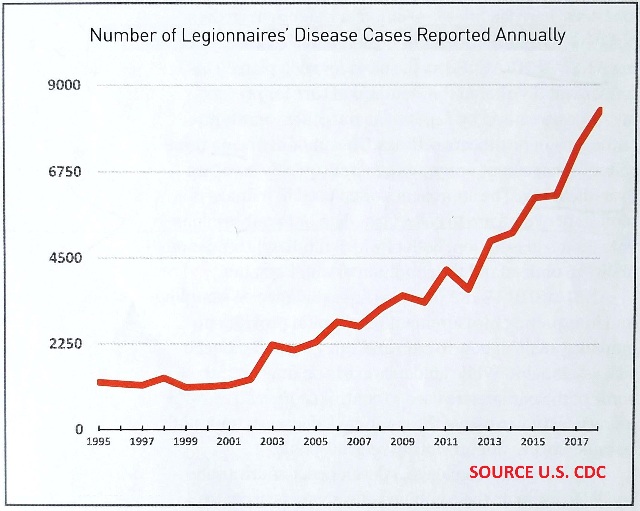 Legionellosis or Legionnaire's Disease and Pontiac Fever are serious respiratory illnesses with roughly a 10% fatality rate in the United States.
The chart at left shows the increase in the rate of reported cases of Legionnaires' disease in the U.S. from 2000 to 2017, as given by the US CDC. Original source: National Notifiable Diseases Surveillance System at the CDC. The cause of this increase is uncertain but experts pose a combination of an increase of Legionnella bacteria in the environment (is global warming a factor?), an improvement in and increased use of testing for Legionella contamination in building cooling towers and water supplies, and possibly an increase in the susceptability to Legionella in the U.S. population.
It's also significant that occurrences of Legionnaires' disease are probably significantly under-reported and under-diagnosed in the U.S.
Yet the disease is almost entirely preventable by appropriate inspection, testing, and management of water systems in buildings. Those systems include building air conditioning systems, particularly cooling towers and potable water supply systems, including both hot and cold water supply but particularly water heaters.
The most-significant sources of Legioniella bacteria in buildings are cooling towers used in large commercial building air conditioning systems and potable water systems, both hot and cold water, but particularly water heaters that can serve as a bacteria farm for Legionella and other bacterial contaminants.
Legionella bacteria were first recognized as a source of respiratory illness and disease in the air conditioning system at the Bellevue-Stratford Hotel in Philadelphia, PA in the U.S. in July 1976. There the American Legion was hosting a three day convention attended by more than 2,000 Legionnaires. Of 189 diagnosed cases of what was at first an unidentified illness, 29 people died.
By the end of January 1977, a U.S. CDC investigation had isolated the cause of these illnesses and deaths to the Bellevue-Stratford Hotel's air conditioning system cooling tower that bred the bacteria along with the air conditioning duct system that spread the bacteria through the building's occupied space. (Confusing the investigation was the occurrence in the same population of the American Legion Convention attendees of 14 cases of swine flue of whom six died.)
Except for rooftop swamp coolers and a much smaller number of evaporative coolers used in private homes (mostly in the American Southwest), the principal cooling tower bacterial hazard occurs on larger buildings such as hotels and offices. However Legionella bacteria hazards are indeed possible in private homes as well, in air conditioning condensate handling systems and in potable water supply equipment, particular water heaters.
In this article we discuss cleaning procedures for HVAC equipment in order to prevent Legionella bacteria formation or to remove it if present, a key step in preventing Legionnaires' disease.
We discuss steps to prevent Legionella bacteria growth in water heaters in a separate article found
at Legionella BACTERIA in WATER HEATERS
Should we disinfect cooling system equipment or condensate trays to prevent Legionella or other bacterial growth?
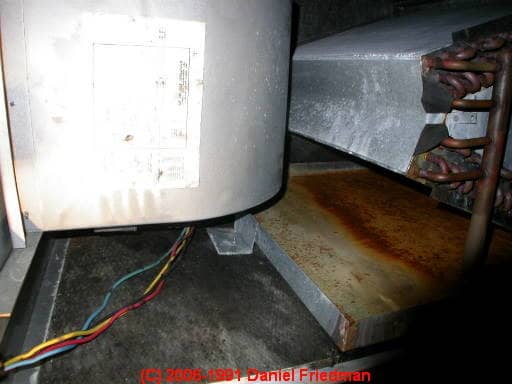 Should we be putting bromide or chlorine tablets in our condensate trays to keep bacteria from growing?
If we should be, then do we need to alternate bromide with chlorine on some type of frequency to prevent development of resistant bacteria?
[Click to enlarge any image]
We're discussing condensate trays from mechanical equipment like heat pumps, fan coil units and air handlers with AC coils.
These pieces of equipment have condensate trays which are then drained through a small pipe, usually clear, but not always, with a trap in it, to a drain.
These condensate trays have some standing water in them when the AC is functioning. Should these condensate trays be treated with an algaecide of some sort?
There are risks beyond mold and algae, in particular Legionella bacteria (legionnaire's disease) which can have an alarmingly high mortality rate, and also potential hazard sources such as biofilms that can include other bacterial and maybe other pathogens.
However the risk of formation of problem levels of mold, bacteria, or other pathogen is probably not the same across all buildings nor types of equipment, and much of the risk may depend on installation and maintenance details at individual installations.
Particularly in climates with a high humidity and a heavy cooling load, and depending on details of the design and installation of the air handler unit and duct work, there is risk of blowing pathogen-contaminated water droplets downstream inside the air conditioning duct work and thus exposing building occupants.
With rooftop-mounted cooling units such as cooling towers using water, conditions may be still more attractive for growth of pathogens and there is some risk of movement of pathogens out of the cooling equipment to people located nearby and downwind from the equipment, even if they are outside the building which the equipment actually serves.
References & Research on Legionellosis & Legionella Bacteria Risk Management
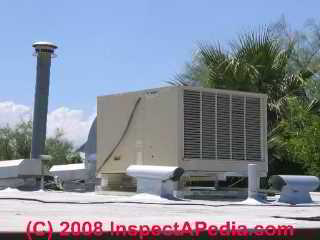 Photo: a residential swamp cooler or evaporative cooler atop an Arizona home. Evaporative coolers, operating in a manner similar to commercial-sized cooling towers, may harbor Legionella bacteria.
See details at SWAMP COOLERS
- Also see citations atReferences or Citations
- American Society for Heating, Refriger ating and Air-conditioning Engineers (ASHRAE). Guideline 12-2000. Minimizing the Risk of Legionellosis Associated with Building Water Systems, 2000.
- Canright, Megan, Madeline Rebullida, David Kahn, John Martinelli, "Legionella Regulations in New York - How Much Progress Have We Made", AIHA, American Industrial Hygiene Association, The Synergist, 3141 Fairview Park Dr, Suite 777, Falls Church VA 22042, USA Tel: 703-849-8888, June/July 2019 pp. 20-24
- Centers for Disease Control and Prevention (CDC). Guidelines for Environmental Infection Control in Health-care Facilities. Recommendations of CDC and the Healthcare Infection Control Practices Advisory Committ ee (HICPAC). Morbidity and Mortality Weekly Reports (MMWR) 52 (RR10):1-42; 2003. www.cdc.gov/mmwr/preview/mmwrhtml/rr5210a1.htm
- CDC, Legionella (Legionnaire's Disease and Pontiac Fever) History, Burden, and Trends, U.S. Centers for Disease Control, retrieved 2019/06/21, original source: https://www.cdc.gov/legionella/about/history.html - original source for the Legionellosis trend chart used at the top of this page.
- CDC, "Toolkit for Developing a Water Management Program to Reduce Legionella Growth & Spread in Buildings: A practical Guide to Implementing Industry Standards", [PDF] retrieved 2019/06/21, original source: https://www.cdc.gov/legionella/downloads/toolkit.pdf
Excerpt:
Legionnaires’ disease is a serious type of pneumonia caused by bacteria, called Legionella, that live in water. Legionella can make people sick when they inhale contaminated water from building water systems that are not adequately maintained. Unfortunately, Legionnaires’ disease is on the rise in the United States. To reverse this trend, we are asking for your help to manage the risk of exposure to Legionella from water in your building. - Kim, B. R., J. E. Anderson, S. A. Mueller, W. A. Gaines, and A. M. Kendall. "Literature review—efficacy of various disinfectants against Legionella in water systems." Water Research 36, no. 18 (2002): 4433-4444
- Krause, J. David, "Performing Legionella Source Risk Assessments, A Hazard Analysis Tool for Data Interpretation", AIHA, American Industrial Hygiene Association, The Synergist, April 2019, pp. 24-28.
- "Domestic Hot Water Temperature Limits for Legionella Prevention an Scald Control", VHA Directive 2009-009, (Feb 2009) [USA] Department of Veterans Affairs, Veterans Health Administration, Washington D.C. retrieved 3/21/2014, original source: http://www.va.gov/vhapublications/ViewPublication.asp?pub_ID=1853
- "How the dual issues of scalding an Legionnaire's Disease are being handled around the world", AntiScald, Inc., 70-40 137th St., Flushing NY 11367, USA, Tel: 718-268-7126, email: information@antiscald.com retrieved 3/20/14, original source: http://www.antiscald.com/prevention/legionnaires/dual_issues.php This company is a distributor of anti-scalding products.
- "Legionella and the prevention of legionellosis", World Health Organization WHO, retrieved 3/21/2014, original source: http://www.who.int/water_sanitation_health/emerging/legionella.pdf
Use the links listed at the ARTICLE INDEX the bottom of this article to read additional details on this topic including recommended cleaning procedures and details of the Legionella hazard in air conditioning systems, humidifiers, etc.
...
Continue reading at WISCONSIN PROTOCOL for Cleaning A/C or select a topic from the closely-related articles below, or see the complete ARTICLE INDEX.
Or see these
Legionella Hazard Reduction Articles
- ANTI SCALD VALVES & TEMPERATURE CONTROL / MIXING VALVES
- CONDENSATE HANDLING - home
- Legionella BACTERIA & HVAC EQUIPMENT
- Legionella sp. Health Concerns
- What are Legionella
- Where do Legionella sp. occur?
- Recommended Level for Legionella sp.
- How When to Test for Legionella sp.
- DUCTWORK CONTAMINATION
- HOT WATER ANTI-SCALD REGULATIONS preventing Legionella formation in water heating equipment.
- Legionella BACTERIA in WATER HEATERS
- LEGIONNAIRES' DISEASE INFO from CDC health hazards associated with Legionella and other biological contaminants in HVAC systems
- SWAMP COOLERS
- WISCONSIN PROTOCOL for Cleaning A/C
Suggested citation for this web page
Legionella BACTERIA & HVAC EQUIPMENT at InspectApedia.com - online encyclopedia of building & environmental inspection, testing, diagnosis, repair, & problem prevention advice.
Or see this
INDEX to RELATED ARTICLES: ARTICLE INDEX to AIR CONDITIONING & HEAT PUMPS
Or use the SEARCH BOX found below to Ask a Question or Search InspectApedia
Ask a Question or Search InspectApedia
Try the search box just below, or if you prefer, post a question or comment in the Comments box below and we will respond promptly.
Search the InspectApedia website
Note: appearance of your Comment below may be delayed: if your comment contains an image, photograph, web link, or text that looks to the software as if it might be a web link, your posting will appear after it has been approved by a moderator. Apologies for the delay.
Only one image can be added per comment but you can post as many comments, and therefore images, as you like.
You will not receive a notification when a response to your question has been posted.
Please bookmark this page to make it easy for you to check back for our response.
Our Comment Box is provided by Countable Web Productions countable.ca
Citations & References
In addition to any citations in the article above, a full list is available on request.
- Thanks to Mark Cramer, Tampa Florida, for assistance in technical review of the "Critical Defects" section and for the photograph of the deteriorating gray Owens Corning flex duct in a hot attic. Mr. Cramer is a Florida home inspector and home inspection educator.
- http://www.osha.gov/dts/osta/otm/otm_iii/otm_iii_7.html is OSHA"s technical manual re Legionnaire's disease US EPA Safe Drinking Water Hotline: 800-426-4791
- "Legionella in NY - How to Conduct a Legionella Risk Assessment", Mark Hodgson, LSC, Naperville IL & Diane Miskowski, MPH, EMSL Analytical, Inc., Westmont NY, Crown Plaza, White Plains, 8 May 2007. Course description: "Guidelines for the control of Legionella in critical care hospitals in New York have been in place for two years. In October 2006, these guidelines were extended to include nursing homes and long term care facilities. Join us for this 8 hour seminar to learn all you need to know to conduct a Legionella health risk assessment, control it in your facility, and remediate it. This course will describe the ecology of the [Legionella] organism, the epidemiology of the disease [Legionnaire's disease], a discussion of some recent outbreaks, and the proper sampling methods and analysis of the bacteria. A significant amount of time will be spent discussing how to actually perform a Legionella risk assessment, and an overview of cooling towers and potable water system design and how that contributes to growth of the [Legionella] organism. Discussion will include where Legionella can be found in the engineered environment, and the use of biocides and other controls."
- Thanks to Craig Balchunas, AHI Accurate, LLC., a home inspection firm in Hyde Park, NY. - (800) 360-3998
- "Legionella", a public information poster provided free by LA Testing, an California environmental testing lab - www.LATesting.com.
- Our recommended books about building & mechanical systems design, inspection, problem diagnosis, and repair, and about indoor environment and IAQ testing, diagnosis, and cleanup are at the InspectAPedia Bookstore. Also see our Book Reviews - InspectAPedia.
- Complete List of Air Conditioning & Heat Pump Design, Inspection, Repair Books at the InspectAPedia Bookstore.
- Modern Refrigeration and Air Conditioning, A. D. Althouse, C.H. Turnquist, A. Bracciano, Goodheart-Willcox Co., 1982
- Principles of Refrigeration, R. Warren Marsh, C. Thomas Olivo, Delmar Publishers, 1979
- Refrigeration and Air Conditioning Technology, 5th Ed., William C. Whitman, William M. Johnson, John Tomczyk, Cengage Learning, 2005, ISBN 1401837654, 9781401837655 1324 pages
CONTINUE READING or RECOMMENDED ARTICLES.
- Carson, Dunlop & Associates Ltd., 120 Carlton Street Suite 407, Toronto ON M5A 4K2. Tel: (416) 964-9415 1-800-268-7070 Email: info@carsondunlop.com. Alan Carson is a past president of ASHI, the American Society of Home Inspectors.
Thanks to Alan Carson and Bob Dunlop, for permission for InspectAPedia to use text excerpts from The HOME REFERENCE BOOK - the Encyclopedia of Homes and to use illustrations from The ILLUSTRATED HOME .
Carson Dunlop Associates provides extensive home inspection education and report writing material. In gratitude we provide links to tsome Carson Dunlop Associates products and services.
 | HOME | ABOUT | ASK a QUESTION | CONTACT | CONTENT USE POLICY | DESCRIPTION | POLICIES | PRIVACY | |
| © 2024 - 1985 Publisher InspectApedia.com - Daniel Friedman | |||||||||