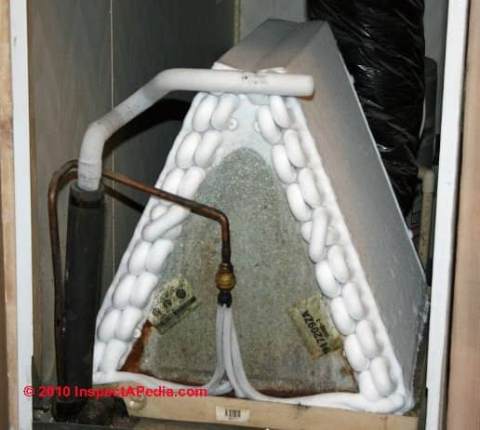
 Air Conditioner / Heat Pump Inspect & Repair
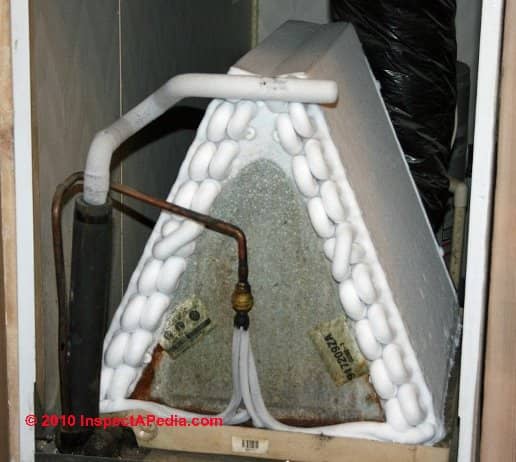
- POST a QUESTION or COMMENT about how to diagnose and repair air conditioning and heat pump systems.
This page lists key articles explaining how to diagnose and fix an air conditioner & heat pump system that's not working; we also give articles on A/C system inspection, installation, and provide sources of parts, manuals & codes.
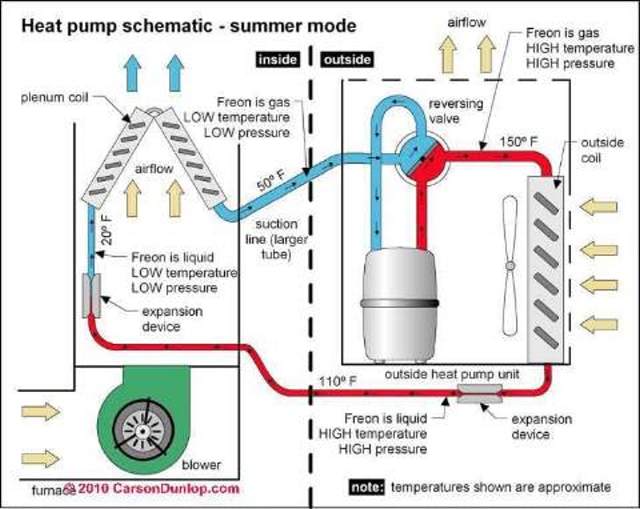
Page top image & air conditioning schematic drawing below were provided courtesy of Carson Dunlop Associates, a Toronto home inspection, education & report writing tool company [ carsondunlop.com ].
The author has worked as a trained HVACR repair technician and is a member of ASHRAE, American Society of Heating, Refrigerating, and Air-Conditioning Engineers.
InspectAPedia tolerates no conflicts of interest. We have no relationship with advertisers, products, or services discussed at this website.
- Daniel Friedman, Publisher/Editor/Author - See WHO ARE WE?
Air Conditioner / Heat Pump Installation, Troubleshooting, Repair
Air conditioners both cool and dehumidify indoor air to increase the comfort of building occupants.

A heat pump is an "air conditioner" with the added feature that in cool weather the same equipment can extract heat from outdoor air and use that to warm the indoor space.
The failure of an air conditioner to turn on, loss of air conditioner cooling capacity, reduced air conditioning output temperatures, loss of cool air supply, or even loss of air flow entirely can be due to a variety of problems with one or more components of an air conditioner or air conditioning system.
Article Contents
- QUICK or MORE-DETAILED REPAIR GUIDES - DIY troubleshooting & more-expert procedures
- A/C HEAT PUMP PROBLEM TYPES - recommended troubleshooting start point organized by problem
Building Owner Air Conditioning or Heat Pump Repair Guides
- For quick air conditioner or heat pump troubleshooting that can be done by many building owners or occupants,
Start Here: DIAGNOSTIC GUIDE A/C or HEAT PUMP - quick easysteps to diagnose an air conditioner or heat pump. - For detailed troubleshooting and procedures used by trained HVAC repair technicians, see our list of detailed diagnosis and repair procedures at
DIAGNOSTIC DETAILS A/C or HEAT PUMP - If you just want to know how an air conditioner or heat pump works,
see HOW an AIR CONDITIONER WORKS
...
Types of Problems with Air Conditioners or Heat Pumps
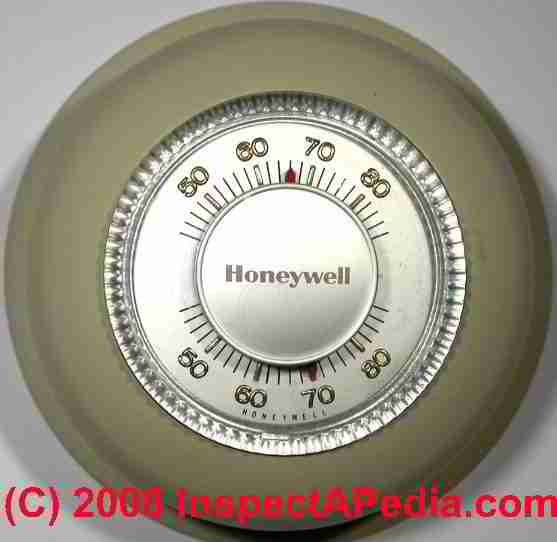 Before we can jump into fixing an air conditioner or heat pump we need to determine just what problem we're solving. That's because the troubleshooting and repair steps will be different depending on just what's not working.
Just below we give brief descriptions of the main types of trouble you may encounter with an air conditioner or heat pump.
1. Air Flow Problems in Air Conditioning or Heat Pump Systems
Weak or no air flow coming out of the supply registers in each room. Often the problem is as simple as a dirty air filter or dirty indoor blower fan in the air conditioner or heat pump air handler unit. See:
- DUCT SYSTEM DESIGN SIZE & DEFECTS - home - problems with the air duct system, air filters, supply registers, return air registers. Something as simple as a dirty air filter or blower fan can cause significant reduction in air flow at the air supply registers in each building area.
2. Cooling Problems in an Air Conditioner or Heat Pump
If there is good air flow out of supply registers but in cooling mode the air does not get cool, or in heating mode (for heat pumps) the air delivered does not get warm the trouble could be that the outdoor compressor unit is not working or that the system has lost its refrigerant charge.
- LOST COOLING CAPACITY - what to do when not enough cool air comes out of the system - key diagnostic articles if your A/C unit is not cooling or the air flow is too weak.
3. Electrical problems at A/C & Heat Pumps
Many service calls for non-working air conditioners or heat pumps turn up an electrical problem.
The most basic electrical problem is that a motor or HVAC unit simply won't start. Other electrical problems include buzzing noises at relays or burning electrical smells.
But first remember to check the system power switches at the air handler indoors, at the compressor/condenser outdoors, and in the electrical panel.
If your A/C system is just not working at all, be sure to check all of our electrical and control setting suggestions first.
-
AIR CONDITIONER WON'T START - are all switches on? Is there electrical power at the panel?
4. Indoor Air Handler / Blower Problems on HVAC systems
Besides weak air flow that we mentioned above, more serious problems such as a failing blower motor or no a blower fan that never starts at all can prevent the delivery of cooled or heated air.
- BLOWER FAN OPERATION & TESTING - what to check at the indoor air handler or "blower unit"
5. Mechanical problems on HVAC systems
We see a number of problems with fans and fan motors in both the compressor/condenser unit and in the air handler/blower fan unit.
Some of those fan problems are mechanical - like a loose fan belt or blade.
A more simple mechanical problem is an air supply or return duct that has become disconnected, loose, crushed, or leaky, leading to the failure of the A/C or heat pump system to deliver air to supply registers. We class these as duct system problems.
6. Outdoor Compressor/Condenser Unit Problems on Air Conditioners or Heat Pumps
The unit has at least two motors: the sealed compressor motor that compresses refrigerant gas so that it can be condensed back to liquid form, and a fan motor that spins the fan necessary to move outdoor air across the condenser unit coils.
An outdoor compressor/condenser unit may refuse to start, may be noisy, or may fail to do its job to compress the system's refrigerant from a gas back to liquid form.
Control relays, boards, switches in the condenser unit may fail, or a refrigerant leak at the unit can cause loss of cooling or heating even though the indoor blower unit delivers air at the supply registers.
- COMPRESSOR / CONDENSER DIAGNOSTICS - what to check at the outdoor compressor/condenser unit.
Detailed A/C or Heat Pump Diagnostic Procedures
- Moved to DIAGNOSTIC DETAILS A/C or HEAT PUMP
...
...
Continue reading at DIAGNOSTIC GUIDE A/C or HEAT PUMP - first steps to diagnose an air conditioner or heat pump, or select a topic from the closely-related articles below, or see the complete ARTICLE INDEX.
Or see these REPAIR GUIDES A/C / HEAT PUMP FAQs posted originally at this page
Also see this complete list of AIR CONDITIONING & HEAT PUMP SYSTEM FAQs sorted by topic.
Or see these
Recommended Articles
- A/C or HEAT PUMP COMPONENTS
- A/C & HEAT PUMP TECHNICIAN CERTIFICATION - training and licensing
- AGE of AIR CONDITIONERS & HEAT PUMPS - how old is the equipment
- AIR CONDITIONING & HEAT PUMP SYSTEMS - home
- AIR CONDITIONER / HEAT PUMP OPERATION - how does an air conditioner or heat pump actually work?
- AIR HANDLER / BLOWER UNITS - home
- COMPRESSOR / CONDENSER REPAIR - home
- CONTROLS & SWITCHES on A/C or HEAT PUMP - what and where are all of the controls?
- DIAGNOSTIC GUIDE A/C or HEAT PUMP - first steps to diagnose an air conditioner or heat pump
- DUCT SYSTEM DESIGN SIZE & DEFECTS - home
- MANUALS & PARTS GUIDES - HVAC - home
- SPLIT SYSTEM AC / HEAT PUMP REPAIRS - home
Suggested citation for this web page
AIR CONDITIONING & HEAT PUMP SYSTEMS - home - HVAC inspection, installation, diagnosis & repair procedures provided free at InspectApedia.com or select a topic from the closely-related articles below, or see the complete ARTICLE INDEX.
INDEX to RELATED ARTICLES: ARTICLE INDEX to AIR CONDITIONING & HEAT PUMPS
Or use the SEARCH BOX found below to Ask a Question or Search InspectApedia
Ask a Question or Search InspectApedia
Share this article:Ask a Question or Search the InspectApedia website using the box just below.
Need to make a private comment? Email editor@inspectApedia.com. We welcome email with your website content critique, corrections, suggestions or questions. Email is monitored daily but our workload may prevent an immediate reply. For immediate results, we hope you'll first try asking your question using the search box just above.
Citations & Reviewers
In addition to any citations in the article above, a full list is available on request.
- [1] "Air Conditioning & Refrigeration I & II", BOCES Education, Warren Hilliard (instructor), Poughkeepsie, New York, May - July 1982, [classroom notes from air conditioning and refrigeration maintenance and repair course attended by the website author]
- [2] Thanks to Mark Cramer, Tampa Florida, for assistance in technical review of the "Critical Defects" section and for the photograph of the deteriorating gray Owens Corning flex duct in a hot attic. Mr. Cramer is a Florida home inspector and home inspection educator.
- [3] Thanks to Jon Bolton, an ASHI, FABI, and otherwise certified Florida home inspector who provided photos of failing Goodman gray flex duct in a hot attic.
- [4] Thanks to Scott at SJM Inspect for suggesting this EPA document and for technical editing remarks regarding our air conditioning website, SJM Inspection Service LLC, serves the entire state of CT, sjminspect.com 203-543-0447 or 203-877-4774 5/16/07
- [5] Thanks to Joe Panimondo for technical editing, April 2011
- [7] HVAC brands discussed include but are not limited to: Lennox, American Standard, Amana, Everrest, Goodman, Frigidaire, Coleman and Gibson. Brands of related air handling equipment include Honeywell, Aprilaire, White-Rogers, Broan. Nutone, Fantech, Venmar, Arzel, Hi-Velocity, Vanguard, Wirsbo, Weil McLain, Unico, Heat Link, A.O. Smith, Water Furnace, ClimateMaster, Geo-Excel, Command Aire, Friedrich, LG, Mitsubishi, Sanyo, Hart &
Cooley, Munchkin, Superstor Ultra, Lochinvar and Knight HVAC equipment. - [8] Bureau of Labor Statistics, U.S. Department of Labor, Occupational Outlook Handbook, Heating, Air Conditioning, and Refrigeration Mechanics and Installers, at https://www.bls.gov/ooh/installation-maintenance-and-repair/heating-air-conditioning-and-refrigeration-mechanics-and-installers.htm (visited June 15, 2022).
- [8a] Bureau of Labor Statistics, U.S. Department of Labor, Occupational Outlook Handbook, 2014-15 Edition, Heating, Air Conditioning, and Refrigeration Mechanics and Installers, on the Internet at http://www.bls.gov/ooh/installation-maintenance-and-repair/heating-air-conditioning-and-refrigeration-mechanics-and-installers.htm (visited February 05, 2014).
- [9] HVAC Education, Training Accreditation agencies: Quoting the U.S. DOL HVAC website above:
After completing the programs below, new technicians generally need between 6 months to 2 years of field experience before they are considered proficient. Three accrediting agencies have set academic standards for HVACR programs:- [10] HVAC Excellence. 1701 Pennsylvania Ave NW, Washington, DC 20006 Tel: (800) 394-5268. Web: https://www.escogroup.org/hvac/
Excerpt:
HVAC Excellence is a not for profit organization that has been serving the HVACR industry since 1994. It is our goal to improve competency through validation of the technical education process. By setting standards and verifying that they have been met, we inspire the industry to excel.
We know that all of the challenges that face our industry are achievable by continuous improvement in the way that we prepare technicians. - [11] National Center for Construction Education and Research, 3600 NW 43rd Street, Bldg. G, Gainesville, FL 32606, Tel: 888.622.3720, Web: http://www.nccer.org/
Quoting:
NCCER is a not-for-profit education foundation created to develop industry-driven standardized craft training programs with portable credentials and help address the critical workforce shortage facing the construction industry. - [12] The Partnership for Air-Conditioning, Heating, and Refrigeration Accreditation, (PAHRA), 2111 Wilson Blvd., Suite 500, Arlington, VA 22201-3001, USA, Tel: (703) 524-8800, Web: http://www.pahrahvacr.org/
Quoting:
The Partnership for Air-Conditioning, Heating, Refrigeration Accreditation (PAHRA) is an independent, third party organization that is a partnership between heating, ventilation, air-conditioning and refrigeration (HVACR) educators and the HVACR industry that will award accreditation to programs that have met and/or exceeded industry validated standards.
This programmatic accreditation program is the only one that is supported by the major industry associations.
- [10] HVAC Excellence. 1701 Pennsylvania Ave NW, Washington, DC 20006 Tel: (800) 394-5268. Web: https://www.escogroup.org/hvac/
- [13] HVAC Training Courses, Schools: HVAC Technician Training Schools [http://technicianschool.net/hvac-technician-training-schools/], lists the following schools offering technical courses may offer specific training programs for potential careers, including HVAC technicians. Among HVAC schools that website lists are
- Everest Colleges [http://www.everest.edu],
- Florida Career College 7891 Pines Blvd Hollywood, FL 33024 http:// www.careercollege.edu/,
- Lincoln Institute 2299 Vauxhall Road Union, NJ 07083 http:// www.lincolnedu.com/
- NOTE: when considering an HVAC training course or school, check the HVAC education accrediting associations listed above.
- [14] Ratib Bakera is member of Refrigeration Service Engineers Society (RSES), an International training organization for the HVACR industry provides educational and certification programs to HVACR professionals of all experience levels. Web: www.rses.org , provides information on the organization and its training materials. Independent testing and certification of HVAC technicians is provided by North American Technician Excellence - NATE - see www.natex.org. NATE is supported by ASHRAE, the US EPA, and a host of other trade and professional associations.
- [15] Singer brand HVAC equipment brand history: Singer was bought by & became the climate control unit of Dallas-based Snyder General Corp. (founded by a former Singer HVAC manager) in 1982. The name Singer was dropped in 1984.
In 1984 Snyder General operations included Arcoaire, Comfortmaker, and McQuay. In 1991 Snyder General sold Arcoaire & Comfortmaker to Inter-City Products. In 1994 Snyder General was acquired by Hong Leong Group Malaysia. Snyder General is at 2001 Ross Avenue Dallas, TX 75201. - [16] Lennox air conditioning and heat pump owners manuals for air conditioners, air handlers, furnaces, heat pumps, indoor air quality systems, packaged units, water heaters, zone controls and other controls such as thermostats, are provided by Lennox at http://www.lennox.com/support/manuals.asp
- [23] Air Diffusion Council, 1901 N. Roselle Road, Suite 800, Schaumburg, Illinois 60195, Tel: (847) 706-6750, Fax: (847) 706-6751 - Email: info@flexibleduct.org - www.flexibleduct.org/ -
"The ADC has produced the 4th Edition of the Flexible Duct Performance & Installation Standards (a 28-page manual) for use and reference by designers, architects, engineers, contractors, installers and users for evaluating, selecting, specifying and properly installing flexible duct in heating and air conditioning systems.
Features covered in depth include: descriptions of typical styles, characteristics and requirements, testing, listing, reporting, certifying, packaging and product marking.
Guidelines for proper installation are treated and illustrated in depth, featuring connections, splices and proper support methods for flexible duct.
A single and uniform method of making end connections and splices is graphically presented for both non-metallic and metallic with plain ends."
The printed manual is available in English only. Downloadable PDF is available in English and Spanish. - [24] Engineering toolbox properties of water - http://www.engineeringtoolbox.com/water-thermal-properties-d_162.html and email: editor.engineeringtoolbox@gmail.com web search 09/16/2010
- [25] Owens Corning Duct Solutions - www.owenscorning.com/ductsolutions/ - provides current HVAC ductwork and duct insulating product descriptions and a dealer locator. Owens Corning Insulating Systems, LLC, One Owens Corning Parkway, Toledo, OH 43659 1-800-GET-PINK™
- [26] "Flexible Duct Media Fiberglas™ Insulation, Product Data Sheet", Owens Corning - see owenscorning.com/quietzone/pdfs/QZFlexible_DataSheet.pdf
"Owens Corning Flexible Duct Media Insulation is a lightweight, flexible, resilient thermal and acoustical insulation made of inorganic glass fibers bonded with a thermosetting resin." - [30] Carson Dunlop, Associates, Toronto, have provided us with (and we recommend) Carson Dunlop Weldon & Associates' TECHNICAL GUIDE to manufacturer's model and serial number information for heating and cooling equipment ($69.00 U.S.).
- [32] FlowKinetics LLC, 528 Helena Street Bryan, Texas 77801 USA, Tel: (979) 680-0659, Email: inform@flowkinetics.com, Website: www.flowkinetics.com, "FKS 1DP-PBM Multi-Function Meter Pressure, Velocity & Flow User’s Manual", web search 07/16/2012, original source: http://www.flowkinetics.com/FKS_1DP_PBM_Manual.pdf [copy on file] and "FKT Series Flow Measurement And Pressure Acquisition System User's Manual" http://www.flowkinetics.com/FKTSeriesManual.pdf [copy on file]
- [33] Histoire de l'Académie royale des sciences avec les mémoires de mathématique et de physique tirés des registres de cette Académie: 363–376. Retrieved 2009-06-19.- Pitot Tubes, Henri Pitot (1732)
- [34] Wikipedia Web: https://www.wikipedia.org/ provided background information about some topics discussed at this website provided this citation is also found in the same article along with a " retrieved on" date.
NOTE: because Wikipedia entries are fluid and can be amended in real time, we cite the retrieval date of Wikipedia citations and we do not assert that the information found there is necessarily authoritative.
"Pressure sensor", retrieved 7/16/2012 - [35] "GE Zoneline® Owners Manual and Installation Instructions, Heat/Cool Model 2900, Heat Pump Model 3900", General Electric Corporation, [copy on file].
- [36] "GE Zoneline® Owners Manual and Installation Instructions, Heat Pump Model 5800", General Electric Corporation, [copy on file].
- [37] "Whirlpool WGPH45 Packaged Heat Pump, Product Specifications", Whirlpool Corporation, [copy on file]. Website: www.whirlpoolcomfort.com
- [38] N Lu, YL Xie, Z Huang, "Air Conditioner Compressor Performance Model", U.S. Department of Energy, August 2008, [copy on file as PNNL-17796.pdf] Available to the public from the National Technical Information Service, U.S. Department of Commerce, 5285 Port Royal Rd., Springfield, VA 22161 ph: (800) 553-6847, fax: (703) 605-6900 email: orders@ntis.fedworld.gov online ordering: http://www.ntis.gov/ordering.htm
- [39] Yinger R, R Bravo, and D Martinez. 2006 Air Conditioner Stalling Effects Study/Air Conditioner Testing Procedures. Southern California Edison, Rosemead, California
- [40] Bravo, R, R Yinger, and L Gaillac. 2006. Conditioner Stalling Unit Level Solutions Test Report. Southern California Edison, Rosemead, California.
- [41] Lu N, B Yang and Z Huang. 2008a. Evaluation of Southern California Edison Air-Conditioner Stalling Solutions. PNNL-17686, Pacific Northwest National Laboratory, Richland, Washington.
- [42] Danny S. Parker, John R. Sherwin, Bart Hibbs, "Development of High Efficiency Air Conditioner Condenser Fans", ASHRAE Transactions June 2005, [copy on file as FSEC-CR-1674-05.pdf]
- [43] Thanks to Alexis Claro alexis.hvaced@gmail.com who maintains a website offering information about HVAC training found at hvaced.com/hvac-training .
- Singer brand HVAC equipment brand history: >Singer was bought by & became the climate control unit of Dallas-based Snyder General Corp. (founded by a former Singer HVAC manager) in 1982. The name Singer was dropped in 1984. In 1984 Snyder General operations included Arcoaire, Comfortmaker, and McQuay. In 1991 Snyder General sold Arcoaire & Comfortmaker to Inter-City Products. In 1994 Snyder General was acquired by Hong Leong Group Malaysia. Snyder General is at 2001 Ross Avenue Dallas, TX 75201 .
- Complete List of Air Conditioning & Heat Pump Design, Inspection, Repair Books at the InspectAPedia Bookstore.
- Modern Refrigeration and Air Conditioning, A. D. Althouse, C.H. Turnquist, A. Bracciano, Goodheart-Willcox Co., 1982
- Principles of Refrigeration, R. Warren Marsh, C. Thomas Olivo, Delmar Publishers, 1979
- Refrigeration and Air Conditioning Technology, 5th Ed., William C. Whitman, William M. Johnson, John Tomczyk, Cengage Learning, 2005, ISBN 1401837654, 9781401837655 1324 pages
- In addition to citations & references found in this article, see the research citations given at the end of the related articles found at our suggested
CONTINUE READING or RECOMMENDED ARTICLES.
- Carson, Dunlop & Associates Ltd., 120 Carlton Street Suite 407, Toronto ON M5A 4K2. Tel: (416) 964-9415 1-800-268-7070 Email: info@carsondunlop.com. Alan Carson is a past president of ASHI, the American Society of Home Inspectors.
Thanks to Alan Carson and Bob Dunlop, for permission for InspectAPedia to use text excerpts from The HOME REFERENCE BOOK - the Encyclopedia of Homes and to use illustrations from The ILLUSTRATED HOME .
Carson Dunlop Associates provides extensive home inspection education and report writing material. In gratitude we provide links to tsome Carson Dunlop Associates products and services.
 |
HOME | ABOUT | ASK a QUESTION | CONTACT | CONTENT USE POLICY | DESCRIPTION | POLICIES | PRIVACY | |
| © 2026 - 1985 Publisher InspectApedia.com - Daniel Friedman | |||||||||