
InspectAPedia® FREE Encyclopedia of Building & Environmental Construction, Diagnosis, Maintenance & Repair |
Question? Just ask us! InspectAPedia
|
 Leaky, Moldy or Wet Air Handlers
Air Conditioning Air Handler Condensate Leaks, Causes of Mold Problems in HVAC Blower Compartments & Ductwork
- POST a QUESTION or COMMENT about leaks in air conditioner or heat pump or furnace air handlers and how to test HVAC systems for mold contamination
Air handler blower unit leaks & mold hazards:
This air conditioning repair article discusses the problem of A/C condensate leaks into air conditioning system air handler units, blower units, or AHU's, (also called fan coil units).
InspectAPedia tolerates no conflicts of interest. We have no relationship with advertisers, products, or services discussed at this website.
HVAC Blower Leaks, Rust, Mold
Air Conditioner Air Handler Rust, Condensate Leaks, Wet Insulation, & Mold Hazards
Leaks in the air handler can cause rust damage and may invite mold contamination in the AHU or in the HVAC system ductwork.
Leaks out of the air handler can also damage surrounding building components such as drywall or insulation.
We include the air conditioner blower fan, air conditioning system filters in this discussion, and we explain the causes, cures, and prevention of air handler condensate or other moisture leaks that lead to rust, damage, and mold contamination in the air conditioning system. The evaporator coil and problems of frost build-up in the air handler are also reviewed.
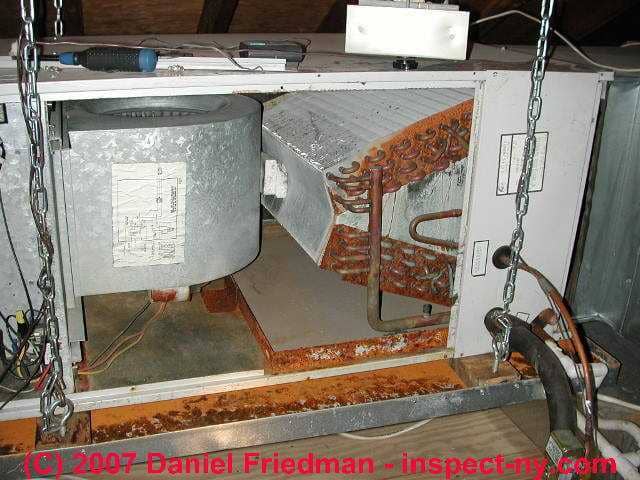
The photograph just above shows quite a bit of rust on components inside this air handler.
More significantly were stains indicating that condensate had blown off of the evaporator coil or otherwise spilled into the air handler cabinet where it had wet fiberglass insulation there.
[Click to enlarge any image]
Wet fiberglass and other wet insulation material form a potential mold reservoir right in the air path.
If an air conditioning system also lacks a good air filter and thus if it also has become loaded with organic house dust and debris, combined with water where we don't want it this material also forms a possible growth medium for toxic or allergenic mold inside the air handler or duct work.
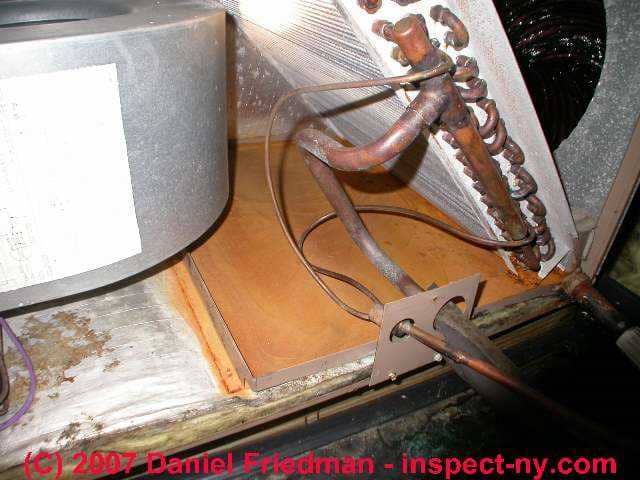
These two photographs (above & below) show more clearly that condensate has been overflowing the condensate collector inside the air handler.
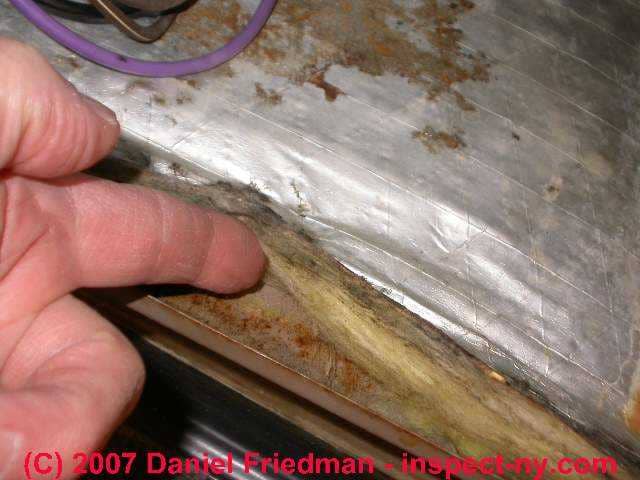
This air conditioning condensate water has gone where we don't want it: onto the fiberglass insulation and into the duct system. The moldy looking material growing on the foil face of the insulation was a rather common Cladosporium cladosporoioides mold which we often find inside air handlers and duct systems that have been wet like this.
The right hand photo is a close up showing evidence that the fiberglass insulation has been wet in this area - note the rust stains? We often find more problematic molds in the Aspergillus sp. genus where fiberglass insulation has been wet, even when no mold was visible to the eye.
Mold on HVAC Air Supply Registers
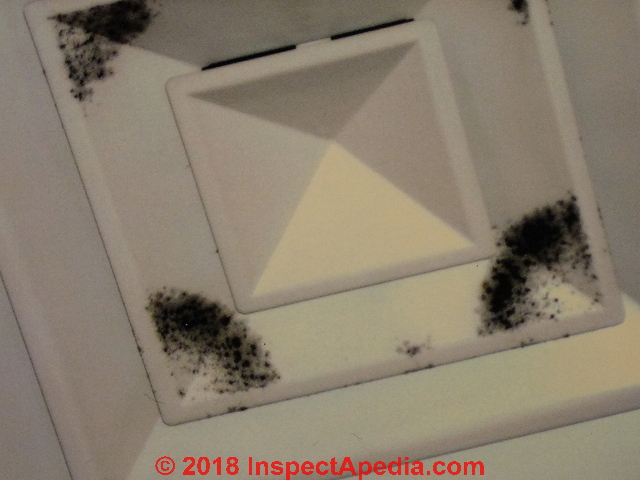
By simple visual inspection (by the naked eye) it can be difficult to know if the black or gray debris on air supply registers is moldy crud or common house dust.
See detao;s at STAINS at HVAC REGISTERS
Our photos below show debris deposited on HVAC ceiling air supply registers in a Kentucky building.
In response to a history of a building leak event and odor complaints as well as the appearance of mold on some building walls, we analyzed samples of the dust from the ceiling air supply register shown below.
Below are the lab photos of the black stuff on the register shown above. You can see that the dominant particle in the sample was Cladosporium sp. C. sphaerospermum spores were also present in this sample.
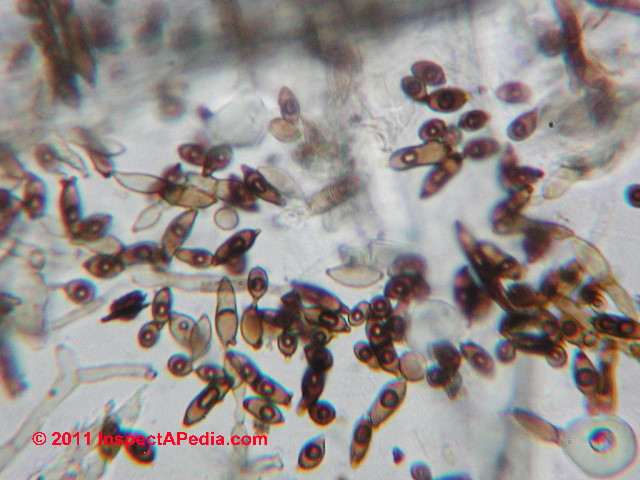
While Cladosporium sp. is the most common mold found on earth and while it's just about everywhere, for some people this is an allergenic mold. We don't want it being blown around by our air conditioning system nor its growth improved by mishandling of HVAC condensate.
and/or see MOLD ATLAS & PARTICLES INDEX for a description of the health effects and air quality complaints associated with various kinds of mold.
Don't panic even if you do find small amounts of mold in an air supply register. Even in a healthy building we might expect condensate forming on ceiling air supply registers in some conditions, and thus an accompanying growth of small areas of mold. If that's the extent of mold contamination, ordinary household cleaning procedures are sufficient.
Watch out: if the building leak history or complaint history suggest that a larger mold reservoir could be present, including other genera/species of mold, further investigation is warranted.
Photographs of mold growing right on an air conditioner squirrel cage blower fan are in our article
at MOLD GROWTH in AIR HANDLERS
More information about the potential of problematic mold growth in fiberglass and more example photographs of this event can be read
...
Reader Comments, Questions & Answers About The Article Above
Below you will find questions and answers previously posted on this page at its page bottom reader comment box.
Reader Q&A - also see RECOMMENDED ARTICLES & FAQs
Question: Just recently noticed white / gray mold around most of the vents
(Sept 17, 2014) Digger said:
New heat pump installed May 30, 2014, both inside and outside units were replaced with the newer technology.
Just recently noticed white / gray mold around most of the vents throughout the house. The installers came back and did about five things to "take care of the problem", e.g., retaped all connections, reduced amount of coolant, reduced fan speed, did something with "superheater(??") unit or similar, and suggested I also place a dehumidifier in the crawl space under the house (it is closed in but vented).
Did not see any mold in ducts, just around vents and clothing and stuff near them. How do you recommend cleaning the vents, shoes, etc. that are affected?
Would appreciate any help as we will start the cleanup soon. Thank you. Digger Q
Moderator (DF) Reply: are we sure it's mold and not house dust?
Digger
mechanical cleaning and sanitizing of ductworks and air handlers may be possible for hard-surfaces (such as sheet metal) but soft surfaces such as fiberglass ducts may be actually damaged by that approach.
So the options are to replace the ducts (most reliable) or to seal their interior (can work but has risks).
I'd not do any such expensive heroic improvements before a visual inspection and possibly supporting surface testing showed that such work was actually necessary.
...
Continue reading at CONDENSATE HANDLING, HVAC - topic home, or select a topic from closely-related articles below, or see our complete INDEX to RELATED ARTICLES. or select a topic from the closely-related articles below, or see the complete ARTICLE INDEX.
Or see BLOWER LEAKS, RUST & MOLD FAQs - questions & answers posted originally at the end of this page.
Or see these
Air Handler / Blower Unit Articles
- AIR FLOW TOO WEAK
- AIR HANDLER / BLOWER UNITS - home
- AIR HANDLER BLOWER DOORS - how to find and open the blower compartment door or cover
- AIRBORNE PARTICLE & MOLD LEVELS in DUCTWORK where we describe how to test HVAC systems and ductwork for mold
- BLOWER LEAKS, RUST & MOLD - you are on this page
- CONDENSATE HANDLING, HVAC - home
- DUCT CLEANING ADVICE
- FIBERGLASS INSULATION MOLD - home
- TEST CHOICES for MOLD in FIBERGLASS
- VACUUM TEST INSULATION CONTAMINANTS
- WATER & ICE IN DUCT WORK
- WET CORRODED DUCT WORK
- WHY DOES MOLD GROW in INSULATION? - examples of mold contamination in or on fiberglass-lined HVAC ductwork.
Suggested citation for this web page
BLOWER LEAKS, RUST & MOLD at InspectApedia.com - online encyclopedia of building & environmental inspection, testing, diagnosis, repair, & problem prevention advice.
Or see this
INDEX to RELATED ARTICLES: ARTICLE INDEX to AIR CONDITIONING & HEAT PUMPS
Or use the SEARCH BOX found below to Ask a Question or Search InspectApedia
Ask a Question or Search InspectApedia
Try the search box just below, or if you prefer, post a question or comment in the Comments box below and we will respond promptly.
Search the InspectApedia website
Note: appearance of your Comment below may be delayed: if your comment contains an image, photograph, web link, or text that looks to the software as if it might be a web link, your posting will appear after it has been approved by a moderator. Apologies for the delay.
Only one image can be added per comment but you can post as many comments, and therefore images, as you like.
You will not receive a notification when a response to your question has been posted.
Please bookmark this page to make it easy for you to check back for our response.
Our Comment Box is provided by Countable Web Productions countable.ca
Citations & References
In addition to any citations in the article above, a full list is available on request.
- Complete List of Air Conditioning & Heat Pump Design, Inspection, Repair Books at the InspectAPedia Bookstore.
- In addition to citations & references found in this article, see the research citations given at the end of the related articles found at our suggested
CONTINUE READING or RECOMMENDED ARTICLES.
- Carson, Dunlop & Associates Ltd., 120 Carlton Street Suite 407, Toronto ON M5A 4K2. Tel: (416) 964-9415 1-800-268-7070 Email: info@carsondunlop.com. Alan Carson is a past president of ASHI, the American Society of Home Inspectors.
Thanks to Alan Carson and Bob Dunlop, for permission for InspectAPedia to use text excerpts from The HOME REFERENCE BOOK - the Encyclopedia of Homes and to use illustrations from The ILLUSTRATED HOME .
Carson Dunlop Associates provides extensive home inspection education and report writing material. In gratitude we provide links to tsome Carson Dunlop Associates products and services.
 | HOME | ABOUT | ASK a QUESTION | CONTACT | CONTENT USE POLICY | DESCRIPTION | POLICIES | PRIVACY | |
| © 2024 - 1985 Publisher InspectApedia.com - Daniel Friedman | |||||||||