 Water Pressure Impact on Water Usage Rate

- POST a QUESTION or COMMENT about using booster pumps & tanks to improve water pressure at a building
Questions & answers about how setting higher water pressure in a building increases water usage and possibly water wastage.
We also compare the Darcy-Weisbach equation versus the Hazen-Williams equation to calculate friction head loss in water piping systems
This article series describes the use of water pressure boosting systems that add a pump and pressure tank to improve water pressure and flow, including improving water pressure & flow on the upper floors of tall buildings.
InspectAPedia tolerates no conflicts of interest. We have no relationship with advertisers, products, or services discussed at this website.
- Daniel Friedman, Publisher/Editor/Author - See WHO ARE WE?
Water Pressure Boost Increases Water Use
 These questions were posted originally
at WATER PRESSURE BOOSTER PUMP - the home page for this topic. You will want to check the advice given there.
Also see our index to all water pressure booster pump questions & answers at WATER PRESSURE BOOSTER PUMP FAQs
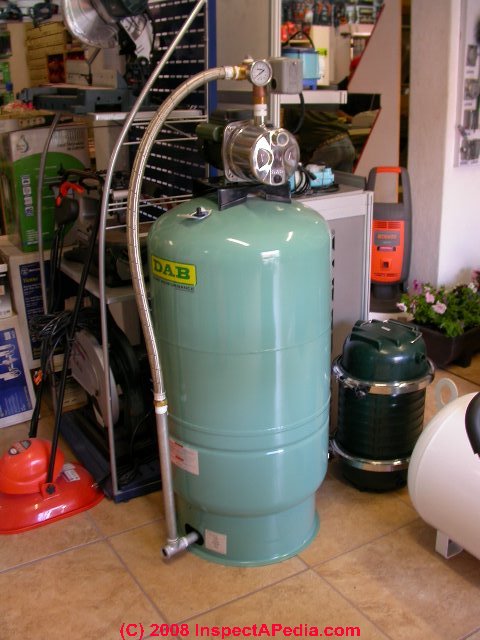
Our photos at page top and just here show a typical water pressure booster pump and tank system for sale at Don Pedro's Ferreteria in San Miguel de Allende.
Article Index
- WATER PRESSURE EFFECT on WATER CONSUMPTION RATE
- Darcy-Weisbach equation vs the Hazen-Williams equation to calculate friction head loss in water piping systems
...
Table: Water Pressure vs GPM vs Water Consumption Rate
Does using a higher pump pressure increase water consumption?
Does consumption of water increase when we use a pressure pump On 2017-05-29 by Latasiddharth @gmail.com
And
Can you let me know how much excess water will be consumed when we use a water pressure booster pump ? On 2017-10-02 by s n naik
by (mod) - Yes, here's a table of % OF water use increase when we boost pressure or change pipe diameter
Lata
In my OPINION, yes, unless we take great care, we will use more water when we convert a gravity-fed water supply system (say from a rooftop water tank) to a water supply system that uses a pressure-pump.That's because the higher "pressure" provided by the pump will increase the water flow rate in liters per minute or gallons per minute at the building's sinks, showers, tubs. (Flush toilets won't use more water than before, they'll just fill faster).
Even with a pressure booster pump set to a rather low 25 psi you'll see a much greater flow rate at the sink or tub faucet. And if your building water supply is from a low pressure municipal supply the same effects will be seen.Example of water consumption increase: You'll use 21% more water to wash hands going from 30 to 40 psi!
When washing hands for personal hygiene most sources including the U.S. CDC typically recommend washing your hands with soap and running water continuously for at least 20 seconds.
Actual water pressure at a plumbing fixture and therefore water flow rate in gpm or Lpm (Liters per minute) varies between a low (at the CUT-IN) pressure and a high (at the CUT-OUT) pressure.
But for simplicity we'll pretend to ignore that reality.
Using the Omni PSM to GPM calculator we found that for a 1/2" water pipe (typical or minimal expected in a home)
at 30 psi delivery pressure and using a cross-sectional area of the pipe of 0.19635 square inches, we're using 29.17 gpm. So in 20 seconds we'd use 9.6 gallons
at just 10 psi more, 40 psi we'd use 12.3 gallons.
That's a 21% increase in water use.
Keeping those parameters the same except increasing the water pressure gives the table I'll show below
Water Consumption for Pipe Sizes & Water System Pressure
Water Consumption vs Water Pressure
Water Pressure
PSIPipe Diameter GPM Gallons of
Water Used in
20 seconds% Used
Increase
From
Previous30 1/2" 29.2 9.6 - 40 1/2" 37.5 12.3 28% 50 1/2" 44.3 14.6 17% 60 1/2" 50.1 16.5 13% 70 1/2" 55.4 18.3 11% 30 3/4" 65.6 21.6 - 40 3/4" 84.4 27.9 29% 50 3/4" 99.7 32.9 18% 60 3/4" 112.9 37.2 13% 70 3/4" 124.8 41.8 12% 30 1" 116.7 38.5 - 70 1" 221.8 73.1 90% Notes to the table above
- Using the Omni PSM to GPM calculator 2026/07/21
- Calculations are for water use at sea level where the atmospheric pressure at the pipe outlet will be 14.7 psi
- We ignore the effects of constrictions in the water flow such as faucet passages and opening size and faucet aerator
- You can buy back some of the increased water usage by changing faucets and shower heads to low-flow fixtures.
- Notice also the very significant difference in water flow rates when we go to a larger pipe diameter
- Related reports illustrating the effect of pipe size and water pressure on flow rate in GPM or LPM
- US EPA, SEWERS, FORCE MAIN Fact Sheet [PDF] (2000) U.S. Environmental Protection Agency, FlexPVC, WATER FLOW RATES VS PIPE DIAMETER [PDF] ADAPTED from data provided by FlexPVC, Tel: 1-888-PBC-FLEX, Web: flexpvc.com retrieved 2021/12/22 original source: https://flexpvc.com/Reference/WaterFlowBasedOnPipeSize.shtml
- WATER CONSERVATION MEASURES
- WATER SUPPLY PIPE DIAMETER vs FLOW
- WELL FLOW TEST for WATER QUANTITY
- ZONE VALVE SIZE vs GPM where we point out that a 3/4" diameter pipe is actually twice the size as a 1/2" diameter pipe.
...
The Darcy-Weisbach equation vs the Hazen-Williams equation for friction head loss in water piping systems
I'm Using William Hazen's equation to determine pressure loss in a 2 inch pipe
Just to clarify, I have 280 ft of 3 inch pipe before the softener, and 1500 ft of 2 inch pipe after the softener.
I work at a metal finishing shop. Supplied water pressure from the city is 48 psi, in a 3 inch line. By the time some process water gets used, the pressure drops before reaching my 30 cubic inch water softener. Pressure drops to approximately 28 psi.
I need 60 psi to lift the resin bed and properly backwash. I am looking at a booster pump that will supply 130 gpm at 85 psi to correct this problem.
When I use William Hazen's equation to determine pressure loss in a 2 inch pipe at 1500 ft, it comes out to be over 100 psi. I know this isn't true. (PVC pipe, schedule 80). Am I using this equation improperly or should I be using a different formula to calculate? On 2017-04-19 by John
by (mod) : how to use the The Darcy-Weisbach equation vs the Hazen-Williams equation to calculate friction head loss in water piping systems
John, the Engineering Toolbox to whom I sometimes turn for greater depth in engineering calculations offers this comment
The Darcy-Weisbach equation with the Moody diagram is considered to be the most accurate model for estimating frictional head loss for a steady pipe flow.Since the Darcy-Weisbach equation requires iterative calculation an alternative empirical head loss calculation like the Hazen-Williams equation may be preferred: - 2017/04/18 original source http://www.engineeringtoolbox.com/hazen-williams-water-d_797.html
The engineers also tell us to add a coefficient to the William Hazen equation for pipe material. - http://www.engineeringtoolbox.com/hazen-williams-coefficients-d_798.html
And they offer a cute little head loss calculator at http://apps.engineeringtoolbox.com/head-loss-water-pipe-a_15.html
You'll see that you need, besides pipe diameter and pressure, pipe length, elbows, etc. Pump output ratings like the one you mention also are lift dependent - though lift may be trivial in your application.h = 0.2083 (100 / c)1.852 q1.852 / dh4.8655 (1)
where
h = friction head loss in feet of water per 100 feet of pipe (fth20/100 ft pipe)
c = Hazen-Williams roughness constant
q = volume flow (gal/min)
dh = inside hydraulic diameter (inches)Note that the Hazen-Williams formula is empirical and lacks a theoretical basis. Be aware that the roughness constants are based on "normal" conditions with approximately 1 m/s (3 ft/sec).
Now plugging in your data and using a smoothness coefficient of 140 (typical smooth pipe interior) I got31.5 (ft H2O/100 ft pipe) head loss
13.6 (psi/100 ft pipe) head loss
473 (ft H2O) head loss
205 (psi) head loss
13.3 (ft/s) velocity
Perhaps the high head loss is a factor of that long run of 1500 feet - that's pretty long for a 2" pipe.
...
Continue reading at WATER PRESSURE BOOSTER PUMP, or select a topic from the closely-related articles below, or see the complete ARTICLE INDEX.
Or see these
Recommended Articles
- WATER PRESSURE BOOSTER PUMP
- WATER PRESSURE LOSS DIAGNOSIS & REPAIR - home
- WATER PRESSURE MEASUREMENT
- WATER PRESSURE REDUCER / REGULATOR
- WATER PRESSURE TOO HIGH: DANGERS
- WATER PRESSURE TOO LOW
- WATER PRESSURE VARIATION CAUSES
Suggested citation for this web page
WATER PRESSURE EFFECT on WATER CONSUMPTION FAQs at InspectApedia.com - online encyclopedia of building & environmental inspection, testing, diagnosis, repair, & problem prevention advice.
Or see this
INDEX to RELATED ARTICLES: ARTICLE INDEX to WATER SUPPLY, PUMPS TANKS WELLS
Or use the SEARCH BOX found below to Ask a Question or Search InspectApedia
Ask a Question or Search InspectApedia
Share this article:Search the InspectApedia website
Need to make a private comment? Email editor@inspectApedia.com. We welcome email with your website content critique, corrections, suggestions or questions. Email is monitored daily but our workload may prevent an immediate reply. For immediate results, we hope you'll first try asking your question using the search box just above.
Citations & References
In addition to any citations in the article above, a full list is available on request.
- In addition to citations & references found in this article, see the research citations given at the end of the related articles found at our suggested
CONTINUE READING or RECOMMENDED ARTICLES.
- Carson, Dunlop & Associates Ltd., 120 Carlton Street Suite 407, Toronto ON M5A 4K2. Tel: (416) 964-9415 1-800-268-7070 Email: info@carsondunlop.com. Alan Carson is a past president of ASHI, the American Society of Home Inspectors.
Thanks to Alan Carson and Bob Dunlop, for permission for InspectAPedia to use text excerpts from The HOME REFERENCE BOOK - the Encyclopedia of Homes and to use illustrations from The ILLUSTRATED HOME .
Carson Dunlop Associates provides extensive home inspection education and report writing material. In gratitude we provide links to tsome Carson Dunlop Associates products and services.
 |
HOME | ABOUT | ASK a QUESTION | CONTACT | CONTENT USE POLICY | DESCRIPTION | POLICIES | PRIVACY | |
| © 2026 - 1985 Publisher InspectApedia.com - Daniel Friedman | |||||||||