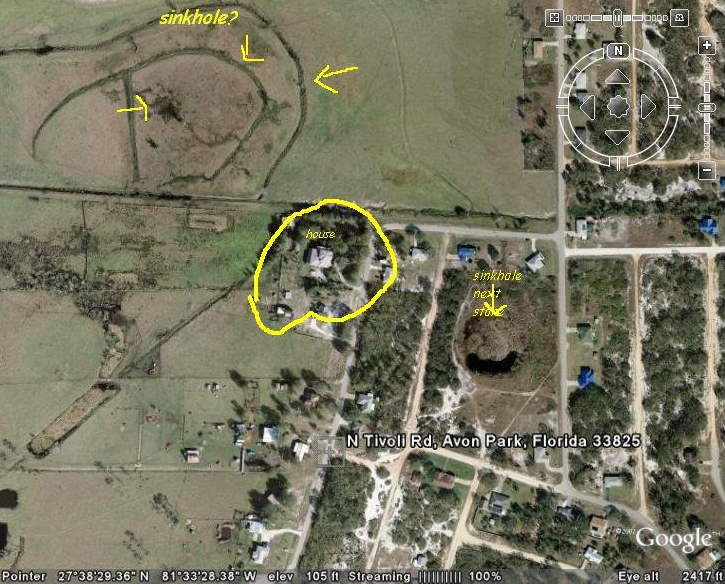
 Sinkholes & Subsidences in Georgia

- POST a QUESTION or COMMENT about sinkholes and their effects on buildings
Sinkholes in Georgia:
This article describes the location & type of sinkholes occurring in Georgia.
This article series explains what sinkholes are and why they occur, describes their effects on buildings, and gives building and site inspection advice useful in identifying areas where there is an increased risk of sink holes at properties.
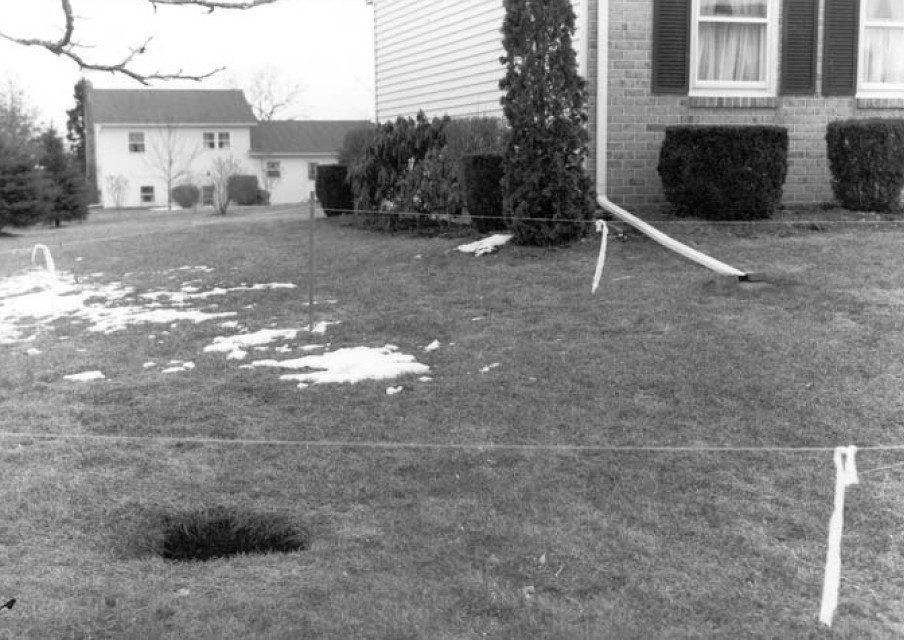
The photograph (above-left) of a sinkhole opening in a residential yard in Pennsylvania, not Georgia, is from Kochanov, W.E. and illustrates the child hazard or even adult sinkhole hazard that can be formed by storm water drainage.
Explanation of causes of sinking buildings from events other than sinkholes.
Catalog of types of sink holes around the world including California, Canada, Quebec, Estonia, Guatemala, Maryland, New York, Pennsylvania, Texas,Tennessee, Virginia and other states and provinces and countries. Explanation of causes of sinking buildings from events other than sinkholes.
InspectAPedia tolerates no conflicts of interest. We have no relationship with advertisers, products, or services discussed at this website.
- Daniel Friedman, Publisher/Editor/Author - See WHO ARE WE?
Sinkholes in Georgia
 Sinkholes have been reported in Georgia including news articles in the Examiner (a freelance writing website) in 2014 describing an event in Atlanta that could have been related to human activity (even a burst water main) though the report attributed it to the presence of a stretch zone in the North American Tectonic plate.
That news report described other stretch-zone events including "... loud booms, moaning, humming, and other sounds coming from the ground ...".
Sinkholes occur in Georgia principally in areas located over karst formations such as the Dougherty Plain in the Albany, Georgia area, Valdosta Georgia, along the Flint River in southwest Georgia, at karst formations below Lake Seminole, and other south Georgia areas.
Lake Louise is a "coalesced" sinkhole lake found in Lowndes County, also in southern Georgia.
Sinkholes have also been studied in Southwest Georgia along the Pelham Escarpment between Bainbridge and Camilla. (Jancin 1993).
Sinkholes may also be ascribed to human activities including lowering of groundwater in some areas or use of injection wells in others. (Newton, 1987).
In general terms a sinkhole is any sudden subsidence of the earth. In more technical terms, a true "sinkhole" is a subsidence or soil collapse caused by a combination of water eroding supporting soils, rock, or limestone, and an underlying geological structure or material that is particularly vulnerable to dissolving in water.
Urban or suburban sinkholes due to burst water mains, sewer lines, or storm drains can occur almost anywhere.
Here we focus on other sinkhole types and causes including sinkholes due to geological formations, types of rock (karst formations), or due to human activities such as mining. We also discuss here sinking buildings from causes other than sinkholes.
Also see BANGING BOOMING NOISE DIAGNOSIS & CURE
Question: scared of sinkholes or mud explosion in Winder Georgia
2016/05/30 Sharon
Hi, I'm scared to death in Winder,GA. I live at the site of an inactive (at least at the moment & not since it's last week eruption in the 1800s which killed everyone in a 10 mile radius.) Mud volcano. Our yard is pasture and woods except right up by the house from the foundation out 10 feet is peat moss and lately I've been feeling like the bottom is dropping out from my feet while I'm in the house.
It's a three story governors mansion style brick home built in 1967.
Almost everything is just how it was back then except the wash down slope to the side that used to lead to a huge lake we had out back about two football fields behind our house and suddenly about a year and a half ago the damn broke and the water went somewhere but the lake is now gone not to mention there's black quicksand down around the area outside the crater a little ways which was already there.
The Indians called this place the gateway to hell and it used to be a burning swamp. Is this house on top of a sink hole cause I'm really certain that it's not safe but I can't convince anyone to listen inside our home. Help me please.
This question was posted originally
at SINKHOLE DETECTION, WARNING SIGNS
Reply:
Sharon, I found a little history, not much, of the historic mud bog explosion in Winder Georgia, often referred to as a " mud volcano ", but not much scientific data; some texts posit that the Nodoroc mud explosion in Winder was due to decaying organic matter (leaves for example) in the bog
. If that was the case, it could certainly have been a methane explosion, though what ignited the methane gas is not stated. Certainly natural forces might ignite marsh gas as might a lightning strike.
Separately from the Nodoroc mud volcano, you describe a more recent bursting of a dam in about 2014. I haven't found references to that event. You might want to see the DeKalb County, Georgia Multi-Jurisdictional Hazard Mitigation Plan, February 2011, available from the DeKalb County government at http://dunwoodyga.gov/
If there was a sudden flooding of the site where your home is located there could have been damage to your home including its foundation.
It is, however, very unlikely that substantial foundation damage or movement could occur at your home, particularly as it is a brick structure, but with no visible evidence such as foundation cracks, building areas out of level, interior cracks, or other damage. Certainly enough house movement to make you feel "the bottom dropping out from under [your] feet" would be visually apparent on the home itself.
I can thus suggest these steps:
1. ask for a local inspection of the visual condition of your home and site for evidence of structural movement or damage
2. be sure that you have working CO detectors and smoke detectors, and ask your inspector to screen the site for presence of high levels of methane or other combustible gases
3. check with your doctor about any health conditions that might explain the conditions you describe
"Sinkholes" that are not verified by a licensed professional geologist or geotechnical engineer to be a true sinkhole are also described in various publications as subsidence incidents.
Readers should see SINKHOLES - IMMEDIATE SAFETY ACTIONS, and also
see FOUNDATION CRACKS & DAMAGE GUIDE and CESSPOOL SAFETY WARNINGS.
Additional septic system safety warnings are at SEPTIC & CESSPOOL SAFETY.
The bare minimum that a property owner needs to know about sinkholes or any other sudden subsidence of soils at a property is that these conditions might be very dangerous.
Someone falling into a sink hole or into a collapsing septic tank could be seriously injured or even die.
If a suspicious hole, subsidence, or depression appears at a property the owner should rope off and prevent access to the area to prevent anyone from falling into the opening, and then should seek prompt assistance from a qualified expert, geotechnical engineer, septic contractor, excavator, or the like.
Georgia sinkhole research
- Beck, Barry F. "Sinkhole development in south Georgia and Florida, USA, and the founding of the Florida Sinkhole Research Institute." In Third International Symposium on Land Subsidence, vol. 609. 1984.
- Brook, George A., and Terry L. Allison. "Fracture mapping and ground subsidence susceptibility modeling in covered karst terrain-the example of Dougherty County, Georgia." Environmental Karst (1983): 91-108.
- Hyatt, James A., and Peter M. Jacobs. "Distribution and morphology of sinkholes triggered by flooding following Tropical Storm Alberto at Albany, Georgia, USA." Geomorphology 17, no. 4 (1996): 305-316.
- Jancin, Mark, and David D. Clark. "Subsidence-sinkhole development in light of mud infiltrate structures within interstratal karst of the coastal plain, Southeast United States." Environmental Geology 22, no. 4 (1993): 330-336.
- Leandro, Amie M., Angela Wall, James A. Hyatt, And Eric C. Brevik. "Identifying Spatial Trends In The Physical Properties Of Sediments, Lake Louise, Georgia." In Geological Society Of America Abstracts With Programs,, Vol. 37, No. 1, P. 15. 2005.
- McConnell, James B., D. W. Hicks, L. E. Lowe, S. Z. Cohen, and A. P. Jovanovich. Investigation of ethylene dibromide (EDB) in ground water in Seminole County, Georgia. No. 933. USGPO,, 1984.
- Newton, John G. Development of sinkholes resulting from man's activities in the eastern United States. No. 968. USGPO,, 1987.
- Newton, J. G. "Natural and induced sinkhole development in the eastern United States." A. I. Johnson et al (1984): 323-331
- Plummer, L. N., Eurybiades Busenberg, J. B. McConnell, Stefan Drenkard, Peter Schlosser, and R. L. Michel. "Flow of river water into a Karstic limestone aquifer. 1. Tracing the young fraction in groundwater mixtures in the Upper Floridan Aquifer near Valdosta, Georgia." Applied Geochemistry 13, no. 8 (1998): 995-1015.
- Ruth, Byron E., Thomas F. Beggs, and Janet D. Degner. "Predicting sinkhole collapse." Civil Engineering—ASCE 55, no. 11 (1985): 58-60.
- "Sinkhole epidemic: Georgia woman steps out front door, disappears in sinkhole", 7 February 2014, original source: http://www.examiner.com/article/sinkhole-epidemic-georgia-woman-steps-out-front-door-disappears-sinkhole
Also see NOISE / SOUND DIAGNOSIS & CURE - home - Torak, Lynn J. Assessment of karst features underlying Lake Seminole, southwestern Georgia and northwestern Florida, using orthorectified photographs of preimpoundment conditions and hydrographic maps. Georgia Institute of Technology, 2003.
Daniel Friedman - Florida Suncoast ASHI Educational Seminar - 1 May 2004, updated 2007, 2008, 2014, 2017 2919 2022.Portions of this text are extracted, quoted, or paraphrased from references provided; a key resource author was Sarah Cervone at Reference-1. The text document is InspectAPedia.com/vision/Sinkholes_Subsidences.php - © 2022 - 2004 Daniel Friedman All Rights Reserved
...
Continue reading at SINKHOLE DAMAGE REPAIRS or select a topic from the closely-related articles below, or see the complete ARTICLE INDEX.
Or see these
Recommended Articles
- BANGING BOOMING NOISE DIAGNOSIS & CURE
- SEPTIC & CESSPOOL SAFETY
- SINKHOLES & SUBSIDENCES - home
- SINKING BUILDINGS
Suggested citation for this web page
SINKHOLES in GEORGIA at InspectApedia.com - online encyclopedia of building & environmental inspection, testing, diagnosis, repair, & problem prevention advice.
Or see this
INDEX to RELATED ARTICLES: ARTICLE INDEX to SINKHOLES
Or use the SEARCH BOX found below to Ask a Question or Search InspectApedia
Ask a Question or Search InspectApedia
Share this article:Questions & answers or comments about sinkholes and their effects on buildings.
Search the InspectApedia website
Need to make a private comment? Email editor@inspectApedia.com. We welcome email with your website content critique, corrections, suggestions or questions. Email is monitored daily but our workload may prevent an immediate reply. For immediate results, we hope you'll first try asking your question using the search box just above.
Citations & Reviewer
In addition to any citations in the article above, a full list is available on request.
- Florea, Lee J. "Using State-wide GIS data to identify the coincidence betwen sinkholes and geologic structure." Journal of Cave and Karst Studies 67, no. 2 (2005): 120-124.
- Waltham, Tony, Frederic Gladstone Bell, and M. G. Culshaw, Sinkholes and subsidence, Springer/Praxis, 2005.
- [1] Thomas V. Cech, Principles of water resources: history, development, management, and policy, John Wiley and Sons 2009 ISBN0470136316, 9780470136317
[11] Reference 3
[12] Reference 7
[13] Reference 19
- "Quick Clay", Wikipedia search 5/13/2010 - http://en.wikipedia.org/wiki/Quick_clay
- Wikipedia - web search 06/04/2010 - http://en.wikipedia.org/wiki/Guatemala_City
Sink Hole & Related Engineering References
- Newton, J. G., 1987, Development of sinkholes resulting from man's activities in the eastern United States: US Geological Survey Circular 968, 54 p.
- White, W. B., 1988, Geomorphology and Hydrology of Karst Terrains: Oxford University Press, New York, 464 p.
- Cited References from this article:
- #3. Detecting Sinkholes with Geophysics, Enviroscan, Inc., Lancaster PA 717-396-8922 email@enviroscan.com www.enviroscan.com 2003
- Avongard FOUNDATION CRACK PROGRESS CHART [PDF] - structural crack monitoring
- Building Pathology, Deterioration, Diagnostics, and Intervention, Samuel Y. Harris, P.E., AIA, Esq., ISBN 0-471-33172-4, John Wiley & Sons, 2001 [General building science-DF] ISBN-10: 0471331724 ISBN-13: 978-0471331728
- Building Pathology: Principles and Practice, David Watt, Wiley-Blackwell; 2 edition (March 7, 2008) ISBN-10: 1405161035 ISBN-13: 978-1405161039
- Diagnosing & Repairing House Structure Problems, Edgar O. Seaquist, McGraw Hill, 1980 ISBN 0-07-056013-7 (obsolete, incomplete, missing most diagnosis steps, but very good reading; out of print but used copies are available at Amazon.com, and reprints are available from some inspection tool suppliers). Ed Seaquist was among the first speakers invited to a series of educational conferences organized by D Friedman for ASHI, the American Society of Home Inspectors, where the topic of inspecting the in-service condition of building structures was first addressed.
- Building Failures, Diagnosis & Avoidance, 2d Ed., W.H. Ransom, E.& F. Spon, New York, 1987 ISBN 0-419-14270-3
- "A Foundation for Unstable Soils," Harris Hyman, P.E., Journal of Light Construction, May 1995
- "Inspecting Block Foundations," Donald V. Cohen, P.E., ASHI Reporter, December 1998. This article in turn cites the Fine Homebuilding article noted below.
- "When Block Foundations go Bad," Fine Homebuilding, June/July 1998
- In addition to citations & references found in this article, see the research citations given at the end of the related articles found at our suggested
CONTINUE READING or RECOMMENDED ARTICLES.
- Carson, Dunlop & Associates Ltd., 120 Carlton Street Suite 407, Toronto ON M5A 4K2. Tel: (416) 964-9415 1-800-268-7070 Email: info@carsondunlop.com. Alan Carson is a past president of ASHI, the American Society of Home Inspectors.
Thanks to Alan Carson and Bob Dunlop, for permission for InspectAPedia to use text excerpts from The HOME REFERENCE BOOK - the Encyclopedia of Homes and to use illustrations from The ILLUSTRATED HOME .
Carson Dunlop Associates provides extensive home inspection education and report writing material. In gratitude we provide links to tsome Carson Dunlop Associates products and services.
 |
HOME | ABOUT | ASK a QUESTION | CONTACT | CONTENT USE POLICY | DESCRIPTION | POLICIES | PRIVACY | |
| © 2026 - 1985 Publisher InspectApedia.com - Daniel Friedman | |||||||||