 Tree or Shrub Distances to Septic System FAQs
- POST a QUESTION or COMMENT about recommended distances from septic drainfields to various trees and shrubs
Questions and answers about the proper distances for planting trees or shrubs over or close to septic system components: the septic tank and soakaway bed.
FAQs about how close or how far to keep trees & shrubs from septic system components, particularly the septic drainfield or leach field and the septic tank.
This article series describes the types of trees, shrubs, or similar plants that should or should not be planted over or near septic fields or other septic system components.
InspectAPedia tolerates no conflicts of interest. We have no relationship with advertisers, products, or services discussed at this website.
- Daniel Friedman, Publisher/Editor/Author - See WHO ARE WE?
FAQs on Planting Guidelines for Trees or Shrubs near Septic Systems
 Questions & answers about planting distances for trees near the septic tank or near the septic drainfield, posted originally
at TREES or SHRUBS OVER THE SEPTIC FIELD or TANK - be sure to review that article.
Article Index
- ALBERTA SPRUCE TREE distance to septic FAQ - dwarf Alberta Spruce Trees
- APPLE TREE DISTANCE to SEPTIC COMPONENTS FAQs
- ARBORVITAE SHRUBS NEAR the SEPTIC Q&A
- AUTUMN BLAZE MAPLE TREE distance to Septic FAQs
- AZALEA BUSH DISTANCE to SEPTIC Q&A
- BLOSSOM TREE DISTANCE to SEPTIC FAQ
- BLUE SPRUCE TREES distance to septic Q&A
- BRADFORD PEAR DISTANCE to SEPTIC FAQ
- CHOKEBERRY DISTANCE to Septic System FAQ
- CREPE MYRTLE TREE distance to septic Q&A
- CYPRESS TREE DISTANCE to SEPTIC FAQ
- DAPPLED WILLOW TREE distance to Septic Q&A
- ELAEGNUS Distance to SEPTIC FAQ
- ELDERBERRY TREE DISTANCE to SEPTIC Q&A
- FORSYTHIA DISTANCE to Septic System FAQ
- FRASER FIR TREE DISTANCE to SEPTIC Q&A
- GOLDEN RAIN TREE distance to Septic FAQ
- HAZELNUT TREE distance to Septic FAQ
- JAPANESE KNOTWEED DISTANCE to SEPTIC FAQs
- LINDEN TREE distance to Septic QA
- LILAC BUSH DISTANCE to SEPTIC Q&A
- MAJESTY PALM TREE Distance to Septic FAQs
- NEEM TREE distance to Septic FAQs
- NORWAY PINE TREE distance to Septic FAQs
- OAK TREE distance to Septic Comonents FAQs
- PALM TREE DISTANCE to SEPTIC SYSTEM FAQs
- POINCIANA TREE distance to Septic FAQ
- PLUM TREE Distance to Septic QA
- REDBUD TREE distance to Septic FAQs
- RED MAPLE TREE distance to septic Q&A
- RED PINE TREE distance to Septic FAQs
- SCRUB PINE TREE Distance to SEPTIC Q&A
- SPRUCE TREE DISTANCE to SEPTIC FAQ
- SUMAC TREE (PLANT) Distance to Septic FAQs
- TAMARIND TREE distance to septic Q&A
- WHITE PINE TREES close to septic Q&A
- WITCH HAZEL TREE distance to septic system Q&A
- YUCCA PLANT DISTANCe to SEPTIC SYSTEM FAQ
...
How do we get rid of Japanese Knotweed growing near our septic mound system?
 We live in Vermont, USA. A local company installed a new Presby mound septic system at our home in the country last summer. Two weeks after construction was complete, Japanese knotweed plants began to sprout on the one acre septic site.
We need to talk with a UK engineer about the potential impact that knotweed roots can create.
Please contact me with information. It appears that the UK has lots more experience with this invasive than the US does.
Thank you.
Winton Goodrich - winton.goodrich@gmail.com - 2023-01-03
This Q&A were posted originally
at U.K. OFF-GRID SEPTIC REGULATIONS & SEWAGE SYSTEMS
Moderator reply:
@Winton I Goodrich,
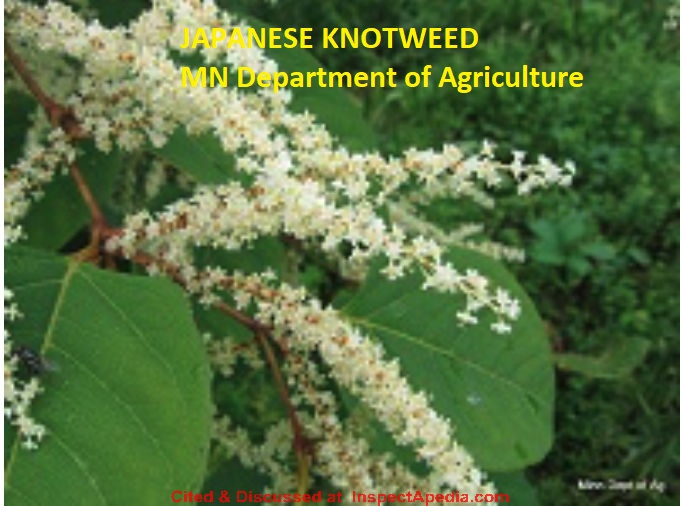
Photo above: Japanese knotweed flowers & leaves, photo by the Minnesota Department of Agricultyure, cited herein.
Thank you for your question about Japanese knotweed of which we need to do further research. And yes, you are correct in being concerned about the impact of an invasive species on your septic system and drainfield.
Knotweed is an invasive species that has a rhizome root system that can grow 6 feet down into the soil - easily ruining a septic drainfield. It is a plant that's difficult to eradicate.
In the UK, according to Schedule 9 of the Wildlife and Countryside Act (1981), it is considered an offence to cause Japanese knotweed to grow in anywhere, especially in the wild. This means that property owners have responsibility in controlling and managing the spread of this weed. - japaneseknotweedspecialists [dot] com 2023-01-03
In the UK the government describes several means of control of Japanese Knotweed:
- Chemical treatment (requires licensing, permits, special disposal etc)
- Burying (requires notification of the Environment Agency at least a month in advance)
- Burning (requires notification of the Environment Agency and other local agencies & permits)
- Hiring a company specialising in treating knotweed
- Disposing of removed knotweed offsite at an approved location
- Watch out: do not mow Japanese knotweed. Cutting or mowing has been found to be ineffective and may, in fact, make ultimate removal of this plant even more-difficult as its rhizome root system will continue to spread and to grow more-deeply into the soil. (Jones 2020)
We will research this topic further but in the meantime, if you are wanting contact information for a UK resource that you can ask questions of, please see the references given below.
Japanese Knotweed Control
- Child, Lois, and Max Wade. The Japanese knotweed manual: the management and control of an invasive alien weed. Packard Publishing Ltd, 2000.
- HOW TO STOP JAPANESE KNOTWEED FROM SPREADING [PDF] (2016) - retrieved 2023/01/03, original source: www.gov.uk/guidance/prevent-japanese-knotweed-from-spreading
an informative article from the UK Environmental Agency that includes their contact information. Reviewing this article's information would be a good starting place for you to learn more about knotweed.
Excerpts:
Japanese knotweed is the most common of 4 invasive knotweed plant species in the UK. These are:
Japanese knotweed
Dwarf knotweed
Giant knotweed
Bohemian (hybrid) knotweed - Jones, Daniel, Mike S. Fowler, Sophie Hocking, and Daniel Eastwood. PLEASE DON’T MOW THE JAPANESE KNOTWEED! [PDF] NeoBiota 60: 19–23. https://doi.org/10.3897/neobiota.60.56935
- Jones, Daniel, Gareth Bruce, Mike S. Fowler, Rhyan Law-Cooper, Ian Graham, Alan Abel, F. Alayne Street-Perrott, and Daniel Eastwood. "Optimising physiochemical control of invasive Japanese knotweed." Biological Invasions 20, no. 8 (2018): 2091-2105.
- MNDA, JAPANESE KNOTWEED [PDF] (2023) Minnesota Department of Agriculture, retrieved 2023/01/03, original source: https://www.mda.state.mn.us/plants/pestmanagement/weedcontrol/noxiouslist/knotweed# - Rhizomes and roots can grow,with more heart shaped bases.
Excerpts:
Japanese Knotweed Prevention and Management
- Do not plant knotweed as an ornamental and eradicate any existing plants from your property.
Do not move soil that may contain knotweed rhizome fragments to uninfested areas. A sound management plan is necessary to manage this species and will take a commitment of several years to ensure that the population has been eliminated.
- Foliar and stem injection application of herbicides that translocate their active ingredients into the root system can be very effective.
Treatments will need to be repeated for several years to eradicate a population.
If using herbicide treatments, check with your local University of Minnesota Extension agent - www.extension.umn.edu/offices/ , co-op, or certified landscape care expert for assistance and recommendations.
There are several businesses throughout the state with certified herbicide applicators that can be hired to perform chemical applications. Japanese knotweed also grows commonly in riparian and wetland habitats.
If treating plants near water with herbicide, please be aware of the state pesticide laws - www.mda.state.mn.us/pesticide-fertilizer/pesticide-use-sales-datawww.mda.state.mn.us/pesticide-fertilizer/pesticide-use-sales-data - and use only products labeled for aquatic use. - Do not cut or mow knotweed. Cutting or mowing increases spread and can stimulate growth. Bending stems out of the way can be useful if knotweed blocks pathways.
- Always clean and inspect equipment after working in an infested area to prevent transport of plant fragments and seed to new areas.
- Do not plant knotweed as an ornamental and eradicate any existing plants from your property.
- KNOTWEED LIFECYCLE & TREATMENT TIMING [PDF] - original source: bugwoodcloud.org/mura/mipn/assets/File/Educational%20Resources/Knotweeds%208_5x11%20(locked).pdf
- UK Japanese Knotweed Specialists, "Japanese Knotweed Roots: What's the Big Deal", [private company, Web: japaneseknotweedspcialists.com UK Tel: 0800 122 3326] - retrieved 2023/01/03, original source: www.japaneseknotweedspecialists.com/news/japanese-knotweed-root
...
Arborvitae bushes near the septic leachfield?
Can Arborvitae bushes be planted along a septic field? On 2021-04-01 by Kim Smith
Reply by (mod) -
@Kim Smith,
Arborvitae roots are fairly shallow, ranging, depending on the Arborvitae species, from 8" deep to 24" deep; I SUSPECT, but don't know, that these "standard" root depths might actually not be obeyed by any plant growing over a septic drainfield where there may be an attractive nutrient in the soil, but that's the best data we've got.
So if your Arborvitae bushes are over a field where the drainfield trench tops are less than 24" deep in the soil, you'd not want to plant these over the soakaway area.
...
Blossom tree (Prunus Cerisfera Nigra) distance to septic tank?
How far away should I plant a blossom tree (Prunus Cerisfera Nigra) from my concrete septic tank that was put in 10 years ago ? I have a spot in the garden that's 23 foot from the septic tank..Any advice that you can give me would be very welcome ? On 2020-06-10 by Chris O Connor
Reply by (mod) -
Thanks for asking Chris and forgive the COVID-19 delayed reply
TreeLogic tell us that about root space for Prunus Cerisfera Nigra)
Based on a mature size specimen of ‘Nigra’ would require approximately 20m2 area or 12m3 root volume (crown projection method). - https://treelogic.com.au/
With a typical canopy spread as a mature tree of 13 ft., if you keep your Blossom Tree 15 feet or more away from the septic drainfield and any septic piping or tank(s) you should be OK.
...
Effect of Leyland Cypress Trees near the septic drainfield?
What can be expected in regard to leyland cypress tress planted near a septic drainfield? they are less then five feet away On 2021-04-28 by phyllis
Reply by (mod) -
@phyllis,
According to gardenguides.com a Leyland Cypress has roots that are small and very shallow, staying close to the surface of the soil. Additionally, the spread of the roots is minimal, especially for such a large tree.
Still you would want the tree to be no less than a distance from the septic drainfield that is equal or better, greater than the diameter of the tree canopy.
These are trees that can grow to 40 ft. tall and 20 ft. in diameter.
It'd be smart to keep the 25 feet from the septic field.
So what can you expect?
At 5 feet distance, and considering the appeal of sewage effulent as a plant nutrient that draws roots, I would not expect the trees to behave themselves nor to keep out of the septic field piping
...
How far away should I plant Elderberry Trees from my septic system?
Hi! ¿How far away should I plant elderberry trees from my septic system? Thanks so much. On 2021-12-18 by Ericka Johnejack
by Inspectapedia Com Moderator (mod) -
@Ericka Johnejack,
Elderberry trees have a shallow roots system but can grow rapidly and are known as being invasive.
You would want the tree to be no less than a distance from the septic drainfield that is equal or even better, greater than the diameter of the tree canopy.
These are trees that could grow to 30 ft. tall and 20 ft. in diameter.
It'd be smart to keep them 25 feet from the septic field.
...
Planting Lilacs over the Septic Drainfield?
I am curious about planting lilacs Over a septic field.
I have to take down a number of trees where the field is going in and want to do some replacement planting this fall.
I was hoping it would be safe to plant some bulbs, lilacs and other shrubs this fall, and then perennial wildflowers in the spring. On 2020-09-30 by Dave
- by (mod) -
Dsve
Lilac Bush roots generally go to an 18" to 24" depth in soil and will spread horizontally roughly one and a 1/2 times with of the plant.
I have not seen an authoritative source on this but in my opinion it would be safest to keep your lilacs 10' to 12' away from the drainfield.
...
We're planting a Red Maple near the septic fields? What distance?
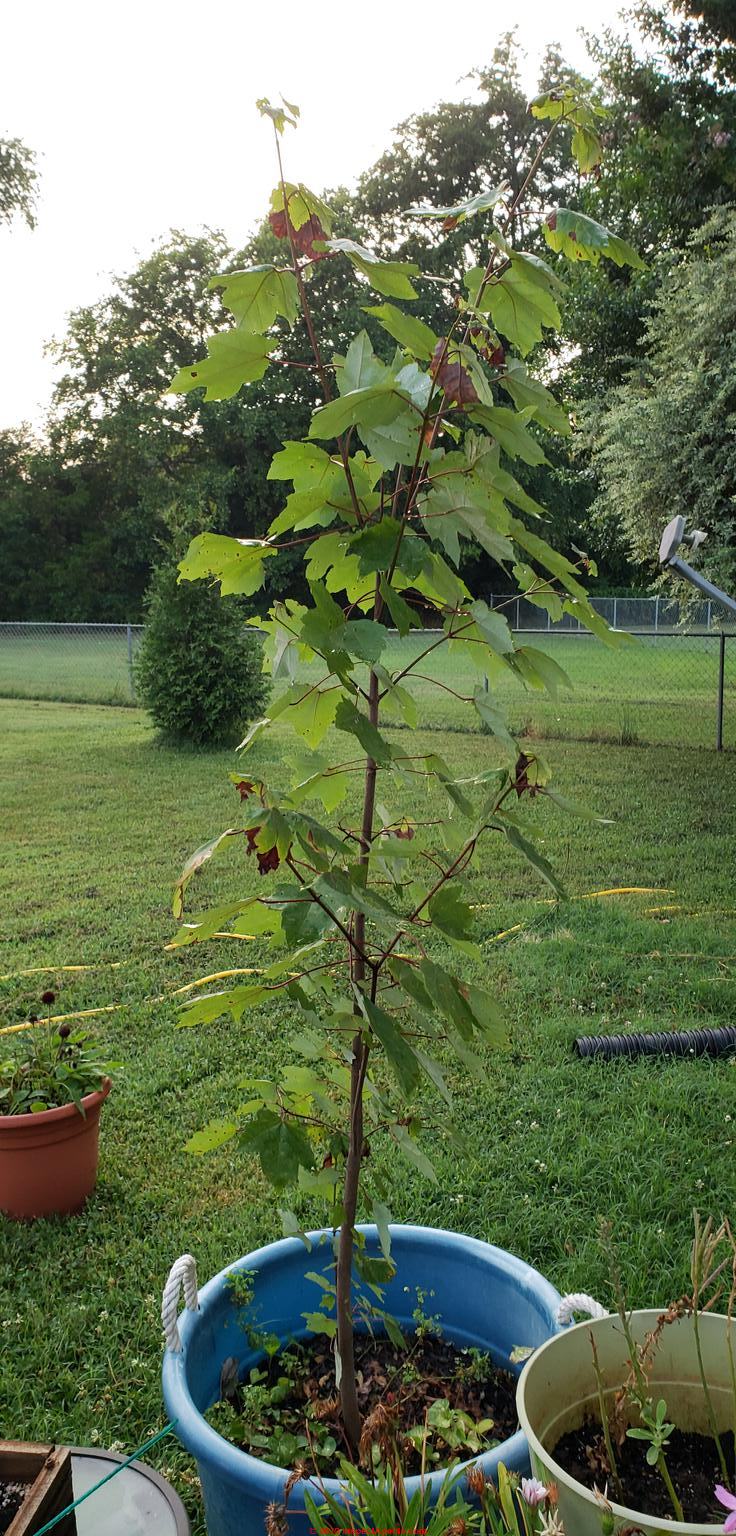
We are planting a Red Maple in our yard [photo above].
We have a septic system. How far from the leach field septic lines would we need to plant it to be a pretty safe distance?
It is really small now but dont want to cause major issues down the line On 2018-07-12 by Crystal
Reply by (mod) - rule of thumb: double the tree canopy width to get safe tree distance from the septic field
We warn about maple trees that can have deep roots in the article cited just below.
For some of those deep rooting or traveling trees the distances can be more significant and are given in the article TREES or SHRUBS OVER THE SEPTIC FIELD or TANK.
Here's a general rule of thumb:
Keep trees at least twice the distance from the nearest septic or drain field component as the diameter of the mature tree canopy.
...
Scrub pines are growing over the septic field; if I cut them down will the roots keep growing?
I have scrub pines growing directly over my septic field. If I cut them off at the ground, will I kill them or will the root keep growing.?
I forgot to say, they are about 5-7 years old and I believe are white pine. I think their roots are shallow but, still think they should go>? On 2020-06-05 by jim m
Reply by (mod) -
You'll probably kill the pines, Anon, but that doesn't tell us whether or not there's already root damage.
...
Are these spruce trees clogging the septic drainfield lines?
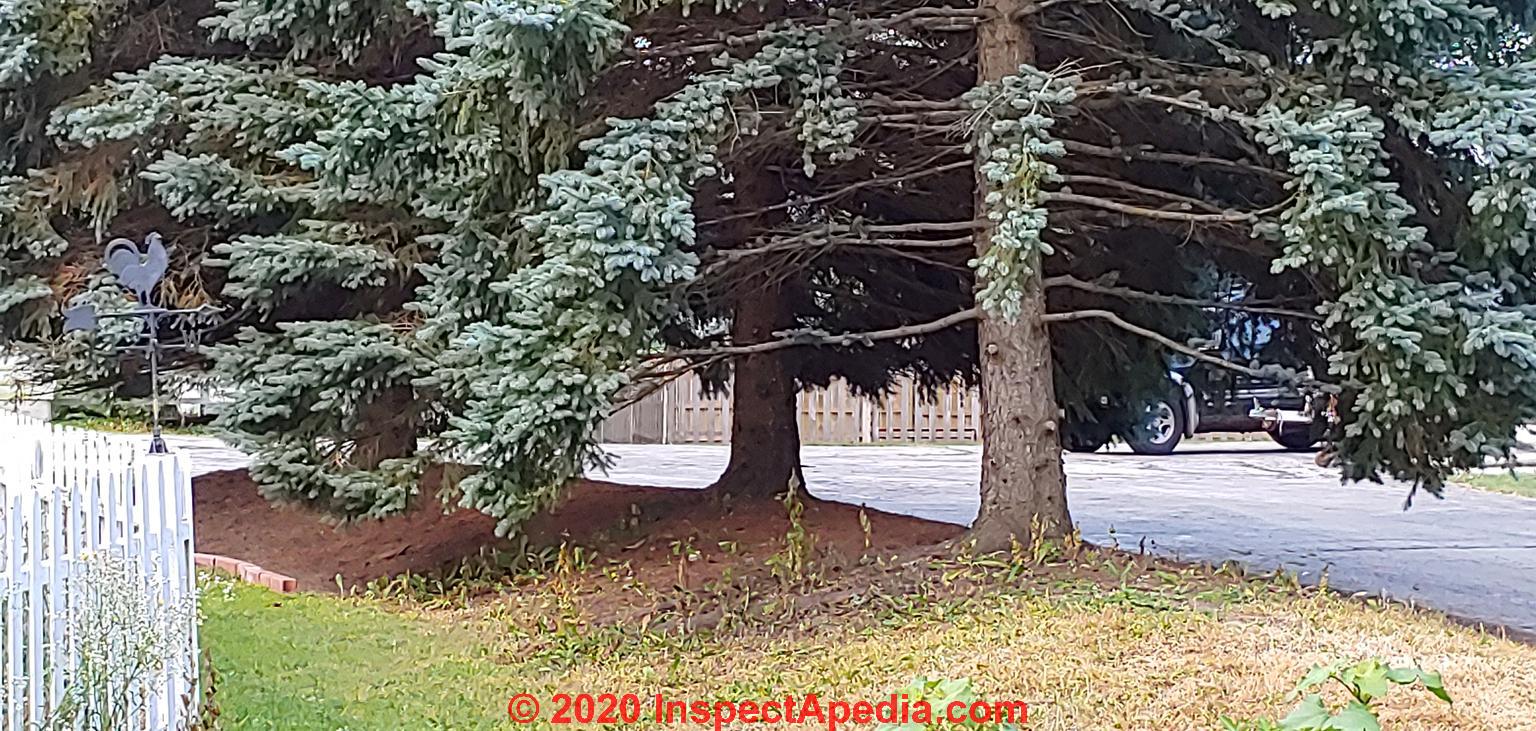 We have several Blue Spruce [trees - photo above ] (could be Colorado Spruce, but cannot be sure) planted over top our six inch sewer line.
Several plumbers have told us these roots are invading our line, plugging it, and must be cut down to avoid further damage.
A neighbor says Blue Spruce are shallow roots and are not invading the line.
The trees are between 25 an 35 feet tall and stand on a mound directly over the line ten feet down under the trees. On 2020-09-26 6 by Elmer
Reply by Morris [Horticulturist]
Hi Elmer. It's pretty unlikely that your trees have a tap root that could reach 10' into the ground! Blue spruce isn't normally a deep rooter, it's more of a spreader.
Most plants are spreaders since the surface of the soil is where the water and oxygen come from (roots take up O2). That said, septic systems where I live in central NC are not buried 10' in the ground - are you sure yours is that deep?
Most septic systems in these parts are only about 18 inches from the soil surface.
Generally speaking the vast majority of tree roots are close to the soil's surface (within a foot) though some will go deeper, and easily 18" deep, especially if there's a convenient water source down there.
I rather doubt that the roots are burrowing down 10' though.
I taught horticulture for a few decades and my thoughts are in line with all I have read as well as all the trees I've seen ripped out of the ground during our all too frequent hurricanes.
Just for future reference - root SPREAD is an all together different story - assume 3x the width of the canopy. Best, Morris On 2021-06-05 by Morris -
Spruce tree root depth, shape, and septic system invasion.
Spruce tree roots are typically rather shallow, moving mostly at an 18" depth from the soil top. The larger flare roots, some visible at the tree boles in your photo, will reach out about as far as the diameter of the tree canopy.
From your own information it is nevertheless possible that some finer roots may be attracted to the nutrients found in septic system effluent and therefore it's possible that your lovely spruce trees have roots have invaded and will continue to invade the septic system.From your photo I see and speculate:
- Watch out: The weight of trees or the weight of equipment that may need to drive close to the trees to maintain them or some-day remove-them risks drainfield damage even if the tree roots themselves are not going to reach the depth of your drainfield piping
- The total area in your photo looks awfully small for a functional septic effluent disposal system
- If your drainfield piping is really 10 feet deep in the soil, it may be successfully disposing of sewage effluent but the effluent treatment, reduction of pathogens, will be limited by lack of bacteria, increasing risk of contaminating nearby waterways or wells.
Happily this question is pretty easy to answer without having to rely on speculation.
Hire a plumber or septic contractor who can provide a sewer line camera.
Find the D-box or distribution box for your drainfield piping.How to do that is at SEPTIC D-BOX LOCATION
Use the camera to scope or inspect each of the drainfield lines.
Because there are no other shrubs, plants, trees near your drainfield other than these spruce trees, if your inspector confirms that the drainfield lines are root-clogged, regrettably we know the culprit.
I would not consider cutting down these trees before we have that definitive answer.
Unfortunately, with the trees in place, when your drainfield needs replacement you will have two options:
1. remove the trees AND their roots and stumps, and install new septic drainfield in that location
or
2. if your property has space, install he new drainfield to another spot.
Thanks for a helpful question.
...
Elaeagnus distance from septic fields?
How safe are Elaeagnus for a privacy shield say 6 feet apart over or near my septic drain field which distributes pumped effluent? On 2022-02-21 by Kendell S
by Inspectapedia Com Moderator (mod) - keep Elaeagnus away from the drainfield
@Kendell S,
From what I've read Elaeagnus has both a deep tap root and a spreading more-shallow root system. You should not plant this over your drainfield nor close to it. Normally we keep such plants well away from the septic drainfield - a distance greater than the expected canopy diameter which often predicts the minimum horizontal roof spread.The plant is said to grow to > 9m in height and at least 4 ft or 1.3m wide and are usually kept 3m or more apart even from one another.
That planting separation recommendation you'll find at various plant sites for Elaeagnus would say your plants need to be 9 ft. apart and I'd figure for safe avoidance root invasion of your septic field you'd want plants no closer than 10-12 ft from the edge of the drainfield.
My reasoning is the experience that the high concentration of nutrients in septic effluent act as a sort of magnet that can attract the roots plants from greater than normal plant root horizontal or vertical distance.
...
OK to plant a Dappled Willow near the septic tank?
I was wondering if it is okay to plant a dappled willow (Salic Alba Maculata) near my septic tank. On 2021-04-25 by Lee-Ann
by danjoefriedman (mod) -
@Lee-Ann,
I looked for botanical information including root depth for your Salic Alba Maculata - and am being swamped by its sister Botanical name: Salix alba. All common names: white willow - that grows to 100 ft. and is said to have a "shallow root system".
I'm left guessing that your sub species is like the rest of the group: tall growing and water-seeking. These trees love to grow along rivers and streams.
Frankly I wouldn't consider planting such a large tree, nor one whose roots are so smart at seeking water over a septic field. My two concerns are root clogging of the drainfield and later, a disaster when I have really big trees in the way of drainfield or septic tank service or repair.
I'm not sure what you have in mind by "near" the septic tank, If a septic tank is in perfect condition it's not leaking sewage effluent into the soil so it's not inviting the willow roots as does the drainfield, but
bottom line and as just an OPINION, I'd want to keep trees like that 75 to 100 ft feet away from a drainfield and 40-50 feet away from a septic tank.
...
Point Sienna (Poinsettia? Poinciana) tree distances to septic
How far from the septic tank can a Point Sienna tree be planted On 2017-05-17 by Anonymous
by (mod) re: Hetz Wintergreen Arborvitae planting distance from septic & Poinciana tree distance from septic
Hetz Wintergreen Arborvitae (Thuja occidentalis 'Hetz Wintergreen') roots are shallow - 18-24" in depth typically. Keep the tree as far away as the expected diameter of the tree's canoply when it's mature - that's about 5 feet.
Point Sienna tree roots - I think you mean Poinciana trees [Monaco Nature Encyclopedia] (Delonix regia) - are trees to keep at a considerable distance from septic system components, because they can send out very long roots spreading horizontally at 4-10 feet PER YEAR, as well as sending their roots to depths of 10 feet or more!So in a year and a half a Poinciana can send its roots to a distance three times the above-ground width or diameter of its canopy.
I would keep such a tree 100 feet from the drainfield and septic tank.
If you eant Poinsettia ornamental plants, those roots prefer the top foot of soil - keep them a couple of feet away from the drainfield.
...
Neem tree near the cesspool?
I just emptied my full cesspool; there is a 30ft neem tree right next to it. Should I cut it down? On 2017-04-28 by pat
by (mod) re: 30+ feet Neem tree distance from septic components
Pat,
From my reading I learned that Neem trees can produce a very deep tap root - that could in turn invade a cesspool, speeding its clogging.The tree would in fact be attracted to the cesspool nutrients. Cutting down the Neem tree won't remove the roots, and in fact the tree may re-grow from its stump.
You'd want a Neem tree to be a distance away from a cesspool or septic soakbed that is greater than the spread of its roots or an estimated root spread by the size of its canopy.
I'd figure 30 feet might be safe, 10 feet would be at the edge of or into trouble.
If after cutting the tree grows back from the stump, OR if you see roots invading the cesspool, you may have to dig out or remove the root-stump.
...
Safe Distance from Septic for Palm Trees
Are fruit bearing palm trees good or dangerous around septic systems?
Are fruit bearing palm trees good or dangerous around septic systems? On 2017-03-14 by James
Answer by (mod) -
James
Read PLANTS & TREES OVER SEPTIC SYSTEMS to read details of the concern not for health of the trees but their possible root damage to septic components and fields.
Generally coconut palm roots, except for a few deep radii, stay high in the soil - presenting less risk to damage to the field components. But of course driving over septic fields to harvest or collect would be a concern.
OPINION as a general answer: the sewage effluent hazard for tree crops is typically not pathogens passing up inside the tree via its root system, rather it's sewage effluent from an aerobic spray, or sewage contaminated soil splashing up on to the edible fruits.As a fruit bearing palm tree is typically between 32ft. and 50ft. in height, on the tree the fruits are pretty safe. A fruit (coconut? ) falling onto the ground - maybe ought to be washed before it's chopped open.
That's because a machete cutting through a dirty exterior from a coconut that fell onto wet sewage effluent (a failing drainfield) or onto contamianted soil *might* carry soil into the edible fruit.
Research on Palm Trees Near Septic Systems
- Timothy K. Broschat and Jonathan H. Crane, "The Coconut Palm in Florida" , U. Florida at http://edis.ifas.ufl.edu/mg043 discusses impact of sewage effluent on the health of palms
- Chary, N. Sridhara, C. T. Kamala, and D. Samuel Suman Raj. "Assessing risk of heavy metals from consuming food grown on sewage irrigated soils and food chain transfer." Ecotoxicology and environmental safety 69, no. 3 (2008): 513-524. discusses risks of heavy metal contaminants (that appear in some sewage waste)
- Iveson, J. B., N. Kovacs, and Wm Laurie. "An improved method of isolating salmonellae from contaminated desiccated coconut." Journal of clinical pathology 17, no. 1 (1964): 75-78. discusses detection of salmonella in contaminated coconut
- Broschat, Timothy K. "Palm nutrition and fertilization." HortTechnology 19, no. 4 (2009): 690-694. - using sewage causes Mn deficiencies in coconut trees
White Pines directly over my drainfield: should I cut them down?
I have recently purchased a home that has multiple large trees around and two directly over the septic drain field. The two directly above the drain field are white pines.
There are other white pines in the area and a few other large trees that I do not know the species. All tress are about 70 ft tall.
My question is, should I cut down the pines planted over the drain field? If the drain field drawing is accurate, the piping for the field is about 36" below grade.
I am confident that the roots have infiltrated the drain field piping, but to what extent I do not know. The system drains fine and the soil above and around is relatively hard and low in moisture (per a septic professional). I have not performed any video or other internal inspections to assess the actual damage.
I can only assume the roots are doing some good in consuming water that would otherwise be released to the soil, but at the same time continuing to consume free-drainage area in the piping. If I cut the trees, the water uptake will cease and I'll simply be left with clogged drain pipes with no uptake.
If I do not cut them, I am concerned about the soil being too moist and the tree up-rooting in a storm and possibly damaging the house. Not to mention the continued infiltration of the roots into the piping.
Are you able to render a recommendation? On 2017-04-19
by Stug
by (mod) re: when to remove trees from septic area
I hate cutting down nice trees, but with trees over the drainfield of the size you say, their roots have probably already invaded it just as you guess.
Watch out: Just cutting the trees down won't clear the intrusion of roots. Roots don't do good in a drainfield, they clog it.
I would remove the trees and then scope the drainfield lines to see their actual condition -
BUT FIRST let's be darn sure we know just where the drainfield lines run and that they are really near those pines.Watch out: also, dropping any large heavy tree onto a drainfield could potentially damage the drainfield piping from the impact. Safer would be to have an arborist working from a bucket truck that is NOT driven over the drainfield itself cut and lower heavy tree sections.
Are White Pines planted within 28 feet of a septic drain field okay?
Are White Pines planted within 28 feet of drain field okay?
I am not sure how deep my drain bed is, but it was installed new in 2019. On 2021-07-19 by James in Ohio
by mak.church (mod)
@James
As noted in the above article TREES or SHRUBS OVER THE SEPTIC FIELD or TANK , keep trees at a distance of at least the expected height of the tree.
Watch out: Since white pine can grow to 80+ feet, your 28 feet is too close. “Keep at least as much distance between the tree and the nearest drainfield component as the anticipated height of the tree at its maturity.”
...
Should we Remove Ornamental Bradford Pear Tree over the Septic?
We live in North Carolina and our septic system is almost 20 years old. There are ornamental pear trees and holly trees planted over the leach field. The pear trees are now three stories tall.
We have not had any problems with the septic system and are not sure if it’s better to just leave the trees or cut them down?
In particular, if we remove the trees and the roots have invaded the septic field could this cause problems when the roots start to decompose? Thanks, Jill On 2022-02-11 by Jill S
by Inspectapedia Com Moderator (mod) -
@Jill S,
Ornamental pears like the Bradford tend to have shallow roots: perhaps you've been lucky and they haven't invaded your septic drainfield.
Why not have a sewer line camera inspection of the leach lines: if you see they are root free you might stop there.by Jill S
My husband and I interpreted your response differently. If we would like to remove a few pear trees, should we be concerned that it might negatively impact the septic leach field?
by Inspectapedia Com Moderator (mod) - how to remove trees over the septic field
@Jill S,
Sorry, you're both right to ask for clarification of my earlier reply.
You can remove the trees if you like - saw down, cut up, carry away.
Leaving tree roots (and stumps) won't in and of itself cause trouble.
If roots are already in the drainfield piping then they're already causing trouble, dead or alive - by clogging the system and reducing its capacity - that's why I suggested a sewer line cam inspection.
Left in place tree roots and tree stumps of many species will ultimately begin to grow anew - so you haven't necessarily "killed" the trees and you might still in the future see a root invasion problem.
Watch out: driving heavy equipment over the fields such as a stump grinder or a truck to pick up tree parts can compress soil or collapse a drainfield line - damaging the system
...
How far from a drain-field should I plant a Honey-Crisp apple tree?
How far from a drain-field should I plant a Honey-Crisp apple tree? (May 2, 2016) surelyready1
Reply: 1.5 x anticipated tree height or about 30 feet for a typical fruit tree, plus safe distance from any aerobic septic effluent sprays
Surely
Most tree root systems extend horizontally for a distance about the same as the tree canopy or crown. Some trees send roots out further.
Typically fruit tree roots extend horizontally at least as far as the canopy, but are in the top 12 to 18" of soil depth - making them not a great risk to buried septic drainfield piping.
A rule of thumb I've read for fruit tree root horizontal distance that's different from tree canopy diameter is to use the height of the tree. Assume that roots will extend horizontally for a distance equal to the height of the tree PLUS 1/2 of that height again for every ten years of the tree's age.
So a 20 foot tall apple tree that is 20 years old would have a root spread assumed to be 30 feet out radially from the trunk.
See
- Atkinson, David, Denise Naylor, and Gwyneth A. Coldrick. "The effect of tree spacing on the apple root system." Hort. Res 16 (1976): 89-105.
- Atkinson, D. "The growth, activity and distribution of the fruit tree root system." In Tree root systems and their mycorrhizas, pp. 23-35. Springer Netherlands, 1983.
- Green, Steve, and Brent Clothier. "The root zone dynamics of water uptake by a mature apple tree." Plant and Soil 206, no. 1 (1999): 61-77.
...
Tree Distances from Septic Components for Hazelnut Trees: 50 ft.
Reader how far should I keep hazelnut trees from the septic leach field. - anonymous by private email 2017/03/12
Reply: 50 feet should be ok
From our reading, 50 feet from the drainfield ought to avoid any worry of root damage to buried drain lines.
For any food crop, if your septic system uses above-ground spray systems to dispose of septic effluent, as do many aerobic septic systems, take care also that wind-blown septic effluent won't contaminate your hazelnut crop.
See
- Henry, Jimmy & Jerry Kaiser, "PLANTING GUIDE, AMERICAN HAZELNUT, Corylus americana Walt." [PDF], USDA, (2000) retrieved 2017/04/12, original source: https://www.nrcs.usda.gov/Internet/FSE_PLANTMATERIALS/publications/mopmcpgcoam3.pdf
...
How far to keep Fraser Fir trees away from the septic leachfield?
I’m wondering how far away fraser fir trees should be from a leach field? On 2020-04-28 by Mike
Reply by (mod) -
Mike,
According to the USDA, the Fraser fir (Abies fraseri (Pursh) Poir.) has these properties, upon which I base an OPINION about a reasonably safe distance from drainfield at the conclusion of this remark.
Rooting Habit- The root system of Fraser fir is usually shallow because it customarily occupies shallow soils. Root growth is more rapid and rooting depth greater, however, than that of its frequent associate, red spruce (8). - source: USDA, www.srs.fs.usda.gov/pubs/misc/ag_654/volume_1/abies/fraseri.htm 2020/04/28
Watch out: from that text one could infer that planted near a septic system the Fraser fir may send roots deeper than in its usual shallow soil habitat, thus invading the leach field.
While a Fraser fir will grow slowly when it is seeded under dense foliage, out in the open and with deeper soil available it may grow faster and larger than you'd guess. The largest recorded Fraser fir crown diameter was 52 ft.
I would keep the Fraser Firs no less than 1.5 x the usual canopy diameter of a mature tree, safer would be 2X that distance or more.
Considering that a Fraser fir can live for 150 years, yours will out-live your septic system. But over the course of 20 - 40 years it'd be smart to keep such trees 50 to 75 feet from the drainfield.
Thank you for asking
...
Tree Distances from Septic Components for Linden Trees: 100 ft.
Are linden trees safe to plant near a septic system? v
Reply: No; keep them 100 feet or more away
Cynthia
I would keep a linden tree 100 feet from septic components. Linden trees grow to 89-90 feet in height, a size reflected as well in their very extensive root system, making the linden tree likely to invade septic systems if too close.
...
Tree distances to septic drainfield for Redbud Trees: 20-30 ft.
How close to a septic line can a redbud be planted? 2017/04/11 Patty
Reply: 20-30 ft.
Patty,
Redbud trees send out roots at least as far as the diameter of the tree canopy - that's around 15 feet for a mature tree. I'd keep such trees 20-30 feet away from a septic drainfield.
The Redbud tree roots are in most texts as shallow but "opportunistic" - that means that a tap root that finds delicious sewage effluent will doubtless head that way.
...
Tree distances to septic drainfield for Red Pine / Norway pines: 60 feet
Have you any information on Norway PInes and Red Spruce as i have these planted in my yard and am concerned about there potential damaging effects on my septic system.. thanks. They are only 4 feet so far so I can transplant them if need be - Will Treeman (4/11)
Reply: 40-60 feet for a 20-40-year early tree-life range, longer for longer tree life expectancy
According to Pennsylvania State University "The red pine is a native North American tree species sometimes erroneously called the "Norway pine". ... Red pines grow very rapidly for their first 60 or 70 years of life.
They can live for up to 350 years and reach heights of 120 feet and diameters of up to three feet. " [1]
Using a 60-year planning time frame, and our rule of thumb for distances of normall-aggressive-root-system trees from septic drainfields, assuming a 60-foot tree height, I'd keep my red pines (or "Norway pines") sixty feet away from the drainfield. 100 feet would be safer as pines can have aggressive root systems.
...
Tree Distances from Septic Drainfield for Dwarf Alberta Spruce Trees: 30 feet
Dwarf Alberta Spruce Tree distance between leech field?10/10/2014 Daryell
Tree distances from septic drainfield for Dwarf Alberta Spruce: 15-30 ft. - Red Spruce: 100 ft.
Reply: Daryell
The roots of a Dwarf Alberta Spruce tree are typically 10-15 feet in all directions from the trunk. 30 feet or more should be a safe distance from the drainfield or soakbed or leach field.
According to the University of Maine's Maine Tree Club, "Red spruce can attain a height of 60-80 feet and a diameter of 1-2 feet. It will occasionally exceed these measurements." Synonyms for red spruce include Yellow Spruce, West Virginia Spruce, Eastern Spruce, He-Balsam" Picea rubens, [2]
So the same rule of thumb as for red pines applies: if you don't want the trees to ever threaten the septic drainfield for the next 30-60 years, promising the trees a long and happy life, keep them 100 feet from septic drainfields.
Note: guessing at the tree root area and health for red spruce is complicated by soil chemistry and nutrients and so guessing root area size based on canopy size is less reliable for this species. [3]
...
Tree Distances from Septic for Tamarind Trees: 100 ft.
How far from drain field should a Lysiloma latisiliquum or false tamarind be planted? 6/22/14 Anonymous
Reply: safe is 100 feet
We found several authors who described rather aggressive root growth and a need for periodic root pruning in ornamental use of the False Tamarind plant. I'd follow the more aggressive distances given in our tables at TREES or SHRUBS OVER THE SEPTIC FIELD or TANK, keeping about 100 ft. to be safe.
Tamarind trees have both a deep tap root and very aggressive root structures that would be likely to invade and clog a septic drainfield.
...
Tree distances from septic drainfield for Witch Hazel: 25-30 ft.
I planted a witch hazel about 25 feet from the septic tank.
I planted a witch hazel about 25 feet from the septic tank. I can't find any information on the root system to see if this will cause a problem in the future. Does anyone know if this distance will be ok. 2017/04/13 Diana
Reply: 25-30 feet recommended
Diana,
From a review of horticultural information we learn that Witch Hazel (family Hamamelidaceae, of which there are multiple varieties and of which Hamamelis virginiana is particularly popular for yards) prefer well-drained soil, have a dense, coarse root system, and "... can take advantage of deep soils" as they use a branching taproot, but - from other sources - are basically a "surface rooting" plant.
I think the root differences among Witch Hazels depends on the individual plant species within the family.
The predominant choice (Hamamelis virginiana ) uses a shallow, spreading root system, a fact that suggests that the concern is indeed horizontal distance between the plant and the edge of the drainfield.
Since horticulturists recommend dedicting 20 sq.ft. to the plant, your 25 ft. distance from your witch hazel to the nearest edge of the drainfield is probably ok, though I, being chicken-hearted, would have probably gone for 30 feet or more horizontal distance.
...
What distance when planting red, white or scarlet oak near my septic
So if i plant a red, white or scarlet oak near my septic, how much distance should there be? On 2015-05-20 by cindy
by (mod) - red, white or scarlet oak: 20-30 feet from your septic drainfield
Cindy Oaks are listed at TREES or SHRUBS OVER THE SEPTIC FIELD or TANK as having "less aggressive" root systems. It'd still be smart to keep a distance of 20-30 meters from the tree to the drainfield.
A bare minimum distance for a very non-aggressive root-species tree would be 3 meters more than the maximum expected canopy diameter of the tree as the canopy diameter also often approximates the root diameter.
...
What's the right distance between Autumn Blaze Maple Trees and the septic leachfields?
I just purchased 2 autumn blaze maple trees. how far from the leach field do they need to be planted? TY! On 2015-05-15 by erin
by (mod) - autumn blaze maple trees near the septic
Erin
In the article TREES or SHRUBS OVER THE SEPTIC FIELD or TANK I read "Maple trees, particularly red and silver maples Acer rubrum and Acer saccharinium" in a list of warning about trees to keep well away from the fields - 100 feet would be smart.
...
My septic drainfield is overgrown with Sumac and Majesty Palm Trees
Hey question here. What about sumac trees? My drain field is little overgrown with sumac. Should I tare the trees out?
We also have majesty palms planted near drain field On 2015-05-03 by Dmitry
by (mod) - septic risk from Sumac trees & Majesty Palms
Dmitry
Sumac trees can have a far-reaching but shallow root system and can grow to a 10+ meter height. It's the "far reaching" that would make me worry about planting these within 10-20 meters of a septic field or soakbed.The roots may be tempted by the nutrients to invade the septic field piping. In addition the trees spread through their root system so they will continue to march towards the soakbed.
Majesty Palm (Ravenea rivularis) Tree roots grow 3-5 feet down and spread out 4-6 feet in any direction, so you'd want to keep those 10-15 feet away from any septic system and in my OPINION 20-30 feet would be safer because I worry about the extra attractiveness to tree roots of soil high in (septic) nutrients.
...
What's the Recommended Blue Spruce tree distance to septic?
How far away from my septic drainfield can I plant a Blue Spruce? On 2017-04-30 by Pam
How to prevent septic damage from nearby spruce trees planted by the neighbor
I recently purchased a home and the lot where the original house was built was divided into two. That put my septic system VERY close to my neighbours property line.
The stake in the ground, which marks where the gravel bed ends, is 4 feet from the property line.
For privacy, my neighbours planted spruce trees that will eventually grow to be 50-60 feet in many years to come. I am trying to prevent roots invading my septic system and leaching bed in years to come. This is my first time owning a home so this is all very new, but I want to avoid a costly clean up in the future.
So, i want to prevent the roots from clogging the field and also getting into the septic system which is made ofconcrete.
I was thinking of digging a trench about 4 feet deep right in front of where the trees are planted and then inserting a root barrier. will this be deep enough and will the roots go down under the leach bed or come up and invade.
What whould i do....I also read dig holes and fill with a plastic pipe and fill that with copper Sulfate, I was thinking to do this behind the barrier for any roots that do pass under. I was also thinking to flush copper sulfate down my toilets every month to prevent roots from invading.
My only concern with Copper Sulfate is that I do not want to pollute the water table. I want to be kind to the environment, but i also need to prevent the costly clean up of a potential invasion of roots. Can anyone provide help. - On 2014-12-02 by Anonymous
by (mod) - For Spruce Trees Closer to Septic than 60-75 feet, a Trench lined with metal to control spruce tree roots vs. septic system damage
Chantal and Anon:
Trees close to your drainfield are indeed likely to produce roots that invade and destory the field.Spruce tree references we consulted assert that most of the root system is in the first two feet of soil around the trees.
If you excavate a four-foot deep trench and line it with corrugated metal roofing or siding panels - or equivalent, you will reduce the ability of roots to spread into your septic system. The roots will want to seek nutrients (like septic effluent) so make the vertical or horizontal joints between your panels sealed and tight as you cvan.
Watch out: I would NOT try root killers, both because of its environmental impact and because if you kill your neighbor's trees you'll have another fight about that. Better to just encourage the trees to send roots in an easier direction away from your property.
Send me some photos (see our CONTACT US link) and I can comment further.I recommend reading NEIGHBORING SEPTIC SYSTEM PROBLEMS
by Chantal
I will send you photos of the problem! I REALLY appreciate your comments and help. THANK YOU so very very VERY much!
...
Dwarf Alberta Spruce Tree distance between leech field?
What's an acceptable Dwarf Alberta Spruce Tree distance between leech field? On 2014-10-09 by Daryell
by (mod) - Dwarf Alberta Spruce tree risk to septic systems: keep 20 to 30 feet away
Daryell
The roots of a Dwarf Alberta Spruce tree are typically 10-15 feet in all directions from the trunk. 30 feet or more should be a safe distance from the drainfield or soakbed or leach field.
...
What to do about a Crepe myrtle tree close to the septic drainfield.
I have a crape myrtle within feet of a septic drain field...it is not a dwarf, it is full size. Should I cut this down to ensure it does not damage the drain field? On 2014-03-10 by Anon
by (mod) - Crape myrtle distance to septic field
Crape,
I hate to ever suggest cutting down a tree, but if you have a full sized tree or shrub within "feet" (you don't say how many but I infer just 1-15 ft) it is likely that its roots will invade the system. Cutting down the tree will slow but not stop that process since leaving the roots live underground will probably cause the tree to grow again from its stump;
At this point you might remove the tree but figure that when you replace the drainfield you may find that some of the drain trenches and piping close to the tree location will be root-clogged, and will be removed and replaced at that time. I'm doubtful that the cost of such action is justified before a failure occurs.
I do not recommend root killers or other chemical additives.
...
OK to plant Forsythia and Chokeberry near the septic lines?
Are forsythia and chokecherry bushes ok near water/septic lines or will their roots cause a problem? 2019-12-15 by Helana
Reply by (mod)
Helana thanks for asking about Forsythia or Chokeberry near a septic field.
The answer depends on plant root depth.
Forsythia roots include a tap root that can go several feet into the soil - best kept off of a drainfield.
https://www.ag.ndsu.edu/trees/handbook/th-3-13.pdf says that Chokeberry roots are shallow (and "suckering") so possibly ok over septic systems.
...
What's the risk when planting Purple Plum Trees near the septic tank?
I've planted six Purple Plum Trees (burgundy leaves). They are about 6 feet tall and 2 are about 6 feet from the tank.
The others are about the same from the drainfield. Does anyone know about the Purple Plum tree root system? Am I in trouble? I think the tank is 1,000 gallons. Small house. Thanks! On 2012-05-16 by Kim Casey
Reply by (mod) - 6 feet is a bit close for planting any sort of tree or shrub near a septic tank
Ornamentals such as your purple plum have less aggressive root systems (I think) - see the examples in the article TREES or SHRUBS OVER THE SEPTIC FIELD or TANK.
Nevertheless, six feet is too close to any septic component and you're risking a root invasion; The risk is less if the septic tank and its piping never leak and are built using recent, impervious materials.
...
Golden Rain Tree too close to the septic system
I planted a golden rain tree about 5-6 feet from my septic/drain field. Now the tree is at least 25-30 ft hight.
The base of the trunk on the tree has several surface roots extending in all directions over the surface of the ground. Is this a danger to my drain field or septic?
My husband says that he wants to cut it down and I love the tree, it reminds me of a hugh canopy in the summer, but in the winter it is just a set of ugly brances. On 2011-09-05 by dandtkato@comcast.net
by (mod) -
Dandtkato
Unfortunately the tree is close enough to the septic drainfield to clog piping. It's a shame to have to cut down a beautiful tree, but then, it's unfortunate to face costly septic repairs sooner than necessary.
If you want to do a little digging to see what's going on, excavate a section of drainfield that is closest to the tree or to one of its major roots. If you find no evidence that the roofs are invading the trench you might decide to wait on sacrificing the tree.
...
Adams Needle Yucca Plant variety damaging to drain pipes and septic systems?
Are Adams Needle yucca variety damaging to drain pipes and septic systems? Thanks, Brian -01-24 by BRIAN RASMUSSEN
by Inspectapedia Com Moderator (mod) - Yucca root system is invasive
@BRIAN RASMUSSEN,
The root system for Yucca plants are invasive, aggressively-seeking water (and storing it too), combined of a shallow root system seeking water and a deeper tap-root.
I've found that "normally-shallow" root systems will be attracted to a drain line if there are openings (hub type older drainfield pipes) and will absolutey be attracted to the drainfield trenches of septic systems.
So you'd want to keep such plants 2-4 x the plant's canopy size diameter away from the drainfield. 20-30 feet or more may be safe.
See details in this
- YUCCA PLANT INFORMATION GUIDE - USDA [PDF] USDA, retrieved k2022/01/24 original source: www.nrcs.usda.gov/Internet/FSE_PLANTMATERIALS/publications/nmpmcrb12162.pdf
...
...
Continue reading at TREES or SHRUBS OVER THE SEPTIC FIELD or TANK - topic home, or select a topic from the closely-related articles below, or see the complete ARTICLE INDEX.
Or see these
Recommended Articles
- PLANTS & TREES OVER SEPTIC SYSTEMS
- GARDENS NEAR SEPTICS
- GRAZING ANIMALS OVER SEPTIC SYSTEMS
- GROUND COVER, IVY OVER SEPTIC FIELDS
- ROOT KILLERS in SEWER LINES or SEPTIC PIPES
- SEPTIC TANK GRASS or SNOWMELT
- SEPTIC TROUBLE SIGNS, OTHER
- SOAKBED SOIL CONDITIONS
- SEWAGE CONTAMINANTS in FRUIT / VEGETABLES
- TREES or SHRUBS OVER THE SEPTIC FIELD or TANK
- SEPTIC TANK & SYSTEM CARE BASICS
- SEPTIC DRAINFIELD FAILURE CAUSES
Suggested citation for this web page
TREE or SHRUB DISTANCE FROM SEPTIC FAQs at InspectApedia.com - online encyclopedia of building & environmental inspection, testing, diagnosis, repair, & problem prevention advice.
Or see this
INDEX to RELATED ARTICLES: ARTICLE INDEX to SEPTIC SYSTEMS
Or use the SEARCH BOX found below to Ask a Question or Search InspectApedia
Ask a Question or Search InspectApedia
Share this article:Search the InspectApedia website
Need to make a private comment? Email editor@inspectApedia.com. We welcome email with your website content critique, corrections, suggestions or questions. Email is monitored daily but our workload may prevent an immediate reply. For immediate results, we hope you'll first try asking your question using the search box just above.
Citations & References
In addition to any citations in the article above, a full list is available on request.
- In addition to citations & references found in this article, see the research citations given at the end of the related articles found at our suggested
CONTINUE READING or RECOMMENDED ARTICLES.
- Carson, Dunlop & Associates Ltd., 120 Carlton Street Suite 407, Toronto ON M5A 4K2. Tel: (416) 964-9415 1-800-268-7070 Email: info@carsondunlop.com. Alan Carson is a past president of ASHI, the American Society of Home Inspectors.
Thanks to Alan Carson and Bob Dunlop, for permission for InspectAPedia to use text excerpts from The HOME REFERENCE BOOK - the Encyclopedia of Homes and to use illustrations from The ILLUSTRATED HOME .
Carson Dunlop Associates provides extensive home inspection education and report writing material. In gratitude we provide links to tsome Carson Dunlop Associates products and services.
 |
HOME | ABOUT | ASK a QUESTION | CONTACT | CONTENT USE POLICY | DESCRIPTION | POLICIES | PRIVACY | |
| © 2026 - 1985 Publisher InspectApedia.com - Daniel Friedman | |||||||||