 How to Spot Unexpected or Odd Septic Drainfield Locations
- POST a QUESTION or COMMENT about hard-to-find septic drainfields or soakaway beds or leach fields
How to find the septic leachfield or drainfield when it is in an unusual or unexpected location. This article series and our accompanying septic system location videos explains how to find the leach field or drainfield portion of a septic system. We include sketches and photos that help you learn what to look for, and we describe several methods useful for finding buried drainfield components. (Septic drain fields are also called soil absorption systems or seepage beds.)
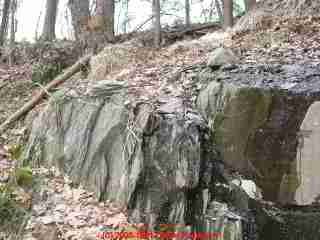
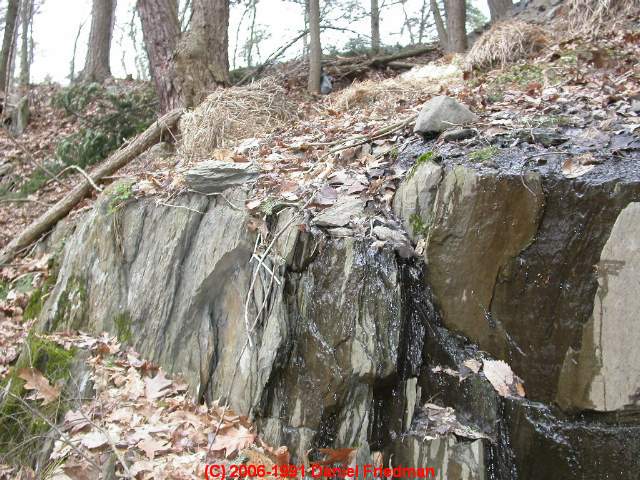
In the page top photo you can see septic effluent running across a rocky surface during our septic loading test. Actually effluent was running across this rock before we began our septic test, but our dye succeed in proving that the wet area was indeed coming from a failed septic system. A conventional tank and drainfield could not work in this location.
InspectAPedia tolerates no conflicts of interest. We have no relationship with advertisers, products, or services discussed at this website.
- Daniel Friedman, Publisher/Editor/Author - See WHO ARE WE?
Surprising Septic System Leachfield Locations

Drainfields may be located very distant from the building and or septic tank
Remember that septic system components can be at an "illogical" or "unlikely" location since people often make expedient or otherwise bad design choices, or may have had no alternative.
We've found drainfields that were quite remote from the building and from the septic tank, more than 200' away (downhill).
The reason this is abnormal is that it is expensive and trouble to dig great distances and there must either be proper slope (elevation change) between the tank and drainfield, or a pumping system is needed.
So normally the septic contractor will not put a septic system component farther away from the building or the tank than is necessary.
But rocky sites, steeps slopes, ponds, or other site features may mean that the tank or drainfield are located surprisingly far from the building they serve.
Septic Soakaway beds, Leachfields, or Drainfields may be located off of the property they serve and even across a road or highway
We've found leaching beds that were located across a public highway from the house and septic tank. We've found leaching beds that were not on the owner's property at all.
An illegal septic system "drainfield" may turn out to be emptying deliberately into a nearby stream or lake
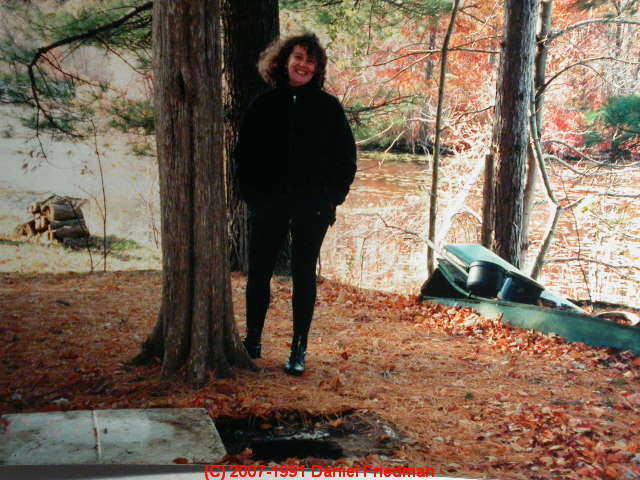
Especially at older, unsupervised, or remote rural properties, the temptation to simply route effluent leaving the septic tank to a stream, lake, pond is sometimes overwhelming (though unsanitary and illegal).
This is particularly true at sites where the soils into which one would have to put the drainfield are rocky, wet, or where the drainfield has previously failed.
In the photo you can see that this septic tank is less than ten feet from a lake.
For example, at properties along Wappingers Creek in Dutchess County, NY, many of the homes located their drainfields downhill from the house and too close to the creek. In times of spring rains the creek floods and floods the drainfield area. These are not working drainfields and are unsanitary.
At a home inspection at one of these properties we found that the previous owner had installed a straight pipe from the end of his failed drainfield right into the creek. Our septic loading and dye test was turning Wappingers Creek a reddish pink!
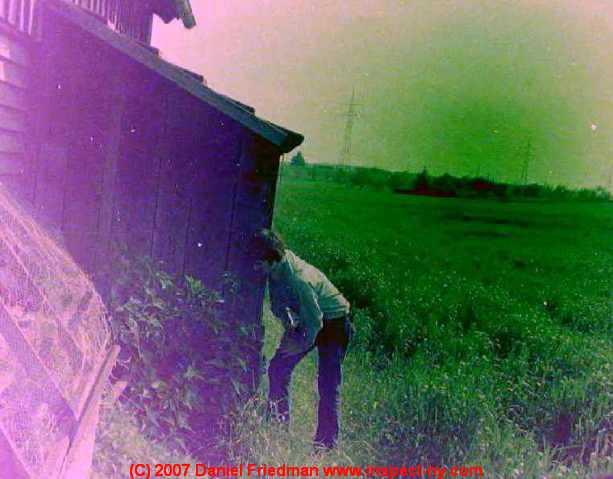
There may be no septic system drainfield at all at some properties. Here is an example:
We've also found that there was in fact no leaching
bed at all - simply a short perforated pipe into the ground next to a septic tank, or worse,
an illegal pipe to a storm drain, creek, or to the surface of a hillside.
This farm property, which we were inspecting outside Frankfort, Germany in 1968, had toilets but no working drainfield at all.
Watch out.
...
Continue reading at UNLIKELY DRAINFIELD LOCATIONS or select a topic from the closely-related articles below, or see the complete ARTICLE INDEX.
Or see these
Recommended Articles
- CLEARANCE DISTANCES, SEPTIC SYSTEM
- SEPTIC COMPONENT LOCATIONS
- SEPTIC DRAINFIELD INSPECTION & TEST - home
- SEPTIC DRAINFIELD LOCATION
- DRAINFIELD PIPE LOCATION, PRECISE
- EXCAVATE to LOCATE DRAINFIELD
- REASONS to FIND THE DRAINFIELD
- RECORDS to LOCATE the DRAINFIELD
- SURPRISING DRAINFIELD LOCATIONS
- UNLIKELY DRAINFIELD LOCATIONS
- VISUAL CLUES LOCATE the DRAINFIELD
- VISUAL CLUES LOCATE the SEPTIC TANK
- SEPTIC DRAINFIELD SIZE
- SEPTIC DRAINFIELD SHAPE
- SEPTIC DRAWINGS
Suggested citation for this web page
SURPRISING DRAINFIELD LOCATIONS at InspectApedia.com - online encyclopedia of building & environmental inspection, testing, diagnosis, repair, & problem prevention advice.
Or see this
INDEX to RELATED ARTICLES: ARTICLE INDEX to SEPTIC SYSTEMS
Or use the SEARCH BOX found below to Ask a Question or Search InspectApedia
Ask a Question or Search InspectApedia
Share this article:Search the InspectApedia website
Need to make a private comment? Email editor@inspectApedia.com. We welcome email with your website content critique, corrections, suggestions or questions. Email is monitored daily but our workload may prevent an immediate reply. For immediate results, we hope you'll first try asking your question using the search box just above.
Citations & References
In addition to any citations in the article above, a full list is available on request.
- New York State Department of Health, APPENDIX 75-A WASTEWATER TREATMENT STANDARDS - INDIVIDUAL HOUSEHOLD SYSTEMS , [PDF] New York State Department of Health, 3 February 2010, retrieved 3/1/2010, original source: https://www.health.ny.gov/regulations/nycrr/title_10/part_75/appendix_75-a.htm
- Percolation Testing Manual, CNMI Division of Environmental Quality, Gualo Rai, Saipan provides an excellent English Language manual guide for soil percolation testing. Original source: www.deq.gov.mp/artdoc/Sec6art108ID255.pdf
- Soil Test Pit Preparation, fact sheet, Oregon DEQ Department of Environmental Quality, original source www.deq.state.or.us/wq/pubs/factsheets/onsite/testpitprep.pdf The Oregon DEQ onsite water quality program can be contacted at 811 South Ave, Portland OR 97204, 800-452-4011 or see http://www.oregon.gov/DEQ/
- Thanks to reader Michael Roth for technical link editing 6/29/09.
- SEPTIC TANK/SOIL-ABSORPTION SYSTEMS: HOW TO OPERATE & MAINTAIN [PDF] - , Equipment Tips, U.S. Department of Agriculture, 8271 1302, 7100 Engineering, 2300 Recreation, September 1982, web search 08/28/2010, original source: http://www.fs.fed.us/t-d/pubs/pdfimage/82711302.pdf.
- Pennsylvania State Fact Sheets relating to domestic wastewater treatment systems include
- Pennsylvania State Wastewater Treatment Fact Sheet SW-161, Septic System Failure: Diagnosis and Treatment
- Pennsylvania State Wastewater Treatment Fact Sheet SW-162, The Soil Media and the Percolation Test
- Pennsylvania State Wastewater Treatment Fact Sheet SW-l64, Mound Systems for Wastewater Treatment
- Pennsylvania State Wastewater Treatment Fact Sheet SW-165, Septic Tank-Soil Absorption Systems
- Document Sources used for this web page include but are not limited to: Agricultural Fact Sheet #SW-161 "Septic Tank Pumping," by Paul D. Robillard and Kelli S. Martin. Penn State College of Agriculture - Cooperative Extension, edited and annotated by Dan Friedman (Thanks: to Bob Mackey for proofreading the original source material.
- Advanced Onsite Wastewater Systems Technologies, Anish R. Jantrania, Mark A. Gross. Anish Jantrania, Ph.D., P.E., M.B.A., is a Consulting Engineer, in Mechanicsville VA, 804-550-0389 (2006). Outstanding technical reference especially on alternative septic system design alternatives. Written for designers and engineers, this book is not at all easy going for homeowners but is a text I recommend for professionals--DF.
- In addition to citations & references found in this article, see the research citations given at the end of the related articles found at our suggested
CONTINUE READING or RECOMMENDED ARTICLES.
- Carson, Dunlop & Associates Ltd., 120 Carlton Street Suite 407, Toronto ON M5A 4K2. Tel: (416) 964-9415 1-800-268-7070 Email: info@carsondunlop.com. Alan Carson is a past president of ASHI, the American Society of Home Inspectors.
Thanks to Alan Carson and Bob Dunlop, for permission for InspectAPedia to use text excerpts from The HOME REFERENCE BOOK - the Encyclopedia of Homes and to use illustrations from The ILLUSTRATED HOME .
Carson Dunlop Associates provides extensive home inspection education and report writing material. In gratitude we provide links to tsome Carson Dunlop Associates products and services.
 |
HOME | ABOUT | ASK a QUESTION | CONTACT | CONTENT USE POLICY | DESCRIPTION | POLICIES | PRIVACY | |
| © 2026 - 1985 Publisher InspectApedia.com - Daniel Friedman | |||||||||