 Alternative Septic System FAQs

- POST a QUESTION or COMMENT about septic system design specifications & solutions for difficult sites
Q&A on how to design, building, inspect, test & matntain alternative septic system designs for problem sites.
InspectAPedia tolerates no conflicts of interest. We have no relationship with advertisers, products, or services discussed at this website.
- Daniel Friedman, Publisher/Editor/Author - See WHO ARE WE?
Alternative Septic System Design FAQs
 Questions and answers posted originally
at SEPTIC SYSTEM DESIGN ALTERNATIVES - topic home - be sure to take see the detailed information given there.
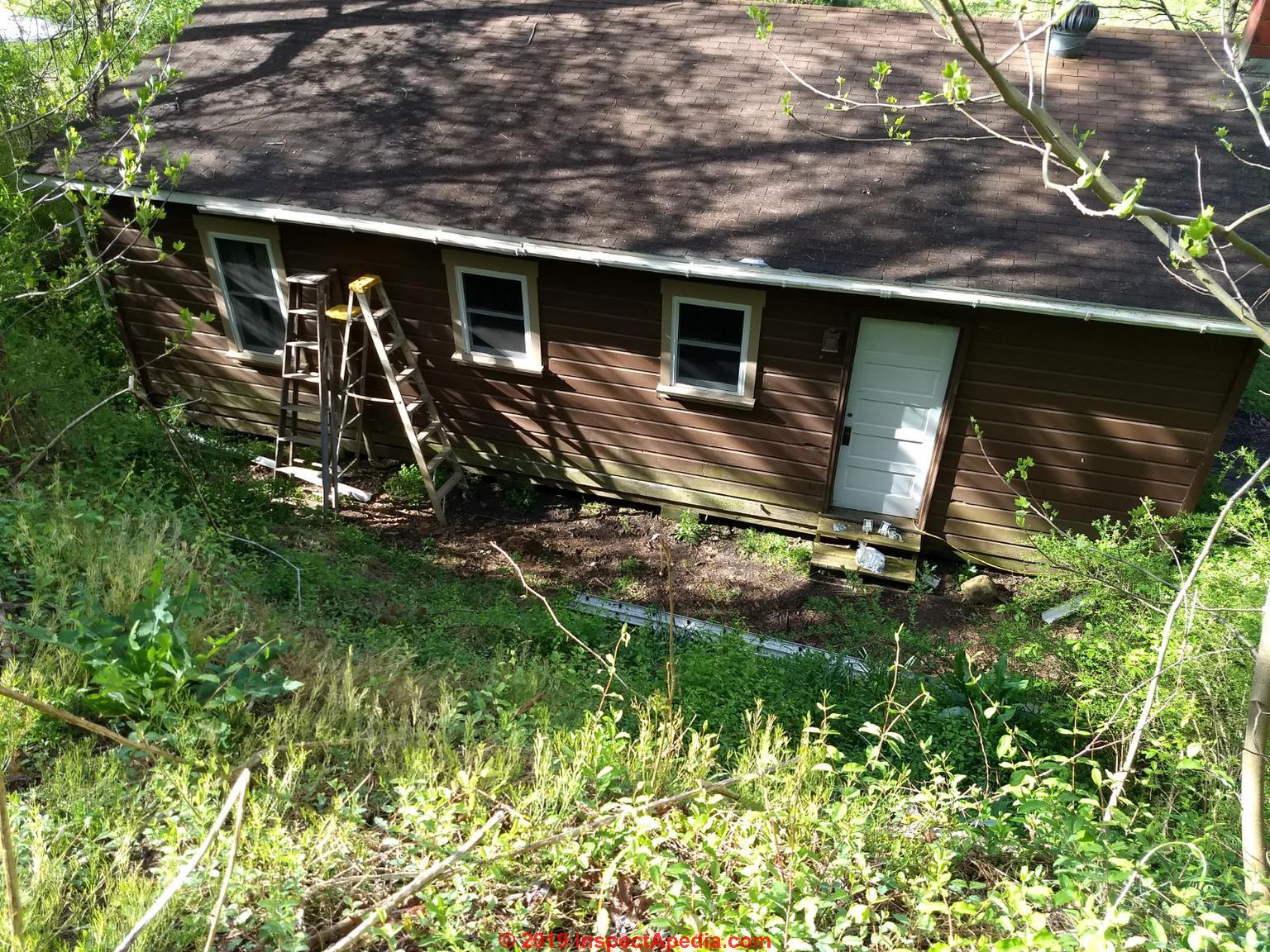
Photo above: a very limited space constrains the type of septic system that may fit shows a steep slope draining right up against the back of this home.
Article Index
- SEPTIC SYSTEM for a STEEP SLOPE WITH NO SPACE Q&A
- SEPTIC SYSTEM for AREA of THIN SOILS Q&A
- SEPTIC SYSTEM TOO CLOSE TO WATER - lake, pond, stream, etc.
- SEPTIC SYSTEM OVER HIGH GROUNDWATER or WET SOILS FAQs
...
Suggestions for adding an in-law suite bathroom sewage disposal to my hillside home
I have a detached garage that I want to put an inlaw suite above.
My house and garage are on the side of a hill and the septic tank is about 25 feet above the desired inlaw suite. I was wondering what my options were for sewage disposal. Can I pump my sewage that far and high?
Put in a seperate and different type of system? Composting toilets? etc.. Any info would be greatly appreciated. Thanks! On 2018-03-25 by Jim Lemieux
by Mod
You may want a sewage grinder and forced main to pump up to your septic. Also your tank and drainfield must be adequately sized and you'll need acceptance from your building department.
Suggestions for septics on steep slopes are at DIFFICULT SEPTIC SITE DESIGNS
If you want to consider an alternative toilet that means you'd only have to dispose of graywater, rather than composting toilets (that in my OPINON sound great but for most people are more trouble than they're willing to handle), take a look at
How can we shoe-horn a septic system onto a site with very limited space?
I have a tight space for getting septic in. Wteep in back and not much room on other sides of lot. [ see photo shown above] - On 2019-04-18 by Meredith McIntosh -
by (mod)
Meredith
You need an on-site septic engineer who can look at- available space
- soil perc
- local septic regulations
- encumbrances such as nearby wateways
and propose an appropriate system
Just bringing in the tank may be easier using a fiberglass tank but you need space for effluent disposal - a drainfield
or if there is literally not enough space, your local health department might approve a packaged wastewater treatment system that can discharge sanitary effluent.There are septic systems that can work in very little space and nearly entirely above ground, discharging sanitary water to an acceptable site destination.
See details at SEWAGE TREATMENT PLANTS, RESIDENTIAL
And see AEROBIC SEPTIC SYSTEMS, ATUs - another type of "packaged" septic system design suitable for some sites.
More suggestions and warnings are at DIFFICULT SEPTIC SITE DESIGNS
Watch out: that steep slope towards your home invites a building water entry and insect damage or mold problems from those leaks unless you provide an adequate intercept swale to direct runoff away from and around the home.
Can I add a toilet in an outbuilding and connect it through a new septic tank to an existing septic drainfield?
We were required to build a very large drainfield. There are only two of us (retired) and the gal who came out to approve/design the drain field had just graduated 3 weeks before ! She insisted that our drain field be large enough for 5 bedrooms 4 bathrooms--even though we showed her our design for 3 bedrooms 3 toilets.
I would like to place a toilet in our new garage which is at the opposite end of the long drain field.
can I use the same drainfield and just install a septic tank and and the long line leading into the leach lines?
Our soil is glacial: fast draining sand with some spots of clay (5ft away). Even the slow draining clay came in under the required time.
The area where the garage is is slightly higher in elevation and would provide could angle down to the leach fields.
Any suggestion as to how to do this without putting the county into a fem/nazi breakdown ! ;-) We are in a rural area and the only house is brother's next door cabin about 100 feet away he has his own septic and drain field.
Their cabin gets used one weekend a year by about 6 people! They installed their drain field 25 years ago with a very small leach field about 10X12 feet ! No problems ! Hope you can help because we are in our 70's now and it is hard to be gardening up at the top of our lot and have to run down to the far end just to go to the toilet! Thank you for your time! On 2017-04-08 by Anne
by (mod) re: Here's a better approach
Anne
Sounds like Holden Caufield strikes again - the Graduate.
Usually a building department requires that the septic system, including tank and drainfield, be sized to accommodate the number of people who COULD reasonably be expected to live in a home - often counting bedrooms for that purpose. They have to consider future occupants, not just two old retired fogies like you or me.
You MIGHT be permitted to connect a nearby structure to the existing septic system (tank) provided the tank is large enough, that there are not property line issues, and that your local building department approves. You'd need a septic engineer to specify that the system meets capacity and meets local codes.
Again, a designer cannot "care" that a property is used only once a year.The design for the septic system still must accommodate the maximum number of regular users. Otherwise, though used just one week or weekend a year, the cabin could still be expected to cause and experience a sewage backup or septic failure.
Clever tip: If you really only need to add a toilet, one of these
would be far easier and less costly than adding a whole septic tank and drainfield connection and plumbing to bring in or supply water just to flush the toilet.
...
I'm arguing with the building department about a septic design that doesn't meet the DOH specifications - too close to a lake
I have property on Cranberry Lake, New York and my engineer and I have been working the the Adirondack Park Agency (APA) and the New York State Department of Health (NYSDOH).
I have been denied by both departments to install a septic system because I don't meet the APA requirements of being a 100' from the mean high water mark of the lake, and the I don't meet the NYSDOH requirements because I'm not 100' from by neighboring wells.
Do you have any suggestions of what type of septic system I can install that will grant approval from these two departments? I purchased this property with a life time dream of owning a home on the lake, and now I faced with this delema. Thank you. On 2017-02-25 by Timothy Russell
Reply by (mod)
Timothy
We could spin a lot of wheels and more dollars when we ought to start by asking the APA and DOH what they will accept.For example there are plenty of lakefront properties that have installed acceptable septic systems by pumping uphill to a suitable distance away from the lake - and of course away from wells.
If your total site size can not meet those specifications then you might install an aboveground wastetreatment system whose discharge is certified to be cleaner than the lake etc.See the suggestions at SEPTIC SYSTEM DESIGN ALTERNATIVES
Remember that your local code officials are the final legal authority on these questions.
What kind of septic system can work at a waterfront property?
I was interested in a piece of property which I understand that cannot accommodate sumping.
I am under the impression (because I have not gotten to the end of figuring out why just yet) that this is because it is a waterfront property and/or the water table is too close to the surface thus reducing the availability of sufficient drainfield without causing water contamination.
So my question is; is there another approved alternative to the absorption field to effectively control liquid effluent retention? - D.M. 8/29/2013
Reply:
From your email I think you need an onsite septic design engineer - there sounds like a confusion of terms, codes, and requirements, and in my own case I'm not sure what you mean by "sumping" nor "liquid effluent retention" - those terms are not ones I use for onsite wastewater disposal.
If you are asking about a holding tank (sewage is retained and periodically pumped and removed by a waste hauler) some communities permit that design along a waterway but many do not.
If you are asking about how sewage and (separated) effluent are handled at wet sites, there are some designs that can handle that case, sometimes combining treatment above ground with disinfection; but again, not all communities will approve them.
That's why you need an onsite expert who also knows local codes & officials.
Some options you might want to discuss can be found in the article SEPTIC SYSTEM DESIGN ALTERNATIVES
Also take a look at Anish Jantrania's book listed in the references section of that article. Dr. Jantrania has described wastewater treatment systems that can function effectively entirely above ground, producing sanitary wastewater discharge.
...
How do I get Health Department approval of a septic drain field that is seasonally under water?
My leach field area was approved over 2 years ago. However, here in Indiana my leech field area is still too wet for the septic system installer to install my 4 100' long fingers.
I have cut down trees, applied lime, blow large fans on the area, and cover the area with tarps during the rain, burned off the weeds with a torch, and now planted ryegrass on the area.
The county health inspector comes out and digs 12" deep and says that its still too wet. Any ideas on how to get my soil dry at 12" deep? On 2016-10-10 by Jason C.
by (mod) re: Use a raised bed mound instead of a seasonally wet septic drainfield that can not function properly: unsanitary
Jason, thanks for the important question.
Watch out: It's curious anyone would want a DOH OK for a leachfield that is seasonally wet as you can be certain that during that wet season the septic drainfield will not work: the bacterial processing of pathogens in the effluent will be impeded by lack of oxygen, there is an increased risk of transport of sewage contaminants to other water bodies, wells, etc., and there is increased risk of drainfield total failure, blockage, and sewage backup into the home.
Generally we want to see a couple of feet between the bottom of a drainfield or soakbed (leachfield) bed and the top of the seasonal high water table if we have any hope of a functional drainfield.
Cutting down trees makes sense: you cannot build a drainfield among trees without expecting a short life and destructive root invasion.
Torching weeds and planting grass is not harmful, but a wasted expense if done before the area is excavated for field installation.
You have several options including going to an advanced wastewater treatment system (search InspectApedia for those term), but the most common approaches (assuming there's no area to relocate the fields) include:
1. installing a curtain drain around the drainfield, draining groundwater to daylight well away from the fields - if terrain slope and shape permit
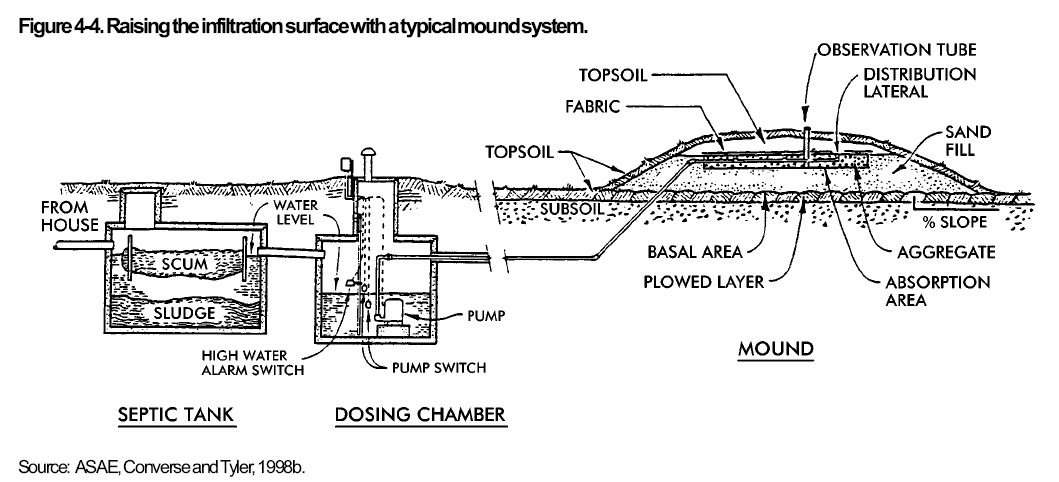
2. building up the soil level to give the clearance I describe - confirming what specifications will be accepted by your local health department, essentially buildinga MOUND SEPTIC SYSTEM or a RAISED BED SEPTIC SYSTEM
See MOUND SEPTIC SYSTEMS
and
see RAISED BED SEPTIC SYSTEMS
How do we treat sewage in an area of high water table soils?
How do we go about sewage treatment in a high water table area? On 2015-11-16 by Kafayat
by (mod) re: septic system designs for areas with a high water table
Good question, K.
You'll need an engineered septic, perhaps a mound or peat bed system that is raised sufficiently above the seasonally high water table (e.g. 2 ft - depending on regulations where you live).
...
Use our soil perc test results to choose a type of cesspool system?
We had a test boring done in the only place we can put a new cesspool and the results were Pec'ed Water: 6'1" comment possible stream.
Estimated Actual Ground Water Level 18' O +/-
My question is how and what kind of cesspool can be put in under these conditions? (Oct 1, 2014) perne construction
Reply: Watch out: do not install a cesspool and Watch out: your soil test says you are at risk of contaminating nearby waterways
Perne
I would not install any kind of cesspool - as that approach to wastewater disposal does not effectively treat the effluent (not enough aerobic bacteria) and as cesspools are not permitted in new construction in most jurisdictions.
If your lot space is very small you may need an advanced wastewater treatment system, even an aboveground one such as Jantrania discusses. It's time to ask for help from a septic design engineer.
See the suggestions at SEPTIC SYSTEM DESIGN ALTERNATIVES
...
What kind of septic system can I install when there is just thin soil cover over bedrock?
I bought 20 acres on a high peak in Putnam County, NY. There is a lot of rock and since it is a peak, I am assuming that the ground below is rock as well.
If I can't dig down 7 feet due to bedrock, will I be able to put in some sort of septic system?
I know the zoning board mentioned that sometimes they ask for 1 acre of area for septic fields as a rule, etc. On 2017-11-23 by Dan
Answer by (mod) -
Yes, Dan, I'm quite familiar with the rocky sites in Putnam County NY. You can design a septic system to work on rock: either a septic mound system or a raised bed septic.
To see other suggestions in detail, take a look at
and
SEPTIC SYSTEM DESIGN ALTERNATIVES
Take care to avoid under-design such as not enough fill brought-in. Else you'll see sewage effluent running across your site.
...
...
Continue reading at SEPTIC SYSTEM DESIGN ALTERNATIVES - topic home, or select a topic from the closely-related articles below, or see the complete ARTICLE INDEX.
Or see these
Recommended Articles
- AEROBIC SEPTIC SYSTEMS, ATUs
- SEPTIC CONSULTANTS, DESIGNERS, ENGINEERS
- SEPTIC SYSTEM DESIGN BASICS - home
- TYPES OF SEPTIC SYSTEMS - master list
Suggested citation for this web page
ALTERNATIVE SEPTIC DESIGN FAQs at InspectApedia.com - online encyclopedia of building & environmental inspection, testing, diagnosis, repair, & problem prevention advice.
Or see this
INDEX to RELATED ARTICLES: ARTICLE INDEX to SEPTIC SYSTEMS
Or use the SEARCH BOX found below to Ask a Question or Search InspectApedia
Ask a Question or Search InspectApedia
Share this article:Questions & answers or comments about septic system design specifications & solutions for difficult sites
Search the InspectApedia website
Need to make a private comment? Email editor@inspectApedia.com. We welcome email with your website content critique, corrections, suggestions or questions. Email is monitored daily but our workload may prevent an immediate reply. For immediate results, we hope you'll first try asking your question using the search box just above.
Citations & References
In addition to any citations in the article above, a full list is available on request.
- In addition to citations & references found in this article, see the research citations given at the end of the related articles found at our suggested
CONTINUE READING or RECOMMENDED ARTICLES.
- Carson, Dunlop & Associates Ltd., 120 Carlton Street Suite 407, Toronto ON M5A 4K2. Tel: (416) 964-9415 1-800-268-7070 Email: info@carsondunlop.com. Alan Carson is a past president of ASHI, the American Society of Home Inspectors.
Thanks to Alan Carson and Bob Dunlop, for permission for InspectAPedia to use text excerpts from The HOME REFERENCE BOOK - the Encyclopedia of Homes and to use illustrations from The ILLUSTRATED HOME .
Carson Dunlop Associates provides extensive home inspection education and report writing material. In gratitude we provide links to tsome Carson Dunlop Associates products and services.
 |
HOME | ABOUT | ASK a QUESTION | CONTACT | CONTENT USE POLICY | DESCRIPTION | POLICIES | PRIVACY | |
| © 2026 - 1985 Publisher InspectApedia.com - Daniel Friedman | |||||||||