 Q&A on Steps to Find Cure the Building Odors

- POST a QUESTION or COMMENT about how to track down & remove or cure odors in buildings
FAQs on using our 6-step procedure to track down the source or cause of odors or smells in or around buildings.
This article series describes six areas of investigation that can help direct the inquiry as to the cause or source of an odor or smell in or around a building.
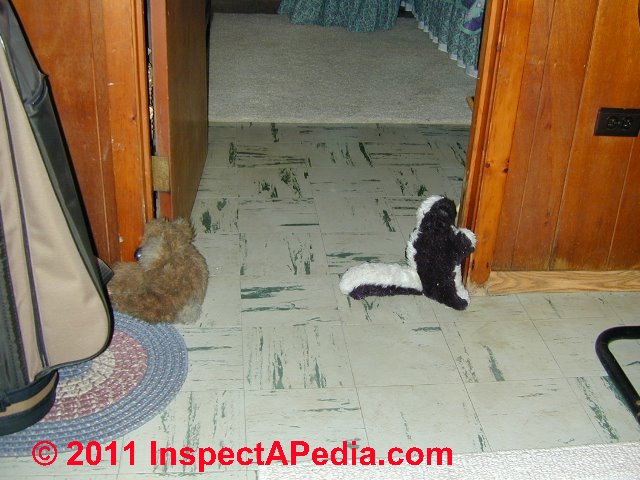
Page top: an odorles skunk was hiding basement water entry stains that can hint at a hidden mold contamination problem that may or may not smell moldy.
InspectAPedia tolerates no conflicts of interest. We have no relationship with advertisers, products, or services discussed at this website.
- Daniel Friedman, Publisher/Editor/Author - See WHO ARE WE?
Six Step Process for Odor Cause or Source Detection
 These questions and answers about a simple six-step procedure to track down the source of building smells or odors were posted originally
at ODOR DIAGNOSIS SIX STEPS - please remember to review that procedure too.
Plastic odors from the Conservatory - a health worry?
Hi our conservatory is smelling like plastic when the sun shines on it.
The conservatory is quite old 10yrs + but a couple of years ago we had the roof insulated with a wooden frame, insulation and plastic panels with spot lights.
I’m not sure if the issue is with the panels on the outside or the insulated roof but I am concerned about my family’s health On 2018-07-01 by Sally
by (mod) - sun-related odors of plastic or vinyl
Sally
Sun-related odors is a helpful diagnositc: you can guess that the odor source (such as vinyl siding, plastic window screens, vinyl windows) is being warmed by the sun.See
and
Vinyl/plastic/chemical odor coming from one outside wall.
Have occasional strong vinyl/plastic/chemical odor coming from one outside wall. Lasts for a few days, then stops. It seems to be on warmer days. We recentlyinstalled new vinyl siding over house wrap in November 2016.
Replaced some plywood on that wall as well. We cannot detect this odor from outside, and only on that one wall, which is the fireplace/chimney wall. On 2017-03-22 by DeMartino
by (mod) - look for sunlight or heat on these vinyl or other plastic building components
Often we see that odor traced to sunlight and heat on vinyl siding or plastic windows or screens. In some products the odor will dissipate over time but some readers report long-persistent offgassing.
Also, for safety, have the chimney flue inspected for integrity, leaks, fire hazards.
How do I track down the source of an unpleasant odor that I can't describe?
Our house has developed a strange odor that I cannot even describe; to me, it doesn't smell like midew and it doesn't smell like something died, nor does it smell like compost.
What I can say is that it's unpleasant and goes away (of course) when we air out the house, and it is back within 24 hours of closing up the house.
I can also say that I noticed the odor first at my brother's house 5 hours from our house. We live in a wet climate and he lives in a dryer climate, so outdoor climate has nothing to do with it. He has a one story house (a nice older manufactured home);
our home has a partial basement and an attic which do not have this peculiar odor; it seems only to be confined to our living area. It is a mystery. does anyone have any ideas?
I forgot to mention that we have been keeping the humidity very low in our home with dehumidifiers; it is since we started keeping the humidity low (under 45%) that we have noticed the odor.
I forgot to leave my email address: peper.jo@gmail.com On 2017-04-26 by Josie
Solution by (mod) -
Josie
Try using the InspectApedia search box just above to find our articleon SMELL PATCH TEST to FIND ODOR SOURCE to see a procedure that can help find the surface or material that's the smell source.
You might also consider hiring an experienced home inspector (or if you home is in the U.K. a chartered surveyor from RICS) who is expert in recognizing points of water entry, signs of leakage, or points of moisture traps in building walls or ceilings.Then we go to the most-suspect of those areas for limited invasive inspection by using a borescope, thermogarphy, moisture meter, and small area test cuts to look for moisture and mold in building walls & ceilings.
Also use the search box to see our article series on INSULATION MOLD that has been found in homes in the U.K., in North America, and in other locations in damp climates.
Our kitchen cabinets developed a very strong peculiar odor
10 years ago I moved into my newly built house and all was fine until about a year ago. My kitchen cabinets developed a very strong peculiar odor that I can't describe.
I store all my dishes, glasses, silverware and serving platters there. I have to rewash any item I want to use (that has already been cleaned by the dishwasher.)
This happens in my oak cabinets along the west wall.
Those cabinets perpendicular on the south side of the house do not have the odor problem, nor do the cabinets built into the island I had installed one year after I moved in. About 40 feet down a slight hill is a wooded area that is also wetlands, although water rarely builds up there.
The odor is not in the kitchen itself, I only smell it when the cabinet doors are open. It has caused me upper respiratory problems which usually disappear when I leave the house. I would truly appreciate any help you could give me. Thank you in advance. On 2017-04-12 by sr 263965
Answer by (mod) -
Check the live link in the article ODOR DIAGNOSIS SIX STEPS
for ODOR EVENT LOG & CHECKLIST FORM printer-friendly PDF file to record odor observations such as time of day, weather, temperature, sunlight, & possible sources as an aid in finding the actual source of odors & smells in or around buildings
and see if that added information helps suggest an odor source.by sr263965
The odor is constant, it doesn't matter what the time or weather conditions. Do you have any other suggestions?
by (mod) -
It sounds as if you need an onsite expert; I can't quite understand your situation.
For example if an odor were present only when a cabinet door were open I'd of course suspect the cabinet interior or something that spilled therein;
but with the cabinet door shut and a conviction that in the reset of the home in that status there is no odor present, I don't understand how the cabinet interior would explain a building-related illness.
Is there any standard or code or guide for finding and controlling bad odors from a building
Is there any standard or code or guide for finding and controlling bad odors from a building? On 2016-08-05 by Anonymous
Answer by (mod) -
Anon:
Interesting question that one could broaden to regulations and standards regarding indoor air quality.
OSHA for example regulates IAQ in the work environment but a quick read of OSHA material suggests that odors are first considered as an indicator of an IAQ problem rather than being simplified as "the problem" itself. This probably reflects the subjectivity of odor complaints;some people may be very bothered by and report a smell that others don't notice at all.
Adding to that confusion, even a person who is bothered by an odor tends to become desensitized to it after being in that environment for a time. All of that makes objective data more important than ever.
When an "odor" is identified to be that of a specific material, such as ammonia, then indeed there are standards for permitted level of exposure over time.
Looking more at the residential (not workplace) environment, some cities such as New York include odor complaints as among tenants' rights to guarantee of a habitable residence. Depending on the odor level and type, a landlord might be found in breach of a Warranty of Habitability. (e.g. New York State Real Property Law 235-b)
We tried the obvious, now how can we track down the source of a smell in our home?
I have a 4 year old brick home, on basement, 1 story. I have smelled a faint odor in one area of the home which is around the master bedroom, master bath, and hallway leading to that area.
The smell tends to be stronger in the hallway area which is on the other side of the wall from the bathroom.
My husband does not smell it and thinks I am crazy. Some days is it stronger than others but I can't figure out why.
The smell is not in the basement, and not in the attic.
We replaced the toilet wax ring, with no results. We put a vent cap on the roof vent of the toilet so that wind would not blow the gases back inside, with no results.
How can I track down the smell?
My only other ideas are that the roof has leaked and the wall has molded, or there is a problem with the bathroom fan leaking in foul air. Or a dead animal stuck somewhere in the wall.
Desperate for some fresh air,- J.H.
Where do we begin to determine why we have an unpleasant odor from our air vents oh our Trane heat pump?
Reply:
Check for an odor source near the air returns;
Have the air handler and ductwork inspected throughout for a spill, leak, dead animal, etc.See our odor diagnosis procedural checklist at ODOR DIAGNOSIS CHECKLIST, PROCEDUREor review the six-step approach to odor diagnosis described in the FAQ just below.
A competent onsite inspection by an expert usually finds additional clues that help accurately diagnose a problem or source of an odor.
That said, It is an error for someone to assume that because they do not personally smell an odor that it is not present. Individual sense of smell varies widely among individuals.
However on occasion there are medical or other sources of perceived odors that only the affected person will experience.
Therefore in some cases it may be appropriate to also check in with a physician. But it makes sense to look for the obvious: an actual source of odors or smells in the building.
Need help sorting out mutiple and confusing odors in home
I am in England, UK and cannot afford to pay for advice. If you can give me any help with my situation I'd be grateful:
I am experiencing an overpowering 'electrical burning' odour in my bathroom. There is no obvious problem with the electrics. Electrics switched off and room ventilated/flushed out but smell continues.
The bath is old cast iron, with damaged enamel and a lead waste pipe. I have used limescale removing chemicals (some weeks ago) and bleach (two days ago). There is no blockage in the drain.
There is green algae/weed growing outside at the end of the lead pipe as it hangs over and empties into the storm water (not foul water) drain system. Advice asap most appreciated. Currently waiting emergency plumber on household insurance. - A.G. 3/4/2014
Reply:
I'd like to help Amanda but I have to say that from your description you need someone on-site.
Your description of odor includes
- Electrical burning - which comes typically from overheated electrical wiring, fixtures, switches, is dangerous, risking a fire, so means that the offending circuit should be shut off
- Damaged enameled cast iron fixtures (not normally an odor source)
- Lead waste pipe - lead itself is not normally an odor source but old piping, especially lead, may be leaking - but would not normally make an electrical odour
- Limescale chemical removers used - often an odor source but not one typically described as burning electrical
- Algae or "weed" on a pipe exterior - suggests a plumbing leak
- A drain pipe emptying into a storm drain - in most jurisdictions it is improper and even illegal to empty a building plumbing drain into the storm system
And of course there could be a different odor source that has not yet been realised. Some help in identifying the odor and its source, perhaps by asking for assistance from others or from your plumber is what's needed along with a visual inspection for safety and sanitary concerns in your home.
It may help to try the six simple odor diagnostic steps in the
article ODOR DIAGNOSIS SIX STEPS,
or to try our more
detailed ODOR DIAGNOSIS CHECKLIST, PROCEDURE.
"BO" smell in our building but not from people
Does anybody have any idea what may be causing an odor in our building that smells like body odor but not coming from humans.
It is located on the first floor of the building and comes and goes. It seems to pop up every few weeks or so. We have replaced carpets, wall coverings, check A/C vents and much more. (July 23, 2014) Jaime
Reply:
Jaime
Of course I can't know by e-text what a smell is nor its source, but it's worth noting that some BO like smells are traced to mold contamination.
There's a famous "dirty socks" smell from some fungi. Look for leaks into or onto mold-friendly materials like drywall, paper, insulation, cloth.
Try keeping an odor log that helps correlate odor observation with time, weather, equipment use, etc.
In the full Odor Diagnosis ARTICLE INDEX found In the ARTICLE INDEX found among the Continue Reading links at the end of this article see ODOR DIAGNOSIS EVENT LOG & CHECKLIST
Sewer smell comes and goes
Been noticing a sewer smell in very specific areas of my house.
Could be gone for days and then it comes back to varying degrees. Original plumber looked it. Have checked everything for dry traps.
I did notice a slow draining bathtub that I am now putting drano in.
That got me wondering if there is something "smelly" I can put in the bathtub drain to see if that same smells appears elsewhere in the house?
That way I will at least know that that drain system is, in some way, responsible for the smell. Any recommendation? Cheap purfume? (Oct 28, 2014) Tom
TOM said: Followup
Found an uncapped stink pipe that had been cut during a renovation 5 years ago. Just started smelling recently.
Had to open up a wall to find it. I think pouring cheap perfume in a drain would have lead me there if I had not found it the first time.
Reply:
Thanks for the follow-up Tom. Indeed tracking down an open vent in a building cavity is a challenge - use of odorants is a fine approach to at least home in on the general area or room(s). That narrowing down followed by some strategic cuts where we hope or think vent piping runs will usually pay off.
See SEWER GAS ODORS - home
...
Continue reading at ODOR DIAGNOSIS SIX STEPS - or select a topic from the closely-related articles below, or see the complete ARTICLE INDEX.
Or see these
Odor Source Detection Articles
- ODORS GASES SMELLS, DIAGNOSIS & CURE - home
- ODOR DIAGNOSIS SIX STEPS
- ODOR EVENT LOG & CHECKLIST FORM [PDF] - Use this form to collect data to help track an odor to its source
- ODOR EVENT / SOURCE LOCALIZATION LOG
Suggested citation for this web page
ODOR DIAGNOSIS SIX STEPS FAQs at InspectApedia.com - online encyclopedia of building & environmental inspection, testing, diagnosis, repair, & problem prevention advice.
Or see this
INDEX to RELATED ARTICLES: ARTICLE INDEX to BUILDING ODOR DIAGNOSIS & CURE
Or use the SEARCH BOX found below to Ask a Question or Search InspectApedia
Ask a Question or Search InspectApedia
Share this article:Questions & answers on how to identify the source of smells or odors in buildings - an odor source checklist.
Search the InspectApedia website
Need to make a private comment? Email editor@inspectApedia.com. We welcome email with your website content critique, corrections, suggestions or questions. Email is monitored daily but our workload may prevent an immediate reply. For immediate results, we hope you'll first try asking your question using the search box just above.
Citations & References
In addition to any citations in the article above, a full list is available on request.
- In addition to citations & references found in this article, see the research citations given at the end of the related articles found at our suggested
CONTINUE READING or RECOMMENDED ARTICLES.
- Carson, Dunlop & Associates Ltd., 120 Carlton Street Suite 407, Toronto ON M5A 4K2. Tel: (416) 964-9415 1-800-268-7070 Email: info@carsondunlop.com. Alan Carson is a past president of ASHI, the American Society of Home Inspectors.
Thanks to Alan Carson and Bob Dunlop, for permission for InspectAPedia to use text excerpts from The HOME REFERENCE BOOK - the Encyclopedia of Homes and to use illustrations from The ILLUSTRATED HOME .
Carson Dunlop Associates provides extensive home inspection education and report writing material. In gratitude we provide links to tsome Carson Dunlop Associates products and services.
 |
HOME | ABOUT | ASK a QUESTION | CONTACT | CONTENT USE POLICY | DESCRIPTION | POLICIES | PRIVACY | |
| © 2026 - 1985 Publisher InspectApedia.com - Daniel Friedman | |||||||||