 Heating System Low Water Cutoff LWCO FAQs

- POST a QUESTION or COMMENT about diagnosing & repairing LWCOs low water cutoff switches & controls on heating boilers
Boiler low water cutoff control service or repair FAQs.
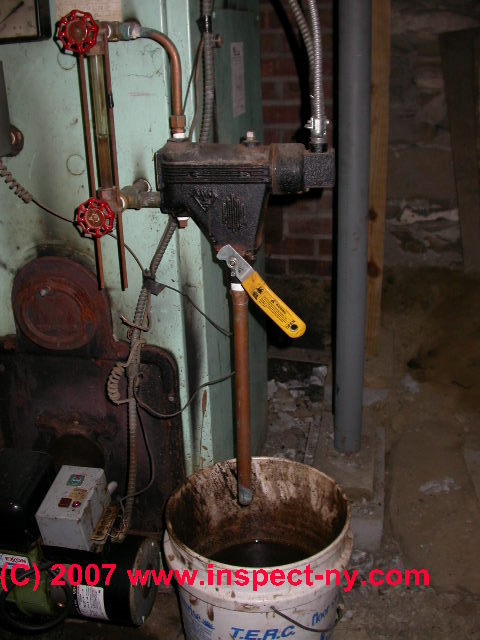
Page top photo: flushing a steam boiler low water cutoff valve into a plastic bucket is a regular, often daily, maintenance chore that keeps both the LWCO and the water feed function working properly.
In this article series we explain Low Water Cutoff Controls: Guide to LWCOs on steam heating and hot water heating systems and we provide a low water cutoff switch Troubleshooting & Repair Guide.
InspectAPedia tolerates no conflicts of interest. We have no relationship with advertisers, products, or services discussed at this website.
- Daniel Friedman, Publisher/Editor/Author - See WHO ARE WE?
FAQs on Low Water Cutoff Valves on Steam Heating Boilers
 These questions and answers were posted originally
at LOW WATER CUTOFF VALVE - be sure to review the LWCO installation, LWCO flush out procedure details and also low water cutoff control repair advice given there.
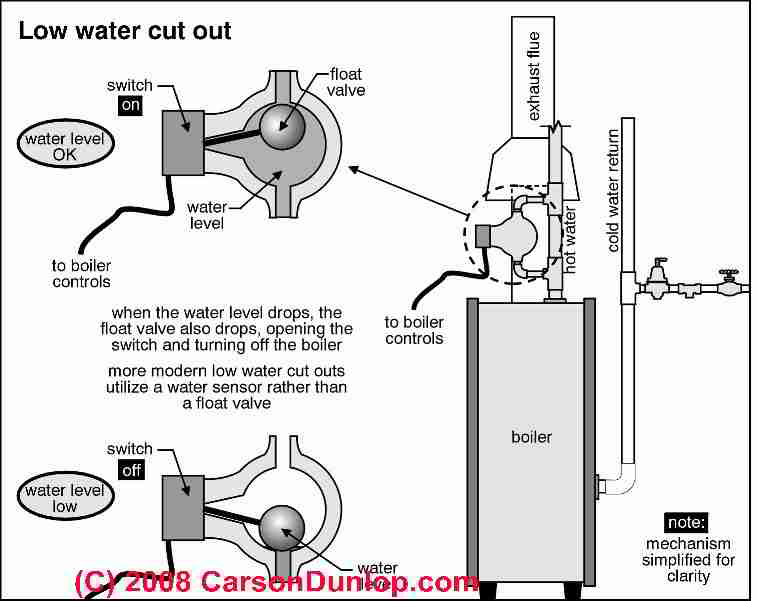
The schematic at left, courtesy of Carson Dunlop Associates, explains how the low water cutoff valve works.
In short, LWCOs are among multiple heating system safety controls that help prevent a boiler BLEVE EXPLOSIONS.
Why does my LWCO keep cycling through a 90 second self-check and shutting off the burner?
I have a steam bolier with an auto feed and LWCO.
Every few minutes the LWCO performs a self check that lasts for 90 seconds.
During the self check, the the LWCO shuts the burner down. Is it normal for it to check itself this often?
It's been this way since it was installed in 2006, but lately I've been thinking that something might be wrong. Thanks .(Nov 11, 2012) Darren
Reply: set the return water check time / water feed delay time on your low water cutoff to a longer interval & check condensate return
First: identify your water feeder brand and model.
On some heating boilers the water feeder may include a built-in delay to allow time for condensate to return to the boiler at the end of a boiler-on cycle. Without this control the steam boiler could be flooded (over-filled) if the water feeder adds water to the boiler before all of the steam condensate has returned there.
I suspect that your water feeder is a Hydrolevel or McDonnell & Miller unit that includes a dip switch or on some models a dial that can be set to change the return water check timer interval to a longer time period (after the boiler shuts off) - for example extend the wait to 3 to 5 minutes to give more time for condensate to return to the boiler.
The example below shows how dip switches can be selected to set the water feed delay time from 30 seconds to 10 minutes on a Hydrolevel VX-120 water feeder.
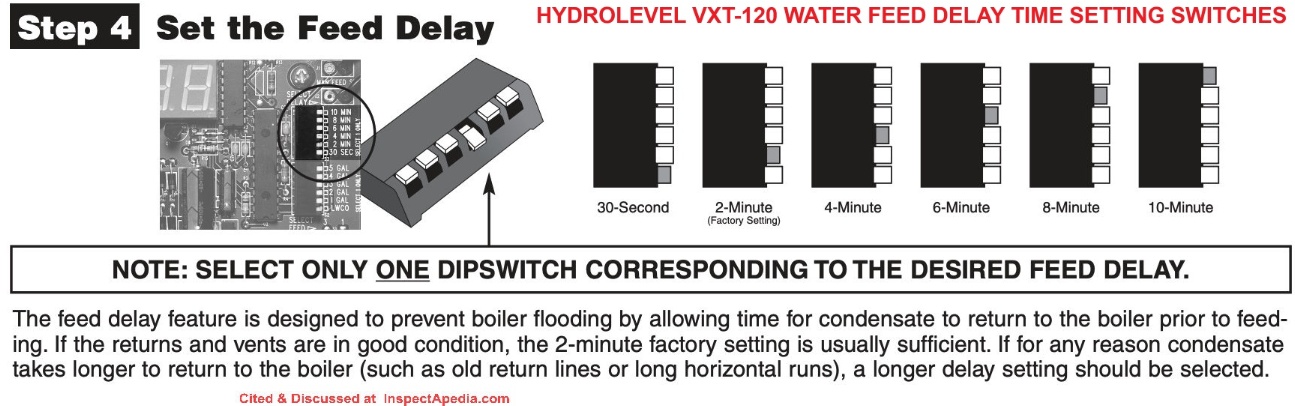
- source: Hydrolevel VXT-120 WATER FEEDER MANUAL [PDF] (2020) (at Hydrolevel) Programmable water feeder for steam boilers, 120VAC, includes programmable water feed delay settings and programmable feed amount settings (using DIP switches) - local copy saved as VXT-120-Instruction-Manual.pdf
Watch out: the example above is specifically for the VXT-120 - your water feeder may be different. Find the manual for your LWCO at
STEAM BOILER CONTROL MANUALS - Daniel F.
Watch out: the fact that your LWCO return water check time switch is shutting down the burner tells me that either the return time setting on your LWCO is too short OR your building's condensate return lines are partly blocked with sediment, delaying return of condensate to the heating boiler.
(Of course also check for leaks anywher in the condensate return piping).
If changing the feed delay settings on your water feeder control don't fix this problem by extending the return check time, then this sounds like a control defect to me: it's time for a service call.
You could first try going through the homeowner's normal LWCO flush-out routine to see if that works.
Also if your unit produces error codes check the code in your specific LWCO installation and maintenance manual.
Bill added:
The self check is probably checking for any more return water.
To prevent flooding (typical problem with newer smaller steam boilers).
You may want to see if you can extend this "check" time or even eliminate it, and then keep eye on site glass for too high of a water line.
How to Diagnose a Water Feed Problem with the McDonnell #67 LWCO - Which part do I replace?
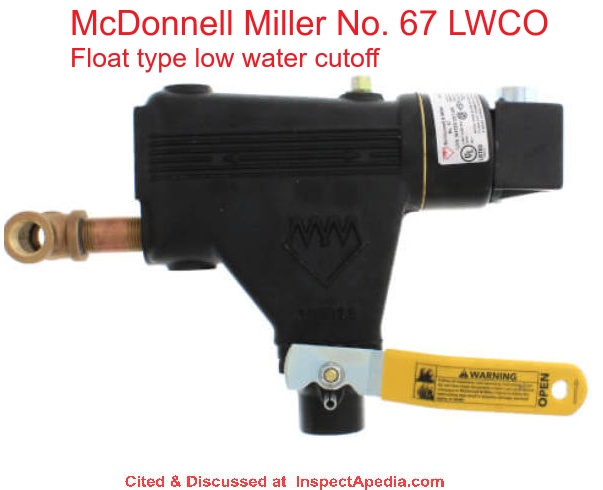
I think I have identified my problem on my LWCO but want to make sure.
I removed the mechanical head 6667 on my Mcdonnell #67 and it sounds as if there is metal in the copper rod. Is there supposed to be a sound?
I don't want to order new if that is a normal sound and might not be the problem. Thanks. (Dec 27, 2012) Emily
Reply: replacing the low water cutoff sensor (Float Blocking Tube) in a LWCO control
Here is the manual for your McDonnell & Miller 67 LWCO
McDonnell & Miller Series 67 & 767 Low Water Cut-Offs for Steam Boilers INSTALLATION & MAINTENANCE MANUAL [PDF] (MM-201(E) ) (2007, ITT Corporation, 8200 N. Austin Ave. Morton Grove, IL 60053 tel: 847-966-3700 fax: 847-966-9052 www.mcdonnellmiller.com
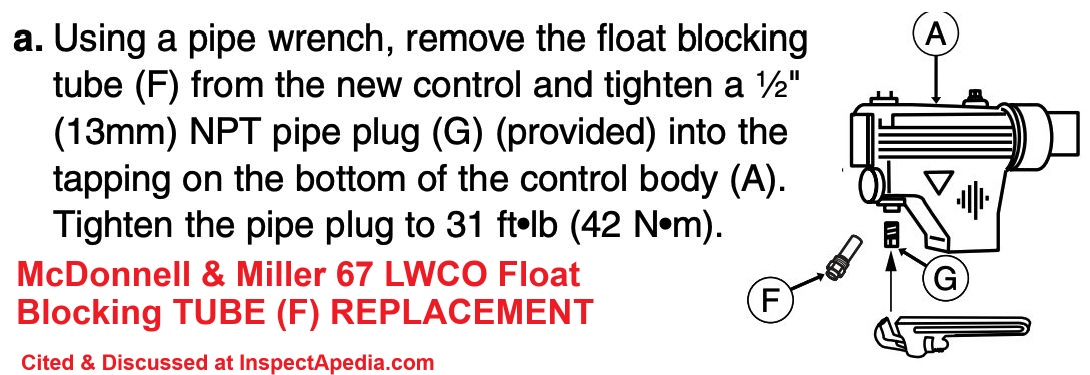
Here is what McConnell & Miller say about the maintenance of your LWCO. We include one of the manual's illustrations from page 3, showing replacement of the float blocking tube (F) .
This is a critical part that detects the water level inside the control. If the float blocing tube is damaged or coated with thick scale the LWCO may fail to accurately detect and respond to the steam boiler's water level.
MAINTENANCE SCHEDULE for the McDonnell & Miller No 67 / 767 LWCO
- Blow down weekly (at least once) when the boiler is in operation.
- Disassemble and inspect annually. Replace the low water cut-off if it is worn, corroded, or if components no longer operate properly.
- Inspect the float chamber and equalizing piping annually. Remove all sediment and debris.
- Replace every 10 years. More frequent replacement may be required when severe conditions exist such as rapid switch cycling, surging water levels, and use of water treatment chemicals.
LWCO Probe troubleshooting
My LWCO says there low water i added water i cleaned the probe got a new probe still says low water i thank i my have to change the sensor but idk On 2017-10-26 by todd
by (mod) - added water, new probe, LWCO still says "low water"
Todd
It would be helpful if we knew the brand and model of your control. But I agree if it's a sensor type low water cut off and you are absolutely certain that the water level is correct in the boiler and there is likely to be a problem with the probe or with connections to it.Your heating service tech will probably remove and replace the probe.
The LWCO won't pull in the gas valve to start my gas fired steam boiler
In my low water cut out, every thing is working perfectly but on the controls 'B' is not pulling in the gas valve On 2018-10-29 by Rosanna Raziah Mohamed
by (mod) - check the water level sensor probe for scale
Let's first look at the steam boiler water level.
You should see water in the sight glass at or close to the index line or mark that you'll find on the glass or on the boiler face close to the sight glass. (Typically that's about half-way up the sight glass).
Next, check for voltage at the control. That is: is power on to all of your equipment?
Let me know what you find and we'll continue from there.
The problem could be that the sensor probe needs to be de-scaled. On some controls the manufacturer wants that done annually or even every six months. You'll need help from a trained steam heat service technician to do that job. - Daniel Friedman
A pump on our steam boiler runs continuously
Sometimes the pump on our boiler takes off and runs continuously and the water rises in the glass tube. Why is this happening and how do we solve this problemOn 2017-12-13 by Greg R
by (mod) - Check boiler water level and flush the LWCO
Greg I can but guess at what's happening since I don't have a clear understanding of what heating system you are using.
The presence of a sight glass probably means that you are talking about steam boiler. And that case I'm not sure what pump you refer to. I'm guessing that it's
- Flush the LWCO:
An automatic water feed valve - doing what it's supposed -to, adding water to the boiler when the boiler water level drops - that's a normal operation for a steam heating boiler.
While the water feeder is sending water into the boiler, the water level in the sight glass tube should indeed rise as you describe.
Watch out: if the water level rises to the top of the sight glass then your boiler is probably over-filled and flooded and the water feeder or its sensor probe need cleaning and repair.
Watch out: steam boilers use a low water cutoff valve that needs to be flushed and cleaned regularly. If you're not doing that your heating system may stop working.
Read details
at LWCO FLUSH OUT PROCEDURE - how to use the Blowdown Valve to flush the LWCO - Check for a hot water heating loop on a steam heat system
Alternatively, sometimes a steam boiler also is connected to a loop of hot water radiator or baseboard piping for an area in a basement or low in a building.
If that's what's happening the circulator for that hot water heating zone may indeed be causing surging in the boiler.
Daniel
Do most hot water boilers use a low water cutoff?
Were most hot water boilers made in the late 80s equipped with low water cut-offs? Mine is for baseboard heating. I can't afford a new boiler, but I want to at least ensure that it is unlikely to explode. On 2023-08-26 by David Geer
by InspectApedia Publisher - All steam boilers and some hot water (hydronic) boilers use an LWCO
@David Geer,
Essentially ALL Steam boilers would be expected to have a low water cut-off (LWCO).
While it's good practice, few residential hot water heating boilers (hydronic heat) have LWCOs, and fewer of those installed 40+ years ago.
The FIRST order of business for your boiler's safety is that it has a properly sized, installed, and tested pressure/temperature relief valve. (Search InspecdtApedia for "relief valves" to read details.
The second order of business for your boiler's safety is that its fuel supply and burner, combustion air, and combustion gas exhaust venting are all properly installed, set-up, and working.
So start by having your boiler inspected, cleaned, adjusted by an experienced heating service technician. Ask her to add to the basic procedure that she might use, additional steps to test the relief valve and to check and report to you on draft, CO detection, etc.
The third order of safety for your boiler is to be sure that you have working, properly located, installed, tested, smoke and fire and CO2 detectors.
Before going to the expense of adding a LWCO to your boiler make absolutely sure that the steps in the article above have been addressed.
or at a
heating boiler safety controls article like
FIRE SAFETY CONTROLS (if yours is an oil fired boiler)
Did you try the search box found at the top or bottom of our pages? Was our information hard to find or confusing?Now PLEASE HELP US manage InspectApedia to keep it most useful and helpful buy telling me why you posted this question here on our Contact Us page rather than on one of the topic pages that address your question such as
Burks pump causes Fulton boiler water level drop
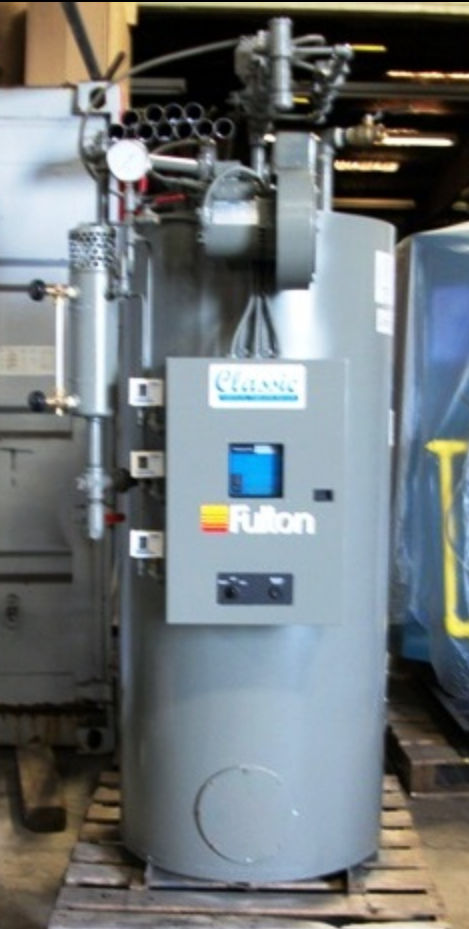 Fulton 15 hp boiler. When Burks pump comes on water level drops low enough for low water shutdown to activate.
Please help. New pump will put up 200psi approximately. Two new one way valves on supply line to boiler. All water level probes cleaned and inspected. On 2020-09-30 by Scott -
by (mod) - Fulton steam Boiler - contact information
Scott:
I'm not clear if the issue is with surging, with a control improperly set, or with a clogged condensate return system.If your local service technician hasn't sorted this out I'd contact the manufactuer's technical support:
Fulton has offices and sales in Canada, The U.S., Great Britain and China.
Fulton Boiler Works 3981 Fulton St., Pulaski NY 13142 USAor
Fulton Thermal Corporation / Fulton Steam Solutions Inc. / Fulton Service Solutions Inc., 972 Centerville Rd., Pulaski NY 13142 USA
Telephone: (315) 298-5121
For emergency assistance outside of normal business hours, you can reach a technician by calling (315) 298-5121 and following the prompts.
For other readers: Fulton produces both hydronic (hot water) and steam boilers;
the Fulton 15HP boiler is a small steam boiler like this model (shown above) ecently-sold by firstechservices.comFor more information
see FULTON BOILERS
Plumber banged on the LWCO to loosen rust - now it stopped working
I had a water feeder installed. The plumber emptied the water by way of the low water valve. He began to bang on it quit hard with a wrench to release any rustication inside.
After installing the water feeder which never worked ,I now had to feed the boiler more often then before(every 2 days).
The plumber's explanation was 2 out of the 4 switches in the low water valve have burnt out.
Is this a possibility or could the banging on the valve have damaged it? The system is pretty old but was working fine until I had him install a water feeder.. I need your help please.
Thanks & Happy New Year -
Tracey On 2019-01-17 by Tracey
by (mod) - flush / clean the LWCO, then repair it if necessary
I don't understand the part about two out of four switches burned out.
Nor am I quite clear on which controls and bells we were discussing.
It sounds as if we are talking about a safety device or "switch" - All of its components need to work.
It sounds to me as though even though you've had a sort of cloudy explanation you need a new low water cutoff valve or water feeder.First review LOW WATER CUTOFF VALVE NOT WORKING - for our simple diagnosis and repair steps that might suffice and so that you'll be familiar with low water cutoff control functions and controls.
Then ask your heating Service Company to send you an experienced service technician to explain the system to you and to decide what replacements are needed for safety.
Does the location of the LWCO matter?
Does it matter on a modulating condensing boiler where the low water cutoff is located? On 2017-08-17 by John
by (mod) - YES! for example see instructions from the Taco LTA-2 LWCO for hot water boilers
John
Absolutely, yes, the height or elevation or position of the low water cutoff sensor has to be correct, but the sensor and control does not always have to be mounted right on the boiler itself. In some installations the device can work perfectly fine mounted on a tapping on the boiler OR on the water return line (at the right height).
The low water cutoff (LWCO) has a sensor - varying by the LWCO design - that has to be put into the boiler at a location that allows the sensor to detect the fall of boiler water below a "safe" level in the boiler. Typically that line is also marked on the boiler itself - for steam boilers, but for a hot water or hydronic boiler you'd have to review the manufacturer's instructions.There is often an existing boiler side tapping reserved specifically for such a control.
Here are example instructions from the Taco LTA-2 LWCO for hot water boilers
Installation:1. Install the probe above the minimum safe water level, as determined from the boiler manufacturer's literature. (See Fig. 1)
NOTE: This may be in a tapping on the boiler or in the boiler supply or return piping.
2. Install the probe to extend into the boiler cavity or piping to make contact with the water.
3. Install the probe so that the exposed portion of the stainless steel is a minimum of 1/4" from any grounding surface inside the boiler (to prevent the probe from shorting).
My self-cleaning LWCO blinks a red light
I have a self-cleaning LWCO on a Smith hot water boiler. LWCO red light shows often and cuts off heat even with thermostat calls for more.
At least 5 years after new install and without prior problems, replaced Honeywell round thermostat 2x and still have heat cut out with LWCO showing red. Auto water in. Any ideas? On 2015-11-29 by Jan
by (mod) - Yes, look for clogged screen in LWCO or inadequate cleaning
Jan
Watch out: on most low water cutoff controls a blinking red light means low water - the boiler can be damaged, ruined or unsafe if it continues to operate, and usually in that condition the LWCO will turn off the boiler.
Often problems with a LWCO are traced to a clogged screen in the device or inadequate cleaning;
If, however, the problem you report has been present since the control was installed "new" I suspect a level adjustment or location problem. Has your heating service tech taken a look at the control?
by Jan
The LWCO was installed new at least 5 years ago and we had no problems as part of the total boiler replacement. This LWCO is cylindrical and is labeled as Self-Cleaning. It is electrically connected to the damper.
The location hasn't changed. The service tech replaced the thermostat. Yesterday, for the first time I noticed the heat was not maintaining at thermostat setting overnight. When I investigated the boiler, I noticed the red light on the LWCO.
I increased the thermostat setting another 5 degrees and the boiler kicked on, the red light went off for about a minute. Then the red light came back on and the boiler kicked off.
Just a side question on the thermostat... there are two switches inside that can be turned on or off depending on the system. If mine is a hot water boiler run off natural gas using radiators throughout the house, should the thermostat settings apply to "hot water (3CPH)" OR "Gas (5 CPH)" ? The tech had it set at gas.
Does a control use pressure to detect loss of boiler water?
Hydronic hot water heat systems that have their output as baseboard heat, or as radiant heat, or are forcued air (hydronic-air) with their water-to-air heat exchanger in attics or on floor above the boiler in the basement all will have a lot of water above the level of the boiler.
That mans that a lot of water will need to leak out before these water level valves will activate. Would it not be better to sense the loss of pressure from such a leak ?
You mention this "the low water cutoff is a device intended to shut down unsafe heating equipment by turning off electrical power to the oil burner or gas burner should the water level or pressure in the heating system fall below a safe level" but do not describe pressure switches. (July 11, 2011) Steve
Reply: no, not pressure, it's water level in the boiler
Good point, Steve. The LWCO has the job of protecting the boiler from damage, not protecting the building from leaks nor the piping system and baseboards from leaking out.
It's not "water pressure" but rather the water level in the boiler that determines when the LWCO operates to shut down the boiler.
Please see details at LOW WATER CUTOFF VALVE, BOILER
In a slow leak in upper building piping, the automagic water feeder keeps pushing makeup water into the system - the leak will run until someone discovers it.
In a fast leak in upper building piping people are going to see it if the building is occupied, or they'll notice that they no longer have heat - before the boiler is at risk.
In a failure of an automatic water feeder to keep water in the system or a fast leak right at a boiler, the LWCO is, as I suggested, focused on protecting the boiler from a meltdown or worse.
Hydronic (hot water) and steam heating systems, especially hot water systems, operate with pressure varying quite a bit from cold to hot - so pressure sensing coudl be trouble. Furthermore, low water in a boiler needs to be detected early to avoid damaging the boiler. Systems typically have several safety controls. The LOWCO doesn't work alone.
The LWCO is dripping - how do I stop the leak?
We just bought a house in upstate NY and have a Weil McLain with a low water cutoff valve very much like the one shown in the photo above.
It was dripping when we moved into the house, but not very much. Then we lost power for three days with the hurricane.
When the power came back on, the bucket started filling up fast -- today it filled completely in about an hour. We are complete newcomers to homeowning.
Is this amount of water "normal" after torrential rains and a power outage? Should we be resetting the boiler? Any help is appreciated. (Aug 31, 2011) Dave Lindsay
If the drain on the LWCO (McD & Miller 149700) drips a drop every 30 seconds or so, what might the problem be?
A plumber gas been called, but I'm curious. A plumber HAS been called. Sorry for the typo. (Dec 13, 2012) John Barkosky
Reply: fix drips at the LWCO
Dave
The Low water cutoff (LWCO) should never drip except perhaps a few drops right after it has been flushed; dripping means (presuming you have an automagic water feeder) that you are continually adding more water to the system, wasting water and perhaps increasing the rate of debris and mineral deposit accumulation in the boiler.
I suspect that you lost power during Hurricane Irene and that resulted in a drop of water pressure in the system, perhaps leading to later dripping at the LWCO.
If you open and close the LWCO valve (over a bucket to collect water) four or five times you may be able to flush the valve seat and stop the dripping. If not, you should call a heating service tech.
John,
Sometimes you can flush the drain valve on the LWCO several times, letting the valve "snap" back to the closed position, to stop a drip; if that doesn't work then the problem probably requires a gasket or vavle part replacement.
Should we install a low water cutoff valve?
We are about to purchase a condominium where the propane fired boiler (McLain)is on the second floor.
The home inspection report recommended the installation of a low water cut off valve. The plumber feels that it is not required in residential installations. What is your take on it? (Sept 1, 2011) Al Mo
Reply:
Al Mo
Depending on your local building codes (which your plumber probably knows better than a home inspector would) you may not be required to have a LWCO on a residential heating boiler. Required.
The home inspector is giving advice for improved safety and improved protection of the heating system. If the inspector included that as a safety recommendation it's quite sound. If s/he said it was "required" s/he may not be correct.
In at least some communities and among some hydronic boiler manufacturers a low water cutoff is being included in new installations as it's benefits are recognized: it's protecting the boiler from damage should an automatic water feeder fail to work properly or (in the case of still older systems) should the home owner forget to keep an eye on and maintain the water level in a steam boiler.
It's not just theory. Unlike a hydronic (hot water) heating system, a steam boiler consumes some water every time the burner runs and boiler cycles. The rate of water consumption varies among systems and buildings, but it's never zero.
In conditions at which there could be a loss of water supply to the building, I'd consider the LWCO an absolute necessity to protect the boiler.
Mcdonnell & Miller Uni-match water feeder and series 67 LWCO diagnosis
My boiler have Mcdonnell & Miller Uni-match water feeder and series 67 LWCO. This morning the water fail to stop feeding the boiler.
Now, I have to cut off the power to the Uni-match feeder. Otherwise, it will flood the boiler. Is the problem with LWCO? Please advise. Thanks. (Oct 23, 2011) Charles s
Reply:
Charles, the low water cutoff (LWCO) is designed to be flushed, typically once a week, by the homeowner. If your LWCO was not being flushed, sediment can collect in the system leading to controls jamming.
If you are not familiar with the flushout procedure for the controls, I'd immediately call a heating service company and ask them to send a steam heat repair tech to your home.
S/he will clean or repair the controls as needed and at the same time s/he can explain to you what you need to be doing to prevent the problem from happening again.
If you don't have it, here's the manual for your LWCO
McDonnell & Miller Series 67 & 767 LOW WATER CUT-OFFS for STEAM BOILERS, INSTALLATION & MAINTENANCE MANUAL [PDF] (MM-201(E) ) (2015) ITT Corporation, 8200 N. Austin Ave. Morton Grove, IL 60053 tel: 847-966-3700 fax: 847-966-9052 www.mcdonnellmiller.com
No water came out of the LWCO when I tried to flush it
I went to turn on heat for first time this year but noticed my LWCO was rusty, and no water came out when I went to draw.
The water level looks to be at proper level in the viewer but am still concerned. I turned the heat on and have been closely monitoring the boiler and saw that the water level in the viewer went all the way to top.
I will be having the LWCO fixed by a professional but in the meantime I do not know what warning signs to look for if there is a serious impending problem. (Oct 29, 2011) Steve
Reply:
The boiler will run if the LWCO is clogged and draining, as long as there is sufficient water in the boiler and the LWCO correctly senses the water level.
But
Watch out: this is a dangerous condition as the safety control intended to sense loss of water and then shut off the boiler is no longer working. I would shut off the system and call for repair.
Safgard model 170, LWCO - boiler overflowed
My Safgard model 170, LWCO is installed between the boiler (above the boiler) and the non bladder expansion tank hanging from the basement ceiling.
Recently, the boiler relief valve overflowed.
I drained the expansion tank twice.
Overflow situation was not corrected.
With the second draining, no water came out from the tank. I measure the temperature with a multi meter on the piping before and after the LWCO. There is a 6 degree Celsius difference.
What from the LWCO is blocking the water flow? Could it be reset without replaced?
Thanks. Happy New Year to all. (Dec 28, 2012) james
Reply:
James,
The LWCO is what turns OFF the boiler if it lacks enough water, or otherwise tells the water feeder valve to put more water into the boiler.
If your boiler is flooding, either of those controls could need cleaning or repair.
Watch out: water spilling at the pressure relief valve means the heating system was unsafe.
Read details at RELIEF VALVE LEAKS
Here's the manual for your Hydrolevel Saftgard 170 LWCO
- HYDROLEVEL Safgard 170 SERIES LOW WATER CUT-OFF MANUAL [PDF] (at Hydrolevel) - local backup copy saved as Hydrolevel-Saftard-170-Manual.pdf
...
...
Continue reading at LOW WATER CUTOFF VALVE, BOILER or select a topic from the closely-related articles below, or see the complete ARTICLE INDEX.
Or see these
Recommended Articlesoilers
- BOILER OPERATING PROBLEMS
- BOILER WATER FEEDER MANUALS
- LOW WATER CUTOFF VALVE, BOILER
- LOW WATER CUTOFF VALVE NOT WORKING
- SIGHT GLASS, STEAM BOILER
- STEAM BOILER FLOODING / SURGING REPAIR
- STEAM BOILER LOW WATER CUTOFF LWCO MANUALS
- STEAM HEATING SYSTEMS & CONTROLS - home
- STEAM BOILER WATER FEEDER MANUALS
- WATER FEEDER VALVE, STEAM
Suggested citation for this web page
LOW WATER CUTOFF VALVE FAQs at InspectApedia.com - online encyclopedia of building & environmental inspection, testing, diagnosis, repair, & problem prevention advice.
Or see this
INDEX to RELATED ARTICLES: ARTICLE INDEX to STEAM BOILERS
Or use the SEARCH BOX found below to Ask a Question or Search InspectApedia
Ask a Question or Search InspectApedia
Share this article:Questions & answers or comments about diagnosing & repairing LWCOs low water cutoff switches & controls on heating boilers
Search the InspectApedia website
Need to make a private comment? Email editor@inspectApedia.com. We welcome email with your website content critique, corrections, suggestions or questions. Email is monitored daily but our workload may prevent an immediate reply. For immediate results, we hope you'll first try asking your question using the search box just above.
Citations & References
In addition to any citations in the article above, a full list is available on request.
- In addition to citations & references found in this article, see the research citations given at the end of the related articles found at our suggested
CONTINUE READING or RECOMMENDED ARTICLES.
- Carson, Dunlop & Associates Ltd., 120 Carlton Street Suite 407, Toronto ON M5A 4K2. Tel: (416) 964-9415 1-800-268-7070 Email: info@carsondunlop.com. Alan Carson is a past president of ASHI, the American Society of Home Inspectors.
Thanks to Alan Carson and Bob Dunlop, for permission for InspectAPedia to use text excerpts from The HOME REFERENCE BOOK - the Encyclopedia of Homes and to use illustrations from The ILLUSTRATED HOME .
Carson Dunlop Associates provides extensive home inspection education and report writing material. In gratitude we provide links to tsome Carson Dunlop Associates products and services.
 |
HOME | ABOUT | ASK a QUESTION | CONTACT | CONTENT USE POLICY | DESCRIPTION | POLICIES | PRIVACY | |
| © 2026 - 1985 Publisher InspectApedia.com - Daniel Friedman | |||||||||