 Solar Panel Outgassing & Glazing Deposit Diagnosis

- POST a QUESTION or COMMENT about solar panel outgassing & solar panel glazing problems
This article discusses the diagnosis of the cause of outgassing from a 3-panel solar collector array using EPDM gaskets, silicone caulk, a selective surface, and 700-Series Owens-Corning high-temperature fiberglass insulation.
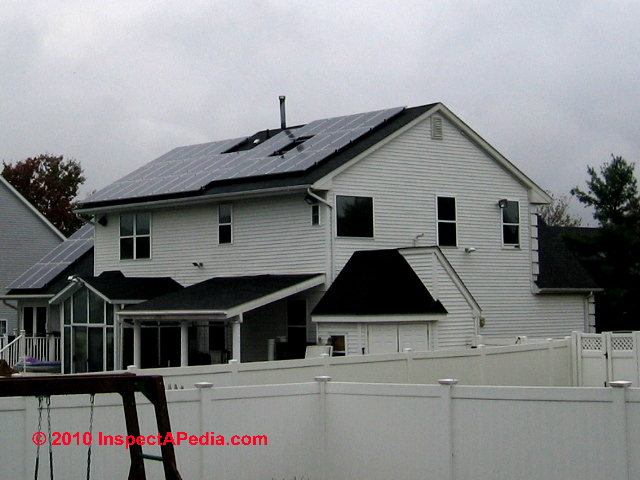
Accompanying text is reprinted/adapted/excerpted with permission from Solar Age Magazine - editor Steven Bliss. Photo a rooftop mounted site-built solar collectors at page top courtesy of Paul Galow.
InspectAPedia tolerates no conflicts of interest. We have no relationship with advertisers, products, or services discussed at this website.
- Daniel Friedman, Publisher/Editor/Author - See WHO ARE WE?
How to Diagnose & Clean Outgassing & Deposits on Glazing in Solar Collectors
This question-and-answer article about the overnight accumulation of a gas (probably air) in a solar collector used for swimming pool heating, quotes-from, updates, and comments an original article from Solar Age Magazine and written by Steven Bliss.
What Is the Probable Source of Gas Accumulating in and Deposits on the Inner Surface of Glazing on a Solar Collector ?
Question: Diagnose the Cause of a Deposit on the Underside of Glazing on a Solar Collector System
A three-panel solar collector array we installed four years ago (1981) recently developed a deposit on the underside of the textured solar collector AFG glazing. The solar collector has EPDM gaskets, silicone caulk, a selective surface, and 700 Series Owens-Corning high-temperature fiberglass insulation.
We think that the outgassing is from the insulation. The solar collector manufacturer has gone out of business.
We want to make sure we have the right solution to clean it with. What do you recommend? - Mike Fabian, Energy Engineering, Fargo ND.
Reply:
According to Frank Gilleland at Owens-Corning (in 1985), Owens Corning 700-Series insulation was not made to go into solar collectors. It is duct insulation made with a binder that can outgas under the high temperatures that occur inside a solar collector.
We think that the deposit on the inside of the solar collector glazing is probably a skin of condensed resin outgas material. Normally you could scrape off a deposit on the inside of the solar collector glazing (if a glass product was used) but that won't work on textured glass.
How to Diagnose the Source of Outgassed Deposits on Solar Panel Glazing
For liability reasons Owens-Corning did not recommend any solar collector glazing solutions. They also would not take responsibility for the solar collector deposit problem, because they said that it could have been caused by any of several materials used on the collector's construction. Gilleland said that with practice [or using forensic microscopy - DF] you can tell residues apart by color.
- A bluish hue in a solar collector residue is typically from EPDM or from paint.
- A chalky colored residue inside a solar collector points to a fiberglass insulation binder resin.
How to Clean Outgassed Deposits on Solar Panel Glazing
AFT Industries' Dick Orton recommended (also in 1985) cleaning the solar collectors with very hot water and a detergent such as Tide™. If that does not work, add a half-pint of white vinegar for each gallon of cleaning solution.
If the film is still there on the solar collector glazing inside surface, try an organic solvent such as toluene or xylene, available from chemical supply or hardware stor4es. He stressed that this is a last resort.
Watch out: toluene and xylene are toxic and carcinogenic and must be used with proper procedures, location, and personal protection. Use extreme caution and follow the manufacturer's instructions precisely.
Never use an abrasive substance to clean solar collector glazing.
If these approaches don't work, talk to chemists. See what they recommend that will break down and remove phenolic resin without leaving a new film on the collector surface. By this time, however, you may just want to replace the solar collector glazing (glass).
There is no guarantee that the outgassing inside the solar collector will stop. If you suspect insulation is the source of the outgassing or collector glazing deposit and the collectors haven't stagnated long enough to burn off all of the resin binder used to produce the insulation in the first place, dismantle the collector and lay aluminum foil between the insulation and the absorber.
Then seal the edges with high temperature caulk. Or replace the solar collector insulation with an oil-free binderless insulation.
As far as Gilleland knew, as of 1985 there was no such product on the market since Owens-Corning stopped manufacturing its SI-100 Series insulation in the early 1980's. But there may be a similar product available.
How to Remove Un-wanted Gases or Air From Solar Collector Systems
As we discussed in more detail at SOLAR COLLECTOR AIR or GAS COLLECTION, in addition to conditions that produced a deposit on the interior surface of a solar collector's glazing, other materials used in the construction of the piping, tubing, or solar collector array used to transport water for heating can also produce gases that interfere with proper solar collector operation.
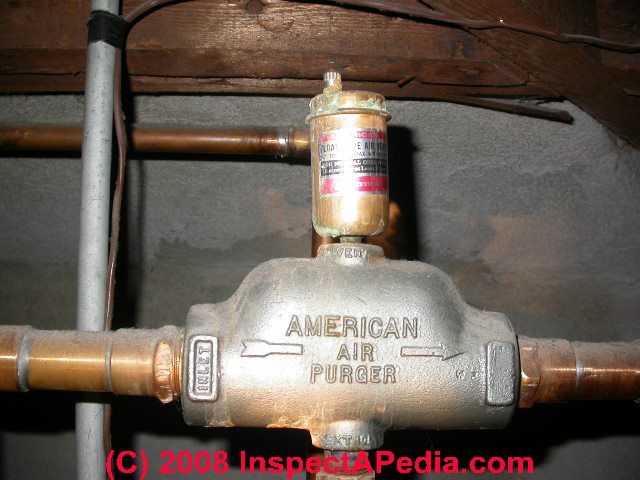
Air accumulating in water in hydronic home heating systems (hot water boilers) is a well-known problem for which at least two components are in common use that may help automatically purge unwanted air or other gases from inside the solar collector plumbing system:
- An automatic float-operated air purge valve is mounted at a high point on the hot water piping (the cylindrical device at the center of our photo at left|) in order to automatically purge any excessive air in the system.
See AIR BLEEDER VALVES for an article about how these automatic air purge valves work, and see Air-bound radiators, baseboards, boilers for examples of air-bound hot water systems.
If your solar heating system does not already contain an air purge valve, and if the system has trouble from becoming air-bound, adding the air purge might solve the problem at very little cost. - A small air expansion tank absorbs the initial pressure increase in the system when water is heated (and air is drive out of solution) to avoid opening and spilling a temperature/pressure relief valve when it's not appropriate. See EXPANSION TANKS for details. But watch out: this approach won't purge unwanted gases from the system.
Here we include solar energy, solar heating, solar hot water, and related building energy efficiency improvement articles reprinted/adapted/excerpted with permission from Solar Age Magazine - editor Steven Bliss.
Original Article
- Collector Outgassing: Q&A on Source of Gas Outgassing in A Solar Collector - original text. Use your browser's back button to return to this page. Original article, Solar Age Magazine, January 1985, adapted and updated for InspectAPedia.com November 2010.
...
Continue reading at SOLAR COLLECTOR AIR or GAS COLLECTION in solar swimming pool heaters, or select a topic from the closely-related articles below, or see the complete ARTICLE INDEX.
Suggested citation for this web page
SOLAR COLLECTOR OUTGASSING at InspectApedia.com - online encyclopedia of building & environmental inspection, testing, diagnosis, repair, & problem prevention advice.
Or see this
INDEX to RELATED ARTICLES: ARTICLE INDEX to SOLAR ENERGY
Or use the SEARCH BOX found below to Ask a Question or Search InspectApedia
Ask a Question or Search InspectApedia
Share this article:Search the InspectApedia website
Need to make a private comment? Email editor@inspectApedia.com. We welcome email with your website content critique, corrections, suggestions or questions. Email is monitored daily but our workload may prevent an immediate reply. For immediate results, we hope you'll first try asking your question using the search box just above.
Citations & References
In addition to any citations in the article above, a full list is available on request.
- Solar Age Magazine was the official publication of the American Solar Energy Society. The contemporary solar energy magazine associated with the Society is Solar Today. "Established in 1954, the nonprofit American Solar Energy Society (ASES) is the nation's leading association of solar professionals & advocates. Our mission is to inspire an era of energy innovation and speed the transition to a sustainable energy economy. We advance education, research and policy. Leading for more than 50 years. ASES leads national efforts to increase the use of solar energy, energy efficiency and other sustainable technologies in the U.S. We publish the award-winning SOLAR TODAY magazine, organize and present the ASES National Solar Conference and lead the ASES National Solar Tour – the largest grassroots solar event in the world."
- Steve Bliss's Building Advisor at buildingadvisor.com helps homeowners & contractors plan & complete successful building & remodeling projects: buying land, site work, building design, cost estimating, materials & components, & project management through complete construction. Email: info@buildingadvisor.com
Steven Bliss served as editorial director and co-publisher of The Journal of Light Construction for 16 years and previously as building technology editor for Progressive Builder and Solar Age magazines. He worked in the building trades as a carpenter and design/build contractor for more than ten years and holds a masters degree from the Harvard Graduate School of Education. Excerpts from his recent book, Best Practices Guide to Residential Construction, Wiley (November 18, 2005) ISBN-10: 0471648361, ISBN-13: 978-0471648369, appear throughout this website, with permission and courtesy of Wiley & Sons. Best Practices Guide is available from the publisher, J. Wiley & Sons, and also at Amazon.com - Paul Galow [Website galowconsulting.com ] - technical consultant on networking, LAN design, applications support. Galow Consulting Services [Website galowconsulting.com ] , 914-204-1749, email: paulgalow@galowconsulting.com
- "Swimming Pool Heating" cost savings suggestions from the U.S. DOE includes suggestions on using a high efficiency (gas-fired swimming pool heater or heat pump swimming pool heater) or solar swimming pool heater, using swimming pool covers, managing swimming pool water temperatures, and installing a more energy efficient swimming pool pump, or using it less.
- "Conserving Energy and Heating Your Swimming Pool With Solar Energy [copy on file as /heat/USDOE_solar_pool_heater.pdf] - ", U.S. Department of Energy
- PASSIVE SOLAR DESIGN HANDBOOK VOLUME II [PDF], the Passive Solar Handbook Comprehensive Planning Guide, in a version used by the U.S. Air Force - online version available at this link and from the USAF also at wbdg.org/ccb/AF/AFH/pshbk_v2.pdf [This is a large PDF file that can take a while to load]
- PASSIVE SOLAR HANDBOOK VOLUME III [PDF], the Passive Solar Handbook Programming Guide, in a version used by the U.S. Air Force - online version available at this link and from the USAF also at wbdg.org/ccb/AF/AFH/pshbk_v3.pdf
- The Passive Solar Design and Construction Handbook, Steven Winter Associates (Author), Michael J. Crosbie (Editor), Wiley & Sons, ISBN 978-047118382 or 0471183083
- "PASSIVE SOLAR HOME DESIGN [PDF] ", U.S. Department of Energy, describes using a home's windows, walls, and floors to collect and store solar energy for winter heating and also rejecting solar heat in warm weather.
- SOLAR WATER HEATERS [PDF] , U.S. Department of Energy article on solar domestic water heaters to generate domestic hot water in buildings, explains how solar water heaters work. Solar heat for swimming pools is also discussed.
- HEAT EXCHANGERS for SOLAR WATER HEATING SYSTEMS [PDF], U.S. DOE describes the types of solar water heater heat exchange methods between the sun and the building's hot water supply
- HEAT-TRANSFER FLUIDS for SOLAR WATER HEATING SYSTEMS [PDF] , U.S. DOE, describes the types of fluids selected to transfer heat between the solar collector and the hot water in storage tanks in a building. These include air, water, water with glycol antifreeze mixtures (needed when using solar hot water systems in freezing climates), hydrocarbon oils, and refrigerants or silicones for heat transfer.
- SOLAR WATER HEATING SYSTEM MAINTENANCE & REPAIR [PDF] , U.S. DOE
- SOLAR WATER HEATING SYSTEM FREEZE PROTECTION [PDF] , U.S. DOE,using antifreeze mixture in solar water heaters (or other freeze-resistant heat transfer fluids), as well as piping to permit draining the solar collector and piping system.
- US DOE, SCALING AND CORROSION IN SOLAR WATER HEATING SYSTEMS, U.S. Department of Energy.
- US DOE, ACTIVE SOLAR HEATING SYSTEMS [PDF], U.S. Department of Energy
- US DOE, RADIANT HEATING SYSTEMS, U.S. Department of Energy
- ABSORPTION HEAT PUMPS & COOLERS [PDF] , U.S. DOE
- SOLAR AIR HEATING [PDF] U.S. DOE also referred to as "Ventilation Preheating" in which solar systems use air for absorbing and transferring solar energy or heat to a building
- SOLAR LIQUID HEATING [PDF] U.S. DOE, systems using liquid (typically water) in flat plate solar collectors to collect solar energy in the form of heat for transfer into a building for space heating or hot water heating. The term "solar liquid" is used for accuracy, rather than "solar water" because the water may contain an antifreeze or other chemicals.
- Our recommended books about building & mechanical systems design, inspection, problem diagnosis, and repair, and about indoor environment and IAQ testing, diagnosis, and cleanup are at the InspectAPedia Bookstore. Also see our Book Reviews - InspectAPedia.
- In addition to citations & references found in this article, see the research citations given at the end of the related articles found at our suggested
CONTINUE READING or RECOMMENDED ARTICLES.
- Carson, Dunlop & Associates Ltd., 120 Carlton Street Suite 407, Toronto ON M5A 4K2. Tel: (416) 964-9415 1-800-268-7070 Email: info@carsondunlop.com. Alan Carson is a past president of ASHI, the American Society of Home Inspectors.
Thanks to Alan Carson and Bob Dunlop, for permission for InspectAPedia to use text excerpts from The HOME REFERENCE BOOK - the Encyclopedia of Homes and to use illustrations from The ILLUSTRATED HOME .
Carson Dunlop Associates provides extensive home inspection education and report writing material. In gratitude we provide links to tsome Carson Dunlop Associates products and services.
 |
HOME | ABOUT | ASK a QUESTION | CONTACT | CONTENT USE POLICY | DESCRIPTION | POLICIES | PRIVACY | |
| © 2026 - 1985 Publisher InspectApedia.com - Daniel Friedman | |||||||||