
InspectAPedia® FREE Encyclopedia of Building & Environmental Construction, Diagnosis, Maintenance & Repair |
Question? Just ask us! InspectAPedia
|
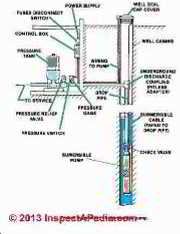 Definitions of Terms used with Drinking Water & Wells
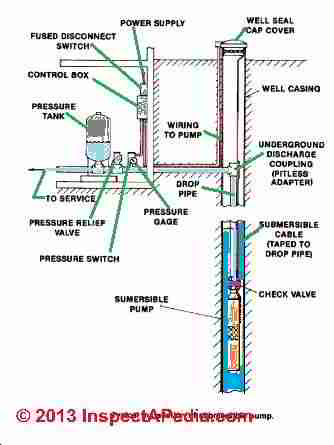
- POST a QUESTION or COMMENT about the definition of various well, drinking water, & well water contaminant or testing terminology
An Illustrated Water Well Terminology Dictionary: EPA & other definitions of drinking water, well, and well contamination terms.
This article gives you general information about drinking water from home wells (also considered private drinking water sources).
InspectAPedia tolerates no conflicts of interest. We have no relationship with advertisers, products, or services discussed at this website.
Definitions - of Terms Describing Drinking Water from Household Wells
 Aquifer - An underground formation or group of formations in rocks and soils containing enough ground water to supply wells and springs.
Backflow - A reverse flow in water pipes. A difference in water pressures pulls water from sources other than the well into a home's water system, for example waste water or flood water. Also called back siphonage.
Bacteria - Microscopic living organisms; some are helpful and some are harmful. "Good" bacteria aid in pollution control by consuming and breaking down organic matter and other pollutants in septic systems, sewage, oil spills, and soils. However, "bad" bacteria in soil, water, or air can cause human, animal, and plant health problems.
Confining layer - Layer of rock that keeps the ground water in the aquifer below it under pressure. This pressure creates springs and helps supply water to wells.
Contaminant - Anything found in water (including microorganisms, minerals, chemicals, radionuclides, etc.) which may be harmful to human health.
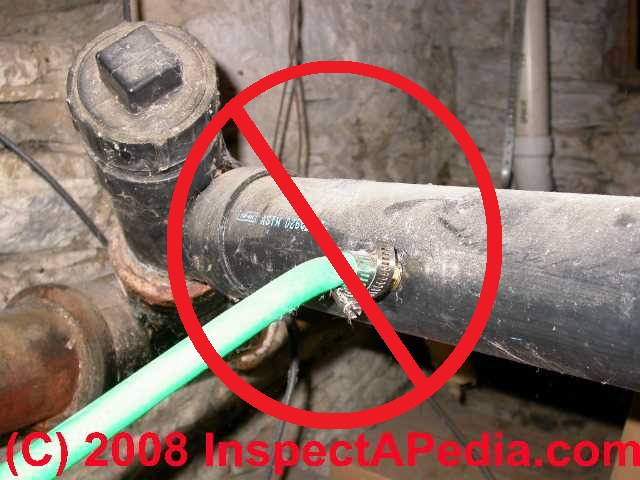
Cross-connection - Any actual or potential connection between a drinking (potable) water supply and a source of contamination.
Our photo below shows a water softener drain line connected to a sewer line. Sewage backup can easily enter the water softner brine tank through this connection, risking contaminating the building water supply.
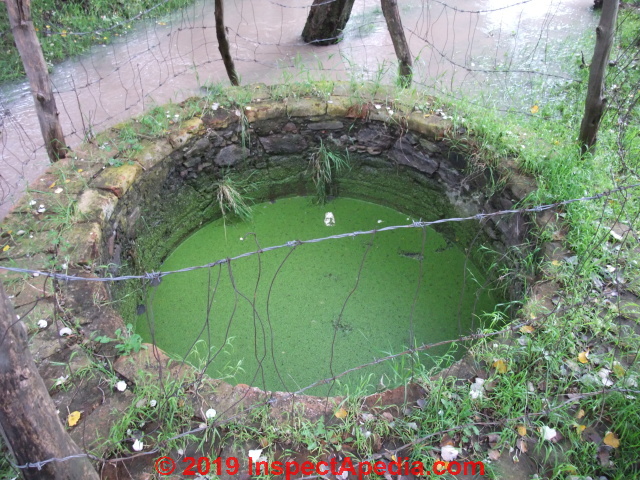
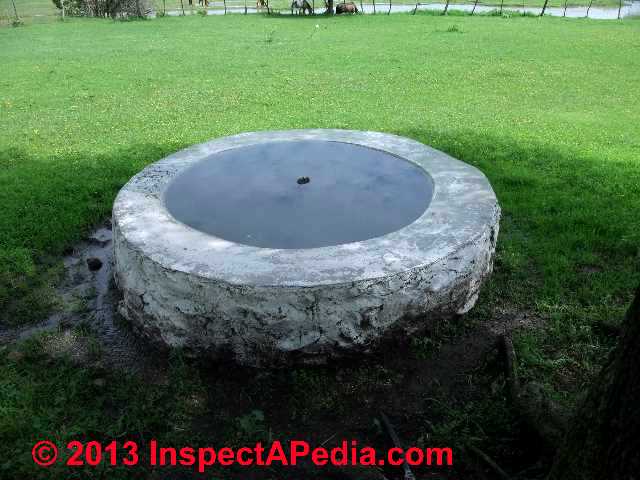
Dug well - any hand-excavated (or in some cases machine excavated) shallow well, such as shown above, intended for use as a water source.
See HAND DUG WELLS - home for details.
Heavy metals - Metallic elements with high atomic weights, such as, mercury chromium cadmium, arsenic, and lead. Even at low levels these metals can damage living things. They do not break down or decompose and tend to build up in plants, animals, and people causing health concerns.
Leaching field - The entire area where many materials (including contaminants) dissolve in rain, snowmelt, or irrigation water and in most common instances, onsite wastewater effluent disposal areas ore septic drainfields are filtered through the soil. Synomyms for leaching field are leach field, drainfield, soakaway bed, seepage bed and similar terms. Details are
at SEPTIC DRAINFIELD INSPECTION & TEST.
Microorganisms - Also called microbes. Very tiny life forms such as bacteria, algae, diatoms, parasites, plankton, and fungi. Some can cause disease.
Nitrates - Plant nutrient and fertilizer that enters water supply sources from fertilizers, animal feed lots, manures, sewage, septic systems, industrial wastewaters, sanitary landfills, and garbage dumps.
Protozoa - One-celled animals, usually microscopic, that are larger and more complex than bacteria. May cause disease.
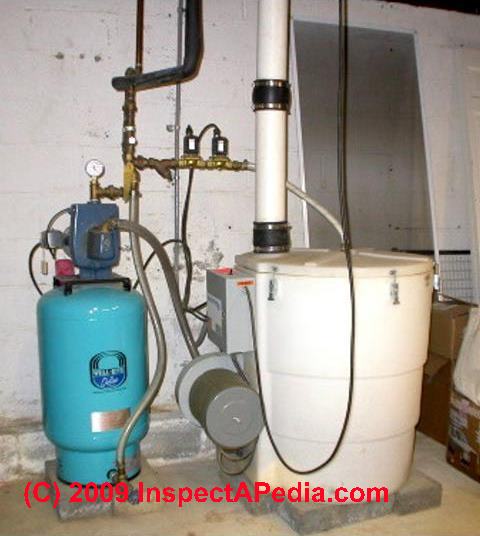
Radon - A colorless, odorless naturally occurring radioactive gas formed by the breakdown or decay of radium or uranium in soil or rocks like granite. Radon is fairly soluble in water, so well water may contain radon.
Shown at left is a system for removing radon gas from drinking water. Details about radon testing and radon gas level correction systems in buildings are at RADON HAZARD TESTS & MITIGATION.
Radionuclides - Distinct radioactive particles coming from both natural sources and human activities. Can be very long lasting as soil or water pollutants.
Recharge area - The land area through or over which rainwater and other surface water soaks through the earth to replenish an aquifer, lake, stream, river, or marsh. Also called a watershed.
Saturated zone - The underground area below the water table where all open spaces are filled with water. A well placed in this zone will be able to pump ground water.
Unsaturated zone - The area above the ground water level or water table where soil pores are not fully saturated, although some water may be present.
Viruses - Submicroscopic disease-causing organisms that grow only inside living cells.
Watershed - The land area that catches rain or snow and drains it into a local water body (such as a river, stream, lake, marsh, or aquifer) and affects its flow, and the local water level. Also called a recharge area.
 Water table - The upper level of the saturated zone. This level varies greatly in different parts of the country and also varies seasonally depending on the amount of rain and snowmelt.
Water well: an opening dug, drilled, or otherwise made into the soil intended to obtain and provide water for drinking, animal use, or other processes.
A water well receives its water supply from groundwater, a spring, or similar sources.
Types of water wells are detailed
Well cap - A tight-fitting, vermin-proof seal designed to prevent contaminants from flowing down inside of the well casing. Well caps are installed atop a steel well liner or casing, typical 6" in diameter but also available in smaller & larger sizes for water wells.
Our photo illustrates a new well cap (orange arrow) installed atop a steel well casing in Two Harbors, MN.
You can see by the plastic electrical conduit that this well is served by a submersible well pump.
The red-tipped stake by the well casing is intended to mark the well location when there is snow cover, in hope that the snow plow, when pushing snow off of the driveway, won't smash the well casing.
Well cover - a tight-fitting, secure safety cover installed atop a dug well or well pit both to keep out animals or vermin and as a safety device to prevent someone from falling into the opening. We discuss well covers for wells & well pits further
at WELL PITS.
Well casing - The tubular lining of a well. Also a steel or plastic pipe installed during construction to prevent collapse of the well hole.
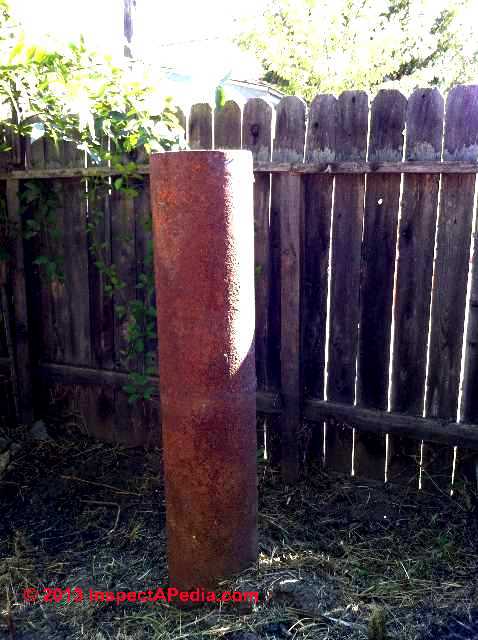 In our photo at left, what appears to be a ten-inch steel drilled well casing has no cap, suggesting that this well is either not in use or is not properly installed.
Well pit - an opening in the ground housing the top of a well casing or other well type and sometimes additional well equipment including pumps, pressure tanks, and electrical controls.
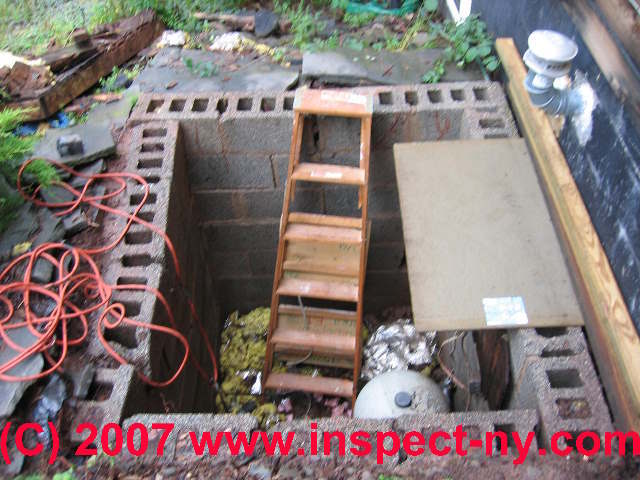
A well pit is intended to protect well piping and components from freezing in cold climates where those components must be located outside of the building(s) served by the well.
Our photo (above left) shows a dangerous well pit that is collapsing and that lacks a safety cover.
Wellhead - The top of a structure built over a well. Term also used for the source of a well or stream.
...
Continue reading at CONSULT LOCAL WELL EXPERTS or select a topic from the closely-related articles below, or see the complete ARTICLE INDEX.
Or see these
Recommended Articles
- WELLS CISTERNS & SPRINGS - home
- WELL CONSTRUCTION & MAINTENANCE
- EPA GUIDE to WATER QUALITY - annotated, illustrated & expanded guide to Ground water & Well Contamination
- WATER WELLS: CAUSES & CURES for CONTAMINATION - home
Suggested citation for this web page
WELL & WELL WATER DEFINITIONS at InspectApedia.com - online encyclopedia of building & environmental inspection, testing, diagnosis, repair, & problem prevention advice.
Or see this
INDEX to RELATED ARTICLES: ARTICLE INDEX to WATER SUPPLY, PUMPS TANKS WELLS & SPRINGS
Or use the SEARCH BOX found below to Ask a Question or Search InspectApedia
Ask a Question or Search InspectApedia
Questions & answers or comments about the definition of various well, drinking water, & well water contaminant or testing terminology.
Try the search box just below, or if you prefer, post a question or comment in the Comments box below and we will respond promptly.
Search the InspectApedia website
Note: appearance of your Comment below may be delayed: if your comment contains an image, photograph, web link, or text that looks to the software as if it might be a web link, your posting will appear after it has been approved by a moderator. Apologies for the delay.
Only one image can be added per comment but you can post as many comments, and therefore images, as you like.
You will not receive a notification when a response to your question has been posted.
Please bookmark this page to make it easy for you to check back for our response.
Our Comment Box is provided by Countable Web Productions countable.ca
Citations & References
In addition to any citations in the article above, a full list is available on request.
- [1] Drinking Water from Household Wells - PDF, U.S. EPA, Original source last retrieved 2/13/2013, original source: http://www.epa.gov/privatewells/pdfs/household_wells.pdf
- 1-Bromo-3-chloro-5,5-dimethylhydantoin (C5H6BrClN2O2) is produced world-wide and is also used in cleaners and bathroom disinfectants and deodorizers. Here is an example MSDS for this product, provided by Leisure Time
- "Bacteria in Drinking Water" - "Chlorine," Karen Mancl, water quality specialist, Agricultural Engineering, Ohio State University Extension. Mancl explains factors affecting the effectiveness of chlorine in water as a means to destroy bacteria and other microorganisms. OSU reports as follows:
- Chlorine kills bacteria, including disease-causing organisms and the nuisance organism, iron bacteria. However, low levels of chlorine, normally used to disinfect water, are not an effective treatment for giardia cysts. A chlorine level of over 10 mg/1 must be maintained for at least 30 minutes to kill giardia cysts. -- http://ohioline.osu.edu/b795/index.html is the front page of this bulletin
- "Chemicals and Our Health", Nicholas D. Kristof, New York Times, 16 July 2009, p. 27. This outstanding editorial calls for improvements in public health policy to address phthalates and other environmental contaminants from common chemicals and products in everyday use. - DJ Friedman
- Crystal Clear Supply provides portable ceramic water filter purifiers and portable reverse osmosis water treatment equipment - see http://www.crystalclearsupply.com/category_s/7.htm
- Disinfectants in water: www.epa.gov/ogwdw/mdbp/pdf/alter/chapt_2.pdf provides an article on use of disinfectants for water treatment
- "Drinking Water Safety in Emergencies", University of Minnesota extension, extension.umn.edu/info-u/nutrition/BJ646.html
- Endocrine Disruptor Exchange, Dr. theo Colborn (also see Our Stolen Future). From that website: The Endocrine Disruption Exchange, Inc. is the only organization that focuses primarily on the human health and environmental problems caused by low-dose and/or ambient exposure to chemicals that interfere with development and function, called endocrine disruptors. ... TEDX's work focuses on the endocrine system, which is the exquisitely balanced system of glands and hormones that regulates such vital functions as body growth, response to stress, sexual development and behavior, production and utilization of insulin, rate of metabolism, intelligence and behavior. Hormones are chemicals such as insulin, thyroxin, estrogen, and testosterone that interact with specific target cells. The interactions occur through a number of mechanisms, the easiest of which to conceptualize is through a lock and key arrangement.
- Giardia exposure limits for drinking water: see www.mass.gov/dep/water/drinking/standards/giardia.htm is the current regulatory exposure limit (your minimum target for sterilization)
- Health Effects of Chemical Contaminants in Drinking Water, US Environmental Protection Agency,
- Hydrogen peroxide: Wikipedia on history of use of hydrogen peroxide: Information on Hydrogen peroxide as a sterilant is in Wikipedia at en.wikipedia.org/wiki/Sterilization_(microbiology) HO2 has been used for a long time, including by vaporization for sterilizing freeze dryers.
- Hydrogen Peroxide warning: US FDA Warning about drinking hydrogen peroxide: www.truthorfiction.com/rumors/h/hydrogen-peroxide.htm This article cites a 2003 entry in Journal of Food and Science on using Hy.Perox to sterilize vegetables, referring to E.coli - NOT to Giardia.
- Iodine: "Do Iodine Water Purification Tablets Provide an Effective Barrier against Cryptosporidium parvum?", Starke, Jeffrey A., Bowman, Dwight D., Labare, Michael, Fogarty, Elizabeth A., and others, Military Medicine, 25 October 2001 [possibly a later version of this article appeared in 2005 -DF] http://www.amsus.org/military medicine/milmed.htm
- Ohio State University article on the concentration of chlorine necessary to act as an effective disinfectant, and the effects of the water's pH and temperature: See http://ohioline.osu.edu/b795/b795_7.html for details.
- Our Stolen Future: Are We Threatening Our Fertility, Intelligence, and Survival?--A Scientific Detective Story, Theo Colborn, Dianne Dumanoski, John Peter Meyers. Plume-Penguin Publishing, 1997, ISBN 0-452-27414-1., ISBN13: 9780452274143. This book is a seminal work on endocrine disruptors (chemical contaminants having impact at extremely low levels in the environment).
Recommended by Daniel Friedman, this book is a critical update to the landmark Silent Spring by Rachel Carson and discusses the effects of minute trace amounts of chemical contaminants in the environment. The text "Identifies the various ways in which chemical pollutants in the environment are disrupting human reproductive patterns and causing such problems as birth defects, sexual abnormalities, and reproductive failure. Reprint. Tour. NYT."
Amazon.com Review: By O T (Ontario, BC) - 'Our Stolen Future' is a great introduction to one of the most important scientific discoveries in our time. Having recently completed a thesis project at university on Endocrine Disruptors, I have reviewed hundreds of papers on the subject. This book is a good clear overview of the scientific literature on EDs. The authors are experts - Theo Colborn is largely responsible for creating the field by bringing together diverse researchers so they could see the big picture of their work. Many of the principle investigators are interviewed and quoted at length on the way chemicals participate in and interfere with delicate hormonal systems in animals (including humans). The major accomplishment of the book is to make an easy-to-follow story out of complex research. Many resources are available to help you assess the reliability of this story, and the best thing to do if you have any doubts is read review articles in scientific journals (which are easier to understand than technical papers). The Physicians for Social Responsibility (PSR) have a guidebook for health-care professionals on Endocrine Disruptors, and the US EPA has many reports on the matter. Beware of people or websites who try to 'debunk' this book (or the science behind it) by simply declaring it false, flawed or disproven. There is far too much supporting research for so simple a refutation.
OPINION: Significant and discussed in this book is the observation that at certain critical points in the development of animals, presumably including humans, exposure to extremely low levels of endocrine disruptor chemicals (EDC's) (such as BPA - Bisphenol-A or BPA, Diethylstilbestrol - DES, dioxins, PCBs, and chemicals used in the production of certain cleansers, dyes, flame retardants, plastics, pesticides, white papers ) perhaps just a few molecules, or in the parts per trillion, is sufficient to cause disruption of the animal's development, including proper sex differentiation, or the lack of it that produced androgynous ducks unable to reproduce under such conditions.
A endocrine disruptor is a synthetic chemical compound that mimics natural hormones when it is taken into the body of a human or other animal. It "disrupts" the endocrine system by turning on or off normal chemical signals that in turn can affect normal hormone levels, bodily functions, and significantly, the development of embryos. Further, unlike naturally occurring hormones ingested, for example from plants (phytoestrogens), synthetically-generated hormones accumulate in the body and can have a half-life of decades or longer.
One significance of this finding includes the observation that an important medical effect that occurs with exposure to chemicals in extremely low concentrations means that experiments to test for correlations between chemical exposure and subsequent serious medical problems will be deeply flawed if, for example, the experimental design does not include testing for the presence of the chemical at extremely low levels. A related concern is that even if harmful effects from exposure to extremely low concentrations of an endocrine disruptor are occurring, teasing out and proving that relationship can be also extremely difficult. - Silent Spring, Rachael Carson, Mariner Books; Anv edition (October 22, 2002), ISBN-13: 978-061824906.
Amazon.com Review: Silent Spring, released in 1962, offered the first shattering look at widespread ecological degradation and touched off an environmental awareness that still exists. Rachel Carson's book focused on the poisons from insecticides, weed killers, and other common products as well as the use of sprays in agriculture, a practice that led to dangerous chemicals to the food source. Carson argued that those chemicals were more dangerous than radiation and that for the first time in history, humans were exposed to chemicals that stayed in their systems from birth to death. Presented with thorough documentation, the book opened more than a few eyes about the dangers of the modern world and stands today as a landmark work. - Shock or Chlorinate a Well, When, How-to - Procedure for Shocking a Well to (temporarily or maybe longer) "Correct" Bacterial Contamination
- US EPA: list of drinking water contaminants: see http://www.epa.gov/safewater/contaminants/index.html
- UV light: This patent application for UV light sterilization www.patentstorm.us/patents/6565803.html Lists good references on water purification for Giardia et als
- Our recommended books about building & mechanical systems design, inspection, problem diagnosis, and repair, and about indoor environment and IAQ testing, diagnosis, and cleanup are at the InspectAPedia Bookstore. Also see our Book Reviews - InspectAPedia.
- In addition to citations & references found in this article, see the research citations given at the end of the related articles found at our suggested
CONTINUE READING or RECOMMENDED ARTICLES.
- Carson, Dunlop & Associates Ltd., 120 Carlton Street Suite 407, Toronto ON M5A 4K2. Tel: (416) 964-9415 1-800-268-7070 Email: info@carsondunlop.com. Alan Carson is a past president of ASHI, the American Society of Home Inspectors.
Thanks to Alan Carson and Bob Dunlop, for permission for InspectAPedia to use text excerpts from The HOME REFERENCE BOOK - the Encyclopedia of Homes and to use illustrations from The ILLUSTRATED HOME .
Carson Dunlop Associates provides extensive home inspection education and report writing material. In gratitude we provide links to tsome Carson Dunlop Associates products and services.
 | HOME | ABOUT | ASK a QUESTION | CONTACT | CONTENT USE POLICY | DESCRIPTION | POLICIES | PRIVACY | |
| © 2024 - 1985 Publisher InspectApedia.com - Daniel Friedman | |||||||||