
InspectAPedia® FREE Encyclopedia of Building & Environmental Construction, Diagnosis, Maintenance & Repair |
Question? Just ask us! InspectAPedia
|
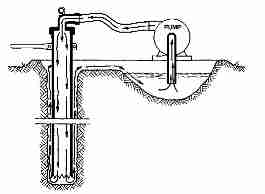 Jetted Wells used for Drinking Water
Jetted Well
or Wash Well Problems & Repair Advice
- POST a QUESTION or COMMENT about how to install, troubleshoot, & repair small diameter wells, jetted wells, wash wells
This article explains jetted wells, also called wash wells: how a jetted well is constructed, what are the capacities of a jetted well, and how is a jetted well water flow problem diagnosed & restored.
These small diameter jetted water wells can provide water sources when water is close to the ground surface and a well pipe or point can be driven into the soil mechanically or by using hydrojetting.
This article series explains installing, diagnosing, and repairing small diameter water wells including driven point wells, wash wells, and jetted wells, three types of water sources that may be used where water is close to the ground surface and a well pipe or point can be driven into the soil mechanically or by using hydrojetting.
We include an excellent UN FAO small diameter well document reference that will be helpful to those needing to construct a water well in areas where water is close to the ground surface and money or other resources are limited.
InspectAPedia tolerates no conflicts of interest. We have no relationship with advertisers, products, or services discussed at this website.
- Daniel Friedman, Publisher/Editor/Author - See WHO ARE WE?
Small Diameter Jetted Wells
 A variety of methods are used to install small-diameter water wells in areas where an adequate water supply is sufficiently close to the surface, where cost must be minimized, where well installation speed is important, and where there may be less concern for drinking water contamination from surface runoff.
This article describes the two most common small diameter well methods, driven point wells and jetted wells.
We provide advice about what to do when things go wrong. Readers of this document should also
see WATER TANK TYPES and before assuming that a water problem is due to the well itself,
see WATER PUMP REPAIR GUIDE an specific case which offers an example of diagnosis of loss of water pressure, loss of water, and analyzes the actual repair cost.
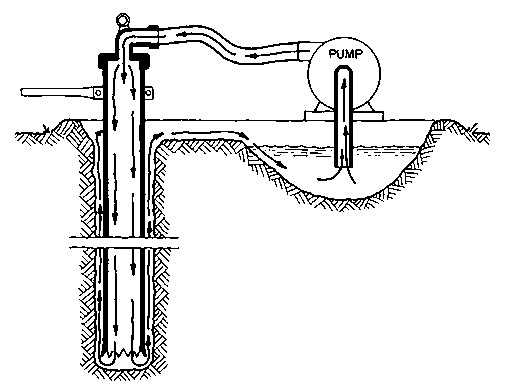
The page top sketch shows one of the methods used to construct a wash well or jetted well, described in an excellent UN FAO small diameter well document (reference included here) that will be helpful to those needing to construct a water well in areas where water is close to the ground surface and money or other resources are limited.
Other small diameter well types include bored or augured wells, hydraulic percussion wells, cable tool percussion wells, bail down wells, and hydraulic rotary-drilled wells. All of these small diameter well methods have the advantage of comparatively low cost, rapid installation, and simplicity, and the risk of limited water availability and surface runoff contamination of the aquifer - considerations we explain in more detail below.
What is a jetted well? Jetted wells or WASH WELLS for drinking water supply are similar to driven point wells in that a pipe is forced into the soil and connected (most often) to a single line jet pump. In some communities the term WASH WELLS is used to mean the same thing as a jetted well water source, as suggested by New Hampshire reader Jack Allen.
How are jetted wells installed? In either case, the pipe that is to be used to obtain water is forced into the soil using water at high pressure (40 psi for sandy soils, up to 150 psi for clay or gravel) from an existing water source.
The illustration (above) is from UN document "Small Diameter Wells"
Unlike a driven point well, however, the pipe used in combination with water to force an opening into the ground (the jetting tube) may be a temporary one (the jetting casing is removed from the ground after the jetting process is complete, followed by the insertion of a new casing and casing end screen) or it may be permanent (left in the ground at the end of the jetting process, jacked up just enough to accommodate a well screen lowered inside the casing to its bottom end).
An alternative jetted well process permits soil material to actually be removed from the well opening during the jetting process (soil flows up from the bottom of the jetting casing around its outside surface.
Water flowing from the tip of the jet dislocates soil sufficiently to permit the well pipe to be pushed into the ground. Using this process a jetted well (or wash well) may be driven deeper into the soil than a driven point well, and a jetted well may be driven through soils harder than those penetrated by a driven point well.
Check valves or foot valves in jetted wells:
To avoid losing prime in a jetted well a check valve may be used at the lower end of the casing, above the well screen. This detail is important for a homeowner to know, because if a jetted well or wash well stops working the problem could be a failed check valve (or foot valve) rather than a loss of water in the aquifer.
Jetted well water capacity or well yield: In soils that contain large amounts of water, particularly in areas of gravel or sand, a jetted well or wash well may deliver good water flow or quantity.
Jetted well water sanitation: However the water quality questions that apply to a driven point well might need to be considered for a jetted well too: a well of this design has little protection from unsanitary groundwater compared with a steel-casing drilled-well that is cut into water bearing rock and that is sealed against surface water entry.
We suspect that a jetted well installed using the alternative process that actually removes material from the well opening by flowing soil to the surface along the outside of the well casing may be more prone to surface water leaking into the well and its aquifer.
Mr. Allen points out that when well repair or service is required for a jetted well, the homeowner will need to contact a company who is familiar with this particular well type.
The UN FAOdocument describes the jetted or wash well construction process in more detail. Quoting from FAO's description of two jetted or wash well construction methods (see the sketches in this document)
(1) Water is pumped down a jetting tube or pipe which is used inside a temporary or permanent casing (Figure 16a). The excavation of material by the stream of water allows the casing to descend and the excavated material is carried upward out of the well via the annular space between the jetting tube and the casing. Rotating the casing and cutting teeth on its bottom edge increases the rate of descent.
If the casing sunk during the jetting operation is temporary, the final casing with screen attached is lowered inside the temporary casing, which is then jacked out of the hole. A
lternatively, the permanent casing may be sunk during the jetting operation. In this case, the well screen is lowered inside the casing and the casing is then jacked up far enough to expose the well screen to the aquifer.
(2) Jetting may be done by pumping the water down through the casing itself with the excavated material being carried up through an annular space around the outside of the casing (Figure 16b). If jetting is interrupted before the casing is sunk to the full desired depth, so that the suspended material settles around it, difficulty may be experienced in re-starting the jetting process.
When an open-ended casing is used, a well screen is subsequently lowered and the casing raised slightly to expose the well screen. A
alternatively a string of casing with a special self-jetting point on the end of a well screen may be used. The jetting orifice at the end of the well screen is closed by a check valve which is held against its seat either by buoyancy or by a spring when not held open by the pressure of the jetting water.
In some cases a smaller string of pipe passes down through the inside of the casing and screen and is screwed into the top of the jetting point. The pipe is used to transmit the jetting water from the pump to the point, without leakage out through the screen. After the jetting operation, this pipe is unscrewed and removed.
This article series describes various types of drinking water sources like wells, cisterns, dug wells, drilled wells, artesian wells and well and water pump equipment.
...
Continue reading at DRIVEN POINT WELLS or select a topic from the closely-related articles below, or see the complete ARTICLE INDEX.
Or see these
Recommended Articles
Suggested citation for this web page
JETTED WELLS at InspectApedia.com - online encyclopedia of building & environmental inspection, testing, diagnosis, repair, & problem prevention advice.
Or see this
INDEX to RELATED ARTICLES: ARTICLE INDEX to WATER SUPPLY, PUMPS TANKS WELLS & SPRINGS
Or use the SEARCH BOX found below to Ask a Question or Search InspectApedia
Ask a Question or Search InspectApedia
Try the search box just below, or if you prefer, post a question or comment in the Comments box below and we will respond promptly.
Search the InspectApedia website
Note: appearance of your Comment below may be delayed: if your comment contains an image, photograph, web link, or text that looks to the software as if it might be a web link, your posting will appear after it has been approved by a moderator. Apologies for the delay.
Only one image can be added per comment but you can post as many comments, and therefore images, as you like.
You will not receive a notification when a response to your question has been posted.
Please bookmark this page to make it easy for you to check back for our response.
IF above you see "Comment Form is loading comments..." then COMMENT BOX - countable.ca / bawkbox.com IS NOT WORKING.
In any case you are welcome to send an email directly to us at InspectApedia.com at editor@inspectApedia.com
We'll reply to you directly. Please help us help you by noting, in your email, the URL of the InspectApedia page where you wanted to comment.
Citations & References
In addition to any citations in the article above, a full list is available on request.
- Thanks to Jack Allen, Brookline, NH for pointing out our omission of wash wells from the discussion of water source types and who also provided the small diameter well reference below for well drilling information from the United Nations. 31 July 2009
- "Small Diameter Wells", Natural Resources Management & Environment Department, Food and Agriculture Organization of the United Nations, FAO Corporate Document Repository - Self-Help Wells - see http://www.fao.org/docrep/X5567E/x5567e05.htm
This article has a nice section on well pipe or dropped tool fishing tools at its end. If a tool is dropped into a well or if a section of well piping becomes disconnected and drops into a well, special devices can be lowered into the well to attempt to grasp or hook the lost object (or pipe) to pull it back out of the well. See http://www.fao.org/docrep/X5567E/x5567e05.htm#4.11%20problem%20solving
This document describes the following types of small-diameter (hand-built) water wells: [Quoting]
4.1 Bored or augered wells - This method of excavation consists of shaving or cutting material from the bottom of the hole by the rotation of a cylindrical tool with one or more cutting lips. The process is quite analagous to boring a hole in wood or metal with an auger or drill. The excavated earth normally feeds upward and is contained in the body of the auger where it remains until the auger is emptied. The auger is both rotated and raised and lowered by means of a vertical shaft which extends upward from the auger to a convenient point above ground level from which it can be rotated. Rotation is frequently accomplished by human power applied to a handle attached to the vertical shaft. However, the auger may be driven by other power sources such as animal or engine power. In this case, the power source drives a horizontal ring gear. Two projections extending upward from the ring gear drive a bar known as a "kelly" which lies across a diameter of the ring. A square section of the auger shaft fits through a square hole at the centre of the kelly bar which causes the auger shaft to rotate with the kelly bar while allowing it vertical freedom.
4.2 Driven wells - The driven well consists of a pointed perforated pipe or a pipe with a pointed well screen attached which has been driven into an aquifer. The pipe with pointed well screen is driven into place in much the same way a nail is driven into wood. Normally special pipe with thick walls and specially designed couplings are used to resist the driving forces. Under suitable conditions this method can yield a finished well in a very short time. While the well diameter is normally small and the yield relatively low, a number of driven wells may be coupled together and pumped with a single pump. Because driven wells are quick to construct, they may be used as a temporary source of water and then be pulled up when no longer needed. Driven well points may be installed and used for dewatering an excavation during construction. Unlike other well construction methods, material is merely forced aside and not excavated by the driving process. This means that little is learned about the material through which the well pipe passes. This kind of well can, however, be used for exploratory purposes to determine static water level and rate of inflow versus drawdown. Hard formations cannot be penetrated by this process. Barring impermeable strata the depth to which such a well can be driven depends on the build-up of friction between the well pipe and the material penetrated and the transmission of the force of the driver down the length of pipe. Twenty-five to thirty metres (80-100 feet) would probably be a maximum. A driven well point might be employed to finish a hole which had been excavated down to the water table by some other method such as an auger.
4.3 Jetted wells - This method makes use of a high velocity stream of water to excavate the hole and to carry the excavated material out of the hole. It therefore requires some type of pump, either motor or hand-powered, of reasonable capacity, as well as a supply of water. It is possible to separate the water and the excavated material in a settling pool or tank and to reuse the water, thus minimizing the quantity required. Since this method depends on the erosive action of water, it is obvious that extremely hard materials cannot be penetrated. However, semi-hard materials may be penetrated by a combination of hydraulic and percussion effects. This is accomplished by raising and dropping a chisel-edged jetting bit. Coarse materials such as gravel require a greater water velocity to move them vertically out of the hole than do finer materials. However, very fine, hard packed materials such as clays require a high water velocity to dislodge them. Water pressure of 3 kg/cm2 (40 psi) for sand and 7-11 kg/cm2 (11-150 psi) for clay or gravel have been recommended. Under good conditions, drilling progress is very fast.
4.4 Hydraulic percussion (also hollow rod method) driven wells - In this method the hole is kept full of water and a combination of mechanical and hydraulic action do the excavating (Figure 17). A chisel-edged cutting bit is attached to the bottom of a string of drill pipe. The hollow bit has inlet ports a small distance above its cutting edge. During drilling the drill pipe is alternately raised and dropped. Pressure due to the impact of the cutting bit in the bottom of the hole and the inertia of the water cause a mixture of water and cuttings to enter the inlet ports of the cutting bit. This causes the already full drill pipe to overflow. A check valve in the cutting bit prevents the mixture of water and cuttings from flowing out of the ports when the drill stem is raised. The cuttings may be settled out from the water in a pool or barrel after the mixture overflows from the drill pipe and the water can then be recycled. Hydraulic percussion is limited to drilling through relatively fine materials, since coarse materials will not rise to the surface through the drill pipe. This method has been used to depths of more than 900 metres (3 000 feet) in alluvial areas where neither hard formations nor coarse materials were encountered.
4.5 Percussion (also cable tool method) driven wells - This method consists of repeatedly raising and dropping a chisel-edged bit to break loose and pulverize material from the bottom of the hole. A small amount of water is kept in the hole, so that the excavated material will be mixed with it to form a slurry. Periodically the percussion bit is removed, and a bailer is lowered to remove the slurry containing the excavated material. The bailer or bailing bucket consists of a tube with a check valve at the bottom and a bail for attaching a cable or rope to the top. When it has been raised and dropped a number of times to fill it with the slurry it is brought to the surface for emptying. Bailing is repeated until the hole has been adequately cleaned, at which time drilling is resumed; drilling and bailing are then alternated. If the hole is unstable, casing is lowered and the driving of casing is alternated with the other two processes. In loose granular material, such as sand, bailing alone may be sufficient to remove the material from the bottom of the hole and allow the casing to be sunk. A heavy bailer with a cutting edge at its lower end, known as a "mud scow" is used for this purpose.
4.6 Hydraulic rotary drilled wells - This method employs a drilling bit at the bottom of a stem of rotating drill pipe. Cuttings are removed by pumping water or a mixture of water and various clays down through the drill stem. This "mud" entrains the cuttings and carries them up through the annular space between the drill pipe and the wall of the hole. When they reach ground level, the cuttings can be settled out in a small pond and the "mud" recirculated. If the reverse flow path is used ("mud" pumped to the surface through the hollow drill pipe) the system is called reverse rotary. The reverse rotary system allows larger particles of cuttings to be brought to the surface, because the upward flow velocity inside the pipe is greater than that through the annular space, due to the smaller flow cross section inside the pipe. - Thanks to reader Lloyd McVey at AKR for discussing using compressed air to restore water flow in a driven point well, July 2010
- Access Water Energy, PO Box 2061, Moorabbin, VIC 3189, Australia, Tel: 1300 797 758, email: sales@accesswater.com.au Website: http://www.accesswater.com.au/
Moorabbin Office: Kingston Trade Centre, 100 Cochranes Rd, Moorabbin, VIC 3189
Australian supplier of: Greywater systems, Solar power to grid packages, Edwards solar systems, Vulcan compact solar systems, water & solar system pumps & controls, and a wide rage of above ground & under ground water storage tanks: concrete, steel, plastic, modular, and bladder storage tanks. - Grove Electric, Typical Shallow Well One Line Jet Pump Installation [PDF], Grove Electric, G&G Electric & Plumbing, 1900 NE 78th St., Suite 101, Vancouver WA 98665 www.grovelectric.com - web search -7/15/2010 original source: http://www.groverelectric.com/howto/38_Typical%20Jet%20Pump%20Installation.pdf
- Grove Electric, Typical Deep Well Two Line Jet Pump Installation [PDF], Grove Electric, G&G Electric & Plumbing, 1900 NE 78th St., Suite 101, Vancouver WA 98665 www.grovelectric.com - web search -7/15/2010 original source: http://www.groverelectric.com/howto/38_Typical%20Jet%20Pump%20Installation.pdf
- Our recommended books about building & mechanical systems design, inspection, problem diagnosis, and repair, and about indoor environment and IAQ testing, diagnosis, and cleanup are at the InspectAPedia Bookstore. Also see our Book Reviews - InspectAPedia.
- In addition to citations & references found in this article, see the research citations given at the end of the related articles found at our suggested
CONTINUE READING or RECOMMENDED ARTICLES.
- Carson, Dunlop & Associates Ltd., 120 Carlton Street Suite 407, Toronto ON M5A 4K2. Tel: (416) 964-9415 1-800-268-7070 Email: info@carsondunlop.com. Alan Carson is a past president of ASHI, the American Society of Home Inspectors.
Thanks to Alan Carson and Bob Dunlop, for permission for InspectAPedia to use text excerpts from The HOME REFERENCE BOOK - the Encyclopedia of Homes and to use illustrations from The ILLUSTRATED HOME .
Carson Dunlop Associates provides extensive home inspection education and report writing material. In gratitude we provide links to tsome Carson Dunlop Associates products and services.
 | HOME | ABOUT | ASK a QUESTION | CONTACT | CONTENT USE POLICY | DESCRIPTION | POLICIES | PRIVACY | |
| © 2025 - 1985 Publisher InspectApedia.com - Daniel Friedman | |||||||||