
InspectAPedia® FREE Encyclopedia of Building & Environmental Construction, Diagnosis, Maintenance & Repair |
Question? Just ask us! InspectAPedia
|
 Septic Filters
Guide to Using Septic Filters and Graywater Filters to Protect Drainfields
- POST a QUESTION or COMMENT about buying and using septic filters and graywater filters
Septic filters or graywater filters:
Septic filters are such a significant improvement in septic system operation and longevity that some jurisdictions (such as Arizona) require them on new septic installations.
This document explains the design and use of various types of septic effluent filter systems and graywater filter systems to protect the septic drainfield or absorption system from clogging.
We explain what types of septic or graywater filters are used, where and how they are installed, and how they are cleaned or maintained.
InspectAPedia tolerates no conflicts of interest. We have no relationship with advertisers, products, or services discussed at this website.
- Daniel Friedman, Publisher/Editor/Author - See WHO ARE WE?
The Basics of Using Septic Filters to Extend Septic Drainfield Life
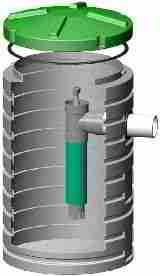
While there are several versions of septic and other types of wastewater filters, the most basic septic effluent filter is a simple tee and filter installed at the septic tank outlet. The installation can be handled by a septic contractor or a skilled homeowner, and can cost less than $100. U.S.
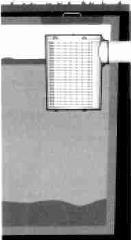
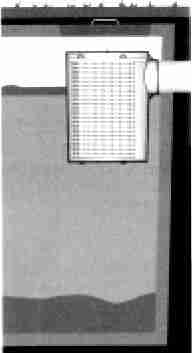
Our illustration shows a filter in use in a septic graywater basin.
These simple septic filters, such as greywater filters, washing machine filters, and filters at the effluent outlet of a conventional septic tank are all designed to protect the septic effluent absorption field or leach field.
Septic filters are placed either in the septic tank at the outlet tee or in a separate chamber outside of and close to the septic tank.
Graywater filters may be placed at the inlet to a drywell or graywater disposal system. Washing machine filters are often installed at the clothes washer outlet hose. We include a list of product sources for these various types of septic filters.
[Click to enlarge any image]
In contrast with septic effluent and graywater filters, media filter septic systems use a conventional septic tank followed by any of several methods to further filter and treat septic effluent before it is discharged to the soil, soil surface, or waterway.
Media filter systems are discussed at Using Septic Media Filters as Components of Alternative Septic Systems for Difficult Sites.
Septic Effluent Filters Protect the Leach Field from Clogging
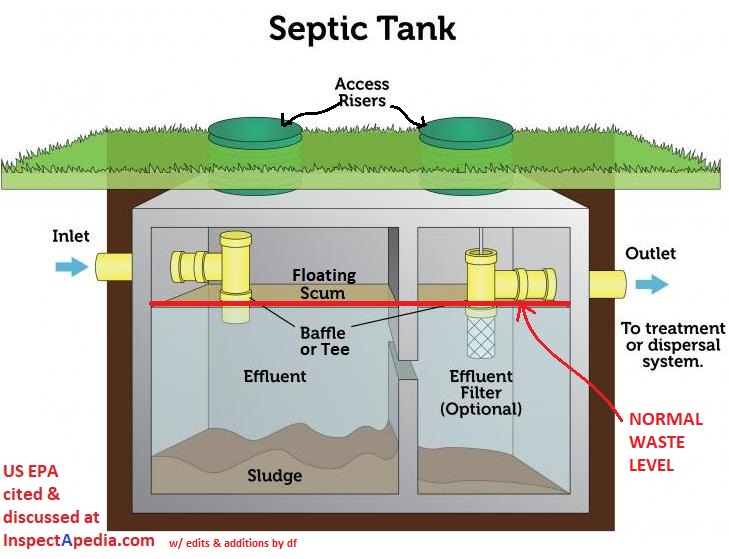
To add protection for the septic absorption system, add a septic effluent or gray water filter at the septic tank outlet tee. The sketch at page top (US EPA) shows a large basket filter installed at a septic tank outlet.
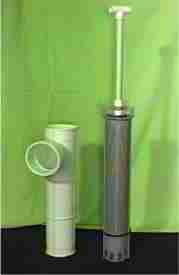
The photo shows a simple filter which is installed inside the outlet tee of a septic tank.
If there is no room in the tank to install such a filter, a small chamber and filter can be installed outside of the septic tank but upstream from the drainfield - just like our septic graywater basin and filter shown in the previous sketch..
Although most grease or large solids entering the septic tank are intended to be retained there where they are reduced to floating scum at the top of the tank or settled sludge at the tank bottom.
However septic tank effluent also contains suspended solids, smaller particles of debris which, as they pass out to the soil absorption system, or drainfield, speed the clogging of the absorption system and thus shorten its life.
By trapping more of the suspended solids in septic effluent we pass clarified septic effluent to the absorption system, extending its life. Don't worry about starving the biomat by filtering the septic effluent. There are still plenty of nutrients in the effluent passing into the absorption system.
A number of companies sell these devices which will add life to your drainfield by reducing the level of suspended solids flowing out of the tank. If you buy a septic tank outlet filter you'll see that the filter product will typically be of about the dimensions of the outlet tee I cited above, or perhaps an inch or two deeper.
See the links below for more information about septic filters and septic media filter systems. [Photo courtesy of thenaturalhome.com - see Product Source List below]
ReaderQuestion: Experience Installing a Tuf-Tite EF4 on a Concrete Septic Tank
 I just installed a Tuf-Tite EF4 in the outlet of my 30-year-old concrete septic tank, whose outlet elbow had broken off.
Very simple job (see comments on the tank tees page), and only took a couple of hours. Total investment maybe $30 - filter was $15, two-foot piece of three inch PVC $4, adapter $5, new can of PVC cement $6. - Brahms 9/29/11
Reply:
Thank you Brahms for the feed-back. We're thrilled that our article on tank tees was useful and glad to read that your repair went well.
Illustration: a conventional two-chamber septic tankwith an effluent filter installed in the outlet tee. - Types of Septic Systems, U.S. EPA, retrieved 2019/04/22 original source: https://www.epa.gov/septic/types-septic-systems
Question: Should I install a septic filter on a tank with multiple baffles?
Is it helpful to install a filter on a septic tank that has multiple baffles? - Deb 12/8/2011
Reply:
Deb your question is a bit confusing but I am guessing you're talking about a multiple-compartment septic tank, or (more rare) a septic tank with multiple outlets to multiple drainfields.
If you have a single tank with ultimately a single outlet pipe that feeds a distribution box and drainfield, you'd install a filter at that outlet end of the tank.
If your septic tank actually has multiple outlets that feed multiple drywells (an unusual installation) you'd need to install a filter at each of them to protect each of the drainfields.
Question: Our septic alarm keeps going off
I just moved to a brand new house and that has a septic. I have septic first time in my life. I have some guest due to family occasion. Alarm goes off every other day.
I am told that septic tank pumps 400 gallons a day. If we use more than 400, it sets off alarm. We have 1250 gallon tank and other tank is 1000 gallons that pumps water to drainfield. I have a big family so I will have guest several times a year.
What should I do? Can I pump it manually e.g. total 800 gallons a day until guests are gone? or Should I buy a small pump e.g. 2 hp and pump water out on a small ditch? Can I do that? What is the solution? What is maximum gallons I can have pumped? My drain field is 6 ft deep and about 500 total length.
flag - Jay 5/7/12
Reply:
Jay this is not a septic filter question, unless your septic tank is backing up because of a clogged septic filter that needs cleaning. It is also possible that your entire septic system, tank and drainfield, was designed with a capacity of processing a maximum of 400 gallons a day.
If you are exceeding the design capacity you will need help from a septic system design engineer to determine the best way to expand capacity of the system. There are other reasons for septic alarms sounding, such as pump or switch problems. Details are
Question: I was told to install a filter at both the inlet and outlet ends of my septic tank.
I was told that i need a filter at both the inlet and outlet of my septic tank . I can't find anyplace that says yes or no .
Can you. and why? - T.C.
Reply: Here are the correct options for installing a wastewater filter in a septic system.
The advice you were given, to "install a filter at *both* the septic tank inlet and septic tank outlet) is incorrect and probably comes from confusion about the recommendation for installing a filter at the septic tank (blackwater) outlet and installing filter at a drywell (graywater) inlet. Here are the correct options for installing a wastewater filter in a conventional septic system.
Septic Filter Location 1 - at the septic tank outlet end, baffle, or tee
At the septic tank outlet: a septic tank outlet filter at the septic tank outlet, either as a separate device or as a filter at the outlet baffle or tee protects the drainfields from early clogging by making sure that suspended solids remain in the septic tank.
The septic filter has to be cleaned or changed periodically - the frequency depends on the level of use of the septic system.
This septic filter location and application is the principal one recommended by experts. Other than regular septic tank pumpout/cleanout, adding a septic filter at the tank outlet is perhaps the most significant, low-cost improvement you can make that will significantly extend drainfield life.
Details about septic filters are in the article above beginning
Septic Filter Location 2 - At a washing machine or graywater drain line, ahead of the main sewage line that carries blackwater to the septic tank.
This case applies to buildings whose gray water from a laundry area is ultimately routed to a septic tank that also receives blackwater.
A gray water filter can be installed at a washing machine to extend the life of a septic tank by reducing the load of lint and fibers that otherwise enter the system and that do not readily break down by bacterial action in the tank.
This filter would be installed at the washing machine, or at a house graywater drain line ahead of the septic tank and also ahead of any connection to a main sewer or septic line that carries blackwater (sewage, waste from toilets).
Septic Filter Location 3 - Graywater Filters Located at the Inlet to a Separate Drywell
If a building drain system routes gray water, say from a washing machine and perhaps laundry sinks, showers or sinks (but never toilets) to a separate drywell (separate and distinct from the septic tank) intended only to receive graywater, then in that case a graywater filter can indeed be installed at the drywell inlet end to protect the drywell from lint clogging and thus extend its life.
A drywell is intended for graywater only (laundry, sinks, showers), not blackwater (sewage).
Details about drywells are
Do NOT install a filter at the septic tank inlet side nor in the main sewage waste line ahead of the septic tank.
Doing so will prevent solids (sewage, feces, toilet paper) from entering the septic tank and will very quickly, probably in less than a day, completely block the entire drain system leading to backups in the building.
Question:
I was interested in a piece of property which I understand that cannot accommodate sumping. I am under the impression (because I have not gotten to the end of figuring out why just yet) that this is because it is a waterfront property and/or the water table is too close to the surface thus reducing the availability of sufficient drainfield without causing water contamination.
So my question is; is there another approved alternative to the absorption field to effectively control liquid effluent retention? - D.M. 8/29/2013
Reply:
From your email I think you need an onsite septic design engineer - there sounds like a confusion of terms, codes, and requirements, and in my own case I'm not sure what you mean by "sumping" nor "liquid effluent retention" - those terms are not ones I use for onsite wastewater disposal.
If you are asking about a holding tank (sewage is retained and periodically pumped and removed by a waste hauler) some communities permit that design along a waterway but many do not.
If you are asking about how sewage and (separated) effluent are handled at wet sites, there are some designs that can handle that case, sometimes combining treatment above ground with disinfection; but again, not all communities will approve them.
That's why you need an onsite expert who also knows local codes & officials.
Some options you might want to discuss can be found in the article link I give just below. Also take a look at Anish Jantrania's book listed in the references section of that article. Dr. Jantrania has described wastewater treatment systems that can function effectively entirely above ground, producing sanitary wastewater discharge.
Question: explanation of septic drainfield soakbed layouts
(Mar 23, 2014) Rocky said:
i noticed that after my septic tank i come across a four way of orangeburg piping. it looks to me that the d box is layed out after this fourway. What would be the most logical explanation for this layout?
Reply:
Rocky,
Indeed in a typical septic tank and drainfield or soakaway bed installation, a single line exits the septic tank and connects to a distribution box or D-box that in turn feeds two or more outlets of piping that are routed into drainage trenches, galleys, or whatever.
But I cannot guess at how your piping is laid out. If that's what you're asking you'd start by guessing by taking a look at the size and shape of the available drainfield area.
In a companion article
inspectapedia.com/septic/Septic_Soakaway_Bed_Shape.php
we show several typical drainfield layouts.
Question: find information about the Clivus Multrum composting toilet
(May 29, 2014) Anonymous said:
Went to Hawk Mnt,Allentown,Pa. Used an outdoor facility called, I belive clumus moltrom. Can you tell me about this and the correct spelling
Reply:
Sure Anon, you're talking about a Clivus Multrum composting toilet discussed here at
inspectapedia.com/septic/Composting_Toilets.php
Question: soil perc test results
(Oct 1, 2014) perne construction said:
We had a test boring done in the only place we can put a new cesspool and the results were Perched Water: 6'1" comment possible stream. Estimated Actual Ground Water Level 18' O +/-
My question is how and what kind of cesspool can be put in under these conditions
Reply:
Perne
I would not install any kind of cesspool - as that approach to wastewater disposal does not effectively treat the effluent (not enough aerobic bacteria) and as cesspools are not permitted in new construction in most jurisdictions.
If your lot space is very small you may need an advanced wastewater treatment system, even an aboveground one such as Jantrania discusses. It's time to ask for help from a septic design engineer.
Question: design for septic systems over soil with high water table
20 January 2015 Susie said:
Im trying to get a septic permit for a property I gave an offer to. In 2002 it was denied due to "too shallow to water table". Is there any solution to this?
Reply:
Susie you need
1. to find out what septic designs your local health department will approve, perhaps a raised bed septic or a mound septic design or another alternative design - see the designs including the two I cite In the ARTICLE INDEX found among the Continue Reading links at the end of this article listed under SEPTIC SYSTEM DESIGN ALTERNATIVES
2. to find a local septic design engineer who understands local soil conditions as well as what the building department finds comfortable among various designs
Keep us posted
Question: Can a homeowner be trained to do the maintenance on the ATT systems
(Feb 8, 2015) Diane said:
Can a homeowner be trained to do the maintenance on the ATT systems so not to be spending thousands every 2 years on a required maintenance agreement to some septic company who gets warnings over the phone line?
Reply:
Diane:
Certainly there are septic system maintenance procedures that a homeowner can do such as changing filters and - WITH CAUTION as you could die - if there is an access port to inspect the septic tank level a homeowner can certainly look therein to see if levels are normal. And for systems that use pumps or areators an owner can and should learn to know if the equipment is running.
The hazards that can be fatal are leaning over a septic tank opening (overcome by fumes), working alone, or entering a septic tank (NEVER do that).
If you know the design, equipment brands, etc. of your system together we should be able to undertand what's installed and which tasks an owner can and should perform.
(Feb 12, 2015) Diane said:
Thank you Dan. Understand the cautions you mention and appreciate the list. No plan on entering the tank...ever.
Planning for future needs and some requirements I was told in maintenance agreements cost a fortune and seemed easy for a home owner to do and assure a good working system....that is affordable.
Reply:
Don't hesitate to ask us if specific septic system maintenance or care questions arise. Indeed studies by Small Flows and other expert sources have repeatedly indicated that the number one factor in early failure of septic systems is that owners ignore the system maintenance requirements.
...
Continue reading at GRAYWATER FILTERS or select a topic from the closely-related articles below, or see the complete ARTICLE INDEX.
Or see these
Recommended Articles
- AEROBIC SEPTIC FILTER CLOGGING
- FILTERS SEPTIC & GREYWATER
- GRAYWATER FILTERS
- PLUMBING DRAIN NOISE DIAGNOSIS
- MEDIA FILTER SEPTIC SYSTEMS
Suggested citation for this web page
FILTERS SEPTIC & GREYWATER at InspectApedia.com - online encyclopedia of building & environmental inspection, testing, diagnosis, repair, & problem prevention advice.
Or see this
INDEX to RELATED ARTICLES: ARTICLE INDEX to SEPTIC SYSTEMS
Or use the SEARCH BOX found below to Ask a Question or Search InspectApedia
Ask a Question or Search InspectApedia
Questions & answers or comments about buying and using septic filters and graywater filters
Try the search box just below, or if you prefer, post a question or comment in the Comments box below and we will respond promptly.
Search the InspectApedia website
Note: appearance of your Comment below may be delayed: if your comment contains an image, photograph, web link, or text that looks to the software as if it might be a web link, your posting will appear after it has been approved by a moderator. Apologies for the delay.
Only one image can be added per comment but you can post as many comments, and therefore images, as you like.
You will not receive a notification when a response to your question has been posted.
Please bookmark this page to make it easy for you to check back for our response.
IF above you see "Comment Form is loading comments..." then COMMENT BOX - countable.ca / bawkbox.com IS NOT WORKING.
In any case you are welcome to send an email directly to us at InspectApedia.com at editor@inspectApedia.com
We'll reply to you directly. Please help us help you by noting, in your email, the URL of the InspectApedia page where you wanted to comment.
Citations & References
In addition to any citations in the article above, a full list is available on request.
- City eying home water-recycling technology; uses bath and washer water for irrigation., (ReWater Systems' equipment for greywater irrigation): This is an article from: San Diego Business Journal [HTML] (Digital) available online in digital format. I have not (yet) reviewed it -- DF
- In addition to citations & references found in this article, see the research citations given at the end of the related articles found at our suggested
CONTINUE READING or RECOMMENDED ARTICLES.
- Carson, Dunlop & Associates Ltd., 120 Carlton Street Suite 407, Toronto ON M5A 4K2. Tel: (416) 964-9415 1-800-268-7070 Email: info@carsondunlop.com. Alan Carson is a past president of ASHI, the American Society of Home Inspectors.
Thanks to Alan Carson and Bob Dunlop, for permission for InspectAPedia to use text excerpts from The HOME REFERENCE BOOK - the Encyclopedia of Homes and to use illustrations from The ILLUSTRATED HOME .
Carson Dunlop Associates provides extensive home inspection education and report writing material. In gratitude we provide links to tsome Carson Dunlop Associates products and services.
 | HOME | ABOUT | ASK a QUESTION | CONTACT | CONTENT USE POLICY | DESCRIPTION | POLICIES | PRIVACY | |
| © 2025 - 1985 Publisher InspectApedia.com - Daniel Friedman | |||||||||