
InspectAPedia® FREE Encyclopedia of Building & Environmental Construction, Diagnosis, Maintenance & Repair |
Question? Just ask us! InspectAPedia
|
 Septic Tank & Drainfield Treatments & Chemicals vs Septic Tank Pumping
- POST a QUESTION or COMMENT about the need for and use of septic system treatments, chemicals, additives, restorers
Septic tank maintenance using treatments, additives, chemicals, booster:
This article discusses the need, choices, and use of septic chemicals or bacterial or other septic tank additives, septic system restorers, and septic tank treatments for septic systems. We cite expert sources all of whom advise against the use of septic treatments, additives, restorers and the like.
Should you add septic treatment chemicals, nutrients, cleaners, bacteria, yeast, root killers, septic drainfield dec loggers to septic systems? Generally, no. Why not? What causes septic system failures?
Some on-site sewage treatment products have been found "not harmful". We include a list of approved treatments published by the Washington State DOH. But generally such treatments are not needed for conventional septic systems (septic tank and conventional drainfield or soakbed or seepage beds).
Disinfectants and some other additives are required for proper operation of some advanced or alternative onsite sewage systems such as some aerobic systems.
Here we include authoritative citations explain that septic tank pumping is what's needed to maintain & preserve the working septic tank and drainfield or soakaway bed, not Septic tank additives: position of septic experts, Canadian & US Government Agencies.
InspectAPedia tolerates no conflicts of interest. We have no relationship with advertisers, products, or services discussed at this website.
- Daniel Friedman, Publisher/Editor/Author - See WHO ARE WE?
Septic Treatment Products For Sale
 What do experts say about septic chemicals and septic treatments?
Why do people use them?
What do experts say about septic chemicals and septic treatments?
Why do people use them?
Bottom line on septic treatments
Septic tank treatments and additives are not necessary for conventional septic tanks & absorption fields, some can contaminate the environment, others can destroy a septic drainfield or soakbed, none will repair a failed drainfield, and such products are at best usless and at worst harmful.
This is the view of all of the septic system authorities we've found and are the views of most engineers and sanitation professionals. Those expert sources are cited here.
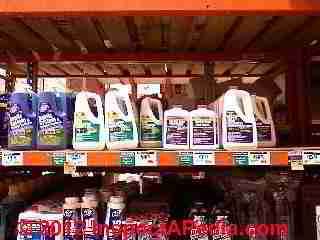
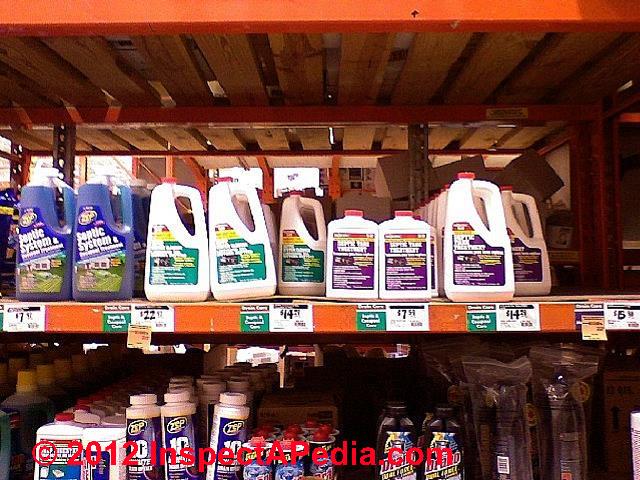
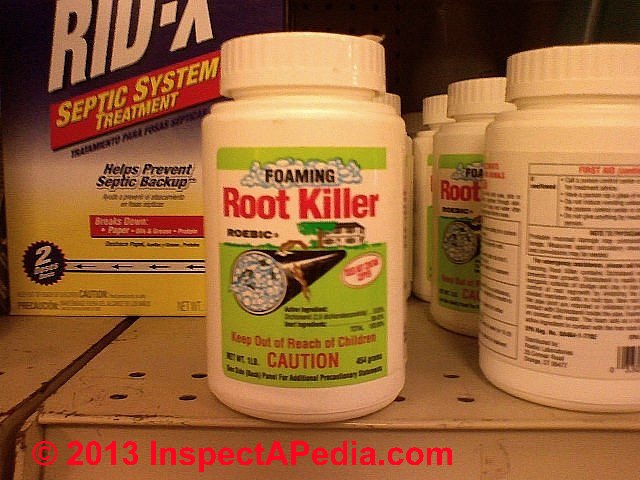
Types of septic system treatments and restorers, their use and effects are addressed here. Our page top photograph shows a collection of septic system additives, chemicals, cleaners, root killers, etc. for sale at a building supply store.
An exception: as we detail at the end of this article, some septic designs such as some aerobic and BAT systems may require occasional addition of beneficial bacteria to the septic tank.
InspectAPedia is an independent publisher of building, environmental, and forensic inspection, diagnosis, and repair information provided free to the public - we have no business nor financial connection with any manufacturer or service provider discussed at our website.
Article Series Contents
- SEPTIC TREATMENTS & CHEMICALS
- ARE ADDITIVES USEFUL?
- PUMPING the SEPTIC TANK is What PREVENTS FAILURES
- CANADA PROHIBITS ADDITIVES
- CHEMICALS to KEEP OUT OF SEPTICS - separate article
- ROOT KILLERS in SEWER LINES or SEPTIC PIPES - separate articlele
- SEPTIC ADDITIVE TYPES - separate article
- SEPTIC DRAINFIELD RESTORERS? - separate article
- OK TO FLUSH THESE
- SEPTIC TREATMENT FAQs - separate article
- NESC on ADDITIVES
- ONTARIO MINISTRY
- US EPA on ADDITIVES
- TOILETS, DON'T FLUSH LIST - separate article
Despite that compelling evidence people still buy and use septic treatments or restorers. So did I - previously. Why? Because repairing a failing or failed septic system drainfield or soakaway bed is expensive the temptation to try a magic bullet is nearly overwhelming. Those bullets, generally, are going to shoot us in the foot.
Are Septic Tank Additives or Treatments Useful or Not? - Septic System Additives and Chemicals - are they needed?
 Septic Additive Companies are Asked for Independent Supporting Research
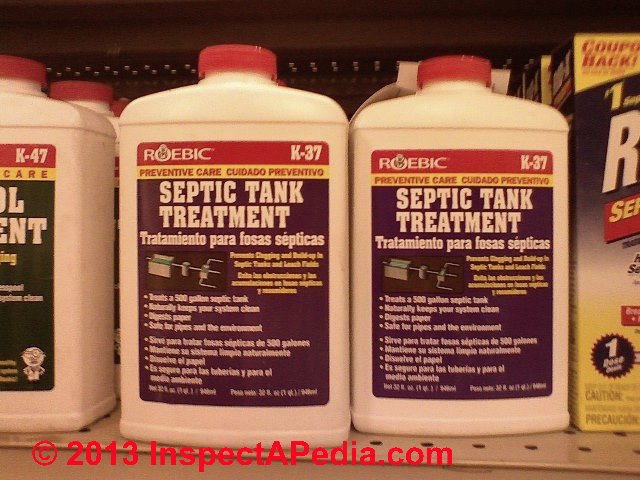
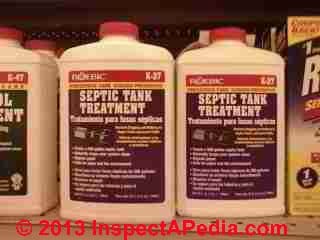
Many septic treatment producers and distributors contact us with suggested products.
We ask for independent, peer-reviewed, professional research supporting each suggested product. Such support is particularly needed for two reasons:
- Magic Septic System Cure Industry: The high cost of replacing a failed septic absorption field or seepage pit system naturally breeds an industry of "magic bullets" that are questionable (see the citations which follow) and sometimes actually harmful to the septic system and/or the environment.
- Illegal Septic System Treatments: Because of the lack of demonstrated effectiveness, and perhaps more important, because some septic additives or cleaners are dangerous or can cause serious ground water contamination they are illegal in many jurisdictions.
Septic tank additives or "rejuvenators" are not needed in your septic tank, whether the additives are chemically-based (organic or inorganic compounds that claim to break up sludge or scum or to unclog drainfields), or biologically-based septic additives (septic tank yeast cultures, septic tank bacteria, starter bacteria, or septic tank enzymes).
Watch out: While many septic and drainfield or soakaway bed treatments are relatively harmless combinations of bacteria and enzymes, some septic tank or septic drainfield additives such as yeast or harsh chemicals can actually damage the septic system and may also be environmental contaminants.
Even yeast, which one might think is harmless, can cause frothing and excessive activity in the septic tank, preventing normal settling of solids and coagulation of greases. This agitation forces solid waste into the drainfield and by clogging the soil, shortens its life. Other septic chemicals intended to kill tree roots or unclog clogged leachfield soils can contaminate the environment.
Exceptions to the generally-true "use no septic treatments" can arise however for some advanced-design septic systems such as some aerobic or biologically-accelerated treatment (BAT) septic system designs.
See SEPTIC TANK BACTERIA BOOST at the end of this article.
Can Some Conditions Kill Off Needed Septic Tank Bacteria? Do we need a septic tank "starter bacteria"?
If other conditions at a property have resulted in killing-off the (needed) septic tank bacteria (such as adding unusually large amounts of bleach, disinfectants, or antibiotics to a septic tank) some folks sell bacterial "starters" to "rejuvenate" the septic tank. This makes little sense for the following reasons:
- Calculations of "septic tank die-off" which demonstrate that about 2 gallons of bleach is likely to harm septic tank bacteria have been based on a "static septic system", a fixed septic tank volume into which no new wastewater, sewage, and their diluting and re inoculating effect have been considered.
You will see in the Ontario ministry statement 3(f)(ii)[below] that small amounts of bleach, drain cleaners, lye, etc. such as the quantities expected in normal household use will not harm a functioning septic system. - If you don't correct the conditions that have caused a bacterial die-off in the septic tank, no amount of starter or booster is going to make any difference.
For example, large quantities of antibiotics entering a septic system at a nursing home will continue to risk harm to the septic tank ecology. - Adding to a septic tank products such as enzymes which claim to break down grease risk destroying the floating scum layer in the septic tank, forcing unwanted
oils and debris into the leach field.
In the Ontario ministry statement 3(f)(iii) [below] you will note that enzyme treatments have not been found effective nor useful in septic systems. - As soon as you stop putting inappropriate bleach, disinfectant, or antibiotics into the septic system and after the first time someone uses a toilet, the septic tank has been re inoculated with what it needs.
However the release of chemicals from a septic system to the environment can be a serious problem in some locations, especially if larger volume industrial processes or larger facilities such as nursing homes are the chemical source, or if a well-meaning property owner pours large quantities of some treatments, chemicals, yeast, bleach, some root killers, or other "additives" into the septic system. - Forcing hydrogen peroxide or other chemicals into drainfield or leach field soils can damage the soil and contaminate the environment.
Septic Tank Pumping Prevents Septic System Failures
Authoritative Citations on Septic Tank Pumping, Failure Prevention, Additives
Pumping the septic tank regularly is the main thing that can and should be done to extend the life of your septic system.
See SEPTIC TANK PUMPING SCHEDULE for details on deciding how often the septic tank should be cleaned.
Details of a thorough septic tank pumpout, cleaning, and inspection are found beginning
at SEPTIC TANK PUMPING PROCEDURE.
In general, septic system chemicals are not needed and are not recommended: Chemicals and other additives promoted to keep a septic system "healthy" or "free-flowing" or "nourished" are generally not required nor recommended by expert sources.
The following references support this statement:
- Canada: The function of a septic tank is not improved by the addition of disinfectants or other chemicals. ... sodium hydroxide or potassium hydroxide ... may result in sludge
bulking and a large increase in alkalinity, and may interfere with digestion. The resulting effluent may severely damage the soil structure and cause
accelerated clogging...
See CANADA PROHIBITS ADDITIVES and see this statement by the ONTARIO MINISTRY - Penn State College of Agriculture - Cooperative Extension,Agricultural Fact Sheet #SW-161 "Septic Tank Pumping," by Paul D. Robillard and Kelli S. Martin - last line of second paragraph "Biological and chemical additives are not needed to aid or accelerate decomposition."
- Agricultural Fact Sheet #SW-161 "Preventing Septic System Failures," by Paul D. Robillard and Kelli S. Martin - page 2, Maintenance Failures, paragraph two, "Chemical or biological additives are not a substitute for pumping."
- "Soil Science Facts, Septic Tank Systems," Michael T. Hoover, Dept. of Soil Science, North Carolina State University, Raleigh, SS 86-4, "Are Septic-Tank
Cleaners Necessary?" "No.
These products include biologically based materials (bacteria, enzymes, and yeast), inorganic chemicals (acids and bases), or organic chemicals (including solvents).
They do not reduce the need for regular pumping of the septic tank.
Some of these products contain organic chemicals and may even damage the drainfield or contaminate the groundwater and nearby wells." - Florida ASHI Seminar, Kissimmee FL, 10/10/93, "Septic Tank News & Views," cites Florida building code 10D-6.050 Maintenance, paragraph (4) "Organic
chemical solvents shall not be advertised, sold, or used in the state for the purpose of degreasing or de clogging onsite sewage disposal systems.
(4)(a) All organic chemical solvents known to have been used as decloggers or degreasers of onsite sewage disposal systems or those which have a likelihood of being used in such a manner shall be labeled on the front of each product container with the following language:
'Florida Statute 381.0065 (13) prohibits the advertisement, sale or use of organic chemical solvents for the purpose of degreasing or de clogging onsite sewage systems in the state.' ... " and
(4)(b) continues, "Persons who use organic chemical solvents for degreasing or declogging onsite sewage disposal systems shall be subject to revocation of their septage disposal service permits and shall be subject to other applicable penalties as described in Chapter 381, or 489 Part III,F.S." These law changes were effective in Florida march 17, 1992. - Massachusetts, SEPTIC SYSTEM ADDITIVES ALLOWED FOR USE UNDER TITLE 5, MASS DEP [PDF] explains that some treatments at least do no harm to the septic; retrieved 2018/01/25, original source: http://www.mass.gov/eea/agencies/massdep/water/wastewater/septic-system-additives-allowed-for-use-under-title-5.html
- Montana, Ravalli County Department of Health: SEPTIC TANK ADDITIVES ARE UNNECESSARY AND MAY DO MORE HARM THAN GOOD [PDF] RCEH, c/o “EnviroHealth Talk,” 215 South 4th St, Suite D, Hamilton MT 59840. Phone: 375-6571. Email: rdaniel@ravallicounty.mt.gov retrieved 2018/01/25, original source: http://ravalli.us/DocumentCenter/Home/View/224
- National Environmental Services Center: While many products on the
market claim to help septic
systems work better, the truth is
there is no magic potion to cure
an ailing system. In fact, most
engineers and sanitation professionals
believe that commercial
septic system additives are, at
best, useless, and at worst,
harmful to a system.
See NESC on ADDITIVES - Lee, Brad, Don Jones, Run Turco, "SEPTIC SYSTEM ADDITIVES" [PDF] HENV-13-W, Purdue University, Purdue Extension, retrieved 2018/01/25, original source: https://www.extension.purdue.edu/extmedia/HENV/HENV-13-W.pdf
Excerpt:
According to the Environmental Protection Agency, there are no conclusive studies to date showing significant benefits from septic system additives.
Given the lack of common conclusions or recent unbiased testing about the effects of septic system additives, our best advice remains to have septic tanks pumped every 3 to 5 years.
Also, consider how the annual cost of additives could be better spent on improving your wastewater system. - Pradhan, S., M. T. Hoover, G. H. Clark, M. Gumpertz, A. G. Wollum, C. Cobb, and J. Strock. "Septic tank additive impacts on microbial populations." Journal of Environmental Health 70, no. 6 (2008): 22-27.
Abstract:
Environmental health specialists, other onsite wastewater professionals, scientists, and homeowners have questioned the effectiveness of septic tank additives.
This paper describes an independent, third-party, field scale, research study of the effects of three liquid bacterial septic tank additives and a control (no additive) on septic tank microbial populations. Microbial populations were measured quarterly in a field study for 12 months in 48 full-size, functioning septic tanks.
Bacterial populations in the 48 septic tanks were statistically analyzed with a mixed linear model. Additive effects were assessed for three septic tank maintenance levels (low, intermediate, and high).
Dunnett's t-test for tank bacteria (α = .05) indicated that none of the treatments were significantly different, overall, from the control at the statistical level tested. In addition, the additives had no significant effects on septic tank bacterial populations at any of the septic tank maintenance levels.
Additional controlled, field-based research is warranted, however, to address additional additives and experimental conditions. - "Septic Tank Maintenance," K. Mancl and J.A. Moore, Oregon State University Extension Service, Extension Circular 1343/January 1990. "Biological and chemical additives are not needed to aid or accelerate settling or decomposition."
- US EPA Statement on Septic Tank Additives: Because of the presence of significant numbers and types of bacteria, enzymes, yeasts, and other fungi and microorganisms in typical residential and commercial wastewaters, the use of septic system additives containing these or any other ingredients is not recommended.
The benefits of consumer products sold as septic system cleaners, degraders, decomposers, deodorizers, organic digesters, or enhancers are not significant or have not been demonstrated conclusively, depending on the product.
Some of these products can actually interfere with treatment processes, affect biological decomposition of wastes, contribute to system clogging, and contaminate ground water.
See US EPA on ADDITIVES - Washington State Department of Health provides this "LIST OF APPROVED ON-SITE SEWAGE SYSTEM ADDITIVES AS ESTABLISHED IN CHAPTER 246-273 WAC" (2017), [PDF]
Washington State Department of Health, 243 Israel Road SE, Tumwater, WA 98501 USA, Mailing address: PO Box 47824, Olympia, WA 98504-7824 USA Tel: 360.236.3330 FAX: 360.236.2257 Website: www.doh.wa.gov/wastewater
Email: wastewatermgmt@doh.wa.gov retrieved 2018/01/25, original source: https://www.doh.wa.gov/Portals/1/Documents/Pubs/337-025.pdf
Excerpt:
In 1993, the Washington State Legislature found that “most additives do not have a positive effect on the operation of on-site systems, and can contaminate groundwater aquifers, render septic drainfields dysfunctional, and result in costly repairs to homeowners.
It is therefore the intent of the legislature to ban the use, sale, and distribution of additives within the state unless an additive has been specifically approved by the Department of Health.”
In 1994, the legislature added, “Chemical additives do, and other types may, contribute to septic system failure and groundwater contamination.
In order to determine which ingredients of nonchemically based additive products have adverse effects on public health or the environment, it is necessary to submit such products to a review procedure.”
After considering these findings, they enacted the Revised Code of Washington State Chapter 70.118 (RCW 70.118). - Washington State University, DON’T LET YOUR DOLLARS GO DOWN THE DRAIN! SEPTIC TANK ADDITIVES [PDF] Washington State University
Extension Clark County
11104 NE 149th Street C 100
Brush Prairie WA 98606
360-397-6060 extension 7720
http://clark.wsu.edu/
Clark County Public Health 1601 East Fourth Plain Boulevard Vancouver, WA 98661 360-397-8428 http://www.clark.wa.gov/publichealth/Index.asp retrieved 2018/01/25, original source http://extension.wsu.edu/clark/wp-content/uploads/sites/36/2014/02/septic-additives.pdf
The view that chemical and other additives are not necessary, and in some jurisdictions are illegal, was held by information we collected from every U.S. state as well as Canadian sources.
CANADA PROHIBITS Septic Tank ADDITIVES - Canadian citations on Septic Tank Additives - prohibited
 Our Canadian sources have offered the most detailed explanation of these issues. (Thanks to Alan Carson, Carson Dunlop, Associates, Toronto, Ontario,
for providing this information.)
Our Canadian sources have offered the most detailed explanation of these issues. (Thanks to Alan Carson, Carson Dunlop, Associates, Toronto, Ontario,
for providing this information.)
See "Manual of Policy, Procedures, and Guidelines for Onsite Sewage Systems," Referring to Ontario Regulation 374/81 under part VII of the Environmental Protection Act, ISBN 0-7743-7303-2.
ONTARIO MINISTRY - Ontario, Canada, Ministry of the Environment, "9.4.1 Class 4 Sewage Systems, Construction, Operation, and Maintenance," May 1982.
- Paragraph 3(f)(i) Chemical [disinfectants & cleaners added to the septic tank]: "The function of a septic tank is not improved by the addition of disinfectants or other chemicals. In general, the additary
products which are claimed to "clean" septic tanks contain sodium hydroxide or potassium hydroxide as the active agent.
Such compounds may result in sludge bulking and a large increase in alkalinity, and may interfere with digestion. The resulting effluent may severely damage the soil structure and cause accelerated clogging, even though some temporary relief may be experienced immediately after application of the product." - 3(f)(ii) [Small amounts of bleach or caustics in the septic tank]: Frequently however, the harmful effects of ordinary household chemicals are overemphasized. Small amounts of chlorine bleaches, added ahead
of the tank, may be used for odor control and will have no adverse effects.
Small quantities of lye or caustics normally used in the home, added to plumbing fixtures, are not objectionable as far as operation of the tank is concerned. If the septic tanks are as large as required by regulation, dilution of lye or caustics in the tank will be enough to overcome any harmful effects that might otherwise occur. - 3(f)(iii) [Septic tank enzymes] Some 1200 products, many containing enzymes, have been placed on the market for use in septic tanks, and extravagant claims have been made for some
of them.
As far as is known, none [of the septic tank enzyme additives] has been proved advantageous in properly controlled tests. - 3(f)(iv) Soaps, detergents, bleaches, drain cleaners, or other material as normally used in the household will have no appreciable adverse effect on the
system. However, as both the soil and essential organisms might be susceptible to large doses of chemicals and other disinfectants, moderation should be the
rule.
Advice of responsible officials should be sought before chemicals arising from a hobby or home industry are discharged into the system. - 3(f)(v) [Porox or Hydrogen Peroxide septic drainfield treatments]: Adsorption trenches or filters can become clogged due to the plugging of the voids in the stone layer with soil particles, or due to the build-up at
the soil/sewage interface of a black, slimy deposit composed of organic wastes, bacteria, inorganic precipitates and other debris, occurring due to
the age of a system or to its overloading with solids.
A combination of these causes may also occur. Where a slimy deposit is causing or contributing to clogging, rejuvenation of the soil/sewage interface may be accomplished by removing any stagnant water from the system and injecting a strong solution of hydrogen peroxide.
This form of chemical restoration was developed and patented (1977) by the Wisconsin Alumni Research Foundation (WARF) and the process named POROX. Applications using hydrogen peroxide to restore leaching beds must be licensed by WARF.Because of the dangers of handling this strong oxidant, this treatment should be done by professionals. Confirmation that slimy deposits are clogging the field can be determined by measuring the liquid level in one or more absorption trenches and comparing it to the level of ground water in an augured hole located a few feet from the bed perimeter.
Inspection of the trenches by exposing portions at two or more dispersed points in the leaching bed will indicate whether the clogging is general in all distribution lines and if the voids in the stone are filled or partly filled with soil.
If the voids are filled POROX™ treatment would not have as lasting an effect. If judged suited to rejuvenation by POROX™, it is important that the septic tank be pumped and that all static liquid is removed from the absorption trenches prior to the treatment.
Biological and chemical additives are not needed to aid or accelerate decomposition in conventional residential septic systems. In some jurisdictions such septic tank products, cleaners, root killers, grease dissolvers, etc. are prohibited by building codes, as the municipality is concerned for chemical pollution of groundwater and aquifers.
Other products may actually harm the septic system. Some of my clients who added yeast to their septic tank regularly discovered that the yeast caused so much frothing in their septic tank that solids were forced into the leach field rather than settling to the tank bottom.
Opinions about what ought to be added to septic tanks to keep them "healthy" range from obscure possibility to ridiculous. At a class on this topic in Ontario an inspector insisted that a bacterial inoculation was needed in the septic tank whenever it was pumped. Nonsense.
There is plenty of bacteria left in the tank and entering it when it's used. Another inspector said he tossed a cat into the septic tank after cleaning.
Although it was difficult to take such a comment seriously, he insisted that he was not kidding. Popular delusions and the madness of crowds has infected the onsite waste disposal topic as badly as the Dutch tulip craze affected gardeners.
National Environmental Services Center (NESC) Statement on Septic Tank Treatments
Additives/System Cleaners
While many products on the
market claim to help septic
systems work better, the truth is
there is no magic potion to cure
an ailing system. In fact, most
engineers and sanitation professionals
believe that commercial
septic system additives are, at
best, useless, and at worst,
harmful to a system.
There are two types of septic system additives: biological (like bacteria, enzymes, and yeast) and chemical. The biological additives are harmless but some chemical additives can potentially harm the soil in the drainfield and contaminate the groundwater.
While there hasn’t been extensive study on the effectiveness of these products, the general consensus among septic system experts is that septic system additives are an unnecessary evil.
Be aware that the extended use of strong pharmaceuticals and personal care products may harm the working bacteria population in the tank. The total effects are unknown at this time. - NESC Pipeline - Fall 2004, Vol. 15 No. 4.
- National Environmental Services Center (NESC), "What Not to Flush - Additives / System Cleaners", NESC Pipeline - Fall 2004, Vol. 15 No. 4., retrieved Jan 2005 & 1 Sept 2015, original source: http://www.nesc.wvu.edu/pdf/ww/septic/pl_fall04.pdf
US EPA Statement on Septic Tank Additives
Onsite Wastewater Treatment Systems Special Issues Fact Sheet 1 EPA 625/R-00/008
Description of Septic Tank Additive Products
Because of the presence of significant numbers and types of bacteria, enzymes, yeasts, and other fungi and microorganisms in typical residential and commercial wastewaters, the use of septic system additives containing these or any other ingredients is not recommended.
The benefits of consumer products sold as septic system cleaners, degraders, decomposers, deodorizers, organic digesters, or enhancers are not significant or have not been demonstrated conclusively, depending on the product.
Some of these products can actually interfere with treatment processes, affect biological decomposition of wastes, contribute to system clogging, and contaminate ground water. The septic tank/soil absorption field system is the most commonly used onsite wastewater treatment system in the United States. It is relatively low in cost, has no moving parts, and requires little maintenance.
Septic tanks have a number of important functions, including:
- Remove oils, grease and settleable solids. The septic tank is designed to provide quiescent conditions over a sufficient time period to allow settleable solids to sink to the bottom of the tank and floatable solids, oils, and grease to rise to the surface.
The result is a middle layer of partially clarified effluent that exits the tank to the soil absorption field. - Store settleable and floatable material. Tanks are generously sized according to projected wastewater flow and composition to accumulate sludge and scum at the bottom and top of the tank, respectively.
Septic tanks require pumping at infrequent intervals (e.g., 1 to 7 years), depending on sludge and scum accumulation rates. - Digest/decompose organic matter. In an anaerobic environment, facultative and anaerobic bacteria can reduce retained organic molecules to soluble compounds and gases, including H2, CO2, NH3, H2S, and CH4. This digestion can significantly reduce sludge volume in warm climates.
Types of septic tank or septic system additives and effects on treatment processes
This topic has moved to SEPTIC ADDITIVE TYPES
There are three general types of commonly marketed septic system additives:
- Inorganic compounds, usually strong acids or alkalis, are promoted for their ability to open clogged drains. Product ingredients (e.g., sulfuric acid, lye) are similar to those used in popular commercial drain cleaners.
These products can adversely affect biological decomposition processes in the treatment system and cause structural damage to pipes, septic tanks, and other treatment system components.
Hydrogen peroxide, once promoted as an infiltration field re conditioner, has been found to actually degrade soil structure and compromise long-term viability of soil treatment potential. Its use to unclog failed infiltration fields is no longer recommended. - Organic solvents, often chlorinated hydrocarbons (e.g., methylene chloride, trichloroethylene) commonly used as degreasers and marketed for their ability to break down oils and grease. Organic solvents represent significant risks to ground water and wastewater treatment processes.
These products can destroy resident populations of decomposer and other helpful microorganisms in the treatment system.
Use of products containing organic solvents in onsite treatment systems is banned in many states. Introduction of organic solvents into onsite systems located in states that ban the use of these products may trigger liability issues if ground water becomes contaminated. - Biological additives, like bacteria and extra cellular enzymes mixed with surfactants or nutrient solutions, which mirror but do not appear to significantly enhance normal biological decomposition processes in the septic tank. Some biological additives have been found to degrade or dissipate septic tank scum and sludge.
- See YEAST in the SEPTIC TANK? - don't do it!
So What Should I Put into the Septic Tank?
- Normal human waste and wastewater
- Toilet Paper
Reader opinions on toilet paper and septic filters or lint traps
Do not put toilet paper or any other material except human waste in the toilet. Place garbage can in bathroom and place paper in the can. Dispose of paper with other household garbage. Will extend life between pumpings by years. Randy Green, 10/30/12
You can extend the life of your septic system by removing enough non-biodegradeable clothing fibers to carpet your living room each year by adding highly-technical lint traps that filter all the fibers from the washing machine discharge line.
It is these non-settleable, drain field plugging fibers that you find adorning the landscape with spider web like features whenever you run into someone who has recycled his gray water for lawn and garden watering. - Sweetfilter 11/1/11
Reply: What's the difference in effect between toilet paper and fabric fibers in the septic system?
 Randy, indeed in some countries it is common practice to keep a small, plastic lined waste container next to the toilet, into which used toilet paper and other wastes other than urine or excrement are deposited.
I expect that keeping paper out of the septic system gives some added relief in areas where the system is of very limited capacity and perhaps where the water volume is lower than common in North America too.
But in normal use with a conventional septic system such as designs commonly used in the North America that does not appear to be necessary and I have not found an authoritative source that recommends it.
If you or other readers come across such a reference be sure to let us know so that we can post it for others.
On the other hand, I agree completely with Sweetfilter that a septic filter that keeps cloth fibers and similar debris out of the septic system or even out of a drywell used to dispose of laundry wastewater and similar graywater is a great idea and will reduce soil clogging and extend the system life.
See FILTERS SEPTIC & GREYWATER for details.
What's the difference in effect between toilet paper and fabric fibers in the septic system?
Toilet tissue is claimed to break down into small enough biodegradable fragments that it does not add significantly to soil clogging in the drainfield.
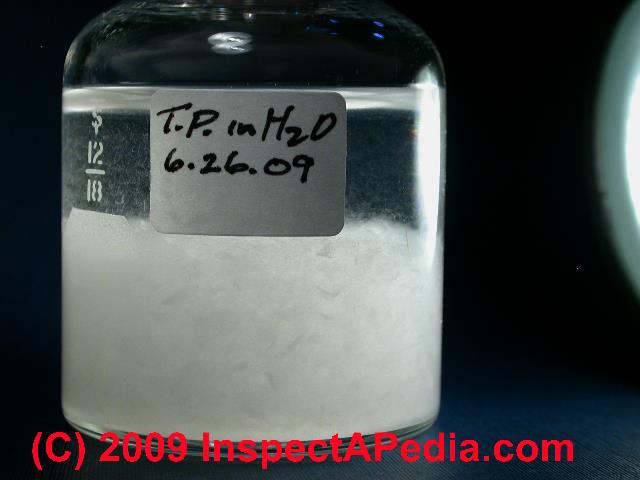
Illustrated in our photo (above), we are running an ongoing test of RV toilet tissue and other tissues to see how they dissolve or break down in plain water and ultimately in water that contains the appropriate septic tank bacteria.
Over a ten year test period in plain water the toilet tissue remains intact in the container above.
and TOILET TISSUE TEST.
Use of Recycled Paper - Based Toilet Paper, US EPA Recommendation, vs. Septic Tank Enzymes
See TOILET TISSUE CHOICES where we address the EPA recommendation for recycled-paper content in toilet tissue. The EPA also provides a search engine to find suppliers.
To Maximize the Life of Your Septic Tank and Drainfield You May
- See SEPTIC LIFE MAXIMIZING STEPS for a list of septic and drainfield life-extending tips that includes the importance of septic tank inspection and pumping, things to keep out of the septic tank, efficient use of water to minimize wastewater volume, what to plant over the drainfield, keeping other water away from the drainfield, keeping vehicles and livestock and trees off of the drainfield.
- Inspect the system for safe conditions, safe tank covers
- Pump the septic tank on schedule -
see SEPTIC TANK PUMPING SCHEDULE - Improve the septic system: adding a greywater system, separate drywell, adding a septic tank inlet or outlet filter (SEPTIC FILTERS), or adding an aerator to convert the conventional septic tank to an aerobic design will increase the level of effluent treatment and extend drainfield life.
See SEPTIC SYSTEM DESIGN ALTERNATIVES.
Watch out: adding a septic tank aerator with incomplete design can push solids into and destroy the drainfield. Aerobic septic tanks use multiple chambers to avoid this problem; a retrofit design would typically include an outlet tee filter or separate filtering chamber that, if omitted or not properly maintained is likely to lead to sewage backups or septic system failure.
We make no specific representation about the efficacy of any of the particular products shown in the page top photo, but expert sources quoted in this article should be read carefully by any property owner considering adding a chemical, enzyme, or other product claimed to treat their septic tank or drainfield.
Comments and suggestions for content and citations of unbiased expert authority are welcome. Citation of this article by reference to this website and brief quotation for the sole purpose of review are permitted. Use of this information at other websites, in books or pamphlets for sale is reserved to the author.
Technical review by industry experts has been performed and is ongoing - reviewers are listed at "References."
- Arcan Enterprises, [Website] Scotch Plains NJ,
septic field hydrogen peroxide treatment system.
Arcan reports that their system can be applied by homeowners. 888-35ARCAN 908-322-0468 in New Jersey. E-mail: arcan@worldnet.net
[Check with your local health department for advice and any local regulations before using this or any other septic system cleaner or additive.] - Biocycle Wastewater Treatment [Website ] a BioCycle Unit, Tertiary Polishing Filter and Monitoring System.- Ireland
- See SEPTIC DRAINFIELD RESTORERS?
- Product Submissions Are Invited - for septic maintenance and repair or alternative septic system products to be considered for listing, please include supporting research and product literature. There is no listing fee. We do ask for supporting literature including studies of septic system treatment product use and product effectiveness. Contact Us - please use email.
Need for Bacterial Boost in Some Septic Systems
Really?: OK so there are some exceptions to the "no septic tank additives or treatments are needed" rule.
While septic tank chemicals, treatments, additives are both unnecessary and often prohibited for conventional septic tank & soakbed or leachfield systems, there are exceptions: occasional treatments with a dry-pack (or wet pack) of beneficial bacteria may be recommended by the manufacturer / designer of BAT or biologically accelerated treatment septic systems and for some aerobic septic treatment systems that are left un-used for six months or longer.
That's because some septic designs continue to treat and remove bacteria during periods of dis-use. But in an ordinary septic system the tank and its wastewater are not normally sanitized.
In addition, flushing continuous or high levels of chemicals or drugs into any septic system can seriously damage the systems' biological process and equipment.
Paints, high-phosphate detergents, salty water softener discharge, heavy use of drain cleaners, concentrated detergents, antibiotics, and even high usage of antibacterial soaps can be a problem for more-delicate septic systems such as the BAT septic design cited above.
See BAT MEDIA SEPTIC PLANTS for an example of cases in which a septic design or manufacturer recommends the replenishment of septic tank bacteria formulated for use with aerobic or BAT (Biologically Accelerated Treatment) septic systems.
See TOILETS, DON'T FLUSH LIST for complete details about stuff to keep out of the septic system.
InspectAPedia is an independent publisher of building, environmental, and forensic inspection, diagnosis, and repair information provided free to the public - we have no business nor financial connection with any manufacturer or service provider discussed at our website.
Septic Tank Additives & Treatments Research
- Original citation for EPA article: http://www.epa.gov/nrmrl/pubs/625r00008/html/fs1.htm
- Andress, S.; Jordan, C. 1998. Onsite Sewage Systems. Virginia Polytechnic Institute and State University, Civil Engineering Department, Blacksburg, VA.
- Angoli, T. 2000. Hydrogen peroxide not recommended to unclog failed drainfields. Small Flows Quarterly Vol. 1 No. 2, p. 42-44. -
http://www.nesc.wvu.edu/nsfc/pdf/SFQ/SFQsp00.pdf
- Clark, G.H. 1999. The Effect of Bacterial Additives on Septic Tank Performance. Master's thesis, North Carolina State University, Department of Soil Science, Raleigh, NC.
- D'Amato, Victor A., P.E., Anita Bahe, Ph.D., Billie Comstock, Thomas Konsler, Sarah K. Liehr, P.E., Ph.D., Sharon C. Long, P.D., Krich Ratanaphruks, Chet A. Rock, P.E., Ph.D., Kevin Sherman, P.E., Ph.D., FACTORS AFFECTING the PERFORMANCE of PRIMARY TREATMENT in DECENTRALIZED WASTEWATER SYSTEMS, [PDF] (2008), retrieved 2018/03/24, original source: http://www.decentralizedwater.org/documents/04-DEC-7/04-DEC-7ResDigest.pdf
Water Environment Research Foundation 635 Slaters Lane, Suite 300 Alexandria, VA 22314-1177 Tel: (703) 684-2470 Website: www.werf.org werf@werf.org and IWA Publishingm Alliance House, 12 Caxton Street London SW1H 0QS, United Kingdom Tel: +44 (0) 20 7654 5500 Fax: +44 (0) 20 7654 5555 www.iwapublishing.com publications@iwap.co.uk
Abstract excerpt:
The objective of this project was to take a fresh look at the existing body of work addressing the performance of primary treatment units in decentralized wastewater systems, with a goal of establishing what is known, what is not known and what future research may be warranted.
Design, construction/installation, and operation, monitoring and maintenance issues were each considered, with a focus on those factors most likely to affect primary unit treatment objectives, including influent characteristics, sizing, hydraulic design, compartmentation, influent and effluent appurtenances and seasonal effects, among others.
Note excerpt:
The research on which this report is based was developed, in part, by the United States Environmental Protection Agency (EPA) through Cooperative Agreement No. X-830851-01 with the Water Environment Research Foundation (WERF).
However, the views expressed in this document are solely those of ARCADIS U.S., Inc. and neither EPA nor WERF endorses any products or commercial services mentioned in this publication. This report is a publication of WERF, not EPA. - Diak, James, Banu Örmeci, and Kevin J. Kennedy. "Effect of enzymes on anaerobic digestion of primary sludge and septic tank performance." Bioprocess and biosystems engineering35, no. 9 (2012): 1577-1589.
Abstract:
Enzyme additives are believed to improve septic tank performance by increasing the hydrolysis and digestion rates and maintaining a healthy microbial population.
Previous studies reported mixed results on the effectiveness of enzymes on mesophilic and thermophilic digestion, and it is not clear whether enzymes would be effective under septic tank conditions where there is no heating or mixing, quantities of enzymes added are small, and they can be washed out quickly.
In this study, batch reactors and continuous-flow reactors designed and operated as septic tanks were used to evaluate whether enzymatic treatment would increase the hydrolysis and digestion rates in primary sludge. Total solids, volatile solids, total suspended solids, total and soluble chemical oxygen demand, concentrations of protein, carbohydrate, ammonia and volatile acids in sludge and effluent samples were measured to determine the differences in digestion rates in the presence and absence of enzymes.
Overall, no significant improvement was observed in enzyme-treated reactors compared with the control reactors. - Dow, D., and G. Loomis. 1999. Septic Tank Additives. University of Rhode Island Cooperative Extension Service Onsite Wastewater Training Center, Kingston, RI.
- El-Zanfaly, H. T., A. Mostafa, M. Mostafa, and I. Fahim. "Effect of bacterial additives on the performance of septic tanks for wastewater treatment in the Upper Egypt rural area." The Sustainable World 142 (2011): 389.
[This paper claims to show improvement in removal of solids when enzymes were added to septic tanks in Egypt] - Hairston, J.E., G. Speakman, and L. Stribling. 1995. Protecting Water Quality: Understanding Your Septic System and Water Quality. Alabama Cooperative Extension Publication wq-125.al, June 1995. Developed with support from Auburn University, Auburn, AL
- US EPA ONSITE WASTEWATER TREATMENT SYSTEMS MANUAL [online copy, free in series of web articles] Top Reference: US E \PA's Design Manual for Onsite Wastewater Treatment and Disposal, 1980, available from the US EPA, the US GPO Superintendent of Documents (Pueblo CO), and from the National Small Flows Clearinghouse.
Original source http://www.epa.gov/ORD/NRMRL/Pubs/625R00008/625R00008.htm Onsite wastewater treatment and disposal systems, Richard J Otis, published by the US EPA.
Although it's more than 20 years old, this book remains a useful reference for septic system designers. U.S. Environmental Protection Agency, Office of Water Program Operations; Office of Research and Development, Municipal Environmental Research Laboratory; (1980) - US EPA ,Environmental Protection Agency. n.d. Septic Tank Additives. Onsite Wastewater Treatment Systems Special Issues Fact Sheet 1. EPA 625/R-00/008.
- "International Private Sewage Disposal Code," 1995, BOCA-708-799-2300, ICBO-310-699-0541, SBCCI 205-591-1853, available from those code associations.
- Kazunori, Hanyu, Hirohisa Kishino, Hidetoshi Yamashita and Chikio Hayashi. "Linkage between recycling and consumption: a case of toilet paper in Japan." Resources, Conservation and Recycling, Volume 30, Issue 3 (1 September, 2000): 177-199.
- Kitsap County Health District. 2002. The Truth About Septic Systems. Additives Brochure #7025. Environmental
Health Division. http://www.kitsapcountyhealth.com/environmenta_health/water_quality/docs/brochures_oss_
additives.pdf - "Manual of Policy, Procedures, and Guidelines for Onsite Sewage Systems," Ontario Reg. 374/81, Part VII of the Environmental Protection Act (Canada), ISBN 0-7743-7303-2, Ministry of the Environment,135 St. Clair Ave. West, Toronto Ontario M4V 1P5 Canada $24. CDN.
- Manual of Septic Tank Practice, US Public Health Service's 1959.
- Massachusetts list of septic additives considered not harmful -
http://www.mass.gov/eea/agencies/massdep/water/wastewater/septic-system-additives-allowed-for-use-under-title-5.html
Note: this list does NOT represent that these additives are necessary nor even helpful: - McKenzie, M. C. 1999. NC State Produces Landmark Research on Septic Tank Additives. Small Flows Newsletter.
Summer 1999. Vol. 13, No. 3. http://www.nesc.wvu.edu/nsfc/pdf/sf/SFs99.pdf - Moletta, R., A. Rambaud, S. Maunoir, and H. Philip. "Les additifs à effet biologique dans le traitement des eaux: application à la digestion anaérobie et à la fosse septique." Techniques Sciences Méthodes 10 (2007): 31-53.
Abstract:
Additives are widely used in the scope of wastewater treatment. They are used to improve settling, to regulate pH conditions, to balance the C/N/P ratio of influent, to supply influent with micro-elements, or to bring specific exogenous enzymes or bacteria. In the field of anaerobic digestion it is well known that micro-elements enhance the methanogenic potential. Wastewater treatment processes like fluidized bed operate with mineral additives as support for biomass.
For domestic wastewater treatment we find mainly, on one hand, biological additives (bacteria and enzymes). The efficiency of such products has not been yet demonstrated. On the other hand, we find products acting as support material for endogenous bacteria and enzymes. They act also in some cases as adsorbants for detoxication or desinhibition. Numerous papers show relationships between supports and bacteria and enzymes.
Particularly, one mineral additive has been the subject of scientific R&D programs for more than 30 years. This product (named Eparcyl™) acts on anaerobic digestion process and it is proposed for septic tank operation. It is manufactured on a specific natural clay base and contains no nutrients nor biodegradable substrates.
Effects of this additive have been studied on anaerobic bacteria cultivations through laboratory tests with control conditions. It has been demonstrate that endogenous bacteria are fixed on mineral particles. The rate of acetic acid conversion into methane is increased (x2) at a dose of 4g/L.
Same results have been shown with a cellulosic substrate : twice the rate for VFA and CH4 production. It has been shown also that endogenous hydrolytic enzymes of sludge are specifically attached on the product. Eparcyl ™ changes the retro-inhibition balance and enhances specific enzyme activity (cellulases, lipases …). Other antagonist enzyme activities, like proteases, are inhibited.
These observations explain results obtain on in-situ septic tanks : Eparcyl™ decreases sludge volume and mass by improving the biological elements of anaerobic digestion. For these reasons, it is a real biological activator. - Montana DOH, SEPTIC TANK ADDITIVES ARE UNNECESSARY AND MAY DO MORE HARM THAN GOOD [PDF]
- Loudon, T. 2005. Will Additives Help My Septic Tank? Michigan State University, Biosystems and Agricultural Engineering. Department Newsletter, March-April 2005. http://www.egr.msu.edu/age/aenewsletter/1_march_
april_05/loudon4_05.htm - National Environmental Services Center (NESC), "What Not to Flush - Additives / System Cleaners", NESC Pipeline - Fall 2004, Vol. 15 No. 4., retrieved Jan 2005 & 1 Sept 2015, original source: http://www.nesc.wvu.edu/pdf/ww/septic/pl_fall04.pdf
- National Small Flows Clearinghouse. 2002. Septic Tank Additives: Question and Answer. Small Flows Quarterly, Winter 2002. Volume 3, number 1. Pages 26-27. http://www.nesc.wvu.edu/nsfc/pdf/SFQ/SFQ_w02.pdf
- Olson, K., D. Gustafson; B. Liukkonen; and V. Cook. 1977. SEPTIC SYSTEM OWNERS GUIDE [PDF]. University of Minnesota Extension Services Publication PC-6583-GO. University of Minnesota, College of Agricultural, Food, and Environmental Sciences, St.Paul, MN.
- Patterson, R. A. HOUSEHOLD CHEMICAL IMPACT ON EFFLUENT REUSE [PDF] In Poster presentation to WaterTech Conference Convention Centre, Brisbane, pp. 27-28. 1998. Poster paper to be presented to WaterTECH Conference Convention Centre, Brisbane 27-28th April, 1998 Final copy - January, 1998
[PDF] retrieved 2018/03/24, original source: http://lanfaxlabs.com.au/papers/P33-re-use.PDF - Pennsylvania State Fact Sheets relating to domestic wastewater treatment systems include
- Pennsylvania State Wastewater Treatment Fact Sheet SW-161, Septic System Failure: Diagnosis and Treatment
- Pennsylvania State Wastewater Treatment Fact Sheet SW-162, The Soil Media and the Percolation Test
- Pennsylvania State Wastewater Treatment Fact Sheet SW-l64, Mound Systems for Wastewater Treatment
- Pennsylvania State Wastewater Treatment Fact Sheet SW-165, Septic Tank-Soil Absorption Systems
- Document Sources used for this web page include but are not limited to: Agricultural Fact Sheet #SW-161 "Septic Tank Pumping," by Paul D. Robillard and Kelli S. Martin. Penn State College of Agriculture - Cooperative Extension, edited and annotated by Dan Friedman (Thanks: to Bob Mackey for proofreading the original source material.)
- Pradhan, S., M. T. Hoover, G. H. Clark, M. Gumpertz, A. G. Wollum, C. Cobb, and J. Strock. "Septic tank additive impacts on microbial populations." Journal of environmental health 70, no. 6 (2008): 22-27.
North Carolina State University, Soil Science Dept., Raleigh, NC 27607-7619, United States
Abstract
Environmental health specialists, other onsite wastewater professionals, scientists, and homeowners have questioned the effectiveness of septic tank additives. This paper describes an independent, third-party, field scale, research study of the effects of three liquid bacterial septic tank additives and a control (no additive) on septic tank microbial populations. Microbial populations were measured quarterly in a field study for 12 months in 48 full-size, functioning septic tanks.
Bacterial populations in the 48 septic tanks were statistically analyzed with a mixed linear model. Additive effects were assessed for three septic tank maintenance levels (low, intermediate, and high). Dunnett's t-test for tank bacteria (α = .05) indicated that none of the treatments were significantly different, overall, from the control at the statistical level tested.
In addition, the additives had no significant effects on septic tank bacterial populations at any of the septic tank maintenance levels. Additional controlled, field-based research is warranted, however, to address additional additives and experimental conditions. - Pradhan, S., Michael T. Hoover, G. H. Clark, M. Gumpertz, C. Cobb, and J. Strock. "Impacts of biological additives, part 1: solids accumulation in septic tanks." Journal of Environmental Health 74, no. 5 (2011): 16.
Abstract:
The efficacy of three septic tank additives and a control was assessed using a randomized complete-block design in a double-blind study described in this article. Sludge depth, scum thickness, and total solids were measured within 48 full-scale, functioning septic tanks.
These tanks were distributed across three sites with low, intermediate, and high priormaintenance levels. No significant, positive long-term additive treatment effects occurred across all maintenance levels at the α = .05 level. Separate analyses of variance, however, indicated that at the high prior-maintenance site, significant treatment effects occurred on sludge depth, scum thickness, and total solids.
Sludge depths for the Liquid-Plumr and Rid-X additives were significantly reduced compared to the control at the high-maintenance site, but not at the low-maintenance site.
Liquid-Plumr septic tank additive had significantly greater sludge depth at the intermediate-maintenance site, which is a negative impact. Sludge accumulation rates averaged 6.9 cm/yr. for 3,780-L (1,000 gallons) septic tanks. - Pradhan, S., Michael T. Hoover, G. H. Clark, M. Gumpertz, C. Cobb, and J. Strock. "Impacts of biological additives, part 2: septic tank effluent quality and overall additive efficacy." Journal of Environmental Health 74, no. 5 (2011): 22.
Abstract:
The efficacy of 1,200+ septic tank additives on the market has always been a concern due to the previous lack of independent, replicated, third-party, field-scale research studies.
Twenty experimental units (well-maintained, full-size, functioning septic tanks) were pumped out 2–3 years before being assessed in the study presented here. These units were treated with one of three biological additives or a control in a double-blind study.
Effluent data analyzed using a mixed linear model showed that the overall treatment effect was significant for effluent five-day biochemical oxygen demand (BOD5 ) concentrations. One additive had significantly lower effluent BOD5 concentrations in septic tank effluent than the control and the other two additives had the same BOD5 as the control.
No statistically significant effluent total suspended solids concentration effect occurred for any additive.
These results were also considered in concert with two prior related studies regarding microbiological contents as well as sludge and scum accumulation rates across three prior-maintenance levels in 48 septic tanks. - Rupp, G. 1996. Questions and Answers About Septic System Additives. Montana State University Extension Service, Bozeman, MT.
- Virginia Polytechnic Institute and State University (Virginia Tech). 1996. Septic System Maintenance. VTU publication no. 440-400, October 1996. Water Quality Program Committee, Virginia Polytechnic Institute and State University, Blacksburg, VA.
- SEPTIC TANK/SOIL-ABSORPTION SYSTEMS: HOW TO OPERATE & MAINTAIN [PDF] Equipment Tips, U.S. Department of Agriculture, 8271 1302, 7100 Engineering, 2300 Recreation, September 1982, web search 08/28/2010, original source: http://www.fs.fed.us/t-d/pubs/pdfimage/82711302.pdf.
- Washington State list of septic additives considered not harmful http://www.septicsystem.com/additives/washington-list/
Note: this list does NOT represent that these additives are necessary nor even helpful.
Baking Soda in the Septic Tank?
This discussion has moved to BAKING SODA
Odor Control For Septic Systems
This topic is now at ODOR CONTROL for SEPTIC TANKS
Phosphorous Removal For Septic
Please see the new page for this topic at PHOSPHOROUS REMOVERS
Yeast Treatments for Septic Tanks
Yeast in septic systems and tanks is now discussed at YEAST in the SEPTIC TANK
Porosity Restorers for Septic Fields
This discussion is now at POROSITY RESTORERS
...
Reader Comments, Questions & Answers About The Article Above
Below you will find questions and answers previously posted on this page at its page bottom reader comment box.
Reader Q&A - also see RECOMMENDED ARTICLES & FAQs
On 2020-09-21 - by (mod) - There is no chemical you can use or add to decompose a toilet
Olawale
There is no chemical you can use or add to decompose a toilet, but I think you are asking about breaking down sewage or fecal waste or wastewater from toilets. There is no chemical that is simply added to such waste that completely breaks it down into safe sewage for disposal.
That's why people use a sewage treatment system, tank + effluent disposal or an aerobic septic or similar system that uses a combination of bacteria and adding air or oxygen to the sewage to speed the digestion before disposing of the clarified effluent wastewater into the soil for final processing.
What chemical toilet treatments or chemicals DO provide is odor control and sanitation and methane control. By controlling odor and the break-down of sewage the toilet additive reduces the potential for both unpleasant odors at the toilet and for potentially dangerous methane gas production.
Bottom line: such treatments do not decompose sewage - toilet waste.
On 2020-09-21 by Olawale
Which chemical can I use to decompose toilet
On 2020-08-17 by kwekuamah@gmail.com
Please good afternoon i want to know where can i get the product to buy i am in Ghana Accra in specific, i want to treat my septic tank myself at home.
On 2020-07-13 - by (mod) -
Tom
Thank you for asking about pouring bleach into septic system as a regular treatment. I can't imagine a more useless and potentially harmful thing to do. We want the bacteria in the system to be healthy and working to treat the sewage. Pouring bleach simply kills off bacteria. Don't do that.
On 2020-07-13 by Tom
I recently bought a house with a septic system from someone who told me that every June or July he would treat the septic field by pouring 2 gallons of bleach into a maintenance port over the field. This has been done for about 12 years now. The septic tank has been pumped out every 4 years or so and overall the system is apparently working fine, but I am leery of the bleach routine. Should I really add bleach to the drain field annually?
On 2020-05-21 - by (mod) -
Lester
Unfortunately, even though you can hire a plumber who can use a drain auger to clean out the roots, they'll return, and in my experience and opinion, adding a "root killer" does not give lasting relief to the clog problem.
Removing trees or shrubs near the lines can work.
On 2020-05-20 by Lester
I have roots in my field lines
On 2019-12-28 - by (mod) -
Theresa
Frankly in my view I would never put either of those products into the septic system. Read details in the article above.
On 2019-12-28 by Theresa
Can you put zep root killer and ridx in your septic tank together .
On 2019-11-17 - by (mod) -
Ed
You're right that enzymes have a number of useful applications above-ground in buildings, laundry, etc. And they can work as a component of drain cleaning as well;
To be clear, the article on this page isn't about any of those applications, it's about the question of whether or not septic additives are necessary to keep a conventional septic tank and drainfield working. There is no authoritative research that answers that question with a "yes". In a conventional septic tank the normal bacteria that enter the tank in sewage are what's needed.
Enzymes added to a septic tank or drainfield will do no harm - whether in the course of using them as a drain cleaner (which is fine) or in the course of using them as a "septic tank treatment" or "additive" (which is unnecessary).
Enzymes are not necessary to assure proper septic tank function nor to assure proper drainfield function.
Other simpler things are, however, critically-needed such as baffles at the septic tank inlet and outlet so as to prevent solids from floating out of the tank and clogging the drainfield, and periodic septic tank pumping on schedule.
Other septic tank additives and treatments actually do harm to the tank (killing needed bacteria) or cause drainfield clogging (such as adding yeast or other frothing activators to a conventional septic tank thence causing small solids to flow out of the tank and into the fields.) Some treatments may also leave the tank and act as chemical contaminants to nearby waterways or wells. All of those treatments are in fact "illegal" - their use is banned - in many jurisdictions.
Finally, this is something that needs to be clear for completeness: SOME advanced septic treatment systems such as some aerobic treatment units from specific manufacturers actually require additional chemicals or treatments necessary for the proper operation of those designs. Those are NOT conventional septic tank and drainfield installations. Another example: some onsite wastewater treatments require a final disinfection treatment stage before their effluent can be discharged into the environment (into soil for example).
THank you for the question. If you have further questions don't hesitate to ask as it helps me see where we need to add or clarify information;
And if you come across an independent study or report (that is not a study paid for and done for the manufacturer of such products) of a septic tank enzyme or other treatment and that demonstrates its need and utility that would be important to review: pass such along by posting here or by email to our page top or bottom CONTACT address.
Thank you so much for the nice note; we work hard to provide just the sort of information whose descriptors you provide, so I'm really grateful when a reader finds our site useful and trustworthy.
For other readers:
InspectAPedia.com provides building and environmental diagnostic and repair information. In order to absolutely assure our readers that we write and report without bias we do not sell any products nor services, nor do we have any business or financial relationships that could create such conflicts of interest.
InspectAPedia is an independent publisher of building, environmental, and forensic inspection, diagnosis, and repair information for the public - we have no business nor financial connection with any manufacturer or service provider discussed at our website.
We very much welcome critique, questions, or content suggestions for our web articles. Website content contributors, even if it's just a small correction, are cited, quoted, and linked-to from the appropriate additional web pages and articles - which benefits us both. Working together and exchanging information makes us better informed than any individual can be working alone.
On 2019-11-17 by Ed
Hi and thanks ... you are my first go-to site when I want technically effective and reliable info on my house operating issues.
I am not sure about the dismissal of septic system additives using enzymes. Our well water contains naturally occurring iron and manganese that cause a gelatinous film in our drain risers below sinks, showers and clothes washer. Over time the build-up seems to attract or interact with wash water/organics, gets thick and grey-brown in color and begins to smell like a dirty drain (not a sewer smell, but dirty drain smell).
No amount of boiling water or cleansers (including chlorine) would remove the gelatin-like film or address the odor for more than a few hours. It required me physically removing risers and cleaning them by hand. I got tired of that and some drains are not accessible due to glued fittings.
I tried Bio-clean and BIo-asap enzymes which have worked remarkably well. Five or six initial treatments (done at night over a week) cleaned the walls of the PVC drain risers like they are new. There is no film or gelatinous material left in the pipes from drain mouth to the trap. I disassembled a couple and the traps are also clean and white.
Most importantly, the smell is gone. There were a couple of days at first use that a new drain smell of decaying organics appeared in the kitchen sink (only) but that has disappeared. Presumably, that was solids left in the trap or trap arm from washing dishes I use the enzyme now preventatively about one treatment every few weeks. I have no idea how this may or may not affect my septic tank though?
...
Continue reading at SEPTIC DRAINFIELD RESTORERS? or select a topic from the closely-related articles below, or see the complete ARTICLE INDEX.
Or see SEPTIC TREATMENT FAQs - questions and answers posted originally on this page.
Or see these
Recommended Articles
- AEROBIC SEPTIC DISINFECTANTS - Calcium Hypochlorite
- SEPTIC LIFE MAXIMIZING STEPS
- SEPTIC POD SYSTEMS
- SEPTIC TREATMENTS & CHEMICALS
- CHEMICALS to KEEP OUT OF SEPTICS
- SEPTIC DRAINFIELD RESTORERS?
- ROOT KILLERS in SEWER LINES or SEPTIC PIPES
- SEPTIC ADDITIVE TYPES
- SEPTIC DRAINFIELD RESTORERS?
- TOILETS, DON'T FLUSH LIST
Suggested citation for this web page
SEPTIC TREATMENTS & CHEMICALS at InspectApedia.com - online encyclopedia of building & environmental inspection, testing, diagnosis, repair, & problem prevention advice.
Or see this
INDEX to RELATED ARTICLES: ARTICLE INDEX to SEPTIC SYSTEMS
Or use the SEARCH BOX found below to Ask a Question or Search InspectApedia
Ask a Question or Search InspectApedia
Try the search box just below, or if you prefer, post a question or comment in the Comments box below and we will respond promptly.
Search the InspectApedia website
Note: appearance of your Comment below may be delayed: if your comment contains an image, photograph, web link, or text that looks to the software as if it might be a web link, your posting will appear after it has been approved by a moderator. Apologies for the delay.
Only one image can be added per comment but you can post as many comments, and therefore images, as you like.
You will not receive a notification when a response to your question has been posted.
Please bookmark this page to make it easy for you to check back for our response.
IF above you see "Comment Form is loading comments..." then COMMENT BOX - countable.ca / bawkbox.com IS NOT WORKING.
In any case you are welcome to send an email directly to us at InspectApedia.com at editor@inspectApedia.com
We'll reply to you directly. Please help us help you by noting, in your email, the URL of the InspectApedia page where you wanted to comment.
Citations & References
In addition to any citations in the article above, a full list is available on request.
- Recycled Content in toilet paper (US EPA definition): When reporting recycled content, some toilet paper (and other product) manufacturers report total recycled content (combining pre- and post-consumer waste re-use) while others report post-consumer only. Both pre-consumer and post-consumer recycled materials provide the environmental benefits of displacing virgin feedstocks such as toilet paper using a high percentage of paper made from trees. Using post-consumer content has the added benefit of providing markets for materials separated for recycling by consumers, such as newspapers and magazines.
- Postconsumer Materials (US EPA definition): A material or finished product that has served its intended use and has been diverted or recovered from waste destined for disposal, having completed its life as a consumer item. Postconsumer materials are part of the broader category of recovered materials.
- Recovered materials: Waste materials and byproducts that have been recovered or diverted from solid waste, but does not include materials and byproducts generated from, and commonly reused within, an original manufacturing process.
- Thanks to reader Ernie Zinter for requesting clarification on the value of adding yeast to a septic tank. 02/17/2010. Don't do it - yeast in the septic is a suburban legend or an old wives tale that is not helpful and may be harmful to the septic system.
- Onsite Wastewater Disposal, R. J. Perkins; Quoting from Amazon: This practical book, co-published with the National Environmental Health Association, describes the step-by-step procedures needed to avoid common pitfalls in septic system technology. Valuable in matching the septic system to the site-specific conditions, this useful book will help you install a reliable system in both suitable and difficult environments. Septic tank installers, planners, state and local regulators, civil and sanitary engineers, consulting engineers, architects, homeowners, academics, and land developers will find this publication valuable.
- Onsite Wastewater Treatment Systems, Bennette D. Burks, Mary Margaret Minnis, Hogarth House 1994 - one of the best septic system books around, suffering a bit from small fonts and a weak index. While it contains some material more technical than needed by homeowners, Burks/Minnis book on onsite wastewater treatment systems a very useful reference for both property owners and septic system designers.
- Septic Tank/Soil-Absorption Systems: How to Operate & Maintain [ copy on file as /septic/Septic_Operation_USDA.pdf ] - , Equipment Tips, U.S. Department of Agriculture, 8271 1302, 7100 Engineering, 2300 Recreation, September 1982, web search 08/28/2010, original source: http://www.fs.fed.us/t-d/pubs/pdfimage/82711302.pdf
- Percolation Testing Manual, CNMI Division of Environmental Quality, PO Box 501304, Saipan, MP 96950
- Planting Over Septic System Component", Daniel Friedman (author/editor, InspectAPedia.com), The Innovator, Winter/Spring 2008, BCOSSA, British Columbia OnSite Sewage Association, 201-3542 Blansard St., Victoria BC V8X 1W3 Canada
- Save the Septic System - Do Not Flush These Items Down the Toilet, Daniel Friedman, InspectAPedia.com - PDF document, printable
- In addition to citations & references found in this article, see the research citations given at the end of the related articles found at our suggested
CONTINUE READING or RECOMMENDED ARTICLES.
- Carson, Dunlop & Associates Ltd., 120 Carlton Street Suite 407, Toronto ON M5A 4K2. Tel: (416) 964-9415 1-800-268-7070 Email: info@carsondunlop.com. Alan Carson is a past president of ASHI, the American Society of Home Inspectors.
Thanks to Alan Carson and Bob Dunlop, for permission for InspectAPedia to use text excerpts from The HOME REFERENCE BOOK - the Encyclopedia of Homes and to use illustrations from The ILLUSTRATED HOME .
Carson Dunlop Associates provides extensive home inspection education and report writing material. In gratitude we provide links to tsome Carson Dunlop Associates products and services.
 | HOME | ABOUT | ASK a QUESTION | CONTACT | CONTENT USE POLICY | DESCRIPTION | POLICIES | PRIVACY | |
| © 2025 - 1985 Publisher InspectApedia.com - Daniel Friedman | |||||||||