
InspectAPedia® FREE Encyclopedia of Building & Environmental Construction, Diagnosis, Maintenance & Repair |
Question? Just ask us! InspectAPedia
|
 Buyer's Guide to Incinerating Toilets
Components of Alternative Septic Systems for Difficult Sites
- POST a QUESTION or COMMENT about incinerating toilets
Incinerating toilets:
What are the brands, types, features & usefulness of incinerating toilets: electric or propane gas operated?
This article series describes the brands, properties, installation, and maintenance of incinerating toilets - a waterless system for onsite waste disposal where a septic system cannot be installed.
Incinerating toilets use electricity or gas to produce heat which literally incinerates the waste. Here we list suppliers of incinerating toilets and compare models, features, and prices.
We add advice on choosing among incinerating toilets and on how to use incinerating toilets. The photo above shows an Eco John Sr - "A highly efficient, waterless toilet that incinerates the waste with propane."
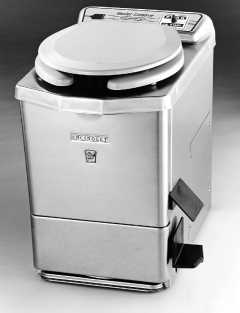
Page top photo: an Incinolet incinerating toilet, from that company's product literature. The author has installed, used, repaired, and researched incinerating toilets for nearly four decades.
InspectAPedia tolerates no conflicts of interest. We have no relationship with advertisers, products, or services discussed at this website.
- Daniel Friedman, Publisher/Editor/Author - See WHO ARE WE?
Guide to Incinerating Toilets: where to buy, how to install, how to use, how to maintain incinerating toilets

Article Series Contents
- INCINERATOR TOILET SYSTEMS
- DEFINTION of INCINERATING TOILET- waterless toilets using electricity or gas to reduce waste to ash
- HOW TO USE an INCINERATING TOILET
- INCINERATOR TOILET CODES
- INCINERATOR TOILET SOURCES & BRANDS
- CINDERELLA INCINERATING TOILET - expensive, but in our opinion far outperforms the competition
- ECO-JOHN INCINERATING TOILET
- EcoJohn OPERATING TROUBLES
- INCINERATING TOILET RESEARCH STUDIES
- INCINOLET TOILET
- Incinolet Toilet OPERATING TROUBLES
- JIFFY JOHN INCINERATING TOILET
- DESTROILET INCINERATING TOILETS
- STORBURN SCANLET INCINERATING TOILETS
- SUN BIO INCINERATING TOILET
- OTHER INCINERATING TOILET COMPLAINTS
Photo above: EcoJohn Model SR incinerating toilet, discussed in detail below on this page.
What are Incinerating Toilets? Waterless Toilets?
Incinerator Toilet Septic Systems: incinerator toilets use electricity or gas to burn the waste placed into these systems.
Like chemical toilets and holding tanks they have limited capacity, are used where water is not available or must be conserved, and they do not address the handling of remaining graywater from sinks and showers.
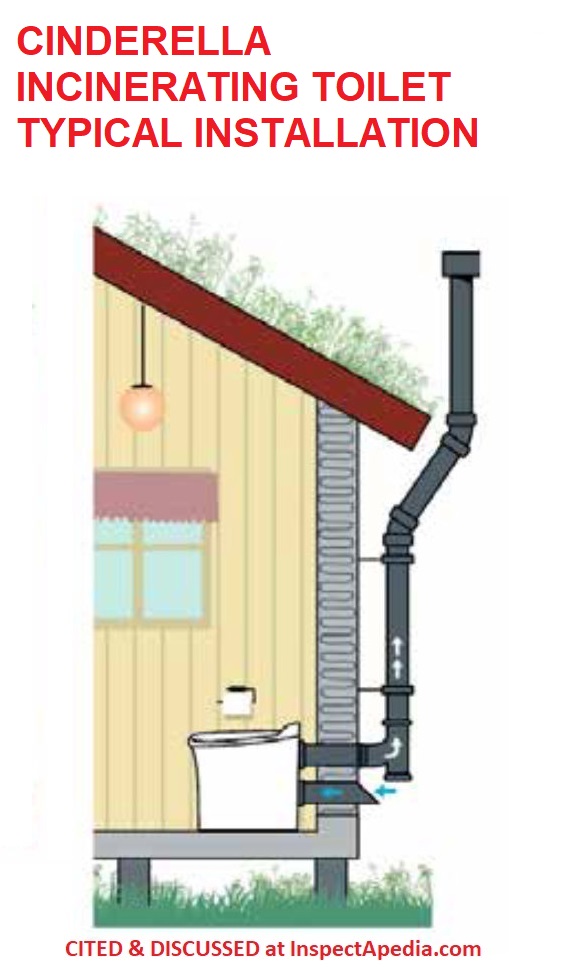 Incinerating toilet models include waterless-versions of incinerating toilets which produce a small amount of ash, and low-water toilet systems that are combined with an incinerator that can reduce gray water as well as sewage.
[Click to enlarge any image]
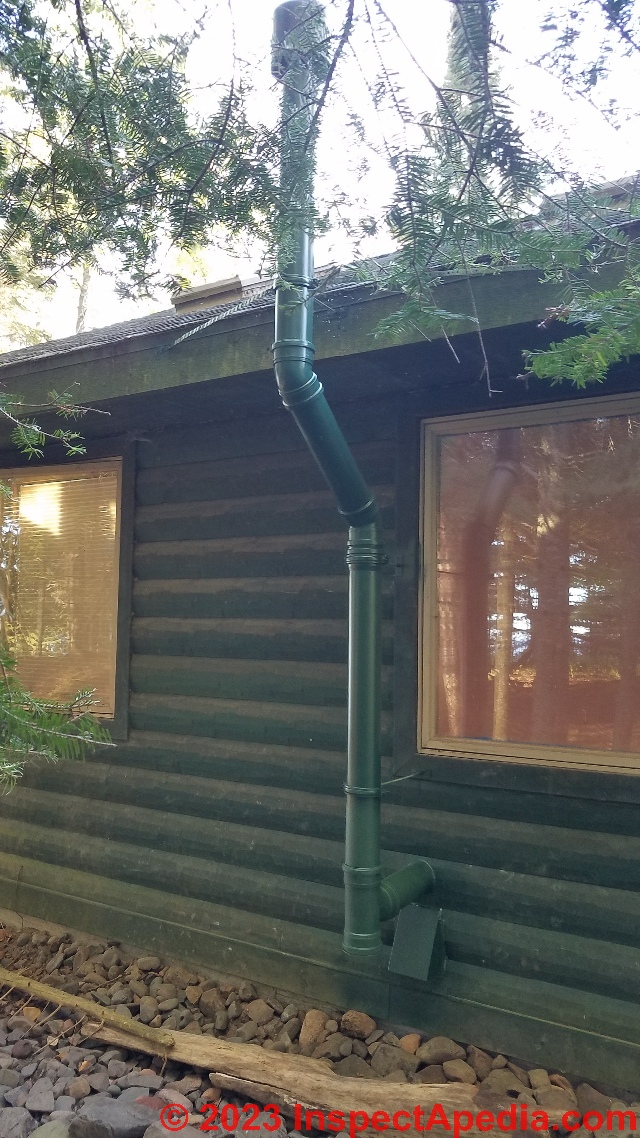
Typically no plumbing, no water, no digging, no drains, are required, though an energy source is necessary, such as electricity, natural gas, or LP gas. A vent is also required for incinerating toilets, either out through a side wall or up through the building roof.
Incinerating toilets can be used in un-heated buildings, though if LP gas is used as the energy source, it should be protected from very cold conditions.
My favorite incinerating toilet name (not my favorite working incinerating toilet) among toilets of this type was the "Destroylet" incinerating toilet which was electric/propane fueled and which is no longer on the market in its original form.
Each flush resulted in a more than 10-minute burn cycle which produced a pretty smelly exhaust.
I'd consider installing an incinerating toilet but I'd be sure to review all of its specifications first, including energy use, overall size and installation costs, storage capacity, incinerating frequency, and the length of the incinerating cycle.
I expect that properly installed, odors, noise, and explosions are not an issue. Some models require that the incinerating cycle be run after each use. As this can take some time the toilet may be unavailable during that interval.
I'm not sure this is the whole story but some sources (NSF) argue that because the process consumes all of the nutrients in the waste, the ash cannot be used for fertilizer.
As long as the ash can be disposed of conveniently in a suitable location, it is sanitary and may not be an issue. Some manufacturers (Incinolet) recommend disposing of the ash in the household garbage.
According to the US EPA "Anti-foam agents, catalysts or other additives are typically required for use" though at least for some products such as the Incinolet the manufacturer notes that no additives are needed.
3 Easy Steps to Use an Incinerating Toilet
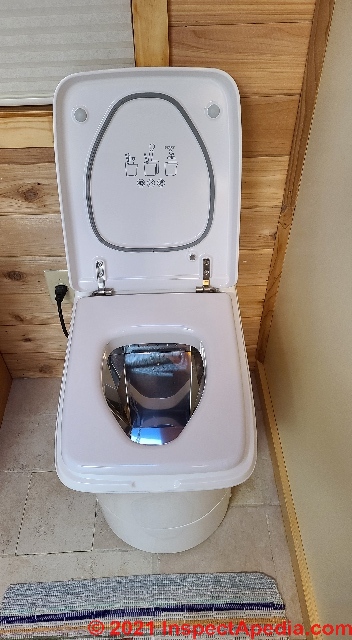
Here are photos of the typical and simple steps to use an incinerating toilet, using an installation that we completed for the Cinderella Comfort incinerating toilet as an example.
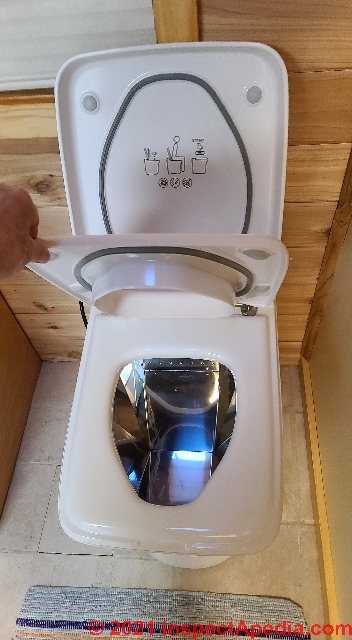
I'm showing lifting the toilet lid and toilet seat in two separate steps but of course you can usually lift them both at once in order to install the paper liner.
1. Install the paper toilet liner or "bag":
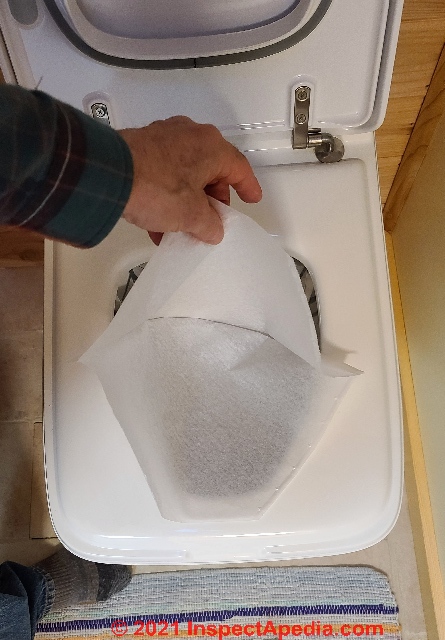
Open the toilet lid (first photo) and also lift the seat (second photo above) and install the manufacturer-provided paper liner.
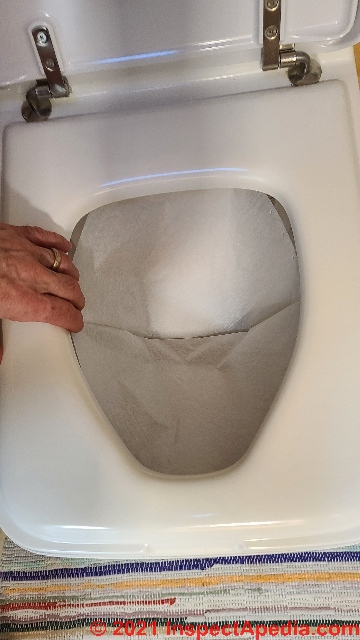
Neater counts as you'll reduce the chances of a collapsed bowl liner or a leak that would require a bit of extra cleaning.
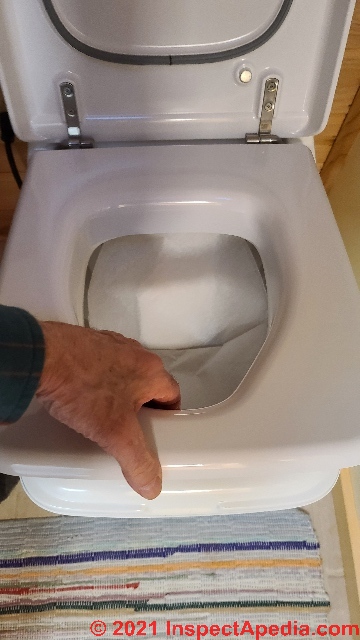
You'll see that the incinerating toilet liner is shaped to fit the bowl.
Fold down the toilet seat so as to hold the paper line in place. [Photo above]
Watch out: always use a paper liner. Otherwise you may damage the toilet and at the very least, you will create a nasty mess to clean off of the toilet bowl surfaces.
The paper toilet bowl liner for your toilet may be provided by the manufacturer and is likely to be specific to that toilet brand or even model.
But all incinerating toilet paper bowl liners are going to be fitted to the proper shape for the bowl of the toilet they serve, and the paper is formulated, often by a thin biodegradable wax coating, to be waterproof to avoid staining the toilet bowl.
2. Use the toilet as you would any normal toilet, with this exception:
Watch out: all uses of the toilet by everyone should be made sitting down, regardless of gender, preference, or machismo. Standing up to pee is going to make a mess that ought not need further explanation. Use of the toilet by small children should be supervised by an adult.
Only waste urine, feces, and toilet tissue should be emptied into an incinerating toilet, though some brands and models can also process tampons.
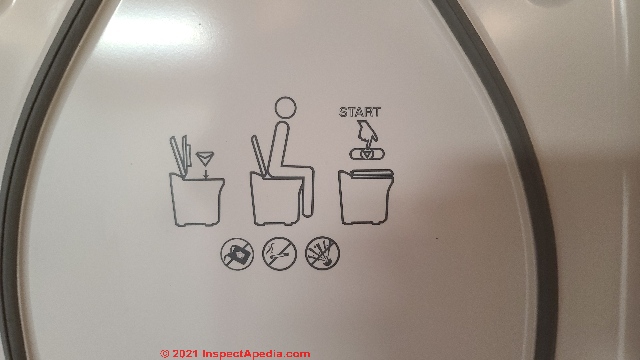
Above: The manufacturer shows how to use this toilet with a simple illustration imprinted inside the toilet lid.
Watch out: do not use your incinerating toilet to try to burn any other sort of trash; you are likely to damage or even destroy it or in the worst cases, cause a building fire.
3. Close the Lid & Flush the toilet using its flush control. For the incinerating toilet in these photos that means simply pushing the flush button.
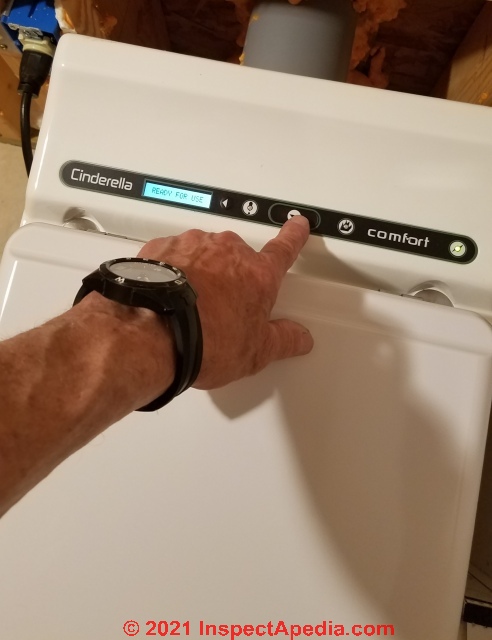
Watch out: the exact usage procedures for your toilet may vary by brand and model. Read the instructions for your particular incinerating toilet to be sure you're using it properly so as to avoid damaging the equipment.
Watch out: regular cleaning and maintenance are needed to keep your incinerating toilet working properly.
Be sure to follow the specific instructions from the manufacturer of your incinerating toilet model and brand. An example of this cleaning procedure is given at
CINDERELLA COMFORT TOILET CLEANING PROCEDURE
What if the Incinerating Toilet Paper Liner Doesn't "Go Down" when the Incinerating Toilet is Flushed?
Occasionally if the toilet use produces only a small amount of waste the product may be too light to cause the paper liner and waste to drop down into the incinerating chamber when the toilet flush mechanism is activated.
You'll know if this problem has occurred when you open the toilet lid and see the old toilet paper bag/liner still in place after the flush mechanism has been activated.
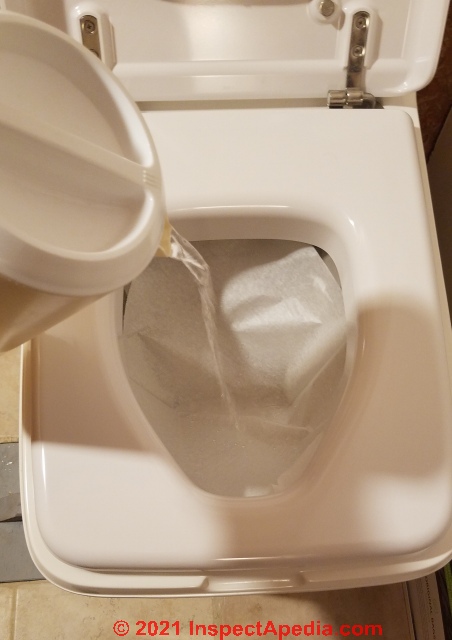
The solution is trivially easy: just pour a bit of clean water into the paper bowl liner, as shown in our photo. About 6-8 ounces (one cup or about 240 cc's) is plenty.
Then activate the flush mechanism again and tell the waste and paper liner goodbye.
Incinerator Toilets [Gas, Electric Toilets] Regulations and Sanitary Codes
These units accept human waste into a chamber where the wastes are burned. They have a very limited capacity and require a source of electricity or gas. The ash remains must be periodically removed. They must be installed according to the manufacturer's instructions. - New York State Plumbing Code Appendix 75-A.
The previous quote is from: New York State Appendix 75-A.10 Other systems.
In sum, other than stating that the product must be installed according to the manufacturer's recommendations, many codes and jurisdictions are silent on this topic.
On 2021-01-20 by (mod) - are Incinerating Toilets approved in the Ontario Building Code?
Doug:
You ask an important question about where incinerating toilets are code-approved. I've found that the final legal authority - the LOCAL building code compliance inspector - is the key person to ask, as local codes vary.
You may want to review section 6 of the Ontario Building Code - OBC - I didn't find "incinerating toilets" but I did find "macerating toilets" and this text
7.4.3.5. Macerating Toilet System
(1) A maceration toilet system shall only be installed,
(a) where no connection to a gravity sanitary drainage system is available, and
(b) in accordance with the manufacturer’s instructions.
and
7.5.7.7. vents for sanitary Sewage Sumps or Tanks, Dilution Tanks and Macerating Toilet Systems
(1) Except as provided in Sentences (2) and (3), the minimum size of the vent pipe for a sanitary sewage sump or tank, or dilution tank shall be one size smaller than the size of the largest branch or fixture drain draining to the sump or tank.
(2) The size of every vent pipe for a sanitary sewage sump or tank, or dilution tank shall be not less than 2 in., but need not be greater than 4 in.
(3) The size of every vent pipe for a macerating toilet system with a sump or tank shall be not less than 1 ½ in.
7.5.8. Sizing of vent pipes
TIP: you might contact the Canadian importer/distributor for
the CINDERELLA INCINERATING TOILET
[we provide contact information at that link]
as I've found those folks very helpful and informed about Canadian code vis-a-vis their product.
By the way, I'm a fan of that toilet as I've found its construction, quality, operation, reliability, noise and odor levels excellent in over a year of testing in a cold climate. That toilet is sold in both electric and propane models.
Note: In order to absolutely assure our readers that we write and report without bias we do not sell any products nor do we have any business or financial relationships that could create such conflicts of interest.
U.S. Code Approvals of Incinerating Toilet Installations
The code-approval of installation of waterless toilets, including incinerating toilets in the U.S. varies by jurisdiction. For example:
If installed in accordance with appropriate codes (gasfitting, plumbing, electric, building), both gasfired and electric toilets are permitted in Massachusetts. It is not clear, however, if their use fulfills the requirement of a water closet under the plumbing code.
Many of you may remember that the issue of a water closet requirement prevented the use of composting toilets for years. - source: BCDHE INCINERATING TOILETS [PDF] (2016) Barnstable County Department of Health and Environment, www.barnstablecountyhealth.org
On 2021-01-19 by Doug Hynes - will the OBC allow occupancy with ONLY incinerator toilets
Hello: I looked on the internet but did not find a clear answer-will the OBC allow occupancy with ONLY incinerator toilets IE small bunkies where there is no running water inside for sinks but an Incinerator toilet installed.
Sources for Incinerating Toilets and Model Comparisons
Cinderella Incinerating Toilets
- Cinderella Incinerating Toilets, is a Norwegian incinerating toilet design & product. For North American users, an Ontario, Canada company, provides several models of both electric and propane-powered incinerating toilets.
Cinderella incineration toilets are available in Australia, Austria, Belgium, Canada, Finland, Germany, Netherlands, Norway, Spain, Sweden, Switzerland, the U.K., and (through Canada) also in the U.S.
Company Contact: Cinderella Eco Group, Cinderella Head Office Norway: Cinderella Eco Group AS, Lyngjavegen 2, 475 Midsund, Norway, Tel: +47 77 71 15 00
Cinderella incinerator toilet factory: Hovedveien 34, 9061 Furuflaten Email: salg@cinderellaeco.no marketing@cinderellaeco.com or service: service@cinderellaeco.no Website: https://www.cinderellaeco.com
Cinderella incinerator toilet Canada Office. Cinderella Eco Group, Canada, 2 Robert Speck Parkway Suite 750, Mississauga ON L4Z 1H8 Canada
Tel: +1 (905) 281-8566 Fax:+1 (905) 306-7542 Email: support.canada@cinderellaeco.com Tel: 905.281.8566
Joey McNeil, Mobile: 647.408.3827 Email. joey.mcneil@cinderellaeco.com Web. https://www.cinderellaeco.com/ca-en
Canadian Exporter to the U.S. Contact: ITI, Incinerating Toilets, Inc., Canada, exporter of Cinderella models, 1572 Little Hawk Lk. Rd. Algonquin Highlands, ON, Canada Tel: 888-646-2664, Website: www.incineratingtoilets.ca - CINDERELLA INCINERATING TOILET INSTALLATION - step by step detailed guide with extra tips for a successful toilet installation
- CINDERELLA INCINERATING TOILET USE GUIDE - photo-illustrated simplified Cinderella toilet user's guide, online
- CINDERELLA COMFORT TOILET CLEANING PROCEDURE
- CINDERELLA INCINERATING TOILET USE GUIDE - photo-illustrated instructions for using the Cinderella toilet
- CINDERELLA INCINERATING TOILET CLEANING GUIDE - photo-illustrated simplified Cinderella toilet cleaning procedures
- CINDERELLA ELECTRIC INCINERATOR TOILET CLASSIC MODEL IO MANUAL [PDF] Op. Cit.
- CINDERELLA ELECTRIC INCINERATING TOILET COMFORT MODEL IO MANUAL [PDF] Op. Cit.
- CINDERELLA PROPANE INCINERATING TOILET IO MANUAL [PDF] Op. Cit.
- GAS APPLIANCE OPERATION at HIGH ALTITUDE - installing a propane fueled Cinderella toilet at high altitude will require some adjustments: manufacturer sanctioned? Maybe not. Here are other examples of what's needed.
Excerpting from theexplorere.no (Norway),
The Cinderella Incineration Toilet incinerates human waste without using water or chemicals. It can be powered by either propane gas or electricity and does not require connection to a sewer or other infrastructure. It is quick and easy to install.
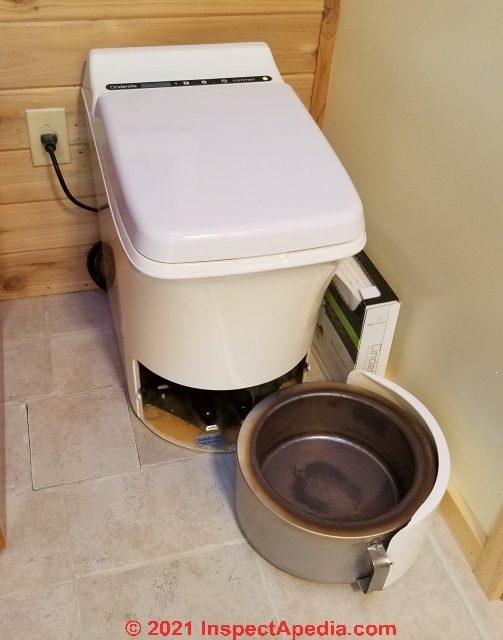
Below: a Cinderella incinerating toilet installed by the author, D. Friedman.
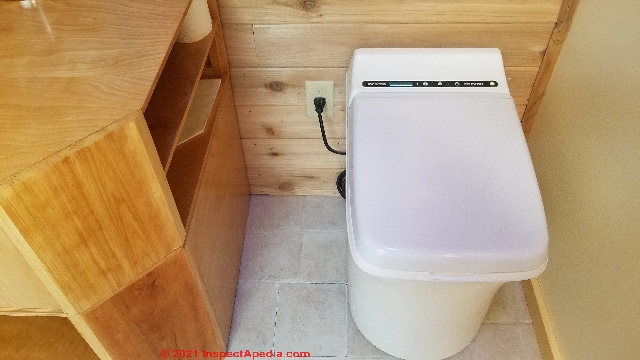
The toilet can also handle toilet paper and tampons, and the only by-product from the process is sterile ash that can easily be deposited with household waste
On average, a family of four produces a coffee cup’s worth of ashes during a week of use.
This eliminates the risk of contamination from sewage and hinders the spread of illness and disease from human waste.
Below: a Cinderella Comfort incinerating toilet installation showing both the toilet and its exhaust vent system.
The Eco John Incinerating Toilet
- EcoJohn, a California company, provides several incinerating toilet models including the SR series waterless incinerating toilet (photo at left).
Here is a copy of the
Eco John company's CATALOG [PDF] of waterless incinerating toilets, separating composting toilets, and incinerating waste control systems for use with low-flush toilets.
This is a toilet that is ideal for cabins, pool houses, guest rooms, or other remote areas where a conventional toilet is not available or too costly to install." "This is a new revolutionary system that incinerates gray/black water from a holding tank. "
The company reports that "These products have been carefully tested and are designed to solve the problems with toilets in remote applications.
ECOJOHN is superior where there is no power or water available, or where septic tanks are restricted, or simply in situations where a regular toilet is too costly or difficult to install.
In addition to our self contained toilets, we also build upscale portable restrooms that include our own ECOJOHN toilet solutions that don’t need unsanitary and costly pump outs the ECOJOHN restrooms provide hygienic, logistical, and economical benefits."
This system is perfect in areas where a water toilet is needed, but pumping out the waste is problematic or too costly." - The company previously offered an interesting waterless toilet system that includes an incinerator for
graywater that marries with a low-water toilet, the the EcoJohn Jr [image file] which is includes a sewage and graywater incinerating unit.
Contact the ECOJOHN company at their website, Eco John or at Global Inventive Industries, 17150 Newhope St. Ste 707, Fountain Valley, CA 92708, Tel:866.ECOJOHN Fax: 714.568.1068 or by email to team@ecojohn.com - ECOJOHN INNOVATIVE TOILET SOLUTIONS [PDF] National Energy Equipment, Inc., Tel: 1-866-574-5100 Website: www.nee.ca retrieved 2020/01/11 original source: http://e.nee.ca/Propane-Natural-Gas-Equipment/files/assets/common/downloads/page0258.pdf
- ECOJOHN™ Sr. [PDF] , Op. Cit., retrieved 2020/01/11 original source: http://www.propaneproducts.com/images/ecojohn/ecojohn-brochure.pdf
Excerpt: ECOJOHN™ Sr is a revolutionary self-contained and waterless toilet that uses an incineration process to reduce waste into sterile ash.
The Sr model is extremely efficient and only leaves a very minimal amount of ash that only needs to be emptied a few times per year.
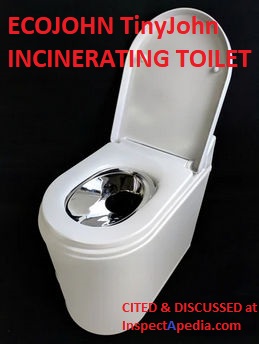 EcoJohn's current product line includes waterless incinerating toilets
TinyJohn BROCHURE [PDF], waterless incinerating toilet for 5 people, 12 D.C. (can be connected to a conventional 120VAC electrical supply). This incinerating toilet combines the use of propane gas and 12V DC, 120VAC or 240VAC electrical supply. Retrieved 2020/04/12
BigJohn, waterless incinerating toilet for 6-12 people
SepticJohn that eliminates black and graywater
WorkJohn, a turn-key evaporating septic system for commercial sites, eliminating wastewater haulage
Question: reader's troubles with the Eco John incinerating toilet
Dear editor,
I have been trying to find information and reviews concerning the EcoJohn SR-5 propane incinerating toilet, but other than a few "sanitized' reviews on the website itself, I have had no luck.
We have a cottage up in Maine, off the grid, with no ability (nor desire) to install septic system.
Last year we used a Sun-Mar composting toilet, with the composting unit outside the house. It stank, did not work properly, and could not work in cold conditions (the plastic crank handle will freeze, rendering the unit inoperable).
This year, after researching all winter on-line, I thought I had solved the problem with the Ecojohn.
It has been nothing but a nightmare, and I have had little to no support from the rep or the company. I think it is unsafe from a heat standpoint (the vent stack gets very hot - using a thermal gun it was 130 degrees even as high as 15 feet up), and it cycled erratically.
Initially, I noticed that the cycle never ended- it went on for over 2 hours. I lifted the lid, which is supposed to halt the burn- and it did not. When I called the company they doubted my veracity!
I figured out that the lever attached to the lid was not adjusted properly and did not depress the kill switch- and subsequently that safety feature works, but I was most unhappy that the initial response from the person at EcoJohn was to doubt that it had actually happened.
Next- the endless cycling- the recommendation was to turn down the temperature a notch. I did. That did seem to make the cycles turn on and off at the appropriate lengths of time (about 13 minutes for a urine cycle and 35 minutes for a waste cycle). I know this because I have been keeping careful notes.
What still troubled me was the heat of the vent stack- it was much too hot to touch at the base, and although I had been assured that it was cooler as it got past the 4-foot level, unfortunately that was not the case.
I measured it as it was exiting the roof (through the second story) and it was just as hot. Thinking I may just be over sensitive, I borrowed a thermal heat sensor from a local stove shop and tested it repeatedly, and it was getting up to 130 degrees both at base level and also at a height of over 15 feet. I could find no reference to the heat issue anywhere online
But it got even worse- as I went to vacuum out the "clean, sterile ash" I discovered that there was no ash to clean out. Instead, there was gobs of you- know- what and an unbelievable stench. Not even the toilet paper had incinerated.
I am at my wit's end with this, and the rep is offering no help at all. I want to return the thing. My children are all afraid to use it, and now so am I.
The only thing I have not yet tried is to raise the temperature again and see if it starts to cycle properly, and to also borrow that gauge again and see if the temperature of the vent gets hotter if the temp is raised. It is a double walled pipe and seems to be a proprietary design.
But I am back in my own (conventional) home again, which is far away from the cottage, and a little reluctant to go back just to poop-test. Luckily the cottage has an outhouse, which compared to my high-priced paperweight is the pinnacle of freshness.
Have you had any people review this product? I have searched and searched and there is no info or reviews out there that I can find. - Anonymous by private email, 2016/10/06
Reply: OPINION - disappointing problems with your EcoJohn incinerating toilet
Good job summarizing the very disappointing issues. If you can send photos and details of your installation that will help.
The problems you describe are indeed very worrisome. It sounds as if the advice to lower the temperature setting to amend the cycling time changed the cycle time but at the cost of adequate incineration. That's an unacceptable outcome.
The issue of stack vent temperature is more manageable.
First, take a lookYou'll see that temperatures around 200 degf. and higher cause the pyrolysis effect that could eventually lead to a building fire if combustible materials are too-near to a vent or chimney operating in that temperature range.
Down at 130 degF the vent temperatures would probably be safe. But before deciding that I'd look more carefully at where and how temperatures are being measured.
For example, using an IR scanner to measure surface temperature is inaccurate except to compare relative temperatures between two similarly-colored and textured surfaces. Only flat black surfaces can be measured accurately.
Options where a vent is considered too hot are to increase clearance to combustibles, add approved heat shielding, or to go to an insulated, metalbestos type flue.
If you're willing to have me publish your comments, including photos of the toilet and its components, any evidence of malfunction, along with model number and age, that may prompt helpful suggestions from other users and perhaps from the company, benefiting both Eco John users and also the company itself.
To protect all parties from bias and also to maintain reader credibility, we need take care to be accurate and unbiased and to distinguish between fact an opinion - something that should be easy for the problems you describe.
About the other installation and operating problems, my opinion is that some of these incinerating toilets are probably rather good designs but were designed and are mostly installed in other countries where there are more people with experience and expertise in installation and set-up.
When support for such a product in the U.S. depends on what looks like a mom and pop operation, it's hit or miss what level of expertise and support we'll find. I hope that by posting these problems the companies and distributors will be more responsive. After all, besides you as the end consumer, they have a tremendous stake in the safe and successful use of their product.
Incinerating toilets can, it appears, be made to work, but their installation, set-up, and operation require some care. Incinerating toilets, either electric or propane powered, are used for example in Arctic stations where conventional sewage disposal systems either cannot work or are impractical.
They're also discussed in NASA research, EPA research, various water saving technology research, in works on railroad systems and for other circumstances where conventional waste treatment is not available such as areas of South Africa.
The Incinolet Electric Incinerating Toilet
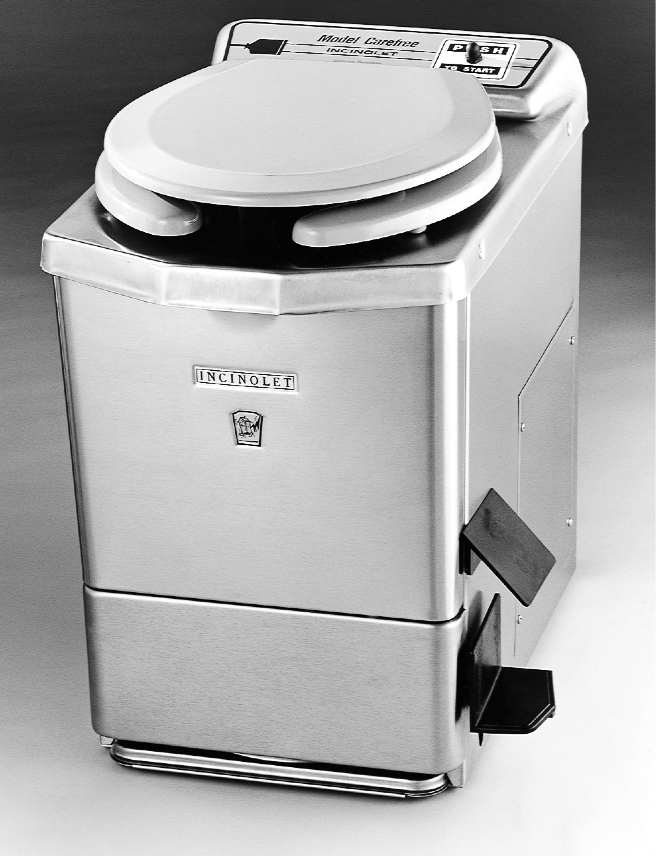
[Click to enlarge any image]
Discussion of the Incinolet electric incinerating toilet has moved to INCINOLET TOILET.
Jiffy John Incinerating Toilet
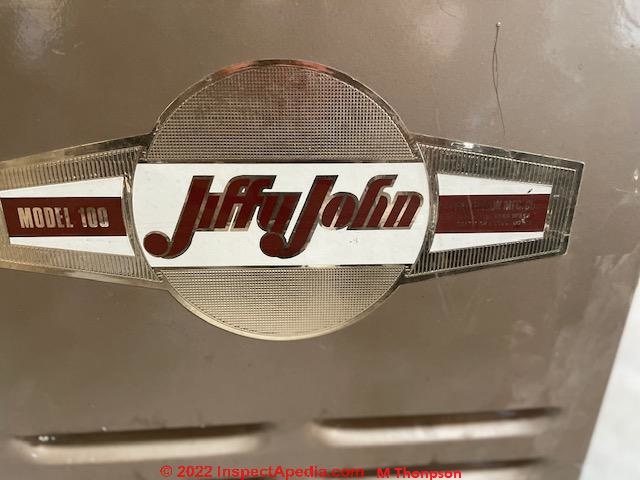
Contact: Jiffy John, PO Box 337 Maple Ridge B.C. V2X 7G2 Canada, Tel: 604-463-0707 Web: https://jiffyjohn.ca/our-toilets/ Email: info@jiffyjohn.ca
Note: the Jiffy John company cited above is a Canadian firm serving the Vanocouver area whom we think had nothing to do with the antique incinterating toilet Jiffy John illustrated above and discussed below.
The Canadian Jiffy John also provides portable chemical toilets for various uses.
Reader Comment: Jiffy John 100 Toilet Received as Gift
I am new to cabin life and was "gifted" an incinerator toilet that is quite old but has never been used or installed.
I can't find information anywhere on it though. It looks just like the Destroilet (big metal box with the seat on top and vents are at the rear to hook pipes up to. Propane hookup is at the back as well.
The issue is that the "bowl" isn't setup like any other incinerating toilet I find as the bowl rotates back slowly (chain generated) like a propeller when closed and a new bowl is then on top (there are essentially 3 separate bowls that rotate each time you close the toilet lid.
The thing I'm really trying to figure out is where does it go? The "bowls" don't have a bucket they drop into and there is no "hatch" or anything that you would go in to clean it out.
The model information on the front (picture attached too) is Jiffy John MODEL 100 - PATTERSON MFC. CO. 1905 SO. 1045 WEST SALT LAKE CITY, UTAH and there is a sticker on the side that reads patent pending.
I am really thinking this is one of the first incinerating toilet designs out there and I need to find out if I'm missing parts to it and/or what the "process" is so I operate it correctly before I try to install it. ANY information would be very appreciated, I have scoured the internet and your article is the closest I have found. - mthomson, 2022/10/10
Moderator Reply:
Thank you for the Jiffy John photo and question. We will do some research to see what we can find. So far we've found this patent, possibly related and naming the owner of the company or inventor of the toilet take a look at this US patent
Patterson, David D., TOILET FACILITY [PDF] U.S. Patent No. US4163294A, filed 1977-11-18 granted 1979008-07
Abstract:A toilet facility that is completely independent of water supply and sewer lines includes a house having a waste-receiving tank within it and another tank located outside the house.
The two tanks are connected by a transfer pipe provided with a pump for pumping the waste from the inside tank to the outside tank.
The outside tank is provided with a discharge pipe leading from it, and this pipe likewise has a pump for removing waste from the outside tank. The discharge pipe for the outside tank easily connects with a collection receptacle that can be detached and disposed of.
Each tank contains an aeration pipe to which an air compressor is connected, thus enabling pressurized air to bubble through the waste in the two tanks and to activate aerobic bacteria in the waste.Each tank also contains a heating element which normally maintains the waste in the tank at about 97° F., but has the capability of elevating the waste to a temperature above the boiling point of water so that the water may be evaporated from the waste.
The pump in the discharge line may not be energized within 48 to 96 hours of the last operation of the pump in the transfer line so as to provide sufficient time to purify the waste in the outside tank after the last addition to that tank.The house has a translucent dome-shaped roof provided with a gutter at its lower edge and a vent that raises and lowers at its top. Major components of the house are formed from plastic using rotational molding techniques.
The Destroilet Incinerating Toilet from LaMere Industries
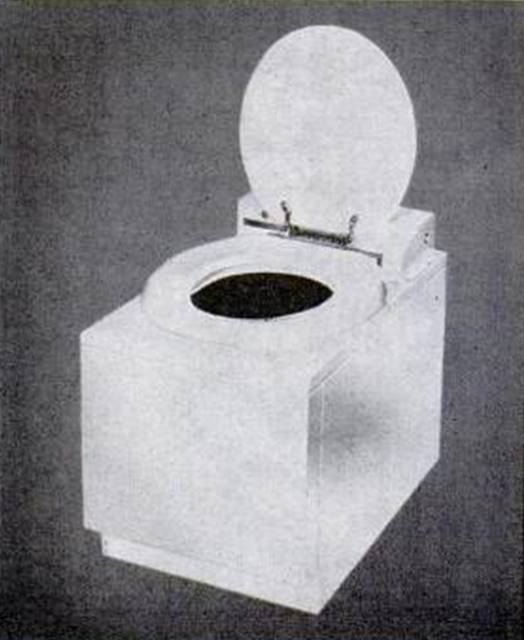
The Destroilet was invented by Frank J. La Mere and was the first commercially successful incinerating toilet that saw widespread use as according to its inventor, Frank La Mere, earlier efforts were costly or otherwise difficult to keep working.
Details about the Destroilet from LaMere are now found
at DESTROILET INCINERATING TOILETS
The Scanlet Incinerating Toilet - propane fueled from Storburn
- Scanlet - a Danish incinerating toilet fueled by propane.
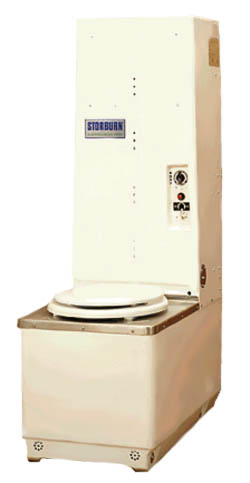
- * Storburn is a "natural gas" fired (actually propane fired or perhaps either) incinerating toilet. The toilet can be used 40-60 times
before an incineration cycle is required.
Storburn International, 1227 Colborne Street W, RR4 Brantford, Ontario, Canada N3T 5L7, Tel: 1-800-876-2286, Email: info@storburn.ca Website: http://www.storburn.ca/
U.S. Contact: Storburn, Aqua Alternatives Dean Petrich 2131 Middle Drive Freeland, WA 98249-9516 (206) 324-5055 Toll-free: (877) 713-7858 petrich@whidbey.com Website: http://www.citizensafe.com/storgasintoi.html
The company says that "a full 100 lb. propane cylinder will burn 16 maximum capacity loads (approximately 960 uses). Cost: about $4000. plus shipping and taxes.
All gas-fired incinerating toilets will require a gas flue to vent combustion products. Incineration cycle time was not obvious at the website. Incinerating toilet prices: $2980 - $3200. U.S. plus possibly some extra costs for vent kits and of course the propane tank and gas piping installation.
This is the brand name that popped up the most during my web research on this topic.
Note: in North America Storburn International distributes this incinerating toilet.
Quoting from the company's website:
STORBURN introduced the "store and burn" incinerator in 1976. The new model 60K builds upon that concept with a completely new control system that is simpler to operate and a new burner designed for increased combustion efficiency.
Under ideal operating conditions a full 100 lb. propane cylinder will burn 16 maximum capacity loads (approximately 960 uses). Because of ambient temperatures, ratio of solids to liquid and other variable factors that affect fuel consumption, it is more reasonable to expect 100 lbs. of propane to burn approximately 600 uses.
It is also more efficient to burn full loads rather than partial loads since it takes virtually the same amount of fuel to preheat the combustion chamber under all load conditions.
The STORBURN toilet can be installed in virtually any heated or unheated building or enclosure. Installation is similar to a vented free-standing space heater.
The Sunbio Electric Toilet from Eco Toilets in New Zealand
- Eco Toilets offers Sunbio Electric Toilets which use 240 watts and require 2-3 hours to completely incinerate waste. Eco Toilets is in Hamilton, New Zealand and also produces composting toilets and other products.
Research on incinerating toilet designs, effectiveness, success, problems, repairs:
- Niwagaba, C., M. Nalubega, B. Vinnerås, and H. Jönsson. "Incineration of faecal matter for treatment and sanitation." Water Practice and Technology 1, no. 2 (2006): wpt2006042.
Abstract
Incineration of faeces offers a treatment method that is useful in reducing the final quantities of faeces and toilet paper.
It is also useful as a sanitation method for faeces. The aim of this work was to increase the knowledge about incineration as a treatment and sanitation method for faeces.
The faecal matter used in this study contained ash used as additive material during the collection phase.
The incinerated faeces/ash mixture had an ash content of 86%. It caught fire when the temperatures reached 800°C and beyond and after this, temperatures in the range of 800 to 1000 °C were recorded.
The mass reduction was 15 - 36% and the organic matter was reduced by 78 - 99%. The plant nutrient content was reduced, total nitrogen by 90 - 94% and available phosphorus by 70 - 94%.
Incinerating material with a dry matter (DM) of less than 90% resulted in a strong smell. When the DM was higher, the smell lessened. The reduction in mass of excreta and the possibility to re-use ashes as additives in toilets can be advantages of incineration of faeces.
Excerpt: ... Incinerating faecal material with more than 10% moisture content resulted into a strong bad ... At even higher moisture levels (>30%), it was not possible to successfully incinerate the faeces. Moisture content for the faecal material incinerated was decreased by sun-drying them in ... - BCDHE, INCINERATINGTOILETS [PDF] Barnstable County Department of Health & Environment, 3195 Main Street, PO Box 427, Barnstable, MA 02630, Email: info@bch.barnstablecounty.org, Tel: 508-375-6613, http://www.barnstablecountyhealth.org/resources/publications/compendium-of-information-on-alternative-onsite-septic-system-technology/incinerating-toilets
Excerpts:
If installed in accordance with appropriate codes (gas-fitting, plumbing, electric, building), both gas-fired and electric toilets are permitted in Massachusetts. It is not clear, however, if their use fulfills the requirement of a water closet under the plumbing code.
Many of you may remember that the issue of a water- closet requirement prevented the use of composting toilets for years.
Boards of Health in Barnstable County and most areas of the state should only consider permitting the use of incinerator toilets as a replacement for a subsurface sewage system after careful consideration and after all other feasible alternatives have been explored.
These units are not specifically referenced in Title 5, and hence there are no specific guidelines for their application. In general, they have been permitted in remedial situations where the living units are seasonal with limited use, and where there is a means for gray water disposal.
Most often, graywater disposal in those situations is permitted to an existing facility in similar fashion as has been allowed under 310CMR 15.289(3)(a)
Incinerating toilets find their most ideal application at sites where it is impractical to extend water service or sites which receive very limited use. In the case of gas-fired incinerator toilets, even electrical service is not required. Applications include camps, cabins, fishing shacks, dune shacks, accessory buildings etc.
Applications in Falmouth included beach cabanas along Shore Rd. that were heavily damaged during a hurricane.
Effects of the toilets’ electric demand were considered to be not noticeable to slightly noticeable.
In two of the five people interviewed, odor from the system was considered a problem because they had not vented the system above their roof line.
When their systems were in the incineration cycle they complained that there was a backdraft of odor/smell that was directly attributed to being vented too low. Both persons said that after the system had run for a while that smell became less noticeable. - Dickey, Elbert C., Robert P. Pharris, Phillip W. Harlan, and Gary Hosek. "Home Sewage Treatment Systems." (1980).
- Green, W., and G. Ho. "Small scale sanitation technologies." Water Science and Technology 51, no. 10 (2005): 29-38.
- Hughes, Kevin A., and Simon J. Nobbs. "Long-term survival of human faecal microorganisms on the Antarctic Peninsula." Antarctic Science 16, no. 03 (2004): 293-297.
- Memon, Fayyaz Ali, and David Butler. "In-house Water Saving Technologies." [PDF] Department of Civil and Environmental Engineering, Imperial College London, Workshop on Water Demand Management,
6 - 18 September, 2003,
Power and Water Institute of Technology, Tehran.
Note: the authors include among their conclusions an observation that for the purposes they were discussing, the operating costs of incinerating toilets exceed the benefits in water savings, but IMO this is not the only consideration - Ed. - Muñiz, Edwin. "A Proposed Sustainable Sanitation System for the Zwelitsha section of Langrug Informal Settlement in Stellenbosch Municipality South Africa." PhD diss., Worcester Polytechnic Institute, 2013.
- Nagy, J., and A. Zseni. "Swot analysis of dry toilets." WIT Transactions on Ecology and the Environment 203 (2016): 257-268.
- NSF, "NSF International Onsite Wastewater Inspector Accreditation Program Applicant’s Guide", http://citeseerx.ist.psu.edu/viewdoc/download?doi=10.1.1.676.7783&rep=rep1&type=pdf
- STEP, INCINERATION and COMBUSTION TOILETS [PDF] Sanitation Technology Platform, Molly O’Donovan Dix
dix@rti.org
Brandy Salmon
bsalmon@rti.org retrieved 2020/01/11 original source: http://stepsforsanitation.org/?smd_process_download=1&download_id=4274
Excerpt:
Odor management claims refer to the use of paper bags for containment, vacuum strategies, air flow, and ignition via electricity. - US EPA Water Efficiency Technology Fact Sheet: INCINERATING TOILETS (EPA 832-F-99-072) [PDF] Retrieved 2016/10/09, original source: https://www.epa.gov/sites/production/files/2015-06/documents/incinera.pdf
Excerpts:
Excerpt: Incinerating toilets are self-contained units consistingof a traditional commode-type seat connected to a holding tank and a gas-fired or electric heating system to incinerate waste products deposited in the holding tank. The incineration products are primarily water and a fine, non- hazardous ash that can be disposed of easily and without infection hazard.
The Storburn was found to effectively reduce human wastes to ash, even at low ambient temperatures. On the coldest day tested, the exhaust temperature was measured going from - 11°C to 100°C (the boiling point of water) only one minute after ignition. On average, the ash remaining after incineration amounted to 2.23 percent of the total weight of waste treated in the Storburn.
Moreover, microbiological examination of the resulting ash revealed no fecal contamination. The coldest temperatures tested did adversely impact incineration, however, because the contents of the propane tank could not vaporize properly.
To maintain an optimal fuel supply to the toilet, the authors of the study recommend keeping propane tanks sheltered or heated when used in sub-zero conditions. - Wadhwa, K. C. "Report on Fire studies in Maitri station and summer huts at Antarctica." (2006).
Excerpt:
BLOCK "C" : Accommodates 5 Nos. incenerator toilets. Most ... manifold. v. Incinerators: Garbage & toilet incinerator can cause fire due to malfunctioning and threatens the adjoining fuel dumps and LPG cylinders in the vicinity.
General Comments about Incinerating Toilets
Watch out: besides the Stewart review of the Incinolet, a scan of product comments across a number of websites made between 2001 and 2014 found the following types of consumer complaints or concerns about incinerating toilets:
- Energy consumption [US EPA, others]
- Noise - "sounds like a roaring freight train" [various sources]
- Odors [various sources]
- I have been around one at work. I refused to use it. When I first started in that area the vent would back draft. Imagine that smell. When we had heavy use it backed and the element burned out. Now we bring in portapotties when there is a work group that can't go back across the levee.
They have found scorch marks on the ceiling where is exits the roof. The smell down wind stinks, the blower is noisy, and it pulls a lot of amps. This is a unit of last resort were nothing else is feasible. - airstream trailer forums at airforums.com retrieved 3/6/2014 original source: http://www.airforums.com/forums/f446/ anyone-use-incinolet-incinerator-toilet-62782.html
* marks units that looked good to me on first review of their specifications, or which have received positive reviews from other sources I respect such as Real Goods.
...
Reader Comments, Questions & Answers About The Article Above
Below you will find questions and answers previously posted on this page at its page bottom reader comment box.
Reader Q&A - also see RECOMMENDED ARTICLES & FAQs
How much propane is burned when incinerating number 1 or number 2.
I am looking all over to see if anyone knows how much propane is burned when incinerating number 1 or number 2. Need to know for my propane planing in my travel trailer, thx. - On 2021-03-10 by Richard G -
Reply by danjoefriedman (mod) - incinerating toilets run for a fixed interval regardless of what waste is "flushed"
@Richard G, the answer to your question will be actually easier than you think because it's probably the case that no incinerating toilet is actually detecting whether feces or urine or both are being deposited into the incinerating chamber.
Instead the way the toilet works is that it burns for a specific amount of time. So there will be a BTUs per hour rating if you're using a propane or natural gas incinerating toilet and, of course, that's manufacturer and model dependent.
So just take a look at the specifications for your particular incinerating toilet or ask the manufacturer to give you that data. Bottom line the toilet doesn't care whether you're doing number one or number two
On 2020-09-23 by Dylan -ok to put incinerator toilets in an RV shower stall?
Can you install an incinerator toilet in an RV shower stall?On 2020-09-23 by (mod)
Dylan
There are incinerator toilets that can be installed in very tight spaces with as little as about 6" from the wall through which the toilet vents and 2" from the toilet sides,
but
if you use your RV shower stall then you will, of course be giving up on having a shower; you can not install an incinerating toilet where it or its wiring or wall plug connector would get wet.
There's a second question about obtaining sufficient electrical power.Depending on the incinerating toilet brand and model you may need, for example, a 20A 240VAC circuit dedicated to the toilet.
There are 110V models as well, around the same amperage, but again, usually as a dedicated circuit.
And of course there are also incinerating toilets that operate on LP gas.
Really? But I'm doubtful that an incinerating toilet is made to install in and actually share space with an active shower stall; the models I've reviewed would not be installed in a wet location like that.
Watch out: don't order an incinerating toilet for RV installation without discussing your specific installation needs with the toilet manufacturer.
Is there a liquid capacity limit before using the burner cycle?
Is there a liquid capacity limit before using the burner cycle? thank you - On 2020-08-21 by e -Reply by (mod) liquid or volume capacity for incinerating toilets - "visits per hour"
Yes, e, incinerating toilets vary in the volume of waste that the toilet model can accept between incineration cycles, but at least as important is the incineration frequency designed into the toilet.
For example the Cinderella Comfort incinerating toilet has a capacity of 4.7 liters or 1 Imperial gallon.
Some incinerating toilets are designed to accumulate a larger volume of waste before infrequent (and in some cases noisy) incineration cycles.
But other models such as the Cinderella Comfort toilet described in this article run an incineration cycle at the end of every use.That toilet's design permits the toilet to be used safely and comfortably during an incineration cycle [incineration pauses automatically during use by detecting that the toilet lid has been lifted] while others may prohibit use entirely during the burn process.
A more-useful way to answer your question is to read the incinerating toilet's specifications for the number of people that the toilet claims to support for full time use; some may also include a peak-use number, expressed as the number of occupants or users per day or per hour.
For example the Cinderella Comfort incinerating toilet is designed for no more than three to four visits per hour andWatch out: a maximum of 6 visits in an hour to this particular incinerating toilet brand and model is not recommended.
Other incinerating toilet brands and models will have similar restrictions.
Add a bidet function to an incinerating toilet?
Can you use a bidet with an incinerating toilet? - On 2020-03-12 by Cherie -
Reply by (mod) - You "can" add a bidet-sat to a conventional incinerating toilet
Cherie
Technically, yes, you "can" add a bidet-seat to a conventional incinerating toilet, with the consideration that adding a liquid load to the incinerating toilet is going to mean more-frequent burn times.And I'd add that the plumbing work and added complexity of adding a bidet to an incinerating toilet is probably not worth the cost, as these toilets are not designed for such add-on features.
SR 5 EcoJohn burner odor complaints
@pwoodward, help is greatly appreciated
I have an SR 5 eco john that came with a chalet I purchased in Northern ontario . The smell from the burn is bad . We have an auxiliary fan at top of the pipe to ensure no back draft . Even when no backdraft the smell is pissing off the wife
Not too many good reviews on the eco john customer service and from what I have experienced so far I must agree . Anyone with ideas to help cut the smell are welcomed. On 2020-01-11 by pwoodward@thebucketshop.ca -
On 2020-01-11 - by (mod) - odor complaints for some incinerating toilets?
I've been disappointed to read occasional odor complaints about incinerating toilets, Mr. Woodward and am researching causes and cures that I'll report here.
The EPA gives an example of the requirement for a catalyst bed for some toilets that, if in poor condition, could explain an odor problem.
In our References you can find the EPA document and also this BCDHE article from which we excerpt:
- BCDHE INCINERATING TOILETS [PDF] (2016) Barnstable County Department of Health and Environment, www.barnstablecountyhealth.org
Excerpt:
Effects of the toilets’ electric demand were considered to be not noticeable to slightly noticeable.
In two of the five people interviewed, odor from the system was considered a problem because they had not vented the system above their roof line.
When their systems were in the incineration cycle they complained that there was a backdraft of odor/smell that was directly attributed to being vented too low. Both persons said that after the system had run for a while that smell became less noticeable.
Meanwhile be sure that your toilet was installed and used following the installation manual.Watch out: be sure that your toilet is properly installed, including its ventilation system.
Some of the incinerating toilet IO manuals I've reviewed emphasize that the venting will work properly only if the total length or height of the vent, the number of elbows, and other details such as height of the vent top termination above rooftop are kept to the incinerating toilet manufacturers specifications.
The operating instructions for the Cinderella incinerating toilet (available in this article series) describe periodic cleaning cycles that involve "incinerating" a liter of fresh water after the toilet has undergone a normal cleanout, and also periodic cleaning of the exhaust flue.
Taking these steps may be important in keeping down burn-smells from your particular incinerating toilet.
Customer's Eco-John complaint
EcoJohn is a dishonest company. Do NOT do business with them unless you like being robbed of your hard earned cash. Stay away from EcoJohn. On 2019-04-20 by Brian Pfau -
Reply by (mod) - reader complaint about EcoJohn
Brian
You might want to try to put more specifics into your message so that readers as well as the company understand the issue.
I need help with my EcoJohn SR12 Toilet
Help would like to talk to someone that has installed ecojohn toilet. We are looking at the SR12 HELP. - On 2017-05-06 by Vicky -
Reply by ECOJOHN
@Vicky, Hi! We have just found this post. Are you still looking for a solution? On 2018-03-01
On 2018-03-02 by (mod) - EcoJohn reaches out to customers & readers
Eco
Thank you for leaving a help offer on this article. Please check our discussion of the ecojohn above on this page and let me know if the contact information that we provided for your company the best that we should use for our readers.Also we would very much welcome any content critique or suggestions that you might have.
What about the smell from incinerating toilets
What about the smell. Also this can be put in to a house to make a new bath room? - On 2017-02-15 by Star -
Reply by (mod) - Properly-installed, cleaned, maintained incinerating toilet vented outdoors ought not smell
Star
A properly-installed incinerating toilet that is vented to outdoors ought not smell any different than a water flush toilet, though some research cites modest odor release (Leich 1975) from some toilet designs.
I did some quick research on odors from alternative toilet designs and found
- Anand, Chirjiv K., and Defne S. Apul. "Composting toilets as a sustainable alternative to urban sanitation–A review." Waste management 34, no. 2 (2014): 329-343.
- Leich, Harold H. "The sewerless society." Bulletin of the Atomic Scientists 31, no. 9 (1975): 38-44.
- Matherly, J. Evaluation of a Field-Type Incinerator for Human Waste (Theater of Operations Sewage Treatment Systems). No. CERL-TR-E-10. ARMY CONSTRUCTION ENGINEERING RESEARCH LAB CHAMPAIGN ILL, 1973.
- Nagy, J., and A. Zseni. "Swot analysis of dry toilets." WIT Transactions on Ecology and the Environment 203 (2016): 257-268.
- Niwagaba, C., M. Nalubega, B. Vinnerås, and H. Jönsson. "Incineration of faecal matter for treatment and sanitation." Water Practice and Technology 1, no. 2 (2006): wpt2006042.
Question: what do incinerating toilets cost?
What's the cost of the first & second one shown on this web site & what's the weight of each? contact me at okeydokee@outlook.com Mike - (Mar 23, 2015) Michael J schmitz
Reply:
For latest costs, Michael, we give the manufacturer's contact information for each toilet alternative. Prices range from about $1000 to several thousand dollars.
Question: does Maryland prohibit use of incinerating toilets?
Neil Crowner said:
looks like MD does NOT allow them.CAN THIS BE?
Reply: no
Neil,
From reading the source I cite below it seems to me that in Maryland in the U.S. Incinerating, waterless, composting toilets are not disapproved per-se but rather are subject to conflicting guidelines, "approved" where written into the land use covenant but at least for composting toilets, "disapproved" or "not recommended" as posing a health risk.
As of 2015 the Maryland state DOE has taken an administrative position as documented in this letter
- Flatley, Joshua, BRF/BAT Technical Lead, "BAT Classification for Waterless Toilet Systems", [PDF] Maryland Department of the Environment (Maryland DOE), 1800 Washington Blvd., Baltimore MD 21230, Tel: 410-537-3000, Tel: 800-633-6101, Website:www.mde.maryland.gov, Memorandum, 10 March 2015 to Environmental Health Directors, THRU: Jay Prager, Wastewater Permits Program, Deputy Program Director
Also see Maryland's septic system regulations under MD
at U.S. SEPTIC AUTHORITIES & DESIGN SPECIFICATIONS
You'll see that not just incinerating (broadly falling under waterless toilets) but other waterless toilets are not necessarily considered "BAT" or Best Available Technology (that is permitted in some circumstances).
Mr. Flatley, from Maryland DOE and writing to Environmental Health Directors, notes that the "compost" from composting toilets does not meet the state's definition for legally marketable "compost" (surely no homeowner is considering selling their toilet waste) and he adds a raised concern for increased levels of pathogens on the private site where such compost may be disposed, calling it "not safe for human contact".
The letter makes clear that waterless toilets are not excluded Per Se, and in fact might benefit from some elaboration since the writer's opinion that composting toilets are in effect unsafe seems to contradict the same letter's citation of Maryland code on the topic that allows a wastewater reduction % where the Maryland DOE has written a requirement for BAT approved incinerating/composting/waterless toilets.
...
Continue reading at INCINOLET TOILET or select a topic from the closely-related articles below, or see the complete ARTICLE INDEX.
Or see these
Recommended Articles
- ALTERNATIVE & WATERLESS TOILETS
- CHEMICAL TOILETS
- COMPOSTING TOILETS
- COMPOSTING TOILET SUPPLIES
- DISABLED or ELDERLY-USE TOILETS
- GAS APPLIANCE OPERATION at HIGH ALTITUDE
- INCINERATOR TOILET SYSTEMS
- INCINERATOR TOILET CODES
- INCINERATOR TOILET SOURCES & BRANDS
- CINDERELLA INCINERATING TOILET
- CINDERELLA INCINERATING TOILET INSTALLATION
- CINDERELLA INCINERATING TOILET USE GUIDE
- CINDERELLA INCINERATING TOILET CLEANING GUIDE
- ECO-JOHN INCINERATING TOILET
- EcoJohn OPERATING TROUBLES
- INCINERATING TOILET RESEARCH STUDIES
- INCINOLET TOILET
- DESTROILET INCINERATING TOILETS
- STORBURN SCANLET INCINERATING TOILETS
- SUN BIO INCINERATING TOILET
- OTHER INCINERATING TOILET COMPLAINTS
- MARINE TOILETS
- OUTHOUSES & LATRINES
- TOILET TYPES, CONTROLS, PARTS
- WATERLESS URINALS
Suggested citation for this web page
INCINERATOR TOILET SYSTEMS at InspectApedia.com - online encyclopedia of building & environmental inspection, testing, diagnosis, repair, & problem prevention advice.
Or see this
INDEX to RELATED ARTICLES: ARTICLE INDEX to TOILET INFORMATION
Or use the SEARCH BOX found below to Ask a Question or Search InspectApedia
Ask a Question or Search InspectApedia
Questions, answers, FAQs, and reader comments about incinerating toilets.
Try the search box just below, or if you prefer, post a question or comment in the Comments box below and we will respond promptly.
Search the InspectApedia website
Note: appearance of your Comment below may be delayed: if your comment contains an image, photograph, web link, or text that looks to the software as if it might be a web link, your posting will appear after it has been approved by a moderator. Apologies for the delay.
Only one image can be added per comment but you can post as many comments, and therefore images, as you like.
You will not receive a notification when a response to your question has been posted.
Please bookmark this page to make it easy for you to check back for our response.
IF above you see "Comment Form is loading comments..." then COMMENT BOX - countable.ca / bawkbox.com IS NOT WORKING.
In any case you are welcome to send an email directly to us at InspectApedia.com at editor@inspectApedia.com
We'll reply to you directly. Please help us help you by noting, in your email, the URL of the InspectApedia page where you wanted to comment.
Citations & References
In addition to any citations in the article above, a full list is available on request.
- Comparing Toilets a brief comparison of Composting, Low-flow, Incinerating, and Chemical Portable toilets from the National Small Flows Clearinghouse http://www.nesc.wvu.edu/NSFC/frd-10/alternativetoilets.htm
- Eco John or at Global Inventive Industries, 17150 Newhope St. Ste 707, Fountain Valley, CA 92708, Tel:866.ECOJOHN Fax: 714.568.1068 or by email to team@ecojohn.com
- WATER EFFICIENCY TECHNOLOGY FACT SHEET: INCINERATING TOILETS [US EPA Article on Incinerating Toilets PDF file, retrieved 1/19/1999, 3/6/2014, 2024/06/30, copy on file as Incinerating-toilet-fact-sheet-EPA.pdf
- U.S. EPA, 1980. Evaluation of 19 On-Site Waste Treatment Systems in Southeastern Kentucky . EPA 600/2-80-101, U.S. EPA, Washington, DC.
- Fire Breathing Dragon nicknamed incinerating toilet - an amusing web article by "Jim" whose web page does not give his last name - (not authoritative). The author reports urinating on glowing waste being incinerated, causing quite a mess. Incinerating toilet brand not specified.
- Lake Geneva A & C Corp, 1977. Store and Burn Incinerating Toilet and Method. United States Patent US4051561
- Ritz , P. and Schroeder, H.P., 1994. “Life Cycle Cost Analysis of a Storburn Propane Combustion Toilet.” Paper presented at the 8 th International Cold Regions Conference, Fairbanks, Alaska
- Lake Geneva A & C Corp, 1977. Store and Burn Incinerating Toilet and Method. United States Patent US4051561.
- Storburn International. Storburn International Inc., 47 Copernicus Blvd., Unit #3 Brantford, Ontario, Canada N3P 1N4. Gas-Fired Incinerating Toilet product literature. Internet site at http://www3.sympatico.ca/storburn/
- Storburn International. Storburn International Inc. Gas-Fired Incinerating Toilet product literature. Internet site at http://www3.sympatico.ca/storburn/
- In addition to citations & references found in this article, see the research citations given at the end of the related articles found at our suggested
CONTINUE READING or RECOMMENDED ARTICLES.
- Carson, Dunlop & Associates Ltd., 120 Carlton Street Suite 407, Toronto ON M5A 4K2. Tel: (416) 964-9415 1-800-268-7070 Email: info@carsondunlop.com. Alan Carson is a past president of ASHI, the American Society of Home Inspectors.
Thanks to Alan Carson and Bob Dunlop, for permission for InspectAPedia to use text excerpts from The HOME REFERENCE BOOK - the Encyclopedia of Homes and to use illustrations from The ILLUSTRATED HOME .
Carson Dunlop Associates provides extensive home inspection education and report writing material. In gratitude we provide links to tsome Carson Dunlop Associates products and services.
 | HOME | ABOUT | ASK a QUESTION | CONTACT | CONTENT USE POLICY | DESCRIPTION | POLICIES | PRIVACY | |
| © 2025 - 1985 Publisher InspectApedia.com - Daniel Friedman | |||||||||