
InspectAPedia® FREE Encyclopedia of Building & Environmental Construction, Diagnosis, Maintenance & Repair |
Question? Just ask us! InspectAPedia
|
 Water Softener Health Risks: Salt in Drinking Water
Impact of water softener on salt content in drinking water & wastewater; salt removal from water
- POST a QUESTION or COMMENT about the Health Risks of Water Softeners and of Water Softener Salt or Bacteria in Drinking Water
Water Softener health risks & effect on drinking water:
This article explains the health risks associated with water softeners or water conditioners: what are the effects of salt introduced into the water supply? How much salt does a water conditioner leave in the building's drinking water?
We also discuss possible bacterial or pathogenic hazards that occur if a water softener drain is not properly connected with an air gap.
InspectAPedia tolerates no conflicts of interest. We have no relationship with advertisers, products, or services discussed at this website.
Health Risks of Water Softeners: Water Softener Salt in Drinking Water & Other Risks
Article Contents
How Much Salt Does a Water Softener Put Into Drinking Water?
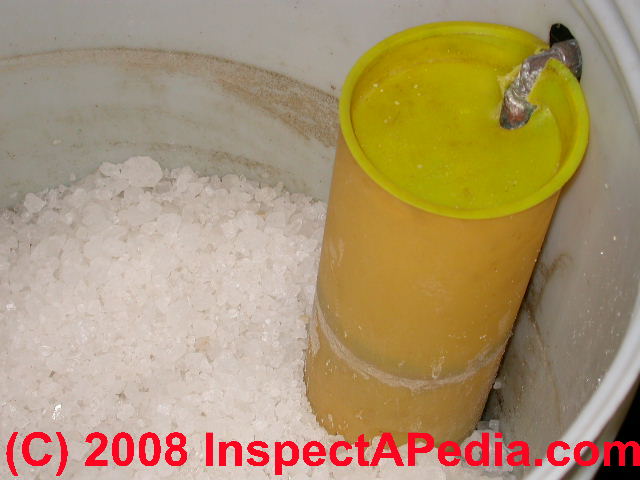
A properly-adjusted water softener puts about 8 mg of salt (sodium, or NaCl) in each liter of treated water for each grain of hardness removed. Water at 10 grains of hardness which has been processed by a water softener will have 80 mg of salt/L.
[Click to enlarge any image or table]
People on low-salt, low sodium, or no-salt diets, infants, and others who want to avoid salt may want to drink water from a tap that bypasses the water softener or that uses water that has had its salt removed after water softening such as water treated by reverse osmosis. -- , CMC, IBC and other sources.
If you are concerned about this salt level, also keep in mind that unless the drinking water supply has been tested and you have a detailed report, the level of various minerals (and other substances) that are in hard water which has not been processed by a water softener has an unknown level of minerals and other materials, possibly more significant than the 8 mg of sodium per liter of treated water.
A water softener which is improperly adjusted or malfunctioning may place higher levels of salt into the building water supply. The salt level in the backwash discharge from a water softener can contain high levels of salt but that discharge is not delivered to the building water supply but rather to a drain.
See WATER SOFTENER ADJUSTMENT & CONTROLS for water softener adjustment advice.
In our water quality articles we suggest that people who need to avoid salt even at low levels may want to install a bypass water line to deliver water to one sink tap for drinking and cooking, or they can install a reverse osmosis system to remove salt from water (and other contaminants) at the point of use, typically in the kitchen.
What water contaminants can a water softener remove?
A water softener removes minerals from the water supply, particularly calcium and magnesium, and perhaps a limited amount of un-wanted iron in the water supply. Keep in mind that a water softener is not a water sterilizer. If your water supply is contaminated with bacteria, chemicals, or sediment, the water softener is not designed to remove those substances and other treatment or filtration may be needed.
More details about water softeners and their salt contribution to the drinking water supply and thus to the septic system can be read
How Much Salt is in Water that has Passed Through the Water Softener?
The answer is ... it depends. If a softener is working correctly and is adjusted correctly then the salt level in treated water should be quite low. Kenmore gives this interesting example of the effect of softened water on salt consumption:
Persons who are on sodium restricted diets should consider
the added sodium as part of their overall sodium
intake. For example, if your water supply is 15 grains
hard, and you drank 3 quarts of softened water you
would consume 335 milligrams of sodium. That is
equivalent to eating 2-1/2 slices of white bread. ...
Persons who are concerned about their drinking water should consider a Kenmore reverse osmosis drinking water system that will remove in excess of 90% of the sodium and other drinking water contaminants. [8]
Also see REVERSE OSMOSIS WATER TREATMENT.
Watch out: if a water softener is not properly adjusted and maintained you may find that higher levels of salt are being placed into the building water supply.
Here is what Sears says about the effects of salt in drinking water in buildings where a water softener is installed:
Sodium information: Water softeners using sodium chloride for regeneration add sodium to the water.
Persons who are on sodium restricted diets should consider the added sodium as part of their overall sodium intake.
For example, if your water supply is 15 grains hard, ou would have to drink 3 quarts of softened water to consume 335 milligrams (mg) of sodium. That's equivalent to eating 2 1/2 slices of white bread.
Persons who are concerned about their drinking water should considre a Kenmore Drinking Water System that will remove or reduce in excess of 90% of the sodium and other drinking water contaminants. - Sears Kenmore 100-150 water softener manual p. 1-6, retrieved 23 May 2015.
[Other water treatment systems, equipment, and methods are available to remove salt from drinking water as well - Ed.]
Plumbing Cross Connections at the Water Softener - Bacterial Contamination Health Risks from Plumbing Cross Connections at the Water Softener
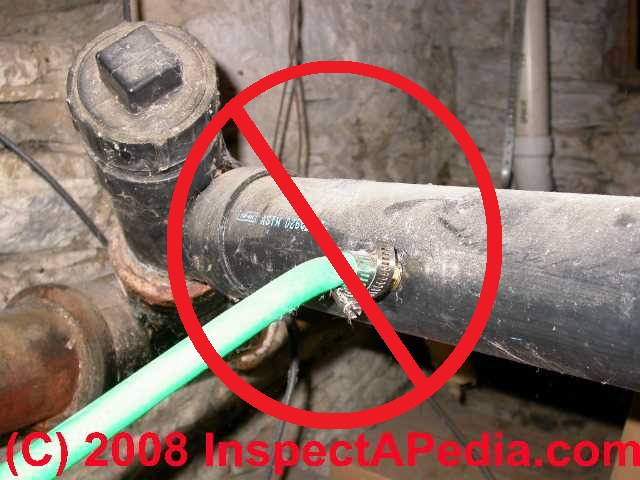
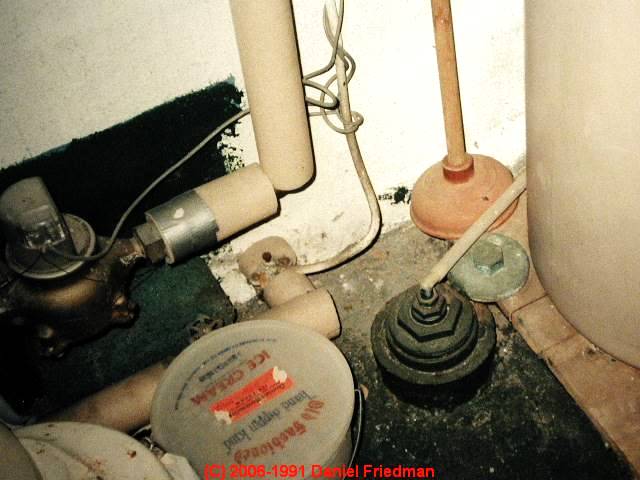 Plumbing cross Connections such as those we show in our water softener backwash/recharge drain tube connections at page top and just at left deserve a mention
while we're discussing water softeners.
Plumbing cross Connections such as those we show in our water softener backwash/recharge drain tube connections at page top and just at left deserve a mention
while we're discussing water softeners.
A "cross connection" is a direct physical connection between a building water supply pipe and a drain pipe.
This may sound like an unlikely event in buildings but in fact it is common in a few instances: installers often make a tight connection between the water softener backwash/discharge drain (usually a small diameter plastic tube) and a building drain.
While it is not unique to water softener installations, this plumbing error is often made when these devices are installed. It is unsanitary and is a health risk.
Watch out: never connect a water softener drain tube or pipe directly to a building drain (as shown in our photographs above. Doing so risks back-siphonage of sewage into the water softener and thus risks dangerous contamination of the building water supply.
For bacteria contamination or other water contaminant test guidelines
see WATER TEST CHOICES & WATER TEST FEES.
Also see CROSS CONNECTIONS, PLUMBING for details about cross connections and various places where they occur in building plumbing systems.
Cross connections are defined with further examples
at Home Inspection Definitions & Terms.
Environmental Impact of Salt in Wastewater
The build-up of salt in wastewater, wastewater disposal soils are undesirable. The effects of salt (Na or Sodium) ultimately reaching ocean waters are of no consequence and in bodies of fresh water are of little consequence - at least at the level of residential wastewater disposal.
More details about salt in wastewater are
at WASTEWATER BIOCOMPATIBILITY
How to Remove Salt from Building Water Supplies
Two easy and common approaches to minimizing the salt level in drinking water work perfectly well if your concern is with the trace levels of salt left in drinking water by a properly-functioning water softener:
- Provide a drinking water supply pipeline taken off of incoming building water supply ahead of the water softener and pipe that to one or more drinking water supply points in the building.
- Use a reverse osmosis treatment as a point of supply drinking water source at one or more sinks in the building.
But neither of these approaches will reduce the salt level in wastewater exiting the building - a problem for septic systems if the salt level is high (from a malfunctioning water softener), and neither approach will address the problem of high salt content in the building water supply itself.
Reader question: what can I do about high salt level in my building's well water?
My well water was tested and it had 200 times the normal salt content. The septic tank builds a thick scum at top even with the addition of expensive septic tank treatments. Do you have any suggestions? Is a whole house reverse osmosis system the only answer?
Thank you for your attention to my inquiry. - J.M. 7/9/2014
Reply:
There are several salt removal systems, (e.g. http://www.twcdistributors.com/AI-salt-removal.php) worth looking through. Whole house RO is a common approach but itself will discharge salty wastewater into the drainage system unless you provide a separate drywell for that disposal.
Research on Salt Health Risks & Approaches to Removing Salt from Drinking Water
These research citations may be helpful as they discuss salt removal approaches (as well as other inorganics) - also give your local water treatment companies a call. Keep me posted as I may be able to comment further and what we learn will assist others.
- Watch out: different water softener settings may be required if you're using potassium chloride (KCl) to reduce the salt level in your softened water.
See WATER SOFTENER SALT SUBSTIUTE: POTASSIUM CHLORIDE. - Bradshaw, Michael H., & G. Morgan Powell SODIUM in DRINKING WATER [PDF] (outdated, may not contain current health recommendations), retrieved 2022/09/21 origianal source: https://www.ksre.k-state.edu/historicpublications/pubs/MF1094.pdf
Excerpt:
The Environmental Protection Agency (EPA) has a draft guideline for sodium in drinking water of 20 milligrams per liter (mg/L). Sodium in Kansas public water supplies varies from less than 10 to more than 300 mg/L - Choong, Thomas SY, T. G. Chuah, Y. Robiah, F. L. Gregory Koay, and I. Azni. "Arsenic toxicity, health hazards and removal techniques from water: an overview." Desalination 217, no. 1 (2007): 139-166.
- Clifford, Dennis, Suresh Subramonian, and Thomas J. Sorg. "Water treatment processes. III. Removing dissolved inorganic contaminants from water." Environmental science & technology 20, no. 11 (1986): 1072-1080.
- Dvorak, Bruce I., DRINKING WATER TREATMENT - SALT-FREE WATER "SOFTENER" OPTIONS [PDF] University of Nebraska Extension, retrieved 2022/09/21 original source: https://extensionpublications.unl.edu/assets/pdf/g2275.pdf
- Fang, Wangxi, Lei Shi, and Rong Wang. "Interfacially polymerized composite nanofiltration hollow fiber membranes for low-pressure water softening." Journal of membrane science 430 (2013): 129-139.
- Gelblum, P. "Softening of sea water by addition of barium carbonate and co2." U.S. Patent 3,725,267, issued April 3, 1973.
- Gleick, Peter H. "Water and energy." Annual Review of Energy and the Environment 19, no. 1 (1994): 267-299.
- Hörold, S., K-D. Vorlop, T. Tacke, and M. Sell. "Development of catalysts for a selective nitrate and nitrite removal from drinking water." Catalysis Today 17, no. 1 (1993): 21-30.
- Jin, Wanqin, Ali Toutianoush, and Bernd Tieke. "Use of polyelectrolyte layer-by-layer assemblies as nanofiltration and reverse osmosis membranes." Langmuir 19, no. 7 (2003): 2550-2553.
- Kapoor, Anoop, and T. Viraraghavan. "Nitrate removal from drinking water-review." Journal of Environmental Engineering 123, no. 4 (1997): 371-380.
- Magara, Yasumoto, Akihisa Tabata, Minoru Kohki, Mutsuo Kawasaki, and Masahiko Hirose. "Development of boron reduction system for sea water desalination." Desalination 118, no. 1 (1998): 25-33.
- Murray, Christine A., and Simon A. Parsons. "Removal of NOM from drinking water: Fenton’s and photo-Fenton’s processes." Chemosphere 54, no. 7 (2004): 1017-1023.
- Postel, Sandra L., Gretchen C. Daily, and Paul R. Ehrlich. "Human appropriation of renewable fresh water." Science-AAAS-Weekly Paper Edition 271, no. 5250 (1996): 785-787.
- U.S. Department of Agriculture and U.S. Department of Health and Human Services. DIETARY GUIDELINES for AMERICANS [PDF] 2010. 7th Edition, Washington, DC: U.S. Government Printing Office, December 2010.
- IS CDC, Sodium and Health - Website: https://www.cdc.gov/salt/index.htm retrived 2022/09/21
Excerpt:
The majority of sodium in our diets comes from packaged and restaurant food (not the salt shaker) as a result of food processing. Even foods that may not taste salty can be major sources of sodium.
Foods with only moderate amounts of sodium, such as bread, can be major sources of sodium because they’re eaten so frequently. Americans consume more than 3,400 milligrams (mg) of sodium each day, on average. This is well above the 2020-2025 Dietary Guidelines for Americans recommendation. - Van der Bruggen, Bart, Carlo Vandecasteele, Tim Van Gestel, Wim Doyen, and Roger Leysen. "A review of pressure‐driven membrane processes in wastewater treatment and drinking water production." Environmental progress 22, no. 1 (2003): 46-56.
Reader Comments, Questions & Answers About The Article Above
Below you will find questions and answers previously posted on this page at its page bottom reader comment box.
Reader Q&A - also see RECOMMENDED ARTICLES & FAQs
On 2020-05-07 - by (mod) -
Jo
Of course we can't assess the level of risk, but if you scoop up the visible salt, taking a bit of soil too, if necessary, then watering or heavy rain may dilute what remains so as not to produce a lasting problem.
On 2020-05-07 by Jo B
Someone dumped a large amount of softener salt on the corner of my property. It looked like they simply dumped out the salt tank there. it's spread over several feet in among some weeds, dead tree limbs & larger cut up logs from dead trees. I've tried to scoop it up into a bucket - have gotten a couple of 1 gallon buckets from there, but there's a lot more & some is really fine, other parts are the larger salt crystals.
I don't see how I can get all of it up again - the fine salt piles stick to the tree limbs & logs. We're supposed to have rain soon too. I'm concerned about the plants, trees & animals on & near my property.
I live in the country & we all have well water out here. Is there a way to clean this up or a company or organization that would help with this. I need to get as much of it cleaned up as possible, as soon as possible - before it soaks in & does damage.
On 2019-03-27 - by (mod) -
Yes, you might first test that the softener is working properly by testing your water for hardness before and after it has passed through the equipment.
See the simple water hardness tests at WATER HARDNESS: HOW TO MEASURE https://inspectapedia.com/plumbing/Hard_Water_Measurement.php
On 2019-03-25 by Martin Gay
Our city water tested fine but it leaves what appears to be gray particulate around the edge of our toilet bowls. In fact it appears to damaging the porcelain at the water line. Could our water softener be the problem?
Thank you.
Marty (Elk River, MN)
On 2018-03-07 - by (mod) -
Debbie
The best place to start with your question is with your own doctor who knows your health and living conditions.
In general, however, a water softener, or any other water treatment equipment that has become contaminated, for example by bacterial growth, could cause illness.
On 2018-03-07 by Debbie
Can it make you feel sick and also have loose bowels
On 2017-10-29 - by (mod) -
Anon
That's an interesting question, and one to ask your doctor. Chronic hyponatraemia ?
In a properly-operating water softener the level of residual salt in the building's water supply should be so low as to not have a medical affect on most people; if you need extra salt in your diet that's something to discover with your physician.
On 2017-10-29 by Anonymous
our water softener has not been working for two weeks we are awaiting the repairs but we are still drinking the water this week all week i have been suffering a low grade headache could this be a result of not having the salted water?
On 2017-04-05 - by (mod) -
Russ
Sound very unlikely. An improperly-adjusted water softener might leave too much salt in the building water supply.
Research does not find that association.
See
Cheng, K. J., T. A. McAllister, J. D. Popp, A. N. Hristov, Z. Mir, and H. T. Shin. "A review of bloat in feedlot cattle." Journal of Animal Science 76, no. 1 (1998): 299-308.
Tursi, Antonio, Giovanni Brandimarte, and GianMarco Giorgetti. "High prevalence of small intestinal bacterial overgrowth in celiac patients with persistence of gastrointestinal symptoms after gluten withdrawal." The American journal of gastroenterology 98, no. 4 (2003): 839-843.
Ganong, William F., and William Ganong. Review of medical physiology. Norwalk, CT: Appleton & Lange, 1995.
On 2017-04-05 by Russ
can water salt softner cause bloating and gas
Question: Is there a hazard drinking liquid brine?
Is there a hazard drinking liquid brine - rios6419@yahoo.com 8/26/2012
Reply:
Certainly, no one would, should, nor could (without getting sick or vomiting) drink the salty brine found in a water conditioner salt tank.
If you were actually asking if there is a hazard drinking water that has been conditioned by a water softener and that might contain low levels of salt, start reading our answer at Health Risks of Water Softeners: Water Softener Salt in Drinking Water & Other Risks in the article above. If questions remain, just ask.
Question: homeowner unhappy with Culligan water softener
(Feb 25, 2014) Tami vogeler said:
We recently attempted to sue Culligan water, Inc. for a faulty whole house potassium water treatment system that poisoned our drinking water. We rented a potassium whole house water softener which was maintained by Culligan. My daughter was physically harmed, and while Culligan admitted to their negligence causing the poisoned water, they refuse to take action to prevent further damage to others.
We requested that Culligan locate the faulty unit that was taken out of our home, they refused and admitted that they don't know where it is & that it could be in someone else's home right now!
Here is the link to the CPSC incident report:
www.saferproducts.gov/ViewIncident/1374272
Culligan offered us money to keep this incident confidential but we refused, and removed any confidentiality clauses so that we may tell our story & prevent others from being harmed by Culligan's negligence.
Culligan "sold" us on the potassium whole house water softener, claiming that it would be safe for our family, even our 12yo daughter who has a kidney condition. I later discovered that The W.H.O. (World Health Organization) warns that those with cardiac or kidney disease should talk to their doctor before using potassium water softeners. Culligan should have known this!
Toxicologist & water analysis reports from Associated Labs verify that Culligan-treated household water had copper sulphate values at 14.9mg/L, which was more than 10-fold the EPA's MCL (Maximum Contaminate Level) of 1.3mg/L (untreated household water had copper levels of .05mg/L). Culligan-treated water also contained acetone (maybe from glue on filters??), untreated household water had no acetone detected.
The culligan-treated water had a very high hardness level (the culligan system was suppose to be softening the water) & the untreated household water had a much lower total hardness level than the treated water.
The culligan treated water was harder and more corrosive than untreated household water & it caused leaching from our copper pipes, which caused copper levels to be at toxic levels in our drinking water. My 12yo daughter & I had documented symptoms which were consistent with copper poisoning. My daughter's symptoms were worse, she had bloody diarrhea and anemia. After the system was removed by culligan, our symptoms got better.
My goal is to prevent others from being harmed by Culligan's negligence & to make them be accountable for providing safe treated water. Maybe they should be required to perform water analysis testing to be sure their systems are working properly. These companies are NOT regulated and therefore, have no accountability. Consumers like myself, take for granted that big corporations like Culligan are making our drinking water safer to consume.
Our city drinking water districts have strict safety regulations to follow to be sure it is safe to ingest, as does bottled water. It is unbelievable that a company can come in and chemically alter our regulated city water and not have any safety standards to follow.
Please help get this story out into the public, so that others can avoid being harmed by this careless company.
Thank you,
Tami Vogeler, RN
C: (425)830-5328
Reply:
Tami I've posted your comment, including the incident report link. As your "My goal is to prevent others from being harmed " and focusing on that objective, it would be most helpful to other readers if we had some detail about
- how the water safety / quality problem you discuss was detected
- what was its technical cause
- how a homeowner or occupant might become aware of a water treatment system problem - what should raise a red flag or alarm and how that might be pursued.
Reader follow-up:
(Mar 27, 2014) Tami said:
Culligan improperly installed a water softener in our house. The culligan-treated water was harder than our untreated water & very corrosive. Corrosive water causes leaching of copper from copper pipes. The Culligan-treated water contained acetone and a very high copper level (15mg/L) - more than 10 times the EPA's safe limit of 1.3mg/L. The untreated household water had copper levels at .05mg/L & contained no acetone. My daughter & I both had symptoms which were consistent with copper poisoning. My daughter now has ulcerative colitis.
Culligan was negligent when they incorrectly installed the softener. There are currently no federal/state safety regulations on these devices. Culligan is installing plumbing without a plumbers license, they are failing to obtain city permits , and in our city, they are installing units which are prohibited by the city. I have reported Culligan to the city, state, and federal authorities. We have spent over $50,000 in litigation fees & medical costs and in the end, we may end up with nothing. We removed the "gag order" in our settlement.
Our settlement is still pending & we may void it & decide to go to trial. I can't tell you how frustrating this has been for us. Culligan was negligent and we got hurt. I wonder how many others there are out there who are being exposed to their negligence and are suffering from the same symptoms as we did. Companies like Culligan need to be regulated and there needs to be enforcement of safe and legal installation procedures. If any of this sounds like something that you've experienced or, you have anything to add please contact me
~Tami (425)830-5328
Reply:
Tami Culligan is a large company with a long history and a large installed-product base. It comes as no surprise that local installation expertise might vary or even be horrible in some localities. The question of who was negligent and where your legal actions ought to aim is not our expertise but rather one for your lawyer.
But I would focus first on what's needed by way of repairs in the home and what's needed to provide safe potable water.
Question: impact of water softner on soil
(June 2, 2014) Anonymous said:
What affect does water Softener have on soil?
Reply:
Please see
inspectapedia.com/plumbing/Water_Softener_Salt_Problems.php
Where we discuss the impact of softeners on septic systems. Gayman's research and others raises a concern about salt deposition in soils, in my view most likelymwhen a system is not working as it should.
...
Continue reading at SALT / SOFT WATER IMPACT on SEPTIC, PLUMBING, HEATERS or select a topic from the closely-related articles below, or see the complete ARTICLE INDEX.
Or see these
Recommended Articles
- HEALTH RISKS & WATER SOFTENERS
- OTHER WATER SOFTENING METHODS
- REDUCE IMPACT of SOFTENER on SEPTIC
- SALT / SOFT WATER IMPACT on SEPTIC, PLUMBING, HEATERS
- WATER SOFTENERS & CONDITIONERS - home
- WATER SOFTENER SALT CHOICES
- WATER SOFTENER CLEANING & SANITIZING
Suggested citation for this web page
HEALTH RISKS & WATER SOFTENERS at InspectApedia.com - online encyclopedia of building & environmental inspection, testing, diagnosis, repair, & problem prevention advice.
Or see this
INDEX to RELATED ARTICLES: ARTICLE INDEX to WATER TREATMENT SYSTEMS
Or use the SEARCH BOX found below to Ask a Question or Search InspectApedia
Ask a Question or Search InspectApedia
Try the search box just below, or if you prefer, post a question or comment in the Comments box below and we will respond promptly.
Search the InspectApedia website
Note: appearance of your Comment below may be delayed: if your comment contains an image, photograph, web link, or text that looks to the software as if it might be a web link, your posting will appear after it has been approved by a moderator. Apologies for the delay.
Only one image can be added per comment but you can post as many comments, and therefore images, as you like.
You will not receive a notification when a response to your question has been posted.
Please bookmark this page to make it easy for you to check back for our response.
Our Comment Box is provided by Countable Web Productions countable.ca
Citations & References
In addition to any citations in the article above, a full list is available on request.
- [1] North Dakota Standards for Water Softeners, North Dakota General Authority Law, Chapter 62-04-08, Water Softener Units http://www.legis.nd.gov/information/acdata/pdf/62-04-08.pdf. "The objective of this chapter is to provide a standard of quality, capacity, and performance for water softener units. Water softener performance is to be based upon referee tests procedures described in section 62-04-08-09."
- [2] Culligan Mark 10 Water Softener 1994-1998 Installation and Operating Instructions (covering models manufactured after 1995) (1-96) 01881948.pdf available from www.culligan.com
- [3] Water Softeners, CMHC, Canadian Mortgage and Housing Corporation, cmhc-schl.gc.ca/en/co/maho/wawa/wawa_005.cfm - October 2008. Canada Mortgage and Housing Corporation acknowledges the contribution of Health Canada to the development of this document. For further questions regarding water treatment and water quality, contact Health Canada at watereau@hc-sc.gc.ca or call 613-957-2991 or 1-866-225-0709.
- [4] "Commercial Water Softener Installation and Operating Instructions", IBC Filtration & Water Treatment Products (Australia) for commercial, industrial and residential application www.ibcwater.com.au (07) 3219 2233
- [5] "Non electric water softener, Installation and Operating Instructions", IBC Filtration & Water Treatment Products (Australia), op.cit.
- [6] "Water Softener Twin Tank Installation and Operating Instructions", IBC Filtration & Water Treatment Products (Australia), op.cit.
- Our recommended books about building & mechanical systems design, inspection, problem diagnosis, and repair, and about indoor environment and IAQ testing, diagnosis, and cleanup are at the InspectAPedia Bookstore. Also see our Book Reviews - InspectAPedia.
- In addition to citations & references found in this article, see the research citations given at the end of the related articles found at our suggested
CONTINUE READING or RECOMMENDED ARTICLES.
- Carson, Dunlop & Associates Ltd., 120 Carlton Street Suite 407, Toronto ON M5A 4K2. Tel: (416) 964-9415 1-800-268-7070 Email: info@carsondunlop.com. Alan Carson is a past president of ASHI, the American Society of Home Inspectors.
Thanks to Alan Carson and Bob Dunlop, for permission for InspectAPedia to use text excerpts from The HOME REFERENCE BOOK - the Encyclopedia of Homes and to use illustrations from The ILLUSTRATED HOME .
Carson Dunlop Associates provides extensive home inspection education and report writing material. In gratitude we provide links to tsome Carson Dunlop Associates products and services.
 | HOME | ABOUT | ASK a QUESTION | CONTACT | CONTENT USE POLICY | DESCRIPTION | POLICIES | PRIVACY | |
| © 2024 - 1985 Publisher InspectApedia.com - Daniel Friedman | |||||||||