
InspectAPedia® FREE Encyclopedia of Building & Environmental Construction, Diagnosis, Maintenance & Repair |
Question? Just ask us! InspectAPedia
|
 How Much Septic Dye & How Much Water for a Septic Loading & Dye Test
Septic System Testing Procedure
- POST a QUESTION or COMMENT about determing the correct volume of water to use for a septic loading & dye test
Septic loading or dye test water test volume:
This article provides a table of septic loading and dye test water volumes and septic dye powder or tablets required to perform a valid septic loading and dye test.
This table includes details of the Septic Loading and Dye Test procedure for testing the function of septic systems, focused on condition of the effluent disposal section, also known as a leach field, seepage pits, drainfield or drainage field.
InspectAPedia tolerates no conflicts of interest. We have no relationship with advertisers, products, or services discussed at this website.
TABLE OF SEPTIC TEST VOLUMES & SEPTIC DYE AMOUNTS - Table of Septic Dye Test Volumes and Septic Dye Requirements
Article Contents
CAUTION: appropriate test volumes may vary depending on the type of equipment installed. Some designs, such as dosing systems, may be approved by local officials but may be capable of only very limited fluid handling capacity per hour.
Information provided by seller, realtor, visual inspection, or neighborhood history may indicate if special limited-capacity systems are installed. The following guidelines pertain to conventional tank and absorptions systems such as tank and trench-line drainfields.
The following table is a general guide to selecting the volume of test water and the amount of septic tracer dye needed to perform a septic loading and dye test. If you're asking "how much septic dye" or "how many septic dye tablets" should I use, look here and also look at the instructions from the manufacturer of your septic dye.
Table of Septic Loading Test Volumes & Septic Dye Amount |
|
| Minimum septic dye test volume in gallons: | 50 + 50 x (number of bedrooms), or 150 gallons (minimum), whichever is more. More or less, if information about system design indicates. Some inspectors use 75 gallons per bedroom for this calculation. |
| Desired septic dye test volume: | 200 gallons. More or less, if information about system design indicates |
| Maximum septic dye test volume: | 300 to 500 gallons. More or less, if information about system design indicates. |
| Number of Septic Dye Tablets to Use: | 15 to 20 dye tablets for a 1200-gallon septic tank. The test liquid is being diluted by the volume already present in the septic tank. Therefore a proper test needs to employ enough tablets to stain the expected volume of the tank. 10 tablets would be the bare minimum to dye a 500 gallon septic tank. |
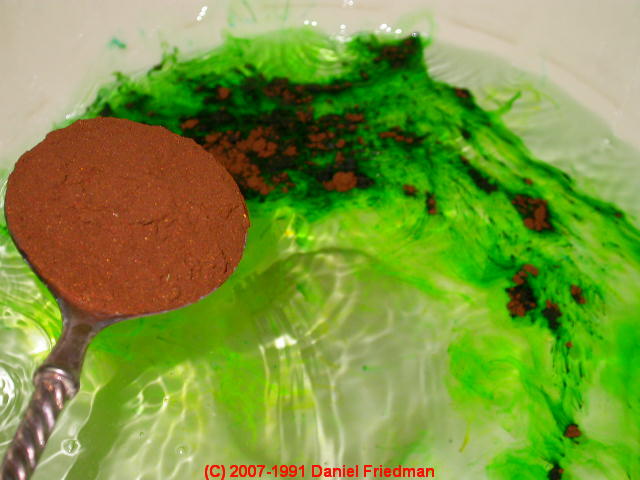
| Amount of Septic Dye Powder to Use: | Minimum of one heaping tablespoon - about 1/100th of a pound or about 2/10 of an ounce by weight. Green septic dye is fine for snowy conditions; red septic dye shows up better in grass. Yellow Green septic dye is better for detection of effluent if there is already murky brown surface water present. For fluorescent dyes, both dye color groups may be visible by using ultraviolet lighting, but home inspectors do not normally apply that method. The two colors will sometimes permit determination of which drain is connected to which septic tank or drywell.) |
| Volume of Liquid Septic Dye to Use: | 1.6 oz (liquid) per 1,000 gallons of septic tank volume. |
Notes to the Table of Septic Dye Test Volumes and Dye Amount
- Before selecting a test volume the inspector needs to know something about the design of the
onsite wastewater disposal system that is installed.
The table above assumes a conventional septic tank and drainfield are installed. If a dosing system, pumping system, or other special designs are present, flooding the system beyond the design-specifications for a given time period could damage the system or produce inappropriate test conclusions. - The validity of a septic loading and dye test is not based on the length of time
that water is run into building fixtures - though readers will see many inspectors who use
this criterion.
Rather the validity of the test depends on the total volume of water that was placed into the system along with other obvious procedural steps such as making sure that the fixtures used to introduce water into the system indeed drain into the septic system being tested and not to somewhere else. - Calculating Septic Tank Volume: see Septic Tank Capacity vs Usage in Daily Gallons of Wastewater Flow calculating septic tank volume and septic tank size required
- Tramfloc Inc., (Tempe AZ) a producer of dye tablets and liquids, indicates the following dye amounts and capabilities:
- One Bright Dyes Tramfloc Dye Tablet will color 60 gallons of water. So to color 600 gallons you'd need to use 10 tablets.
- One pound of Tramfloc "Bright Dyes Standard Blue and FLT Yellow/Green will treat 120,000 gallons of water.
- One pound of FWT Red Dye (more expensive to use) will treat 60,400 gallons.
- One pint of liquid Standard Blue and FLT Yellow/Green will treat 12,500 gallons
- One pint of liquid Red 25 will treat 6,250 gallons
- "Treat" in this instance means that a strong, easily visible color is produced.
- Where existing surface water is murky brown colored, Tramfloc recommends the FLT Yellow/Green tracer dye.
- Tramfloc Inc. informs us that their septic dye products are non-toxic and are rated for use in potable water. However inspectors who put any dye product into a toilet which overflows or into a drain which is leaking will stain the building.
How to Determine Septic Loading Test Volume
Recommended Septic Loading: How to Determine Dye Test Water Volume, and Amount of Septic Dye
FIXTURE FLOW RATE - Estimate the test fixture flow rate during a septic test
Based on field experience, actual test measurements at 25 residences served by private well systems and observations of typical flow and pressure at residences served by municipal water supply systems, we find that 3 gpm is a reasonable estimate of flow from a single tub or un-screened sink fixture. Most private systems can deliver this volume.
Actual quantitative flow rate measurements taken at a single fixture at a single time are dangerously misleading since variations in pump pressure, pipe obstructions, valve settings, can affect flow.
If accurate quantitative measurement of flow rate is needed, and remembering that you're measuring the flow provided by the pump, pipes, valves, and fixtures, not the well flow capacity, a simple procedure is the use of a 5-gallon bucket under the test fixture, and a stopwatch. However multiple measurements may be needed to evaluate the variation in flow rate during the pump on-off cycle.
How to Set the Septic Loading or Dye Test Water Volume
Some authorities commonly test by loading the system with 50 gallons/bedroom over an hour - the likely maximum load for a typical residential system. A typical trench-type absorption field would contain this volume of water even if there were no percolation during the test period. Therefore breakout or failure at these volumes is a reasonable sign of system failure or inadequacy.
Typical septic system design handles 150 gallons/bedroom/day. [Ref. 30, Oberg, citing "Private Water Systems Handbook," produced by the US Dept. of Agriculture Cooperative Extension.]
Lockwood in our own article Septic Systems - An Engineer's View uses this same figure of 150 gallons/bedroom/day to estimate water usage in a typical residential building.
Also see Home & Outdoor Living Water Requirements for more detail.
Keith Oberg (ASHI, Binghamton NY) computes that a standard leach line for soils in central NY range from 90 lineal feet with a 3 foot wide trench and a percolation rate of 1" in 5 minutes, to 375 lineal feet of 3 foot trench with a perc rate of 60 minutes.
The gravel in a standard trench leaves approximately 38% of total volume available to contain effluent. Therefore, assuming no percolation during the test period, the water level will rise 2.35" in a 90' trench and .56" in a 375' trench. (Double these depths for more narrow gravel trenches.) These are not excessive increases in a leaching field which is typically set at least 12" below the surface with 18" depth of gravel as standard practice. It is therefore apparent that an adequate septic system should not break out when subject to this test.
Oberg applies this same test to all septic systems of all types, including sand mounds, sand filters, aeration ponds, jet aerators, drywells, cesspools, etc. If there are multiple systems the water load is split on each system and a 33% extra water load is added to account for errors in estimation of the percentage of total use.
Where to buy septic dye for septic drainfield breakout effluent indication
The first links below allow you to purchase septic dye directly from the producer.
Also see Septic Dye MSDS.
- Bright Dyes, Bright Dyes - A Division of Kingscote Chemicals, 3334 South Tech Blvd. Miamisburg, OH 45342, Tel: 937-886-9100, Toll Free - 800-394-0678, Fax - 937-886-9300 Email: sales@brightdyes.com. Bright Dyes sells Fluorescent Dyes in Yellow/Green, Red, Blue, and Orange colors and in various forms including liquids, powders, tablets, and wax cakes. The company also sells ultraviolet lights that can detect Fluorescent Dye at low concentration. The company describes their products as dye tracers, toilet leak detection, and UV lights.
- Pollard Water source of septic system testing tracer dyes
- Pylam Pyla-Tel Fluorescent green septic dye test dye powder, Pylam Products Company, Inc. 2175 East Cedar Street Tempe, Arizona 85281-7431. Phone: 480-929-0070 800-645-6096. Fax: 480-929-0078. Emails: sales@pylamdyes.com www.pylamdyes.com/contact.html
- Pylam Pyla-Tel Fluorescent red septic dye test dye powder
- Septic dye test powder may be packaged and re-sold by local plumbing or chemical suppliers in in your area.
- For example, we bought repackaged septic dye powder from Duso Chemical in Poughkeepsie NY
- Trace A Leak dye tablets - watch out to be sure you use enough for a valid septic test -
See SEPTIC TEST VOLUMES & DYE AMOUNTS - Trace A Leak liquid septic dye (fluorescent yellow.green) - Tool Experts - http://www.toolexperts.com/
- Tramfloc, Inc. source of septic system testing tracer dyes
- Septic, Cesspool Yellow Fluorescent tracer dye (powder) - http://www.professionalequipment.com home inspection supplier
...
Continue reading at SEPTIC DYE TEST REPORT or select a topic from the closely-related articles below, or see the complete ARTICLE INDEX.
Or see these
Recommended Articles
- CLOGGED DRAIN DIAGNOSIS & REPAIR
- SEPTIC DISPOSAL FIELD CLOGGING INSPECTION
- SEPTIC LOADING & DYE TEST PROCEDURE - home
Suggested citation for this web page
SEPTIC TEST VOLUMES & DYE AMOUNTS at InspectApedia.com - online encyclopedia of building & environmental inspection, testing, diagnosis, repair, & problem prevention advice.
Or see this
INDEX to RELATED ARTICLES: ARTICLE INDEX to SEPTIC SYSTEMS
Or use the SEARCH BOX found below to Ask a Question or Search InspectApedia
Ask a Question or Search InspectApedia
Try the search box just below, or if you prefer, post a question or comment in the Comments box below and we will respond promptly.
Search the InspectApedia website
Note: appearance of your Comment below may be delayed: if your comment contains an image, photograph, web link, or text that looks to the software as if it might be a web link, your posting will appear after it has been approved by a moderator. Apologies for the delay.
Only one image can be added per comment but you can post as many comments, and therefore images, as you like.
You will not receive a notification when a response to your question has been posted.
Please bookmark this page to make it easy for you to check back for our response.
Our Comment Box is provided by Countable Web Productions countable.ca
Citations & References
In addition to any citations in the article above, a full list is available on request.
- "International Private Sewage Disposal Code," 1995, BOCA-708-799-2300, ICBO-310-699-0541, SBCCI 205-591-1853, available from those code associations.
- "Manual of Policy, Procedures, and Guidelines for Onsite Sewage Systems," Ontario Reg. 374/81, Part VII of the Environmental Protection Act (Canada), ISBN 0-7743-7303-2, Ministry of the Environment,135 St. Clair Ave. West, Toronto Ontario M4V 1P5 Canada $24. CDN.
- Manual of Septic Tank Practice, US Public Health Service's 1959.
- Septic Tank/Soil-Absorption Systems: How to Operate & Maintain, Equipment Tips, U.S. Department of Agriculture, 8271 1302, 7100 Engineering, 2300 Recreation, September 1982, web search 08/28/2010, original source: http://www.fs.fed.us/t-d/pubs/pdfimage/82711302.pdf
- SEPTIC SOIL & PERC TESTS soil perc testing guide and instructions
- Percolation Testing Manual, CNMI Division of Environmental Quality, PO Box 501304, Saipan, MP 96950
- Mark Cramer Inspection Services Mark Cramer, Tampa Florida, Mr. Cramer is a past president of ASHI, the American Society of Home Inspectors and is a Florida home inspector and home inspection educator. Mr. Cramer serves on the ASHI Home Inspection Standards. Contact Mark Cramer at: 727-595-4211 mark@BestTampaInspector.com
- John Cranor [Website: /www.house-whisperer.com ] is an ASHI member and a home inspector (The House Whisperer) is located in Glen Allen, VA 23060. He is also a contributor to InspectApedia.com in several technical areas such as plumbing and appliances (dryer vents). Contact Mr. Cranor at 804-873-8534 or by Email: johncranor@verizon.net
- Advanced Onsite Wastewater Systems Technologies, Anish R. Jantrania, Mark A. Gross. Anish Jantrania, Ph.D., P.E., M.B.A., is a Consulting Engineer, in Mechanicsville VA, 804-550-0389 (2006). Outstanding technical reference especially on alternative septic system design alternatives. Written for designers and engineers, this book is not at all easy going for homeowners but is a text I recommend for professionals--DF.
Design Manuals for Septic Systems
- US EPA ONSITE WASTEWATER TREATMENT SYSTEMS MANUAL [online copy, free] Top Reference: US EPA's Design Manual for Onsite Wastewater Treatment and Disposal, 1980, available from the US EPA, the US GPO Superintendent of Documents (Pueblo CO), and from the National Small Flows Clearinghouse. Original source http://www.epa.gov/ORD/NRMRL/Pubs/625R00008/625R00008.htm Onsite wastewater treatment and disposal systems, Richard J Otis, published by the US EPA. Although it's more than 20 years old, this book remains a useful reference for septic system designers. U.S. Environmental Protection Agency, Office of Water Program Operations; Office of Research and Development, Municipal Environmental Research Laboratory; (1980)
- In addition to citations & references found in this article, see the research citations given at the end of the related articles found at our suggested
CONTINUE READING or RECOMMENDED ARTICLES.
- Carson, Dunlop & Associates Ltd., 120 Carlton Street Suite 407, Toronto ON M5A 4K2. Tel: (416) 964-9415 1-800-268-7070 Email: info@carsondunlop.com. Alan Carson is a past president of ASHI, the American Society of Home Inspectors.
Thanks to Alan Carson and Bob Dunlop, for permission for InspectAPedia to use text excerpts from The HOME REFERENCE BOOK - the Encyclopedia of Homes and to use illustrations from The ILLUSTRATED HOME .
Carson Dunlop Associates provides extensive home inspection education and report writing material. In gratitude we provide links to tsome Carson Dunlop Associates products and services.
 | HOME | ABOUT | ASK a QUESTION | CONTACT | CONTENT USE POLICY | DESCRIPTION | POLICIES | PRIVACY | |
| © 2024 - 1985 Publisher InspectApedia.com - Daniel Friedman | |||||||||