
InspectAPedia® FREE Encyclopedia of Building & Environmental Construction, Diagnosis, Maintenance & Repair |
Question? Just ask us! InspectAPedia
|
 Just Where to Look to Find the Septic Drainfield
- Video 3
Just Where to Look to Find the Septic Drainfield
- Video 3
- POST a QUESTION or COMMENT about looking for the septic drainfield or soakaway bed or leach field
How to use visual clues to find the seepage beds or leaching field:
Exactly where should you look to find the septic drainfield or soakaway bed? This article helps you find a septic tank, D-box, soakaway bed or drainfield and other components by identifying locations at a building site where those components could fit and should have been placed.
InspectAPedia tolerates no conflicts of interest. We have no relationship with advertisers, products, or services discussed at this website.
Visual Clues that Indicate Drain Field Location
Septic Location Video Part 3 - Probable Drainfield Location at a Site - by visual clues
Click the image above, or use this YouTube URL https://youtu.be/01tRj5vrIoA to see the video above in a larger window.
The septic system video#3 above describes walking an 18 year old homesite by a lake to find the septic system components. We observe one area that by its space and absence of trees and rocks is almost certainly the drainfield location - a fact later confirmed by the owner.
This particular drainfield is uphill from the septic tank and the home which it serves. A septic pumping system will be needed.
This article series and our accompanying SEPTIC COMPONENT LOCATION VIDEOS explains how to find the leach field or drainfield portion of a septic system.
We include sketches and photos that help you learn what to look for, and we describe several methods useful for finding buried drainfield components. (Septic drain fields are also called soil absorption systems or seepage beds.)
Suppose we have no documentation and no idea where the drainfield is located.
You can walk the building site looking for where a septic field could possibly be placed based on space, soil, and terrain conditions as well as distances from property boundaries and from a well if one is present.
Our video at the top of this page gives a site walk through example of that procedure.
If you cannot find any candidate locations for a drainfield, go back to "square one" and start with our SEPTIC TANK, HOW TO FIND article. Once we can find the septic tank itself, the septic tank outlet defines the location of the effluent drain line that leads to the leach field.
But remember that a drainfield may not be installed at all. There could be a seepage pit, or nothing, yet the septic system may appear to be working, depending on the level of its usage and soil characteristics.
An experienced contractor or inspector can often tell where the leach field is by a simple visual check of the property since s/he knows the typical size, elevation, and soil requirements - in other words, we look to see where a leach field could possibly be fit at a property.
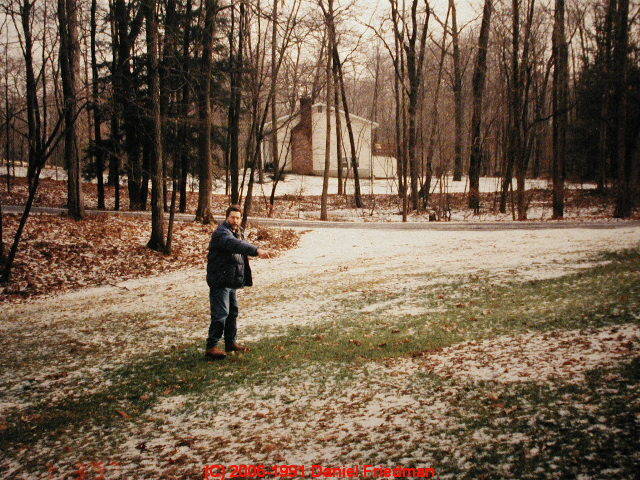
In the photo our client is pointing to a filled-area at the front of his home - which we determined was the probable drainfield area. Unfortunately the installer put his fill right across a creek bed (look in the upper photo at the natural lay of the land). So the drain field did not have much of a life before its effluent leaked into groundwater, appearing in our test as pink-dyed effluent in a nearby stream.
Our article SEPTIC DRAINFIELD SIZE discusses how to locate the septic field and how to determine septic field size for a conventional drain field. Knowing these most basic design considerations can tell you where to look for septic fields at a building site by knowing where a working field might be expected to be installed.

If a property has an alternative design system such as a mound or raised bed or other special absorption field designs, those will be more obvious as a terrain feature. You'll see a rather large, rather flat area of raised soil or filled soil on the property.
Sizes can vary widely but a small constructed drainfield made of fill might be 30' wide x 50' long. In the photo a two-level or "tiered" septic mound was installed perhaps 20 years ago; the lower mound is visible in the foreground.
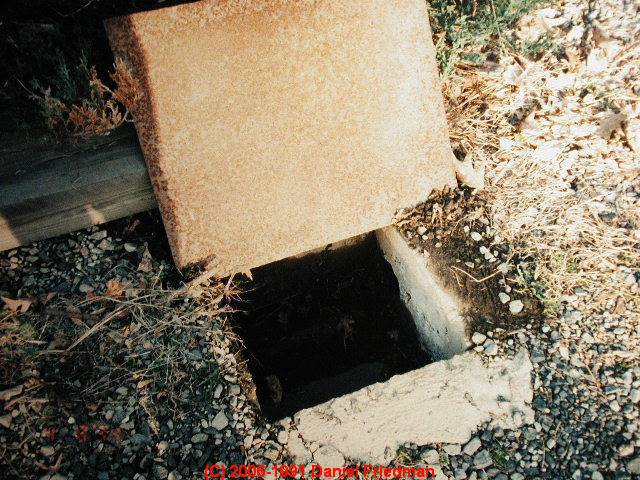
The shrubs are a bit close to the septic field, which we found was in failure - dyed septic effluent appeared in the driveway in the close foreground, and could be seen quickly in this drain basin intended we were told to remove water from the driveway. Actually it was removing septic effluent from the drive.
There may be good visual clues that indicate the drainfield location, especially if you know what to look for.
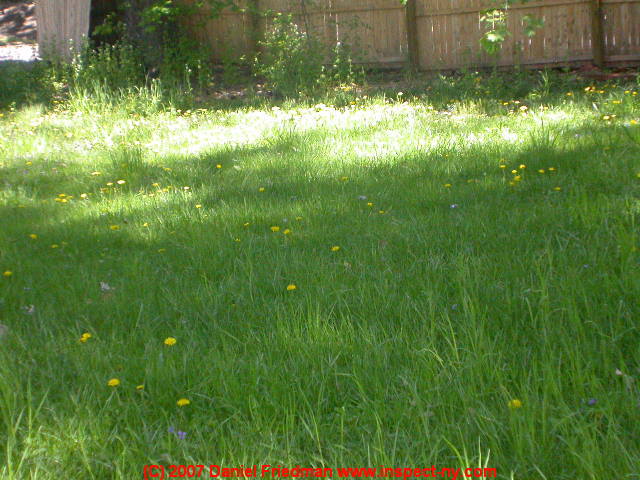
Areas Cleared of Rocks and Major Trees Often Marks the Location of an Older Drainfield
This older and mature lawn is free of large trees and rocks though those items are found at other areas of this building site. This is where we expected to find the septic tank and drainfield.
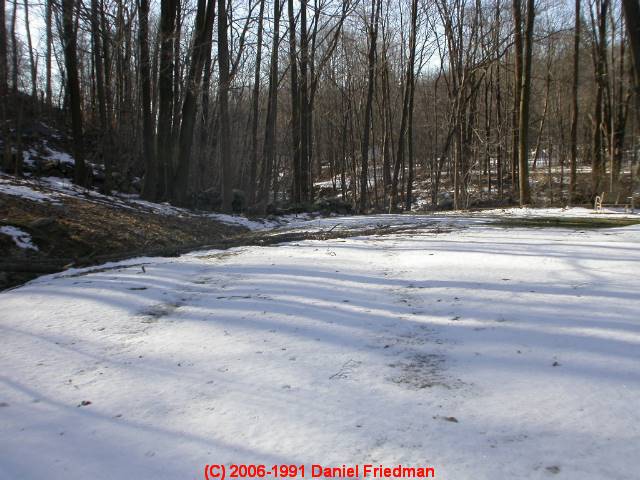
Often it is possible to see long parallel depressions which mark leach field trenches. You cannot see them in this photo (a tank and seepage pit were found later) but you can see them in the next section of this article. These depressions are caused by earth fill settlement over the drainfield trenches.
They may
be visible in systems of almost any age. Long parallel depressions, perhaps 24 to 30" wide and
many feet long, perhaps 20' to 40' and spaced perhaps 4' to 6' apart are suggestive of
drain field trenches.
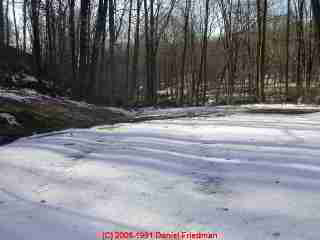
Areas of Snow Melt may Show Drainfield Layout, Trench Lines, Location
In northern climates when there is light snow cover, the drain field depressions may be easier to see for a couple of reasons:
- the snow cover forms a smooth blanket which more easily shows-up depressions, especially in late afternoon light when the sun is low in the sky and shadows are more obvious.
- Because septic effluent is flowing into an in-use drainfield the trench areas may be a bit warmer than the surrounding soil, causing snow to melt or be thinner over the trenches, and adding to the "depression" effect.
Wet Areas may Show a (failing) Drainfield Location
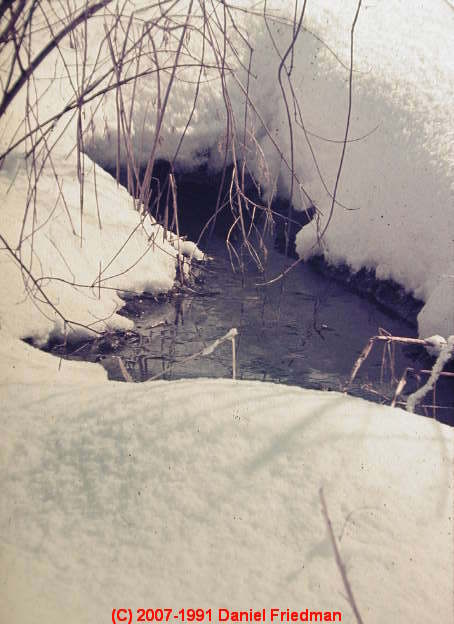
It's too bad, but sometimes the leaching bed or drainfield location becomes obvious because it is in failure mode.
If a drainfield is failing by pushing effluent to the surface that is a rather obvious clue of the field location.
The effluent breakout most-often occurs at the low-end of the failing drainfield line(s), but it can occur anywhere that a pipe is clogged, damaged, or leaking. In this photo, which we discuss in more detail below, the septic system failure and thus the septic field location was visually evident even under deep snow cover.
Often it is possible to see an area of raised-fill which was built to house the leach field.
VISUAL CLUES LOCATE the DRAINFIELD contains additional clues that telltale where you can expect to find the septic drainfield.
Citation of this article by reference to this website and brief quotation for the sole purpose of review are permitted. Use of this information at other websites, in books or pamphlets for sale is reserved to the author. Technical reviewers and content suggestions are welcome and are credited at "References."
...
Continue reading at VISUAL CLUES LOCATE the SEPTIC TANK or select a topic from the closely-related articles below, or see the complete ARTICLE INDEX.
Or see these
Recommended Articles
- CLEARANCE DISTANCES, SEPTIC SYSTEM
- SEPTIC COMPONENT LOCATIONS
- SEPTIC DRAINFIELD INSPECTION & TEST - home
- SEPTIC DRAINFIELD LOCATION
- DRAINFIELD PIPE LOCATION, PRECISE
- EXCAVATE to LOCATE DRAINFIELD
- REASONS to FIND THE DRAINFIELD
- RECORDS to LOCATE the DRAINFIELD
- SURPRISING DRAINFIELD LOCATIONS
- UNLIKELY DRAINFIELD LOCATIONS
- VISUAL CLUES LOCATE the DRAINFIELD
- VISUAL CLUES LOCATE the SEPTIC TANK
- SEPTIC DRAINFIELD SIZE
- SEPTIC DRAINFIELD SHAPE
- SEPTIC TANK, HOW TO FIND for details about finding the septic tank or chamber or drywell or seepage pit.
- SEPTIC VIDEOS - home, showing how to find the septic system, septic tank, & septic drainfield
Suggested citation for this web page
VISUAL CLUES LOCATE the DRAINFIELD at InspectApedia.com - online encyclopedia of building & environmental inspection, testing, diagnosis, repair, & problem prevention advice.
Or see this
INDEX to RELATED ARTICLES: ARTICLE INDEX to SEPTIC SYSTEMS
Or use the SEARCH BOX found below to Ask a Question or Search InspectApedia
Ask a Question or Search InspectApedia
Questions & answers or comments about problems with the operation of aerobic septic systems
Try the search box just below, or if you prefer, post a question or comment in the Comments box below and we will respond promptly.
Search the InspectApedia website
Note: appearance of your Comment below may be delayed: if your comment contains an image, photograph, web link, or text that looks to the software as if it might be a web link, your posting will appear after it has been approved by a moderator. Apologies for the delay.
Only one image can be added per comment but you can post as many comments, and therefore images, as you like.
You will not receive a notification when a response to your question has been posted.
Please bookmark this page to make it easy for you to check back for our response.
Our Comment Box is provided by Countable Web Productions countable.ca
Citations & References
In addition to any citations in the article above, a full list is available on request.
- New York State Department of Health, APPENDIX 75-A WASTEWATER TREATMENT STANDARDS - INDIVIDUAL HOUSEHOLD SYSTEMS , [PDF] New York State Department of Health, 3 February 2010, retrieved 3/1/2010, original source: https://www.health.ny.gov/regulations/nycrr/title_10/part_75/appendix_75-a.htm
- Percolation Testing Manual, CNMI Division of Environmental Quality, Gualo Rai, Saipan provides an excellent English Language manual guide for soil percolation testing. Original source: www.deq.gov.mp/artdoc/Sec6art108ID255.pdf
- Soil Test Pit Preparation, fact sheet, Oregon DEQ Department of Environmental Quality, original source www.deq.state.or.us/wq/pubs/factsheets/onsite/testpitprep.pdf The Oregon DEQ onsite water quality program can be contacted at 811 South Ave, Portland OR 97204, 800-452-4011 or see http://www.oregon.gov/DEQ/
- Thanks to reader Michael Roth for technical link editing 6/29/09.
- SEPTIC TANK/SOIL-ABSORPTION SYSTEMS: HOW TO OPERATE & MAINTAIN [PDF] - , Equipment Tips, U.S. Department of Agriculture, 8271 1302, 7100 Engineering, 2300 Recreation, September 1982, web search 08/28/2010, original source: http://www.fs.fed.us/t-d/pubs/pdfimage/82711302.pdf.
- Pennsylvania State Fact Sheets relating to domestic wastewater treatment systems include
- Pennsylvania State Wastewater Treatment Fact Sheet SW-161, Septic System Failure: Diagnosis and Treatment
- Pennsylvania State Wastewater Treatment Fact Sheet SW-162, The Soil Media and the Percolation Test
- Pennsylvania State Wastewater Treatment Fact Sheet SW-l64, Mound Systems for Wastewater Treatment
- Pennsylvania State Wastewater Treatment Fact Sheet SW-165, Septic Tank-Soil Absorption Systems
- Document Sources used for this web page include but are not limited to: Agricultural Fact Sheet #SW-161 "Septic Tank Pumping," by Paul D. Robillard and Kelli S. Martin. Penn State College of Agriculture - Cooperative Extension, edited and annotated by Dan Friedman (Thanks: to Bob Mackey for proofreading the original source material., Diagnosis, & Repair
- Advanced Onsite Wastewater Systems Technologies, Anish R. Jantrania, Mark A. Gross. Anish Jantrania, Ph.D., P.E., M.B.A., is a Consulting Engineer, in Mechanicsville VA, 804-550-0389 (2006). Outstanding technical reference especially on alternative septic system design alternatives. Written for designers and engineers, this book is not at all easy going for homeowners but is a text I recommend for professionals--DF.
- Builder's Guide to Wells and Septic Systems, Woodson, R. Dodge: $ 24.95; MCGRAW HILL B; TP; Quoting from Amazon's description: For the homebuilder, one mistake in estimating or installing wells and septic systems can cost thousands of dollars. This comprehensive guide filled with case studies can prevent that. Master plumber R. Dodge Woodson packs this reader-friendly guide with guidance and information, including details on new techniques and materials that can economize and expedite jobs and advice on how to avoid mistakes in both estimating and construction. Chapters cover virtually every aspect of wells and septic systems, including on-site evaluations; site limitations; bidding; soil studies, septic designs, and code-related issues; drilled and dug wells, gravel and pipe, chamber-type, and gravity septic systems; pump stations; common problems with well installation; and remedies for poor septic situations. Woodson also discusses ways to increase profits by avoiding cost overruns.
- In addition to citations & references found in this article, see the research citations given at the end of the related articles found at our suggested
CONTINUE READING or RECOMMENDED ARTICLES.
- Carson, Dunlop & Associates Ltd., 120 Carlton Street Suite 407, Toronto ON M5A 4K2. Tel: (416) 964-9415 1-800-268-7070 Email: info@carsondunlop.com. Alan Carson is a past president of ASHI, the American Society of Home Inspectors.
Thanks to Alan Carson and Bob Dunlop, for permission for InspectAPedia to use text excerpts from The HOME REFERENCE BOOK - the Encyclopedia of Homes and to use illustrations from The ILLUSTRATED HOME .
Carson Dunlop Associates provides extensive home inspection education and report writing material. In gratitude we provide links to tsome Carson Dunlop Associates products and services.
 | HOME | ABOUT | ASK a QUESTION | CONTACT | CONTENT USE POLICY | DESCRIPTION | POLICIES | PRIVACY | |
| © 2024 - 1985 Publisher InspectApedia.com - Daniel Friedman | |||||||||