
InspectAPedia® FREE Encyclopedia of Building & Environmental Construction, Diagnosis, Maintenance & Repair |
Question? Just ask us! InspectAPedia
|
 Septic Pump Alarms &
Septic Alarm Video
- POST a QUESTION or COMMENT about how to buy, install, test, & repair septic alarms on septic of sewage pumps and tanks
Septic alarms / septic or sewage pump alarm systems:
This article describes alarm systems used on septic pumps, grinder pumps, and septic tank pumping stations and pumping systems.
This article series explains the differences between Sump Pumps, Sewage Ejector Pumps, Septic Grinder Pumps, Sewage Pumping Stations, & Septic Pump Alarms.
InspectAPedia tolerates no conflicts of interest. We have no relationship with advertisers, products, or services discussed at this website.
- Daniel Friedman, Publisher/Editor/Author - See WHO ARE WE?
Septic Pump Alarm Systems
 What to Do if the Sewage Grinder Pump or Ejector Pump Alarm Sounds
- Stop using water, stop flushing toilets, turn off the washing machine, dishwasher, etc. right away to reduce the chances of a sewage backup.
- Turn off the septic or sewage pump alarm. Look for a lit-up button or red "off" button on the alarm box. This switch will stop the alarm from sounding. A warning light may remain illuminated until the pump problem has been repaired.
Watch out: do not open a sewage pumping chamber, pit, or electrical box if you do not know the proper and safe inspection and repair procedures for your requipment. Falling into a septic pit or tank or being shocked can both be fatal.
For a small homeowner-type ejector pump system it may be possible to inspect the sewage pump pit for high water level or flooding.If there has
been an unusual surge of building wastewater into the pumping pit and if the sewage pump is running, then the problem may be temporary and no repair may be needed.
If the pump is running and the wastewater level in the pumping pit is not dropping then the pump is not working and needs repair.
- Examine the pump control float. Rising wastewater should lift the float that in turn operates a switch that turns on the pump.
If the float is stuck by debris, obstructions or anything in the pumping chamber the sewage grinder pump cannot turn on and off as it should. - Contact a licensed plumber who has experience with sewage grinder pump installation and repair work if the pump is not working, not pumping, or not turning off.
If your sewage pumping system is operd by your local municipality, that is if it is not a privately-owned system you will need to contact your local department of public works. - For aerobic septic system alarms, see our diagnostic checkllist
at AEROBIC SEPTIC ALARM SYSTEMS
Septic Tank Pump Alarm Video
Our video demonstrates the operation of a septic tank pump system alarm.
Click the image above, or use this YouTube URL Click the image above, or use this YouTube URL https://youtu.be/oLgsyHrP71Q to see the video above in a larger window.
Septic alarms indicate when the septic tank pump is not operating. Repair is needed promptly.
Advice is given for septic tank effluent or sewage pump selection and use.
Septic pumps used for pumping air in aeration systems and septic pumps used to move effluent in a drip dispersion system are discussed under the appropriate septic system type which are outlined
at SEPTIC SYSTEM DESIGN ALTERNATIVES.
Citation of this article by reference to this website and brief quotation for the sole purpose of review are permitted. Use of this information at other websites, in books or pamphlets for sale is reserved to the author.
Use & Operation of Single septic pump alarm system details
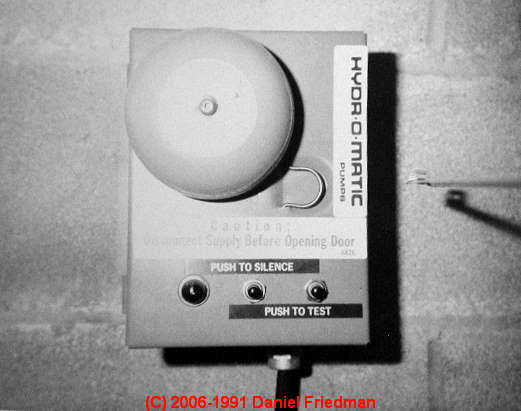 Any sewage pump setup should include an alarm that tells you when a pump has stopped working.
It is important to be able to distinguish between blocked building drains, failing septic systems, and lost function of a septic pump.
Otherwise you will soon be unable to run plumbing fixtures and you may not know why.
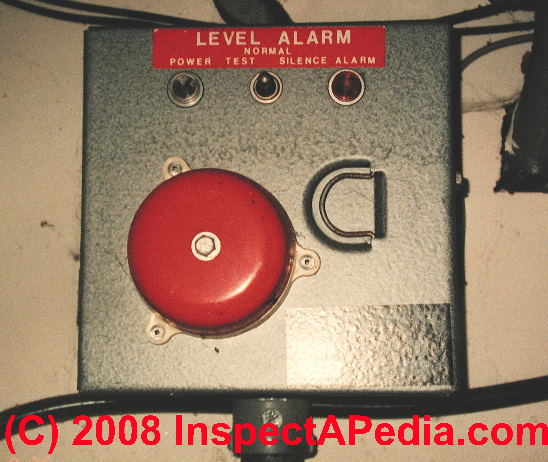
In a single-pump septic system (shown in the photograph at left and at page top) if you hear the septic alarm buzzer or bell it means that you have very little septic capacity before repairs are made, since there is no working pump.
Use & Operation of Duplex septic pump alarm system details

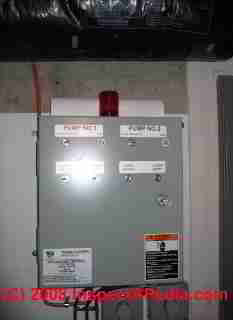
In a duplex septic tank pump system, (shown in photo ) sounding of the septic alarm indicates that you're running on the backup pump.
You need to repair the failed septic pump but you can continue to use the building's plumbing fixtures as the backup pump should be working.
There are two different philosophies for designing duplex backup systems - alternating septic pump cycles and reserve septic pump installations.
We discuss simplex and duplex septic pump installations and the different methods of designing a duplex septic pump system in more detail at
SEWAGE EJECTOR / GRINDER PUMPS
See the septic alarm test demonstration video at the top of this page for an example of testing the septic tank pump alarm system.
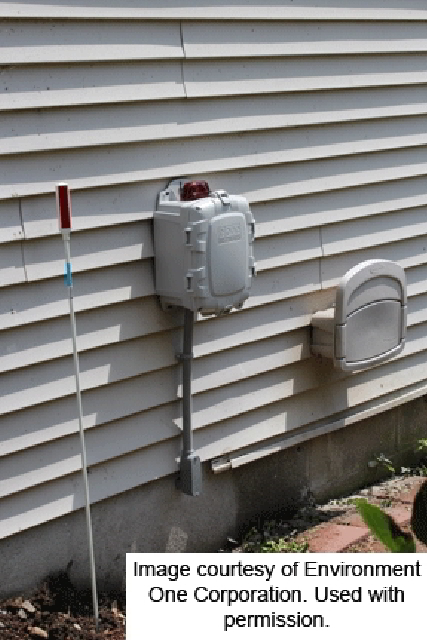
Our illustration at left shows a sewage grinder pump alarm system mounted outdoors on the building exterior wall.
The control panel for a sewage grinder pump system includes pump power switches, alarm, and alarm reset switch or button.
The Environment One Corporation grinder pump control panel shown here should be part of any sewage grinder pump system.
...
Reader Comments, Questions & Answers About The Article Above
Below you will find questions and answers previously posted on this page at its page bottom reader comment box.
Reader Q&A - also see RECOMMENDED ARTICLES & FAQs
On 2020-11-24 by (mod) - how to find the second or third tank in a septic pumping system
Well that's helpful.
IF you still need help locating the second tank, one way to do that quickly is to use a tank locating service. The tech inserts a metal snake into the line leaving the known- and located- tank's outlet that feeds the second tank.
Then she can use an aboveground sensor to follow that snake to find the inlet to the second tank.
On 2020-11-24 by LeAnn
The pump installer is here now. The alarm panel was so old (probably original to house 30+ years ago) that he didn't understand what it did at first. We also had two pumps, the second of which we guessed was a backup pump. So we're getting a new panel too with an alarm.
Our current understanding is that we *do* have two separate tanks. At least, that's the way they're drawn on on as-built plan and what our landscape architect told us. Thank you for your help!
On 2020-11-24 - by (mod) -
No need to be sorry, none of us knows all of the terms involved in any of these topics
Usually the settling chamber is a joining the pumping chamber. If that's the case were probably describing a three compartment septic tank. Sewage comes in two compartment 1. Effluent flows in to compartment 2 and clarified efuent is pumped out of compartment 3
Not all systems use a three-compartment tank and it is possible that instead of a multi-compartment tank there are multiple tanks but the latter would be a bit unusual.
On 2020-11-23 by Anonymous
I'm sorry that I got the terms backwards. It took me days to even understand what kind of system we had. We know where the pumping chamber is. We don't know where the settling chamber is.
We didn't know that we had an ejector pump or that the tanks held anything until a DPW inspector caught the sewage leak. He happened to have been a private contractor a decade ago who installed the ejector pump on our second tank. The sewer installer who came to repair the leak told us that it was likely the pump, but that the pumping chamber needed to be pumped clear to confirm
. Then he told us that the first tank should be pumped every two years, which we haven't done and don't know when it was last done. We haven't been able to find the access panel yet.
I plan to ask the pump installer to put an alarm on the pump chamber so that we aren't caught off guard in the future. But in reading this site, I came across the idea that the frequency of pumping the first tank depends on tank size and usage. We don't know that tank size yet but plan to pump it anyway. I wondered if there was a sensor/alarm that would help us know when the first tank needed to be pumped.
On 2020-11-23 - by (mod) -
I want to help but am a little confused about just what's installed for your septic system.
Usually most of the solids are kept in the first or settling tank, so the pumping chamber doesn't need to be pumped or cleaned so often; but surely your effluent pump that is pumping out of the second tank or chamber is located in or on that tank, right? If so, repairing the pump surely finds the pumping chamber.
Let your septic pumping co. open the tank and measure the depth of sludge and thickness of scum in that chamber and let us know what they find and what they advise.
On 2020-11-23 by LeAnn
We've lived in our house for 3 years and just discovered that we have a dual-tank hybrid septic-forced sewer system. The ejector pump on the second tank ("settling chamber"?) failed but there was no alarm. We need to find the second tank ("holding tank"?) and have it pumped. I know that the settling chamber is 1500 gallons from the sewerage service and will find out how big the holding tank is when it is pumped. It appears to be 30% larger on the as-built plan we have. It's not clear how often we need to pump the holding tank. Is there a separate alarm that can be used to alert us even if it doesn't have a pump?
On 2020-08-14 - by (mod) -
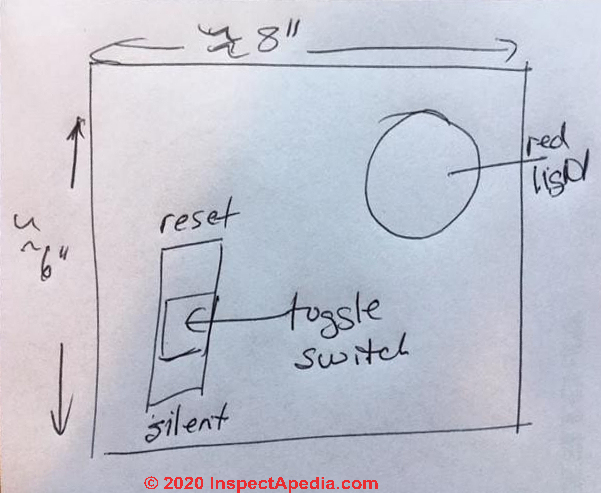
Apologies, Nancy as I want to help, but without a brand and model we're reduced to blind guessing.
Can you find ANY data tags of any sort on the equipment? How about inside any access covers?
Meanrwhile check for a stuck float switch.
On 2020-08-13 by Nancy W
9000 litre septic holding tank red light was on, alarm was on silent but went off when toggled up to reset position. So we had it pumped out. But the red light and alarm have remained on.
We do not have a manual for the system and there are no identifiers for brand / model etc, but we know it was installed in 2015 and this was the first time it needed to be pumped out.
There is only one toggle switch with two positions: down is silent, up is reset.
We don't know exactly how to do a reset on the system. Does anyone know?
Or can anyone identify the brand or model number for us so I can find a manual online?
Many thanks.
On 2020-07-06 - by (mod) -
I'd start by looking for a blockage. Then check pump condition.
On 2020-07-06 by Stephen Ellis
My low air pressure alarm is going off on my aerobic system but the aeration pump is running and producing air. Any suggestions?
On 2020-07-01 - by (mod) -
AE
An electrician who does outside wiribg and has access to a Ditch Witch or other trenching tool can do what you need.
On 2020-06-30 by AE
I moved into a new build that the alarm system for the septic system was not installed properly. The wire running from the septic to the alarm in the house I suspect was damaged when it was burried or cement was poured for our patio. A septic guy installed a temporary line above ground from the septic to the house and the alarm works. We need to find someone that will replace the underground damaged line or install a new one. Unfortunately, cement has been poured for our patio which is over the line running to the septic.
Who is the best person to contact to have an underground permanent line put in so our septic alarm works properly and permanently (electrician, plumber, septic guy?). The above ground wire is not a permanent solution as we have to keep disconnecting during mowing/etc.
On 2020-05-10 - by (mod) -
 Joy
Joy
I agree that that doesn't sound as if your Tank Alert is working properly.
If you don't have the user's manual you can find a copy here:
TANK ALERT SJB USERS MANUAL [PDF]
This manual is described as
SJE PANEL LINK™ RTU WEB-BASED CELLULAR REMOTE MONITORING CONTROL PANEL
That didn't help us out.
I also looked at the installation guide - if you don't have that, see TANK-ALERT AB INSTALLATION MANUAL [PDF] at
There is not much detail. Here's a quote:
This alarm system monitors liquid levels in lift pump chambers, sump pump basins, holding tanks, sewage, agricultural, and other water
applications.
The Tank Alert® AB indoor rated alarm system can serve as a high or low level alarm depending on the float switch
model used. The alarm horn sounds when a potentially threatening liquid level condition occurs.
The horn can be turned off, but the
alarm light remains on until the condition is remedied.
Once the condition is cleared the alarm will automatically reset. A green "Power On" light indicates 120 VAC primary power to the alarm.
Low battery chirp feature indicates when battery should be replaced.
So what's left? Contact the company to ask for advice.
Contact: SJE Inc.
Technical support: +1 800-746-6287
techsupport@sjeinc.com
22650 County Highway 6
Detroit Lakes, Minnesota 56501 USA
www.csicontrols.com www.primexcontrols.com www.sjerhombus.com
On 2020-05-10 by Joy
Our septic alarm only makes a "click" sound when the test button is pushed - not an alarm sound. I know the alarm system works because we intentionally activated it by lifting the float in the tank - which did cause the alarm button to light up properly but the noise was only a click (not a audible alarm as it should). I tried unplugging the uint to reset it but had the same results when plugged back in. Any suggestions on how to repair in order to save the cost of replacing the entire unit? It is a Tank Alert AB SJE Rhombus.
On 2020-04-30 - by (mod) - septic alarm is now turned off but can we use the toilets?
I'm cautious as i know nothing about your system.
The worry us overflowing toilets into the home.
Safest temporary measure is use toilets if you must, but flush rarely.
On 2020-04-30 by Anonymous
Thank you danjoefriedman I got it turned off but the problem is I've got 5 kids (bathroom) so you suggest not using anything at all until someone comes to fix it?
On 2020-04-30 - by (mod) - alarm on my jet inc. Backwash control panel won't silence
If the silence alarm switch doesnt work,
Then
Turn off electrical power to the system.
Avoid using plumbing until the system is diagnosed.
On 2020-04-30 by Anonymous
My alarm on my jet inc. Backwash control panel. The reset button will not shut out off. What can I do. It's 11pn can't sleep. Help.
On 2019-05-22 - by (mod) - there is no conventional septic system that requires a monthly treatment or additive
Denna
Except for some special aerobic system cases, there is no conventional septic system that requires a monthly treatment or additive - you could IMO as well simply flush a ten dollar bill down the toilet. Furthermore, some treatments are illegal and can contaminate the environment.
You won't find a septic alarm on a conventional septic system that receives its waste by gravity and disposes of effluent by gravity to a drainfield.
Septic alarms are used on septic and other equipment that use a pump, such as a lift pump that lifts sewage up from a low building level (perhaps a basement) to a main sewer line that runs out of the building higher than that.
A pump alarm may also be on an effluent pump that lifts effluent out of a septic tank and UP to a raised bed septic or into a mound system that's higher than the septic tank.
And aerobic septic systems that use an air pump to aerate the septic tank and to move effluent use alarms.
On 2019-05-22 1 by Denna
@Denna
An addendum: Being over 70 years old, this is the first house I've lived with a septic system. Otherwise, it's always been on a city or county sewer system.
I moved to a house with a septic system a year ago. So far, all is well. I use an appropriate septic product monthly and follow healthy septic system guidelines. My question, does all septic systems have an alarm? As far as I know, my septic "tank" is below ground and I cannot nor have ever seen it.
Where might an alarm be installed? I know one is not in the house next to the breaker box. My house was built in 1991.
On 2018-11-08 - by (mod) - the alarm continues to sound because ...
Brad
I'm guessing that the alarm continues to sound too because the condition that is causing it, such as abnormally high waist water levels or a pump that is not working, has not been cleared.
You might want to check the instructions for your control to see what the alarm signals and then let me know what you find.
On 2018-11-07 by Brad
Elect box making a chirping sound but alarm light When I push the reset button the chirping is still there
On 2018-05-11 by Jeanette C Dalton
Pump alarm goes off Tank has been cleaned We do have one toilet that has been causing problems
On 2018-01-14 - by (mod) - American system control box alarms goes off
If re-setting the alarm does not fix the trouble, it's possible that a power surge has damaged a pump controller.
On 2018-01-13 by Anonymous
My American system control box alarms goes off when there is a spike in the house electric and has to be manually shut off. What should I do to fix this problem. I installed this system 15 years ago but this problem just started a couple months ago.
My American system control box alarms after a spike in the house electric.
On 2016-10-26 by Anonymous
My lift station control has a lit green light what should I do
Reader Question: what are the common causes for a pump alarm to go off
What are the most common causes a pump tank alarm would go off?
My grinder pump is only 4 yrs old and we are still building, so it does not get that much use. C.S. 8/5/12
 Reply:
A competent onsite inspection by an expert usually finds additional clues that help accurately diagnose a problem with a sewage pump such as a defective check valve or a running toilet that keeps filling the reservoir tank.
That said, the alarm sounds when the level in the reservoir reaches a level that means that the primary pump is not working, or in a single pump system, that no pump is working.
So in addition to checking for a running toilet and bad check valve, check that the float switch is properly installed and that its movement is not obstructed.
Question: why is the septic alarm going off in our new home?
What happens with a new home less then 6 months old and the alarm keeps going off? - Carol 8/18/11
Reply:
Carol, septic pump alarm systems operate on a sensor or float control that monitors wastewater level in the septic tank or pumping chamber.
The idea is that if the level rises above some point, the alarm warns the homeowners that the single pump has failed to start, or if it's a duplex pump system (two pumps) that the first pump didn't work and the second pump has started (the backup pump is doing all the work).
You need to know from the installer what design you have;
Perhaps there is a pump to repair or replace (duplex pump, running off backup) or there is a pump alarm float switch that is not set to the proper level.
Question: Our septic alarm gose off if the system loses power.
Checked all the floats, everything working fine. Pump ok, high level alarm ok, Q: the alarm goes off if the power goes off to the system. It has never done this before. If I turn off the breaker, and back on, the alarm sounds until I silence and reset. - Mike 10/13/11
Reply:
Mike in the past when we heard about alarm sounding problems the problem was usually traced to a float that had slipped out of position. As you've checked the floats and wastewater levels I'm afraid it sounds as if there may be as shorted wire. The float is basically a switch that closes to sound the alarm. So I'd check the float switch or the actual wiring.
If you use an ohmmeter and see zero resistance across the wires that are supposed to trigger the alarm, the wires are probably shorted or the switch is stuck.
Also check for a battery-backup alarm system that is intended to warn of loss of power - basically we can't keep using a septic grinder pump very long if there is no electrical power. The usage time buffer depends on the size of the holding tank.
Reader follow-up:
Thanks. I will disc. the float wires and troubleshoot from there.
Reply:
Sounds right, Mike. In fact if you can disconnect the wires at both ends that's another way to check for a short between them enroute.
Question: why does a grinder pump alarm go off on a seldom used system?
What are the most common causes a pump tank alarm would go off? My grinder pump is only 4 yrs old and we are still building, so it does not get that much use,. C.S. 8/5/12
Reply:
A competent onsite inspection by an expert usually finds additional clues that help accurately diagnose a problem with a sewage pump such as a defective check valve or a running toilet that keeps filling the reservoir tank.
That said, the grinder pump alarm sounds when the level in the reservoir reaches a level that in turn signifies that the primary pump is not working, or in a single-pump system, that the pump is working and the level of wastewater has reached the level at which the alarm will sound.
So check your plumbing system for:
- a running toilet draining into the toilet or even a running shower or faucet
- ground water or some other water source (A/C condensate?) draining into the grinder pump reservoir
- bad check valve that lets other household wastewater drain back into the grinder pump reservoir
also
- check that the float switch is properly installed and is at the right level
Also see water & flood alarms described at SEWAGE EJECTOR / GRINDER PUMPS
...
Continue reading at SEWAGE EJECTOR / GRINDER PUMPS - home, or select a topic from the closely-related articles below, or see the complete ARTICLE INDEX.
Or see these
Recommended Articles
- AEROBIC SEPTIC SYSTEMS, ATUs - home page for Aerobic Septic Systems
- AEROBIC SEPTIC ALARM SYSTEMS - how to silence & troubleshoot
- AEROBIC ATU SEPTIC PROBLEMS
- FLOOD ALARMS - detect water on floors or in basements or crawl spaces
- SEPTIC PUMP ALARM SYSTEMS
- SEWAGE EJECTOR / GRINDER PUMPS - home - includes additional descriptions of sewage & flood alarms
Suggested citation for this web page
SEPTIC PUMP ALARM SYSTEMS at InspectApedia.com - online encyclopedia of building & environmental inspection, testing, diagnosis, repair, & problem prevention advice.
Or see this
INDEX to RELATED ARTICLES: ARTICLE INDEX to SEPTIC SYSTEMS
Or use the SEARCH BOX found below to Ask a Question or Search InspectApedia
Ask a Question or Search InspectApedia
Questions & answers or comments about warning alarms on septic tanks and septic pump systems
Try the search box just below, or if you prefer, post a question or comment in the Comments box below and we will respond promptly.
Search the InspectApedia website
Note: appearance of your Comment below may be delayed: if your comment contains an image, photograph, web link, or text that looks to the software as if it might be a web link, your posting will appear after it has been approved by a moderator. Apologies for the delay.
Only one image can be added per comment but you can post as many comments, and therefore images, as you like.
You will not receive a notification when a response to your question has been posted.
Please bookmark this page to make it easy for you to check back for our response.
IF above you see "Comment Form is loading comments..." then COMMENT BOX - countable.ca / bawkbox.com IS NOT WORKING.
In any case you are welcome to send an email directly to us at InspectApedia.com at editor@inspectApedia.com
We'll reply to you directly. Please help us help you by noting, in your email, the URL of the InspectApedia page where you wanted to comment.
Citations & References
In addition to any citations in the article above, a full list is available on request.
- [1] Environment One Corporation, 2773 Balltown Road, Niskayuna, NY 12309, Tel 518-346-6161,l website: www.eone.com/sewers
E/One Extreme Series grinder pump stations for indoor and outdoor installations, residential and light commercial applications. - [2] Weinman Installation and Operation Manual, Submersible Sewage Ejector Pump, Crane Pumps and Systems, 420 Third Street, Piqua, Ohio 45356 Phone: (937) 778-8947 and Crane Pumps and Systems,
83 West Drive, Bramton,
Ontario, Canada L6T 2J6,
Phone: (905) 457-6223
Fax: (937) 773-7157 Fax: (905) 457-2650
www.cranepumps.com. See Weinman submersible sewage ejector pump installation and service manual for an example instructions for the Weinman Series WE and 3WE sewage ejector pumps ranging from .5 to 1 hp. Web search 8/9/11, original source: http://www.cranepumps.com/downloadables/CATALOGS_OIPMs/
Manuals%20&%20Instruction%20sheets/108038.pdf - [3] Grundfos Sewage Ejector Pump Package Installation and Operating Instructions, Grundfos Pumps Corporation, 2555 Clovis Ave., Clovis CA 93612, Tel: 800-333-1366, web search 8/9/11,original source
http://www.us.grundfos.com/web/download.nsf/Pages/
7C03990D6E09EC6C882565220069C131/$File/Seeje-io.pdf - [4] Submersible Sewage Ejector Pump Installation, Operation, & Parts Manual, by Hydromatic Pentair Water, 740 East 9th Street, Ashland, OH 44805, Phone: 1-888-957-8677, Web Site: http://www.hydromatic.com
- In addition to citations & references found in this article, see the research citations given at the end of the related articles found at our suggested
CONTINUE READING or RECOMMENDED ARTICLES.
- Carson, Dunlop & Associates Ltd., 120 Carlton Street Suite 407, Toronto ON M5A 4K2. Tel: (416) 964-9415 1-800-268-7070 Email: info@carsondunlop.com. Alan Carson is a past president of ASHI, the American Society of Home Inspectors.
Thanks to Alan Carson and Bob Dunlop, for permission for InspectAPedia to use text excerpts from The HOME REFERENCE BOOK - the Encyclopedia of Homes and to use illustrations from The ILLUSTRATED HOME .
Carson Dunlop Associates provides extensive home inspection education and report writing material. In gratitude we provide links to tsome Carson Dunlop Associates products and services.
 | HOME | ABOUT | ASK a QUESTION | CONTACT | CONTENT USE POLICY | DESCRIPTION | POLICIES | PRIVACY | |
| © 2025 - 1985 Publisher InspectApedia.com - Daniel Friedman | |||||||||