
InspectAPedia® FREE Encyclopedia of Building & Environmental Construction, Diagnosis, Maintenance & Repair |
Question? Just ask us! InspectAPedia
|
 Winter & Cold Weather Roof Problems
Roof snow loading, raking snow off of roofs, other solutions to snow accumulation
Roofing in cold weather?
- POST a QUESTION or COMMENT about the effects of winter and cold weather on building roofs and related building components: common problems, causes, prevention, cures
Cold weather & winter weather roof problems, troubleshooting, repairs:
This article describes problems caused in building roofing systems by cold weather and winter weather conditions, and additional roofing troubles that come during roof maintenance (or lack of it) and during re-roofing, roof-overs, or roof replacement jobs.
We also describe a case of severe roof leaks blamed on the roof contractor (who omitted roof flashing) but for which the homeowner also bore some responsibility.
InspectAPedia tolerates no conflicts of interest. We have no relationship with advertisers, products, or services discussed at this website.
Winter & Cold Weather Roof Troubles: Q&A [1]
 Question: Besides ice dams, what other winter issues can hurt your roof?
Reply: List of winter problems, risks, and damage to building roofs besides ice dams
If you restrict comments to hurting the roof itself, it's a too-narrow scope question, because some cold weather and winter roof problems can cause serious trouble in other building areas and with other building components too.
[Click to enlarge any image]
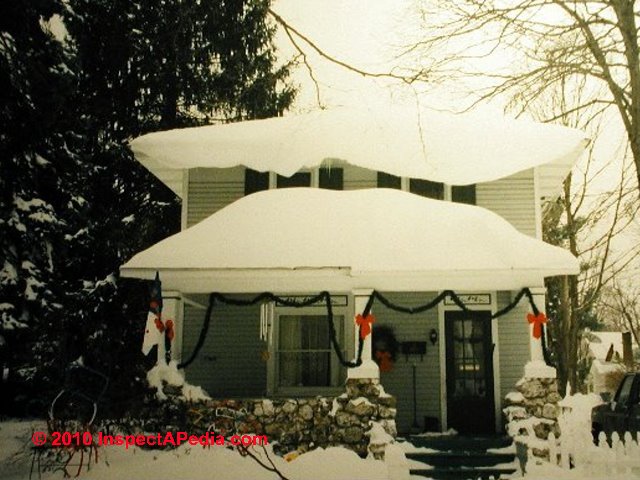
- Heavy weight of accumulated snow, particularly near spring when heavy snow covering may absorb rainfall, can cause structural damage, breaking rafters and leading to catastrophic collapse.
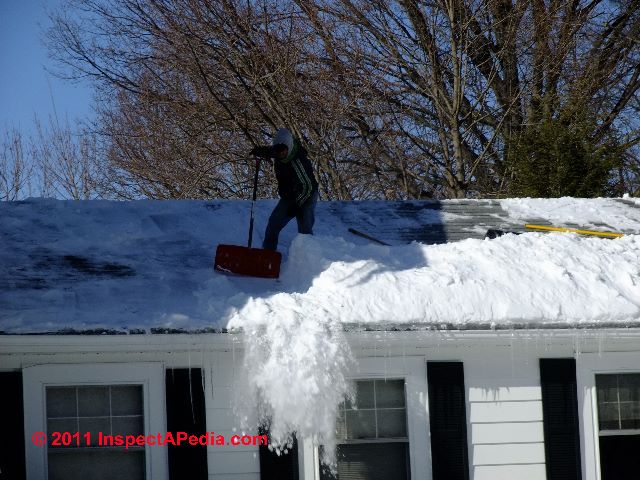
This worry is more of a concern on older structures whose framing may be below modern standards, and on newer structures that either were not properly framed (wrong size and spacing of framing members (rafters, trusses, purlins)), or not properly connected (inadequate or improper nailing, improper or inadequate rafter bearing on the top plate or at the ridge.) - Serious fall injuries, even death, when people try to clear the snow off of their laden roofs without knowing safe procedures for doing-so - secondary damage from people chopping to try to get rid of ice, damaging shingles and gutters - ice pushing off gutters leading to later leaks and building water entry
- Snow-blocked plumbing vents (too-short vents) leading to poor drainage and even sewer gas backups into the building - unsanitary and an explosion risk
- Cracked broken shingles on older roofs that are walked-on when cold.
- Skylight leaks if covered by deep snow followed by heavy rain, most likely at skylights that were already damaged or that were not properly installed, flashed, sealed
- Other roof flashing leaks or leaks at worn roof areas are more likely to show up in the building interior when the weather begins to warm and there is accumulated snow on the building roof. The accumulated snow slows the mechanical drainage of water off of the roof surface, giving water more time to find its way into the structure through even the smallest defect at a hole in a roof valley, a loose section of chimney flashing, or an area of worn shingles.
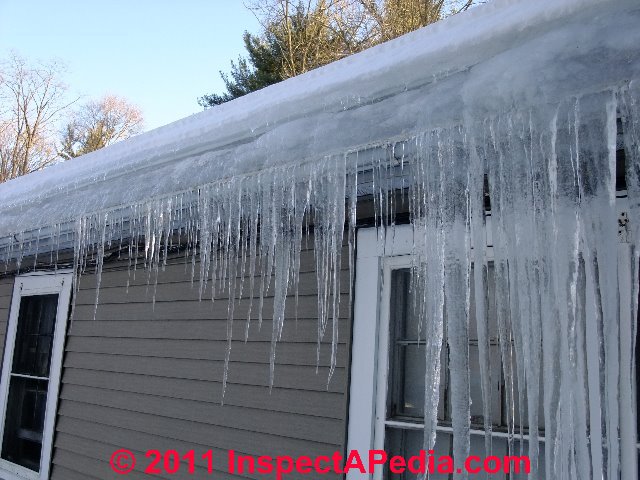
- Ice dams that leak into walls and lead to a costly mold or insect or rot problem can be a much bigger and more costly problem than first meets the eye. Our photo (left) shows severe ice dams at the eaves of a Poughkeepsie New York roof. Ice and water at this building leaked into and around some windows and walls on this structure.
So while your question excludes ice dams it is important for readers to understand that the problems caused by ice dams at roof edges can affect more building areas than the roof itself, including leaks into the attic or roof cavity, leaks into building walls, and an invitation to wood destroying insects or to serious building and building insulation mold contamination.
See our article on ice dams, condensation, and roof leaks caused by ice dams
at ROOF ICE DAM LEAKS.
Also
see FLAT ROOF MOISTURE & CONDENSATION.
And if you're using heat tapes at roof edges to avoid ice dam leaks,
see HEAT TAPES & CABLES for ROOF ICE DAMS.
- Cold weather roof noises: cracks, booms, crashes. We have fielded some interesting reports of annoying roof noises, some of which occur only in very cold weather. On flat and low slope roofs, expanding freezing ice can fracture with a terrific booming noise. Also, temperature-related movements in roofing materials can cause annoying roof noises that lead to building noise complaints by the occupants.
See NOISE CONTROL for ROOFS for details.
Also see BANGING BOOMING NOISE DIAGNOSIS & CURE
Question: If a roof needs to be re roofed or if shingles need to be replaced, is November too late?
Reply: year round roofing procedures
In our opinion, no, not if proper cold-weather roofing procedures are followed. Experts install roofs throughout the year. However if your roofer is not an expert in cold-weather roofing the roof job may indeed not be properly executed and may leak or have a shorter life.
It is our OPINION however that the best roofing work is done in cool dry weather.
 Too hot roof surfaces (asphalt shingle, roll roofing, modified bitumen) may be damaged by workers in very hot weather.
Too wet roof surfaces may result in materials being installed in violation of the roofing manufacturer's instructions, industry standards, and good practice, resulting in reduced roof life. Don't install roofing in the rain nor install roof coverings over wet surfaces.
Too cold roof surfaces and cold weather roofing conditions have a different set of concerns. Some examples of common cold weather snafus during re-roofing or new roof installation include:
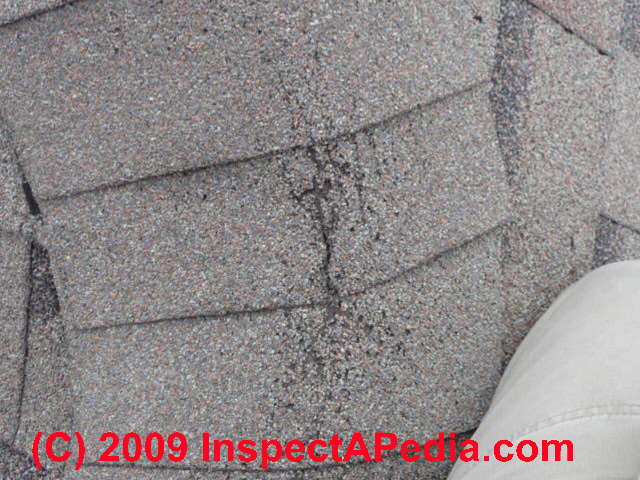
- Cracked shingles installed wherever shingles had to be bent, e.g. over a ridge or hip. Our roof ridge / hip cap shingle photo (left) shows both cracking wear and possibly foot traffic wear (and granule loss).
- Inadequate nailing and hasty or sloppy shingle placement due to the rush that comes to some workers who are suffering cold fingers and general discomfort
- Inadequate flashing or sealing, including later wind-damage if the shingle tabs didn't seal down well (requires sun exposure) before a wind storm occurs; use of mastics and sealants that don't work in low temperatures (there are now cold-weather approved caulks and sealants, and an expert warms the shingles to be bent by leaving them in a heated space until needed). See WIND DAMAGE to ROOFS for examples of wind damaged shingles
Question: Should a contractor remove leaves and sticks OR should a homeowner include this as part of their regular maintenance?
Reply: who is responsible for roof maintenance on a residential building?
This roof maintenance question needs some clarification before we can write a cogent answer.
A roofing contractor who is hired to install or repair a roof will have to remove debris as part of the job. If the roof does not otherwise need maintenance and repair, it is the homeowner responsibility to care for their roof just as for their yard, and their gutters.
But as our roof debris (and moss) photos below show, some roof cleaning tasks are probably beyond the scope of an ordinary homeowner and would be dangerous for the homeowner to attempt, while other seemingly easy tasks still risk dangerous falls or damage to the roof itself.
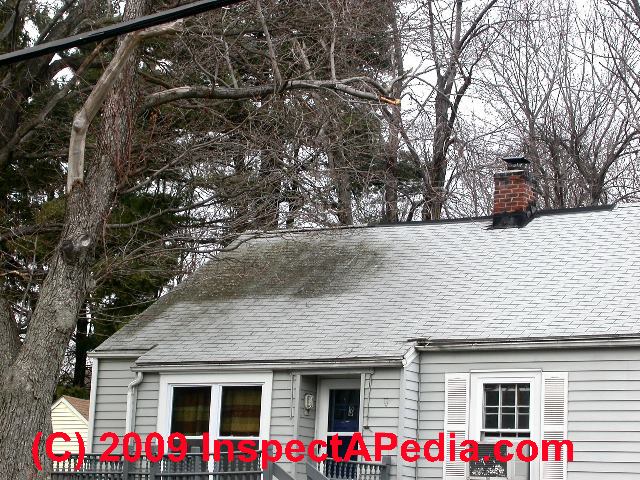
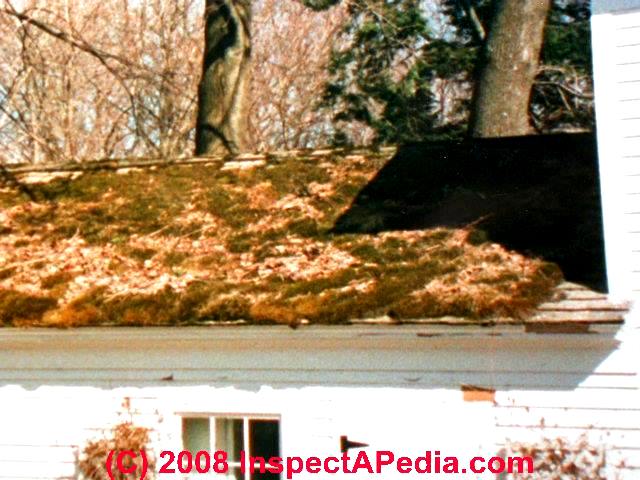
Watch out: working on roofs and from ladders is inherently very dangerous. For people who lack the physical ability, knowledge, skill, and for high and steep-slope roofs, it's safer to hire an expert.
Watch out to make sure that your roof "expert" really is one. If you hire an amateur handyman who does not know safe procedures nor know just what's needed, the dangers include improper, inadequate work, reduced roof life, or worse, an injury.
See ALGAE, FUNGUS, LICHENS, MOSS on ROOFS for one of several articles about moss and debris found on roofs.
Watch out for improper cleaning too: aggressive measures like power washers and even stiff brooms can damage shingles, removing their protective granules and reducing roof life.
See DEBRIS STAINING on ROOFS for examples of causes and steps to cure debris problems on building roofs.
Question: "What's newer"? Shingles installed 5 years ago or 2 years ago?
Reply: how do we predict the remaining age of a roof?
This is a trick question, right? Perhaps you are implying that five years ago roof products were better quality so would be "newer" in condition than poorer products on a chronologically newer roof? Perhaps you mean, which roof is likely to have a longer anticipated life? Or you are suggesting that more recent roof products are inferior to ones made five years ago? Nonsense.
Roof covering product quality varies by specific product, manufacturer, and even by occasional variations in the manufacturing process for a given roofing product.
Similarly, wide variations in the expected roof live may be traced very often to the roof installation and workmanship.
While we may be interested in knowing the chronological age of a roof as a way to guess its remaining life, a better rule of thumb used by home inspectors and roof inspectors is the wear age of a specific or individual roof.
In addition to the the quality of the shingles or other roofing materials, lots of factors influence the life of a roof covering
Even where workmanship and roof covering product quality are identical, not all roofs wear at the same rate. There are quite a few factors that affect the rate of wear on a roof (after excluding roof product quality or defects) including:
- Roof shingle or other roof covering product quality
- Roof covering material storage and handling. Believe it or not, leaving bundles of shingles unprotected from the weather for any length of time risks damage to the material and a shorter roof life.
- Roof slope (steeper roofs drain better and resist water penetration as a result)
- Roof color (lighter colors may resist the wear-effects of sunlight and heat)
- Roof exposure (which way individual roof slopes and surfaces face affect the amount of sunlight and heat received by the surface)
- Roof flashing installation details
- Attic or roof cavity ventilation affect the occurrence of moisture problems,
- Ice dam leaks, and sometimes inadequate under-roof ventilation can cause or contribute to shingle curling
See CURLING ASPHALT SHINGLES - Cupping
See CUPPING ASPHALT SHINGLES - Fishmouthing
See FISHMOUTHING ASPHALT SHINGLES
that in turn affect the life of the roof
See details at
ATTIC VENTILATION
- Ice dam leaks, and sometimes inadequate under-roof ventilation can cause or contribute to shingle curling
- Roof maintenance, for example keeping leaves and debris off of a roof, using non-damaging methods for roof cleaning
- Roof installation workmanship, including the most important, most basic, and often ignored layout and nailing instructions provided by the roof covering manufacturer
For a more meaningful prediction of roof life: ask what is the roof's "wear age" ?
So if we see what looks like (or was claimed to be) a 20-year asphalt shingle roof, and in the judgment of an experienced roof inspector, a close inspection of the roof from outside and inside suggests that it's about half-way through it's predictable or usually-expected life, then we'd call the roof's wear age 10 years, even if the chronological age of the roof were different.
Watch out against giving a low "wear age" (longer remaining life) to an older roof without a close inspection.
Some wear signs such as shingle cracking and porosity and other shingle defects such as thermal splitting can be difficult or impossible to spot from ground level or even from a ladder at roof edge if the roof has other slopes or sections not accessible. (Roofs do not always wear equally on all slopes).
Details are at CRACKS & THERMAL SPLITTING in FIBERGLASS SHINGLES.
Also see ASPHALT SHINGLE LIFE / WEAR FACTORS for a list of factors that affect the life expectancy of an asphalt shingle roof.
See AGE OF ROOFING for help in determining the chronological or wear age of a building roof and for more factors that affect just how long a roof can be expected to last.
Question: How would a homeowner know if their shingles are newer and if algae growth is a risk?
Reply: AR - algae resistant shingles, & factors that affect algae stains on building roofs
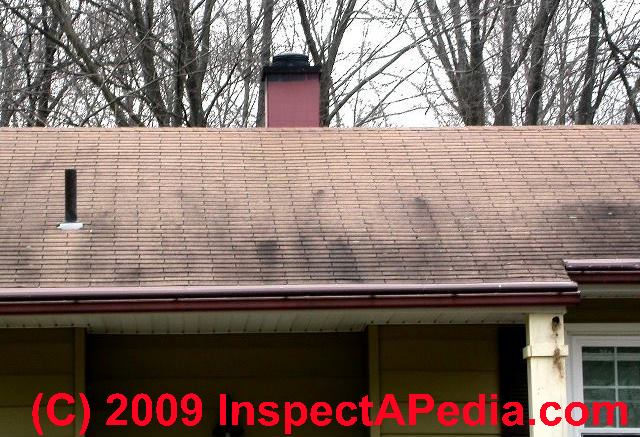 Check to see if algae-resistant shingles or other algae-resistant roof covering materials were used. The manufacturers of mineral-granule-covered asphalt shingles indicate on on the package and/or in their product literature the algae resistance of various shingle products.
Nevertheless, algae-resistant is not "algae-proof" and green, brown, or black algae may show up on some roofs even where AR shingles were installed.
Other factors affect algae growth on roof surfaces include:
- Under-roof ventilation (not enough),
- Roof slope areas exposed to shade vs sun exposure (not always), including areas shaded by trees that may need to be trimmed back, areas shaded by other structural components
- Roof maintenance - leaving debris on the roof keeps surface areas damp and shaded
- Local climate - while we have seen algae growth on roof and other building surfaces throughout the U.S., Canada, and Mexico, including both cool and hot wet and hot dry climates, both hot wet and cool wet climates may increase algae growth rates on some roofs
- Shingle or other roof covering chemistry: variations in the percentage and chemistry of algae-resistant mineral granules on the shingle surface.
There may also be variations even within a given shingle brand and product, as manufacturing consistency might vary, or as shingle storage-conditions (before the shingles were installed) may have varied from one building to another.
How to diagnose and remove or prevent algae stains on roofs
There may be other causes of black stains on roofs, including roof stains or discoloration from
- Algae stains on roofs (very common)
See ALGAE, FUNGUS, LICHENS, MOSS on ROOFS for information about algae staining on roofs - Debris stains on roofs (very common)
See DEBRIS STAINING on ROOFS - Extractive bleeding from defective shingles (uncommon)
See EXTRACTIVE BLEEDING on SHINGLES - Black asphalt bleed-down from mis-application of sealants or from defective shingles
See TARRY BLEED on ASPHALT SHINGLES
See STAIN DIAGNOSIS on ROOFS for a complete catalog of roof stain sources and cures.
See BLACK STAIN REMOVAL & PREVENTION for suggestions about cleaning black stains off of roof surfaces.
Question: What happens if old roof flashing isn't replaced with new flashing during re-roofing?
Reply: increased risk of roof leaks during a roof-over that relies on existing or old roof flashing
As our friend Mark Cramer, a building inspection educator likes to say, ... "It depends". [2]
Old flashing that is heavy, high quality material (such as heavy weight copper) might itself be fine depending on the location at which it is being left in place (for example at chimneys or roof sidewalls) for re-use by careful interleaving with the new roof shingles when they are installed.
Other roof flashings (plumbing vents, valleys) really won't be properly integrated with the new roof surface if they are simply left "in place" below old roof materials during a re-roof (roof-over) job. (Some of these might be re-usable if the re-roof job includes removal of all of the old roof covering.)
What are the problems with relying on old roof flashing when re-roofing a building?
Roof flashing that is corroded, thin, worn, cracked, or otherwise damaged should not be relied upon when re-roofing. It should be replaced completely if a tear-off roof job is underway, or new flashing might be installed over old valley flashing during a roof-over.
Re-roof snafus at roof-sidewall and roof-chimney intersections
A basic problem with relying on old flashing to prevent roof leaks in the new roof covering is illustrated by flashing requirements at the roof-sidewall (the intersection of a lower roof surface with a vertical building wall) or at the abutment of the roof surface to the sides of a chimney.
Perhaps the old roof flashing and roof was not leaking at all in that location so the roofer and owner were happy just placing a new layer of shingles atop the old, with no new flashing whatsoever at the roof-wall abutment.
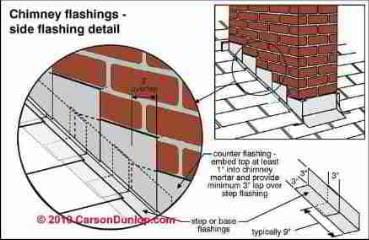 Leaks at roof-wall abutments or chimneys when relying on old roof flashing and when leaving old shingles in place
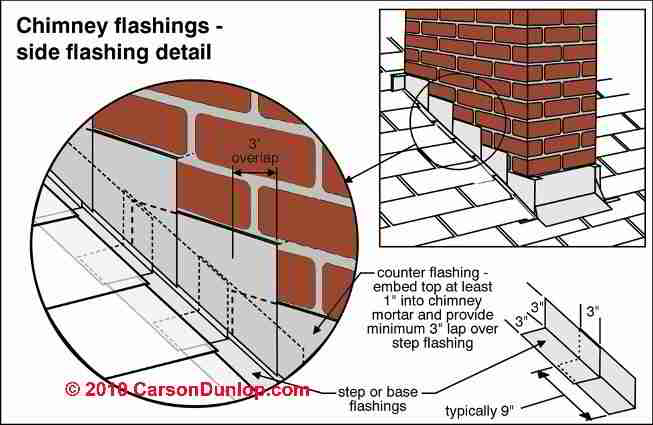
But properly installed step flashing at a roof-wall intersection is designed to bring water at each individual shingle back out onto the upper surface of the next shingle course below.
Water that runs down the vertical wall or chimney side or that falls on the roof surface by the wall is constantly directed out onto the outer uppermost surface of the roof where it can drain away safely.
Chimney flashing details at left illustrate the positioning of step flashing and counterflashing along a vertical side wall or chimney surface.
Courtesy of Carson Dunlop Associates, a Toronto home inspection, education & report writing tool company [ carsondunlop.com ].
When a new layer of roof shingles is installed along the same abutting wall without its own step flashing and counter flashing, all of the water that runs down the wall or falls on to the roof surface in that area easily enters under the new layer of roof shingles where, depending on the conditions below water may run anywhere under the new roof covering and on top of the old roofing layer.
Thus if there was a leak anywhere down-slope on the original roof, water entering at this roof-wall intersection has a better chance of finding it and leaking into the building, even though a new roof was installed above.
During a re-roof job, just gobbing on roof mastic or sealants is not a reliable substitute for properly-installed roof flashing
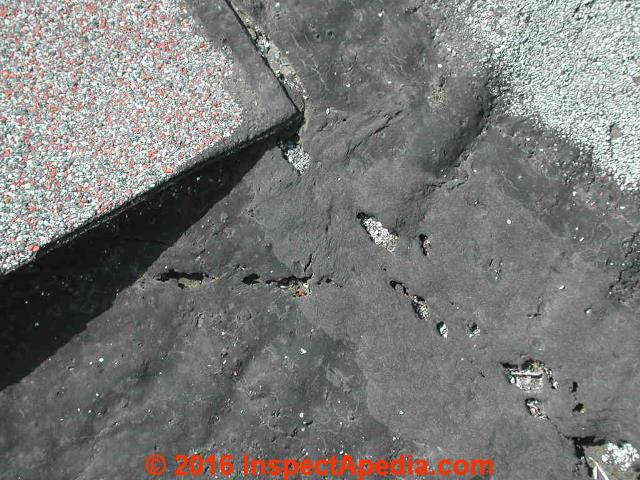 Later someone comes along and blobs flashing cement or mastic along the roof wall intersection to try to seal this un-flashed area. But because the various building materials expand and contract at different rates (wall, flashing, roofing, chimney side, roof deck, etc.), even a flexible mastic material is not a long term reliable substitute for properly installed flashing.
Roof flashing is intended to serve as a mechanical means of diverting water back onto the upper surface of roof shingles rather than permitting it to pass under the shingles where it finds a place to leak into the building.
When the installer stops relying on the mechanical drainage properties of flashing and relies instead on globbing on sealant, the risk of future leaks is increased.
Even though there are some very good, durable, stick, flexible sealants on the market, the sealant has a difficult job to do: it has to bridge a variety of materials during times of widely changing temperatures.
Wood, copper, aluminum, asphalt shingles, roofing felt, roof decking plywood or boards, masonry chimneys, wall siding materials all have different coefficients of thermal expansion. That means pulling and tearing at the intersections where the installer relied on sealant.
And often that leads to cracks or separation at the sealant, caulk, mastic, or other "flashing cement".
Re-using old flashing when old shingles have been removed may be OK
If the old roof shingles had been removed, and if the new shingle courses line up perfectly with the old step flashing left in place, then the old step flashing and counter flashing might be re-used with success, though there too there are some troubles to overcome.
Removing the old roof shingles can leave the step flashing bent up away from the roof surface. If the roofer doesn't take steps to flatten out the old step flashing and leaves it curled up the new roof looks bad and may leak, especially during conditions of wind-blown rain.
And the lifted shingles may fail prematurely.
Worse, "fixing" this curled lifted old, re-used step flashing by nailing down the flashing corners risks leaving a shingle penetration in the wrong location, where that too may leak.
Don't rely on thin, corroded, worn or damaged roof flashing materials when re-roofing
Old flashing that is crimped, cracked, leaky, punctured by nails now withdrawn, improperly installed in the first place, coated with roofing mastic (that corrodes through copper flashing even though it's a short term fix), is going to leak, especially in heavy rains, behind built-up on-roof debris, or when the roof is covered with wet snow (in such climates).
Distinguish between a tear-off re-roof job and a "roof over" re-roof job
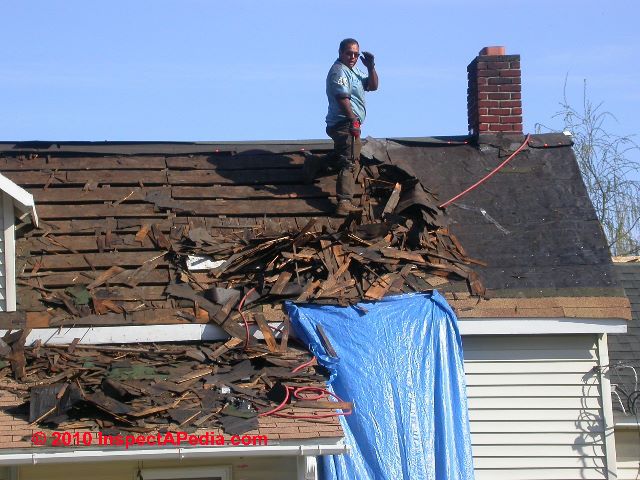 It's useful to distinguish between a complete tear-off re-roof job and a "roof-over" job at which an additional layer of shingles is installed atop the existing covering.
A complete roof tear off won't leave any flashings on the roof except perhaps the counter-flashing at a chimney. In our photo (left) the roofer is removing all of multiple layers of roofing before installing a new asphalt shingle roof on this home.
So leaving old flashing isn't much of an issue except that when the new roof and flashing are installed around the chimney (or at the abutment of an upper sidewall or dormer to the lower roof surface) the counter flashing may need to be carefully bent down and sealed against wind-blown rain leaks.
A roof-over job too often leaves all old flashings in place for the obvious reason that to remove it means removing part of the old shingles that means in turn an uneven surface under the new shingles (unless it's built-up level using shingle pieces).
At a roof valley where the old flashing is in excellent condition, both old and new layers of shingles may need to be sealed along the valley. That approach leads to come confusion about what flashing is, what it's for, and how it works.
See FLASHING, ASPHALT SHINGLE VALLEYS
See FLASHING ROOF-WALL SNAFU for roof-wall flashing SNAFUs to avoid
Roof Snafu case history: "My new roof is leaking like mad every time it rains! ... "
An pediatrician acquaintance in Poughkeepsie, NY, H.L., called me in desperation.
- HL "Dan, my new roof is leaking like mad every time it rains!"
The low-bid roofer got the job.
Now I have to add that H.L. is a tightwad who pressed every bidder for his roof replacement to come in at the lowest possible price. He gave the job to the lowest bidder.
No roof flashing was installed anywhere.
I inspected the roof and found that following a complete tear-off, NO roof flashing had been installed anywhere. No flashing at the plumbing vents, no flashing at the chimneys, no roof flashing at the upper sidewall abutment to roof locations.
The roofer said that roof flashing would be an extra charge!
- DF "H. I see that your roof has no flashing. Didn't the roofer discuss this with you ?"
- HL "Well sure. He said he could "do" flashings but that the flashing would be "extra" so I decided to just skip it."
- DF "I think your roofer was so anxious to win the job that he was less than straightforward with you. If he'd had any sense and wanted to avoid an argument later when your roof leaked, the roofer should have said 'Look Dr. L, the flashing will be an extra cost, but I'm warning you that if you don't have me install it, your roof will leak every time it rains."
Who really caused this leaky roof-job?
The roofer desperately wanted the job.
The homeowner desperately wanted the lowest price.
In my OPINION the homeowner was partly responsible for causing his leaky roof trouble because of his insistence on squeezing the last dime out of his roofing contractor.
But the roofing contractor was responsible for not making sure the client understood that flashing is required at roof penetrations and abutments and that without it the roof would sooner or later leak. In this case it was sooner- at the first rain.
The roofer should make clear to the client the significance of the different roofing choices being offered - in terms not just of cost but of roof durability.
The lowest price for your re-roof job is not always really the lowest cost.
More advice about choosing a roofing contractor is at CHOOSING A ROOFING CONTRACTOR or select a topic from the closely-related articles below, or see the complete ARTICLE INDEX.
Reader Comments, Questions & Answers About The Article Above
Below you will find questions and answers previously posted on this page at its page bottom reader comment box.
Reader Q&A - also see RECOMMENDED ARTICLES & FAQs
On 2016-04-11 by (mod) -
Great question, Carol as there's an un-spoken and un-clear aspect of what you ask:
In Florida many roofs use clay or cement roof tiles for aesthetic reasons and to protect the roof membrane from sun-wear. On those roofs, the protection against roof leaks is not the tiles themselves, but the roof membrane. Most often I see modified bitumen used, though some installers may use other materials such as rubber roofing.
In some climates and areas it's the clay tiles themselves that are expected to shed water and keep the building interior dry. In those roof designs, simple felt underlayment is adequate.
On 2016-04-09 4 by Carol
What roofing underlayment or combination of underlayments should be used with cement tiles to give the longest life without leaks in the Florida climate?
On 2015-07-05 by (mod) -
Jim this sounds like an interesting question but despite your clear writing I'm not sure I've got the picture. Can you use our email found at the page top or bottom CONTACT link to send me a couple of photos of the situation?
It sounds as if there is a risk of back-up in a valley that ends at an obstruction - if that's the situation, be sure to run the ice and water shield well up the roof, not just one 3 ft width but maybe 6 or even 9 feet.
On 2015-07-05 by Jim Koby
Is there a good effective way to install a closed cut valley where the lower end of the valley is located at the outside corner of the house? Because of the placement of a triangular gable on the front of the house, one side of the gable roof and the main roof plane taper to nothing at the corner. The valley will have ice and water shield applied before shingling.
On 2014-11-13 by (mod) -
Ray the article above notes that some roofers install roofing year round, but have to take some extra steps in cold weather. And I doubt that any smart roofer installs roofing materials when the roof is wet or in rainy weather.
On 2014-11-12 by Ray France
What are the proper weather conditions for roofing a residential home?
...
Continue reading at ICE DAM PREVENTION on ROOFS or select a topic from the closely-related articles below, or see the complete ARTICLE INDEX.
Or see these
Recommended Articles
- ATTIC CONDENSATION CAUSE & CURE
- COLD WEATHER ROOF TROUBLE
- ICE DAM PREVENTION on ROOFS
- ROOF VENTILATION SPECIFICATIONS
- ROOF ICE DAM CURE: Comparing Two Houses
- ROOF ICE DAM LEAKS
- ROOF VENTILATION for DEEP SNOW
- SNOW GUARDS & SNOW BRAKES
- WINTER & SNOW-COVERED ROOF VENT RESOURCES & RESEARCH
Suggested citation for this web page
COLD WEATHER ROOF TROUBLE at InspectApedia.com - online encyclopedia of building & environmental inspection, testing, diagnosis, repair, & problem prevention advice.
Or see this
INDEX to RELATED ARTICLES: ARTICLE INDEX to BUILDING ROOFING
Or use the SEARCH BOX found below to Ask a Question or Search InspectApedia
Ask a Question or Search InspectApedia
Try the search box just below, or if you prefer, post a question or comment in the Comments box below and we will respond promptly.
Search the InspectApedia website
Note: appearance of your Comment below may be delayed: if your comment contains an image, photograph, web link, or text that looks to the software as if it might be a web link, your posting will appear after it has been approved by a moderator. Apologies for the delay.
Only one image can be added per comment but you can post as many comments, and therefore images, as you like.
You will not receive a notification when a response to your question has been posted.
Please bookmark this page to make it easy for you to check back for our response.
Our Comment Box is provided by Countable Web Productions countable.ca
Citations & References
In addition to any citations in the article above, a full list is available on request.
- In addition to citations & references found in this article, see the research citations given at the end of the related articles found at our suggested
CONTINUE READING or RECOMMENDED ARTICLES.
- Carson, Dunlop & Associates Ltd., 120 Carlton Street Suite 407, Toronto ON M5A 4K2. Tel: (416) 964-9415 1-800-268-7070 Email: info@carsondunlop.com. Alan Carson is a past president of ASHI, the American Society of Home Inspectors.
Thanks to Alan Carson and Bob Dunlop, for permission for InspectAPedia to use text excerpts from The HOME REFERENCE BOOK - the Encyclopedia of Homes and to use illustrations from The ILLUSTRATED HOME .
Carson Dunlop Associates provides extensive home inspection education and report writing material. In gratitude we provide links to tsome Carson Dunlop Associates products and services.
 | HOME | ABOUT | ASK a QUESTION | CONTACT | CONTENT USE POLICY | DESCRIPTION | POLICIES | PRIVACY | |
| © 2024 - 1985 Publisher InspectApedia.com - Daniel Friedman | |||||||||