
InspectAPedia® FREE Encyclopedia of Building & Environmental Construction, Diagnosis, Maintenance & Repair |
Question? Just ask us! InspectAPedia
|
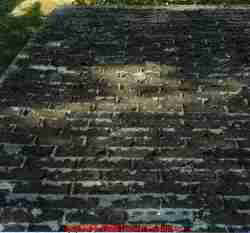 Organic Felt Asphalt Roof Shingle Defects
- POST a QUESTION or COMMENT about the life expectancy & defects found on organic felt asphalt shingle roofs
Guide to asphalt shingle roofing:
This article series explains how to identify & explain the most-common asphalt roof shingle failures and how to obtain asphalt roofing shingle failure claims assistance. These defects occur on organic-mat or fiberglass-mat asphalt roof shingles.
Common shingle failure factors include improper storage and handling of the asphalt shingles before installation, improper nailing, improper flashing (which pertains to any roofing material), and defective asphalt shingle product material leading to thermal splitting, cracking, blistering, staining, and in some cases curling or cupping shingles.
InspectAPedia tolerates no conflicts of interest. We have no relationship with advertisers, products, or services discussed at this website.
- Daniel Friedman, Publisher/Editor/Author - See WHO ARE WE?
Organic-mat-based Asphalt Roof Shingle Wear & Failures

"Organic felt" roof shingles refers to using cellulose (paper) as the substrate on which the shingle is constructed. The cardboard or cellulose shingle mat is impregnated with hot asphalt and coated with mineral granules to form a sunlight and weather resistant upper surface. Shown above: normal end-of-life curling at the edges of an organic shingle. This roof is fragile, should not be walked-on, and is ready for replacement. Below we describe other types of wear or damage found on this type of roof shingle.
By contrast, at CRACKS & THERMAL SPLITTING in FIBERGLASS SHINGLES we discuss a previous history of thermal splitting of fiberglass-mat-based asphalt roof shingles.
Storm damage from wind and hail occur and need to be distinguished from defective asphalt shingle product or asphalt shingle installation errors.
By listing common causes of asphalt roof shingle failures and how to recognize them, building owners and roofing contractors may also be able to reduce the occurrence of asphalt roof shingle storage, handling, and installation errors that affect roof life. Readers are also invited contribute roof failure information to the web author for research purposes.
Mineral granule loss from asphalt roof shingles
Below are summary remarks, full details about asphalt shingle granule loss are at GRANULE LOSS from SHINGLES
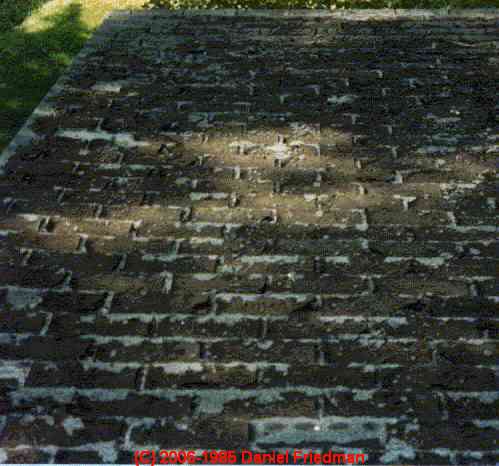
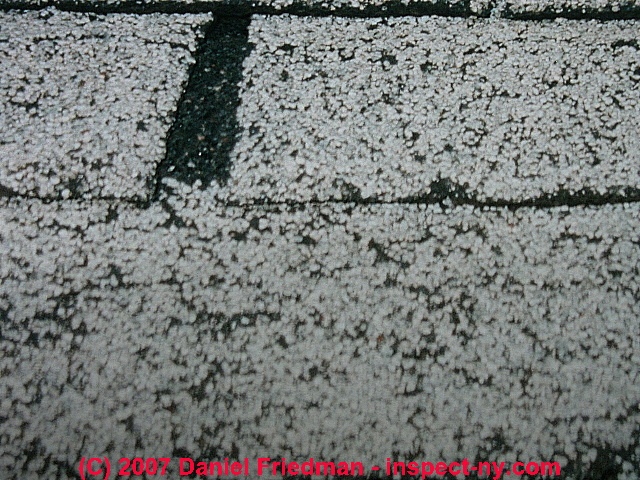
This photograph shows severe loss of mineral granules from an asphalt shingle roof. This roof is way past needing replacement and is almost certainly leaking. Even a roof with less dramatic granule loss is showing signs of wear and reduced future life. Anywhere that a shingle has lost the protection of its mineral granules that shingle has a reduced life expectancy.
In all climates the loss of granules from an asphalt shingle or mineral-covered roll roofing roof means that area of the roof shingle has lost its protection from sunlight. In freezing climates, shingle wear may accelerate in the area of lost granules as the roof ages and is exposed to freeze thaw cycles.
Once the shingle substrate is exposed by mineral granule loss, that area of the shingle will absorb more water than its neighbors. While in this photo the roof is "worn out", there are several other conditions that can produce mineral loss on asphalt shingle roofs:
- Cracking of old organic asphalt shingle roofs
is a common, normal wear sign; roof wear accelerates as fine cracks (due to loss of volatiles in the asphalt and increasingly brittle shingles) permit water to enter the shingle substrate.
See ORGANIC FELT SHINGLE NORMAL WEAR
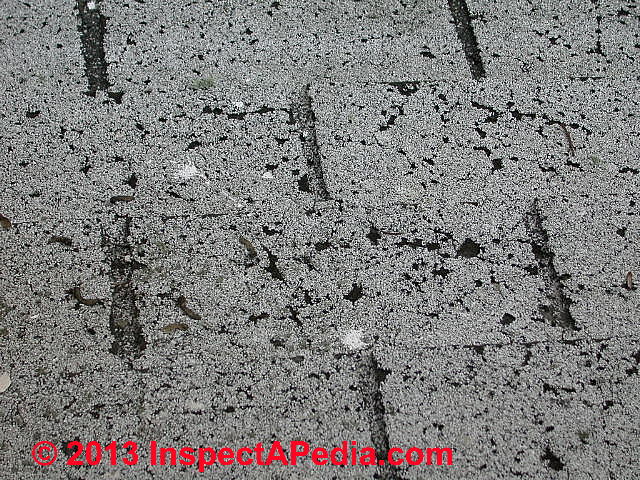
- Granule loss on a new asphalt roof,
loose mineral granules wash down the roof and will appear in gutters and at the ends of downspouts. This is a normal condition unless it continues and begins to show black exposed roof shingle substrate. - Granule loss on roof shingles due to blister rash damage or wear:
blistered asphalt shingles, normally an artifact of the manufacturing process, can be a point of wear due to foot traffic, hail damage, or aging and wear. If you see granule loss at the tops of shingle blisters this is probably what's going on on your roof. Details are
at BLISTERS on ASPHALT SHINGLES - Granule loss on a roof being walked-on:
walking on any asphalt shingle roof loosens some of the mineral granules from their attachment embedded in the asphalt used to impregnate and coat the shingle. If there is a lot of roof traffic, such as when work is being done on a chimney, you may see "bald" areas of shingles with lost granules where people have been walking. This is damage caused by workers and is not a product defect.
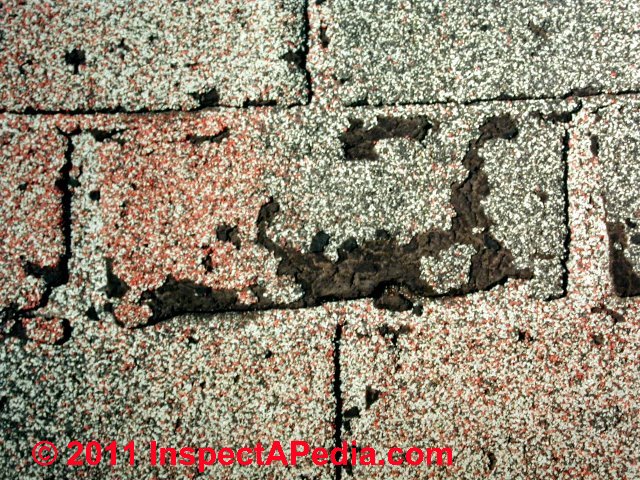
- Granule loss on old asphalt shingle roofs:
when an asphalt shingle roof is nearing the end of its life (or is at end of live as in the photo just above) we may see that granules have begun to wash off of the shingles so as to leave large "bald" or nearly bald areas showing black shingle substrate. These shingles have more porosity than those where their mineral granules remain in place and may already be leaking even if leaks are not quite visible in the building interior. Such a roof is ready for replacement.
See GRANULE LOSS from SHINGLES - Granule loss on asphalt shingles due to storms:
it is possible that severe weather, such as hailstorms, may damage shingles producing pitting and granule loss. Such roofs have a reduced remaining life, depending on the severity of damage.
See HAIL DAMAGED SHINGLES & OTHER ROOF COVERINGS
and
see WIND DAMAGE to ROOFS - Granule loss due to blistering: blisters or "pimple-like" protrusions from a shingle surface may be
a "cosmetic" manufacturing defect (at least in the opinion of the manufacturers). On at least some roofs we find that these blisters
ultimately become the first wear points on the shingle when their upper surface wears away (perhaps from foot traffic or weather) exposing
small round dots of missing granules on the shingle.
We discuss this defect and how to distinguish between defective shingle product and storm damage
at ASPHALT SHINGLE BLISTERS,
Normal Age & Wear Cracking in Organic Mat Asphalt Roof Shingles
Organic mat asphalt shingles also may show cracking and accompanying granule loss. Defective asphalt shingle products of either organic or fiberglass based shingles may experience several failures including cracking, tearing, granule loss, blistering, etc. So, splits or cracks can occur in both organic-mat based and fiberglass-mat based asphalt roof shingles.
But thermal splitting is particularly a problem with fiberglass mat based asphalt roof shingles.
Normal Asphalt Single Wear Cracking & Granule Loss
Our photos (left and below) show a badly worn organic mat asphalt roof shingle with multiple fine cracks throughout its surface. This shingle is worn-out, but the wear pattern is homogenous over the roof slope and in our opinion is a normal wear condition.
Hairline cracks appear in the (generally thicker) organic mat based asphalt roof shingles as a normal sign of aging, and normally late in the life of the roof shingles.
Our OPINION is that a variegated cracking in a somewhat random pattern over the exposed shingle surface is a common age and wear indicator found on older organic based (paper) substrate asphalt shingle roofs.
See ORGANIC FELT SHINGLE DEFECTS for other wear signs on organic mat asphalt shingles.
Nevertheless, fine cracks through roof shingles, regardless of cause, mean accelerating wear rate and on a roof like the one shown at left, the roof needs replacement.
But catastrophic early shingle splitting failures like the ones illustrated earlier in this article were principally a problem of lightweight, fiberglass-mat based asphalt roof shingles made during the period discussed above. Roughly, from 1992 - 1997.
Cracking due to cold weather installation & bending ridge or hip cap shingles:
see RIDGE & HIP CAP SHINGLES for additional discussion of distinguishing cracking wear failures from other types of shingle failures.
Also see ASPHALT SHINGLE PROPERTIES and
see Choosing an Asphalt Shingle: Organic vs. Fiberglass, Ted Cushman, The Journal of Light Construction, May 1993 for more about the debate around the advantages and disadvantages of organic mat asphalt shingles vs. fiberglass mat-based asphalt roof shingles.
Readers are also invited contribute roof failure information to the web author for research purposes. web author for research purposes.
Roof shingle fragility and damage risks
We recommend that inspectors stay off of cupped-asphalt shingle roofs, particularly in cold weather (shingles are more likely to break).
If we absolutely have to walk on a cupped shingle roof, we would tiptoe carefully, avoiding stepping on the raised or cupped shingle sections, or if doing repairs, we would prop a ladder up off of the roof surface and work from that scaffold as is sometimes done with slate or other fragile roof surface repairs.
Is Roofing Felt Underlayment Needed Under Asphalt Roof Shingles?
While the requirement for felt underlayment beneath asphalt roof shingles seems to be a topic of almost timeless argument subject to much arm-waving and little reading of manufacturer's instructions and warranties, various sources recommend or require installation of a felt underlayment over the roof deck before asphalt roof shingles are installed.
The short answer is that underlayment should be installed beneath asphalt shingles.
See UNDERLAYMENT REQUIREMENTS, ROOF - topic home, for complete information on this question.
Also see Choosing an Asphalt Shingle: Organic vs. Fiberglass, [PDF] Ted Cushman, The Journal of Light Construction, May 1993 for more about the debate around the advantages and disadvantages of organic mat asphalt shingles vs. fiberglass mat-based asphalt roof shingles.
Question: can I replace individual organic roof shingles?
(Sept 4, 2012) hkorsh said:
can i replace organic shingles if i can find them
Reply:
HKorsh
Certainly; while fiberglass mat based roof shingles are very popular, organic mat (asphalt impregnated paper) are still made by some companies.
Watch out: for color mis-match or accept that new shingles may not exactly match older ones even if the product name and colour are the same as what was originally installed.
Question: my roof shingles are blistering and I want to make a warranty claim
Mike said:
I have asphalt shingles that were installed in 2000 on a new addition to my house. I just found out that my shingles are blistering and that they are asphalt which means they are defective. I have two extra shingles in my garage and they have a model 12020 on them but no name for the manufacturer. I have contacted the builder and awaiting a response about the brand of the shingles. Can you help me with finding out the brand name through the 12020 number on my shingles? I would like to file a claim. Thank you. Mike
Reply:
Mike,
First, the shingle manufacturers do not agree with you that blisters are shingle defect, arguing that they're of only cosmetic import. I do not completely agree as blisters can be a point of early granule loss.
Next, shingles do not develop blisters after installation - shingle blistering is an artifact that occurs during the much higher temperatures of fabrication.
See BLISTERS on ASPHALT SHINGLES for details.
IF you can demonstrate that the roof has failed (is leaking) before the end of its warranty period you may still have the basis for a warranty claim. But in my experience putting in a warranty claim on blisters alone is not likely to be fruitful. DO keep us posted - what you learn may assist other readers.
...
Continue reading at ASPHALT SHINGLE FAILURE TYPES or select a topic from the closely-related articles below, or see the complete ARTICLE INDEX.
Or see these
Recommended Articles
ASPHALT SHINGLE LIFE / WEAR FACTORS
ASPHALT ROOF SHINGLES - topic home, for all articles about asphalt roof shingles
Suggested citation for this web page
ORGANIC FELT SHINGLE DEFECTS at InspectApedia.com - online encyclopedia of building & environmental inspection, testing, diagnosis, repair, & problem prevention advice.
Or see this
INDEX to RELATED ARTICLES: ARTICLE INDEX to BUILDING ROOFING
Or use the SEARCH BOX found below to Ask a Question or Search InspectApedia
Ask a Question or Search InspectApedia
Try the search box just below, or if you prefer, post a question or comment in the Comments box below and we will respond promptly.
Search the InspectApedia website
Note: appearance of your Comment below may be delayed: if your comment contains an image, photograph, web link, or text that looks to the software as if it might be a web link, your posting will appear after it has been approved by a moderator. Apologies for the delay.
Only one image can be added per comment but you can post as many comments, and therefore images, as you like.
You will not receive a notification when a response to your question has been posted.
Please bookmark this page to make it easy for you to check back for our response.
Our Comment Box is provided by Countable Web Productions countable.ca
Citations & References
In addition to any citations in the article above, a full list is available on request.
- Carl Gerosa, New Rochelle, NY.
- "The Uses and Performance Requirements of Steep-Slope Roof Underlays in North America and the United Kingdom", Robert J. Booth, Keith Roberts, Proceedings of the North American Conference on Roofing Technology, p. 112-118 - Web Search 07/12/2010. This scholarly article cites 33 research articles on the role of roofing underlayments.
- "Unvented Roofs, Hot-
Humid Climates, and
Asphalt Roofing Shingles
Research Report - 0306
Feb-2003
Building Science Corporation", Building Science Corporation, 30 Forest Street,
Somerville, MA 02143
Quoting from the article abstract: "When constructing unvented roofs with asphalt shingles in hot-humid climates, a vapor barrier must be installed between the asphalt shingles and the roof deck." - Web Search 5/21/2010 - NRCA Roofing & Waterproofing Manual, 5th Edition, National Roofing Contractors Association, 10255 W. Higgins Road Suite 600 Rosemont, IL 60018-5607 Telephone: (847) 299-9070 Toll Free: (866) ASK-NRCA (275-6722), e-mail: info@nrca.net. - http://www.nrca.net/rp/pubstore/details.aspx?id=243&c=9
- "Choosing an Asphalt Shingle: Organic vs. Fiberglass", Ted Cushman, The Journal of Light Construction, May 1993, pp. 11-14. Used with Permission from the Journal of Light Construction.
- The Journal of Light Construction has generously given reprint permission to InspectAPedia.com for adaptations, quotations, or reproductions used at this website. All rights and contents of the JLC material are ©Journal of Light Construction and may not be reproduced in any form.
- Asphalt Roofing Residential Manual from ARMA the Asphalt Roofing Manufacturers Association Website https://www.asphaltroofing.org/product/residential-asphalt-roofing-manual/ ,
- Building Pathology, Deterioration, Diagnostics, and Intervention, Samuel Y. Harris, P.E., AIA, Esq., ISBN 0-471-33172-4, John Wiley & Sons, 2001 [General building science-DF] ISBN-10: 0471331724 ISBN-13: 978-0471331728
- Building Pathology: Principles and Practice, David Watt, Wiley-Blackwell; 2 edition (March 7, 2008) ISBN-10: 1405161035 ISBN-13: 978-1405161039
- Our recommended books about building & mechanical systems design, inspection, problem diagnosis, and repair, and about indoor environment and IAQ testing, diagnosis, and cleanup are at the InspectAPedia Bookstore. Also see our Book Reviews - InspectAPedia.
- Best Practices Guide to Residential Construction, by Steven Bliss. John Wiley & Sons, 2006. ISBN-10: 0471648361, ISBN-13: 978-0471648369, Hardcover: 320 pages, available from Amazon.com and also Wiley.com. See our book review of this publication.
- In addition to citations & references found in this article, see the research citations given at the end of the related articles found at our suggested
CONTINUE READING or RECOMMENDED ARTICLES.
- Carson, Dunlop & Associates Ltd., 120 Carlton Street Suite 407, Toronto ON M5A 4K2. Tel: (416) 964-9415 1-800-268-7070 Email: info@carsondunlop.com. Alan Carson is a past president of ASHI, the American Society of Home Inspectors.
Thanks to Alan Carson and Bob Dunlop, for permission for InspectAPedia to use text excerpts from The HOME REFERENCE BOOK - the Encyclopedia of Homes and to use illustrations from The ILLUSTRATED HOME .
Carson Dunlop Associates provides extensive home inspection education and report writing material. In gratitude we provide links to tsome Carson Dunlop Associates products and services.
 | HOME | ABOUT | ASK a QUESTION | CONTACT | CONTENT USE POLICY | DESCRIPTION | POLICIES | PRIVACY | |
| © 2024 - 1985 Publisher InspectApedia.com - Daniel Friedman | |||||||||