
InspectAPedia® FREE Encyclopedia of Building & Environmental Construction, Diagnosis, Maintenance & Repair |
Question? Just ask us! InspectAPedia
|
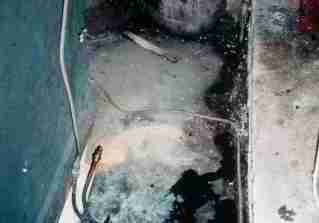 Building Buyers & Owners Guide to Leaky Heating Oil Tanks
What to Do About & When to Report Oil Tank Leaks

- POST a QUESTION or COMMENT about what a homeowner should do about a leaky oil tank or about heating oil smells
Leaky oil storage tank guidance for homeowners:
Issues surrounding leaking oil tanks, describes oil tank inspection and tank testing methods, suggests what a home owner or home inspector is obligated to do and report if an oil leak is found.
This article also provides links to more detail about above ground and buried oil and other storage tanks.
InspectAPedia tolerates no conflicts of interest. We have no relationship with advertisers, products, or services discussed at this website.
Residential Buried Oil Tanks: the risks, the rules, the remedies
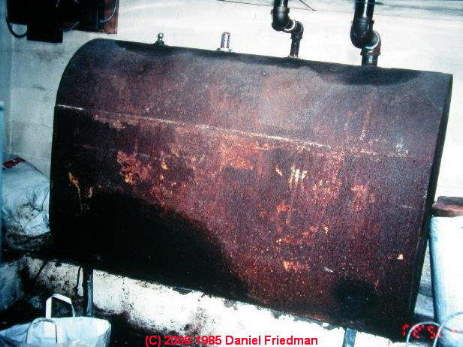 Leaking oil tanks are not only a concern as contaminants of the water supply, but
have become an increasing general environmental concern addressed by the DEC. Leaking commercial equipment and
even simply-suspect equipment have been extremely costly to address.
Leaking oil tanks are not only a concern as contaminants of the water supply, but
have become an increasing general environmental concern addressed by the DEC. Leaking commercial equipment and
even simply-suspect equipment have been extremely costly to address.
Click to enlarge any image]
Such burdens were never anticipated when the equipment was installed. While similar regulations pertaining to residential installations are scarce, this topic is of growing concern to home owners and home buyers.
This article explores opinions and suggestions culled from news articles, discussions in several states and provinces, and discussions among several home inspectors.
Back in 1961, traditional heating oil tank installation procedures and standards recommended that all oil-storage tanks be buried outside wherever feasible. That was then. This is now.
New concerns about leakage and environmental pollution raise warnings about buried tanks. (Reference: Standards of the National Board of Fire Underwriters, as referenced by "Domestic and Commercial Oil Burners,", Charles H. Burkhardt, 1961, 3rd Ed., McGraw Hill Book Company, p. 172.)
In states where oil is used for residential space and water heaters, oil storage tanks are found buried outside (550 or 1080 gallons), outside above ground (often a 275-gallon "indoor" tank never intended for weather exposure), and inside (275 to 550 gallons maximum). Leaks at any of these tanks are at risk of causing environmental damage. In one older property we found an indoor tank leaking directly into the casing of a private well which was located in the basement!
New York State's Department of Environmental Conservation has been developing and enforcing a Petroleum Bulk Storage Program since the early 1980's. The goal of this program is to prevent leaks and spills of petroleum into the environment.
The New York State DEC estimates that there may be as many as 185,000 above and underground tanks storing petroleum in New York State subject to DEC regulations. Many of the tanks installed in the 1950's and 60's are bare steel and have a fifty percent chance of developing leaks today.
Currently the regulations apply to any facility with a combined capacity (liquid non-waste petroleum-based oils) which exceeds 1,100 gallons but is less than 400,000 gallons. No individual unregulated site can exceed 1,100 gallons; if the owner has a 1,000 gallon tank out by the garage and another 275 gallon tank for heating oil the regulations still apply. (Reference: Telephone conversation, author with Southern New York office of the Department of Environmental Conservation, DEC ca 1988.)
The regulations require that these facilities must be registered with the state. Depending on the size, age, location, and type of product stored the system may have to be upgraded or tested.
Frequency of Oil Storage Tank Leaks & Heating Oil Piping Leaks, Frequency of & Responding to Oil Leaks in Underground (Buried) Oil Storage Tanks - Residential
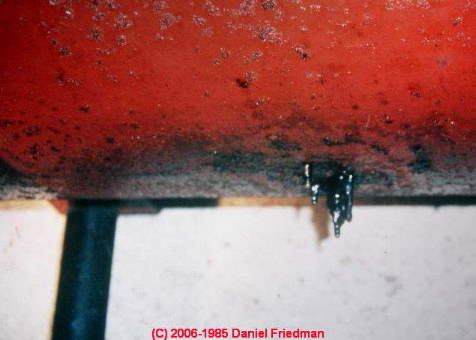 In New England for a two year period [1984-5] among customers who have buried heating oil tanks (16% of total customers or one buried oil tank per 10,000 oil heat customers) surveyors found an average of 1.7 tank leaks per thousand customers.
They also found 2.5 fuel line leaks per 1000 customers. (Fuel Oil and Oil Heat magazine, August 1985 p.18.)
A study of 500 underground fuel storage tanks was completed for the U.S. EPA and studied tanks on Long Island in New York in 1988. See "[Fuel Storage] Tank Corrosion Study", U.S. EPA report on gasoline and oil tank corrosion, November 1988. Of those 500 storage tanks about half were used for gasoline storage and about one fourth were used for home heating oil storage. But significantly the underground storage tank leak rate did not depend on what fuel was being stored.
More recent oil tank leak data scan be difficult to obtain, but the two articles below provide additional detail and specifics.
- OIL TANK LEAK / FAILURE RATES gives details and statistics about the chances that an oil tank or oil tank piping system is leaking or about to leak or has already leaked.
- OIL TANK LEAK POINTS explains that oil tank & piping leaks are caused by corrosion, mechanical damage, soil conditions, & other factors
- ABOVE GROUND OIL TANK INSPECTIONS discusses the visual inspection of above ground tanks for evidence of leaks or other defects.
- OIL TANK PIPING & PIPING DEFECTS discusses the causes & frequency of occurence of types of leaks in oil tank fill, vent & distribution piping. Heck reported that 82% of leaks at petroleum product storage tanks (n=240) were in the piping system![3]
Usual Reasons for Oil Storage Tank Leaks - Rust Perforation, or Mechanical Damage / Corrosion at Piping
Underground fuel storage tanks usually fail from rust perforation due to several effects of water inside the tank including, in the case of heating oil, combination of water with sulphur in the fuel. External rust, unless very heavy, isn't highly correlated with internal rust. A new tank can involve significant expense.
Oil tank leaks are also caused by mechanical damage during installation,oil fill, vent, or supply piping errors, corrosive soil conditions, possibly by oil tank manufacturing defects, possibly indirectly, by weather conditions and in-tank condensation, and finally, by delivery of bad oil that contains excessive amounts of water.
- OIL TANK LEAK / FAILURE CAUSES gives details about the causes of oil tank leaks and oil piping leaks.
- OIL TANK ABANDONING PROCEDURE discusses the requirements for abandoning or removing oil tanks. If a tank is leaking its use will have to stop and an oil spill cleanup performed.
- Oil tank leaks must be reported, as discussed below at WHAT IF AN OIL TANK IS LEAKING?
Environmental Issues Regarding Underground Oil Storage Tanks (USTs)
The U.S. Department of Environmental Conservation has a program registering buried tanks at any site storing more than 1100 gallons of heating oil. Requirements for gas (auto fuel), or other fuels may be different. Eventually this concern may spread to smaller residential tanks. The concern is for leaks which contaminate the environment.
Oil storage tanks located where they may leak into a local waterway or into the water supply are a special environmental concerns.
Free publications are available from New York DEC regional offices: Petroleum Storage Regulations, How to Register Your Petroleum Storage Facility, Testing Underground Storage Tanks. A New York Help-line number is also available at 1-800-242-4351.
Other state environmental regulators and their contact information are listed at OIL TANK LEAK & ABANDONMENT REGULATIONS where we give details about the regulations that require reporting leaks and regulations governing oil tank abandonment
Oil Tank Leak Actual Environmental Impact & Leak Regulations: How are we affected by oil tank regulations?
On-site oil storage capacity can require tank registration: It is not unusual for a homeowner in the Northeastern U.S. to have installed additional storage tanks during the energy crisis of the 1970.
The added storage can bring the capacity of the property above the 1,100 gallon threshold and under the DEC regulations.
Many older homes with underground steel tanks have a good chance of developing a leak. We should provide our clients with this information. They can then make an informed decision to seek additional data and can also decide if testing should be performed.
What to Do if the Oil Tank is Leaking or Has Leaked? - What if an oil-fired heating tank or system is leaking? Oil Tank Leak Reporting Requirements
A leaking above ground oil tank may be discovered by simple visual observation. Leaks in buried tanks require special testing methods to locate and then test the tank for leaks or the soil for past leakage.
If you see a leaky oil tank or an oil spill: In New York (and in most other jurisdictions) anyone visually inspecting a petroleum storage tank of any size and finding that the system is leaking must report the leak to state environmental authorities. In New York State an oil leak must be reported within two hours to New York DEC. The New York Oil spill hotline is 1-800-457-6362.
For other states see the state contact information listed at OIL TANK LEAK & ABANDONMENT REGULATIONS.
We do not consider a minor drip onto the boiler room floor at a bad fitting a reportable leak for these purposes. (Beware! A small leak at an oil line can result in air entry into the system which can create other dangerous conditions at the equipment.)
Test oil storage tanks for presence of water
Buried fuel tanks should be tested for amount of water present in tank bottom, and any water should be pumped out. Water corrodes the tank and leads to leaks. So if there is a lot of water in the tank we are more concerned about the chances that inside-tank corrosion is severe and there is a greater risk of tank leaks.
While we've found them lasting longer, a common life expectancy of buried oil tanks is 10-15 years. We do not have the same data for gas tanks. Life may be similar. If the tank is to remain in use, ask your fuel supplier about using an additive or other methods to help remove water.
What should a home inspector report to a client about buried oil storage tanks?
Inform clients that a buried heating oil tank is installed using at least the following text:
A buried oil storage tank is installed at this property.
Such components are not inspected (tested) during a home or building inspection unless specific prior test arrangements have been made for advice by an appropriate expert.
Watch out: if an oil storage tank has leaked and not been properly cleaned-up or if the tank has not been properly-abandoned there is risk of significant cost to the property owner as well as risk of serioius environmental contamination. In most jurisdictions reporting of oil tank leaks and oil tank removal or abandonment are regulated by law.
More information on what to do about inspecting, testing, abandoning, or replacing oil tanks is available at the OIL TANKHOME PAGE found at https://InspectAPedia.com/oiltanks/Oil_Storage_Tanks.php
...
Continue reading at OIL SUPPLY LINE PIPING LEAKS or select a topic from the closely-related articles below, or see the complete ARTICLE INDEX.
Or see OIL TANK LEAK & SMELL FAQs - questions & answers posted originally at this page.
Or see these
Recommended Articles
- OIL TANK HOME PAGE
- OIL TANK ABOVE GROUND (AST) GUIDE
- OIL TANK, BURIED, ADVICE
- OIL TANK LEAKS & SMELLS - home
Suggested citation for this web page
OIL TANK LEAKS & SMELLS at InspectApedia.com - online encyclopedia of building & environmental inspection, testing, diagnosis, repair, & problem prevention advice.
Or see this
INDEX to RELATED ARTICLES: ARTICLE INDEX to HEATING OIL, OIL BURNERS, OIL FIRED HEATERS, OIL TANKS
Or use the SEARCH BOX found below to Ask a Question or Search InspectApedia
Ask a Question or Search InspectApedia
Try the search box just below, or if you prefer, post a question or comment in the Comments box below and we will respond promptly.
Search the InspectApedia website
Note: appearance of your Comment below may be delayed: if your comment contains an image, photograph, web link, or text that looks to the software as if it might be a web link, your posting will appear after it has been approved by a moderator. Apologies for the delay.
Only one image can be added per comment but you can post as many comments, and therefore images, as you like.
You will not receive a notification when a response to your question has been posted.
Please bookmark this page to make it easy for you to check back for our response.
Our Comment Box is provided by Countable Web Productions countable.ca
Citations & References
In addition to any citations in the article above, a full list is available on request.
- [1] "[Fuel Storage] Tank Corrosion Study", U.S. EPA report on gasoline and oil tank corrosion, James H. Pim, P.E., John M. Searing, Suffolk County DOHS, 15 Horseblock Place, Farmingville Long Island, NY 11728, November 1988, for the Office of Underground Storage Tanks, U.S. EPA. ATTN: David O'Brien. The report presents a study of 500 underground storage tanks spanning 24 February 1987 and September 1 1988 and summarizes earlier reports on this same study. Tank sizes ranged from 175 gallons to 50,000 gallons, and oil tank ages ranged from two years to 70 years old. All 500 oil storage tanks were constructed of welded steel, and 12 other tanks that were other than plain steel were also examined.
- [2] Thanks to Arlene Puentes for for technical edits on oil tank leak advice- 12/2005. Arlene Puentes is a licensed home inspector, educator, and building failures researcher in Kingston, NY.
- [3] "A Case Study of a Large Scale Precision [oil or fuel] Tank Testing Program", Diane H. Heck, Tetra Tech Richardson, Newark, Delaware, web search 4/27/12, original source: http://info.ngwa.org/GWOL/pdf/870143411.PDF, copy on file as /heating/OIl Tanks UST/Tank_Test_Heck_870143411.pdf Abstract:
In September 1986, a precision tank testing program was started to bring a major Maryland utility into compliance with the State of Maryland Oil Spill Control Regulations regarding underground storage tanks. This program involved the testing of over 240 tanks ranging in size from 300 gallons to 1,500 gallons located throughout the entire state of Maryland.
Analyses of the testing results revealed that 40% of the systems tested leaked. Piping leaks caused 82% of the testing failures and tank leaks caused the remaining 18%. Tank systems located in urban areas experienced a 50% testing failure rate, while tank systems located in rural areas experienced only a 25% failure rate. Leaks in tank systems in urban areas appear to be the result of structural loading and corrosion, affects [effects] absent in rural areas. The age, capacity, and usage of the tanks did not have a role in causing leaks either in the piping or the tank. - [4] Fuel Oil and Oil Heat Magazine, August 1985 p.18. Fuel Oil & Oil Heating Magazine, 3621 Hill Rd., Parsippany, NJ 07054, 973-331-9545
- [5] Standards of the National Board of Fire Underwriters, as referenced by "Domestic and Commercial Oil Burners,", Charles H. Burkhardt, 1961, 3rd Ed., McGraw Hill Book Company, p. 172
- Our recommended books about building & mechanical systems design, inspection, problem diagnosis, and repair, and about indoor environment and IAQ testing, diagnosis, and cleanup are at the InspectAPedia Bookstore. Also see our Book Reviews - InspectAPedia.
- In addition to citations & references found in this article, see the research citations given at the end of the related articles found at our suggested
CONTINUE READING or RECOMMENDED ARTICLES.
- Carson, Dunlop & Associates Ltd., 120 Carlton Street Suite 407, Toronto ON M5A 4K2. Tel: (416) 964-9415 1-800-268-7070 Email: info@carsondunlop.com. Alan Carson is a past president of ASHI, the American Society of Home Inspectors.
Thanks to Alan Carson and Bob Dunlop, for permission for InspectAPedia to use text excerpts from The HOME REFERENCE BOOK - the Encyclopedia of Homes and to use illustrations from The ILLUSTRATED HOME .
Carson Dunlop Associates provides extensive home inspection education and report writing material. In gratitude we provide links to tsome Carson Dunlop Associates products and services.
 | HOME | ABOUT | ASK a QUESTION | CONTACT | CONTENT USE POLICY | DESCRIPTION | POLICIES | PRIVACY | |
| © 2024 - 1985 Publisher InspectApedia.com - Daniel Friedman | |||||||||