
InspectAPedia® FREE Encyclopedia of Building & Environmental Construction, Diagnosis, Maintenance & Repair |
Question? Just ask us! InspectAPedia
|
 Oil Tank Pressure Levels & Pressure Tolerance
Residential Oil Tank Pressures During Testing & During Oil Tank Fill-up
- POST a QUESTION or COMMENT about the pressures encountered in and on oil storage tanks under various conditions
Oil storage tank pressure exposure & tolerance:
Here we explain the typical oil tank test pressure at the factory, the pressures that an oil tank is subjected to during oil tank fill-up, and the cause and prevention of excessive pressures that can cause leaks at oil tanks. We also answer the question of the amount of pressure to which an oil tank is subjected during an oil delivery, providing pressure limits, calculation of oil tank pressure changes, and listing both causes and steps to prevent over pressurizing a home heating oil tank.
This series of articles discusses the causes of leaks at oil tank fill or vent piping, what the leak and other hazards are, and what to do about oil tank piping leaks.
InspectAPedia tolerates no conflicts of interest. We have no relationship with advertisers, products, or services discussed at this website.
- Daniel Friedman, Publisher/Editor/Author - See WHO ARE WE?
Factory Test Pressures on Steel Heating Oil Tanks
Thanks to David Hollen, Applications & Technical Support, at pump manufacturer and distributor Yamada America for help with this data.
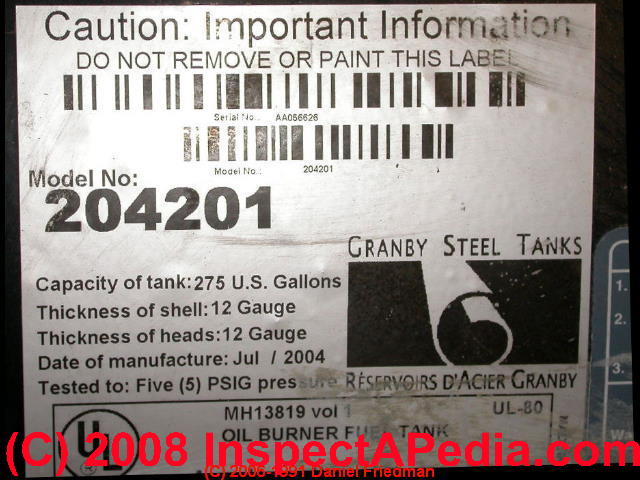
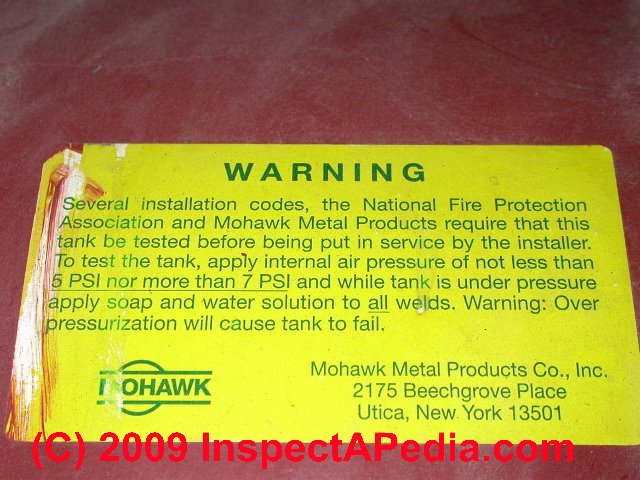
Residential above ground steel heating oil tanks are typically factory tested to 5 psi to 7 psi by the manufacturer, as our two photographs of oil tank labels show (above).
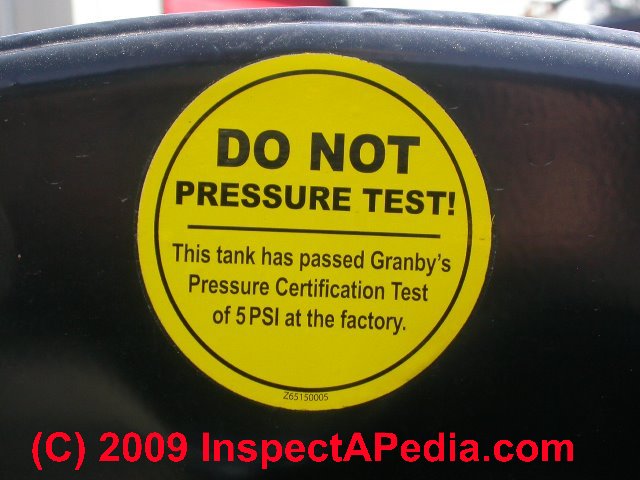 In fact, as the labels show on oil tanks we photographed early in 2009 (at left and at the top of this page), some steel oil tank manufacturers specifically advise against further pressure testing of their oil tanks.
If you need to know the condition of an above-ground home heating oil tank after it has been installed, ask your heating oil company to perform a metal thickness scan of the oil tank.
The technician will use a sonic test instrument to measure the thickness of the steel at a number of locations on the lower portion of the tank.
The reason the technician tests the lower tank areas is that it is there that corrosion and thus thinning of the tank steel most often occurs.
This inspection procedure will not, however, detect a faulty tank weld nor piping errors in the heating oil handling system.
If you are concerned about the chances that a buried oil tank has leaked, you'll need to locate the tank and have appropriate soil tests performed.
We discuss pressure testing of oil tanks
at OIL TANK LEAK TEST METHODS.
Effects and Amounts of Oil Tank Pressures During a Home Heating Oil Delivery
How Much Pressure is There on a Home Heating Oil Tank During an Oil Delivery?
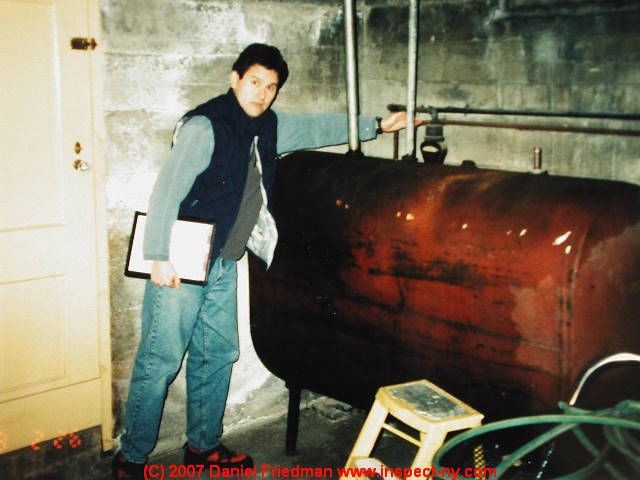 But what is the pressure to which a heating oil tank is subjected during an oil delivery? The pressure experienced by the oil tank during fill from the home heating oil delivery truck is expected to be less than the oil tank manufacturer's tank test pressure (5-7 psi) if the oil tank is adequately vented.
A more detailed answer to the question of oil tank pressures is that it depends on several factors including the two main oil tank pressure factors listed below.
- The pressure at which oil is pumped into the oil tank from the home heating oil delivery truck.
A typical home heating oil delivery truck pumps oil into the heating oil tank at 20 to 50 gpm and at less than 10 to 15 psi.
-- Thanks to David Hollen, Applications & Technical Support, at pump manufacturer and distributor Yamada America for help with this data. - The condition of the oil tank vent piping on the home heating oil tank receiving the oil. If a heating oil tank is not vented at all or if it is not vented properly, the pressures to which the oil tank are subjected can be substantial, as we explain in detail below.
- Some oil delivery trucks pump up to 70 gpm according to Bottini. The actual pressure that this gpm flow rate will develop in the oil tank during a delivery depends on at least the variables above and on
- the internal diameter of the oil delivery truck pumping hose (roughly 1 7/8") and length and possibly the effect of bends or coils
- the ID, length, and number of elbows in the oil tank filler piping, typically 2" ID and at least 2 90's
- the ID, length, and number of elbows in the oil tank vent piping
- the resistance to air venting created by the tank alarm
- resistance to oil tank air venting created by any blockage in the oil tank vent pipe cap such as screening or insects and wasp nests (common)
So What is the PSI Pressure the Oil Tank is Exposed To During Fill-Up?
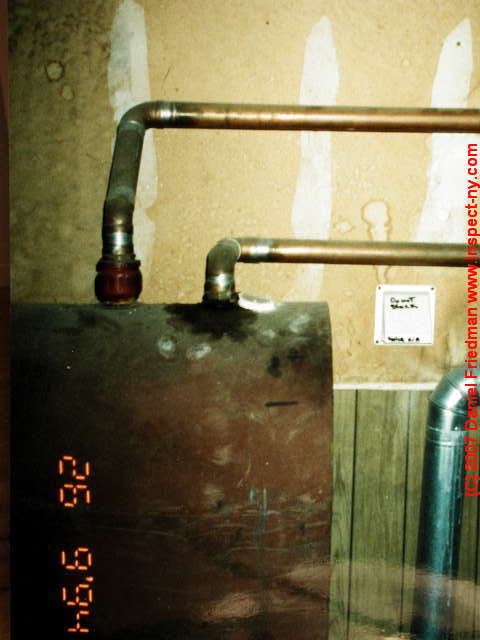 Home heating oil is delivered under pressure at many buildings: the oil delivery truck's hose nozzle latches onto a special fitting at the top of the oil tank fill-valve. When this type of connection is made, the driver can fill the oil tank more rapidly than otherwise, and also can avoid spillage around the oil tank fill pipe.
Just how much pressure an oil tank is subjected to during filling varies as follows:
Normal oil tank fill tank pressure: less than 5 psi on a properly vented heating oil tank (the presumed tank pressurization must be less than the manufacturer's factory tested tank pressure)
Totally-blocked or missing oil tank venting: pressures up to 280 psi - this would be an unusual condition such as an oil tank vent that has not only become totally blocked, but the vent blockage is not "blown out" by pressures created during the tank filling operation.
Anticipated partially-blocked oil tank venting: as oil tank pressure increases due to compressed air in the tank pressing against an obstruction in the oil tank vent pipe (such as an oil slug blocking the vent line or a cap blockage by an insect nest or a painted-over vent cap screen) the pressure may be sufficient to "blow out" a transient blockage of that type.
The pressure required depends on the solidity and adhesion of the blocking oil tank vent line debris. Our opinion is that considering the range of possible oil tank pressures, between 0 psi and over 200 psi (with a totally obstructed vent), it should be quite easy for an oil tank pressure to exceed the manufacturer's factory-test pressure of 5 to 7 psi.
Calculation of Increase in Oil Tank Pressure During Fill-up
If an oil tank is NOT vented, depending on how empty the tank was (how much air it contained), when the tank is filled it could be subjected to quite high pressure. Using BOYLE's LAW (P1V1 = P2V2),
- if we assume that a 275 gallon oil tank contained only 75 gallons at the start of fill up (200 gallons of air at 1 atmosphere pressure (14.7 psi)),
- and if the tank had absolutely no exit venting,
- and if the tank is filled to leave just 10 gallons of air remaining (actually it may be filled to the top if the tank lacks overfill protection or if the driver is not paying attention)
then the pressure would increase from atmospheric (14.7 psi) to 294 psi. If we subtract out our starting 14.7 psi that means we've pressurized the tank to about 280 psi.
Examples of Causes of Excessive Pressures in a Heating Oil Tank
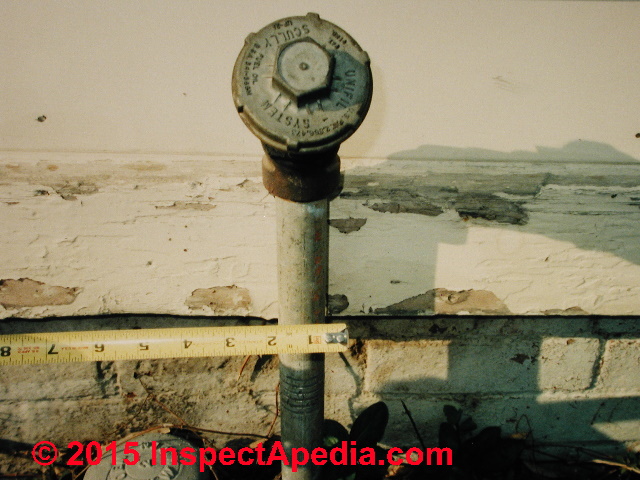
- A restricted oil tank vent pipe diameter, such as using too-small diameter oil tank vent piping (2" diameter is recommended in many jurisdictions, and a minimum of 1 1/2" diameter piping is common. Some older oil tank vent pipes may be just 1" in diameter and should be upgraded.
- Since 1902, NFPA, the National Fire Protection Association has provided oil burning equipment standards including dealing with oil tanks and tank vents. Many municipalities have adopted NFPA standards as part of their building codes.
An under-sized oil fill pipe, a tipped one, and other defects may fail to meet NFPA or other building codes and certainly they increase the risk of an oil leak during an oil delivery. - Oil vent pipe clogged by a slug of oil or water: if an oil vent pipe is not properly sloped to drain back into the oil tank and if the tank is over-filled, oil may be pushed into a down-sloping section of piping, causing a blockage that increases tank pressure during fill-up.
- Oil vent pipe cap clogged by insects or debris: we have found oil tank vent pipe caps that were totally blocked by insects, such as mud daubers who filled the vent with mud and nest materials. We've also see oil tank vent caps that include screens to keep out insects, but the screen has been blocked by paint or by grass clippings from the passage of a lawn mower.
- Oil tank ball float valves - can cause an oil tank spill by malfunction.
Protection from Oil Tank Overfill - Methods
Because overfilling an oil tank might contribute to high oil tank pressures, we list some methods and products used to avoid over-filling a home heating oil tank:
- Measure the oil level in the tank before filling to be sure that the tank really needs oil delivery. On occasion an oil tank gauge can stick and give erroneous readings.
- Oil tank vent whistles are an old and traditional way to avoid tank overfilling. A whistle sounds as air is escaping the tank and stops when the tank is full. The oil tank delivery driver needs to stay close to the fill and vent piping to listen for this event. If the driver walks away from the building to have a smoke during oil tank fill-up there could be an overfill event. In some states such as Maine, state law requires that the delivery person remain present during oil tank fill-up.
Just below we discuss types of oil tank alarms & vent whistles. - Oil tank level alarms: can provide an audible signal when the tank is filled to a specified level, typically set at 90% full.
- Spill buckets may be provided around the filler pipe for buried or underground oil storage tanks.
- Watch Out: Remove un-used oil filler and vent piping: Never ever leave an oil and vent pipe installed at a home where the oil tank has been removed. There is a risk that a mistaken oil delivery driver will attempt to deliver to the wrong pipes, flooding and ruining the home with heating oil.
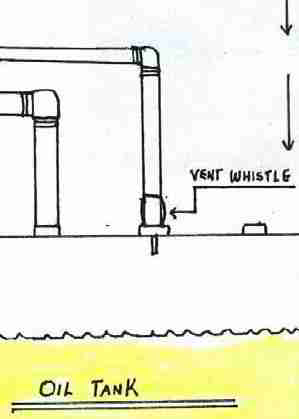 Reader Question: how is a vent alarm represented in plumbing drawings for oil tanks?
What is the drawing symbol for a vent whistle? - Anon. 11/7/11
Reply:
The schematic uses a simple representational shape at the oil tank vent pipe base connection to the oil tank and labels it as "vent alarm".
Anon, we took a look at the FDNY's training materials for the certification for supervising fuel oil piping & storage in buildings (above-left). Plumbing layout schematics for oil tank vent alarms or vent whistles may vary - we'll continue to look and post details here.
Four overfill protection devices used on USTs and in some cases ASTs include
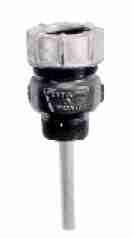 Vent alarms are one of four common heating oil tank overfill protection device, but you should not rely on the alarm alone. Make sure that the fill and vent piping is properly sized, routed, and installed too.
- Overfill alarms - remote tank fill status indicators with an in-building audible alarm and light
- Automatic shutoff devices - a mechanical device built right into the fill piping on the oil tank. The automatic shutoff combines a float with a valve that closes in the intake pipe.
- Ball Float Valves - a similar overfill protection device mounted in a buried oil tank vent pipe
- Venty Alarms, vent whistles, tank whistles.
Paraphrasing and editing from the State of Vermont DEC:
A vent alarm, or vent whistle, is a small device, usually a tube, typically is installed between the oil storage tank and the vent pipe mounted at the tank top. The vent alarm provides an audible whistle as the oil tank is being filled: as oil is pumped into the tank, air is displaced from inside the tank through the vent alarm and the tank vent piping.
When the level of the fuel reaches the end of the tube oil in the tank blocks air entry into the vent alarm, and the whistling stops. This indicates that the oil tank is full. Vent whistles are typically used on small tanks only. It is very uncommon to find a vent whistle on a tank larger than 2,000 gallons.[1]
...
Reader Comments, Questions & Answers About The Article Above
Below you will find questions and answers previously posted on this page at its page bottom reader comment box.
Reader Q&A - also see RECOMMENDED ARTICLES & FAQs
On 2022-06-24 by InspectApedia-911 (mod) - blocked fuel line
@Anonymous,
If you disconnect the fuel line from the oil tank at the point where it enters the oil filter and ahead of your oil burner and no fuel runs out and you know that either the line is blocked or you don't have enough oil in the tank to reach it.
On 2022-06-23 by Anonymous
Hmm, well the valve is open so I guess the fuel line is the only possibility. Thanks for your help.
On 2022-06-23 by InspectApedia-911 (mod)
@Anonymous,
The oil tank is vented to the exterior. There may be a bit of temporary additional pressure during fill, but nothing having to do with operation of the fuel unit.
No fuel at the air bleeder and no air either sounds like a blocked fuel line or a closed oil valve.
On 2022-06-23 by Anonymous
Hi, yeah - I've bled the feed lines before - I spent a long time trying today but no joy. The fuel is fed by a single copper pipe to the filter then pump, back to a transparent bubble thing (sorry, I don't know the name) with a float then back to the pump. The fuel goes through the filter and pump, and back into the transparent bubble and to pump, but the boiler still doesn't fire.
When bleeding, no air or fuel comes out of the bleed valve. A plumber previously said that oil tanks get pressure when filled and that helps the flow - it's an inside tank in the basement, the boiler is in the next room in the basement, and the copper feed pipe exits from the top of the tank then goes down the side of the boiler before getting to the filter.
On 2022-06-23 by InspectApedia-911 (mod) - do not keep pressing the RESET button or unburned oil could cause a puffback explosion
@Anonymous,
Oil tanks are not pressurized.
Are there 2 copper oil lines at the tank and burner or just 1?
Is the oil line connection at the tank top or bottom?
Do you know how to bleed sir from the system?
Watch out: do not keep pressing the RESET button or unburned oil could cause a puffback explosion.
On 2022-06-23 by Anonymous
Hi, my tank has run out of oil and I am waiting a few days for a new delivery. I put in a bit of diesel to keep us going for a few days (hot water and heating) but the boiler is not firing despite bleeding. I think the oil storage tank has lost pressure, is there a way I can safely repressurise the tank myself from the fill pipe?
On 2022-02-09 by Inspectapedia Com Moderator - Can an oil over fill damage my oil gauge?
@Grace koenig,
An oil tank over-fill may disclose a poorly-made connection in the fill or vent piping that results in an oil spill or leak, but it would not normally damage the oil tank gauge.
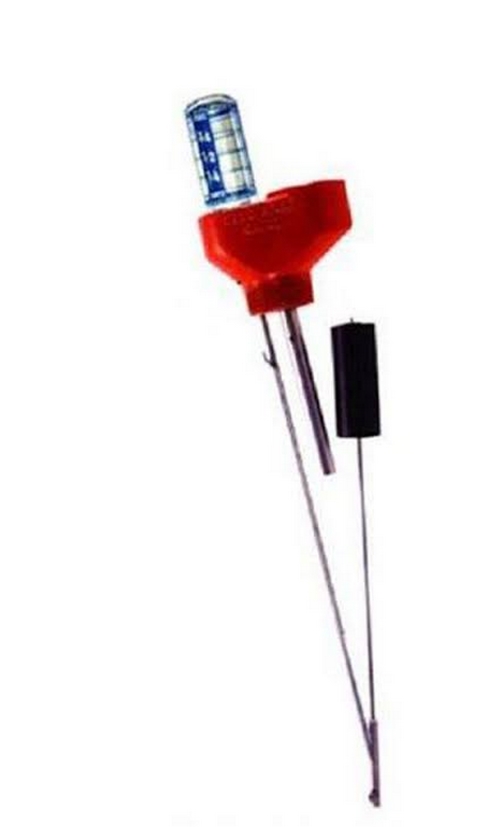
The mechanical gauge on an oil tank is a set of hinged rods ending in a float that moves up and down with oil level inside the tank. If the gauge is not properly installed and positioned that movement could be impaired or might bind. And, as very speculative comment, it might be that a poorly-positioned hinged rod gauge might bind when moved to its extreme-up position in an over-filled tank. If that occurred, simply loosening the gauge and jiggling it up and down to free moving parts ought to free the bound-rods.
See details in our series of oil tank gauge articles beginning at
OIL TANK GAUGES
and also see
OIL TANK GAUGE ACCURACY
On 2022-02-08 by Grace koenig
Can an oil over fill cause my oil gauge to malfunction or damage it?
On 2021-03-02 by danjoefriedman (mod) - municipal oil storage tank regulations will address testing requirements
@debe, that's a great question but I don't think there's a single right answer. Depending on the country and city where your Municipal oil tanks are located there are almost certainly oil storage tank regulations that will address testing requirements.
On 2021-03-01 by debe
how often should an oil tank be tested for leaks when it is on municipal property?
On 2022-02-09 by Inspectapedia Com Moderator
@Roy Aldridge,
I'm not familiar with your situation, but I speculate that you could pipe a dip tube in the larger tank that, at the right pressure, would force oil out of the larger tank, up the tube - whose open end at a suitable depth - and through the piping into the smaller tank. You'd need to use valves to avoid simply pressurizing the receiving tank with air, preventing it from receiving oil.
Frankly I think using a pony pump might be easier.
Honestly I can not imagine any way of moving 60 gallons out of a 60 gallon tank into a container of only 12 gallon capacity. I think we need more description of your situation so that we have a correct understanding of the question.
On 2018-08-06 by Roy Aldridge
how to move oil with air pressure from a full 60 gallon tank to an empty 12 gallon without overfilling. I have a relief valve on both tanks, with a cutoff valve in the connecting pipe. It tends to overfill when during transfer no matter how quickly I stop the flow and open the relief valve on the pressurized tank.
On 2022-02-09 by Inspectapedia Com Moderator - avoid an erroneous oil delivery and a disastrous heating oil spill
@Markus,
You would have the present oil tank pumped out and removed, and you would be sure that the oil tank fill and vent pipe are also removed completely at the same time.
Never leave the fill and vent pipe in place when an oil tank has been removed or discontinued as it invites an erroneous oil delivery and a disastrous heating oil spill .
On 2017-02-07 by Markus
I just converted to gas. The oil delivery guy came and almost pumped oil into my basement. How do I make sure he can't do that.
On 2022-02-09 by Inspectapedia Com Moderator
@Anonymous,
Apologies but I don't understand your description of the situation regarding your oil tank fill-up nor what problem occurred.
If you're asking who's responsible for inspecting oil tank piping, the homeowner is responsible for the oil tank and its piping and in turn she might hire an experienced plumber or installer to inspect the tank for condition, leaks, piping defects, and then to have those corrected.
It is true that an oil tank delivery person who has opportunity to see an obvious leak hazard might refuse to deliver oil until that's fixed. But for example if the oil tank is buried or indoors and the delivery driver can only see the outside fill and vent pipe, that person can't possibly be expected to notice an indoor or buried defect in the oil tank or its piping.
On 2016-11-12 by Anonymous
a dilemma , likely yard and insect waste in oil tank vent , pipe n, ordered fill up for 275 @ 210,pumped 66 , then , 5 gallons or more about the unit and area , the tank piping & filter ?? could it have been the partial blockage ? ,already 210 gal. in there pressure , the employee whom did not tighten / inspect fittings or properly refasten joints@ time last changed / tune up ?
no leak in operation of any part , only at fill - up ,meaning since 1982,with addition of new furnace? , 30 year responsible o/o of home heating services for personal home heating system , at times highly complex needs without a blemish of unsafe , deficent operation ?
Question: leak at oil tank after oil delivery
(Sept 15, 2014) Bill Bilcheck said:
The other day, my oil company delivered heating fuel oil while I was not home. They overfilled the tank located in my basement causing approximately 4-5 gallons of heating fuel to pour out from the top measuring gauge and onto the floor. When I cam home and found the spill, I immediately contacted the oil company. They sent a man out who drained enough oil out of the tank3-4 gallons to get the oil level below the measuring gauge.
He then threw down oil absorption material to soak up the heating oil. He then noticed what seemed like a small pin hole leak on the back side of the tank that faces the basement wall. Prior to the delivery, there was no leak in the tank. Now I have one and the oil company is claiming they had nothing to do with it. T
hey claim that there was not enough pressure to cause a blow out of the tank. The delivery man only pumped 16 gals. and must have not been paying attention while it was overfilling the tank. The fill and vent piped where completely filled with oil and had to be drained back by the oil company's man who came out to cleanup the leak.
Reply:
Bill,
Overfilling an oil tank might indeed subject it to a bit of extra pressure. Oil tanks are filled under pressure (see the article above) even if the tank is not over-filled.
That pressure might ultimately disclose a leak that has been developing in the tank for some time. That is, most often when we see a "pinhole leak" in a heating oil storage tank it is due to corrosion on the tank's interior wall, usually near the bottom of the tank.
In short, it sounds as if your oil tank has a corrosion problem, and it sounds as if there is risk of more serious leaks at any time. I'd suggest having the tank inspected and tested, including an ultrasonic test for corrosion and a look in the tank at water level.
Meanwhile
WATCH OUT: do NOT poke at that point of leak or corrosion or you may convert a pinhole into a bigger leak.
If inspection confirms corrosion to the point of risk of additional leakage, it's time to replace the oil tank.
OPINION: the oil company may be responsible for spillage due to overfilling but it would be very odd for that process to cause a leak in the tank body.
Question: how to keep a person from being able to siphon out heating oil out of the tank
(Apr 25, 2015) gg said:
Is there some obstruction in the oil fill line to keep a person from being able to siphon out heating oil?
I probably should have said mechanism.
Reply:
GG:
Yes there are several possible blocks to being able to siphon oil out of a tank through the oil line, depending on which "oil line" to which you refer:
Through the vent line the siphon tube will encounter a tank whistle or gauge mechanism
Through the oil supply piping one encounters check valves or fusible link safety valves
Through the fill piping one may encounter the edge of a pipe elbow or union.
Through the police department and security cameras one stealing heating oil by any means may encounter the interior of a patrol car.
...
Continue reading at OIL TANK LEAK & ABANDONMENT REGULATIONS or select a topic from the closely-related articles below, or see the complete ARTICLE INDEX.
Or see these
Recommended Articles
- OIL TANK LEAKS & SMELLS - home
- OIL TANK FILL / VENT PIPE LEAK REPAIRS
- OIL SUPPLY LINE PIPING LEAKS
- OIL TANK GAUGE & VENT ALARM INSTALL / REPLACE
- OIL TANK GAUGE LEAK REPAIR
- OIL TANK GAUGE SMART WIFI INSTALLATION
- OIL TANK LEAK & ODOR CAUSES
- OIL TANK LEAK / FAILURE RATES
- OIL TANK LEAK CLEANUP GUIDE
- OIL TANK LEAK POINTS
- OIL TANK LEAK TEST METHODS
Suggested citation for this web page
OIL TANK PRESSURE at InspectApedia.com - online encyclopedia of building & environmental inspection, testing, diagnosis, repair, & problem prevention advice.
Or see this
INDEX to RELATED ARTICLES: ARTICLE INDEX to HEATING OIL, OIL BURNERS, OIL FIRED HEATERS, OIL TANKS
Or use the SEARCH BOX found below to Ask a Question or Search InspectApedia
Ask a Question or Search InspectApedia
Try the search box just below, or if you prefer, post a question or comment in the Comments box below and we will respond promptly.
Search the InspectApedia website
Note: appearance of your Comment below may be delayed: if your comment contains an image, photograph, web link, or text that looks to the software as if it might be a web link, your posting will appear after it has been approved by a moderator. Apologies for the delay.
Only one image can be added per comment but you can post as many comments, and therefore images, as you like.
You will not receive a notification when a response to your question has been posted.
Please bookmark this page to make it easy for you to check back for our response.
IF above you see "Comment Form is loading comments..." then COMMENT BOX - countable.ca / bawkbox.com IS NOT WORKING.
In any case you are welcome to send an email directly to us at InspectApedia.com at editor@inspectApedia.com
We'll reply to you directly. Please help us help you by noting, in your email, the URL of the InspectApedia page where you wanted to comment.
Citations & References
In addition to any citations in the article above, a full list is available on request.
- [1] Oil Tank Overfill Protection, State of Vermont, http://www.anr.state.vt.us/dec/wastediv/ust/erp/Chapter_4.3.pdf
- [2] Security Document).
- [3] Study Material, Certificate of Fitness for Supervise Fuel-Oil Piping and Storagte in Buildings, P-98, Fire Department, City of New York, web search 4/27/12, origianl source: http://www.nyc.gov/html/fdny/pdf/cof_study_material/csm_p_98.pdf
- [4] Scully Oil Delivery Systems, http://www.nee.ca/admin/documents/Delivery
%20Systems%20Catalogue.pdf - [5] Pollution Prevention Guideline, Above Ground Oil Storage Tanks: PPG2, Scottish Environment Protection Agency, et als., http://www.doeni.gov.uk/niea/ppg02.pdf
- [6] "Spill Prevention Controls and Countermeasures Plan for Woods Hole Oceanographic Institution", Woods Hole MA, March 2008 http://www.whoi.edu/fileserver.do?id=44446&pt=10&p=31077
- Yamada Pumps, 800 990-7867, is a leading producer of industrial equipment since 1905, and of fluid handling products for over 60 years. Yamada America supports pump requirements for North, Central, and South America and has an assembly facility in the U.S. in Arlington Heights, IL. Special thanks to David Hollen, Applications & Technical Support, 847 631-9200 ext. 218, for technical consulting regarding pump selection and capacity.
- Our recommended books about building & mechanical systems design, inspection, problem diagnosis, and repair, and about indoor environment and IAQ testing, diagnosis, and cleanup are at the InspectAPedia Bookstore. Also see our Book Reviews - InspectAPedia.
- In addition to citations & references found in this article, see the research citations given at the end of the related articles found at our suggested
CONTINUE READING or RECOMMENDED ARTICLES.
- Carson, Dunlop & Associates Ltd., 120 Carlton Street Suite 407, Toronto ON M5A 4K2. Tel: (416) 964-9415 1-800-268-7070 Email: info@carsondunlop.com. Alan Carson is a past president of ASHI, the American Society of Home Inspectors.
Thanks to Alan Carson and Bob Dunlop, for permission for InspectAPedia to use text excerpts from The HOME REFERENCE BOOK - the Encyclopedia of Homes and to use illustrations from The ILLUSTRATED HOME .
Carson Dunlop Associates provides extensive home inspection education and report writing material. In gratitude we provide links to tsome Carson Dunlop Associates products and services.
 | HOME | ABOUT | ASK a QUESTION | CONTACT | CONTENT USE POLICY | DESCRIPTION | POLICIES | PRIVACY | |
| © 2024 - 1985 Publisher InspectApedia.com - Daniel Friedman | |||||||||